Foundation: Optimize Your LinkedIn Profile for Maximum Impact
Your LinkedIn profile is more than a static resume. It serves as your digital business card and the core asset you will use as you execute LinkedIn Growth Tactics. Every element should work in harmony to convey your value, attract the right audience, and set the stage for meaningful engagement. The following approach helps turn your profile into a high converting growth engine.
Start by aligning your profile with your goals, your target audience, and the outcomes you want. A well-tuned profile creates a clear narrative that guides visitors toward the actions you want them to take. This alignment lays the groundwork for ongoing conversations and relationships that fuel growth.
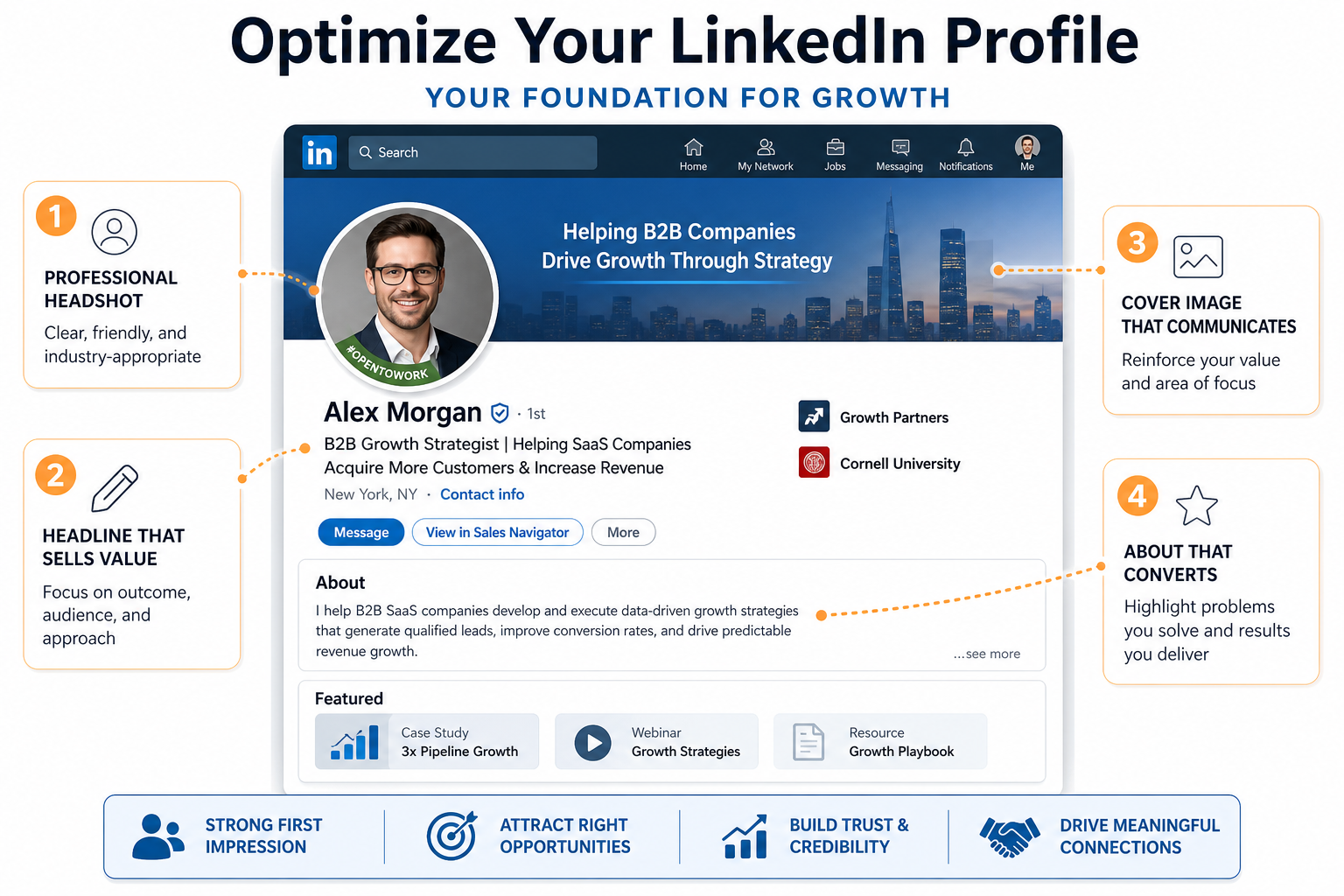
Professional Headshot: Your First Impression
The profile photo is the most visible signal visitors receive. A high quality image with a neutral background communicates professionalism and approachability. Aim for a headshot that exudes confidence without appearing intimidating. Use consistent lighting, a clear focal point, and attire that matches your industry standards.
- Resolution: Use a sharp image at least 4000 pixels wide when possible.
- Expression: A natural, friendly smile increases perceived trustworthiness.
- Background: Choose a simple, non distracting backdrop that reflects your field.
Keep the visual messaging consistent across your profile. A cohesive look helps visitors recall you and your expertise quickly. Small details, like cropping and color balance, can reinforce your professional image.
Headline That Sells Your Value
Your headline appears with every post and interaction, making it prime real estate for communicating impact. Move beyond a job title to an outcome-oriented statement that resonates with your target audience. Focus on outcomes, audiences, and methods.
- What you deliver: the outcome your work achieves.
- Who you serve: the target audience you help.
- How you achieve it: the means or approach you use.
Example transformation:
From “Marketing Manager at XYZ” to
“Marketing strategist helping B2B SaaS reduce churn by 18% through targeted growth experiments.”
Custom LinkedIn URL for Professional Appeal
A clean, customized URL reinforces credibility and makes it easier to share your profile. It also helps with search visibility on both LinkedIn and external search engines.
Target format: linkedin.com/in/yourname or a concise variant that includes your name and, if needed, a minor differentiator.
- Promotional materials: include this URL in email signatures, business cards, and slides.
About Section: Tell Your Story
Craft your About section as a concise narrative that centers the reader. Use first person to create a personal connection and weave in the problems you solve, the results you deliver, and the specific audience you serve. Integrate keywords naturally to improve visibility in LinkedIn and Google search results.
- Hook the reader with a compelling opening that relates to their pain point.
- Explain your unique approach and how it differs from typical solutions.
- Show proof with tangible outcomes, client examples, or case highlights.
- Finish with a clear next step, such as a consultation or content offer, and consider including a Calendly link or contact method.
Structure suggestion using a simple framework:
Hook — Problem you solve — How you solve it — Proof — Call to Action.
Visual Branding Elements
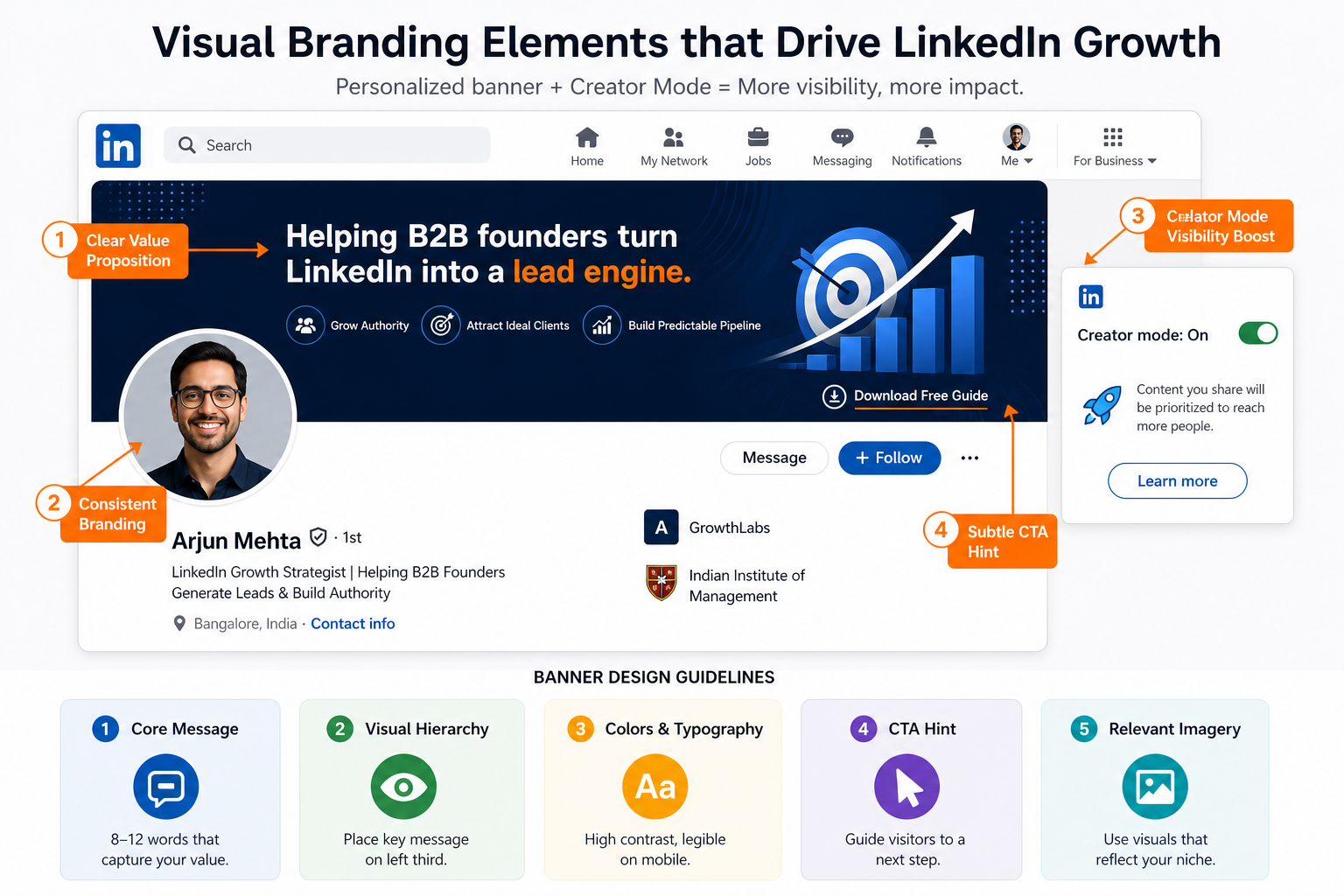
Your profile banner and visual tone reinforce your value proposition at a glance. Use a cohesive banner and, if possible, activate Creator Mode to highlight your content and improve discovery.
Banner content: clearly state you help with a specific outcome and include a concise CTA. Align colors, typography, and imagery with your overall personal brand. Creator Mode: consider this feature if you publish regularly and want to emphasize your professional content.
Optimization for Search
Search optimization helps you appear in both LinkedIn and broad search results. Thoughtful keyword usage should be natural and audience oriented rather than forced.
A well-structured profile reads clearly and earns trust. Focus on language that resonates with your audience and answers their questions directly.
- Keywords: integrate terms your target audience might search for, without compromising readability.
- Public visibility: ensure your profile is public so external search engines can index it.
- Profile sections: distribute keywords across the About, Experience, and Skills sections where relevant.
Practical Quick Wins Checklist
| Area | Best Practice | Impact |
|---|---|---|
| Profile Photo | Professional headshot with neutral background | Improved views and initial trust signals |
| Headline | Outcome oriented, audience specific, method hinted | Higher click through and profile completion |
| Custom URL | linkedin.com/in/yourname | Cleaner branding and easier sharing |
| About Section | First person, problem to solution narrative, includes proof | Stronger connection and clearer conversion path |
| Banner | Clear messaging, CTA, and brand visuals | Enhanced interest on first impression |
| Public Visibility | Set profile to public, enable search indexing | Increased external discoverability |
| Keyword Integration | Natural keyword placement across sections | Improved search ranking within LinkedIn and beyond |
By aligning each element with your core value proposition, you create a cohesive profile that supports your Linkedin Growth Tactics and accelerates engagement with the right audience. This foundation not only improves your visibility but also increases the likelihood that visitors convert into connections, conversations, and eventually opportunities.
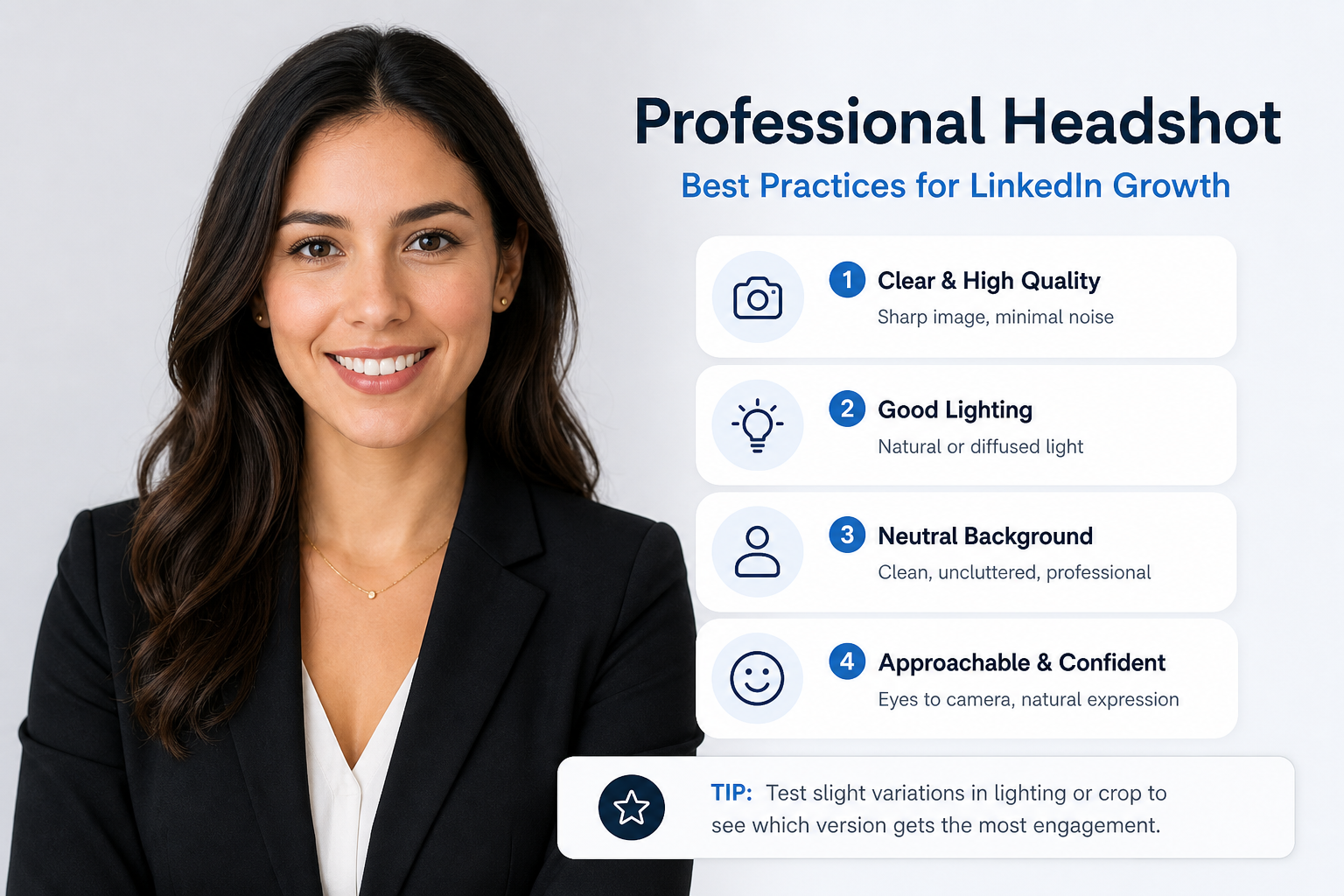
Professional Headshot
A clear, high-quality image on a neutral background creates the first impression visitors form when they view your LinkedIn profile. Profiles with professional photos receive substantially more views and messages than those without, making your headshot a foundational element of LinkedIn Growth Tactics.
- Resolution and clarity: Use a sharp image with minimal noise. If possible, shoot at high resolution so cropping for thumbnails remains crisp.
- Lighting: Favor natural or diffused lighting that evenly illuminates your face, avoiding harsh shadows or glare.
- Background: Choose a neutral, uncluttered backdrop that keeps the focus on you and aligns with your industry standards.
- Expression and framing: An approachable, confident expression with eyes toward the camera, and a head and shoulders crop that places you centrally within the frame.
- Consistency: Use a photo style that matches your personal brand across all professional channels for cohesive branding.
Tip: test variations by rotating small changes in lighting or crop to see which version yields the strongest engagement over a few weeks. Ensure alt text describes the subject and setting for accessibility and search relevance.
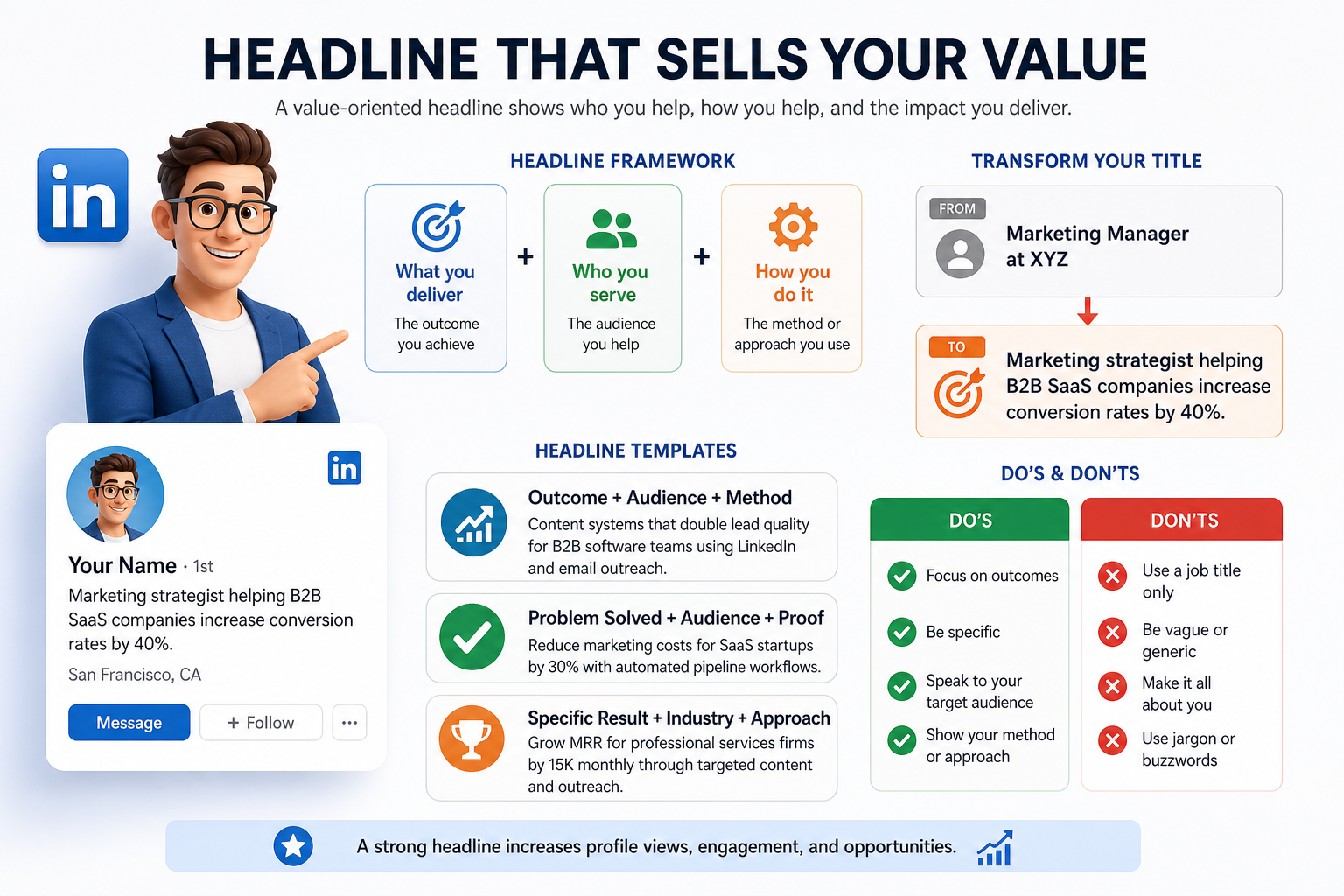
Headline That Sells Your Value
Your LinkedIn headline is prime real estate that appears with every post and interaction. A value oriented headline moves beyond a title and communicates directly how you help your target audience. When readers instantly see a concrete benefit, they are more likely to engage, follow, and reach out. Use a clear, outcome driven statement that pairs the impact you deliver with the audience you serve and the method you use. This is a core element of LinkedIn Growth Tactics and a reliable lever for increasing profile views and meaningful connections.
Headline framework to guide your craft:
- What you deliver → the outcome your work achieves
- Who you serve → the target audience you help
- How you do it → the approach or method you apply
Transform your typical title from a job descriptor to a value proposition. Example transformation:
From Marketing Manager at XYZ to Marketing strategist helping B2B SaaS companies increase conversion rates by 40 percent.
Headline templates you can adapt:
- Outcome oriented + Audience + Method
Example: Content systems that double lead quality for B2B software teams using LinkedIn and email outreach - Problem solved + Audience + Proof
Example: Reduce marketing costs for SaaS startups by 30 percent with automated pipeline workflows - Specific result + Industry + Approach
Example: Grow MRR for professional services firms by 15K monthly through targeted content and outreach
Do’s and don’ts for a high converting headline:
- Do focus on outcomes readers care about, not just your title
- Do mention the target audience to attract the right people
- Do hint at your method so readers understand how you help
- Don’t use vague statements like open to opportunities or excited about new challenges
- Don’t overwhelm with too many buzzwords or industry jargon
Quick copywriting checklist for your next headline:
- State the outcome in measurable terms where possible
- Identify the audience you serve
- Include the approach or channel you rely on
- Keep it under 120 characters for optimal visibility
Revision exercise: take a current headline and run it through the three element test (outcome, audience, method). If any element is missing, rewrite to fill the gap. The goal is a headline that instantly communicates value and invites a click or a connection request.
In practice, a strong headline acts as a miniature value proposition that primes the reader for your content. When aligned with your broader LinkedIn Growth Tactics strategy, it helps attract the right followers, signals credibility, and sets expectations for the knowledge you share. Keep testing variants, measure engagement, and iterate toward the crisp, benefit focused statement that resonates most with your target audience.
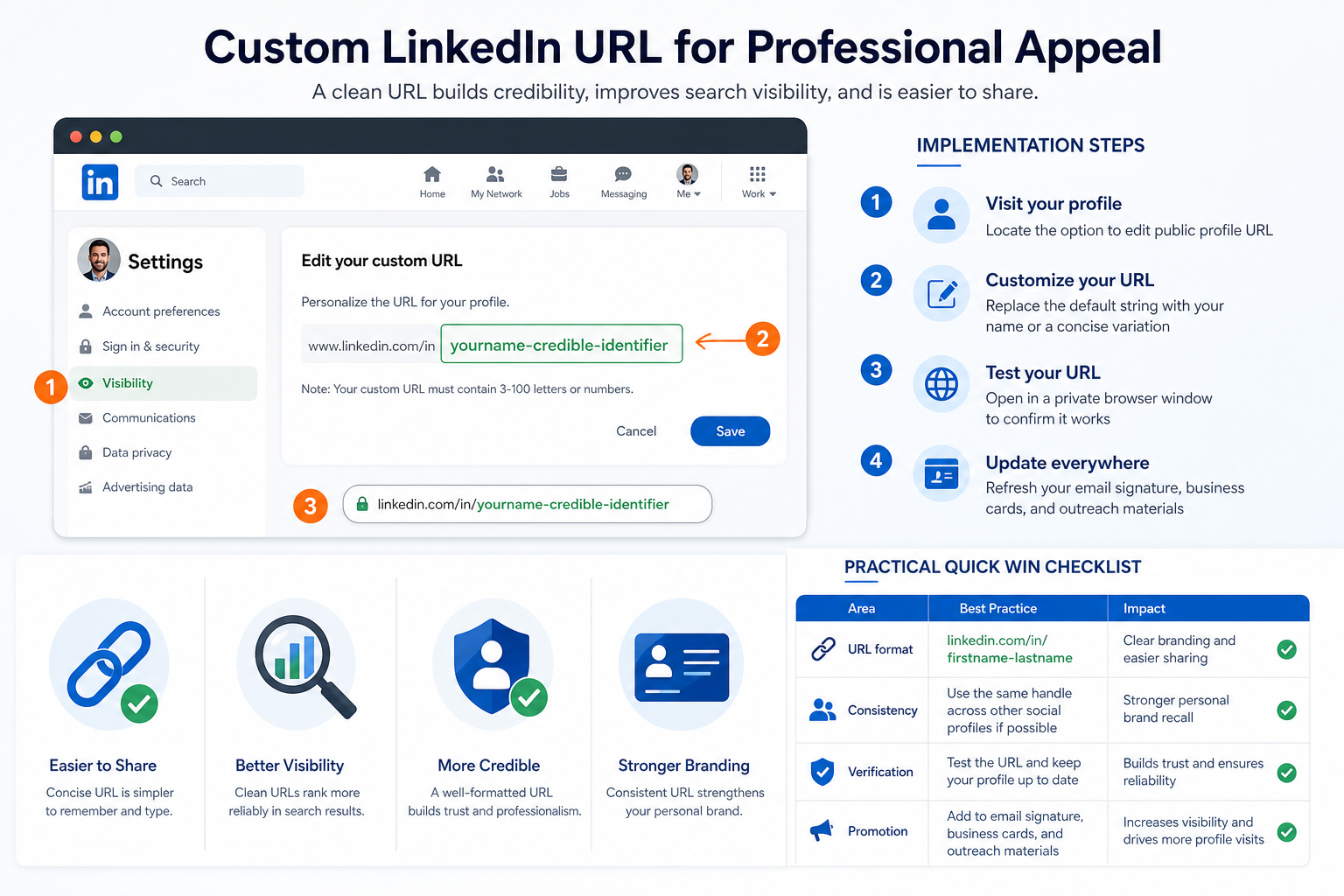
Custom LinkedIn URL for Professional Appeal
A clean LinkedIn URL that uses your name is more credible and easier to share. It also supports general search visibility when people look for your expertise. A well formatted URL acts as a subtle trust signal and makes your profile feel more professional in all outreach materials.
- Target format: linkedin.com/in/yourname or linkedin.com/in/yourname-credible-identifier
- Shareability: a concise URL is simpler to remember and easier to type into messages, emails, and business cards
- Search visibility: clean URLs tend to rank more reliably in both LinkedIn and external search results for your name and skills
Implementation steps you can follow to optimize your URL:
- Visit your LinkedIn profile and locate the option to edit public profile URL
- Replace the default string of characters with your name or a concise variation that preserves clarity
- Test the URL by opening it in a private browser window to confirm it resolves correctly
- Update your email signature, business cards, and any place you promote your profile to reflect the new URL
Practical quick win checklist
| Area | Best Practice | Impact |
|---|---|---|
| URL format | linkedin.com/in/firstname-lastname | Clear branding and easier sharing |
| Consistency | Use the same handle across other social profiles if possible | Stronger personal brand recall |
| Verification | Test that the URL resolves and redirects correctly | Reduces friction for new connections |
| Promotion | Include URL in email signatures and business cards | Increases profile visits and opportunities |
By adopting a professional and memorable LinkedIn URL, you reinforce your personal brand and streamline how your expertise is discovered and shared. This small change supports your overall Linkedin Growth Tactics by lowering friction for new connections and boosting search visibility for your professional niche.
About Section: Tell Your Story
I know that your About section is more than a summary. It is a compact sales page for your professional value. When I write mine, I speak directly to the problems my target audience faces. I focus on concrete results they care about. This is where Linkedin Growth Tactics begin to come alive by turning curiosity into connection and attention into opportunity.
First, I recognize the exact challenges my audience experiences. For example, a potential client might struggle with unclear ROI from their marketing efforts, difficulty proving value to stakeholders, or a lack of clarity about who benefits most from their services. I name those pain points plainly and show that I understand their world. This establishes credibility and signals relevance, which helps with LinkedIn visibility and Google search visibility when people search for terms like LinkedIn growth expert or B2B marketing strategy.
Next, I articulate the unique approach I take to solve those problems. I describe my framework in a concise way so readers can grasp how I work without wading through jargon. I emphasize outcomes such as increased qualified inquiries, higher conversion rates on content, and faster progress toward pipeline goals. This is where keywords flow naturally: I weave in terms like profile optimization, content strategy, engagement tactics, and lead generation on LinkedIn to reinforce relevance for both LinkedIn users and search engines.
In my About section I include tangible proof that what I claim actually happens. I share concise results, client-style examples, or process-driven milestones that demonstrate impact. The idea is not to brag, but to establish trust through verifiable outcomes such as increased profile visits, improved connection quality, or measurable engagement growth. These elements contribute to higher trust signals for LinkedIn and boost discovery through related searches on Google when someone looks for practical, data-backed growth tactics.
I structure the narrative using a simple, reader-friendly flow that resembles a mini sales page. A typical pattern looks like this:
- Hook — Identify a core pain point your audience faces and mirror their language.
- Solution — Explain how your approach specifically addresses that pain with clarity and practicality.
- Proof — Include a brief example or metric that demonstrates results.
- Call to Action — Invite a clear next step, such as scheduling a quick chat or downloading a value resource.
When I craft my About section, I aim for authenticity and accessibility. I avoid heavy industry jargon and instead focus on plain language that a decision maker, a teammate, or a potential partner can quickly understand. This approach improves engagement rates on LinkedIn and helps your page surface in Google searches for topics like LinkedIn profile optimization, personal branding on LinkedIn, and lead generation strategies.
Finally, I weave in a few keywords naturally to support discovery without sacrificing readability. The result is a narrative that resonates with readers and aligns with the broader goal of Linkedin Growth Tactics. By combining a relatable story, concrete methods, and measurable outcomes, your About section becomes a powerful driver of credibility, connections, and inbound interest.

Visual Branding Elements
Your visual branding is the first impression a visitor receives beyond your profile text. A personalized background banner that clearly reinforces your value proposition helps you stand out in a crowded feed and signals your niche focus at a glance. When paired with Creator Mode, this visual alignment expands the reach of your content by prioritizing your posts in the LinkedIn ecosystem and making your expertise easy to discover for new followers and potential collaborators.
Strategic banner design should communicate two core ideas: who you help and the outcome you deliver. Use clean typography, high contrast, and imagery that resonates with your target audience without feeling generic. Consistency between your banner and your profile photo, headline, and About section creates a cohesive brand experience that visitors remember.
Banner composition guidelines
- Core message: A concise statement that captures your primary value proposition in 8 to 12 words.
- Visual hierarchy: Place the value proposition near the left third of the banner where eyes tend to land first.
- Colors and typography: Use your brand palette with legible typefaces; ensure high contrast for readability on mobile.
- CTA hint: Include a minimal call to action such as “Download a guide” or “Book a quick chat” if appropriate, but avoid hard selling.
- Imagery: Opt for subtle, professional visuals (icons, abstract shapes, or a relevant context image) that reinforce your niche rather than overshadow the message.
Creator Mode activation is a strong lever for visibility. When enabled, Creator Mode prioritizes your original content, expands your follower growth potential, and enhances discoverability in the LinkedIn ecosystem. This feature helps your posts surface more readily to people who are exploring topics within your niche, rather than just your existing network.
Implementation steps to maximize impact:
- Design or refine your banner to reflect your core value proposition with a clean, scalable layout.
- Test readability by viewing the banner on mobile devices, then adjust font sizes and contrast as needed.
- Set up your profile so that the banner aligns with your headline and About section for a unified narrative.
- Enable Creator Mode in your LinkedIn profile settings and review how your content appears in followers’ feeds.
- Publish a short, value-driven post introducing your niche and linking back to a relevant resource in your banner context.
Performance considerations and optimization tips:
- Banner updates: Refresh your banner seasonally or when you launch a new offering to keep the visuals aligned with your current focus.
- Consistency across assets: Ensure your banner, profile photo, and post visuals share a cohesive color palette and typography to reinforce brand recall.
- A/B testing: Try two banner variations over several weeks to see which communicates your value more effectively and drives higher profile engagement.
- Accessibility: Include alt text for any linked banner imagery and ensure text remains legible against varied backgrounds for users with different displays.
By weaving a personalized background banner with Creator Mode activation, you create a strong visual anchor for your LinkedIn Growth Tactics. This combined approach increases recognition, supports your value proposition, and accelerates engagement with the right audience long before a single message is exchanged.
Optimization for Search
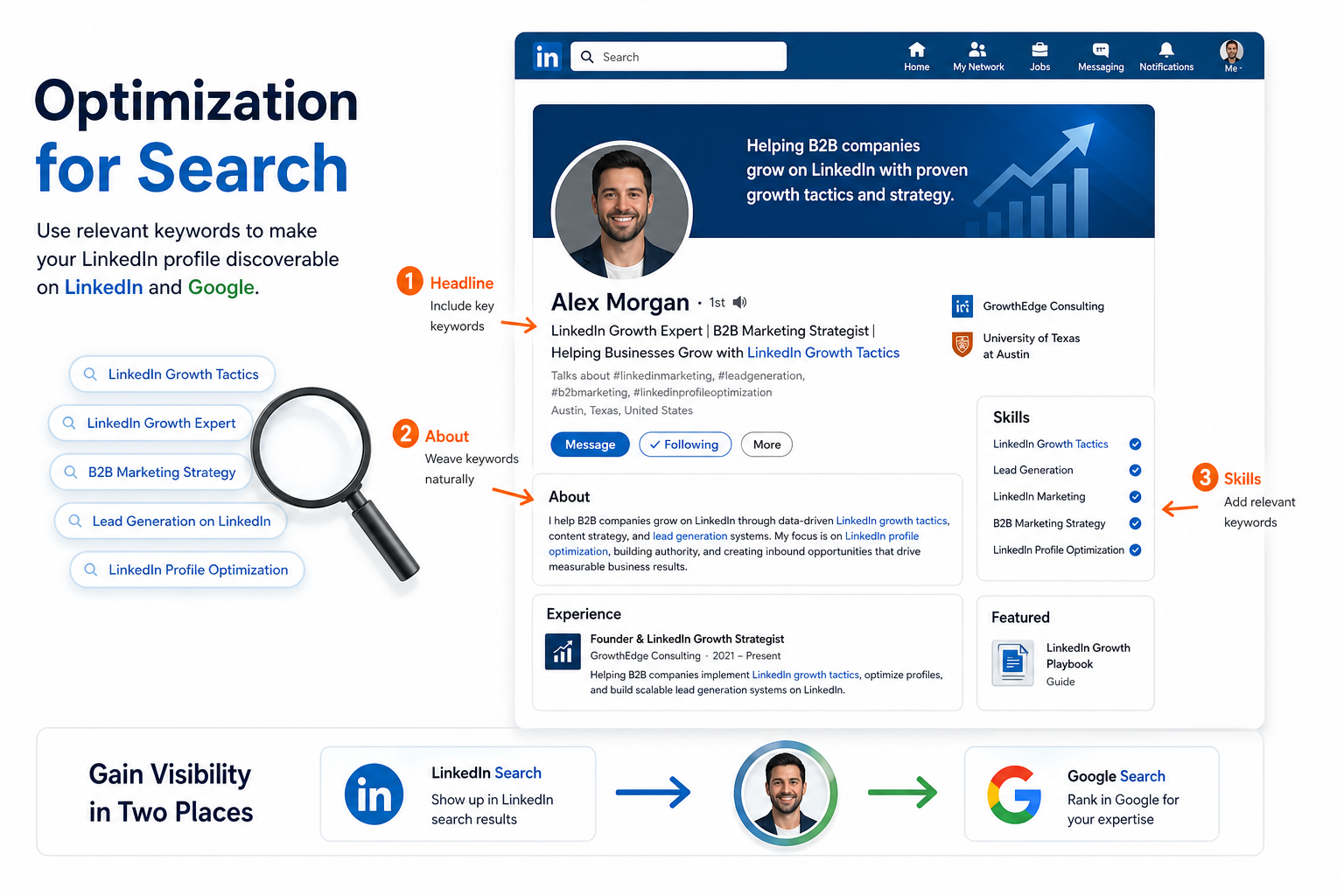
Optimization for search is about making your LinkedIn profile discoverable by the people who matter in your industry and by external search engines. The core idea is to weave relevant keywords into natural, readable places so that both LinkedIn’s internal search and Google can surface your profile when potential clients, partners, or collaborators look for expertise like Linkedin Growth Tactics, lead generation on LinkedIn, or profile optimization.
Key areas to optimize include your About section, Experience entries, Skills, and even your headline. The goal is to align your profile with the search terms your ideal audience is actually typing while preserving readability and a compelling narrative. When done well, you gain visibility in two powerful arenas: LinkedIn search results and external search results, which can drive inbound inquiries long after you publish new content.
Best practices for keyword integration:
- Research target keywords: Identify terms your audience uses, such as LinkedIn growth expert, b2b marketing strategy, or LinkedIn profile optimization.
- Distribute keywords naturally: Place them in your About text, Experience descriptions, and Skills, avoiding keyword stuffing.
- Prioritize user experience: Write for humans first and search engines second. Keywords should feel seamless within your story.
- Be specific: Use long tail phrases that match your niche, for example LinkedIn growth tactics for professional services firms rather than generic terms.
- Keep public visibility: Ensure your profile is public to maximize discoverability both on LinkedIn and in external search engines.
Public visibility is a multiplier for reach. When your profile is set to public, every public element can be indexed by external search engines, extending your footprint beyond LinkedIn. This raises the likelihood that a decision maker or recruiter will encounter your profile when they search for your domain expertise. To enable public visibility, review your Settings and Privacy options and toggle the Public profile setting so that your profile is discoverable by search engines and non LinkedIn users alike.
Practical optimization steps you can apply now:
- Audit your headline and About section: Ensure your top keywords appear within the first 1 to 2 sentences or the opening hook so scanners pick them up quickly.
- Enhance Experience descriptions: Add context around results and methodologies that include target keywords in a natural way.
- Curate your Skills with keyword alignment: Select skills that reflect your niche and align them with the keywords you want to rank for.
- Enable public profile indexing: Allow search engines to index your profile to expand your reach beyond LinkedIn.
- Monitor and adjust: Use LinkedIn analytics and external search results to see which keywords attract profile views and adjust your copy accordingly.
In practice, a well crafted profile reads smoothly while signaling authority to both the LinkedIn algorithm and external audiences. Integrating relevant keywords in a natural narrative fosters better visibility for topics like Linkedin Growth Tactics, lead generation on LinkedIn, and professional branding on LinkedIn, helping you attract the right connections, conversations, and opportunities.
| Area | Action | Impact |
|---|---|---|
| Headline | Incorporate outcome, audience, and method with focused terms | Increased profile impressions from relevant searches |
| About Section | Weave in keywords naturally while telling a reader focused story | Improved Google and LinkedIn search indexing and engagement |
| Experience Descriptions | Describe responsibilities and outcomes using niche terms | Higher relevance in recruiter and client searches |
| Skills | Align skills with core keywords and niche topics | Better discovery through skill based searches |
| Public Visibility | Set profile to public and enable indexing | External search visibility and broader reach |
| Content Signals | Publish keyword aligned posts and articles | Reinforces topic authority and improves ranking signals |
By pairing keyword rich copy with public accessibility, you lay a solid foundation for ongoing discovery and engagement. This key facet of LinkedIn Growth Tactics ensures that your profile not only attracts the right audience but also remains discoverable as your content and network evolve.
Content Strategy: Create Consistent, High Value Posts
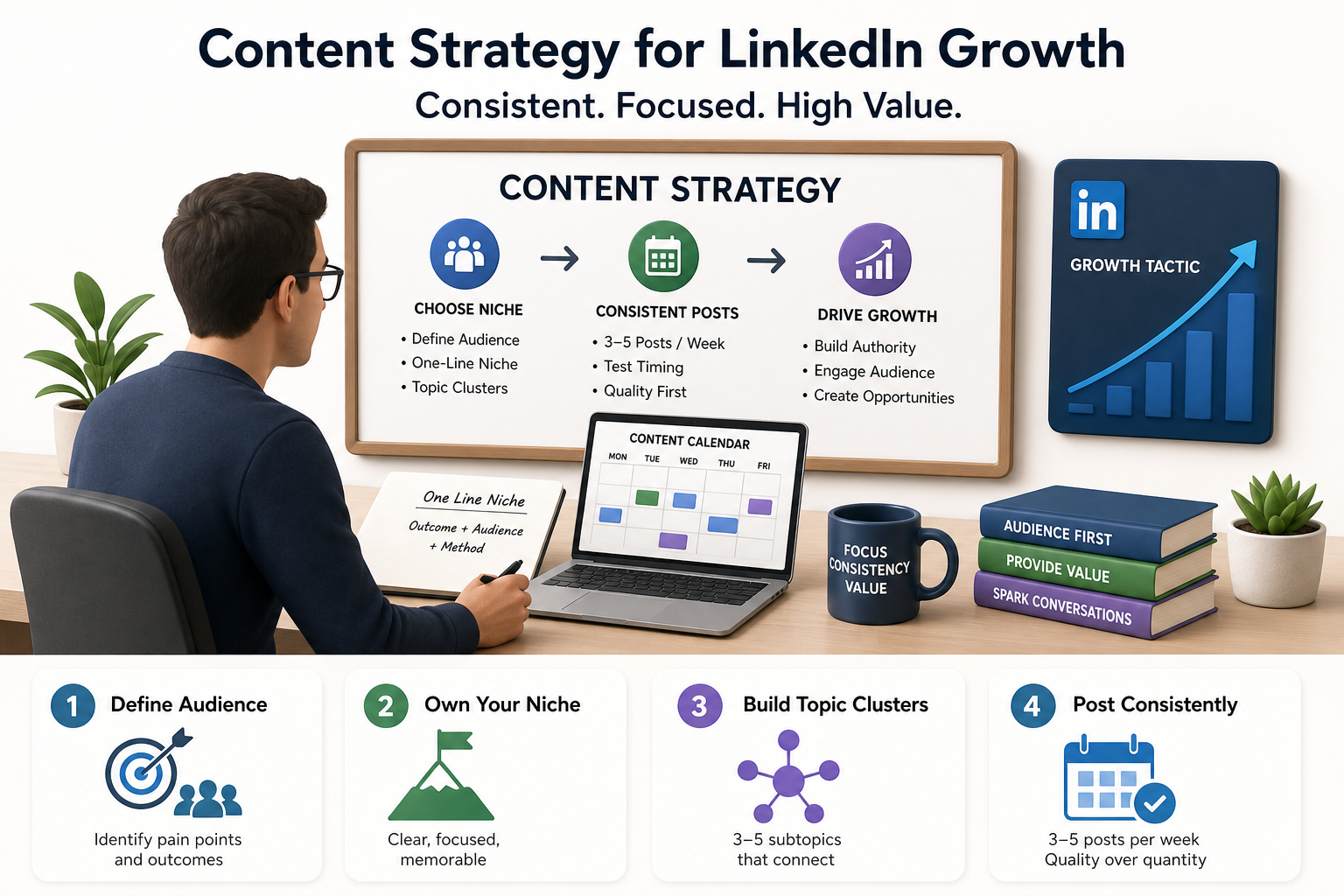
Content is the engine that drives growth on LinkedIn and a core pillar of Linkedin Growth Tactics. By delivering consistent, high value posts within a focused niche, you establish authority, attract an engaged audience, and create a reliable pipeline of conversations and opportunities. The goal is to produce content that resonates deeply with a clearly defined audience, not to chase broad reach with generic tips.
Focus on quality and relevance over volume. Build a cadence that fits your schedule and your audience’s expectations, and keep your voice steady across posts. This consistency helps you stay memorable and signals reliability to potential connections and collaborators.
Choose Your Niche and Own It
The fastest path to visibility is to own a well defined topic area. Narrow focus helps you cut through the noise and become the go to resource in your domain. When you speak consistently about a specific intersection, the right followers recognize you and are more likely to engage, comment, and share.
- Define your audience: identify a target segment with shared pain points and outcomes.
- Articulate the niche: craft a clear, one line description that combines outcome, audience, and method.
- Build topic clusters: create a content map around 3 to 5 related subtopics that feed each other.
Maintain clarity in your messaging and revisit your niche from time to time to ensure it still aligns with your goals and the needs of your audience.
Posting Frequency and Timing
Consistency beats occasional brilliance. A practical rhythm keeps you visible without burning out. Use data to tailor timing to your audience’s habits, not just generic best practices.
- Baseline cadence: aim for 3 to 5 posts per week.
- Experiment with times: test morning, midday, and early evening slots in your target timezone.
- Quality first: never sacrifice value for volume; increase frequency only when each post meets your standards.
Over time, you’ll learn what cadence feels natural for you and your audience. Let insights guide adjustments rather than sticking to a rigid plan.
Craft Hooks That Stop the Scroll
The first 125 characters determine whether someone continues reading. A strong hook pairs immediacy with relevance and hints at a concrete benefit.
A well-crafted hook speaks to a real need and sets a clear expectation. It invites readers to invest a moment in your post.
- Lead with a problem your audience recognizes.
- Include a surprising stat or a provocative question to spark curiosity.
- Preview the outcome readers will gain by engaging with the post.
Content Formats That Drive Engagement
Diversifying formats helps you reach different learning preferences and keeps your timeline dynamic.
Each format serves a distinct purpose in reinforcing your niche authority.
| Format | Best Use | Engagement Tip |
|---|---|---|
| Carousels | Explain a process step by step or share a mini case study | Use 5 to 8 slides with a clear narrative arc per slide |
| Short Posts | Quick insights, micro lessons, or timely observations | Ask a specific, answerable question to prompt comments |
| Videos | How-to tips, demos, or behind the scenes | Keep it under 2 minutes and include captions |
| Long-form Articles | In-depth frameworks and credible analyses | Break into easily scannable sections with subheads |
| Polls | Gauge opinions and gather data for future content | Follow up with a post sharing results and implications |
Topic Clusters and Content Mapping
Organize content around central themes and supporting subtopics to create a cohesive narrative.
A well structured map makes it easier to plan, repurpose, and optimize for discoverability.
- Core pillar: the primary outcome you help clients achieve.
- Three to five supporting subtopics: each should circle back to the pillar.
- Repurposing plan: turn a carousel into a video, a video into a post series, and a post into a short article.
Engagement and Community Signals
Engagement drives visibility. Build conversations by inviting input and acknowledging comments.
Continue threads across posts. Active participation signals the LinkedIn algorithm that you are a valued contributor within your niche.
- Ask thoughtful questions at the end of posts to stimulate dialogue.
- Respond promptly to comments with meaningful replies that advance the topic.
- Comment strategy: allocate time blocks to engage with peers, ICPs, and potential collaborators.
Content Calendar and Workflow
A simple, repeatable workflow keeps momentum strong. Use a content calendar to plan topics, formats, and publication dates, while leaving room for timely responses to industry shifts.
A clear routine helps you stay consistent. Map out weekly themes and post formats, then adjust as industry signals change.
| Week | Topic | Format | Goal |
|---|---|---|---|
| Week 1 | Niche framing and audience pains | Short post + carousel | Clarify value proposition and attract ICP followers |
| Week 2 | Step-by-step framework | Video + long-form article | Establish credibility with actionable guidance |
| Week 3 | Case study snippet | Carousel | Provide social proof and tangible outcomes |
| Week 4 | Audience poll results and implications | Poll + follow-up post | Engage community and inform future topics |
Measuring Impact and Iteration
Track signals that matter for growth and learning. Focus on quality indicators that reflect resonance with your niche and the momentum of conversations rather than vanity metrics alone.
- Engagement quality: comments with thoughtful insights, not just likes.
- Audience growth: rate of new followers within your target ICP.
- Click-through and conversations: visits to your resource or Calendly link, and the number of direct messages or inquiries.
- Content evolution: use feedback to refine topics, formats, and post timing.
With a disciplined approach to content strategy, you create a durable flywheel for growth. By concentrating on a precise niche, delivering consistently high value, and actively nurturing conversations, you align with the core drivers of Linkedin Growth Tactics and set the stage for sustained authority, engagement, and opportunity generation.
Choose Your Niche and Own It
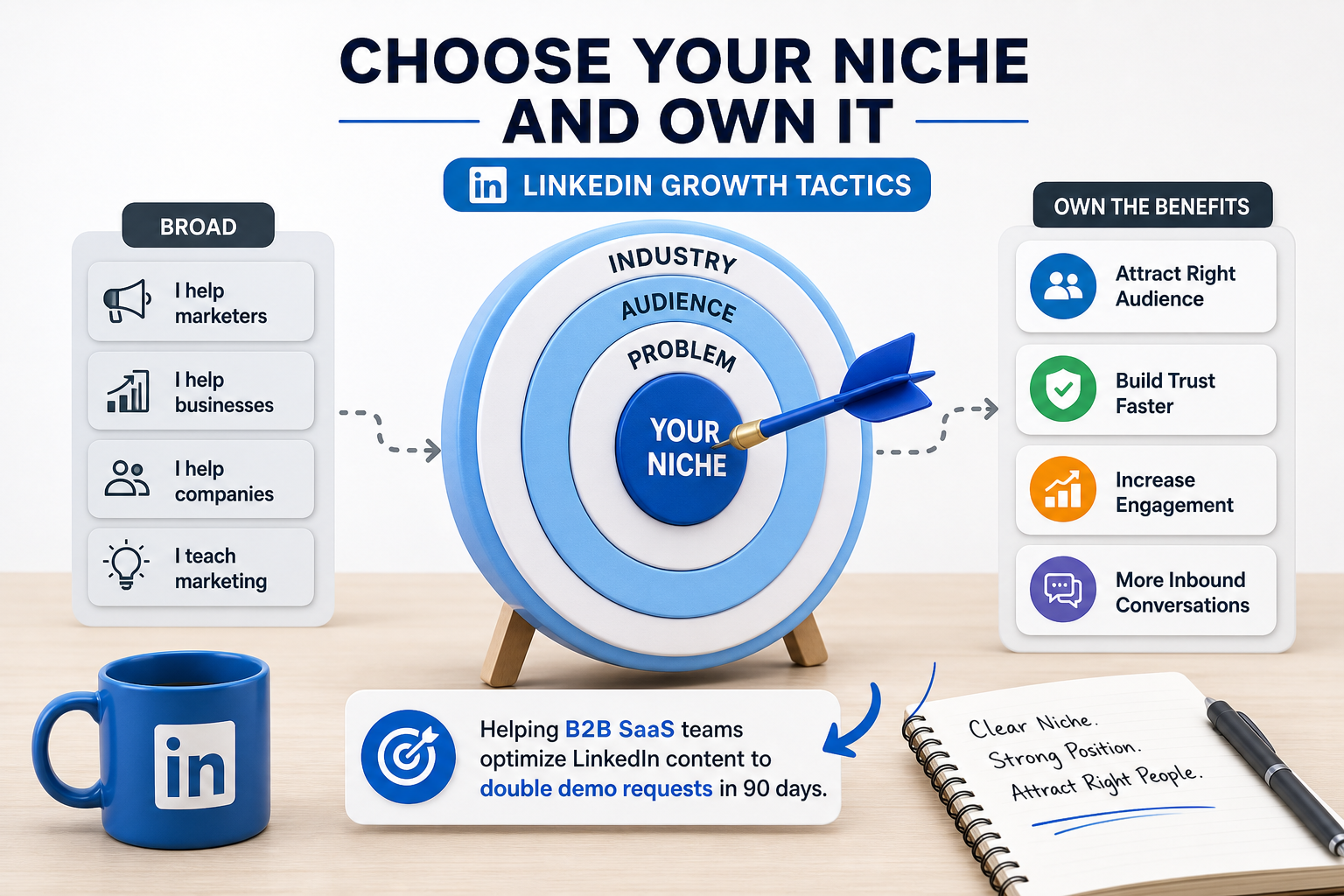
Choosing a precise sub niche is the fastest path to becoming the go to expert in your field. A narrow focus helps you cut through the noise, attract an audience that cares deeply about your specialized knowledge, and accelerate trust, credibility, and inbound conversations. This is a foundational pillar of Linkedin Growth Tactics because clarity signals expertise to both your audience and the LinkedIn algorithm.
Start by defining a crisp target audience and the concrete outcome you help them achieve. The more specific you are, the easier it is to create content that resonates, to craft messages that convert, and to surface in searches that matter. Instead of broad statements like “I help marketers,” aim for something like “Helping B2B SaaS teams optimize LinkedIn content to double qualified demo requests in 90 days.” That level of specificity attracts the right people and repels the wrong ones, which improves engagement and saves time on outreach.
Guiding questions to illuminate your sub niche
- Who is your ideal client or collaborator within the industry?
- What specific problem do you solve for them, and what does success look like?
- What unique angle or framework do you bring that others do not?
- What outcomes can you reliably deliver, and in what timeframe?
Once you have a clear audience and problem set, craft a concise one line that combines outcome, audience, and method. This single sentence becomes your north star for content creation, profile messaging, and outreach.
Example of a strong niche description you can adapt:
“Niche focus: LinkedIn growth strategies for professional services firms, using a repeatable content and outreach framework to generate measurable pipeline velocity.”
Building topic clusters around your niche
Structure your content around a central pillar topic and a handful of related subtopics. This creates a cohesive content map that the audience can follow, repurpose, and reference. A well designed cluster reinforces your authority and improves discoverability within Linkedin Growth Tactics.
| Core Pillar | Supporting Subtopics | Content Formats to Use | Audience Benefit |
|---|---|---|---|
| LinkedIn growth for professional services | Profile optimization for credibility; content systems for thought leadership; outreach playbooks; case study storytelling | Carousels, short posts, long-form articles, video tutorials | Clear paths to trust, pipeline, and referrals within service firms |
| Content strategy for B2B SaaS | Niche messaging; demand generation via LinkedIn; onboarding content for trial users | Videos, polls, long-form guides, newsletters | Better quality leads and faster product-led growth signals |
| Lead generation through personal branding | Profile branding for high intent; engagement routines; social proof through micro case studies | Short posts, carousels, weekly newsletters | Stronger inbound interest and scheduled conversations |
Practical steps to implement this now:
- Choose a sub niche with a specific audience and a tangible outcome you can measurably influence.
- Draft a one line niche description that includes the audience, outcome, and method.
- Identify 3 to 5 supporting subtopics that feed into the core pillar and map them into a content calendar.
- Develop a content rhythm that alternates between educational, actionable, and proof-focused formats to demonstrate results.
Measurement and iteration are essential. Track audience fit through engagement quality, follower growth within the target ICP, and the rate at which new connections convert to conversations or opportunities. If a sub topic consistently underperforms, refine the framing, adjust the format, or replace it with a higher impact angle while keeping your core niche intact.
By narrowing your focus and owning a clearly defined sub niche, you set a strong foundation for all elements of your LinkedIn growth plan. This approach makes it easier to attract a highly engaged audience, produce deeply relevant content, and accelerate momentum within the broader framework of Linkedin Growth Tactics.
Posting Frequency and Timing
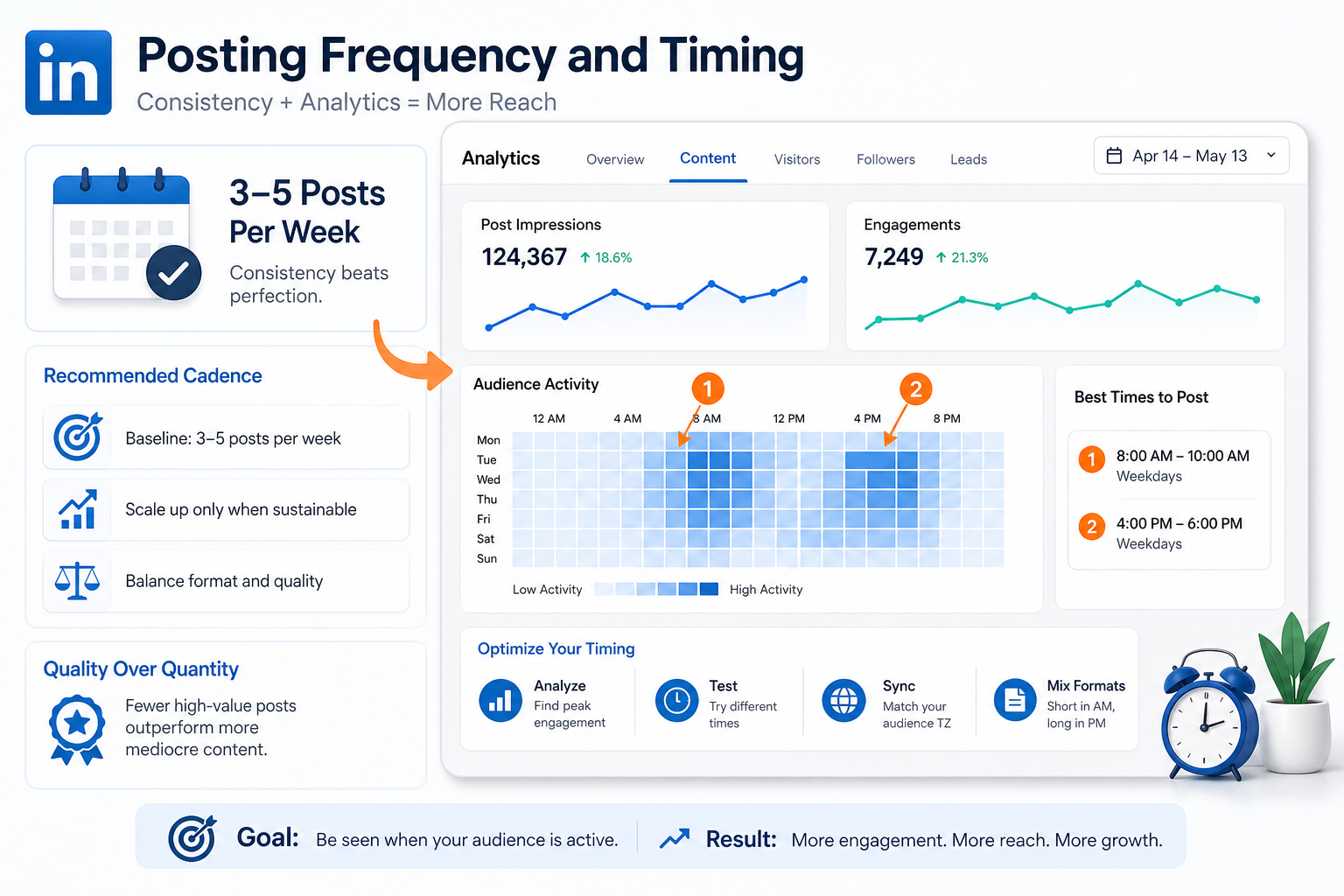
Consistency beats perfection when building momentum on LinkedIn. The most sustainable path to growth is a predictable posting rhythm that your audience can rely on, not sporadic bursts that vanish into the noise. By aiming for 3 to 5 high value posts per week, you maintain visibility in the feeds of your target audience while preserving the quality that drives engagement and trust.
Recommended cadence:
- Baseline goal: 3 to 5 posts per week.
- Adjust upward only after you can sustain consistency without sacrificing value.
- Balance post length and format so you can maintain quality at the chosen frequency.
Timing is a multiplier, not a mystery:
Use analytics to identify when your audience is most active and align your publishing schedule accordingly. Posting during peak windows increases the likelihood of early engagement, which can boost reach and longevity in feeds.
Practical steps to optimize timing:
- Analyze your LinkedIn analytics to find the hours and days with the highest engagement for your audience.
- Test a small rotation of times across a 4 to 6 week window to confirm patterns.
- Sync post times with audience time zones when you serve multiple regions.
- Consider multi format timing, for example a quick post in the morning and a deeper long form in the late afternoon to maximize different reader habits.
Quality over quantity:
It is better to publish fewer posts that are genuinely useful than to push out more content that feels rushed. Each post should deliver a clear takeaway, a tangible insight, or a concrete call to action that moves a reader closer to a conversation or a next step.
Analytics driven iteration:
- Measure engagement rate, average watch time for videos, saves, and comments to gauge resonance.
- Adjust topics, formats, and posting times based on what the data reveals about your audience’s preferences.
- Experiment with formats one at a time (for example, try a carousel week, then a video week) to isolate impact.
Scheduling and workflow tips:
Use a simple content calendar to plan topics, formats, and posting times for the upcoming week. Batch create content when possible to protect your cadence and reduce last minute rushes. Maintain a standard review process to ensure every post aligns with your niche, avoids filler, and includes a clear takeaway or question to stimulate discussion.
Applied consistently, a disciplined frequency and data informed timing approach expands your reach, compounds engagement, and accelerates the path from posting to meaningful conversations and opportunities within your targeted professional community.
Craft Compelling Hooks
Did you know the first 125 characters decide if a post gets read on LinkedIn and whether readers scroll or stop cold? Crafting hooks that grab attention fast is a foundational skill in Linkedin Growth Tactics. Clear, punchy language that respects your audience’s time expands reach and invites deeper engagement from a broad professional spectrum.
In this section we break down how to assemble hooks that spark curiosity, signal value, and invite action. A strong hook does not just tease a topic; it promises a concrete outcome or a relatable pain point within the opening lines. The result is higher view times, more comments, and better distribution in feeds across your target audience.
Principles of a high impact hook
- Relevance: Start with a problem or scenario your ICP recognizes.
- Specificity: Use concrete details instead of vague statements to increase credibility.
- Curiosity with clarity: Pose a question or make a bold claim that begs a simple follow up answer.
- Outcome oriented: Hint at the result readers will gain by continuing.
Hook frameworks you can apply today
- Problem to Promise:
“Struggling to prove ROI from LinkedIn outreach? Here is a simple 3 step tweak that doubles response rates.” - Provocative Question:
“What if your most visible post is a mirror of your least actionable strategy?” - Surprising Statistic:
“90 percent of B2B content on LinkedIn fails to spark conversation. Here is how to beat the odds.” - Mini Case Preview:
“How one 5 minute tweak turned a cold outreach message into 7 booked demos this week.”
Practical hook crafting steps
- Identify a core pain point your audience faces this week.
- Lead with specificity by naming the outcome and the audience in the hook itself.
- Preview the benefit in a way that implies a simple next step or insight.
- Keep it succinct and accessible; aim for one crisp thought in the opening 125 characters.
Hook examples mapped to outcomes
| Hook Type | Example | What you elicit |
|---|---|---|
| Problem to Promise | “Tired of content that attracts likes but not inquiries? Here is a 2 minute framework to boost qualified messages.” | Clear value proposition and time saved |
| Provocative Question | “If your LinkedIn profile could talk, would it tell the truth about your pipeline?” | Curiosity and self-assessment |
| Surprising Statistic | “Two in three posts fail to spark a comment. Here is a simple trigger that changes that.” | Credibility and immediate relevance |
| Mini Case Preview | “Posted 5 short tips yesterday and booked 3 demos today. Here is the exact format.” | Social proof and practicality |
Integrating hooks into your post structure
Think of a post as a short dialogue. The hook opens the conversation, the body delivers value, and the conclusion invites a response or action. A well designed hook aligns with the post’s core message and the audience’s needs, ensuring a seamless transition from attention to engagement.
Quick hook synthesis checklist:
- Lead with a question, bold claim, or problem statement
- Mention the target audience or domain to increase relevance
- Imply a concrete outcome or benefit
- Keep the opening under 125 characters where possible
By applying these hook strategies, you unlock immediate engagement and set up your subsequent content for sustained visibility within your niche. This disciplined approach to opening lines is a core lever in Linkedin Growth Tactics and a practical way to accelerate conversations, connections, and opportunities across professional networks.
Authenticity Drives Engagement
Authenticity is the connective tissue that turns passive readers into active participants. When you share real experiences, including the missteps and the lessons learned, you invite others to see themselves in your journey. Audiences respond not just to polished outcomes, but to the human volatility behind them—the courage to be imperfect and to learn in public.
Story 1: A turning point behind a breakthrough. Rather than presenting a flawless victory, describe the moment of uncertainty that preceded progress. For example, write about a project that stalled mid course, the late nights, the awkward pivots, and the stubborn questions you kept asking. Closing with the concrete adjustment you made helps readers imagine how they might apply a similar mindset to their own work.
Story 2: The daily grind you rarely showcase. Behind the scenes glimpses can illuminate day to day discipline that sustains results. Consider sharing a snapshot of your morning routine, a planning ritual, or a weekly review that clarified priorities. When readers see the ritual behind the result, they gain practical takeaways rather than abstract inspiration.
Story 3: The human impact and the humility that followed. If a tactic or approach didn’t work as expected, explain what happened, what you would do differently, and the metrics you watched to know when to pivot. Demonstrating accountability builds credibility and signals that you value growth over ego.
Practical frameworks to weave authenticity into your content:
- Vulnerability with value: share a challenge, then deliver a concrete, actionable tip that addresses it.
- Behind the scenes snapshots: show context, not just results. Include sketches, notebooks, or a screen capture of a process step.
- Lessons the audience can reuse: end with a takeaway that readers can apply in their own work this week.
- Transparency about outcomes: if possible, include a before and after reveal with specific numbers or milestones.
When you couple honesty with practical experience, your content becomes a reliable signal of credibility. Readers are more inclined to engage, ask clarifying questions, and share their own experiences. The goal is not to be flawless, but to be useful in a human way, inviting collaborative conversation rather than a one way broadcast.
Tips for nurturing authentic engagement over time:
- Lead with a real moment or question that reflects a common professional struggle.
- Invite participation by asking a specific, experience based question in your post.
- Respond with thoughtful, context rich replies that extend the conversation rather than short acknowledgments.
- Repurpose authentic stories into multiple formats (short post, a carousel, and a longer article) to reinforce the learning and broaden reach.
Incorporating authenticity into your LinkedIn routine strengthens trust, accelerates meaningful conversations, and creates a durable platform for growth. It aligns perfectly with the broader goal of Linkedin Growth Tactics by turning shareable experiences into both learning and momentum in your professional network.
Strategic Call-to-Actions
Strategic call-to-actions are the taps that convert passive readers into active participants. A well crafted CTA does more than request a comment; it invites a specific action, signals value, and encourages interaction that the LinkedIn algorithm treats as meaningful engagement. In the framework of Linkedin Growth Tactics, thoughtful CTAs help propel conversations, surface new perspectives, and expand your reach through authentic unintended asks like comments, shares, or tagging colleagues who will benefit from the insight.
With clear prompts, you invite ongoing participation and feedback. Treat each post as a step in a longer conversation.
CTA Principles to Guide Your Posts
- Specificity: Tell readers exactly what you want them to do and what they will gain by doing it.
- Value cue: Tie the CTA to a tangible outcome, such as a takeaway, a resource, or a concrete next step.
- Audience alignment: Direct the ask to your ICP or to colleagues who can contribute or benefit.
- Channel clarity: Use prompts that work well within the LinkedIn feed, such as comments, tagging, or sharing with a team.
CTA Formats You Can Plug Into Posts
- Comment for a lesson:
Prompt readers to share one practical takeaway from your post and add a brief example from their own experience.
Example: “Share one technique you use to shorten the sales cycle in your firm.” - Ask for experiences:
Invite readers to narrate a real world case or challenge, then promise to synthesize three common patterns in a follow up post.
Example: “What has been your most effective LinkedIn outreach sequence this quarter? Tell us your approach and results.” - Tag a colleague:
Encourage readers to tag teammates who would find the post relevant, increasing exposure to new networks.
Example: “Tag a colleague who should test this framework with you this week.” - Poll or quick decision:
Pose a narrowly scoped question and invite votes or commentary to spark quick engagement.
Example: “Which format yields higher quality conversations for you this month: carousels or short videos? Vote and explain why in comments.” - Resource drop:
Offer a concise resource and ask readers to comment with their implementation plan or results.
Example: “I shared a one page framework in the comments. Download it and share your initial plan in the thread.”
CTA Copy Templates You Can Adapt
- Engagement prompt: What is your key takeaway from this post? Share one concrete step you will implement this week.
- Experience prompt: Tell us about a similar challenge you faced and how you approached it. What surprised you most?
- Tag and collaborate: Tag a teammate who would benefit from this approach, and invite them to share their perspective in the comments.
- Curveball question: What would you do differently if you had one more hour to work on this initiative?
Engagement Signals to Watch
- Comments: Aim for thoughtful, multi sentence responses that advance the topic.
- Replies: Monitor and respond to follow up questions within the thread to sustain momentum.
- Tag activity: Track how often readers tag colleagues and whether those tags produce new conversations.
- Saves and shares: Craft CTAs that encourage saves for later reference and shares to relevant networks.
Practical Implementation Steps
- End each post with a clear action prompt tailored to your objective (comment, tag, share, or download).
- Rotate CTA styles across posts to learn which prompts drive the strongest response from your audience.
- Experiment with positioning, such as placing the CTA at the end of the body, after a quick cliffhanger, or within a bold callout box in the post.
- Monitor performance over 2 to 4 weeks and iterate the phrasing, targeting, and format based on data.
To kick off a practical exercise, try this structured prompt in your next post: “Here is a practical takeaway from this framework. If you implement it this week, drop a comment with your first result and tag a colleague who should try it too. I will compile the most common questions into a short follow up post.” This approach invites comments, encourages collaboration, and signals value to the algorithm through meaningful interaction.
Remember, CTAs are not mere formalities; they are invitations to participate in a conversation. When you embed clear, value driven requests into your content and invite colleagues to join, you increase reach and reinforce your position within the targeted professional community. This is a core element of Linkedin Growth Tactics that helps cultivate richer conversations, broader visibility, and more sustainable momentum over time.
Hashtag Strategy
Hashtag strategy is a precise lever for expanding reach without spamming your audience. The goal is to surface your content to the right professionals who care about your niche, not to chase broad impressions. A well crafted mix of targeted hashtags helps your posts appear in relevant feeds, supports your SEO efforts on LinkedIn, and reinforces your authority within your niche.
Focus on tags that matter to your ICP and sector. A steady core of core hashtags anchors your content, while a rotating set of secondary tags tests resonance. This combination keeps your posts accessible to the right people and helps you accumulate consistent signals over time.
Principles of an effective hashtag mix
- Relevance first: choose tags that your ICP actually follows and searches for in your industry.
- Moderation: limit to a targeted handful to avoid looking spammy.
- Niche + broad balance: combine 1 or 2 highly specific tags with 2 to 4 broader, widely followed tags.
- Consistency: use a stable set of core hashtags across your posts to build recognition.
- Variation: rotate secondary tags to test resonance while keeping core tags constant.
Recommended hashtag framework
- Core niche tags that define your specialty and audience. These should appear on most posts.
- Audience segment tags focused on the ICP or vertical you serve.
- Topic tags tied to the specific post topic (e.g., a post about outreach, content strategy, or analytics).
- Event or format tags sparingly, only if relevant to a campaign, challenge, or content format you routinely publish.
Hashtag best practices for LinkedIn
- Limit per post: aim for 3 to 5 hashtags per post to maximize reach without appearing spammy.
- Place strategically: include core hashtags in the post body or as a compact line at the end; avoid stuffing in the middle of the text.
- Test and learn: track engagement signals by hashtag to identify which tags drive meaningful interactions.
- Avoid overused general tags: tags like #marketing or #business are crowded; pair them with more specific terms.
- Align with audience hashtags: ensure your tags reflect the terms your target clients or collaborators actually search for.
Example hashtag sets by common LinkedIn growth niches
| Niche / Focus | Core Tags (1-2) | Supplementary Tags (2-3) | Audience Focus |
|---|---|---|---|
| LinkedIn growth for B2B services | #LinkedInGrowth, #B2BMarketing | #LeadGeneration, #ContentStrategy, #LinkedInTips | Marketing leaders, strategists, and business developers |
| Profile optimization and personal branding | #ProfileOptimization, #PersonalBrand | #LinkedInProfile, #CareerBranding, #ThoughtLeadership | Job seekers, consultants, executives building authority |
| Content strategy and engagement | #ContentStrategy | #ContentMarketing, #EngagementTips, #SocialSelling | Content leaders, editors, community managers |
| Lead generation through outreach | #LeadGen, #Outreach | #SalesEnablement, #LinkedIn outreach, #Prospecting | Sales teams, growth practitioners, founders |
| Thought leadership and niches | #ThoughtLeadership, #NicheAuthority | #IndustryInsights, #FutureOfWork, #B2B | Subject matter experts, consultants, niche communities |
Practical quick win checklist
| Area | Action | Impact |
|---|---|---|
| Core hashtags | Select 1-2 core tags central to your niche and consistently include them | Improved topic alignment and audience recognition |
| Supplementary hashtags | Choose 2-3 targeted tags per post and rotate them | Represents breadth without dilution |
| Avoid spammy overstuffing | Limit to 3-5 tags per post | Maintains credibility and algorithm signal quality |
| Performance tracking | Tag performance metrics in a simple sheet each week | Clear insight into which hashtags drive saves, comments, and inquiries |
By combining a concise core tag set with a small rotation of targeted supplements, you can extend the reach of your posts to the most relevant professional audiences. This Hashtag Strategy supports your broader Linkedin Growth Tactics while keeping your presence clean, professional, and focused on meaningful engagement.
Link Placement Strategy
Effective link placement on LinkedIn is a subtle art. The platform’s feed rewards engagement signals, and posts with external links can dampen organic reach compared to posts that keep readers on LinkedIn. The practical approach is to guide readers to resources without sacrificing visibility. By pairing thoughtful link placement with clear calls to action, you can sustain reach while still delivering value and driving qualified traffic to your resources.
Core principle: prioritize in post value and momentum, and share external links in comments rather than in the post body. This preserves the post’s reach while still connecting readers with deeper content, tools, or resources when they are most engaged.
Guiding practices
- Lead with value: craft a post that delivers a standout insight, framework, or quick win before any link appears in the comments.
- Anchor your CTA in the post: invite readers to explore further by commenting or saving the post, and then respond with a helpful link in the subsequent comments.
- Comment placement discipline: place the external link in the first comment after the post goes live, and pin that comment if possible for easy visibility.
- Context in the post body: if you must reference a resource, keep the mention generic and focus on the outcome, then provide the link in the comments for readers who want to dive deeper.
Comment sequencing strategy
- Initial post: publish with a strong hook, core insight, and a clear CTA to discuss or apply the idea.
- First comment: add a concise summary of the resource and a direct link to the material or tool, such as a guide, checklist, or template.
- Pin the link comment: if the platform allows, pin the comment containing the resource to keep it highly accessible to readers scrolling the thread.
Whenever to break the rule
There are rare occasions when a post benefits from an immediate resource link in the body, such as when the link is essential to understanding the post’s core value or when you are conducting an explicit, time bound offer. In those cases, ensure the post remains mobile friendly, avoids abrupt interruptions, and provides a compelling justification for readers to click the link. Even then, monitor engagement after publishing to verify that the impact on reach remains favorable.
Operational tips
- Link hygiene: use clean, stable URLs and avoid long tracking parameters that clutter the comment space.
- Accessibility: include a brief, descriptive anchor text in the comment so readers understand what they will find when they click.
- Value alignment: ensure the resource in the comment directly supports the post’s promise and delivers actionable takeaways.
- Measurement: track metrics such as post reach, engagement rate, click-throughs from comments, and the conversion rate of readers who access the linked resource.
Adopting a disciplined link placement workflow reduces friction for readers while preserving the organic momentum of your posts. This approach aligns with broader Linkedin Growth Tactics by maintaining feed health, encouraging authentic engagement, and directing interested readers to high quality resources at the moment they are most receptive.
Content Types That Drive Engagement
Content types are the surface where your Linkedin Growth Tactics come to life. Diversifying formats keeps your feed fresh and speaks to different learning preferences within your network. By combining educational, experiential, and interactive content, you increase the likelihood that people stop, read, and act. Here is a practical map of formats you can mix and match to maximize engagement and visibility across the feed.
Carousel Posts for Education
Carousels bundle bite-sized insights into a scrollable deck. They are ideal for teaching a process, sharing a framework, or presenting a mini case study. They tend to generate higher dwell time and save rates compared with single image posts.
- Structure: 5 to 10 slides with a clear narrative arc (problem, steps, results).
- Visuals: use concise text, readable typography, and supportive charts or icons.
- CTA: end with an actionable takeaway and an invitation to comment or save for later.
Video Content for Maximum Visibility
Video formats typically command more attention in the LinkedIn feed and occupy more real estate, which increases reach. Authentic, concise videos that deliver practical tips, demonstrations, or behind the scenes glimpses tend to perform best.
- Length: aim for 60 to 120 seconds, with captions enabled for silent viewing.
- Delivery: speak clearly, use a friendly tone, and deliver a single clear takeaway per video.
- Repurposing: extract short clips from longer videos to fuel multiple posts and maintain momentum.
LinkedIn Polls for Interaction
Polls are an efficient way to spark engagement and gather audience insight. They also provide social proof and seed ideas for future content. Pair polls with follow up posts that analyze results and present actionable guidance.
- Question design: keep it focused, relevant to your niche, and allow for meaningful commentary.
- Answer options: provide 3 to 4 thoughtful choices that reflect realistic scenarios.
- Post-poll follow up: summarize learnings, showcase wins, and invite deeper discussion in the comments.
Long-form Articles for Authority
Long-form articles give you space to articulate frameworks, provide data-driven analyses, and present step-by-step guides. Articles have longevity in the feed and can drive sustained traffic to your profile over weeks or months.
- Depth: choose a topic where you can deliver a repeatable method or proven system.
- Structure: use subheads, bullet lists, and visuals to improve readability.
- Cross link: reference related posts or carousels to reinforce the topic cluster you are building.
Behind the Scenes Content
Behind the scenes content humanizes your brand and can lower barriers to engagement. Show your work process, planning rituals, or a candid look at how you approach challenges.
- Authenticity: pair with a learning takeaway, not just a diary entry.
- Format options: short video clips, image sequences, or concise narrative posts with diagrams.
- Accessibility: add brief captions or descriptions so readers can grasp the gist without watching every frame.
Industry Commentary and Thought Leadership
Commentary on industry news or emerging trends positions you as a thoughtful leader within your niche. Timely, well-reasoned perspectives that connect to your audience’s day-to-day challenges tend to attract thoughtful engagement and credible eyeballs.
- Angle: connect news to practical implications for your ICP.
- Evidence: cite sources or data where possible to bolster credibility.
- Moderation: invite constructive discussion and acknowledge differing viewpoints respectfully.
Content Mapping and Repurposing
To sustain a steady velocity, map your content into a simple pillar and cluster approach. Each pillar piece anchors related formats that feed each other.
| Pillar Topic | Supporting Formats | Audience Benefit | Repurposing Notes |
|---|---|---|---|
| LinkedIn Growth Tactics for Professionals | Carousel, Video, Polls | Clear, actionable steps to improve visibility and engagement | Turn carousel into a step by step video series or a long form article |
| Profile Optimization and Personal Branding | Short Posts, Behind the Scenes, Guides | Practical improvements you can apply today | Convert a guide into a checklist infographic or a micro video tutorial |
| Lead Generation and Outreach | Case studies, Video Demos, Live Q and A | Proof of concept and measurable results | Repurpose into a podcast snippet or a downloadable template in the comments |
Practical takeaway: aim to publish a diversified mix each week, such as two carousels, one short video, one poll, and one long form article. This blend ensures you cater to different preferences while maintaining a robust presence in the feed. When done consistently, it strengthens your authority within the Linkedin Growth Tactics framework and accelerates momentum across postings, comments, and messages.
Carousel Posts for Education
Carousel posts are a powerful education vehicle on LinkedIn. They combine concise text with visuals to guide readers through a clear, step-by-step narrative. When designed well, carousels increase dwell time, encourage saves, and boost overall engagement by delivering structured learning experiences that are easy to skim and actionable to implement.
Why Carousels work for education
- Structured learning path: readers move through a defined sequence, which reduces cognitive load.
- Visual reinforcement: charts, icons, and diagrams support understanding and retention.
- Higher dwell time: multi-slide formats tend to keep attention longer than a single image or text post.
- Shareability: a clear framework or checklist is highly valuable for followers to save and share.
Slide structure and narrative arc
Design each carousel to tell a complete mini story. A typical arc looks like this:
- Slide 1 — Hook and context: identify the problem your audience cares about.
- Slides 2–3 — Core steps or concepts: lay out the method, framework, or process in digestible chunks.
- Slide 4 — Examples or data visualization: illustrate with a simple chart, example, or before-after comparison.
- Slide 5 — Practical takeaway: provide a concrete action readers can apply this week.
- Slide 6 — Next step or CTA: invite comments, a save, or a link to a related resource.
Slide design and content guidelines
- Keep text concise: aim for 10 lines or fewer across all slides; each slide should convey a single idea.
- Use visuals to complement text: employ icons, simple charts, or diagrams to illustrate concepts.
- Readable typography: use large, high-contrast type and avoid long paragraphs on slides.
- Consistent layout: maintain a uniform grid, color palette, and font treatment across slides.
Recommended slide count and pacing
Aim for a sequence of 5 to 10 slides. A shorter carousel is quick to consume and share, while a longer one can cover a more complex topic without overwhelming the reader. If you are new to carousels, start with 5 slides and gradually expand as your comfort with the format grows.
Content ideas that perform well in carousels
| Educational Focus | Carousel Idea | Engagement Trigger |
|---|---|---|
| Frameworks | Present a 4 step framework with brief explanations on each slide | Clear takeaway and applicability |
| Checklists | 5 item checklist with actionable tips and a final optimization tip | Save and apply later |
| Before and After | Visual comparison showing the impact of a method or tweak | Demonstrated value |
| Data Visualizations | Simple chart or infographic that distills a key insight | Shareable data point |
Practical creation checklist
- Define the outcome: what should readers be able to do after viewing the carousel?
- Draft slide copy: write concise statements for each slide, then trim to essentials.
- Design assets: create or source simple visuals that reinforce the point of each slide.
- CTA alignment: finish with a concrete action such as saving the post, trying a step, or commenting with a takeaway.
- Mobile readability: ensure text remains legible on small screens and images scale cleanly.
Example carousel outline you can adapt
- Slide 1: Hook — “Here is a 3 step method to accelerate your LinkedIn pipeline this month.”
- Slide 2: Step 1 — Define your ICP and a concrete outcome you will target.
- Slide 3: Step 2 — Build a repeatable outreach framework that aligns with the outcome.
- Slide 4: Step 3 — Metrics to track and how to adjust based on data.
- Slide 5: Real world example or calculation showing potential impact.
- Slide 6: Practical takeaway — implement one element this week.
Carousels for education are a scalable way to package knowledge, demonstrate credibility, and invite ongoing engagement. By combining a tight narrative with visuals and actionable steps, you create a reusable format that fans of your niche will return to, share, and reference as a trusted learning resource within the broader Linkedin Growth Tactics framework.
Video Content for Maximum Visibility
Short authentic videos tend to perform well on LinkedIn and can be created with just a smartphone. These quick clips deliver practical tips, behind the scenes insights, or real world demonstrations without requiring heavy production.
Used consistently, smartphone video becomes a reliable engine for visibility within your Linkedin Growth Tactics framework.
Why short videos work
- Higher engagement: concise formats capture attention and encourage more views and comments.
- Mobile friendly: easy to watch on the go, which suits the default mobile behavior of most users.
- Authenticity: raw, unpolished content often feel more trustworthy and relatable.
Video production basics
- Length: aim for 60 to 90 seconds for maximum retention.
- Framing: shoot in landscape or vertical depending on your audience habits, with your face centered and clearly visible.
- Lighting: use natural light where possible; avoid harsh backlighting and ensure your face is well lit.
- Audio: if possible, record in a quiet space; speak clearly and at a steady pace. If audio quality is uneven, add captions later.
- Background: choose a clean, professional setting or a neutral backdrop that supports your topic.
Content ideas you can start with
- Quick tips: one actionable technique or framework explained in under a minute.
- Behind the scenes: a brief look at your daily workflow, a planning session, or a toolkit walkthrough.
- Mini demonstrations: show a small process, screen share a simple template, or annotate steps in real time.
Captions and accessibility
- Captions: add on screen captions to ensure your message comes through without sound.
- Clear value in the first 5 seconds: mention the outcome or result early to hook viewers.
- Readable on small screens: use large text overlays and high contrast visuals.
Posting and optimization tips
- Offer a takeaway: end with a concrete action or resource the viewer can apply.
- Consistency: publish regular short videos to build audience expectations and return visits.
- Repurposing: trim longer videos into shorter clips for multiple posts or capture a teaser for a longer article.
Quick start checklist
- Pick a single focused tip or behind the scenes angle
- Record a 60 to 90 second clip with good lighting
- Enable captions and review for clarity
- Publish with a clear outcome in the first 5 seconds
- Engage with comments to boost early signals
By embracing short, authentic video made with a smartphone, you can steadily increase visibility, credibility, and connection within your niche. This approachable format fits naturally into a disciplined Linkedin Growth Tactics plan and scales as your audience grows.
LinkedIn Polls for Interaction
Polls are a compact and efficient tool for sparking curiosity, inviting participation, and gathering actionable insights from your network. When used thoughtfully, they generate immediate engagement signals while providing a data point that informs future content and outreach. In the context of Linkedin Growth Tactics, polls help you understand audience preferences, validate assumptions, and seed meaningful conversations that can lead to deeper relationships and opportunities.
Polls are a compact and efficient tool for sparking curiosity, inviting participation, and gathering actionable insights from your network. When used thoughtfully, they generate immediate engagement signals while providing a data point that informs future content and outreach. In the context of Linkedin Growth Tactics, polls help you understand audience preferences, validate assumptions, and seed meaningful conversations that can lead to deeper relationships and opportunities.
Why polls work
- Simplicity: quick, low effort for respondents increases participation rates.
- Social proof: seeing others vote encourages more people to weigh in.
- Feedback loop: poll results illuminate trends, pain points, and priorities within your ICP.
- Content inspiration: use outcomes to craft follow up posts, carousels, or articles.
Poll design best practices
- Clear question: frame a single, relevant question that ties to your niche and promises a concrete takeaway.
- Thoughtful options: provide 3 to 4 well considered choices that reflect realistic scenarios.
- Descriptive wording: keep options distinct to avoid overlap and confusion.
- Context in follow ups: accompany the poll with a short post that explains the implications of the results and next steps.
Follow up strategies that amplify impact
- Result analysis post: summarize the outcomes, highlight surprising takeaways, and link to supporting resources.
- Pattern synthesis: identify 3 to 5 common themes and publish a concise guide or checklist.
- Audience spotlight: invite respondents to share their reasoning in the comments to deepen conversation.
Poll formats you can deploy
| Format | Use Case | Engagement Tip |
|---|---|---|
| Yes / No | Quick decisions about a process, tool choice, or priority | Follow with a brief explanation of the tradeoffs in the comments |
| Multiple Choice | Compare approaches, strategies, or timing options | Offer a short analysis of why each option matters |
| milestone / preference | Gauge readiness for a new format, feature, or template | Announce the winning approach and deliver a complementary resource |
| Ranking | Order of priorities or impact of different tactics | Comment the top two or three and invite counterpoints |
Measurement and iteration
- Engagement rate: track votes, comments, and shares to gauge interest level.
- Quality of discussion: evaluate the depth of responses and whether conversations continue beyond the thread.
- Content ideas: harvest poll topics that reveal high value topics for future posts and articles.
- Conversion signals: monitor subsequent messages, connection requests, or calendar bookings that originate from poll interactions.
Practical quick win checklist
| Area | Action | Impact |
|---|---|---|
| Question clarity | Ask a single, direct question tied to your niche | Higher participation and relevant responses |
| Option quality | Provide 3 to 4 well differentiated choices | Clear insights and actionable follow ups |
| Follow up post | Publish a post analyzing results within 24 to 48 hours | Sustained engagement and content momentum |
| Poll cadence | Schedule 1 to 2 polls per week, spaced out | Regular audience anticipation without fatigue |
By integrating polls into your content mix, you create a lightweight yet powerful mechanism for curiosity, conversation, and continuous learning. Polls complement other facets of Linkedin Growth Tactics by turning passive readers into active participants and turning insights into informed next steps for your growth plan.
Long-form Articles for Authority
Long-form articles are a cornerstone of building durable thought leadership on LinkedIn. When executed with rigor, these pieces become reference content that continues to attract qualified readers, drive traffic to your profile, and compound your credibility over time.
The goal is not to publish once and disappear, but to create evergreen insights that remain relevant, actionable, and shareable for months or even years. This section outlines a disciplined approach to crafting, optimizing, and leveraging long-form articles as a reliable engine for authority within the field of Linkedin Growth Tactics.
Why long-form content matters for authority
- Depth and credibility: In-depth analyses demonstrate mastery, evidence, and methodical thinking beyond bite sized posts.
- Evergreen value: Well structured articles remain discoverable long after publication, continuing to attract new readers.
- Search visibility: Rich, keyword aligned long-form content can rank in both LinkedIn search and external search engines for niche topics.
- Lifecycle benefits: Each article can seed repurposing into newsletters, carousels, videos, and follow up posts, creating a durable content loop.
Topic selection and positioning
Choose topics that align tightly with your niche and the concrete outcomes you deliver. Focus on problems your ICP repeatedly faces and provide a clear framework for solving them. A strong article should answer a practitioner’s question with actionable steps and measurable implications.
- Anchor questions: Start with a high value question your audience is actively seeking to answer.
- Framework approach: Introduce a repeatable method or model that readers can adopt, adapt, and reuse.
- Evidence cadence: Balance data, case examples, and qualitative insights to build trust.
Structure that preserves readability and impact
A well structured long-form piece guides readers from context to clear takeaways. Consider the following anatomy as a baseline, then tailor to your voice and topic:
- Intro with hook: a concise snapshot of the problem and the value readers will gain.
- Context and landscape: outline the current state, common pitfalls, and why the topic matters today.
- Framework or model: present your method in a logical sequence, with labeled steps or stages.
- Proof and data: include relevant metrics, case highlights, or research findings to support claims.
- Practical playbooks: provide checklists, templates, or step by step guides readers can implement immediately.
- Anticipated objections: address common pushbacks and offer clarifications or caveats.
- Summary and next steps: recap key takeaways and suggest concrete actions, such as a calendar entry or a linked resource.
Research and credibility best practices
- Source integrity: cite reputable sources when referencing data or industry benchmarks.
- Original insights: pair existing knowledge with your own experiments, observations, or client experiences.
- Clear attribution: attribute quotes, datasets, and external ideas to their origin to maintain transparency.
Keyword and semantic optimization for discoverability
Integrate keywords naturally to improve visibility without diminishing readability. Long-form articles should illuminate core themes associated with Linkedin Growth Tactics while weaving related terms in a way that feels seamless to readers and search engines alike.
- Primary keywords: identify one or two core terms you want to rank for, such as LinkedIn growth strategy or lead generation on LinkedIn.
- Supporting terms: include meaningful related phrases that users might search, like content strategy for professionals, profile optimization, or engagement tactics.
- Natural placement: distribute keywords in the opening, subheads, and conclusion, avoiding keyword stuffing.
Length, depth, and pacing guidelines
Strive for a length that allows you to thoroughly cover the topic without overwhelming the reader. A practical range is 1,500 to 3,000 words for core pillars, with shorter companion pieces for subtopics. If you curate a series, serialize the article into logical chapters that readers can bookmark and return to.
Engagement and readability techniques
- Subheads and scannability: break the text with descriptive subheads, sublists, and bullet points.
- Visual support: include a few informative diagrams, charts, or annotated screenshots to illustrate complex points.
- Narrative rhythm: alternate between explanation, example, and takeaway to keep momentum.
Repurposing and distribution plan
Turn each long-form article into a portfolio of assets that feed your broader content strategy. A disciplined repurposing workflow extends reach and longevity while reinforcing the article’s core ideas.
- Newsletter features: extract a digest or executive summary for an email or LinkedIn newsletter issue.
- Carousels and visuals: convert key frameworks into carousel slides that summarize the main steps or outcomes.
- Video clips: record a brief video walking through the core framework, then embed or link it in follow up posts.
- Follow up posts: publish a series of posts that dive into each section of the article with practical experiments or client examples.
Measurement and iteration
Track engagement signals that indicate resonance and practical application. Use these indicators to refine future long-form pieces and to guide your content calendar.
- Read depth and time: monitor estimated reading time and completion rate to assess engagement quality.
- Comment quality: evaluate the depth of reader commentary, questions asked, and ideas proposed.
- Shares and saves: measure how often readers save or share the article, signaling lasting value.
- Traffic and conversions: track referrals to your website, Calendly, or content offers from the article.
Practical implementation checklist
| Step | Action | Impact |
|---|---|---|
| Topic framing | Define a high value problem and a repeatable framework | Clear value proposition and consistent offering for readers |
| Outline and sections | Create a detailed outline with subheads and data points | Improved readability and pacing |
| Draft with evidence | Incorporate metrics, examples, and tangible takeaways | Greater credibility and usefulness |
| Visuals | Add 1–3 supporting visuals that clarify complex ideas | Enhanced comprehension and retention |
| SEO and keywords | Embed target terms naturally in opening, headers, and conclusion | Better discoverability on LinkedIn and external search |
| Publication and promotion | Publish with a compelling introduction and schedule follow ups over subsequent weeks | Sustained engagement and ongoing traffic |
Long-form articles, when produced with discipline and aligned to a clear niche, become foundational assets in your LinkedIn Growth Tactics. They signal authority, educate your audience, and create a durable content flywheel that continuously attracts readers, invites conversations, and accelerates opportunities over time.
Behind-the-Scenes Content
Behind the scenes content is the humanizing thread that turns a professional profile into a relatable narrative. When you lift the veil on your work process, planning rituals, and daily routines, you invite your audience to see the person shaping the outcomes they value. This transparency builds trust, signals consistency, and makes your strategic methods feel doable rather than abstract. In the context of LinkedIn Growth Tactics, behind the scenes content acts as a practical bridge between aspiration and action.
Key benefits of sharing backstage moments include:
- Authenticity: audiences connect with real experiences, including missteps and iterative improvements.
- Accessibility: showing how you approach problems makes complex ideas feel approachable for peers and clients alike.
- Credibility through process: documenting steps, tools, and decision criteria demonstrates competence and discipline.
- Content repurposing: backstage snippets can be repurposed into short posts, carousels, or micro videos.
Practical angles to explore in behind the scenes content:
- Weekly planning rituals: describe your cadence for prioritizing tasks, selecting topics, and allocating time for experimentation.
- Roadmapping and iteration: share how you translate goals into a runnable content or outreach plan, including how you adjust based on feedback and data.
- Tool and workflow snapshots: reveal the lightweight toolset you rely on for research, drafting, scheduling, and analytics without exposing private data.
- Decision moments: narrate a recent pivot or a tradeoff you faced, what influenced the choice, and the outcome you observed.
- Learning loops: highlight how you capture lessons from experiments, categorize insights, and apply them to future work.
Content formats that work well for backstage storytelling include:
- Short behind the scenes notes: quick posts that reveal a single insight or a micro lesson from your week.
- Process walk-throughs: step by step demonstrations of how you approach a common challenge, such as outlining a post or drafting a script.
- Planning snapshots: screenshots or annotated diagrams that show your content calendar, topic selection criteria, or KPI targets.
- Routines and rituals: morning rituals, weekly reviews, or retrospective reflections that shape your output quality.
Best practices when sharing behind the scenes content:
- Maintain value with transparency: pair honesty about challenges with practical takeaways your audience can apply.
- Protect sensitive information: omit client names, confidential data, and proprietary strategies unless you have explicit permission to reveal them.
- Show progression, not perfection: emphasize learning moments and how they led to better results over time.
- Invite participation: end with a prompt such as asking readers to share their own planning rituals or to comment on a decision point you described.
A structured approach to a backstage post could follow this simple flow:
- Context — briefly state the challenge or objective you are addressing.
- Process — outline the steps you take, tools used, and criteria you apply.
- Tradeoffs — acknowledge any alternatives you considered and why you chose the path you did.
- Outcome and learnings — share the result, what you learned, and how you will adjust going forward.
Incorporating behind the scenes content into your LinkedIn Growth Tactics mix helps you appear more human, credible, and consistently thoughtful. When followers understand how you operate, they are more likely to trust your insights, engage with your posts, and consider you a dependable resource for practical guidance and collaboration.
Industry Commentary
Industry commentary is a disciplined way to establish thought leadership by translating news, trends, and emerging practices into practical insights for your audience. Instead of reacting to every headline, you curate a perspective that helps your ICP understand implications, opportunities, and potential course corrections. In the context of Linkedin Growth Tactics, timely commentary should illuminate what changes mean for pipeline goals, content strategy, and outreach workflows, while staying grounded in your niche expertise.
Why industry commentary matters:
– It signals you are plugged into the real world challenges your audience faces.
– It provides a stable framework for content cadence, keeping your feeds anchored to relevant conversations.
– It creates opportunities for dialogue with peers, prospects, and partners who value informed, evidence based viewpoints.
How to craft insightful industry commentary
- Anchor to a concrete trend: identify a visible shift in your field (e.g., alignment between product-led growth and demand generation on LinkedIn).
- Frame implications for your ICP: translate the trend into concrete consequences or actions your audience can take.
- Provide a balanced view: acknowledge both opportunities and potential risks or downsides to maintain credibility.
- Back up with evidence: reference data, reputable sources, or observed outcomes from your own experiments or client work.
Content formats that suit industry commentary
| Format | Best Use | Engagement Tips |
|---|---|---|
| Brief analysis post | React to a single industry development with a clear takeaway | Lead with a provocative question or a concrete implication for your ICP |
| Long form commentary | Deep dive into a trend, supported by data and examples | Structure with a problem, framework, evidence, and actionable guidance |
| Commentary threads | Build a multi post conversation around a complex topic | Use a consistent thread starter and invite diverse perspectives |
| Data driven insights | Present metrics or benchmarks that illuminate a shift | Include visuals such as mini charts or annotated graphs |
Ethical and credibility considerations
- Attribute sources: cite reports, studies, or expert opinions to bolster trust.
- Avoid sensationalism: focus on constructive analysis rather than fear based rhetoric.
- Disclose affiliations: if you reference datasets or platforms, be transparent about methodology and any potential biases.
- Respect confidentiality: do not disclose proprietary client data or sensitive information when discussing industry shifts.
Cadence and consistency
Establish a predictable rhythm for industry commentary to become a reliable signal in your audience’s feed. For example, you might publish a concise analysis weekly and a deeper dive monthly. Pair every piece with a takeaway that ties back to Linkedin Growth Tactics goals such as improving engagement, increasing qualified conversations, or refining your content strategy.
Prompts to generate impactful commentary
- Impact prompt: What does this trend mean for pipeline velocity in professional services firms?
- Risk/reward prompt: What are the potential drawbacks of shifting to a more video heavy content mix in Q2?
- Practical implementation prompt: Which two actions should we test next month to capitalize on this industry shift?
- Comparison prompt: How does this trend align with our current content calendar and outreach playbooks?
In practice, industry commentary should feel like a knowledgeable colleague weighing in after a thoughtful read of the landscape. It should spark discussion, invite perspectives, and, above all, offer practical value that your audience can act on this week. When integrated into your broader Linkedin Growth Tactics framework, thoughtful commentary reinforces your credibility, fuels engagement, and helps you become a trusted resource in your niche.
Tools and Platforms to Accelerate Growth
Leveraging purpose built tools is crucial to scale Linkedin Growth Tactics with a data-informed mindset. The right platforms simplify workflows, increase reach, and provide measurable signals that help you optimize timing, messaging, and audience targeting. Below is a structured overview of tool categories that align with a growth oriented approach, along with the benefits you can expect and key capabilities to look for when evaluating solutions.
1) Profile and Content Planning Tools
These tools help you map your content strategy, organize topics, and maintain a consistent publishing cadence. Look for features that support keyword capture, topic clustering, and content calendars that synchronize with your outreach plan.
Choose tools that integrate with your profile updates and outreach sequences so ideas move from concept to post quickly. Favor interfaces that support collaboration, so teammates can review topics and calendars before publishing.
- Content ideation: keyword suggestions, competitive topic gaps, and trend indicators to fuel niche oriented posts.
- Content calendar: drag and drop scheduling, multi format planning, and collaboration workflows for teams.
- Topic clustering: visualize core pillars and supporting subtopics to maintain thematic coherence.
2) Analytics and Attribution Platforms
Data-informed growth requires accurate measurement of what moves the needle. Analytics tools should track engagement quality, follower growth within target ICP, and downstream conversions such as messages, bookings, or content downloads.
Good analytics reveal what resonates. Track engagement quality, follower growth within your ICP, and downstream actions such as messages, bookings, or content downloads.
- Engagement signals: breakdowns by comments, shares, saves, and click throughs to gauge resonance.
- Audience insights: demographic and firmographic breakdowns to validate ICP alignment.
- Attribution: tie LinkedIn activity to pipeline metrics or calendar bookings to demonstrate impact.
3) Scheduling and Outreach Automation
Automation should support human judgment, not replace it.
Select tools that enable safe, compliant outreach, personalized messaging, and scalable follow ups without spamming. Key capabilities include permission-based connectivity, sequence customization, and performance dashboards.
- Sequencing: multi step touchpoints with conditional branches based on recipient engagement.
- Personalization: dynamic fields to tailor messages at scale while preserving authenticity.
- Compliance: controls to respect platform policies and user preferences.
4) Lead Generation and CRM Integration
Turning engagement into opportunities requires a clean handoff from social activity to your CRM or lead management system.
Integration-friendly tools help you capture lead data, score prospects, and nurture relationships across channels.
- Lead capture: lightweight forms or contact intents embedded within content or follow up messages.
- Lead scoring: behavior based signals to prioritize conversations with ICPs.
- Data synchronization: bidirectional sync with your CRM to prevent data silos and ensure consistent context.
5) Content Creation and Enhancement Tools
High quality visuals, clear narratives, and accessible formats accelerate comprehension and engagement.
Favor tools that streamline design, editing, and accessibility checks so your content remains crisp across devices.
- Design and visuals: templates for banners, carousels, and video overlays that align with your brand.
- Video and captioning: auto captions, sample scripts, and quick editing workflows for short form video.
- Accessibility checks: readability scoring, alt text suggestions, and color contrast analysis.
6) Social Listening and Reputation Management
Stay ahead of shifts in your niche by monitoring conversations, competitor movements, and industry signals.
Social listening helps you respond quickly with relevant commentary, while reputation management ensures consistent credibility across your network.
- Topic monitoring: alerts for emerging keywords and themes in your field.
- Mentions tracking: capture mentions of your name or brand to respond promptly.
- Sentiment analysis: quick read on how your audience perceives your content and messaging.
7) Data Enrichment and Targeting Tools
To sharpen your ICP alignment, use data enrichment to verify firmographics, roles, and intent signals. These tools empower precise targeting for outreach and content relevance without sacrificing privacy or quality.
Start by aligning your ideal buyer profile with available data and identifying gaps that enrichment can fill. Then choose sources that complement your existing CRM while honoring privacy rules and platform policies.
- Profile augmentation: enrichments that clarify decision maker roles and organizational context.
- Intent signals: indicators that help prioritize outreach to prospects with higher likelihood of engagement.
- Privacy safety: clear data governance so you stay compliant with regulations and platform policies.
Implementation Guidelines
When selecting and deploying tools, keep these guiding principles in mind to increase effectiveness and minimize friction.
Focus on practical steps that fit your current processes. Start small, test often, and scale what works across teams.
- Start with a focused stack: pick 3 to 5 core platforms that directly enhance your top growth levers.
- Ensure integration: confirm API accessibility and native integrations with your existing workflow tools.
- Prioritize data hygiene: establish a regular cadence for data cleaning, deduplication, and privacy checks.
- Measure tool impact: define a small set of success metrics for each tool and review monthly.
Quick Reference: Tool Capability Matrix
| Tool Category | Primary Use | Key Capabilities to Look For | Examples of Outcomes |
|---|---|---|---|
| Profile and Content Planning | Plan and organize content assets and publishing schedule | Content calendar, keyword tracking, collaboration features | Aligned weekly content map, consistent posting rhythm |
| Analytics and Attribution | Measure engagement quality and downstream impact | Engagement scoring, ICP growth tracking, conversion tagging | Clear view of which posts convert to conversations |
| Scheduling and Outreach | Scale outreach while preserving personalization | Sequencing, merge fields, delivery analytics | Increased response rates and higher meeting bookings |
| CRM and Lead Management | Capture and nurture prospects from social activity | Bidirectional sync, lead scoring, activity logging | Shorter sales cycles and more qualified conversations |
| Content Creation and Enhancement | Produce compelling media and accessible formats | Templates, captioning, accessibility checks | Higher engagement and easier comprehension across devices |
| Social Listening | Track trends and protect reputation | Mention alerts, sentiment dashboards, competitor insight | Timely commentary and strategic content pivots |
| Data Enrichment | Improve targeting precision | Firmographic data, role inference, intent signals | Better ICP alignment and higher quality outreach lists |
By pairing a thoughtful set of tools with disciplined processes, you create a scalable growth engine that amplifies your Linkedin Growth Tactics while maintaining quality, authenticity, and compliance across activities.
The approach blends tools with disciplined processes to sustain quality, authenticity, and compliance across activities.
LinkedIn Sales Navigator
LinkedIn Sales Navigator is a purpose built tool designed to help sales and growth professionals find and engage with highly targeted prospects. By extending the reach of your outreach beyond basic LinkedIn search, Navigator offers advanced filters, saved searches, and lead recommendations that streamline the process of building a qualified pipeline. When integrated with your broader Linkedin Growth Tactics framework, it becomes a strong driver for discovering the right ICPs, tailoring messages, and nurturing conversations at scale.
Core capabilities you can leverage
- Advanced search filters: refine prospects by industry, company size, function, seniority, geography, and more to align with your ideal customer profile.
- Saved leads and accounts: bookmark individuals and organizations for ongoing monitoring and personalized outreach.
- Lead recommendations: receive alerts and suggestions that reveal new targets similar to your best customers.
- In depth insights: view company updates, role changes, and recent activity to time your outreach with context.
- Team collaboration: share lists, notes, and templates with teammates to maintain a coordinated approach.
How to integrate Sales Navigator into a growth workflow
- Define your target profile: map your ICP with precise firmographics and role based criteria before you search.
- Build saved searches: create multiple searches for different segments or buying stages, and set regular checks for new matches.
- Curate lead lists: group prospects by priority, intent signals, and potential deal size to optimize outreach sequencing.
- Combine with content signals: align your outreach with recent activity on LinkedIn such as posts, comments, or shared content to improve relevance.
- Coordinate outreach: use personalized templates and track responses to refine your messaging over time.
Best practices for effective use
- Be specific in messaging: reference a recent company update or a known challenge relevant to the prospect’s sector.
- Leverage account level insights: tailor outreach to the needs and priorities of the target organization, not just the individual.
- Avoid over indexing on volume: prioritize quality connections that align with your niche and offer potential pipeline value.
- Track and reflect: maintain a simple review routine to assess which searches and messages yield the strongest responses.
Common pitfalls to watch out for
- Over personalization without relevance: customization should connect to a real business benefit rather than generic flattery.
- Inaccurate ICP definitions: unclear targeting leads to wasted effort and lower response rates.
- Ignoring cadence: sporadic outreach undermines momentum; establish a repeatable sequence that fits your workflow.
Quick win checklist for using Sales Navigator
| Area | Action | Impact |
|---|---|---|
| ICP clarity | Define precise industry, function, seniority, and company size | Sharper search results and higher quality leads |
| Saved searches | Create 3 targeted searches and set up weekly refreshes | Steady stream of new targets without manual rework |
| Lead lists | Label priorities (High, Medium, Seed) and assign outreach cadence | Improved hit rate and organized follow ups |
| Contextual outreach | Incorporate a recent company update or post into your message | Higher reply rates and more meaningful conversations |
| Documentation | Capture notes and outcomes in a simple CRM or tracking sheet | Clear visibility into ROI and engagement patterns |
When used as part of Linkedin Growth Tactics, LinkedIn Sales Navigator helps you uncover precise targets, approach outreach with relevant context, and accelerate the movement from connection to conversation to opportunity. The tool shines when paired with strong profile optimization, compelling content, and disciplined engagement rituals, enabling you to scale your prospecting without sacrificing quality.
Creator Mode
Creator Mode is a LinkedIn setting designed to elevate the visibility of creators and thought leaders who publish regularly. When activated, Creator Mode shifts the attention toward your original content, increasing your reach within the LinkedIn community and making it easier for new followers to discover your insights.
This feature aligns with the core objective of Linkedin Growth Tactics by turning your activity into a persistent magnet for engagement, conversations, and opportunities.
What Creator Mode does for you
- Highlighting your content: Your original posts and articles are given priority placement in follower feeds, increasing the likelihood of initial engagement.
- Follow-first dynamics: Visitors can follow you without needing to connect, which lowers the friction to grow your audience.
- Content discovery signals: Creator Mode emphasizes content discovery over passive profile visits, helping your topics surface to like minded professionals.
- Optimization leverage: It pairs well with a focused content strategy, niche positioning, and a disciplined posting cadence.
Activation and setup guidance
- Navigate to your LinkedIn profile and open Settings and Privacy.
- Find the section labeled Creator Mode and toggle it to On.
- Follow the prompts to select content topics that reflect your niche and expertise.
- Review how your profile presents itself to new visitors, including any prompts to follow and subscribe options for newsletters or updates.
Content strategy considerations when Creator Mode is enabled
- Topic alignment: choose a tight set of pillars that you will publish around consistently.
- Posting cadence: maintain a predictable rhythm (for example, 3–5 posts per week) to maximize the flywheel effect.
- Content formats: diversify with carousels, short videos, polls, and long-form articles to maximize engagement across formats.
- CTA discipline: pair each post with a clear call to action that invites comments, shares, or follows.
Best practices to maximize impact
- Lead with value in the first 125 characters: hooks still matter, and Creator Mode helps your value proposition stand out early in the feed.
- Leverage follow prompts: encourage readers to follow you for ongoing insights, especially if your content is evergreen and high utility.
- Consistency over intensity: steady publishing beats sporadic viral bursts and sustains long-term growth.
- Engagement rituals: allocate regular time blocks for responding to comments, continuing conversations, and nurturing new connections.
Measurement and optimization
| Metric | What it indicates | Target benchmarks |
|---|---|---|
| Follower growth rate | Momentum of audience expansion driven by content discovery | Increase month over month by a consistent percentage aligned with niche size |
| Post reach and impressions | Organic visibility of your original content | Steady uplift after activation, with higher lift on content aligned to pillars |
| Engagement quality | Depth of comments, meaningful conversations, and inbound messages | Growth in thoughtful comments and longer discussions per post |
| Click through and conversions | Traffic to resources, Calendly, or lead magnets | Incremental increases tied to strong CTAs and relevant offers |
Practical quick wins with Creator Mode
- Anchor content pillars: publish a focused set of foundational posts in the first two weeks to signal your niche to the algorithm and readers.
- Commit to a weekly newsletter or series: if available, use Creator Mode to promote ongoing series that deepen engagement and retention.
- Experiment with formats: rotate between carousels, video, and polls to identify what resonates best within your audience.
- Optimize profile visuals: ensure your banner and headshot reinforce the Creator Mode narrative and your content pillars.
Creator Mode is a strong lever in your LinkedIn Growth Tactics toolkit. By consistently delivering high value content and guiding new followers toward meaningful actions, you can accelerate visibility, deepen engagement, and convert passive readers into active participants in your professional community.
LinkedIn Premium
LinkedIn Premium unlocks a set of advanced capabilities that extend your reach, visibility, and understanding of who is interacting with your content. The premium layer is designed to complement your existing Linkedin Growth Tactics by providing deeper insights into engagement patterns and expanding your networking potential beyond standard connections. This section outlines how premium features can translate into tangible growth for your personal brand and pipeline.
What Premium Adds to Your Insight Toolkit
- Expanded viewer insights: See who has viewed your profile over time and identify patterns among visitors, including job function, industry, and seniority where available.
- Post engagement analytics: Access more granular data about who is engaging with your posts, enabling you to refine messaging for your target ICP.
- Audience trend visibility: Track shifts in your audience composition, helping you tailor content to the evolving needs of your network.
Enhanced Networking Capabilities
- InMail messaging: Reach out to prospects, partners, or mentors who are not in your immediate network with personalized notes and clear value propositions.
- Expanded connection potential: Proactively connect with a broader set of professionals who fit your ICP, increasing your opportunities for collaboration and deals.
- Conversation catalysts: Use premium prompts and insights to craft messages that feel relevant, timely, and respectful of the recipient’s priorities.
Practical Ways to Leverage Premium Day to Day
- Profiling visitors: Regularly review who is visiting your profile and adjust your About and Headline to appeal to rising audience segments.
- Refined outreach: Build targeted InMail sequences that reference recent company updates or common pain points tied to your niche.
- Content refinement: Observe which audience segments engage most and tailor future posts to their needs, using premium insights to validate topics.
Privacy and Etiquette Considerations
- Respect boundaries: personalize messages without overstepping boundaries or appearing intrusive.
- Value first: lead with a specific benefit or resource, not a generic pitch.
- Consent aware outreach: align with platform policies and user preferences when designing outreach campaigns.
Measurement and Iteration
Track how premium enabled actions translate into outcomes. Key signals include increased connection acceptance, higher reply rates to outreach, and more meaningful conversations that move recipients toward appointments or content downloads. Use these metrics to tune your content topics, outreach scripts, and follow up cadence within your broader Linkedin Growth Tactics framework.
Quick Start Checklist for LinkedIn Premium
| Area | Action | Impact |
|---|---|---|
| Profile alignment | Review viewer insights and adjust messaging to align with rising audience segments | Improved profile relevance and engagement quality |
| InMail planning | Create 3 focused InMail templates targeted at top ICPs | Higher response rates and more meaningful conversations |
| Engagement tracking | Monitor who engages with your posts and segment follow ups by interest area | More precise content iteration and outreach targeting |
| Cadence optimization | Experiment with premium data to time outreach and follow ups around engagement hotspots | Faster momentum in conversation to calendar bookings |
By integrating LinkedIn Premium thoughtfully with your existing growth playbook, you can illuminate who is truly engaging with your content, customize your outreach with greater precision, and expand your networking potential in ethically and strategically sound ways. This aligns with the core aim of Linkedin Growth Tactics to convert visibility into credible relationships, opportunities, and measurable pipeline growth.
Public Profile and Reach
Public visibility is a multiplier for reach. When your LinkedIn profile is set to public, every public element can be indexed by search engines and surfaced in external results, extending your footprint beyond the LinkedIn ecosystem. This increased exposure can attract more targeted visitors, potential collaborators, and opportunities from audiences who might not discover you through native LinkedIn navigation alone.
Why a public profile matters
- Expanded discoverability: external search engines index public profile content, making it easier for new audiences to find you based on skills, niche, and outcomes you enable.
- Credibility signal: a public, well crafted profile signals transparency and professionalism to recruiters, clients, and peers.
- Traffic quality: visitors arriving from outside LinkedIn tend to be more intentional about exploring your expertise and offerings.
Key settings to enable for maximum reach
- Public profile visibility: ensure your profile and all critical sections are visible to non members of LinkedIn.
- Profile indexing: allow search engines to index your profile so it can appear in Google and other search results.
- Custom URL consideration: use a clean, memorable URL to improve click through from off-site references.
- Experience andSkills openness: expose the Experience entries, Skills, and About information in a way that remains readable to outsiders.
Practical steps to make your profile public
- Open LinkedIn Settings and Privacy from your profile menu.
- Navigate to the section controlling your Public profile visibility.
- Toggle the public profile option to On and review which sections are exposed.
- Consider a concise public headline and About snippet that align with your core niche for external visitors.
After enabling public visibility, monitor how external audiences interact with your profile. Use analytics and external search results to identify which keywords and sections attract the most click throughs, and iterate your copy to improve relevance and appeal for non LinkedIn visitors.
Quick wins to maximize off platform reach
| Area | Action | Impact |
|---|---|---|
| Public profile switch | Turn profile visibility to public in Settings | Increases external discoverability and search indexing |
| Public snippet | Craft a tight public About snippet and headline for non LinkedIn readers | Improved first impression and click through from external results |
| Custom URL alignment | Set a clean linkedin.com/in/yourname URL | Cleaner branding and easier off platform sharing |
| External links readiness | Ensure your website or portfolio is ready to receive traffic from profile visitors | Smoother conversion path for interested readers |
| Content alignment | Synchronize public copy with on platform messaging to avoid confusion | Consistent brand narrative across channels |
In sum, making your profile publicly visible expands your potential audience beyond immediate connections. When paired with careful optimization of the About section, headline, and exposed sections, public reach becomes a reliable amplifier for your broader Linkedin Growth Tactics strategy, driving more qualified visits, conversations, and opportunities from outside sources.
Newsletter Leveraging
LinkedIn newsletters offer a powerful channel for deeper topic exploration and sustained audience engagement. By delivering regular, value rich writing directly to subscribers, you create a recurring touchpoint that compounds over time. Newsletters tend to generate higher opt in rates and stronger long term relationships than standalone posts, making them a central lever in Linkedin Growth Tactics.
Why newsletters outperform standard posts
- Deeper engagement: subscribers invest time to read and anticipate new installments, increasing your content residency in their attention sphere.
- Higher opt in rates: newsletters typically convert more readers into loyal followers who actively seek your insights.
- Content longevity: newsletter issues remain discoverable in followers’ inboxes and LinkedIn feeds for weeks or months, extending shelf life.
- Permission based reach: you communicate with an audience that has explicitly chosen to receive your ideas, improving signal quality for the LinkedIn algorithm.
How to launch and grow a LinkedIn newsletter
- Define a focused scope: identify a niche pillar that aligns with your Linkedin Growth Tactics and commit to a consistent cadence.
- Set a publishing cadence: start with a sustainable rhythm such as biweekly or monthly, then scale as you gain confidence and topics.
- Offer a lightweight signup: create a simple signup prompt within your profile and recent posts to seed early subscribers.
- Link content to actions: include practical takeaways, templates, or checklists readers can apply immediately.
Content framework for compelling newsletters
Use a reusable structure to keep issues tight and actionable. A practical framework is:
- Opening hook: state the problem or opportunity readers care about.
- Core insight: present a clear framework, method, or set of steps readers can adopt.
- Proof or mini case: share a concise example or data point that validates your approach.
- Practical templates: provide a ready to use checklist, template, or playbook.
- Next step: invite readers to try a step and reply with results or questions.
Promotion without over saturation
Promoting a newsletter requires subtlety. Use posts to announce new issues, tease snippets, and invite signups without turning your feed into a hard sell. Consider these approaches:
- Teaser posts: share a provocative insight from the upcoming issue and invite readers to subscribe for the full discussion.
- Behind the scenes: reveal the research or preparation that goes into an issue to build curiosity.
- Cross format repurposing: convert newsletter takeaways into carousels or short videos to widen reach while funneling to the signup.
Audience growth and segmentation
Grow your subscriber base by aligning content with distinct audience segments and by offering targeted value. Consider segmenting newsletters around themes such as:
- Industry focus: newsletters tailored to specific sectors or job functions.
- Outcome driven: focus on measurable results readers can replicate.
- Format preferences: occasional deep dives for subscribers who love long form, with lighter quick tips for others.
Measurement and iteration
Track signals that indicate resonance and growth, then refine over time. Key metrics include:
- Open rate: indicates interest in your subject line and relevance.
- Click rate: shows engagement with embedded resources or links.
- Subscriber growth: net new subscribers per issue and churn rate.
- Replies and conversations: quality of reader feedback and the number of inbound messages or meeting requests.
Quick win quick wins checklist
| Area | Action | Impact |
|---|---|---|
| Scope and cadence | Define one niche pillar and publish every other week | Foundation for consistent growth without burnout |
| Signup friction | Embed a simple signup form in your profile and posts | Faster onboarding of new subscribers |
| Content packaging | Publish issues with a clear takeaway and a ready to use resource | Higher perceived value and saves/bookings for readers |
| Promotion cadence | Schedule 1 to 2 posts per month promoting the latest issue | Steady subscriber growth without feed saturation |
By weaving newsletters into your overall Linkedin Growth Tactics framework, you create durable, high value touchpoints that deepen trust, extend reach, and accelerate opportunities. Treat each issue as a milestone that advances your authority and nurtures a community of readers who actively engage, implement, and share what they learn.
Linqin.ai Perspective: A Modern Growth Framework for 2026
Linqin.ai Perspective on growth in 2026 centers on authentic community building and niche-focused content. We believe that sustainable momentum comes from real relationships within a targeted audience, paired with content that consistently delivers measurable value. By blending precise profile optimization, disciplined content production, and purpose-driven engagement, professionals can maximize reach, trust, and conversions without resorting to flashy but fleeting tactics.
Core beliefs that shape the framework
- Authenticity over amplification: long term growth is earned through transparent storytelling, credible insights, and consistent practice.
- Niche clarity as a growth accelerator: a well defined audience and outcome compresses the time to momentum and improves quality of conversations.
- Content as a value engine: high value content in a focused niche compounds reach and deepens relationships over time.
- Community as a growth asset: engaged peers, clients, and collaborators become multipliers of your message and opportunities.
These beliefs guide daily actions and long-term decisions. They help professionals build trust, deepen connections, and convert conversations into opportunities.
With a steady focus on authentic interactions, your LinkedIn presence grows through repeat, meaningful engagements rather than quick wins.
The three pillar framework for 2026
This framework rests on three solid elements that work together. It focuses on how you present yourself, the kind of content you share, and how you participate in conversations.
Each pillar reinforces the others, creating a coherent path to growth that feels natural and sustainable.
- Profile optimization as a converter: every element from headline to banner works in harmony to attract the right audience and pre frame the value you deliver.
- Consistent high value content in a defined niche: a repeatable content system that delivers actionable outcomes, supports search visibility, and demonstrates credibility.
- Strategic engagement and community participation: intentional interaction that expands reach, builds trust, and nurtures conversations into opportunities.
What the framework looks like in practice
This section shows how the pillars come together in daily work. The goal is to keep your profile active, your ideas clear, and your conversations meaningful.
By applying steady routines, you turn insights into actions that others can follow and trust. The result is a recognizable pattern that signals reliability and focus.
- Profile discipline: alignment of photo, headline, About, and public visibility with your niche and outcomes. Every section reinforces your value proposition.
- Content discipline: a weekly rhythm of 3 to 5 high value posts in a tight topic map. Formats rotate to educate, prove, and inspire action.
- Engagement discipline: regular, meaningful interactions in comments, collaborations with peers, and assistance to peers in your ICP.
Key components and how they connect
These components work together to build credibility and attract the right audience on LinkedIn.
| Component | What it delivers | How it feeds growth |
|---|---|---|
| Profile optimization | Clear value proposition, credible proof, public visibility | Increases profile impressions from the right audience and improves conversion to connections and inquiries |
| Niche focused content | Actionable frameworks, case highlights, and audience specific insights | Positions you as a go to expert, attracts engaged followers, and boosts search discoverability |
| Strategic engagement | Quality conversations, collaborative posts, and peer validation | Expands reach through networks, accelerates trust, and creates pipeline momentum |
| Creator Mode and newsletters | Prioritized content distribution and durable audience engagement | Amplifies visibility, nurtures recurring readership, and sustains long term growth |
Used together, these components form a repeatable pattern that builds trust and expands reach over time.
Metrics that matter in 2026
Choosing the right signals helps teams align on priorities and track progress.
- Engagement quality: depth of comments, thoughtful replies, and meaningful conversations.
- ICP growth rate: new followers within your defined target audience over time.
- Conversation to opportunity: direct messages, calendar bookings, and meaningful inquiries that arise from content and interactions.
- Content funnel velocity: speed at which audience moves from awareness to engagement to action within your niche.
In this Linqin.ai perspective, growth is a balanced blend of credible profile presence, consistently valuable content, and proactive community engagement. By committing to authenticity, sharpening niche focus, and applying disciplined engagement rituals, professionals can create a durable flywheel that scales with integrity in 2026 and beyond.
Our Approach to Niche Focus
Our approach to niche focus centers on helping professionals declare a precise sub niche that directly aligns with a defined audience. When the niche is clearly articulated, content becomes sharper, engagement quality improves, and conversations move more efficiently from awareness to action. This reduces noise, accelerates momentum, and sets up a scalable growth engine built on relevance rather than broad reach.
Clarity around the sub niche keeps messaging tight and outcomes tangible. It guides what to produce, how to talk about it, and where to spend time on LinkedIn.
What it means to define a sub niche
- Audience specificity: identify a tight group with shared pains, roles, and outcomes.
- Outcome clarity: pinpoint the concrete results you help the audience achieve.
- Method signature: summarize the unique approach or framework you apply.
Steps to articulate the niche
- Map the ICP: outline the ideal client profile in terms of industry, function, company size, and geography.
- Define the outcome: describe a measurable result your audience can expect from working with you.
- Craft a one line niche description: combine audience, outcome, and method into a concise statement that guides all messaging.
- Validate with content: test the niche by creating targeted content and measuring resonance through engagement quality and conversations.
Content mapping around the niche
Organize a content map that reinforces the niche through pillar topics and supporting subtopics. This alignment ensures every post reinforces the core value proposition and advances the audience from awareness to meaningful engagement.
Organize a content map that reinforces the niche through pillar topics and supporting subtopics. This alignment ensures every post reinforces the core value proposition and advances the audience from awareness to meaningful engagement.
- Pillar topic: the central outcome you help achieve for the defined audience.
- Supporting subtopics: 3 to 5 related angles that deepen expertise and address adjacent concerns.
- Format rhythm: rotate between carousels, short posts, and longer articles to demonstrate practical application and results.
Metrics to validate focus
Track signals that indicate resonance with the niche and momentum within the target audience:
- Engagement quality: depth of comments, relevance of questions, and willingness to continue the conversation.
- ICP follower growth: new followers within the defined audience at a steady pace.
- Conversation to opportunity: messages, meeting requests, and inbound inquiries originating from niche content.
By establishing a clearly defined sub niche and consistently mapping content to the needs and outcomes of that audience, professionals create a more predictable growth flywheel. The focused approach enhances credibility, accelerates trust building, and elevates the quality of every engagement within Linkedin Growth Tactics.
Community Engagement as a Growth Engine
Community engagement is the engine that multiplies reach and trust on LinkedIn. Rather than relying on broadcast posts alone, you intentionally participate in the conversations shaping your niche. By contributing thoughtful commentary, collaborating with peers, and nurturing relationships within relevant networks, you turn passive visibility into active engagement and credible influence. This section lays out practical practices to make engagement a measurable driver of growth within Linkedin Growth Tactics.
Community engagement acts as a multiplier. Shared insights and genuine conversations turn followers into advocates, and advocates into opportunities. The approach remains practical and observable in daily routines.
Principles of active participation
- Give first before you ask for anything. Share insights, acknowledge others’ contributions, and provide value in every interaction.
- Be specific in comments and discussions. Offer concrete frameworks, examples, or next steps that others can apply.
- Quality over quantity matters. A few high value comments that advance the topic outperform volume with generic praise.
- Consistency builds trust across weeks and months, not in a single high effort burst.
Commenting and conversation routines
- Daily micro engagements: allocate 20 to 30 minutes to read and comment on posts from influencers, ICPs, and peers.
- Three category approach: target a mix of Influencers, Ideal Customer Profiles (ICP), and Industry Peers for balanced exposure.
- Thoughtful, multi sentence responses: avoid single word replies; add context, questions, or a brief example to deepen discussion.
Collaborative content and network effects
- Co authored posts: team up with a peer to present a joint framework, case study, or experiment. This expands reach and credibility.
- Shared value series: run a recurring thread or weekly cross post with complementary experts, each contributing a piece that feeds the other’s audience.
- Community challenges: issue a practical challenge to your network and invite results, then feature noteworthy submissions in follow up content.
Engagement rituals and cadence
- Engagement blocks: reserve two fixed time blocks per week dedicated to meaningful conversations rather than passive scrolling.
- Conversation mapping: keep a simple map of who you engage with, the topics discussed, and the next suggested outreach step (e.g., schedule a call, share a resource).
- Follow up rigor: revisit meaningful threads after 24 to 72 hours to extend momentum with additional insights or questions.
Signals that indicate healthy community momentum
- Quality comments: responses that contain new ideas, data, or practical takeaways.
- Increased inbound conversations: direct messages, meeting requests, or collaboration inquiries that originate from community interactions.
- Shared content and reshares: peers increasingly amplifying your ideas within their networks.
- Collaborative content indicators: engagement spikes when you co create or guest post with others.
Measurement and iteration
Track engagement quality and downstream impact to refine your approach. Key metrics include:
- Engagement quality score: average length and relevance of comments you leave and receive.
- Network lift among ICPs: growth in followers or connections within your defined audience as a result of engagement efforts.
- Conversation to collaboration ratio: proportion of meaningful conversations that lead to projects, partnerships, or booked conversations.
- Content amplification: changes in reach and impressions attributable to engaged collaborators resharing or mentioning you.
Practical quick wins
| Area | Action | Impact |
|---|---|---|
| Daily engagement | Comment thoughtfully on 5–7 posts per day from ICP and peers | Increases visibility and rapport within your niche |
| Collaborative post cadence | Publish a joint post or series with a peer every 4–6 weeks | Expands reach and credibility through association |
| Community prompts | Invite your network to share a specific insight or example in comments | Deepens engagement and creates a knowledge bank for future content |
| Follow up discipline | Return to active threads within 48 hours with a new angle or additional data | Sustains momentum and demonstrates ongoing commitment |
Incorporating disciplined community engagement into your routine ensures that your visibility compounds through real relationships. This is a core element of Linkedin Growth Tactics because trust accelerates conversations, referrals, and opportunities more reliably than isolated broadcasts ever could.
Mobile First Content Creation
Mobile first content creation focuses on how people consume on smartphones. With the majority of LinkedIn traffic coming from mobile devices, every post should be instantly scannable, visually digestible, and action oriented. The goal is to deliver maximum clarity in the few seconds a reader spends on a feed, turning quick glances into meaningful engagement and conversations. This approach is a core discipline within Linkedin Growth Tactics.
Mobile first design intends to capture attention quickly and guide readers toward a concrete takeaway. It minimizes distractions and arranges information for easy scanning, even on small screens.
Key design principles for mobile readability
- Simplicity wins: focus on one core idea per post and remove non essential details.
- Short paragraphs: keep blocks to 2–3 lines to avoid overwhelming the thumb scroll.
- White space: use generous spacing between lines and sections to reduce cognitive load.
- Bold keys: emphasize outcomes, numbers, and actions with bold text to guide the reader’s eye.
Composition tweaks that boost mobile engagement
- Opening hook in first 125 characters: capture relevance quickly and promise a concrete takeaway.
- Subheads every 2–3 lines: create scannable segments so readers can skim for points of interest.
- Bullet lists and checklists: convert dense ideas into actionable steps readers can apply immediately.
- Captions for visuals: include concise captions or alt text so readers grasp visuals without sound or extra taps.
Format mix optimized for mobile
Leverage formats that perform well on small screens. Each format should be concise but complete, delivering value without forcing a long read.
| Format | Best Use on Mobile | Engagement Tip |
|---|---|---|
| Short Posts | Fast insights, micro lessons, timely observations | Ask a specific question at the end to spark quick comments |
| Carousels | Step by step frameworks, checklists, mini case studies | Use 5 to 7 slides with a clear narrative arc and a single takeaway per slide |
| Videos | Quick tips and behind the scenes | Add on screen captions and target sub 90 seconds |
| Polls | Fast interactions and data gathering | Keep options precise and follow up with a succinct results summary |
Practical templates you can adapt
- Hook line: 1 sentence that states the problem and the immediate outcome readers will gain.
- Body scaffold: 3 short bullets that outline the method, the impact, and the next step.
- CTA fragment: end with a clear ask such as “comment your experience,” “save for later,” or “watch the short demo.”
Accessibility considerations for mobile
- Readable text: choose legible font sizes and high contrast for readability on small screens.
- Alt text: provide descriptive alt text for images and carousels so readers using assistive tech gain context.
- Tap targets: ensure buttons and links are easy to tap with sufficient spacing to reduce mis-taps.
Workflow tips for mobile efficiency
- Batch create for mobile: draft multiple posts in one sitting, optimized for quick reading.
- Preview on mobile: check how text wraps and how visuals appear in a feed on a phone screen.
- Batch scheduling: schedule posts at times aligned with your audience’s mobile activity patterns.
By adopting a mobile first lens, you ensure every piece of content is designed to be read, understood, and acted on in the few seconds readers spend while scrolling. This discipline accelerates immediate engagement and builds momentum for deeper conversations within your Linkedin Growth Tactics framework.
Treating Your Following as an Asset
Your followers are not a vanity metric; they are a highly valuable, engaged audience that can be nurtured into meaningful conversations, partnerships, and opportunities. Treating your following as an asset means delivering consistent, high quality value that aligns with their needs, and maintaining a rhythm of interactions that strengthens trust over time. When you view your audience as a living community rather than a passive list, you unlock a durable growth engine powered by goodwill, reciprocity, and credible credibility.
Why followers matter as an asset:
– They represent a ready audience who has chosen to receive your insights, making them more receptive to future content and offers.
– Active followers amplify your reach through comments, shares, and recommendations, extending your impact beyond your direct connections.
– A loyal audience creates a feedback loop that informs topic selection, format choices, and messaging that resonates with your niche.
Practical strategies to treat followers as an asset:
- Regular value delivery: publish consistently with posts, carousels, videos, or newsletters that teach, inspire, or retrofit with actionable takeaways.
- Quality over quantity: prioritize depth, clarity, and usefulness over mere volume. Each interaction should move followers closer to a tangible outcome.
- Engagement rituals: establish predictable times to respond to comments, initiate conversations, and acknowledge follower contributions.
- Personalized touch: recognize frequent commenters or active followers by name, reference their work, or tailor a short, relevant reply to deepen connection.
Lifecycle approach to your follower base:
- Attract: share clear value propositions and niche driven content that speaks to a defined audience.
- Engage: spark conversations with compelling hooks, thoughtful questions, and prompts that invite expert input.
- Nurture: deliver deeper insights through multi format content, such as newsletters or long form articles, that reward ongoing attention.
- Convert: guide interested followers toward conversations, collaborations, or resource downloads that move them toward a next step.
Measurement and iteration to maximize follower value:
- Engagement quality: track the depth of conversations, the usefulness of replies, and the frequency of meaningful DMs or calendar bookings.
- Follower health: monitor the rate of unfollows versus new followers and the alignment of growth with your ICP.
- Content resonance: assess which formats and topics generate the strongest long term engagement and loyalty.
- Lifecycle velocity: measure how quickly followers move from passive viewing to active participation and downstream actions.
In practice, treating your following as an asset means designing content and interaction patterns that reward attention with tangible value. It requires patience, consistency, and a clear understanding of your niche. Over time, this approach creates a self reinforcing flywheel: trusted followers amplify your reach, new connections enter into higher quality conversations, and every post becomes more likely to move someone from awareness to action within your Linkedin Growth Tactics framework.
Operational Cadence and Tools
Operational cadence is the backbone of Linkedin Growth Tactics. It turns strategy into repeatable action by pairing a disciplined schedule with the right set of tools. When you design a cadence that integrates Sales Navigator, Creator Mode, and other growth enablers, you create a scalable engine that consistently moves from visibility to conversation to opportunity. The goal is to establish rituals you can repeat week after week, with clear inputs, activities, and measurable outputs.
1) Cadence Framework
A well defined cadence includes planning, creation, distribution, engagement, and review. Here is a practical framework you can adapt:
A well defined cadence includes planning, creation, distribution, engagement, and review. Here is a practical framework you can adapt:
- Weekly planning (60 minutes): review ICP, topic clusters, and upcoming events or launches. Decide on 3 to 5 core actions for the week.
- Content production block (2 x 90 minutes): draft posts, carousels, and short videos aligned with the current pillar topics.
- Engagement windows (2 x 30 minutes): comment thoughtfully on ICP and peer content, and participate in relevant discussions.
- Outreach and nurture (3 x 20 minutes): personalized outreach sequences and follow ups for promising conversations.
- Measurement and iteration (30 minutes): review key metrics, identify gaps, and adjust the plan for the next cycle.
2) ToolStack and Roles
These categories align with a scalable, data driven growth workflow. Each category includes what to track and how it feeds the cadence.
These categories align with a scalable, data driven growth workflow. Each category includes what to track and how it feeds the cadence.
| Tool Category | Core Purpose | Key Capabilities to Leverage | Cadence Application |
|---|---|---|---|
| Sales Navigator | ICP targeting and lead discovery | Advanced search filters, saved leads, lead recommendations, in depth company insights | Weekly prospecting sprints; refresh saved searches; curate priority outreach lists |
| Creator Mode | Amplified content discovery and follower engagement | Prioritized original content, follow prompts, topic alignment, multi format publishing | Daily posting rhythm with pillar support; rotate formats to test resonance |
| Analytics and attribution | Signal based optimization and ROI visibility | Engagement quality scoring, ICP growth tracking, conversion tagging | Weekly review of signals; adjust content and outreach accordingly |
| Content creation and design | High quality visuals and accessible formats | Templates for carousels and banners, captioning, accessibility checks | Batch production sessions; maintain a reusable library of assets |
| CRM and lead management | Turn engagement into opportunities | Bidirectional syncing, lead scoring, activity logging | Post interaction handoffs; track pipeline progress from LinkedIn to CRM |
3) Weekly Cadence in Practice
Below is a sample week that demonstrates how to weave Sales Navigator and Creator Mode into a steady rhythm. Adapt timing to your time zone and audience behavior.
Below is a sample week that demonstrates how to weave Sales Navigator and Creator Mode into a steady rhythm. Adapt timing to your time zone and audience behavior.
- Monday: Plan, review ICP updates, set 3 to 5 weekly actions. Publish a quick value post to kick off the week.
- Tuesday: Prospecting sprint using Sales Navigator; add 5 to 7 new saved leads; comment on 5 ICP posts with value driven insights.
- Wednesday: Produce one carousel and one short video aligned with current pillar; engage in ongoing conversations.
- Thursday: Outreach sequence touch points; respond to replies and schedule follow ups; share a concise resource in comments when relevant.
- Friday: Analyze metrics, flag top performers, adjust next week plan, and publish a longer form article or newsletter fragment if available.
4) Measurable Signals and KPIs
Tracking the right metrics is essential to demonstrate progress and justify the cadence. Focus on signals that reflect engagement quality, audience alignment, and pipeline momentum.
Tracking the right metrics is essential to demonstrate progress and justify the cadence. Focus on signals that reflect engagement quality, audience alignment, and pipeline momentum.
| Metric | What It Tells You | Target Range (example) |
|---|---|---|
| ICP follower growth | New followers within defined ICP | 3–7% monthly growth |
| Engagement quality | Depth of comments and meaningful conversations | Average comment length > 15 words; 2+ substantive replies per post |
| Messages and conversations | Inbound inquiries and scheduled conversations | 2–6 qualified conversations per week |
| Lead and pipeline pull through | SQLs or qualified opportunities sourced via LinkedIn | 1–2 opportunities per week from LinkedIn activity |
| Content efficiency | Output per hour of creative work | 1 high quality post or 1 carousel per 2 hours of production |
5) Governance and Quality Control
To keep cadence scalable, establish guardrails that protect quality and authenticity.
To keep cadence scalable, establish guardrails that protect quality and authenticity.
- Content review checklist: clear value proposition, audience alignment, actionable takeaway, and a credible proof point.
- Cadence guardrails: cap post frequency to maintain quality; freeze cadence if engagement quality declines or if pipeline stagnates.
- Privacy and compliance: ensure outreach respects platform policies and stakeholder privacy; monitor for data hygiene and consent practices.
6) Practical Quick Wins
Table of quick wins to jumpstart momentum and keep the cadence moving smoothly.
Table of quick wins to jumpstart momentum and keep the cadence moving smoothly.
| Area | Action | Impact |
|---|---|---|
| Saved searches | Create 3 targeted searches and set weekly refreshes | Steady stream of new ICP targets |
| Creator Mode alignment | Publish a pillar aligned post in the first two days after activation | Faster rhythm establishment and visibility lift |
| Commenting discipline | Block time for thoughtful engagement with ICP and peers | Increased impressions and topic relevance |
| Resource anchor | Offer a small, high value resource in comments or posts | Boosts saves, shares, and return visits |
By codifying how you plan, produce, engage, and review, you create a scalable cadence that sustains momentum without draining energy. The deliberate integration of Sales Navigator and Creator Mode within this cadence ensures you continually refine your targeting, expand your reach, and deepen engagement, all while maintaining a clear path from visibility to credible conversations and measurable pipeline growth.