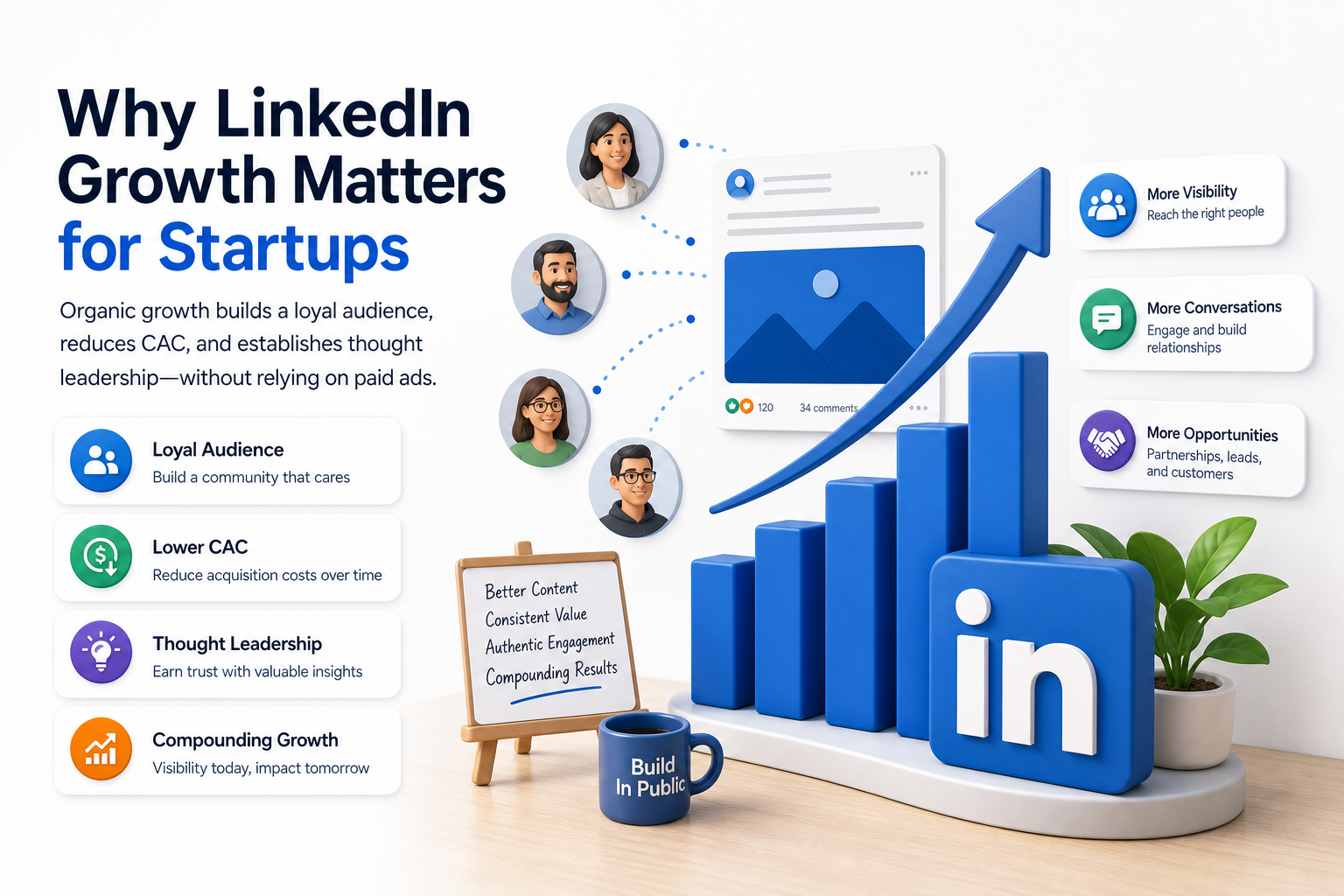
Why LinkedIn Growth Matters for Startups
At linqin.ai, we believe that a well crafted organic LinkedIn growth strategy is a foundational pillar for startups. In an era where every dollar counts, building a loyal audience on LinkedIn delivers compounding value over time. Our approach centers on earning attention through substance, not just through paid amplification. By focusing on authentic engagement and consistent value, we help startups turn visibility into conversations, partnerships, and customers without relying solely on paid ads.
Organic LinkedIn growth is more than vanity metrics. It creates a community around your product or solution, giving you a dependable pipeline of leads who actually care about your mission. When you nurture this audience with relevant insights, your brand becomes endemic to their day to day decision making. The payoff goes beyond a single post or campaign; it compounds as your audience grows and starts to advocate for you organically.
Our platform helps startups structure growth as a repeatable system. We encourage you to cultivate thought leadership, not just posts. When your content reflects a clear point of view and practical expertise, you attract decision makers who need the problem you solve. That alignment drives higher quality conversations, shorter sales cycles, and a lower cost of customer acquisition over time.
Key reasons organic LinkedIn growth matters for startups
A steady, consistent narrative builds trust over time. Followers engage more, share insights, and bring new people into the conversation.
With inbound conversations and referrals from an engaged audience, paid media becomes supplementary rather than central. The result is a more efficient path to customers.
- Loyal audience: A consistent, valuable narrative creates followers who trust you and engage regularly.
- Lower CAC: With inbound conversations and referrals from an engaged audience, paid media becomes supplementary rather than central.
- Thought leadership: A clear point of view and demonstrated expertise position you as a credible authority in your space.
- Scalability without escalating spend: Content and community building cost less per incremental audience member than many paid strategies.
To translate these benefits into concrete outcomes, we emphasize a holistic framework that integrates messaging, profile optimization, content engine, and authentic engagement. This enables startups to convert attention into conversations, partnerships, and revenue without sacrificing financial discipline.
If you want to see tangible progress, start with a compact, repeatable plan that prioritizes quality over quantity. We champion a disciplined approach: define your audience, articulate your point of view, publish consistently, and measure impact through meaningful engagement rather than sheer impressions. This is how LinkedIn Growth Tactics become a sustainable driver of startup velocity.
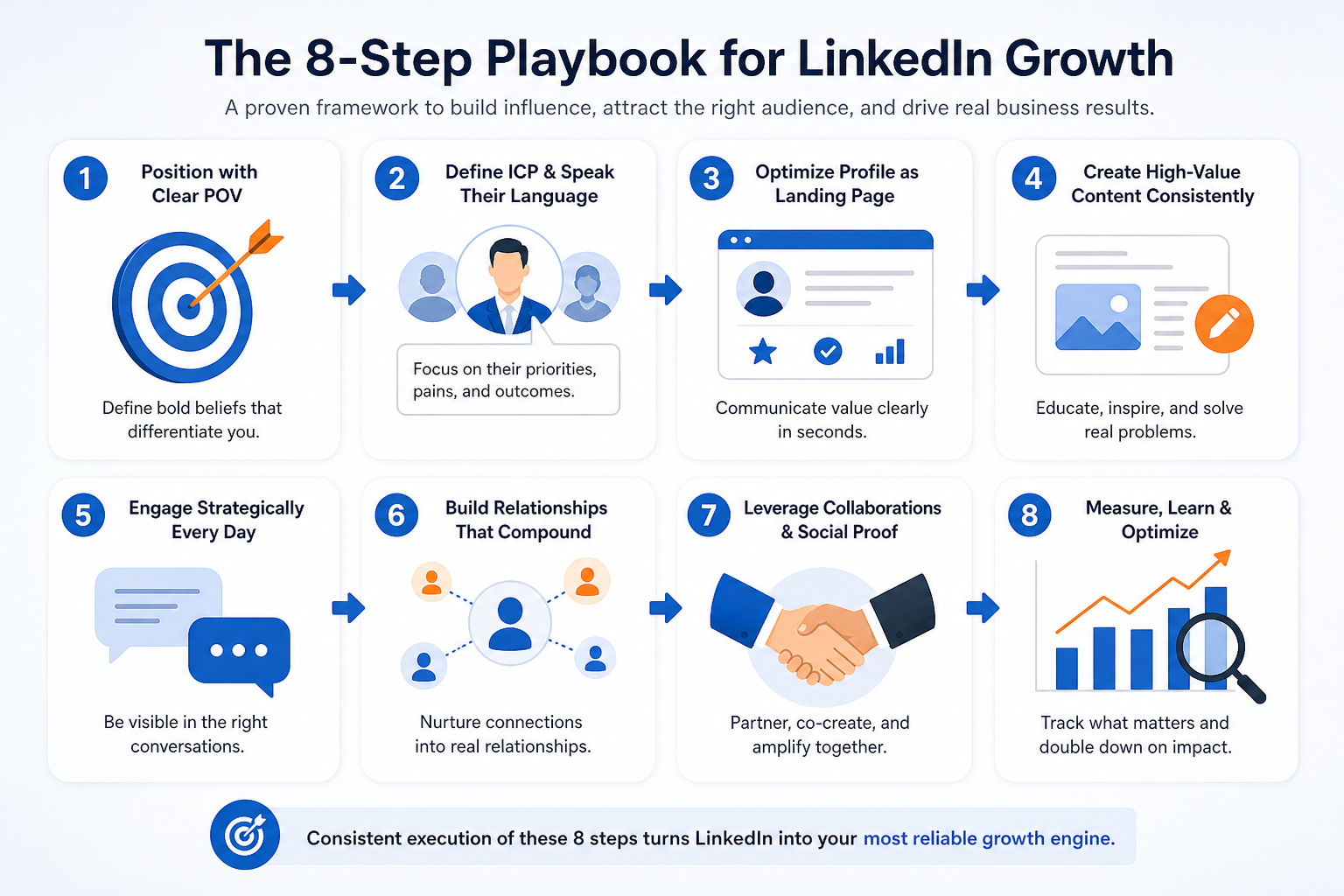
The 8-Step Playbook for LinkedIn Growth
-
Position with a clear point of view
Start by defining the beliefs and perspectives that differentiate you from the crowd. Your point of view acts as your moat on LinkedIn, shaping every post, comment, and message.
Ground your stance in real world industry observations and a few bold claims you can defend with evidence. This creates a recognizable voice that attracts the right audience rather than chasing blanket reach.
- Identify three non negotiable beliefs that go against the status quo.
- Document a concise rationale for each belief with concrete examples you can point to in posts.
- Publish a short inaugural post outlining your stance and inviting discussion.
-
Define ICP and speak their language
Know who you are talking to and tailor language to their priorities. Focus on decision makers who feel the problem you solve in a way they recognize.
Eliminate jargon that only insiders understand and replace it with outcomes, metrics, and practical steps your audience can picture implementing.
- Create a simple ICP brief with job titles, priorities, and pains.
- Draft posts that address specific pain points and promise a tangible outcome.
- Track resonance by direct feedback and comments from the target group rather than generic engagement.
-
Optimize your profile as a high converting landing page
Your profile should instantly answer who you help, what problem you solve, and what to do next. Treat the headline, About section, and featured content as a conversion funnel.
High quality imagery and a clear CTA lift conversions even before your first direct message.
- Headline: clearly state who you help and the result you deliver.
- About: present proof points, outcomes, and a concrete next step.
- Featured: showcase case studies, guides, or templates that build credibility.
-
Build a scalable content engine
Rather than posting ad hoc, implement a repeatable process that turns existing knowledge into a stream of posts in multiple formats.
Record conversations, extract takeaways, and repurpose them into text posts, carousels, short videos, and infographics.
- Keep a running ideas list and batch-produce content weekly.
- Design a content mix that rotates formats to keep the feed dynamic.
- Use one original idea as three posts: thought leadership, practical steps, and a visual version.
-
Master the hook and the first lines
The opening line should speak to a pain point, promise a takeaway, and spark curiosity.
A strong hook sets the tone and determines whether readers will invest time in your post. Experiment with hooks that ask a question, reveal a surprising stat, or present a bold stance connected to your POV.
- Test several opening lines per post to learn what resonates with your ICP.
- End with a prompt that invites commentary or a clear next action.
- Pair hooks with a strong opening image or video to boost early engagement.
-
Leverage network effects through advocacy
Employee advocacy and partner amplification extend reach beyond your own page.
Equip teammates with simple, repeatable ways to share valuable content and engage with comments. Collaboration with customers, partners, and industry peers can unlock new audiences and add credibility to your brand narrative.
- Launch a lightweight advocacy program with clear guidelines and easy participation steps.
- Encourage employees to share their own perspectives related to your POV.
- Coordinate joint content or LinkedIn Live events with relevant partners.
-
Engage with content that expands your ecosystem
Comment thoughtfully on posts from potential clients, collaborators, and influencers in your niche.
Sharing valuable insights in replies positions you as a helpful voice and draws attention back to your own profile and content. Diversify interactions beyond liking by asking questions and offering concrete suggestions.
- Set aside time daily for meaningful comments on a curated list of target posts.
- Use replies to drive conversations toward your content or a direct message conversation.
- Share external content with added synthesis that ties back to your POV.
-
Collaborate externally to cross pollinate audiences
Partnerships extend reach and lend third party validation.
Co create articles, host LinkedIn Live sessions, or publish guest insights on each other’s pages. The goal is to introduce your ideas to complementary audiences while maintaining a consistent narrative and value exchange.
- Identify 2 to 3 potential partners with overlapping ICPs.
- Agree on a content format that benefits both audiences (live, article, or carousel series).
- Promote the collaboration across both pages and monitor cross engagement.
-
Measure, learn, and adapt with a data driven mindset
Regularly review what is working and what is not. Focus on meaningful engagement and quality conversations rather than raw impressions.
Use a compact dashboard to monitor KPIs and iterate quickly. The best growth comes from disciplined optimization and strategic pivots based on insights.
- Define a small set of KPIs (for example, qualified conversations, ICP aligned engagement, and content saves or shares).
- Analyze post archetypes that generate the strongest conversations with your ICP.
- Refine your POV, messaging, and content mix every quarter based on data.
Framework recap
| Step | Focus | Key Deliverables |
|---|---|---|
| 1 | Positioning | Point of view articulation, three core beliefs |
| 2 | Audience | ICP brief, tailored messaging framework |
| 3 | Profile | Landing page style optimization, CTA |
| 4 | Content engine | Batch production plan, formats mix |
| 5 | Hooks | Compelling opening lines, prompts |
| 6 | Advocacy | Employee and partner amplification plan |
| 7 | External collaboration | Joint content and events calendar |
| 8 | Measurement | KPI dashboard, quarterly optimization |
By following this eight step playbook, startups can move from positioning to measurement in a cohesive, real world manner. The emphasis is on durable narratives, precise targeting, repeatable content processes, and disciplined learning. When these elements align, LinkedIn becomes a reliable growth engine rather than a perpetual experiment.
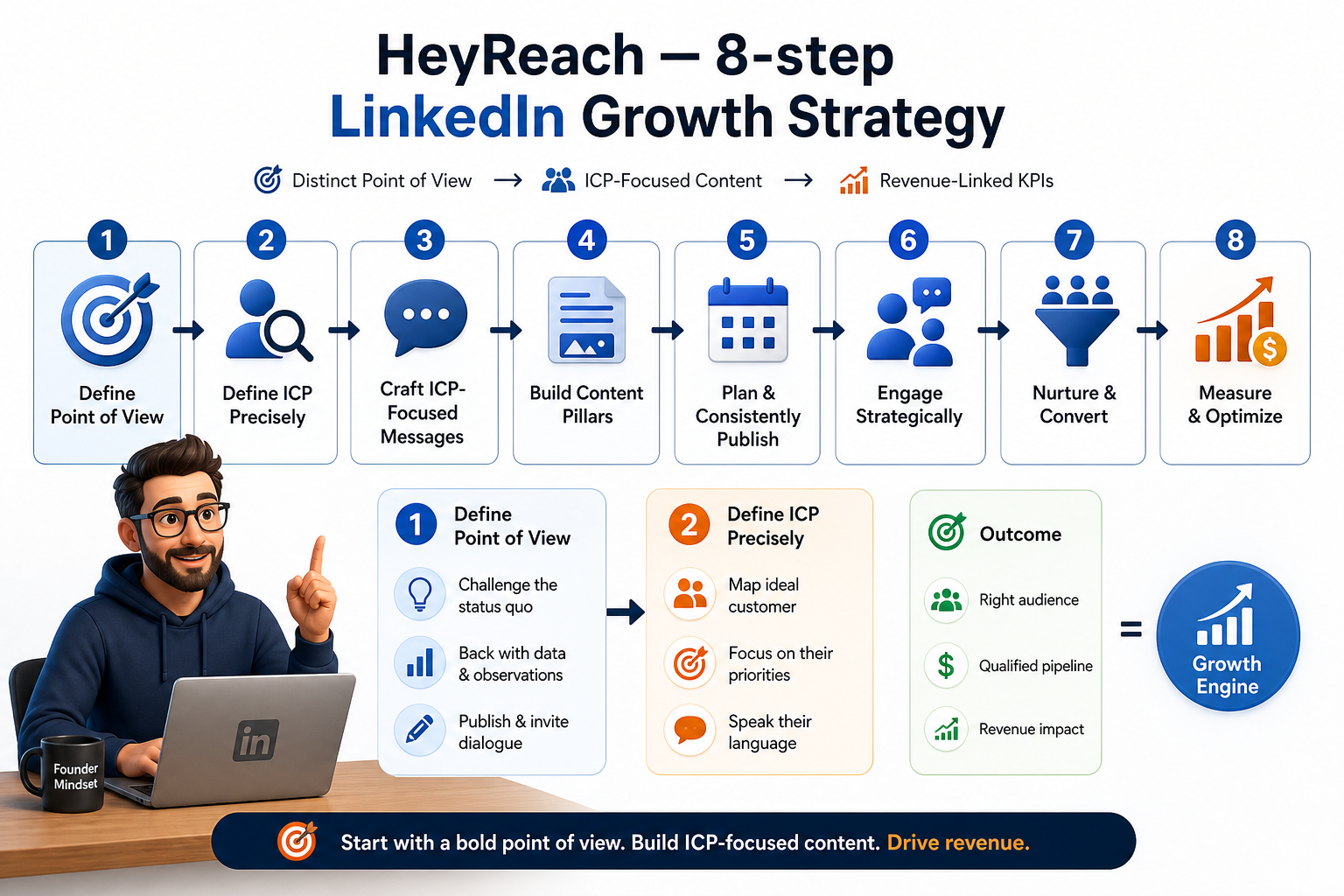
HeyReach — 8-step LinkedIn growth strategy
HeyReach founder perspective centers on a simple truth: growth on LinkedIn begins with a distinct point of view and evolves through ICP focused content that ties directly to revenue related KPIs. This eight step framework is designed to transform a startup’s LinkedIn presence into a measurable engine. At its core is the discipline of starting with a clear point of view and then building a dependable content strategy around authentic, ICP aligned content that moves leads toward revenue outcomes.
-
Define a distinctive point of view
The starting point is a founder level stance that differentiates you from the broader crowd. This is not just about what you do, but how you interpret the market and the problems your ICP actually faces. A strong point of view acts as a moat, guiding topics, tone, and the kinds of conversations you want to own on LinkedIn.
- Identify three core beliefs that challenge the status quo in your space.
- Ground each belief with concrete industry observations and data points.
- Publish an inaugural post that publicly states your stance and invites dialogue.
-
Define ICP with precision and speak their language
Move beyond broad audiences and map a precise ICP. Speak in terms of their priorities, outcomes, and the metrics they care about.
Replace insider jargon with tangible results and practical steps that your ICP can visualize implementing.
- Create a concise ICP brief including job titles, priorities, and pain points.
- Draft posts that address specific ICP pain points and promise measurable outcomes.
- Measure resonance through direct feedback, comments, and conversations from the ICP rather than generic engagement.
-
Treat the profile as a revenue oriented landing page
Your profile should clearly answer who you help, which problem you solve, and what the next step is. Treat the headline, About section, and Featured content as a conversion funnel that nudges visitors toward conversations and demos.
- Headline communicates ICP and result in two lines or less.
- About section includes proof points, outcomes, and a concrete call to action.
- Featured content highlights case studies and templates that demonstrate value.
-
Build a scalable content engine around ICP outcomes
Replace ad hoc posting with a repeatable process that converts existing knowledge into a steady flow of posts in multiple formats. Capture insights from calls, emails, and chats, then repurpose them into text posts, carousels, short videos, and infographics tailored to the ICP.
- Maintain a running ideas list and batch produce content weekly.
- Design a formats mix to keep the feed engaging and aligned with ICP preferences.
- From one idea create three post archetypes: a thought leadership piece, a practical how to, and a visual summary.
-
Master the hook and opening lines for ICP impact
The entry line must address a real ICP pain, promise a tangible takeaway, and spark curiosity. A strong hook sets the stage for meaningful engagement and signals that your content is relevant to their role.
- Craft multiple opening lines per post and test which resonates with the ICP.
- Close with a prompt that invites comments or a clear next action such as a DM or a download.
- Pair hooks with a strong opening visual to maximize early engagement.
-
Leverage advocacy to amplify reach and credibility
Employee advocates and partner amplification extend reach beyond your own network. Provide teammates with simple, repeatable ways to share valuable content, engage with comments, and provide authentic perspectives aligned with your point of view.
- Launch a lightweight advocacy program with clear guidelines that are easy to participate in.
- Encourage employees to share personal perspectives related to your ICP and POV.
- Coordinate joint content or live events with customers and partners to broaden exposure.
-
Collaborate externally to cross pollinate audiences
Strategic collaborations extend reach and add third party validation. Co create articles, host LinkedIn Live sessions, or publish guest insights that introduce your ideas to adjacent audiences while preserving a coherent narrative.
- Identify 2 to 3 partners whose ICPs overlap with yours.
- Agree on formats such as live sessions, joint articles, or sequential carousels.
- Promote collaborations across both pages and monitor cross engagement to optimize future runs.
-
Align content with revenue linked KPIs
The framework keeps revenue in view by tying content outcomes to concrete KPIs. Focus on qualified conversations, pipeline influenced by LinkedIn activity, and content driven demonstrations or trials.
- Define a compact KPI set such as qualified conversations, ICP aligned engagements, and later stage demos.
- Track which post archetypes most reliably generate pipeline or opportunities.
- Quarterly, reassess messaging and formats to improve the revenue signal from content.
Framework recap: Start with a distinctive point of view, sharpen ICP oriented messaging, treat the profile as a conversion surface, build a scalable content engine, craft compelling hooks, amplify through advocacy, seek external collaborations, and measure against revenue linked KPIs. When these elements align, LinkedIn becomes a predictable growth channel rather than a random exposure event.
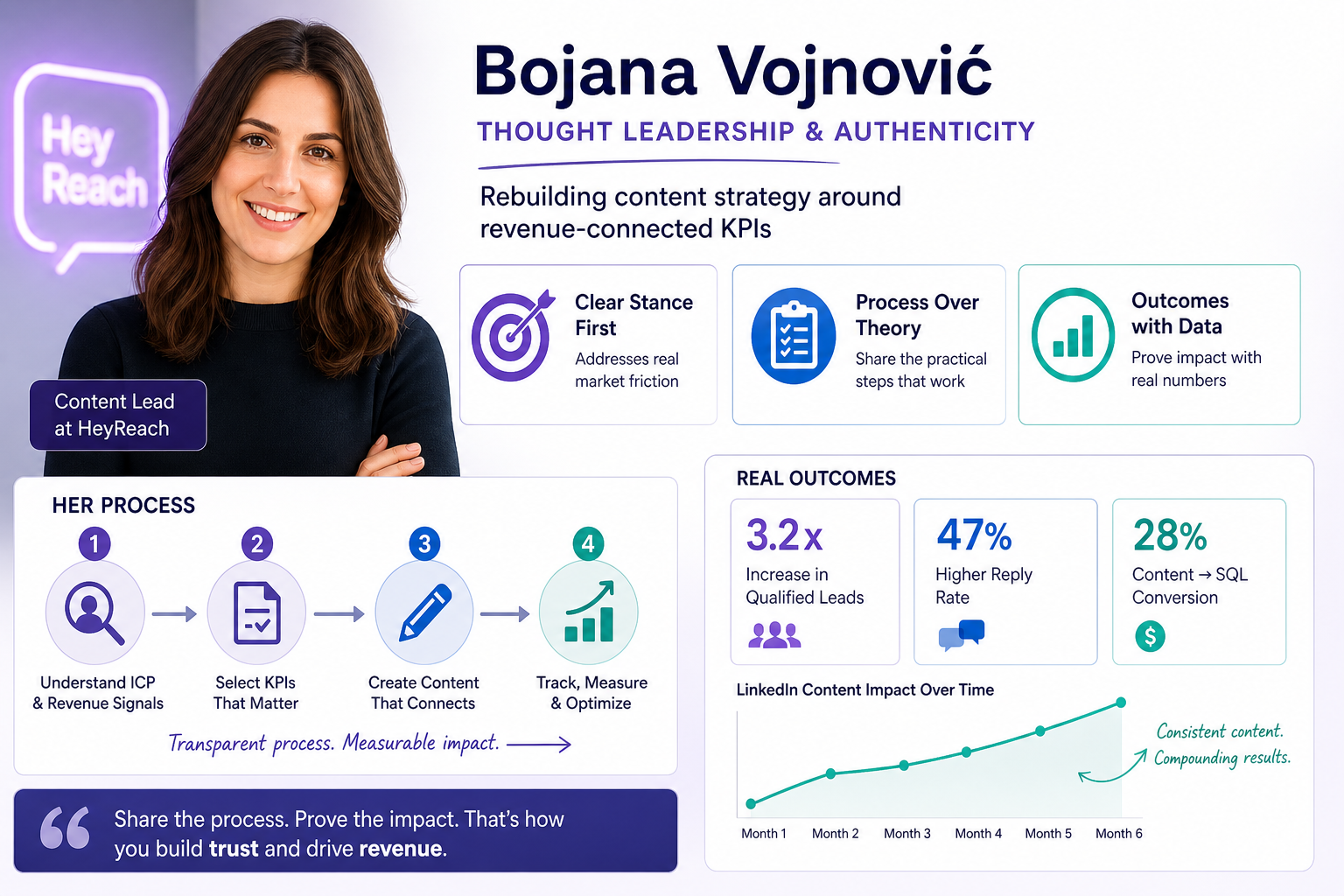
Bojana Vojnović — Thought leadership and authenticity
Bojana Vojnović, a Content Lead at HeyReach, exemplifies how to rebuild a content strategy around revenue-connected KPIs while preserving authenticity and a clear stance. Her approach started with a decisive shift away from safe, generic SEO plays and towards content that directly ties to ICP driven outcomes. By removing the safety net of a brand guide and leaning into real, observable results, she created a feed that stands out in a crowded LinkedIn landscape.
The core of Bojana’s move was to articulate a distinctive point of view and then demonstrate the practical steps that deliver measurable impact. She shared the exact process she used to align content with revenue signals, offering peers a transparent blueprint rather than abstract tips. This transparency not only clarified her position but also built credibility with decision makers who care about tangible business results.
- Clear stance first: Bojana established a concrete point of view that addresses real market friction, making her posts memorable rather than background noise.
- Process over theory: She disclosed the practical steps she followed to convert insights into revenue-connected content, including how she evaluated KPI relevance and tracked outcomes.
- Outcomes demonstrated with data: Each content initiative was anchored by concrete numbers and real world examples that demonstrate impact rather than promises.
In practice, this manifested as targeted content crafted for an ICP with explicit outcomes tied to revenue goals. Rather than broad marketing chatter, the posts showcased authentic workflows, decision making, and the concrete results that followed. The emphasis on real examples empowered her audience to envision applying the same approach to their own teams, accelerating trust and relevance in a crowded feed.
The result is content that communicates a powerful narrative: you can lead with conviction, share your actual method, and still deliver concrete business value. By foregrounding revenue-oriented KPIs and a transparent process, Bojana created a durable differentiator that resonates with founders and marketers who want to see measurable progress from thought leadership.
- Define revenue-connected KPI milestones and align every post to a specific metric such as qualified conversations, pipeline influence, or trial starts.
- Publish the method, not only the result by detailing the steps, data sources, and decision criteria used to move KPIs forward.
- Show real outcomes with before and after examples, including numbers or context that demonstrate impact on revenue.
Try this exercise to apply Bojana’s thinking in your own work: draft a short post that identifies one revenue-connected KPI, describe the concrete process you follow to influence it, and attach a tangible outcome you achieved. End with a question that invites peers to critique or share their own approach. In a feed saturated with generic advice, this level of specificity and candor acts as a powerful moat for your personal brand.
Nadja Komnenic — Profile optimization as a conversion engine
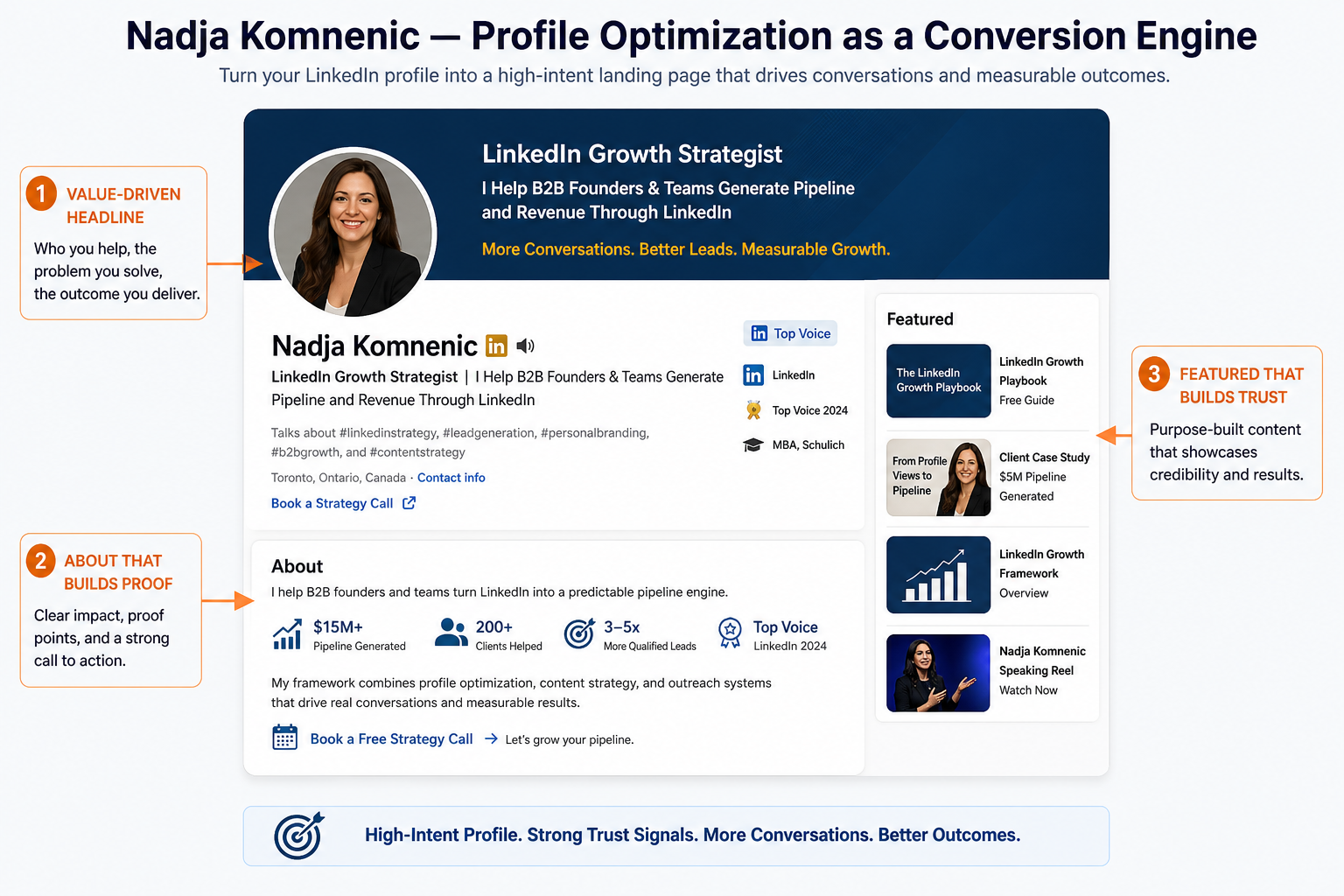
Nadja Komnenic demonstrates a disciplined approach to turning a LinkedIn profile into a conversion engine. Her method centers on three core elements: a value-driven headline, an About section that pairs proof with a clear call to action, and a purpose-built Featured area that showcases credibility without relying on hype. By treating the profile as a high intent landing page, she turns passive profile visitors into engaged conversations and measurable outcomes.
Nadja’s framework emphasizes clarity and credibility. She builds a narrative that speaks directly to the reader’s problem, the outcome they can expect, and the concrete steps they can take to engage.
Headline that communicates value
The headline is not merely a job title; it is a promise about the result a reader can expect. Nadja crafts headlines that quickly answer three questions: who she helps, what problem she solves, and what outcome she delivers. This precision reduces ambiguity and increases relevance for decision makers scanning the top of the profile.
- Specify the ICP and the measurable outcome in two lines or less.
- Use action oriented language that hints at tangible results rather than generic capabilities.
- Avoid clutter by removing excess adjectives and focusing on concrete value.
About section that builds proof and invites action
Nadja structures the About section like a compact narrative with evidence. It opens with a crisp statement of who she helps and the real world impact, followed by concise proof points such as revenue growth figures, client outcomes, and relevant credentials. A strong call to action sits at the end, guiding readers toward a next step that aligns with their needs.
- Lead with the reader’s problem and the outcome they can expect.
- Incorporate quantifiable results and concrete examples to establish credibility.
- Close with a clear next step such as a conversation request, a demo, or access to a resource.
Featured area engineered for trust and conversion
The Featured section is deliberately curated to reinforce the profile’s value proposition. Nadja highlights targeted case studies, client success snapshots, and practical templates that prospective collaborators can review without leaving LinkedIn. Each item is chosen to establish trust, demonstrate real world impact, and provide a tangible pathway for engagement.
| Section | Purpose | Best Practices |
|---|---|---|
| Headline | Communicate value to the specific audience | Two lines or fewer; ICP and outcome; action oriented |
| About | Provide proof and a clear CTA | Lead with problem and outcome; include metrics and a concrete next step |
| Featured | Build credibility and facilitate engagement | Showcase case studies, templates, and outcomes; link to next steps |
By aligning the headline, About section, and Featured content around a cohesive value narrative, Nadja turns a LinkedIn profile into a conversion engine. This approach reduces friction for visitors who are evaluating whether to initiate a conversation and increases the likelihood that those conversations lead to meaningful outcomes.
Try this quick exercise to emulate Nadja’s approach:
- Draft a value driven headline that states who you help and the result in two lines or less.
- Rewrite your About section to open with a concise problem statement, followed by three proof points and a precise CTA.
- Curate 2 to 3 Featured items that demonstrate revenue impact or practical value, with a short description and a clear next step for viewers.
When these elements are harmonized, your LinkedIn profile does more than attract attention; it guides visitors toward conversations, demos, or collaborations that move your business forward.
Diandra Escobar — Audience-focused messaging for decision makers
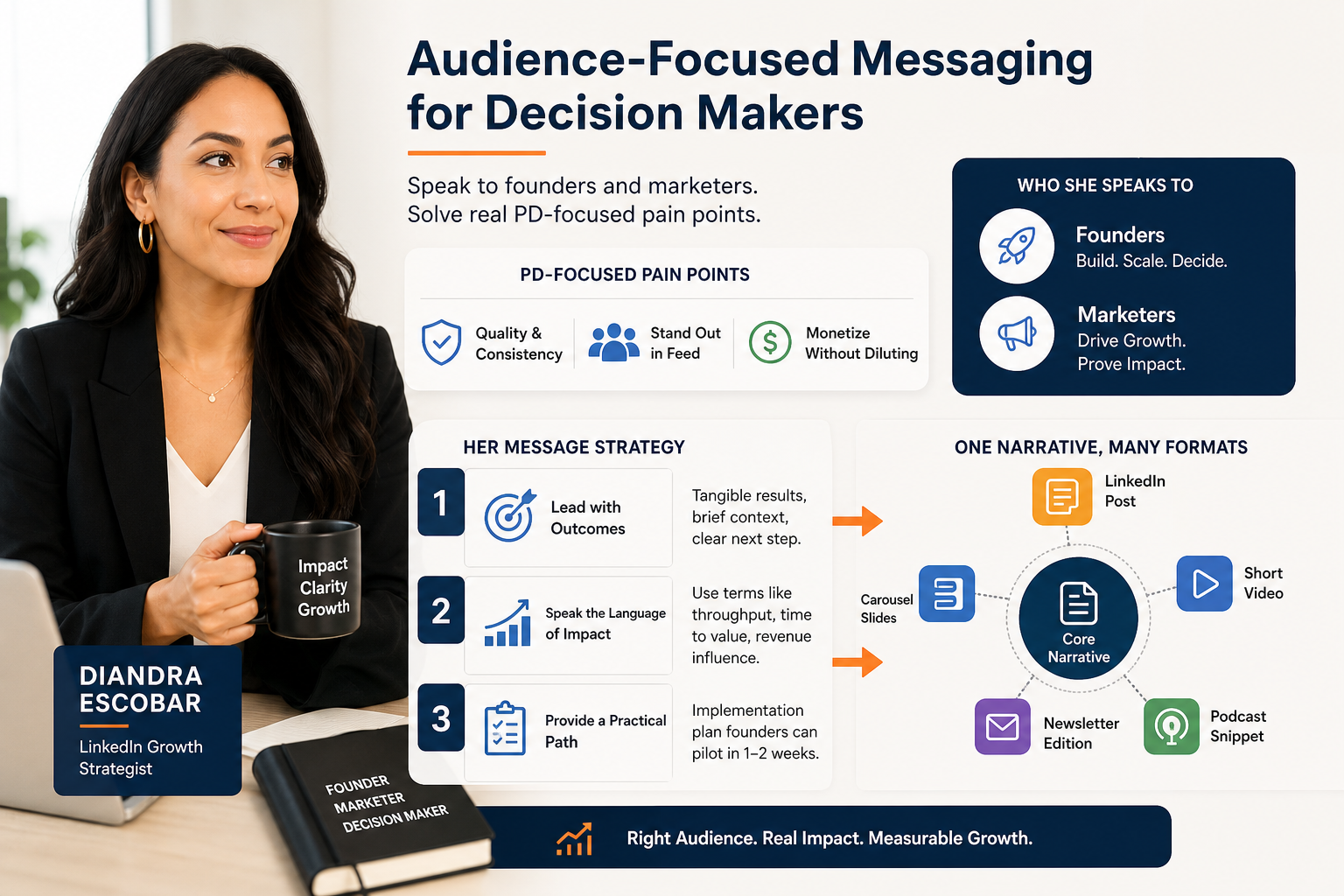
Diandra Escobar demonstrates how to speak directly to the people who actually make decisions in startups. Her approach centers on addressing the exact PD focused pain points that founders and marketing leaders contend with every day: quality and consistency in output, standing out in a crowded feed, and monetizing content without diluting the brand voice. By avoiding generic industry jargon and instead speaking in practical, outcome oriented language, she positions herself as a trusted authority whose insights feel actionable from day one.
The core of Diandra’s strategy lies in reframing content around the decision maker’s priorities. Instead of sharing broad tips that could apply to anyone, she zeroes in on concrete metrics and real world implications. This creates posts that founders and marketers can picture implementing, which in turn accelerates engagement from the right audience and reduces the noise from hobbyists or non buyers.
- Lead with outcomes, not philosophies: Each post presents a tangible result a founder or marketer can expect, backed by brief context and a next step.
- Speak the language of impact: Use terms like throughput, time to value, and revenue influence rather than vague buzzwords.
- Provide a practical path: Pair insights with a clear implementation plan that a founder can pilot in a week or two.
To illustrate her method, Diandra often shows how a single narrative can be repurposed into multiple formats that matter to decision makers. For example, she might share a concise post that highlights a problem founders face with content quality, followed by a step by step post detailing how to establish a feedback loop with sales or product teams, and then a visual summary that maps out the metrics to track. This triad demonstrates competency, feasibility, and impact without drifting into generic industry talk.
In practice, this approach builds authority by proving she understands the buyer’s journey. Decision makers feel seen when you acknowledge their constraints and offer concrete ways to move from awareness to a qualified conversation. The result is stronger alignment with ICPs, more meaningful comments from the people who matter, and a higher likelihood that engagement translates into conversations and opportunities.
- Define the decision maker’s top three priorities and align every post to how your guidance helps achieve them.
- Articulate a single practical change per post that a founder or marketer can implement without specialized tools.
- Avoid jargon and hype by replacing terms like big ideas with concrete steps, clear metrics, and expected outcomes.
Try this exercise to apply Diandra’s thinking: review your last five posts and rewrite the first sentences so they address a founder or marketer directly, focusing on a measurable outcome and a simple next action. Then create one follow up post that outlines a three step plan to reach that outcome, and a third post that visualizes the impact with a quick data snapshot. By consistently speaking to decision makers in this way, you build credibility as a practitioner who can move initiatives from concept to revenue impact.
RightSideUp — Organic growth strategy and content repurposing
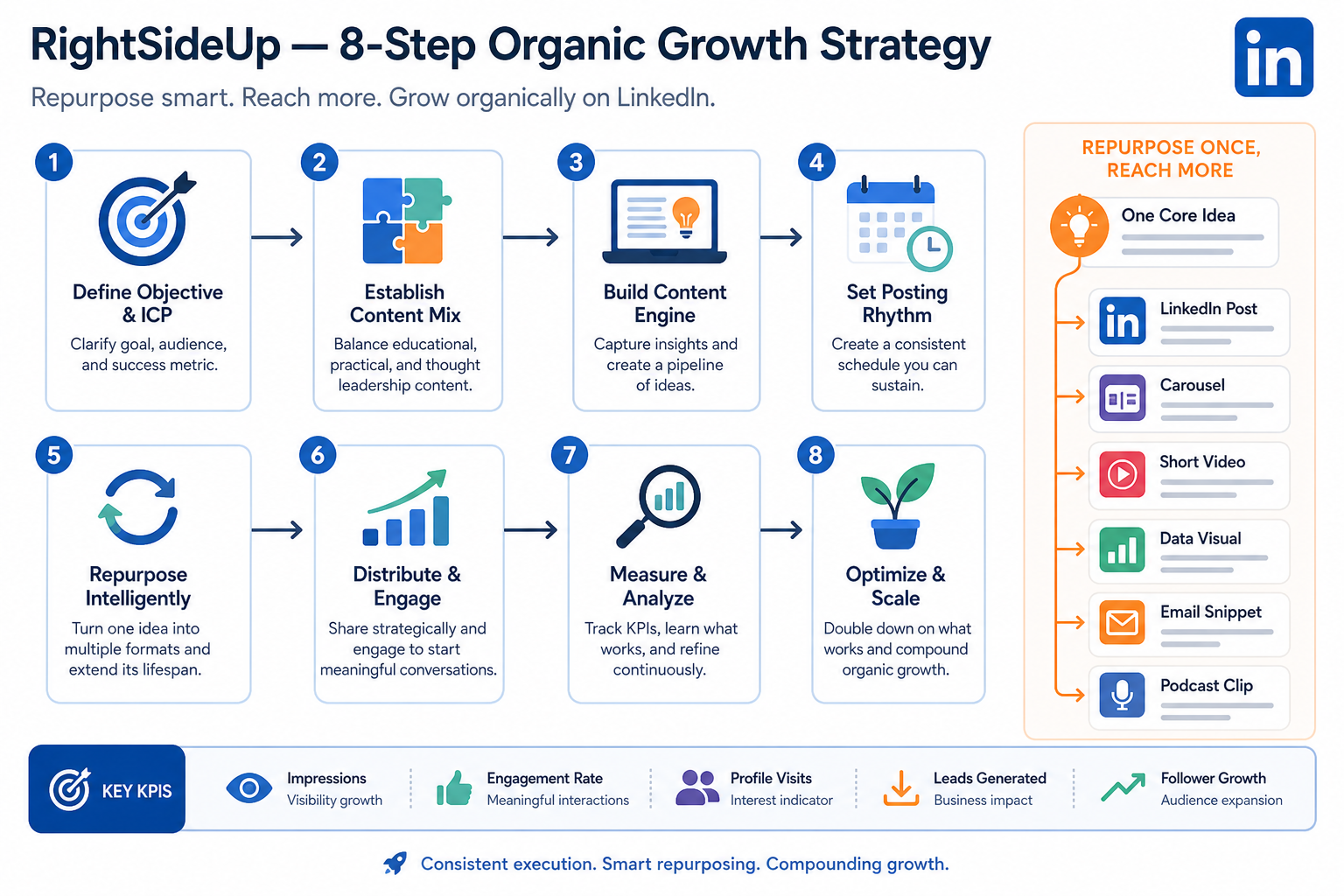
RightSideUp presents a practical eight step framework for building an organic growth strategy on LinkedIn that emphasizes consistency, a diversified content mix, and smart repurposing to maximize reach without relying on paid media. The approach starts with a clear purpose and audience focus, then expands into a repeatable content engine, disciplined posting rhythms, and intelligent use of repurposed assets to sustain engagement over time.
RightSideUp presents a practical eight step framework for building an organic growth strategy on LinkedIn that emphasizes consistency, a diversified content mix, and smart repurposing to maximize reach without relying on paid media. The approach starts with a clear purpose and audience focus, then expands into a repeatable content engine, disciplined posting rhythms, and intelligent use of repurposed assets to sustain engagement over time.
-
Identify the objective and ICP
Define the primary business objective for LinkedIn activity and map a precise target audience. This step anchors all content decisions and helps measure impact beyond vanity metrics.
- Specify the ICP and the key outcome you want to influence.
- Pair the objective with a concrete, observable metric to track progress.
-
Establish a balanced content mix
Blend educational, practical, and thought leadership content to address different stages of the buyer journey while keeping the feed varied and engaging.
- Mix formats such as short text posts, how-to carousels, brief videos, and data visuals.
- Rotate themes to avoid format fatigue and maintain audience interest.
-
Set a repeatable content engine
Turn existing knowledge into a steady pipeline of assets. Capture insights from calls, emails, and meetings, then systematically convert them into multiple formats.
- Maintain an ideas repository and batch create content on a regular cadence.
- From a single insight, produce at least three post variations: a narrative post, a practical step by step piece, and a visual summary.
-
Plan a sustainable posting rhythm
Consistency matters more than frequency. Choose a manageable cadence that your team can sustain and align it with audience activity patterns for optimal reach.
- Define a minimum weekly posting target and preferred days/times based on audience behavior.
- Monitor performance and adjust cadence to maintain momentum without burnout.
-
Prioritize engagement over pure impressions
Focus on conversations, comments, and shares as signals of value, rather than counting views alone. Meaningful engagement drives algorithmic distribution and longer term credibility.
- Encourage discussion with thoughtful prompts and open questions.
- Respond promptly to comments to accelerate conversations and visibility.
-
Leverage employee and partner advocates
Extend reach by enabling colleagues and strategic partners to share and engage with content in authentic ways, multiplying organic reach without paid spend.
- Provide simple guidelines for sharing and commenting to maintain consistency with the POV.
- Coordinate co created content or joint posts with complementary audiences.
-
Repurpose for cross format amplification
Maximize the value of every idea by transforming a single insight into multiple formats that fit different consumption habits.
- Convert a short narrative into a carousel, a how to guide, and a micro video.
- Extract data points into a shareable infographic or quote graphic.
-
Analyze data and iterate with a lean KPI framework
Use a compact dashboard to track essential metrics and quickly pivot based on what moves the needle the most.
- Track KPIs such as qualified conversations, ICP aligned engagements, saves and shares, and pipeline influenced.
- Regularly review which post archetypes generate the strongest conversations and refine the content mix each quarter.
Framework recap: Start with a clear objective and ICP, build a balanced content mix, establish a scalable content engine, maintain a sustainable posting rhythm, emphasize engagement, mobilize advocates, repurpose content across formats, and measure with a concise KPI set to guide continuous improvement. When applied consistently, this eight step framework turns organic LinkedIn activity into a reliable growth lever with reduced dependency on paid media.
| Area | What to Do | Suggested KPIs |
|---|---|---|
| Objective and ICP | Define primary goal and target audience with a clear value proposition | ICP clarity, targeted engagement rate |
| Content mix | Balance educational, practical, and thought leadership content | Format diversity, average engagement per post |
| Content engine | Capture insights and batch produce multi format posts | Posts per week, repurpose rate |
| Posting cadence | Choose a sustainable rhythm aligned with team capacity | Consistency score, missed week rate |
| Engagement focus | Drive conversations through prompts and timely responses | Conversation count, response time |
| Advocacy | Leverage employees and partners to amplify content | Advocate participation rate, earned media value |
| Repurposing | Transform insights into three format variations | Repurposed assets per initial idea, total reach |
| Measurement | Lean KPI dashboard and quarterly optimization | Pipeline influenced, qualified conversations, content saves/shares |
By following this RightSideUp inspired framework, startups can sustain engagement, extend reach through authentic advocacy, and reduce reliance on paid channels while steadily moving leads through the funnel.
Buffer — Scheduling and timing for optimal reach
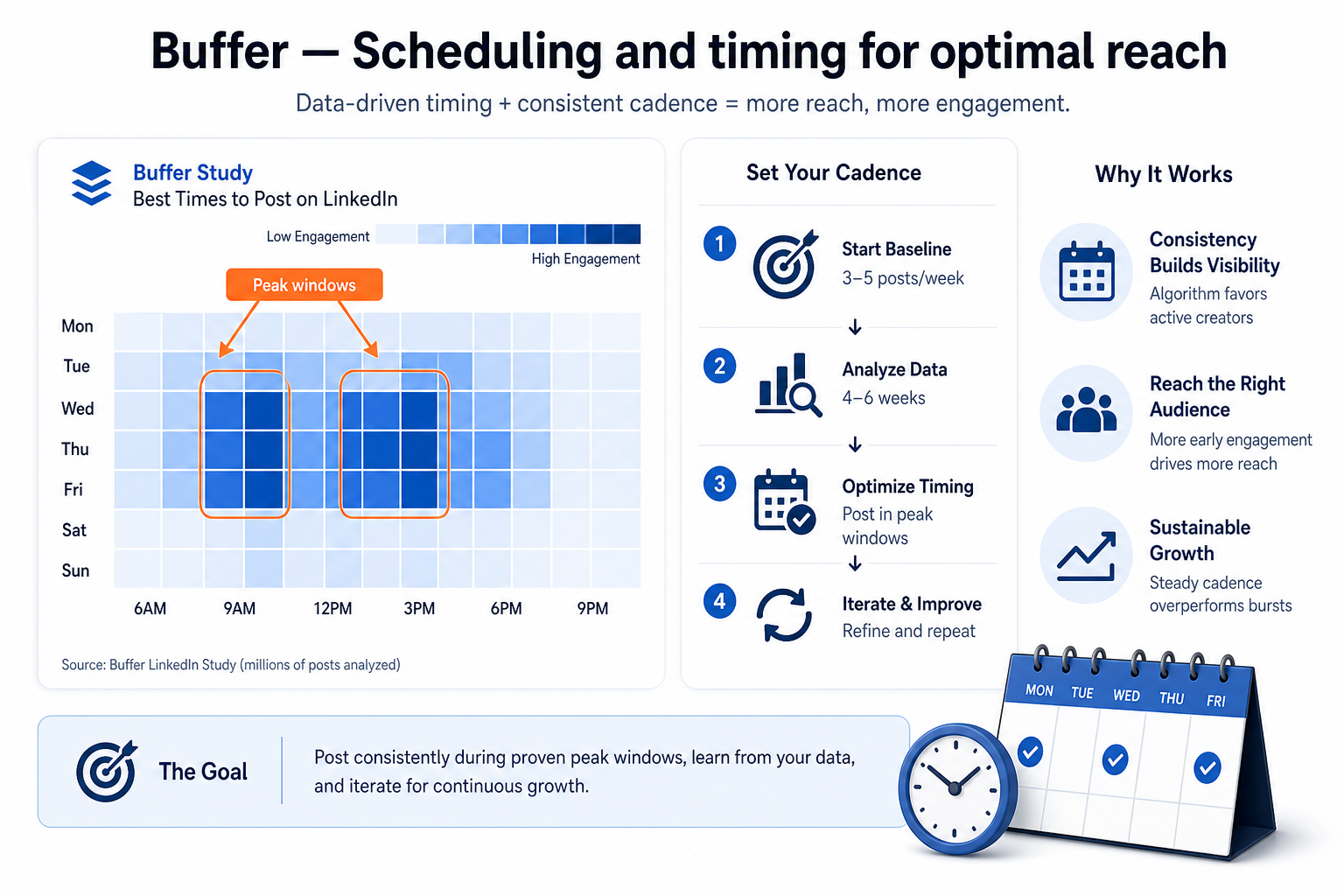
Scheduling and timing are not afterthoughts on LinkedIn growth. They are levers that help your content reach the right people when they are most receptive. Buffer’s study, built on millions of LinkedIn posts, provides empirical insight into when audiences are most likely to engage. The takeaway is simple: there are predictable windows where your posts perform better, but consistency and cadence matter just as much as the exact minute.
Key takeaways from Buffer’s findings include:
- Consistency beats bursts: Regular posting signals to the algorithm that you are an active, dependable source. A steady cadence helps maintain visibility, even if a single post performs modestly on any given day.
- Strategic windows drive initial reach: Publishing during established engagement peaks increases the probability that your post will be seen by your target ICP, generating more early interactions that can compound reach.
- Cadence should fit capacity: It is better to publish reliably 3 to 5 times per week than to overextend and burn out. A sustainable rhythm supports quality and consistency over time.
How to set your initial cadence using data:
- Establish a baseline cadence: Start with a modest, sustainable target such as 3 posts per week, spaced evenly across non consecutive days to avoid clustering.
- Leverage data to refine timing: Use performance data from your first 4 to 6 weeks to identify which days and times deliver the strongest impressions, clicks, and meaningful comments from your ICP.
- Balance breadth and depth: Mix lighter, quick hooks with deeper, value driven posts to maintain momentum across the week and maximize opportunities for conversation.
Practical guidelines to implement right away:
- Experiment cadence in blocks: Try a three week test where you post on different days and at different times to map your own peak windows.
- Document the findings: Maintain a simple scorecard tracking impressions, engagements, and meaningful conversations over each time slot.
- Iterate quarterly: Revisit your timing strategy every quarter in light of evolving audience behavior or product/market changes.
In practice, you might begin with a predictable pattern such as posting on Monday, Wednesday, and Friday mornings. If the data shows higher engagement on Wednesdays around mid morning for your ICP, you would adjust to favor that window and maintain a consistent cadence thereafter. Remember, the objective is to establish a reliable rhythm that your audience comes to expect, while continuously refining the exact posting times based on concrete outcomes rather than guesswork.
To operationalize this, pair timing with a content calendar and a simple analytics routine:
| Step | Action | What to measure |
|---|---|---|
| 1 | Set initial cadence | Post frequency per week, distribution across days |
| 2 | Publish at varied times within windows | Impressions, early engagements, comments in first 2 hours |
| 3 | Analyze weekly results | Engagement rate, meaningful conversations, new followers from ICP |
| 4 | Iterate plan monthly | Adjusted times, adjusted cadence, overall trajectory |
By anchoring your posting schedule in data and maintaining a sustainable cadence, you create a reliable growth engine. The combination of Buffer inspired timing insights with a disciplined posting rhythm provides a practical pathway to higher reach and more meaningful conversations with your target audience.
Sprout Social — Employee advocacy and earned media value
Mark Schaefer — Conversations as the growth engine on LinkedIn
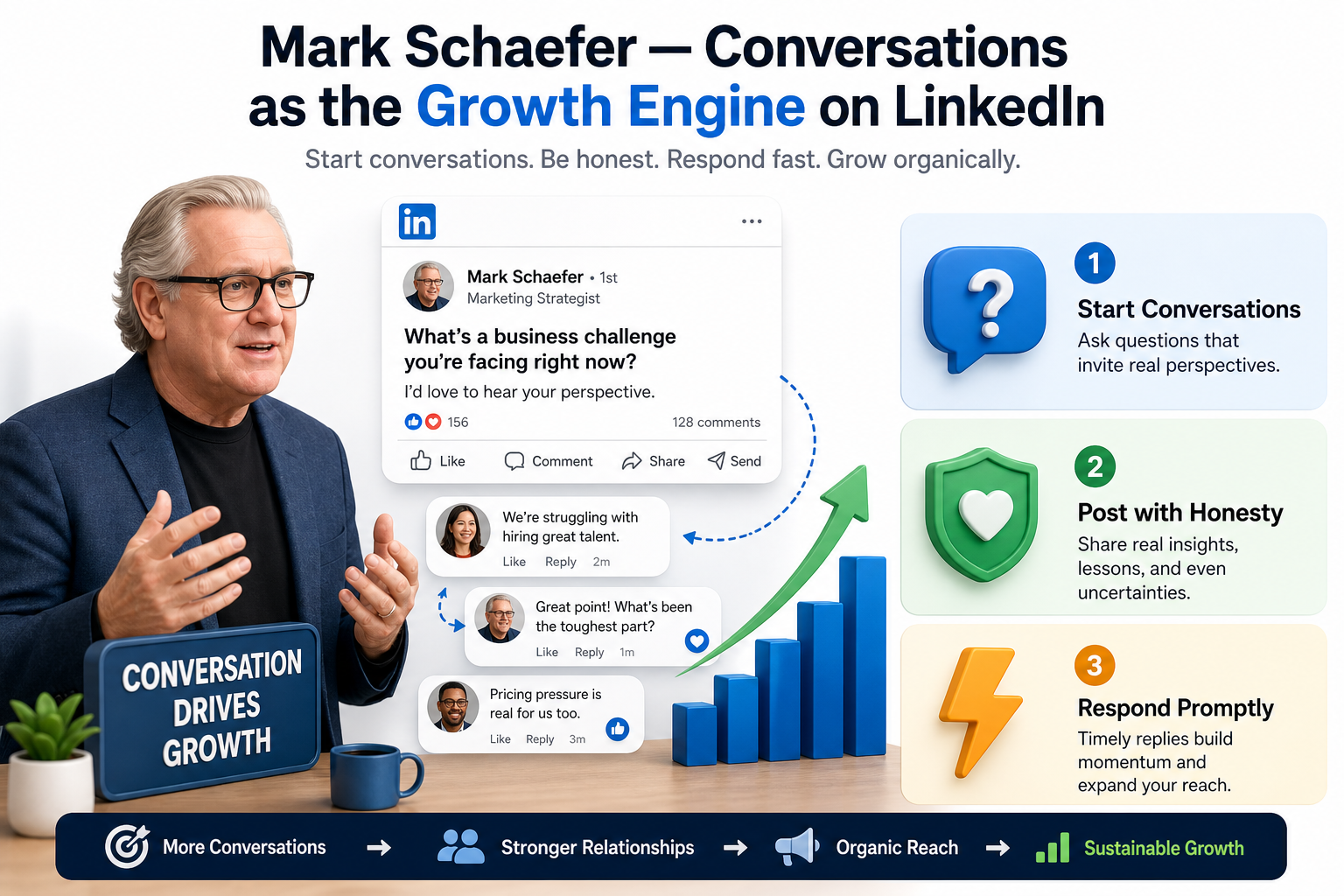
Mark Schaefer emphasizes that the true engine of LinkedIn growth is conversation. Instead of chasing vanity metrics or relying on flashy formats, he argues that initiating meaningful dialogues, sharing honest reflections, and replying promptly to comments create a sustainable loop of engagement that expands reach organically.
Core to his approach are three practical principles that Startup teams can apply right away:
- Start conversations, not broadcasts: Begin posts with open questions, provocative but respectful ideas, or real world stories that invite others to contribute their perspectives. The aim is to spark discussion that others want to weigh in on, not just deliver a monologue.
- Post with honesty: Share authentic observations, including uncertainties or lessons learned. Audiences respond to transparency because it builds trust and invites relatable dialogue rather than polished but distant statements.
- Respond promptly to comments: Timely replies accelerate momentum. When you engage quickly, you signal that your content matters and you value the conversation, which can lead to additional visibility through the platform’s distribution system.
Practical execution tips drawn from this perspective include:
- Kick off with a question that matters: Frame your post around a single, concrete decision makers care about, and invite a debate or a share of experiences.
- Share a candid takeaway: Describe a recent challenge, what you learned, and how it changed your approach, avoiding overly safe or generic statements.
- Allocate time for engagement: Reserve a daily window to read and respond to comments, even if it’s just 15 minutes, to maintain momentum.
The potential impact of this approach extends beyond a single post. By consistently inviting conversations and modeling genuine engagement, you attract the decision makers you want to reach, improve the quality of interactions, and gradually widen your organic reach as people participate and share the dialogue with their networks.
Try this practical exercise to apply Mark Schaefer’s principles:
- Post a thought provoking question that relates to your ICP’s top priority this week.
- Answer every incoming comment within 24 hours with a substantive takeaway or a follow up question to deepen the discussion.
- Summarize the conversation in a short follow up post, highlighting 2 to 3 key insights and inviting additional perspectives.
By infusing honesty into your posts and prioritizing prompt, value driven engagement, you can transform conversations into a scalable growth mechanism on LinkedIn.
LinkedIn — Platform fundamentals that enable growth
On LinkedIn, growth is a function of what you optimize for and how you play the long game. The platform rewards consistency, relevance, and authentic relationships more than quick hacks. This section grounds you in practical realities you can act on today, from profile optimization to the formats you publish, and the patient, relationship driven approach that sustains growth over time.
Profile optimization as the foundation
Your profile is more than a static bio.
It acts as a high intent landing page that moves visitors toward conversations, value exchanges, and opportunities. Treat each element as a conversion lever:
- Photo and banner: Use a professional, approachable headshot and a banner that communicates your value proposition at a glance.
- Headline: State who you help and the outcome you deliver in a concise, outcome oriented way. Think ICP focused and benefit driven.
- About section: Tell a narrative that leads with the problems you solve, anchors with tangible metrics, and ends with a clear next step such as a conversation or resource.
- Featured content: Curate case studies, templates, or proof points that reduce friction and establish credibility.
Content formats that work on LinkedIn
A diversified content mix helps you reach people in different contexts and learning styles. Each format has a distinct purpose and best practice:
| Format | What it is | When to use | Best practices |
|---|---|---|---|
| Text posts | Short to medium length written updates, ideas, or observations. | To share quick insights, questions, or reflections that invite discussion. | Lead with a strong hook, ask a question, and close with a call to comment or DM. |
| Video | Short talking head clips or screen recordings that explain concepts or show processes. | When tone and demonstration boost trust or feasibility, such as how to implement a workflow. | Keep it under two minutes, optimize for captions, and include a clear takeaway. |
| Carousels | Slide decks that break down a step by step concept or data story. | To teach a sequence, share a framework, or present a case study visually. | Use a consistent design language, one idea per slide, and a closing CTA. |
| Documents and PDFs | Downloadable content such as checklists, playbooks, or templates. | When your audience benefits from a tangible takeaway they can reuse. | Provide a concise summary, then offer the full resource with a link in the post copy. |
| LinkedIn Live and events | Live conversations, interviews, or panels with real time interaction. | For deeper engagement, panel style thought leadership, or product announcements. | Prepare topics in advance, moderate actively, and circulate the event recording for ongoing value. |
Long game mindset for personal brands and relationships
Building a personal brand and business relationships on LinkedIn is a marathon, not a sprint. Growth compounds as you accumulate credible conversations, reliable content, and trusted connections. Key realities to internalize:
- Consistency compounds: Regular, quality contributions create familiarity and trust over time, increasing the likelihood of inbound conversations.
- Quality over vanity metrics: Focus on meaningful comments, thoughtful replies, and genuine conversations rather than chasing likes alone.
- Relationship velocity: Respond promptly to comments, messages, and invites to keep momentum and move conversations toward tangible outcomes like demos or partnerships.
- Authority requires depth: Share specifics, frameworks, and real world results to establish credibility with your target audience.
Practical playbook for daily work
To translate these platform fundamentals into action, use a simple, repeatable routine:
- Audit and optimize your profile once per quarter, updating headline, About, and Featured to reflect current value and outcomes.
- Publish a diversified weekly mix with at least one text post, one video, and one carousel or document piece.
- Engage with intent spend 10 to 15 minutes daily commenting on posts from your ICPs, partners, and peers who share your POV.
- Measure toward revenue oriented signals track conversations initiated, meetings scheduled, and opportunities influenced rather than only impressions.
By anchoring your activity in profile optimization, a disciplined content mix, and a patient, relationship driven approach, LinkedIn becomes a reliable platform for growing both personal influence and business opportunity.
Identify the KPIs and audience on LinkedIn
The foundation of a scalable LinkedIn effort starts with two clear questions: what are we trying to achieve, and who are we talking to? A startup friendly KPI framework helps translate vague ambitions into measurable outcomes, while a precise ICP (ideal customer profile) ensures every post and interaction moves you closer to revenue and growth goals.
Start by aligning LinkedIn activity with early business priorities. Whether you are building awareness, validating product fit, generating qualified conversations, or accelerating pipeline, define the concrete outcome you want from LinkedIn and tie it to observable metrics. This disciplined alignment prevents vanity metrics from driving your actions and keeps the team focused on outcomes that matter.
Step 1 — Define the primary objective
Articulate a single, measurable business objective for LinkedIn.
Examples include increasing qualified conversations, driving inbound meetings, or influencing a portion of the funnel pipeline. Keep the objective specific enough to measure and broad enough to allow multiple content formats to contribute.
- Objective should be observable and time bound (for example, generate 15 qualified conversations per month by Q3).
- Connect the objective to a downstream metric such as meetings scheduled or opportunities created.
- Make sure the objective aligns with broader company goals and ICP priorities.
Step 2 — Build a precise ICP brief
Move beyond broad categories and map a concise ICP that captures the decision makers who actually buy or influence purchases. Include roles, responsibilities, pains, and expected outcomes they care about.
| ICP Element | Detail |
|---|---|
| Job titles | Primary buyers, influencers, and budget holders (e.g., VP of Growth, Head of Ops, Chief Marketing Officer) |
| Pains | Top challenges your solution addresses in their context |
| Priorities | Outcomes they are actively chasing (e.g., faster time to value, higher quality leads) |
| Metrics they care about | Revenue impact, time savings, efficiency gains, customer outcomes |
| Where they hang out | LinkedIn content formats, groups, and topics they engage with |
Step 3 — Craft a resonance test plan
Create lightweight experiments to gauge whether your ICP responds to specific messages. Use direct feedback, comments, and lead indicators rather than just likes to measure resonance.
- Draft three post concepts each addressing a distinct ICP pain point.
- Publish them at controlled intervals and monitor comments, takeaways, and questions from the ICP.
- Refine your ICP and messaging based on observed responses, not assumed intent.
Step 4 — Define a compact KPI set
Use a small, actionable dashboard to track progress. Prioritize indicators that reflect engagement quality and revenue relevance over surface level reach.
| KPI Area | What to Measure | Why It Matters |
|---|---|---|
| Qualified conversations | Comments, DMs, and initial exploratory calls with ICPs | Indicates genuine interest and potential sales momentum |
| ICP aligned engagement | Engagement from ICP job titles and related roles | Signals resonance with the right audience |
| Content saves and shares | Saves, bookmarks, and shares by ICPs | Shows intent to revisit and share value with peers |
| Pipeline influence | Opportunities or deals influenced by LinkedIn activity | Direct tie to revenue impact |
| Meetings scheduled | Calendar invites or demo requests originating from LinkedIn | Hard conversion signal from content to conversation |
Step 5 — Establish a measurement cadence
Set a regular rhythm for review and optimization. A lightweight cadence works well for startups.
- Weekly: scan comments, note ICP feedback, and adjust messaging as needed.
- Monthly: assess KPI trends, refine ICP details, and refresh post ideas that resonated least.
- Quarterly: revalidate the ICP, update the KPI dashboard, and align LinkedIn goals with product and sales milestones.
Practical playbook snapshot
Use this concise framework to kick off your next LinkedIn sprint:
- Define the objective with a clear, time bound target.
- Create an ICP brief that captures titles, pains, and outcomes.
- Draft resonance experiments with three ICP oriented post concepts.
- Set KPIs that emphasize qualified conversations, ICP engagement, and revenue signals.
- Review cadence with a structured weekly, monthly, and quarterly plan.
When you tie objectives to a defined ICP and a lean KPI framework, your LinkedIn activity becomes a purposeful growth lever rather than a passive marketing exercise.
Craft a diversified content mix and repurpose for impact
A diversified content mix is the antidote to overreliance on link previews and one dimensional posts. Drawing from RightSideUp and broader LinkedIn best practices, the goal is to create a rhythm of content that appeals to different learning preferences while keeping the feed dynamic and your ICP engaged. By combining text, video, carousels, and infographics, you reduce friction for your audience and increase the likelihood that someone new discovers and trusts your perspective.
The core idea is to convert a single insight into multiple formats. RightSideUp emphasizes repurposing as a disciplined habit rather than an afterthought. This approach not only expands reach but also reinforces your value proposition through repeated exposure in varied formats.
Core content formats and their roles
| Format | What it is | When to use | Best practices |
|---|---|---|---|
| Text posts | Concise, thought provoking updates or observations. | To pose questions, share framework ideas, or reflect on outcomes. | Lead with a strong hook, present a concrete takeaway, end with a call to comment or DM. |
| Video | Short talking head clips or screen recordings that demonstrate processes or explain concepts. | When tone and demonstration increase clarity or trust, such as a step by step workflow. | Keep under two minutes, optimize for captions, and include a clear takeaway in the first 10 seconds. |
| Carousels | Slide decks that break down a sequence, framework, or data narrative. | To teach a multi step process or present a case study visually. | One idea per slide, consistent design, a logical progression, and a closing CTA. |
| Infographics and graphics | Visual data storytelling with concise insights and metrics. | To summarize complex findings, benchmarks, or comparisons at a glance. | Use clear typography, minimal text, and a shareable horizontal narrative. |
| Documents and templates | Downloadable resources such as checklists, playbooks, or templates. | When the audience benefits from a tangible takeaway they can reuse repeatedly. | Offer a concise executive summary in the post and provide the full resource with a clear entry point. |
Repurposing as a repeatable engine
The RightSideUp approach advocates turning one insight into multiple formats to maximize impact. Practical steps to implement a scalable repurposing process:
- Record a short explanation of a result or insight and extract three post variants:
- a thought leadership piece that frames the why behind the result,
- a practical how to that outlines steps to reproduce the outcome,
- a visual summary such as a carousel or infographic that highlights the key data points.
- Keep a running ideas list and schedule batch creation to avoid daily scrambling.
- Plan formats to rotate naturally so the feed remains fresh without repeating the same style too often.
Avoiding link previews and keeping the audience in platform native content
Link previews can hurt visibility on LinkedIn because the platform often prioritizes native content that keeps users on the site. A diversified mix reduces dependence on external links while preserving measurable outcomes. To counteract the lower visibility of link previews, prioritize formats that stay within LinkedIn:
- Transform long blog insights into shorter text posts with a clear takeaway.
- Convert key data points into an infographic or data visual in a carousel.
- Use short videos to explain concepts and point viewers to a downloadable resource only when it adds immediate value on platform.
Practical workflow for a diversified week
Use a simple weekly rhythm to keep content flowing without overwhelming your team. A practical framework:
- Batch generate content once per week from core insights and recent client wins.
- Publish across formats in a planned sequence: one text post, one short video, one carousel, and one infographic or document piece.
- Rotate topics to cover different aspects of your POV and ICP pain points.
By embracing a diversified content mix and a disciplined repurposing process, you create a robust content engine that sustains reach, deepens engagement, and accelerates movement with your ICP. This approach aligns with platform best practices that reward variety, depth, and consistent value delivery over time.
Implement a consistent posting cadence with timing insights
A disciplined posting cadence paired with timing insights is a practical, near-term lever for LinkedIn growth. Buffer’s large-scale study shows that consistency often trumps spurts of activity. Certain time windows reliably unlock initial reach. For startups, a feasible rhythm that can be maintained without burnout forms the foundation for sustainable momentum.
Core principles to follow:
- Consistency beats bursts: Regular activity signals reliability to the algorithm and to your audience.
- Strategic windows matter: Publish during established engagement peaks to maximize early interactions that can compound reach.
- Cadence must fit capacity: It is better to publish reliably 3 to 5 times per week than to overextend and burn out.
Below is a practical plan you can implement in the first month. It uses Buffer style insights as a starting point and then adapts based on your own performance signals.
Recommended initial cadence
| Weekday pattern | Recommended frequency | Target time window | What to measure |
|---|---|---|---|
| Week 1 | 3 posts | Tue, Thu, Sat or Tue, Thu, Sun | Impressions, early engagements, comments in first 2 hours |
| Week 2 | 4 posts | Mon, Wed, Fri, Sun | Quality of comments, ICP relevance of engagement |
| Week 3 | 4 posts | Tue, Wed, Thu, Sat | Average engagement per post, saves and shares from ICPs |
| Week 4 | 3 to 5 posts | Adjust to your data; aim for a steady pattern | Consistency score, trend in qualified conversations |
Timing strategy:
- Start with a broad, data-backed baseline window such as mid morning on weekdays and a mid afternoon slot on weekends if your ICP is global.
- Record performance by time slot for the first 4 to 6 weeks to identify which windows consistently yield meaningful conversations.
- Once you identify peak windows, overweight those times and maintain a stable cadence around them.
Practical step by step:
- Set a baseline of 3 posts per week to establish a predictable rhythm.
- Choose 2 to 3 time windows to test in Week 1 and Week 2.
- Batch create content for the week to reduce last minute scrambling and improve quality.
- Track signals such as comments from ICPs, direct messages, and meetings scheduled from LinkedIn interactions.
- Iterate weekly by shifting a post into a higher performing window or adjusting the content format to suit the audience response.
Weekly planning framework:
- Monday: publish a value driven post that addresses a top ICP pain point.
- Wednesday: share a practical how to or a carousel that distills a framework.
- Friday or Saturday: post a shorter, conversational piece that invites reflection and comments.
What to measure to gauge success early:
- Qualified conversations and replies from ICPs
- Engagement rate by post (comments, shares, saves)
- Messages opened or replies that lead to a next step (demo, call, or resource download)
- Follower growth aligned with ICP engagement, not just total impressions
Next steps after the first month:
- If 3 posts per week shows healthy ICP engagement and increasing conversations, maintain or gradually increase to 4 posts per week.
- If certain time windows underperform, prune them and concentrate on the top performing slots.
- Document learnings in a lightweight cadence dashboard and align future content plans with what generated the strongest conversations.
By anchoring your cadence in data while keeping the plan simple and attainable, you create a repeatable engine. The key is to start with a feasible frequency, then adapt based on meaningful signals such as ICP conversations, pipeline influenced, and meeting milestones rather than raw vanity metrics.
Tap into advocacy and partnerships to amplify reach
Harnessing advocacy and partnerships is a practical way to expand reach and boost credibility on LinkedIn without relying solely on paid tactics. When employees share thoughtful content in their own voices, it feels authentic to audiences and often earns higher engagement than corporate messages. External partnerships extend your signal beyond your own network, introducing your ideas to adjacent communities and potential buyers who may not have encountered your content otherwise.
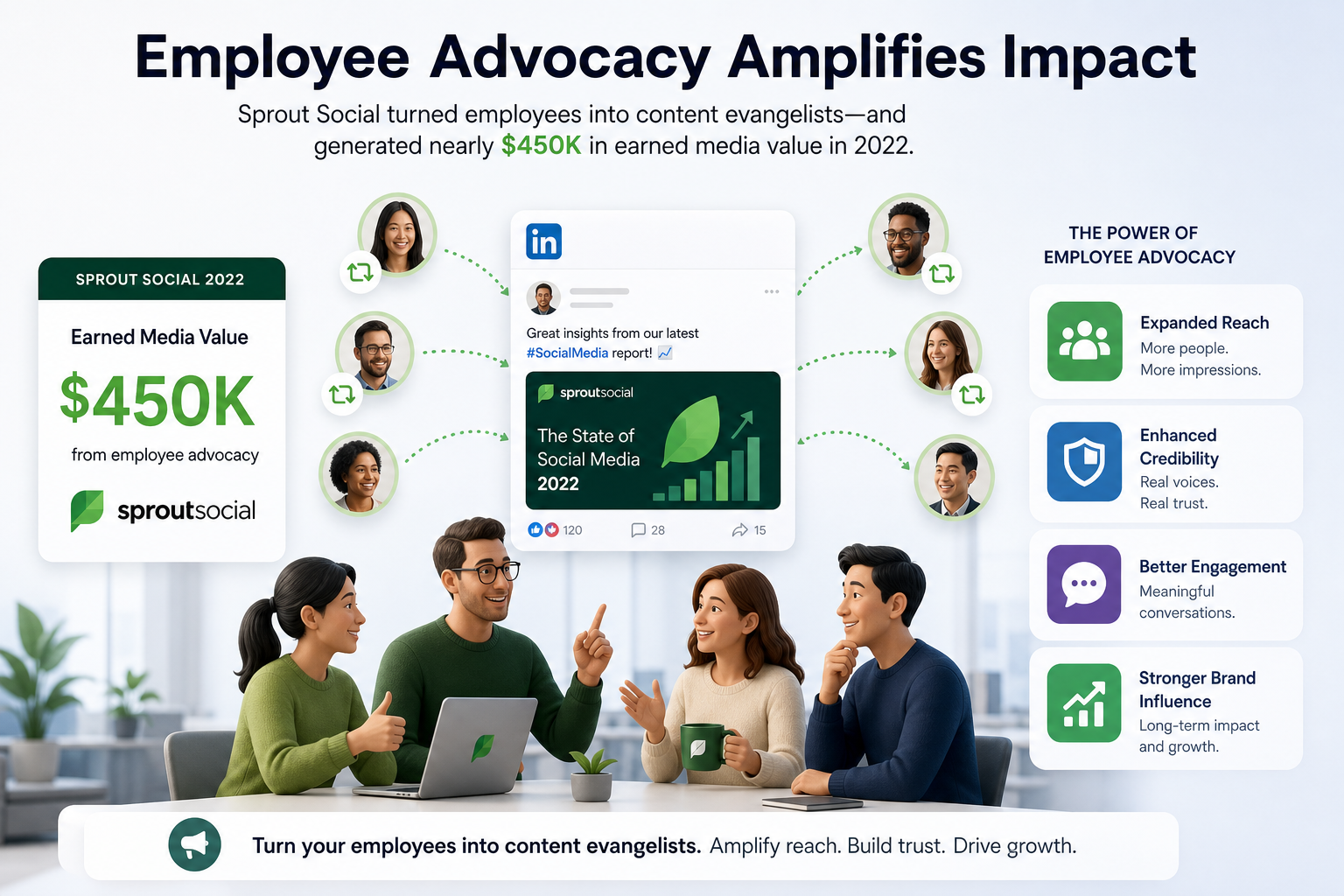
A key metric that demonstrates the impact of employee advocacy is earned media value. Sprout Social reported that earned media value from employee advocacy approached $450,000 in 2022. This figure shows how a disciplined, scalable advocacy program can translate to meaningful, filterable exposure without additional media spend. The lesson is not to chase vanity numbers, but to cultivate authentic amplification that compounds over time.
The benefits of advocacy and partnerships extend beyond reach. They enhance credibility, diversify touchpoints with your ICP, and accelerate conversations by presenting more faces voicing the same value proposition. When teammates and partners participate, your content gains social proof from multiple trusted voices, which can shorten the path from awareness to consideration.
How advocacy drives durable impact
- Authentic amplification: Content shared by employees often earns higher trust and engagement because it comes from relatable, real people.
- Signal diversity: Multiple voices reinforcing your POV create a richer narrative and broaden your reach across different audience segments.
- Frictionless participation: Lightweight guidelines and ready-to-share prompts reduce the effort required to contribute, increasing participation rates.
- Talent and culture signals: Active internal advocacy signals a healthy, engaged culture, which can attract partners and talent alike.
How to implement a lightweight advocacy program
- Define guidelines that outline tone, topics aligned with your POV, and disclosure expectations to keep messaging consistent.
- Provide simple prompts such as a one paragraph takeaway, a short video clip, or a ready-to-share quote graphic to lower friction for participants.
- Offer optional content variants so volunteers can adapt prompts to their voice and role without feeling constrained.
Cross pollination with external partners
Partnerships unlock opportunities to introduce your ideas to complementary audiences. Practical collaboration formats include co authored articles, LinkedIn Live sessions, and joint posts that showcase a shared point of view or a blended solution. The goal is to maintain a coherent narrative while leveraging the partner’s audience to broaden exposure.
- Identify overlapping ICPs with 2 to 3 potential partners whose audiences align with yours.
- Agree on a value exchange such as a live event, a joint article, or a carousel series that benefits both sides.
- Promote and monitor the collaboration across both pages and track cross engagement to learn what resonates.
Execution checklist
| Area | Action | Metric to track |
|---|---|---|
| Advocacy guidelines | Publish clear guidelines and example prompts for employees | Participation rate, content alignment with POV |
| Employee participation | Encourage volunteers to share personal perspectives related to your POV | Number of posts, average reach per post |
| Partner collaborations | Co create at least one piece of content per quarter with each partner | Cross engagement, new ICP reach, joint content saves |
| Cross promotion | Coordinate promotion across both pages and in comments | Audience overlap, referral conversations, inbound messages |
By weaving together internal advocacy and external partnerships, startups can expand their reach in a credible, scalable way. The combined effect is greater visibility among the right decision makers, enhanced trust through multiple voices, and a more resilient growth engine that does not rely solely on paid media.
Measure, analyze, and adapt your LinkedIn strategy
A data driven mindset helps turn LinkedIn activity into measurable growth. By measuring what matters, analyzing patterns, and adapting quickly to performance signals, startups can improve effectiveness over time and stay aligned with evolving LinkedIn dynamics.
Define a compact KPI framework
Start with a lean set of indicators that connect content to revenue outcomes. Focus on quality signals that predict meaningful conversations and pipeline impact rather than vanity metrics.
Keep the set lean and revisit it monthly to stay aligned with what matters most.
- Qualified conversations: comments, direct messages, and early discovery calls with ICPs.
- ICP aligned engagement: reactions, comments, and replies from the right job titles and personas.
- Content saves and shares: evidence of intent to revisit or share value with peers.
- Pipeline influence: opportunities or deals influenced by LinkedIn activity.
- Meetings scheduled: demos or discovery calls booked via LinkedIn outreach.
Set up a lean measurement cadence
Implement a simple, repeatable rhythm that fits startup teams. A three tier cadence works well:
- Weekly review: scan comments, capture ICP feedback, and flag promising threads for follow up.
- Monthly analysis: assess KPI trends, identify top performing post archetypes, and adjust messaging for the next month.
- Quarterly strategic review: revalidate ICP definitions, refresh content themes, and align LinkedIn goals with product and sales milestones.
Three practical tools for tracking
Use a compact KPI dashboard to monitor the five core metrics above in a simple sheet or dashboard tool.
Post archetype analysis helps you see which formats drive conversations with ICPs, and qualitative notes capture direct feedback to refine positioning and language.
- Compact KPI dashboard in a simple sheet or dashboard tool to monitor the five core metrics above.
- Post archetype analysis categorize posts into thought leadership, practical how tos, and case studies to see which formats drive conversations with ICPs.
- Qualitative notes capture direct feedback from ICP comments and messages to refine positioning and language.
Experimentation framework that scales
Treat every post as an experiment with a clear hypothesis. Define a smallest viable test, run it, learn, and iterate.
Each test should include a compact hypothesis and a quick read on what Success looks like.
| Experiment | Hypothesis | Metrics | Decision Rule |
|---|---|---|---|
| Opening line test | A stronger hook will increase ICP friendly comments by 20 percent. | Comments from ICP, early engagement, saves | If ICP comments rise by at least 15 percent over baseline in 7 days, adopt the winning hook |
| Format mix test | Carousels outperform text posts for ICP with longer buying cycles. | Engagement per post, ICP comments, qualified conversations | Shift more budget to the top performing format for the next 2 weeks |
| Time window test | Posting during a specific window yields more meaningful conversations. | Meaningful conversations in first 2 hours, comments per post | Publish more in the winning window for the next 2 weeks |
Data sources to inform decisions
LinkedIn Analytics for impressions, clicks, and audience demographics.
Comment quality assessments gauge relevance and intent, while CRM and sales feedback map content influence to deals or opportunities.
- LinkedIn Analytics for impressions, clicks, and audience demographics.
- Comment quality assessments to gauge relevance and intent.
- CRM and sales feedback to map content influence to deals or opportunities.
- Competitor and peer benchmarks to contextualize performance within your space.
Analytical mindset and governance
Cultivate a culture of continuous improvement. Encourage quick experimentation, transparent sharing of results, and disciplined decision making.
Weekly rituals review the latest data, capture learnings, and adjust content plans. Ownership assigns clear roles for data collection, analysis, and optimization in your team.
- Weekly rituals to review the latest data, capture learnings, and adjust content plans.
- Ownership assign clear roles for data collection, analysis, and optimization in your team.
- Documentation maintain a lightweight playbook of what works and what does not to onboard new team members quickly.
Framework recap
A data driven LinkedIn strategy emphasizes the linkage from content to conversations to revenue. By defining a lean KPI set, stabilizing a repeatable measurement cadence, running disciplined experiments, and making agile adjustments based on evidence, startups can steadily improve performance while staying aligned with evolving platform dynamics.
A focused approach keeps teams aligned and moves conversations toward outcomes.