Most advice on how to generate leads on LinkedIn is backward. It tells you to post more, polish your personal brand, and wait for inbound interest. That can work, but it's a slow path and a bad default for founders, operators, and sales leaders who need pipeline, not applause.
A better approach starts where attention already exists. Instead of fighting for reach on your own posts, you use a comments-first system to get in front of the right audiences, turn profile visits into warm interest, and build a lead list with context attached. That's the difference between LinkedIn activity and LinkedIn lead generation.
Table of Contents
- Why Most LinkedIn Lead Gen Advice Fails
- Build a High-Conversion LinkedIn Profile
- The Comments-First Funnel for Borrowed Reach
- Smart Organic Outreach and Automation
- Capturing and Measuring Your LinkedIn Leads
- Putting It All Together A Repeatable System
Why Most LinkedIn Lead Gen Advice Fails
The standard playbook says to post every day and stay consistent. That advice sounds reasonable, but for many teams it creates effort without a strong return. You spend time drafting posts, the reach swings wildly, and the business outcome is unclear.
The deeper problem is that posting is often treated as the strategy. It isn't. It's one activity inside a system. If your profile doesn't convert, your comments don't create curiosity, and your follow-up doesn't happen fast, more posting just means more wasted motion.
LinkedIn is too important to use casually. LinkedIn accounts for 80% of all B2B social media leads and is 277% more effective for lead generation than Facebook and Twitter (X), according to Cirrus Insight's LinkedIn lead generation statistics. That's why weak execution hurts so much. The channel is strong. The system is usually weak.
Activity is not the same as pipeline
Founders fall into this trap constantly. They write thoughtful posts, get a few likes from peers, maybe pick up some followers, then conclude LinkedIn doesn't work. What failed was the operating model.
A useful LinkedIn system does four things:
- Attracts the right audience: It puts your name in front of decision-makers, not random spectators.
- Creates curiosity: It gives people a reason to click your profile after seeing you in the feed.
- Captures intent: It turns engagement into a warm lead list instead of letting interest disappear.
- Triggers follow-up: It gives sales or the founder context for a relevant message.
Practical rule: If LinkedIn activity doesn't create conversations with buying context, it isn't lead gen. It's content production.
Why the common advice burns people out
Posting-first advice fails because it assumes your own feed is the main distribution engine. It isn't, especially when you're starting from a modest network or operating in a crowded category. Many users don't need more content pressure. They need more borrowed reach, better audience signals, and cleaner follow-up.
That's why the comments-first approach works so well. It starts with visible conversations that already have attention, then turns that attention into profile visits, then into leads. It's less glamorous than "build a thought leadership brand" and much more reliable.
Build a High-Conversion LinkedIn Profile
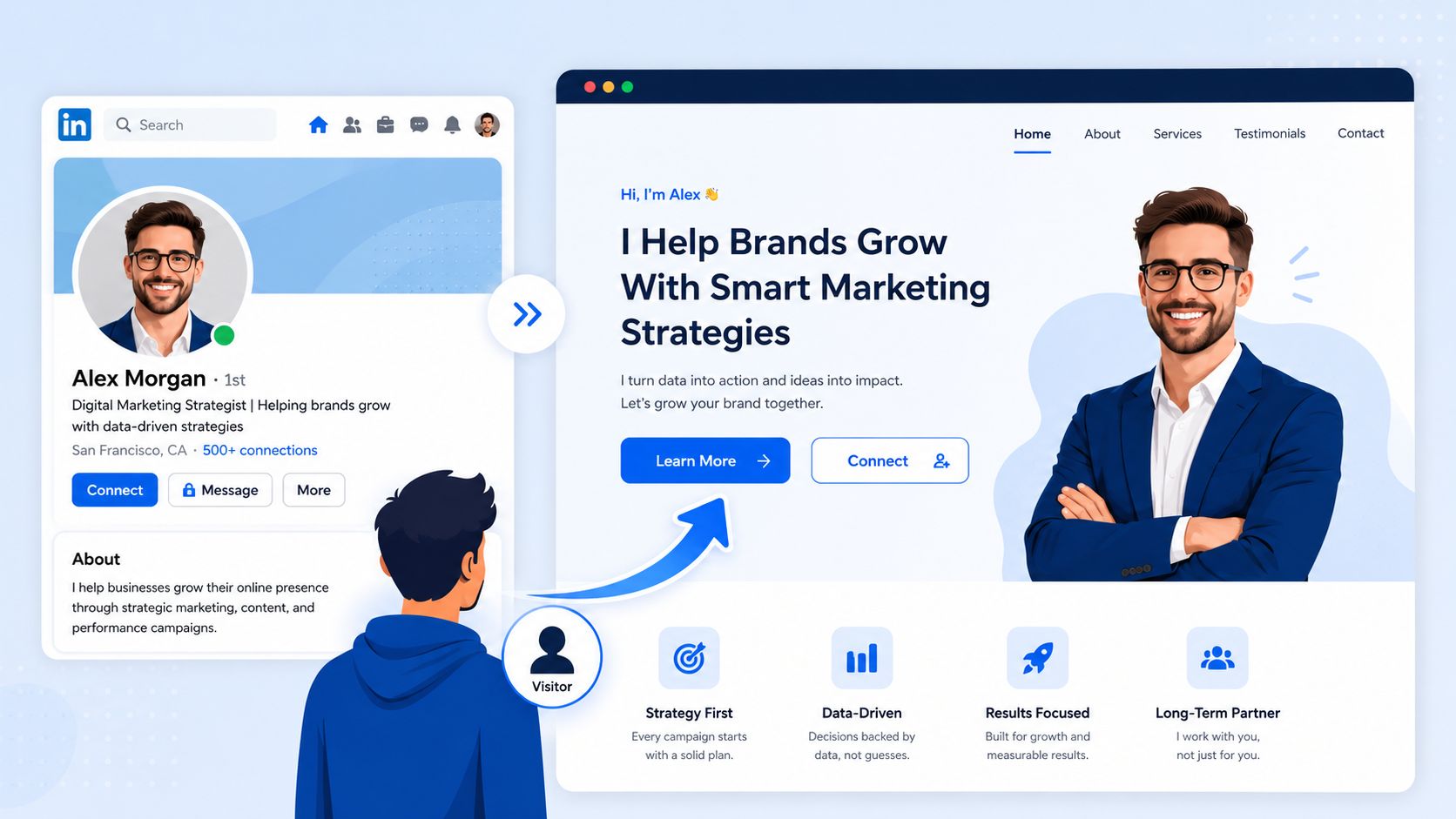
Your profile isn't a resume. It's a landing page for people who noticed you somewhere else and want to know whether you're worth talking to.
That shift matters. When someone clicks through from a comment, they make a fast decision. They scan your headline, your About section, your proof, and whether there's a clear next step. If those pieces are vague, the lead dies before any outreach begins.
Turn your headline into a value proposition
The biggest profile mistake is using a title as the headline. "Founder at X" or "Account Executive at Y" tells people almost nothing. Your headline should tell the reader who you help, what outcome you help create, or what category problem you solve.
A stronger headline usually includes three ingredients:
- Audience clarity: Name the buyer or company type you serve.
- Business outcome: State the improvement, result, or problem solved.
- Positioning cue: Add your role, category, or mechanism if useful.
For example, "Helping B2B SaaS teams turn LinkedIn engagement into qualified pipeline" is better than "Growth Consultant." It qualifies the visitor and filters out people who aren't relevant.
If you want a deeper walkthrough, this LinkedIn profile optimization guide breaks down the profile elements that influence response quality.
Write an About section that sells the next step
The About section should read like a short sales page, not a career summary. Buyers don't care about your full background on first touch. They care whether you understand their problem and whether you're credible enough to help.
Use this sequence:
- Start with the problem your target buyer already feels.
- Show your point of view on why most approaches underperform.
- Explain your method in plain language.
- End with a clear next step such as DMing you, visiting a resource, or booking time.
Keep it readable. Short paragraphs win. Dense blocks lose.
Most profile visitors don't need your full story. They need enough clarity to decide whether a conversation is worth having.
A profile video can also help you see how experienced operators frame their positioning and offers in practice:
Use Featured to qualify serious buyers
The Featured section is where you control the next click. Too many profiles waste it on random links or old company posts. Use it to pre-sell your offer.
A strong Featured section usually includes a mix of assets such as:
| Asset | What it does |
|---|---|
| Case-study style proof | Shows how you think and what outcomes you aim for |
| A practical guide or checklist | Gives prospects a low-friction way to engage |
| A call booking or contact path | Removes guesswork for ready buyers |
This isn't about decorating the profile. It's about reducing uncertainty. When a prospect sees a sharp headline, a buyer-focused About section, and proof in Featured, your later message lands better because the profile already did part of the work.
The Comments-First Funnel for Borrowed Reach
The fastest way to stall LinkedIn lead gen is to rely only on your own posts for discovery. Reach from your feed is uneven. Borrowed reach is steadier.
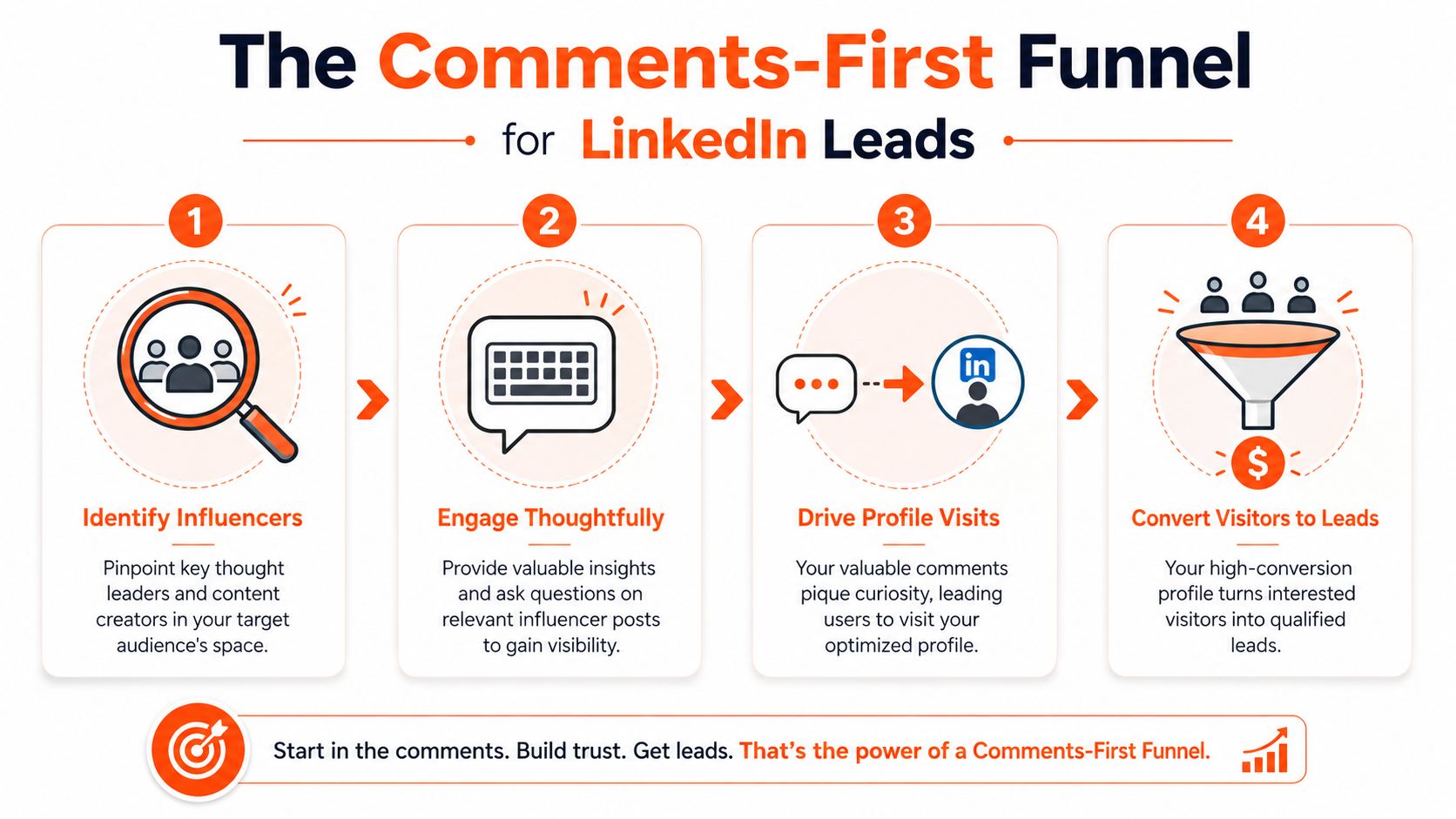
A comments-first funnel works because it puts your thinking inside conversations that already have the right audience. You don't need to manufacture attention from scratch. You join relevant discussions where buyers, creators, and peers are already reading.
Why comments beat isolated posting
This is the core mechanic. Comment engagement on popular posts can drive 3 to 5 times more profile visits than standalone posts because comments appear in the feeds of the original post's audience, not just your own network, according to Copilot AI's breakdown of LinkedIn automation and commenting.
That matters because profile visits are the bridge between visibility and pipeline. A post impression from the wrong audience is worthless. A profile visit from the right buyer after a sharp comment is often the beginning of a qualified lead.
Organic execution doesn't need to consume your day either. A practical pattern is to spend 10 to 15 minutes daily commenting on target-account posts and updates from relevant first and second-degree connections, as described in Sopro's LinkedIn lead generation best practices. That's enough when the comments are chosen carefully and tied to intent.
What a high-value comment actually looks like
Most comments fail because they add nothing. "Great post" is invisible. So is a mini pitch. The right comment does one of three things:
- Adds a missing angle: You extend the original post with a specific observation the audience can use.
- Sharpens the idea: You point out a trade-off, constraint, or operational detail.
- Asks a real question: You invite the author and readers into a better discussion.
Here are the traits I look for:
- Context-aware: The comment responds to what was directly said, not just the topic.
- Native to your voice: It sounds like you, not like an AI summary bot.
- Useful on its own: Even if nobody clicks your profile, the comment still adds value.
- Non-needy: It doesn't ask for attention, force a CTA, or pivot into your offer.
A good comment earns curiosity. A bad one asks for it.
The hidden advantage is contextual history. If someone later replies to your DM, you already know where they saw you and what conversation pulled them in. That makes your outreach warmer and more relevant than a cold first touch.
How AI voice adaptation changes execution
This is the part most guides miss. They mention commenting, but they don't explain how to do it consistently without turning it into another daily chore.
The newer approach is AI that reads the full post, understands the argument, and drafts a comment in your tone. That matters because generic automation produces generic comments, and generic comments don't start real buyer journeys.
One option in this category is Linqin, which supports a comments-first workflow by identifying relevant conversations, drafting comments in the user's voice, and capturing engagement into a warm-lead list with the context of the original comment. Its product mechanics line up with the process described in this LinkedIn commenting strategy guide.
What doesn't work is blind automation at high volume. If the comment sounds detached from the post, people notice immediately. Voice adaptation only matters if it preserves judgment, cadence, and category knowledge.
A strong comments-first funnel usually follows this path:
- Identify target creators and buyer-adjacent voices
- Comment where the audience overlap is strong
- Watch for profile views, likes, and replies as intent signals
- Capture those names into a warm list with conversation context
- Reach out only when the context supports a natural next message
That's how to generate leads on LinkedIn without becoming another person shouting into the feed.
Smart Organic Outreach and Automation
Public engagement creates awareness. Private outreach turns that awareness into a sales conversation. The handoff is where many organizations get sloppy.
The bad version is obvious. Someone accepts your connection request and gets a pitch immediately. That kills trust because there was no transition, no relevance, and no sign that you paid attention to what just happened.
Move from public engagement to private conversation
The better move is to wait for a cue. If someone liked your comment, viewed your profile, replied to your post, or accepted a connection after seeing you repeatedly in relevant threads, you have a reason to start a conversation.
That message should reference the context that already exists. Keep it light. You're not trying to close. You're trying to make the next response easy.
A simple structure works well:
- Open with context: Mention the post, comment thread, or topic you both touched.
- Add relevance: Show why you reached out to them specifically.
- Give a light next step: Ask a question, offer a relevant resource, or continue the discussion.
What to automate and what to keep human
Automation gets a bad reputation because people use it to fake scale. Used properly, it removes repetitive work and protects consistency.
What you can automate safely:
- Comment drafting: Especially when the system reads the full post and follows your voice rules.
- Lead capture: Tagging people who engaged and recording where they came from.
- Routing and reminders: Moving warm names into a CRM or task queue quickly.
- Nurture steps: Sending follow-up content based on prior engagement.
What should stay human or at least heavily reviewed:
- Offer positioning for high-value accounts
- Nuanced objections
- Late-stage conversations
- Anything emotionally sensitive or commercially complex
Personalization is where automation helps when it's done right. AI-powered personalized LinkedIn outreach increases response rates by 40 to 60 percent compared with generic messages, according to LinkedIn's analysis of AI in lead generation. The difference comes from using shared context, industry cues, and buyer signals, not from sending more messages.
A simple outreach structure that doesn't feel spammy
You don't need fancy copy. You need timing and relevance.
Try this pattern:
- Connection request
Mention the shared conversation or niche overlap. - First message after acceptance
Continue the topic, don't introduce your pitch. - Second touch
Share a useful point, asset, or question related to their situation. - Sales transition
Only after back-and-forth exists, suggest a call or deeper exchange.
If you're also running paid LinkedIn campaigns, execution details matter there too. For lead form ads, use the Lead Generation objective, layer filters like job function, seniority, company size, and industry, exclude competitors, and keep forms to 3 to 4 essential fields so you reduce friction, as outlined in Firebrand's LinkedIn B2B lead generation best practices. The same source stresses immediate follow-up through CRM routing and automated nurture. That's just as true for organic leads as it is for paid ones.
For more message examples and sequencing logic, this LinkedIn DM outreach strategy guide is a useful reference point.
Capturing and Measuring Your LinkedIn Leads
A lot of LinkedIn programs look busy and still fail one basic test. Nobody can tell which actions created qualified opportunities.
If you want LinkedIn to be a repeatable channel, you need a way to capture warm interest with context and then measure what happened next. Likes and impressions can help you diagnose visibility, but they don't tell you who might buy.
Build a warm lead list with context
A warm lead list should include more than names. It should tell you why the person is on the list.
Useful fields include:
- Originating touchpoint: The post, comment thread, or message that triggered interest
- Engagement type: Profile view, comment reply, reaction, follow, or DM
- Topic context: What subject got their attention
- Suggested next action: Connect, message, monitor, or route to sales
Without this context, follow-up gets generic fast. With it, the outreach feels like a continuation of a real interaction.
Track the first meaningful touchpoint, not just the latest one. That's usually where the buying story starts.
Measure outcomes instead of vanity metrics
The right question isn't "Did this post perform?" It's "Did this activity create qualified movement?"
I look at outcomes in layers:
| Layer | What to track |
|---|---|
| Attention | Profile visits, relevant follower growth, comment replies |
| Engagement quality | Inbound messages, repeat interactions, connection acceptance with context |
| Pipeline movement | Qualified conversations, meetings, and opportunities sourced from LinkedIn activity |
Comments-first has an edge. Because the first touch often happens in a public thread, you can connect later actions back to a visible interaction. That makes attribution cleaner than a lot of other social channels.
Score behavior so sales works the right leads first
Not every engaged person deserves immediate follow-up. Some are curious. Some are browsing. Some are close to a real buying conversation.
Behavioral scoring helps sort that out. Lead scoring based on signals such as reply rates, dwell time, and sentiment can reduce time spent on cold leads by up to 50 percent, according to this example of AI-driven lead scoring tied to LinkedIn engagement data.
The takeaway isn't just efficiency. It's focus. When sales works the warmest names first, response quality improves and LinkedIn stops feeling like a top-of-funnel vanity project.
A practical scoring approach might look like this:
- High priority: Replied to your message, visited your profile repeatedly, or engaged across multiple touches
- Medium priority: Liked or replied to a comment and fits your target account profile
- Low priority: One-off reaction with no clear buying signal
That kind of sorting gives your team a real operating rhythm. It also shows which comments, themes, and conversations are producing the strongest buyer intent.
Putting It All Together A Repeatable System
LinkedIn lead gen gets easier once you stop treating it like a content calendar and start treating it like an operating system. The highest-yield setup is boring in the right way. It runs on the same sequence every week, tracks the same signals, and gives sales the same kind of context every time.
That is what makes it repeatable.
A practical weekly rhythm looks like this:
- Tighten positioning: Review your headline, About section, and proof assets against the buyers and offers that matter now.
- Run comment distribution: Spend time in the posts your market already pays attention to. Good comments earn borrowed reach without waiting for your own posts to take off.
- Follow up with context: Reach out after a like, reply, profile visit, or repeat engagement gives you a real reason to start a conversation.
- Log intent signals: Capture who engaged, where they engaged, what topic pulled them in, and how strong the buying signal looks.
- Work the list by temperature: Put the highest-intent names in front of sales first, then keep nurturing the rest.
Order matters. Teams that start with cold DMs usually get weak reply rates because there is no prior context. Teams that rely only on posting usually burn time creating content without enough distribution. The comments-first funnel fixes both problems. It creates visibility first, then turns that visibility into a warm-lead list with conversation history attached.
That last part is the difference.
A name in a spreadsheet is not very useful. A prospect who replied to your comment on a pricing post, viewed your profile twice, and connected after seeing a second comment is a real lead with a usable narrative. AI voice adaptation helps here because follow-up can match the tone and topic of the original interaction instead of sounding like a generic outbound template.
Consistency wins because the work is small enough to keep doing. Thirty focused minutes in the right threads beats random bursts of posting and outreach. The point of automation is not to replace judgment. It is to handle capture, organization, and follow-up triggers so your team can spend time on live conversations.
Linqin fits into that system in a factual way. It supports the comments-first workflow by helping teams keep engagement history, warm intent, and follow-up timing organized without adding more manual admin.
If you want better LinkedIn pipeline, commit to a weekly system that starts in the comments, builds context before outreach, and measures conversation quality instead of feed activity. That is how LinkedIn becomes a reliable demand gen channel instead of another place to stay busy.