You're probably doing some version of this already. You post a role, run a search, send a batch of connection requests, maybe fire off a few InMails, then wait. A few people accept. Fewer reply. The strongest candidates never engage, and the hiring manager starts asking why LinkedIn “isn't working.”
That usually isn't a platform problem. It's a system problem.
Knowing how to use LinkedIn for recruiting now means more than running title searches and sending polite outreach. The recruiters who consistently fill hard roles use LinkedIn like a compound channel. They build credibility before outreach, source by skills instead of labels, warm candidates up in public before landing in the inbox, and track which actions produce replies, interviews, and hires.
Table of Contents
- Why Your Current LinkedIn Recruiting Efforts Are Falling Short
- Build Your Foundation for Recruiting Success
- Find Top Talent with Advanced Search Strategies
- Craft Outreach Sequences That Get Replies
- Warm Up Your Candidate Pool with Strategic Engagement
- Measure and Scale Your LinkedIn Recruiting Engine
Why Your Current LinkedIn Recruiting Efforts Are Falling Short
A recruiter can spend half a day on LinkedIn and still end the day with nothing useful in pipeline. That's common when activity replaces strategy.
One pattern shows up again and again. The recruiter posts a role, searches exact job titles, sends generic outreach, and assumes volume will compensate for weak targeting. It rarely does. The same candidates are hearing from multiple companies, often with nearly identical messages.
That competition is real. GoRemotely reports that 77% of professional recruiters actively use LinkedIn for hiring, which is why showing up isn't enough anymore. LinkedIn is still the dominant recruiting platform, but that same adoption creates intense competition for attention in GoRemotely's LinkedIn recruiting statistics.
The real issue is low-signal activity
Most underperforming LinkedIn recruiting efforts have three problems:
- Weak reach: A job post on a quiet company page doesn't travel far unless people already engage with your brand.
- Weak targeting: Searching by title alone misses strong candidates with adjacent titles, narrower scopes, or growth-stage role definitions.
- Weak credibility: Candidates click your profile before they reply. If they see a bland recruiter headline and a dormant company page, trust drops fast.
Practical rule: If a candidate visits your profile after your message and still can't tell what kind of roles you hire for or why your company is worth a conversation, your outreach has already lost momentum.
Passive candidates don't behave like applicants
Top candidates usually don't wake up hoping to answer recruiter messages. They're busy, they're selective, and they often need context before they'll respond.
That changes the job. Good LinkedIn recruiting isn't about broadcasting openings. It's about creating enough relevance and trust that a passive candidate is willing to take a first call.
What doesn't work:
- Template-heavy connection requests that could have gone to anyone
- Long InMails that explain the company before explaining the fit
- Corporate job language filled with internal jargon and vague “exciting opportunity” phrasing
What does work is narrower and more disciplined. Recruiters who win on LinkedIn know exactly who they want, what signals matter, and how to make the first interaction feel earned instead of intrusive.
Build Your Foundation for Recruiting Success
Before sending a single outreach message, fix the surface area candidates will inspect. Your profile and company page do a lot of selling before you ever get a reply.
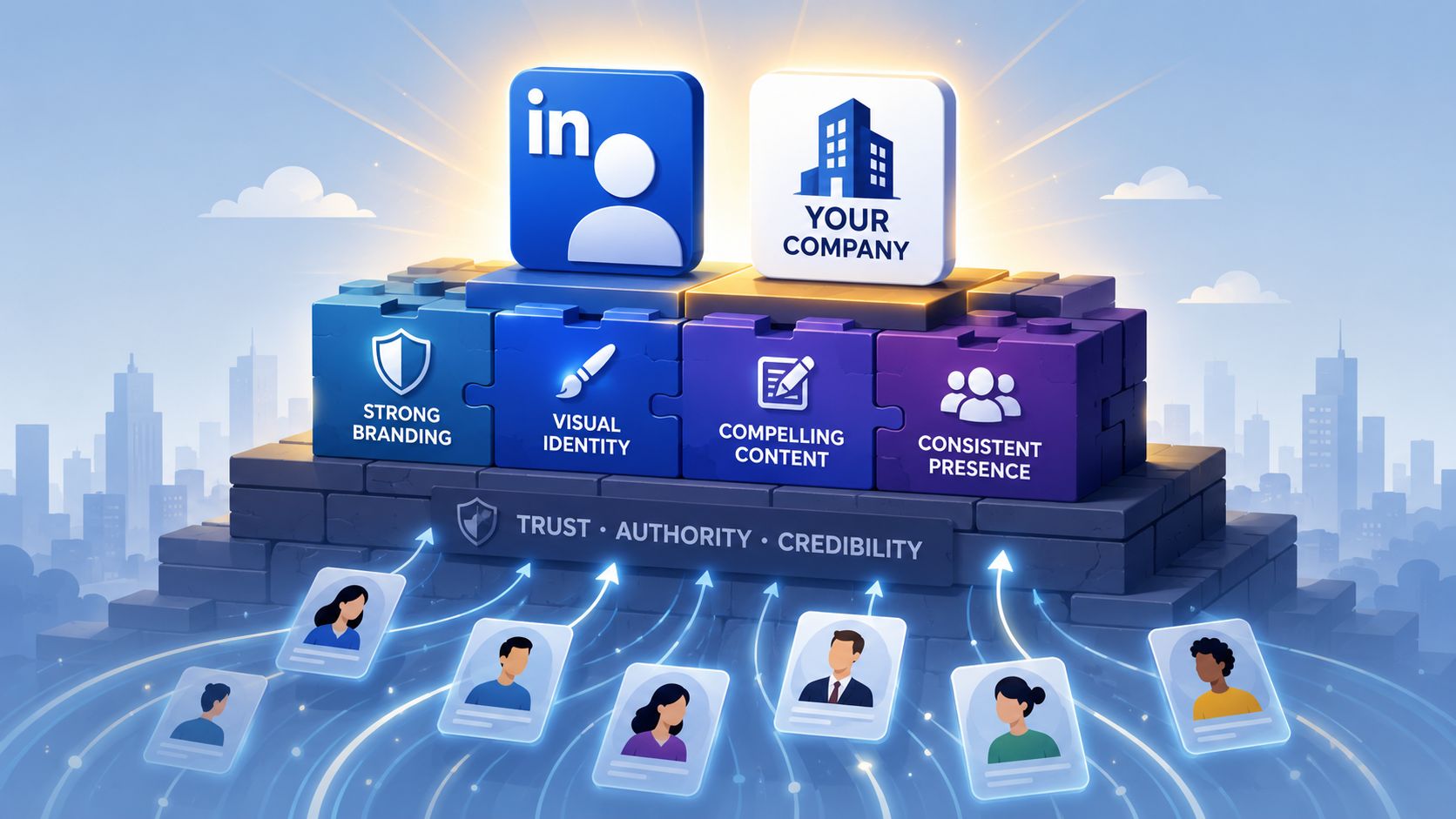
Make your profile candidate-facing
Most recruiter profiles are written like internal resumes. That's the wrong frame. A candidate doesn't care about your task list. They care whether you understand their market and whether the opportunities you represent are worth attention.
A stronger profile has three jobs:
- State your niche clearly. Don't use a vague headline like “Talent Acquisition Specialist.” Use the space to signal who you help and what kinds of roles you fill.
- Show context in the About section. Summarize the kinds of teams, problems, and career moves you work on.
- Create proof through activity. Comment intelligently, repost thoughtfully, and share enough market perspective that candidates see you as informed, not transactional.
If you want a stronger recruiter profile, this LinkedIn profile optimization guide is a useful reference point.
A simple profile checklist:
- Headline: Make it specific to function, level, or domain.
- About section: Write for candidates, not for your HR org chart.
- Featured section: Add open roles, team stories, or hiring content if relevant.
- Recent activity: Keep it current enough that a profile visit doesn't feel like stepping into an abandoned page.
A good recruiter profile reduces friction. It answers “Why should I respond to this person?” before the candidate has to ask.
Turn the company page into proof
Candidates don't just vet the recruiter. They vet the company behind the message.
A company page should show evidence of what it's like to work there. That means less polished brand filler and more signals of substance. Team wins, product direction, hiring manager perspectives, and employee stories usually outperform sterile recruiting banners because they give candidates something concrete to react to.
Use the page to reinforce four things:
- Mission with clarity: What the company is building and why it matters
- Role context: How teams work, not just what roles are open
- People evidence: Real employees, real functions, real voices
- Momentum: Fresh activity that shows the company is alive and executing
If your page only posts openings, you've built a bulletin board. Strong recruiting pages feel more like a window into the work.
Find Top Talent with Advanced Search Strategies
The fastest way to miss strong candidates is to search only for exact titles. Titles vary wildly across companies, especially in startups, international markets, and technical functions.
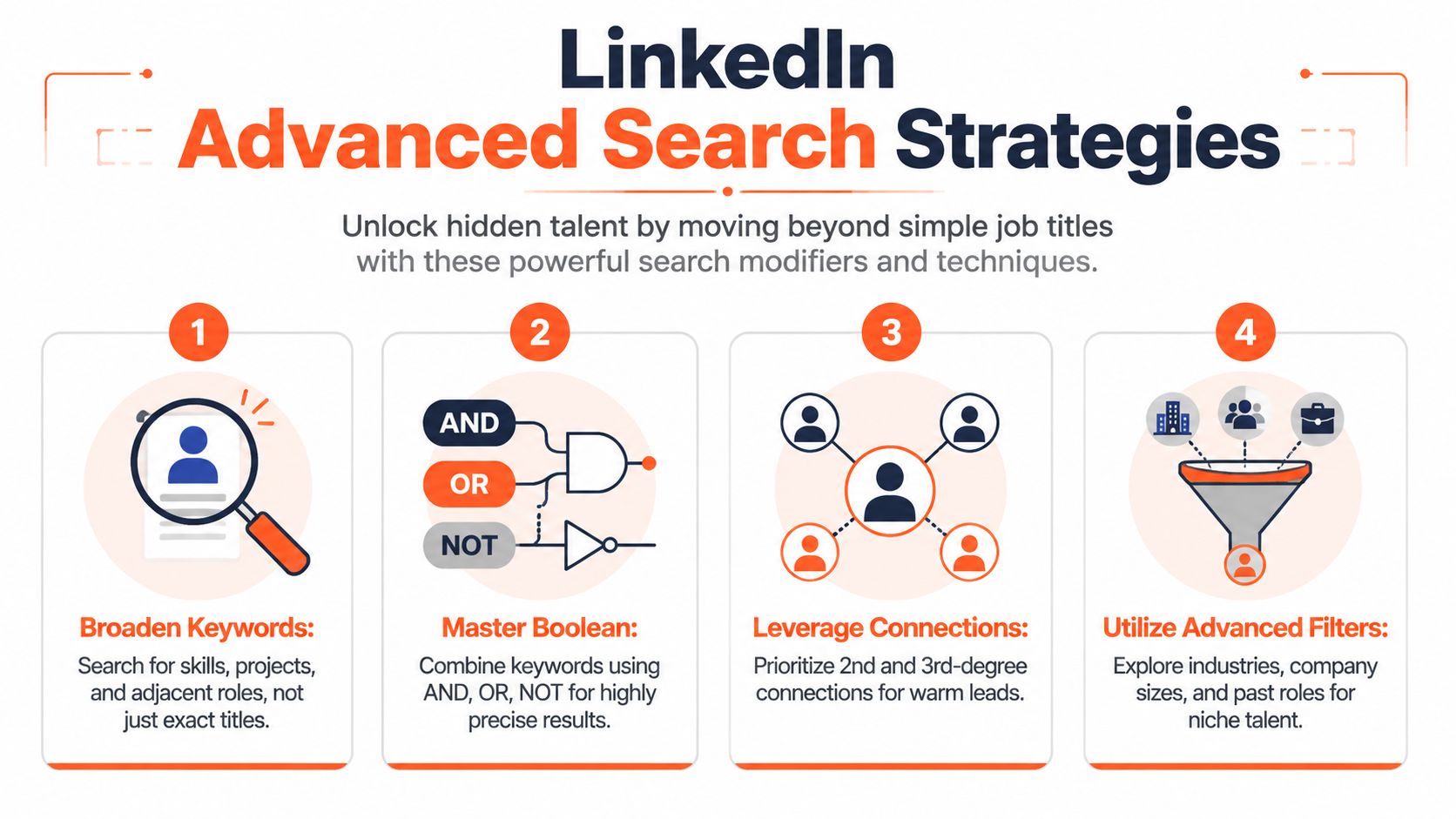
According to LinkedIn's 2025 Future of Recruiting report, companies prioritizing skills-based searches are 12% more likely to make a quality hire. That's the practical shift. Search for capability first, then use title as supporting context.
Search for capability, not labels
Start with what someone must know how to do. For a backend hire, that may be specific languages, cloud environments, architecture work, distributed systems exposure, or domain experience. For a revenue operations role, it may be Salesforce administration, forecasting, dashboard ownership, and process design.
Build searches around:
- Core skills
- Adjacent tools
- Relevant industries
- Likely stepping-stone roles
- Seniority signals without relying only on title
If you only search “Software Engineer,” you'll get noise. If you search for the stack, business context, and likely scope, the list gets sharper.
Use Boolean to narrow, then human judgment to rank
Boolean still matters because it helps you create a repeatable search frame. The mistake is treating the string as the whole strategy.
A useful pattern looks like this:
- Core capability query:
(Java OR Python) AND (AWS OR Azure) AND "machine learning" - Exclusion layer:
NOT (manager OR director) - Context filters: location, company size, current or past employers, industry, connection degree
Then review profiles manually. Search gives you candidates. Judgment tells you who is right.
Here's where many recruiters leave quality on the table:
| Search habit | What happens | Better move |
|---|---|---|
| Search exact title only | You miss adjacent or rising talent | Search skills, projects, and role scope |
| Ignore connection degree | Outreach starts colder than it needs to | Prioritize 2nd-degree paths when possible |
| Use one static search | You keep seeing the same profile type | Build multiple variations by skill cluster |
| Over-trust keyword matches | Good resumes float up, good operators hide | Read experience for evidence of ownership |
A practical sourcing pattern for hard roles is to look one level below the target seat. Someone who's already doing parts of the next role often makes a better hire than someone with the “perfect” title but weaker trajectory.
Search broad enough to discover people, then narrow fast based on evidence of scope, progression, and skill density.
That's how to use LinkedIn for recruiting when the obvious shortlist is either exhausted or already in everyone else's inbox.
Craft Outreach Sequences That Get Replies
Once you've found a strong candidate, the message has to feel like it came from a real person who noticed something real.
LinkedIn's recruiting guidance notes that 70 to 80% of top candidates are passive and not actively applying to jobs, and that InMail messages should be under 100 words, highly personalized, and include a clear, low-effort call to action in LinkedIn's recruiting best practices.
That one fact should reshape your messaging. Passive candidates don't need a pitch deck. They need a relevant reason to answer.
What good outreach actually sounds like
Bad recruiter outreach usually has one of two problems. It's either generic, or it's overloaded with company detail before establishing candidate fit.
A better first message does four things quickly:
- names the person
- references a specific signal from their profile
- gives concise context on the role
- asks for a small next step
This is the structure I'd hand to a new hiring manager.
Connection request example
Hi Maya, I liked your move from platform engineering into ML infrastructure at your current company. I'm hiring for a team working on similar scaling problems. Thought it made sense to connect.
Short InMail example
Hi Maya, your work on ML infrastructure at Acme stood out, especially the shift toward production systems. I'm helping hire for a team facing similar scale and reliability challenges. If it's useful, I can share a brief overview and you can decide if it's worth a conversation. Open to that?
What not to send:
- A paragraph about your company history
- A message that sounds copied from an ATS template
- An aggressive ask for a call without context
- A fake compliment with no detail
For deeper message examples, this LinkedIn DM outreach strategy guide is worth reviewing.
Sample Outreach Cadence for Passive Candidates
Passive outreach works better as a sequence than a single shot.
| Day | Action | Message Focus |
|---|---|---|
| Day 1 | Send connection request | Brief personalization tied to role, project, or career move |
| Day 3 | If accepted, send first message | Specific fit, short context, low-friction call to action |
| Day 6 | Follow up | Add one useful detail about team, scope, or challenge |
| Day 10 | Final follow-up | Respectful close, keep door open for later timing |
The tone matters more than the exact day count. You're trying to create a professional opening, not pressure someone into replying.
A few rules keep sequences effective:
- Keep it short: Under 100 words is a good forcing function.
- Reference a real accomplishment: Project, transition, post, comment, or company move.
- Ask for the smallest next step: “Open to a brief overview?” works better than “Can you interview next week?”
- Stop before it feels repetitive: Persistence helps. Pestering doesn't.
Warm Up Your Candidate Pool with Strategic Engagement
Most recruiters treat outreach and content as separate activities. That's a mistake. Public engagement can make private outreach work much better.
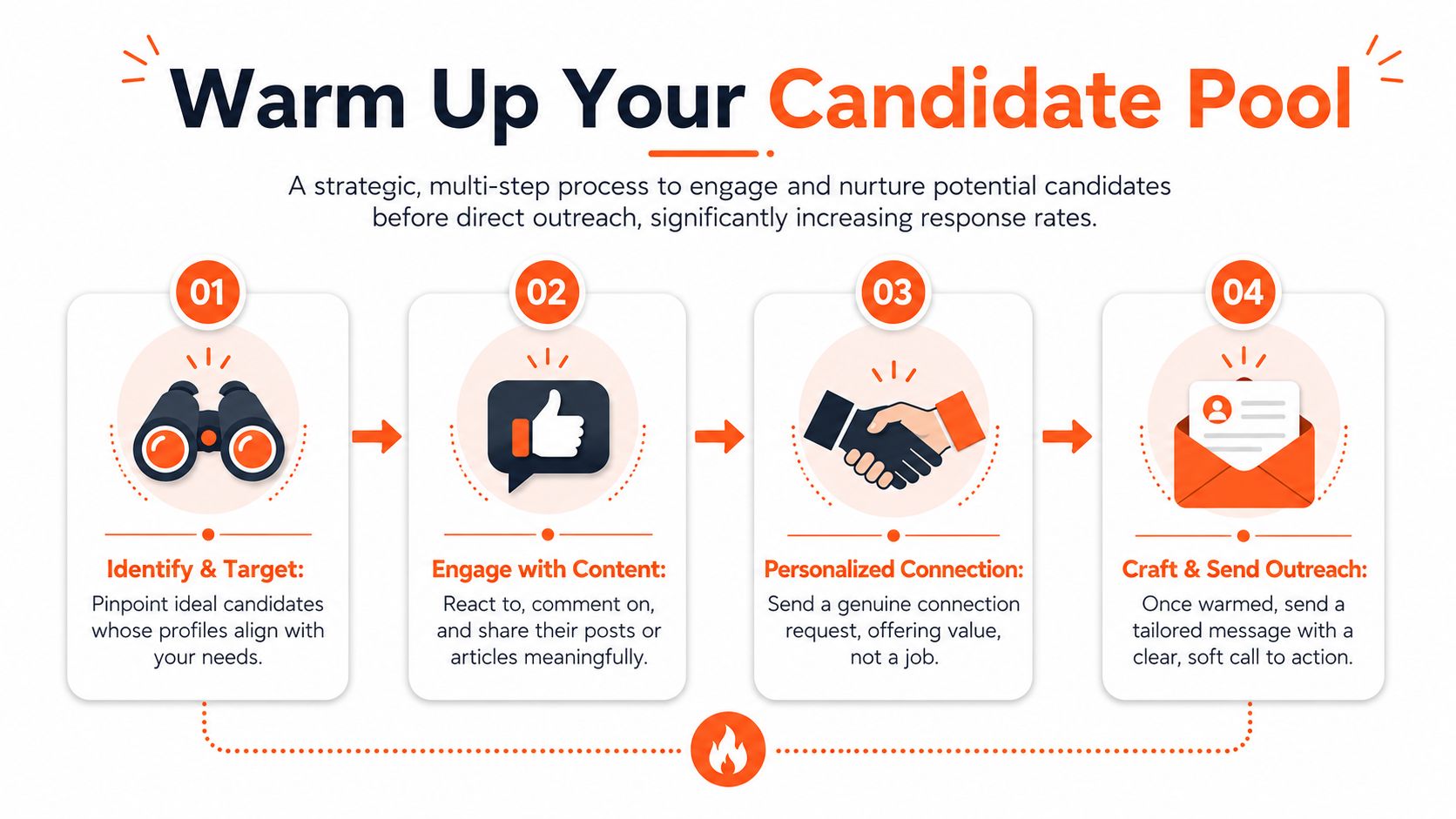
Recruiterflow's coverage of LinkedIn recruiting points to an underused reality: a comments-first approach is widely ignored, even though candidates engage 20% more with personalized InMails, and public engagement in their niche increases the perception of personalization in Recruiterflow's guide to recruiting on LinkedIn.
Why comments beat isolated posting
Posting from your own feed has limits. If your audience is small or inconsistent, the post may never reach the people you want to hire.
Comments work differently. When you add a thoughtful comment to a high-visibility post in your target niche, you borrow distribution from the original creator's audience. That creates a better path to candidate attention than publishing in isolation and hoping the algorithm finds your people.
This is especially useful when hiring for concentrated talent markets like engineering, product, data, design, or niche GTM roles. Strong candidates often spend more time reading trusted voices than browsing job posts.
The candidate doesn't have to reply to your post. They just have to notice that you sound credible before your message shows up.
A comment worth making usually does one of three things:
- Adds a practical observation
- Disagrees constructively with reasoning
- Asks a smart question that extends the discussion
“Great post” is wasted motion. Useful comments create familiarity.
How to run a comments-first workflow
This works best as a weekly operating rhythm.
First, identify the conversations your target candidates already pay attention to. That may include founders, engineering leaders, product operators, industry analysts, or respected practitioners.
Then engage in a way that's visible and specific:
- Pick the right posts: Go where your target candidates already read and react.
- Comment with substance: Respond to the actual argument, not just the headline.
- Stay in your lane: A recruiter commenting credibly on hiring, team design, role scope, or candidate market dynamics will sound more natural than pretending to be a domain expert in everything.
- Use the profile as the bridge: The comment earns the profile visit. The profile earns the reply.
This LinkedIn engagement strategy guide maps well to that style of execution.
The payoff is simple. By the time you send a connection request or InMail, your name may already be familiar. That changes the feel of the interaction from interruption to continuation.
Employee advocacy helps here too. When hiring managers and team leads comment in the same ecosystem, candidates get repeated proof that the company has thoughtful people, not just an active recruiter.
Measure and Scale Your LinkedIn Recruiting Engine
Most LinkedIn recruiting programs stall because nobody can say which actions created pipeline. A team knows messages were sent and content was posted, but they can't tie replies or hires back to specific work.
A better operating model starts with attribution. RecruHR's LinkedIn recruiting advice points to the gap clearly: personalized InMails see roughly 20% higher response rates, but a framework that links profile visits, replies, and inbound messages to the exact post or comment that triggered them is often missing in RecruHR's LinkedIn recruiting tips.
Track actions, not vanity
The wrong dashboard focuses on impressions, likes, and follower growth alone. Those can be useful directional signals, but they don't prove recruiting value.
Track a chain instead:
| LinkedIn action | Immediate signal | Recruiting outcome |
|---|---|---|
| Comment on niche post | Profile visits | Warm audience building |
| Connection request | Accepts | Expanded reachable pool |
| Personalized message | Replies | Qualified conversations |
| Follow-up sequence | Continued engagement | Screen or intro calls |
| Ongoing activity | Inbound messages | Self-generated pipeline |
That attribution discipline changes team behavior. You stop asking, “Did we stay active?” and start asking, “Which activity produced qualified conversations?”
Scale what works without looking automated
Once you know which comments, post types, and outreach patterns produce results, consistency becomes the next bottleneck. Manual execution breaks down fast when req load rises.
Used carefully, automation helps maintain cadence without sacrificing quality. The key is to automate the repeatable layer, not the judgment layer. Let systems support research, scheduling, draft generation, and tracking. Keep final message quality, candidate selection, and relationship-building human.
There's also a compliance reality. ConnectSafely.ai's guide to LinkedIn comment automation notes that LinkedIn can detect automated comments with 97% accuracy when behavior follows obvious spam patterns like identical text, instant timing, or excessive volume. The same guidance recommends varying timing and staying under 30 to 50 comments daily to avoid getting flagged.
That matters because sloppy automation destroys trust fast.
Comment quality matters too. Louise Brogan's LinkedIn comments analysis notes that comments longer than 10 words that provide genuine value receive more algorithmic weight than shallow responses. And Heyreach's LinkedIn commenting strategy highlights the importance of engaging in the first 30 to 60 minutes after a post goes live, when distribution decisions are being made.
For a practical walk-through of this kind of workflow, this video is useful:
A recruiting engine gets stronger when it can do three things repeatedly:
- Find the right people
- Warm them before the ask
- Prove which actions moved them into pipeline
That's how to use LinkedIn for recruiting without mistaking motion for traction.
If you want a system that helps you run a comments-first recruiting strategy, attribute profile visits and replies to specific LinkedIn actions, and maintain consistent engagement without living in the platform all day, try Linqin. It's a practical way to grow LinkedIn while you sleep. Use Linqin signup to get started.