Your team is active on LinkedIn. The founder posts when there's time. Sales sends connection requests in bursts. Marketing rewrites the company story every few weeks. Still, the results feel random. Some days you get profile views and a warm reply. Most days you get silence.
That's where most B2B startups get stuck with B2B lead generation on LinkedIn. Posting alone rarely creates enough reach, and cold DMs without familiarity usually land flat. The more reliable path is comments first. Not generic “great post” activity, but structured comments on the right people's content, followed by measured outreach and tight tracking.
What changes the game is pairing that framework with a safe, voice-trained AI comment agent. Most guides talk about automation as if volume is the goal. It isn't. The primary benefit is consistency, voice fidelity, and attribution. If your agent can read the full post, respond in your cadence, and log what action created a lead, LinkedIn stops being a guessing game and starts acting like a channel you can manage.
Table of Contents
- Introduction to B2B Lead Generation on LinkedIn
- Optimize Your Profile and Define Your Niche Audience
- Master Comments-First Engagement and Posting Strategies
- Build Outreach Sequences and Apply Automation Safely
- Capture Leads Track Metrics and Measure ROI
- Scale Your Program with Teams and Employee Advocacy
- Conclusion and Next Steps
Introduction to B2B Lead Generation on LinkedIn
A familiar startup pattern looks like this. You've already tested outbound email, paid search, partnerships, and webinars. LinkedIn should be working because your buyers are there, but the channel feels uneven. Posts disappear fast. DMs feel premature. Writing fresh content every week creates blank-page dread.
Comments-first execution solves a different problem than posting does. Posting asks your own audience to notice you. Commenting lets you borrow attention from conversations that already have it. That matters most when your brand is still building trust and reach.
Practical rule: If your posts aren't creating enough distribution on their own, stop forcing a posting-only strategy and work inside active conversations first.
The strongest version of B2B lead generation on LinkedIn combines a structured engagement model with a voice-trained AI assistant that supports consistency without sounding synthetic. That means getting the profile right, narrowing the audience, commenting on posts from the right decision-makers, following up after familiarity exists, and tracking which interactions create meetings.
This playbook is built for operators who want measurable output, not vanity activity. The standard isn't “be more visible.” The standard is whether LinkedIn creates warm conversations you can trace back to a specific comment, post, or follow-up.
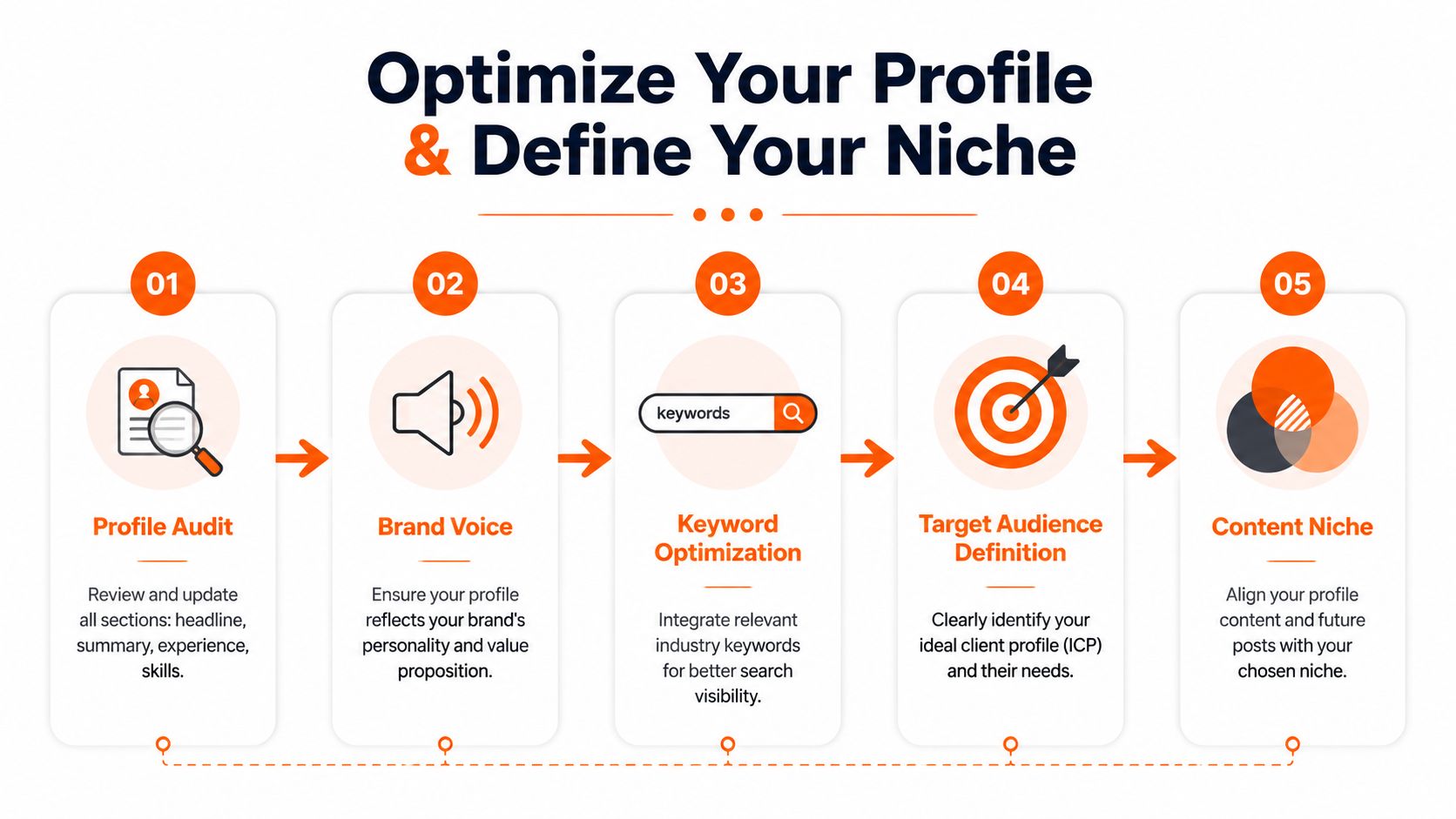
Optimize Your Profile and Define Your Niche Audience
A prospect sees one of your comments, clicks through, and spends ten seconds on your profile. In that short window, they decide whether you sound like someone who understands their business or someone testing a growth tactic.
Make the profile earn the click
Comments create the visit. The profile has to convert that visit into a connection request, a reply, or at minimum name recognition the next time you show up in their feed.
Start by removing resume language. A founder, consultant, or GTM operator using a comment-first LinkedIn motion needs a profile that reads like a clear market position, not a job history with nicer formatting. If your comments sound sharp but your profile sounds generic, trust drops fast.
A profile that supports lead generation does four things well:
- Names the buyer and problem clearly. The right person should recognize themselves in seconds.
- Shows a point of view. Say how you approach the problem, especially if your method includes comments-first distribution, AI-assisted workflow, or another specific operating model.
- Matches your actual voice. This matters even more if you use a voice-trained AI comment agent. The agent can only stay safe and believable if your source material sounds like you.
- Gives a next step. Make it obvious whether you want profile visitors to follow, connect, book time, or send a message.
Teams often get sloppy with AI. They train an agent on polished website copy, then write comments in a different tone, then send DMs that sound different again. The fix is simple. Train on founder posts, sales call notes, customer emails, and strong comment examples. Then tighten the profile to match. If you want a practical checklist, this LinkedIn profile optimization guide covers the parts that affect conversion from profile views to conversations.
Your profile should answer one question without making the buyer work for it. Why should this person be in my network?
Define a niche that the market will recognize
Broad targeting weakens the entire motion. It weakens your comments because they become safe and generic. It weakens your connection requests because they lack context. It also makes AI less useful, since a voice-trained system performs better inside a narrow set of pains, terms, and buyer objections.
Pick one commercial lane first. Then stay there long enough to learn the language.
A workable niche usually includes:
- A specific company type. Industry alone is too loose. Add business model, size, or maturity.
- A specific buyer group. Name the function and seniority level.
- A recurring pain. Use the problem they already talk about publicly.
- A trigger. Hiring, fundraising, team restructuring, new tooling, market pressure, or a shift in strategy all create openings for relevant engagement.
For example, “B2B SaaS” is too wide. “VC-backed B2B SaaS companies with 20 to 100 employees, targeting heads of marketing and founders dealing with low outbound reply rates” gives you something you can work with.
Build a target account list around people, not just companies
Random commenting creates random outcomes. A comment-first program gets better when the team knows exactly whose posts matter, what they care about, and where each person sits in the Visibility-Connection-Conversion path.
I usually start with a focused list of named buyers rather than a giant account spreadsheet. For a single rep or founder-led motion, a list around 50 to 75 active decision-makers is manageable enough to track and large enough to produce repeat exposure. SalesBread makes a similar point in its account-based prospecting guidance. Small, well-researched target lists outperform bloated lists because reps can personalize outreach and stay relevant over time, not just touch more names once. Their team explains that trade-off in its ABM prospect list advice.
That target list becomes your operating system. Track who posts often, who never posts but comments heavily, who engages with industry creators, and who is already connected to customers or investors in your circle.
Use a simple structure:
- Tier 1: High-fit decision-makers you want in active rotation
- Tier 2: Adjacent buyers and champions
- Tier 3: Industry voices that help you earn visibility with the same audience
This is also where the Visibility-Connection-Conversion framework starts paying off. Visibility comes from showing up in the right conversations. Connection comes from repeated relevance with the same buyers. Conversion only has a chance if the first two steps are deliberate.
Use metrics that tie niche quality to pipeline quality
A narrow audience feels slower at first. It usually performs better after a few weeks because the signal improves. You see the same names, the same objections, and the same language patterns often enough to sharpen your comments and outreach.
The metrics worth watching here are not follower growth or profile views on their own. Track profile-view-to-connection rate, connection-to-reply rate, and how many sales conversations can be traced back to a target account that engaged with your comments or profile before the first DM.
LinkedIn's own B2B research supports the bigger point. The platform reports that brands with stronger relevance and trust with their buying committee see better buying outcomes over time, especially as more stakeholders influence each deal, according to LinkedIn's B2B Institute research on the 95-5 rule and buyer readiness. That is why niche definition matters. You are not trying to reach everyone who could buy. You are trying to stay visible with the small group that is likely to buy soon, and credible with the larger group that will enter market later.
Done well, this section of the system looks simple from the outside. Clear profile. Tight ICP. Named decision-makers. Consistent voice. Under the hood, that structure is what makes a safe AI comment agent useful instead of risky.
Master Comments-First Engagement and Posting Strategies
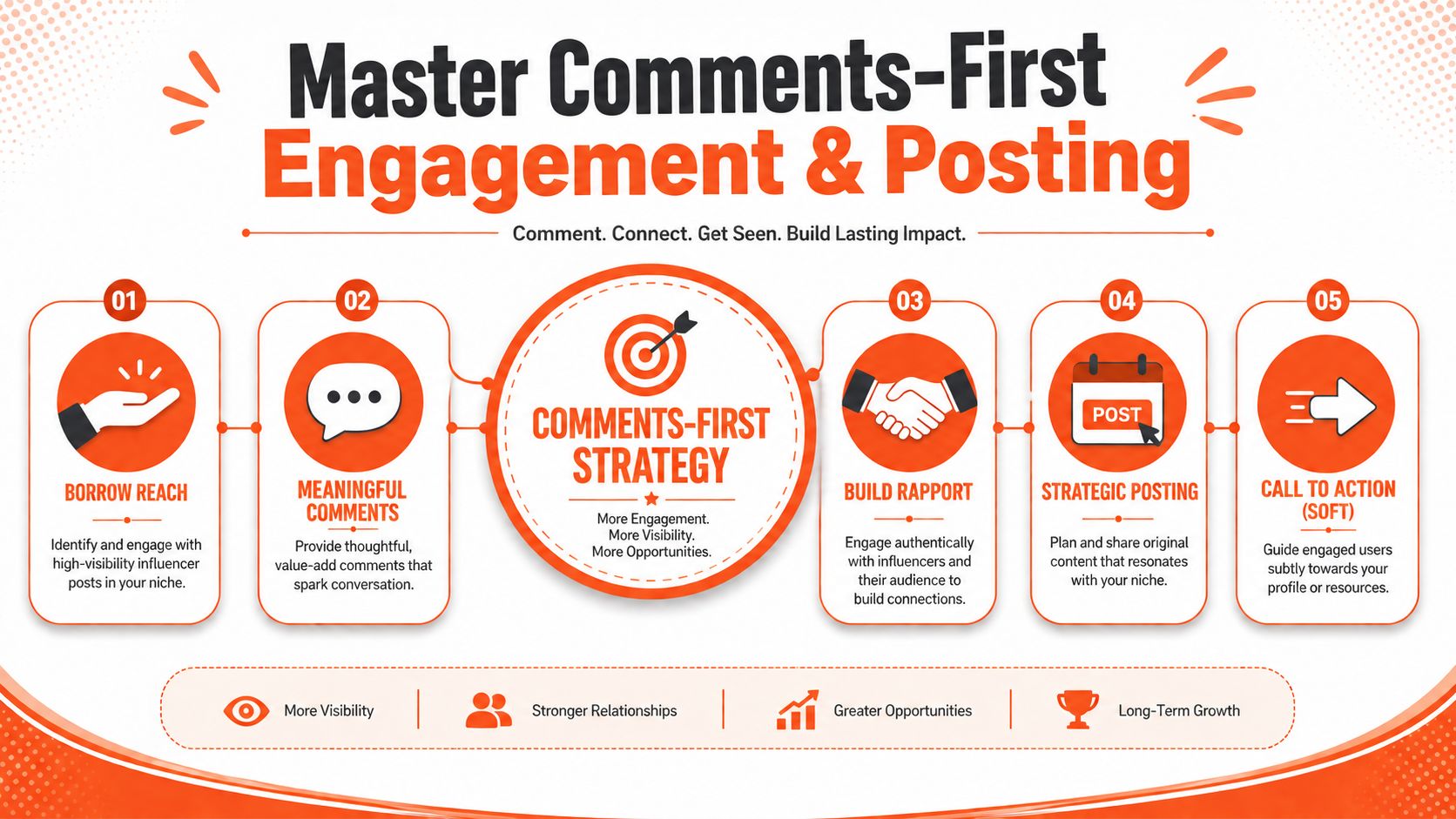
Posting has a role, but comments do the heavy lifting early. They put your thinking in front of established audiences without waiting for your own feed distribution to catch up.
Use borrowed reach before you chase replies
The cleanest framework I've seen for B2B lead generation on LinkedIn is the Visibility-Connection-Conversion model. It allocates 70% of comments to high-visibility influencer posts, 20% to target prospects' posts, and 10% to direct conversion comments, with commenting in the first 30 to 60 minutes driving the most reach. It also recommends directing at least 90% of total commenting activity to confirmed decision-makers matching your ICP. That framework comes from Commenter.ai's LinkedIn commenting strategy research.
That split matters because each comment type does a different job:
- Influencer-post comments create visibility.
- Prospect-post comments create familiarity.
- Conversion comments only work after the first two steps are already in place.
If teams skip straight to conversion, they usually end up pitching in public or DMing too soon.
A short explainer is worth watching before building your routine:
Write comments that behave like micro-posts
A good comment isn't applause. It's a compact idea. The most useful formulas are A-V-Q which stands for Acknowledge, Value-Add, Qualifying Question, and Affirm + New Data + Open Question.
A few examples:
- On an influencer post about outbound quality: “Strong point on sequence fatigue. What I've seen work better is tightening message context around one commercial trigger instead of rewriting the whole script. Are you seeing the same pattern with founder-led outbound?”
- On a prospect post about hiring sales reps: “Hiring faster often exposes onboarding gaps before it fixes pipeline. One thing I'd watch is whether new reps can explain the category in the same language as leadership. How are you handling message consistency today?”
- On a product-led growth thread: “Agreed on activation being more important than raw signups. The teams I trust here usually separate curiosity actions from intent actions before they change onboarding. Which product signal matters most in your motion?”
In a study of 16,000 LinkedIn comments, the biggest engagement drivers were timing, relevance, and a clear hook, and comments that add a specific point or end with a genuine question pulled people back into the thread, while generic praise rarely earned a response, according to the Linqin comment study.
The fastest way to waste a comments-first strategy is to sound agreeable but forgettable.
Turn comment momentum into posts
Your posts should echo what already works in comments. If buyers respond to your short takes on attribution, outbound quality, or hiring mistakes, turn those into standalone posts. Don't write in a different tone just because it's “content.”
A simple operating rhythm works well:
- Comment first in the morning when target conversations are fresh.
- Save replies that spark discussion because they show what your market cares about.
- Convert the strongest angle into a post later, using the same language and tension.
For execution support, a tool like Linqin's commenting strategy guide can help structure the workflow, especially if you're trying to align comments and posts in one system.
Build Outreach Sequences and Apply Automation Safely
A common failure pattern looks like this. A founder leaves a smart comment, gets a profile view, sends a connection request, and follows it the same hour with a demo ask. The prospect accepts the connection and goes silent.
The problem is not outreach itself. The problem is sequence design.
Sequence outreach around Visibility, Connection, and Conversion
Comments-first lead generation works better when each step has one job.
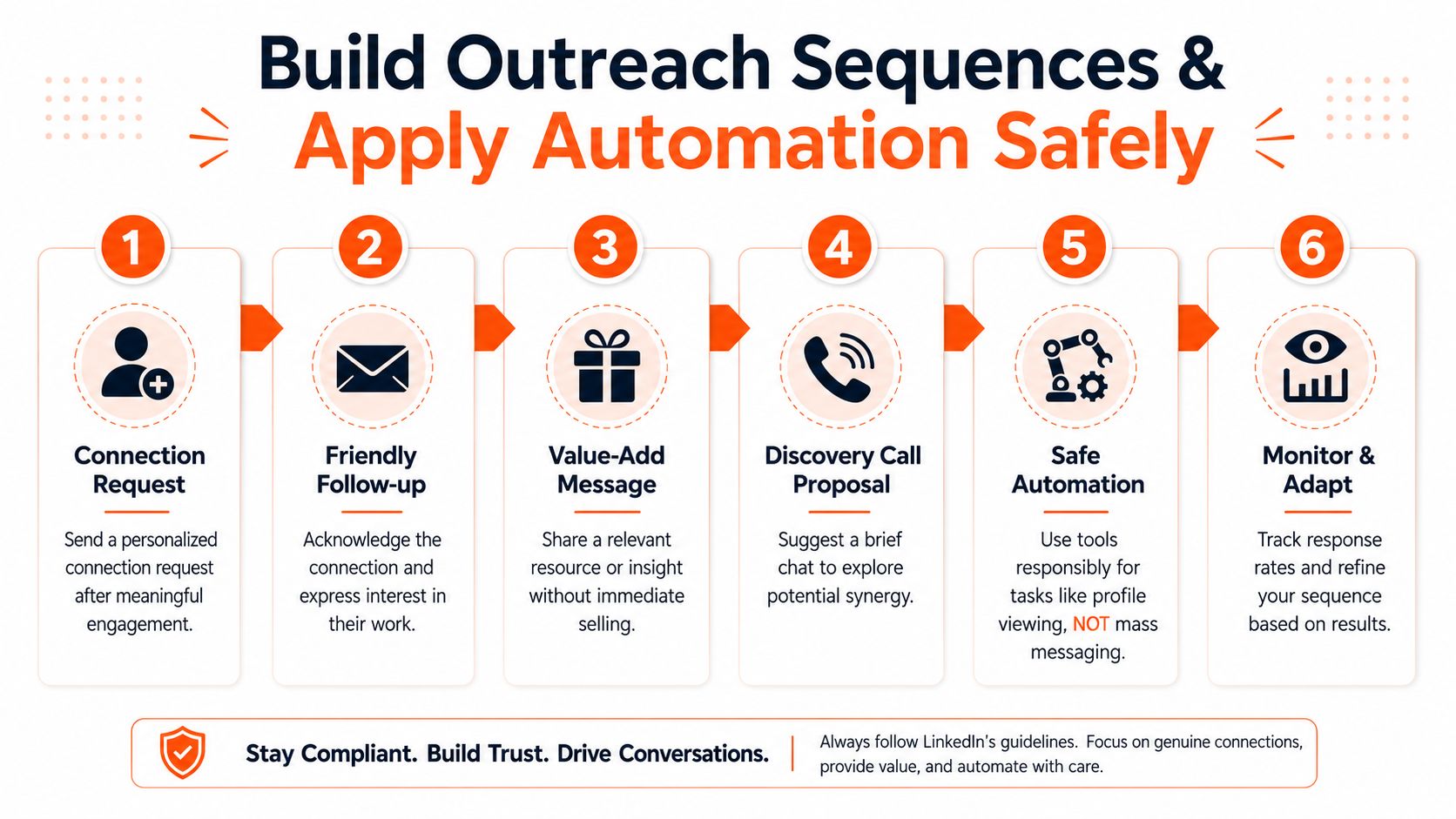
Visibility comes first. The prospect sees your name in a relevant thread and gets a clear signal that you understand their topic. Connection comes next. Your request references a shared discussion, not a cold pitch. Conversion comes last, after a few days of familiar, low-friction interaction.
That order matters because LinkedIn buyers respond to continuity. If the comment discusses onboarding friction and the DM suddenly pushes a meeting, the thread breaks. If the message continues the original point, reply rates usually improve.
A practical sequence looks like this:
- Visibility: Leave a specific comment with a point of view, example, or question tied to their post.
- Connection: Send a connection request that references the thread in plain language.
- Context: After they accept, send a short follow-up that adds one useful idea, resource, or observation.
- Conversion: Once there has been light back-and-forth and a little time has passed, ask whether a conversation would help.
I usually advise teams to leave a gap between the connection acceptance and the pitch. Industry sales guidance generally points to a short nurturing window of a few days, often around three to five, before asking for a call. The exact timing depends on intent. Someone who replied twice in the comments can move faster than someone who only accepted the request.
Write messages that continue the thread
The best outbound messages on LinkedIn read like part two of an existing conversation.
A weak follow-up says, “Thanks for connecting. We help B2B teams generate more leads. Open to a quick chat?” That resets the relationship to zero. A stronger follow-up says, “Your point about demo quality over volume was interesting. We've seen the same pattern when teams separate comment engagement from DM conversion. Curious whether your reps track that split today.”
The second version works because it keeps context alive. It also gives your voice-trained AI agent a safer job. Instead of inventing rapport, it can draft from real interaction history, the original post, and your approved messaging patterns.
If you need examples, this LinkedIn DM outreach strategy guide is useful for adapting message structure without turning every follow-up into a template.
Use automation for consistency, not impersonation
Automation is useful on LinkedIn. It saves time on queueing, reminders, and first-draft preparation. It causes problems when teams use it to fake judgment.
That trade-off gets missed all the time. A safe setup helps a founder or rep show up consistently in the right conversations. A risky setup posts generic comments, sends rigid follow-ups, and creates patterns that buyers and the platform can spot quickly.
The safer model is a voice-trained AI comment agent with clear controls. It should read the full post, draft in the account owner's normal tone, stay inside approved topics, and hand off anything sensitive for review. That supports the Visibility stage without damaging trust. Then your workflow can trigger Connection and Conversion steps only when there is an actual signal such as a reply, profile view, or accepted request.
Use this line carefully:
| Use case | Safe approach | Risky approach |
|---|---|---|
| Comment drafting | Draft from full post context and approved voice examples | Reuse the same compliment template |
| Timing | Vary actions based on normal working patterns | Run actions at identical intervals |
| Review | Require approval for high-value accounts or edge cases | Put every account on full autopilot |
| Messaging | Trigger follow-ups after real engagement signals | Blast DMs to new connections with no context |
The goal is measurable ROI, not activity volume. A structured Visibility, Connection, Conversion system gives automation a narrow role it can handle well. Your team still owns judgment, positioning, and the final ask.
Capture Leads Track Metrics and Measure ROI
A founder comments on ten ICP posts in a week, gets a spike in profile views, adds a few new connections, and books one meeting. If the team cannot trace that meeting back to the comment, the result gets written off as “organic.” That is how LinkedIn programs lose budget even when they are working.
Comments-first lead generation needs a clean measurement path from Visibility to Connection to Conversion. A safe, voice-trained AI comment agent can help create the first touch at scale, but ROI only becomes visible when every downstream signal is captured with context.
Measure the full Visibility, Connection, Conversion path
Start with the event that created attention. Log the exact comment, the post URL, the author, the date, and the angle you used. Then track what happened next: profile visit, connection request, reply, DM, meeting, opportunity.
That sounds basic. In practice, B2B teams often miss one of two things. They either track social engagement with no pipeline tie-in, or they force attribution into the CRM after the fact and lose the original context that explains why the interaction worked.
A working record usually includes:
- Visibility source: the specific comment, post, or thread that created attention
- Buyer context: account name, role, seniority, and ICP fit
- Connection signal: profile view, accepted request, reply, or inbound DM
- Conversion outcome: discovery call, qualified opportunity, pipeline value, closed revenue
The comment matters. The context matters more. “Commented on a demand gen post” is weak data. “Commented with a contrarian view on SDR handoff friction, prospect viewed profile within two hours, accepted connection next morning, replied after case study follow-up” is data a team can effectively use.
Track leading indicators before pipeline shows up
Pipeline is the endpoint, not the first sign that the program is healthy. In the first few weeks, watch for leading indicators that show your comments are pulling qualified attention from the right people.
LinkedIn's own guidance on profile strength and discovery supports using profile views and search appearances as early visibility signals, because they show whether your activity is driving people back to your profile rather than dying in the feed (LinkedIn profile optimization guidance).
For comment-first programs, the useful leading indicators are:
| Metric | What it shows | How to use it |
|---|---|---|
| Profile views from ICP accounts | Your comments are creating enough curiosity to earn a second look | Check job titles and company fit, not just volume |
| Inbound connection requests | Visibility is turning into buyer intent | Separate peer requests from target-account requests |
| Reply rate after accepted connection | Your follow-up is relevant enough to continue the conversation | Review by persona and comment angle |
| Meetings from comment-originated conversations | Public engagement is producing sales activity | Compare against other LinkedIn-sourced meetings |
Use benchmarks carefully
Benchmark tables are useful for sanity checks, but they can also push teams into fake precision. A founder-led motion and an SDR-led motion will not have the same conversion pattern. Commenting on category posts will produce different signals than commenting on bottom-of-funnel operator content.
What holds up across setups is the sequence. Public relevance comes first. Then a connection signal. Then a direct conversation. Industry guidance from LinkedIn's sales resources and third-party sales research consistently points to warm outreach outperforming cold, context-free messaging, which is why a short nurture period after visible engagement usually performs better than pitching immediately (LinkedIn Sales Solutions, HubSpot sales outreach research).
The practical lesson is simple. Do not optimize for raw comment volume. Optimize for qualified profile views, accepted connections, replies, and meetings from target accounts.
Build attribution your team will actually maintain
The best measurement model is the one reps will update without being chased. Keep it light.
A simple setup can live in your CRM or a spreadsheet with these fields:
- Prospect name and company
- ICP tier
- Comment URL or thread reference
- Comment angle or theme
- Date of first public engagement
- Connection status
- Reply status
- Meeting booked
- Opportunity created
- Revenue outcome
Add one more field if you use AI in the workflow: drafted by AI or written manually. That gives you a clean way to compare output quality, acceptance rates, and downstream results without guessing. It also helps you audit whether your voice-trained agent is creating useful first-touch visibility or just increasing activity counts.
Hooktide's review of LinkedIn lead generation makes a point many guides skip. Borrowed reach from comments can create exposure quickly, especially for startups without a large audience, but the ROI disappears from view when teams fail to instrument the path from engagement to pipeline.
That is the gap to fix. Capture the origin, track the signal, and tie the conversation to revenue. Once that system is in place, the strongest comment patterns become obvious and the weak ones stop wasting team time.
Scale Your Program with Teams and Employee Advocacy
A solo founder can prove the model. A team can turn it into coverage. Those are different jobs.
Build a team system instead of a founder habit
When companies scale B2B lead generation on LinkedIn, they usually fail in one of two ways. Either everyone posts and comments in different voices, or all activity gets centralized and becomes bottlenecked behind one person.
A better setup uses shared guardrails with distributed execution. That means a common brand kit, a short voice guide, approved positioning, and a lightweight review process for sensitive accounts. Sales, marketing, and leadership don't need identical writing styles, but they do need the same commercial narrative.
A workable team model includes:
- Shared messaging rules so employees describe the category and pain points consistently.
- Role-based prompts so SDRs, founders, recruiters, and marketers all comment from their real perspective.
- Approval workflows for high-visibility posts or automated drafts that touch sensitive accounts.
- Central reporting so leadership can compare outputs across individuals without flattening everyone into one style.
This is also where employee advocacy becomes useful. Give team members prompts that fit their job. A founder can comment on market shifts. A sales lead can comment on qualification mistakes. A recruiter can engage around hiring trends and role transitions. That widens reach without making the program feel manufactured.
Evaluate agents like operators do
If AI agents are part of the stack, evaluate them on operational performance, not novelty. The practical benchmarks are straightforward. LinkedIn's guidance on assessing AI agents recommends measuring task completion rate to confirm the agent completes full workflows, plus latency metrics because response speed still matters in production.
That applies cleanly to LinkedIn execution:
- Task completion rate asks whether the agent found the right post, generated a usable comment, logged the action, and handed off the lead context.
- Latency asks whether the draft arrived fast enough to comment while the thread still had momentum.
One tool option in this category is Linqin, which combines voice training, comment and post drafting, lead tracking, analytics, and team features like approval workflows and company-level reporting. The useful part of that model isn't just automation. It's having one system for voice consistency, action logging, and warm-lead context across multiple users.
Conclusion and Next Steps
LinkedIn becomes a dependable B2B channel when you stop treating it like a random publishing platform and start treating it like a structured engagement system. The difference is discipline. Strong profiles convert clicks into trust. Tight ICP definition keeps activity focused. Comments create reach and familiarity. Sequenced outreach turns recognition into replies. Tracking closes the loop so you can see which actions influence pipeline.
The overlooked edge is combining that framework with a safe, voice-trained AI comment agent. Not to blast more activity, but to keep the cadence steady, adapt to your real tone, and make every action attributable. That's what turns B2B lead generation on LinkedIn from a founder hobby into an operating motion.
If your current approach depends on posting when inspiration shows up, you'll keep getting uneven results. If you build around targeted comments, measured follow-up, and real attribution, LinkedIn starts compounding.
Ready to grow LinkedIn while you sleep? Try Linqin to deploy a voice-trained AI agent, keep your comment-first workflow consistent, and turn LinkedIn engagement into measurable leads.