You've probably done the hard part already. Your LinkedIn profile is updated, your headline is sharp, your experience section is credible, and you're starting to think seriously about your next role or your personal brand. Then you reach the part that still looks thin: recommendations.
That gap matters more than is commonly assumed. A polished profile without strong recommendations can feel self-reported. Recruiters, hiring managers, and clients often want a signal that another professional has seen your work up close and is willing to put their name behind it.
The catch is that most advice on how to ask for recommendation on LinkedIn is too generic. It treats every recommendation as if it carries the same value. It doesn't.
Table of Contents
- Why Not All LinkedIn Recommendations Are Created Equal
- Laying the Groundwork Before You Ask
- Crafting the Perfect Recommendation Request
- Message Templates for Any Professional Relationship
- Navigating Post-Request Etiquette and Follow-Ups
- Amplify Your Social Proof and Grow on Autopilot
Why Not All LinkedIn Recommendations Are Created Equal
A lot of people assume the goal is simple: get as many recommendations as possible. That's the wrong target.
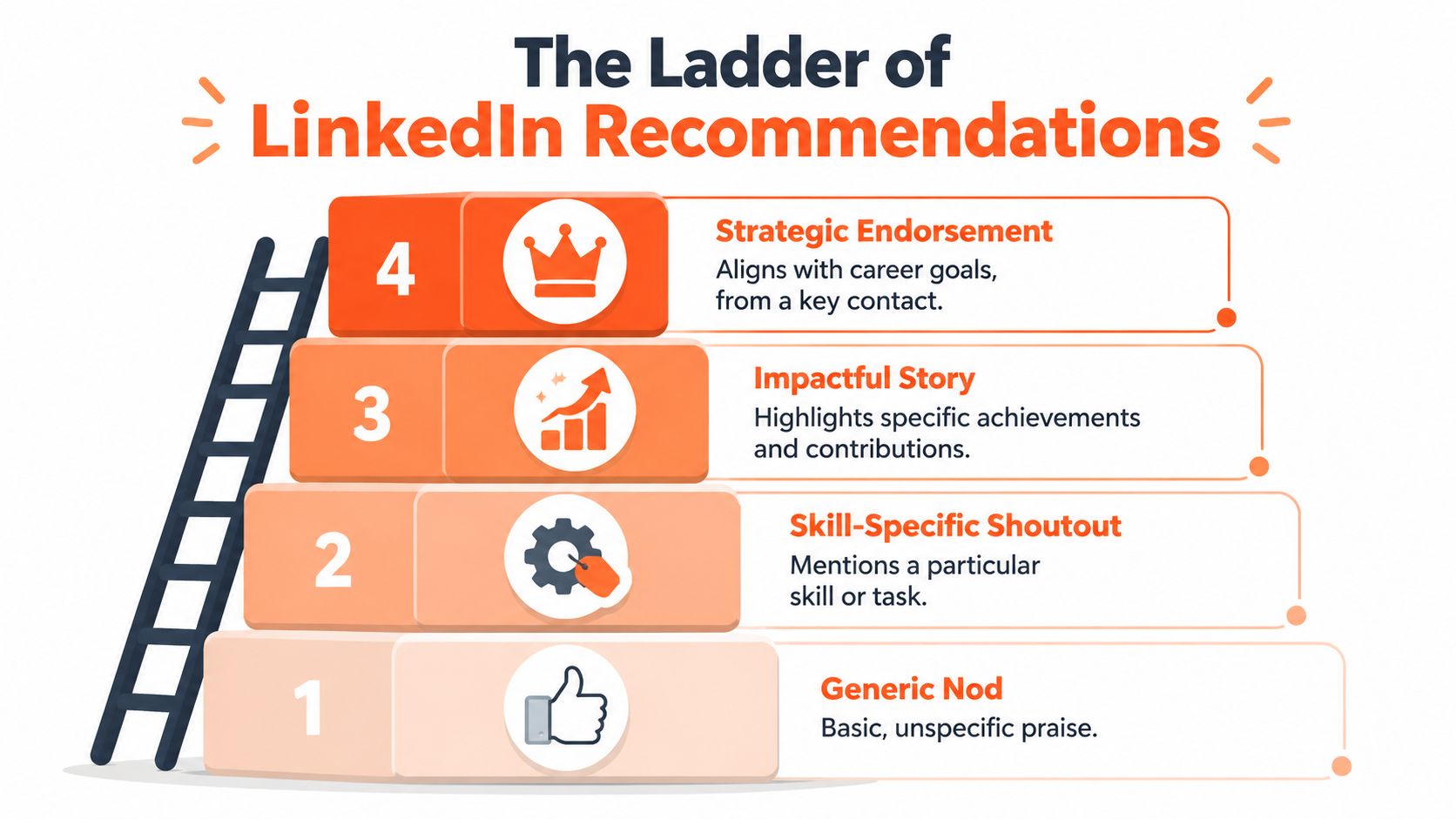
What helps is getting the right recommendations from the right people, written in a way that reinforces the role you want next. LinkedIn recommendations are social proof, but social proof has tiers. A vague compliment from someone who barely worked with you doesn't carry the same force as a direct manager describing what you delivered and how you worked.
The biggest mistake I see is treating recommendations like decorative profile filler. They're not. They shape credibility, keyword relevance, and how another person interprets your experience.
A stronger way to think about recommendations is this:
- Generic nods look nice but say very little.
- Skill-specific praise starts to add signal.
- Story-based endorsements create trust because they sound lived-in and real.
- Strategic endorsements do the most work because they come from a credible source and align with the role you want.
Practical rule: Don't ask, “Who might say yes?” Ask, “Whose endorsement would actually change how a recruiter reads my profile?”
That distinction matters because recent guidance tied to LinkedIn job search visibility says manager-verified recommendations carry 2.3x more ranking weight in job search results, and a Coursera 2025 study cited in the same discussion found that profiles with manager endorsements receive 68% more inbound recruiter messages than profiles with only peer recommendations. That's the core reason to prioritize manager requests when possible, especially if you're job searching in a competitive market. The reference appears in the University of Arizona career article discussing LinkedIn recommendation strategy.
That doesn't mean peer or client recommendations are weak. It means they serve a different purpose. Peer recommendations often validate collaboration. Client recommendations strengthen commercial credibility. Recommendations from people you mentored or managed can reinforce leadership. But if you can secure a well-written recommendation from a former manager, that should usually move to the top of your list.
Those looking for advice on how to ask for a recommendation on LinkedIn often seek specific wording. While wording is important, the true advantage begins before you type a single message.
Laying the Groundwork Before You Ask
A weak recommendation request usually starts long before the message. It starts with the wrong person, sent at the wrong time, attached to a profile that does not clearly support the story you want told.
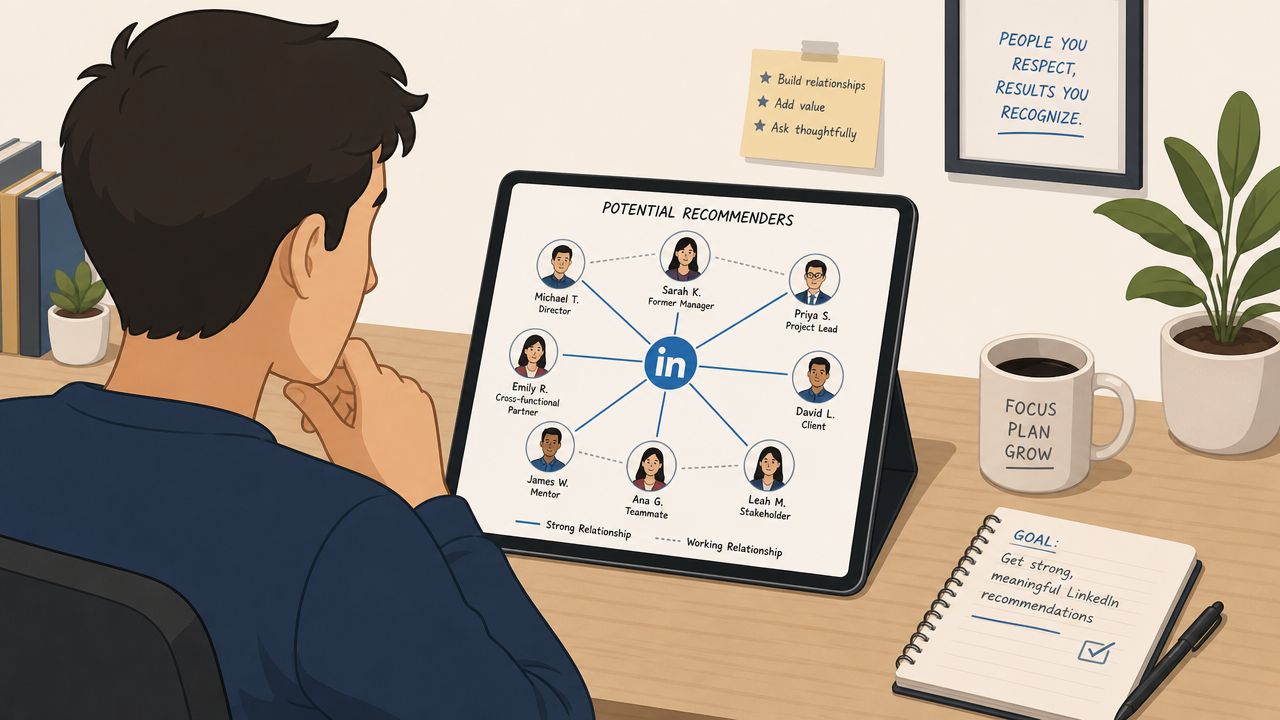
If your goal is job search visibility, do not treat every potential recommender as equal. A recommendation only helps if the writer can describe your work with enough specificity to sound credible, and if their relationship to you strengthens the signal recruiters care about. For many professionals, that means starting with people who managed your work directly, then filling in the rest of the picture with peers, clients, or direct reports.
Choose for credibility, not convenience
The fastest way to get a recommendation is to ask the person most likely to say yes.
That is not always the best move.
A former manager who can speak to performance, judgment, and readiness for a bigger role will usually add more search value than a friendly contact who barely saw your work. Peer recommendations still help. Client recommendations can be excellent for consultants, account leaders, and customer-facing operators. Direct reports can reinforce people management and coaching ability. The point is to build a recommendation set with intention, not collect generic praise.
Use this filter before you ask:
- Former manager: Best for authority, performance, and promotion-readiness.
- Peer or cross-functional partner: Best for collaboration, reliability, and execution.
- Client or stakeholder: Best for trust, communication, and business impact.
- Direct report or mentee: Best for leadership style, coaching, and team influence.
If you only plan to get three recommendations, a strong mix is usually one manager, one peer, and one client or direct report. That combination gives recruiters multiple angles without making your profile feel repetitive.
Ask while the evidence is fresh
Timing affects quality more than people expect. The best recommendation requests arrive when the other person can still remember the problem, your role, and the result without digging through old emails.
Good moments include:
Right after a project finishes well
A launch, turnaround, migration, renewal, or high-stakes presentation gives the writer a clear reference point.Right after specific praise
If a manager mentions your ownership in a review, or a stakeholder thanks you for handling a difficult situation, ask while that language is still fresh.During a transition
Team changes, company exits, and contract completions are natural moments to document the working relationship.
I generally tell clients to ask within a few days of a visible win, not six months later. Warm feelings fade slowly. Specific examples disappear fast.
Make it easy for someone to endorse the right story
Before you ask, check whether your profile supports the recommendation you want. If your headline says one thing, your About section says another, and your recent experience is written in vague internal jargon, even a strong recommendation loses force.
This matters even more if you are repositioning. Someone moving from individual contributor to manager, from in-house to consultant, or from one industry to another needs the profile and the recommendation to point in the same direction. A quick review of this LinkedIn profile optimization guide for stronger positioning before you request endorsements can help you tighten the headline, About section, and experience entries so recommenders know what they are validating.
Set up the recommendation before you request it
Good recommendation requests rarely come out of nowhere. If the relationship has gone quiet, reestablish contact first. Share an update. Mention the project you worked on together. Give them an easy reminder of the context.
There is also a trade-off here. Some people prefer to write a recommendation first because it creates goodwill and often prompts reciprocity. That can work well with trusted peers, former clients, or long-term collaborators. With a former manager, I usually prefer a direct ask if the relationship is solid. It feels cleaner, and it avoids making the exchange sound transactional.
One more practical rule. Do not ask someone who liked you personally but only saw a fraction of your work, especially if you are targeting competitive roles. Polite but vague recommendations fill space. Specific recommendations shape perception.
Crafting the Perfect Recommendation Request
A weak LinkedIn request creates extra work. A strong one gives the other person enough context to write something specific, credible, and useful for the roles you want next.
That difference matters more than many job seekers realize. If you want recommendations that help search visibility and recruiter response, ask for firsthand proof of work from people whose title and relationship to you carry weight. A short note from a former manager who can speak to outcomes, scope, and trust usually does more for your profile than a warm but generic blurb from a casual colleague.
What a strong request includes
The best requests do four jobs at once. They explain why you are asking now, remind the person what they saw directly, point them toward the themes that support your target role, and make it easy for them to decline if timing is bad.
Here is the difference in practice.
Weak:
“Hi, could you write me a LinkedIn recommendation?”
Stronger:
“Hi [Name], I'm updating my LinkedIn profile because I'm targeting senior project roles this quarter. You had direct visibility into my work on the product migration, so I wanted to ask if you'd be open to writing a recommendation. If helpful, a note on stakeholder coordination or delivery under pressure would be especially relevant.”
That request works because it answers the questions the other person would otherwise have to figure out alone. Why now? Why me? What part of your work should I focus on?
A useful request usually includes:
A timely reason
Mention the job search, promotion path, career pivot, or profile update that makes the request relevant now.A shared example
Reference a project, team, account, launch, or problem you worked through together.A focused prompt
Suggest one or two strengths that fit your target positioning, such as team leadership, client communication, revenue ownership, or cross-functional execution.A low-pressure close
Give them room to say no. Busy professionals respond faster when the ask feels respectful, not loaded.
For example:
“Would you be open to writing a recommendation based on our work during the CRM rollout? I'm positioning myself for operations roles, so any mention of cross-functional coordination, process improvement, or stakeholder management would help. No pressure at all if now is not a good time.”
Guide the content without writing it for them
This is the part many professionals mishandle. They either give no direction and get a vague recommendation, or they over-script the message and make the request feel transactional.
Good guidance refreshes memory and sharpens relevance. It does not try to control the wording.
Use language like:
- “If useful, you could mention the onboarding redesign project.”
- “I'd especially value your perspective on how I handled client communication during that period.”
- “I'm aiming for product marketing roles, so any reference to messaging work, launch planning, or cross-team collaboration would fit well.”
Avoid language like:
- “Please say I'm exceptional at leadership and strategy.”
- “Can you describe me as impactful?”
- “Could you include these exact phrases?”
The trade-off is simple. More guidance usually improves relevance, but too much guidance reduces authenticity. On LinkedIn, authenticity matters because readers can spot inflated language fast, and recruiter trust drops when recommendations sound ghostwritten.
Ask for evidence, not praise
The highest-value recommendations are built on examples. A hiring manager scrolling your profile does not need another vague statement that you were “great to work with.” They need signals that map to hiring risk. Did you lead a launch? Calm a difficult client? Improve a process? Own a KPI? Build trust across teams?
That is why the request should orient the recommender toward observable facts.
A better prompt sounds like this:
“If you're open to it, I'd really appreciate anything you can share about the turnaround work we did on the enterprise account, especially how I handled client communication and kept the renewal on track.”
That kind of recommendation is more persuasive because it gives future employers something concrete to believe.
What usually fails
Poor requests tend to break down in predictable ways.
| Mistake | Why it hurts | Better move |
|---|---|---|
| Generic ask | The recommender has to reconstruct everything from memory | Name the project, team, or period you shared |
| No clear reason | The request feels random or low priority | Explain why you are asking now |
| Too many talking points | The final recommendation becomes scattered | Focus on one or two themes tied to your target role |
| Over-scripted language | The recommendation sounds forced | Prompt with examples, not exact wording |
| No easy out | People delay instead of declining | Close with a simple, polite release valve |
One more practical point. If you are sending this through LinkedIn messages, keep it tight. Long asks get postponed. A concise note with a clear reason and one relevant prompt performs better, especially if you already use a LinkedIn DM outreach strategy that keeps messages short and specific.
Respect the other person's time. That alone improves your odds of getting a recommendation that reads like real professional proof, not profile filler.
Message Templates for Any Professional Relationship
Templates work best when you treat them like a starting point, not a script. The strongest recommendation requests still sound like you, and they still fit the relationship.
LinkedIn recommendation request templates
| Relationship | Template | Strategic Focus |
|---|---|---|
| Former manager | Hi [Name], I hope you're doing well. I'm updating my LinkedIn profile and wanted to ask if you'd be open to writing a recommendation because I'm targeting [role type] roles and you had a direct view of my work on [team/project]. If helpful, it would be great if you could mention how I handled [specific responsibility], especially around [leadership/KPI ownership/cross-functional execution]. No pressure at all if your schedule is packed. | Prioritizes authority and firsthand evaluation. Best for roles where recruiter trust matters most. |
| Peer or colleague | Hi [Name], I've been refreshing my LinkedIn profile and thought of our time working together on [project/team]. Would you be open to writing a recommendation because your perspective on how I collaborate day to day would mean a lot? If anything comes to mind, I'd especially appreciate mention of [teamwork/problem solving/communication]. Happy to return the favor as well. | Pulls out collaboration signals that managers often don't mention in detail. |
| Client or stakeholder | Hi [Name], I really appreciated the chance to work together on [engagement/project]. I'm updating my LinkedIn presence and wanted to ask whether you'd be comfortable writing a recommendation because your view of the business side of our work would be especially valuable. If useful, you could speak to [responsiveness/clarity/problem solving/working style]. Only if it feels natural. | Builds outside-in credibility. Strong for consultants, freelancers, account leads, and customer-facing roles. |
| Recruiter or hiring contact | Hi [Name], I appreciated how smoothly you managed the process when we worked together around [role/company/process]. I'm refreshing my LinkedIn profile and wanted to ask if you'd be open to writing a brief recommendation because your perspective on communication and professionalism through the hiring process would be helpful. No pressure if that's outside your usual practice. | Useful when the recruiter had enough interaction to comment on professionalism, preparation, and follow-through. |
A few notes on what makes these work:
- The tone is specific but not needy.
- Every template includes because, which gives the request a reason.
- Each one gives the other person a clear lane rather than asking for a generic endorsement.
- None of them sound like they were copied from LinkedIn's built-in prompt.
If you're sending these through direct message first, it helps to keep the tone conversational. If you're using LinkedIn's request feature after that, your message can be shorter because you've already provided context. For that kind of outreach, a strong LinkedIn DM outreach strategy guide can help you avoid stiff, transactional messages.
One more practical point. Manager requests deserve extra care. Don't just ask them to say you were great. Ask them to reflect what they directly observed: ownership, judgment, consistency, leadership under pressure, and the kind of work they trusted you with when stakes were high.
Navigating Post-Request Etiquette and Follow-Ups
Sending the request isn't the finish line. People get busy, messages get buried, and good intentions slip.
You don't need to hover, but you do need a professional follow-up habit.
When to follow up
A good rule is to wait one to two weeks before checking in. That window is long enough to show patience and short enough that the request is still familiar.
A follow-up should feel light, not guilty-making. Something like this works:
Hi [Name], just wanted to follow up on my LinkedIn recommendation request in case it got buried. No rush at all, and no pressure if now isn't a good time. I appreciated our work together and thought your perspective would be especially meaningful.
That message works because it does three things well. It reminds them. It gives them an out. It keeps the relationship intact even if they never complete it.
If they respond positively but seem stuck, offer help. You can send a few bullets about the project, remind them of the shared context, or point them toward the themes that matter most for your next role.
What to do after they write it
Once a recommendation comes in, move quickly and act like a professional.
- Approve it promptly: Don't leave thoughtful recommendations sitting in limbo.
- Send a private thank you: A direct message or email is better than silence.
- Offer reciprocity: If appropriate, write one for them too.
- Check alignment: Make sure the recommendation supports the story your profile is telling.
A recommendation that's kind but generic doesn't have to be featured if it weakens your positioning. You're allowed to be selective. The point isn't to collect compliments. The point is to build a profile that reads as credible, coherent, and relevant.
Amplify Your Social Proof and Grow on Autopilot
Recommendations help, but they still need visibility. A strong endorsement buried on a quiet profile won't do as much as it should.
LinkedIn rewards consistent activity. One recent content note says users need to post four to five times per week while mixing formats such as text, carousels, videos, and polls to avoid algorithmic stagnation, based on this LinkedIn post about platform performance. That's a real workload for people with full-time jobs.
Recommendations need visibility to do their job
There's also a speed component. Guidance from LinkedIn's content education says early interaction matters, and responding to comments within the first hour after posting helps trigger stronger distribution. You can read that in LinkedIn's guidance on driving meaningful engagement in comments.
That's the practical bottleneck. Most professionals can ask for recommendations, polish their profile, and post once in a while. Very few can maintain the daily consistency that keeps those signals in front of the right people.
If you want the broader system for building visibility around your credibility markers, this LinkedIn personal branding growth guide is a useful next read.
The professionals who get the most from LinkedIn usually combine both sides of the platform. They build proof on the profile itself, and they stay active enough that people see it.
Ready to grow your LinkedIn presence while you sleep? Linqin helps professionals build visibility through AI-assisted commenting, posting, and lead tracking so the credibility you've worked hard to earn gets seen by the right audience. If you want to grow LinkedIn while you sleep, try Linqin and sign up free at grow your LinkedIn while you sleep.