The LinkedIn Growth Landscape in 2025–2026
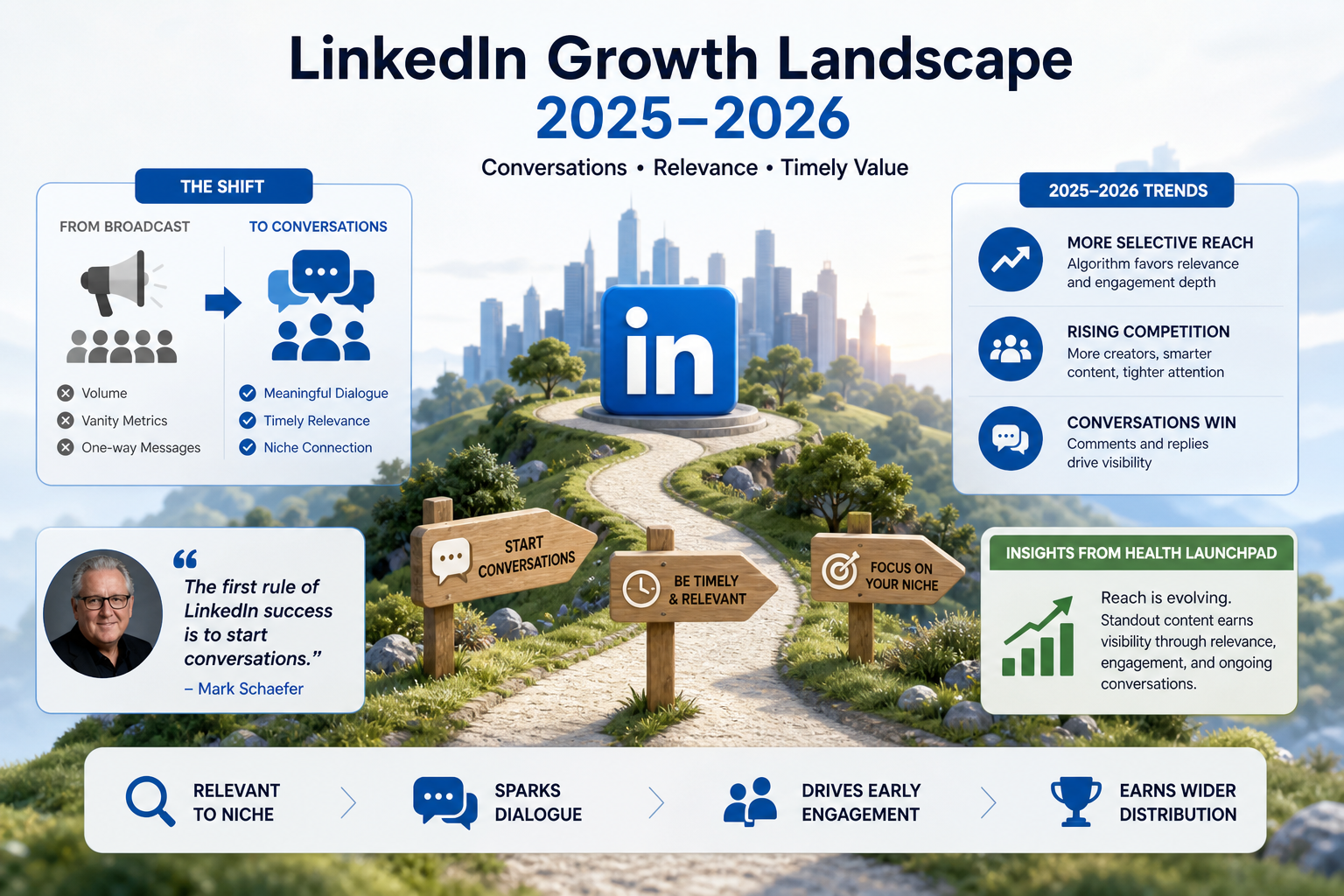
The LinkedIn growth landscape for 2025 to 2026 shifts away from broad broadcast metrics toward quality conversations and timely relevance. Platform changes have tightened reach for many creators, making it harder to rely on volume alone. Instead, the field rewards content that sparks meaningful dialogue, aligns with current events, and speaks directly to specific audiences. This dynamic mirrors Mark Schaefer’s observations, who emphasizes that the first rule of LinkedIn success is to start conversations. In practice, posts that invite reflection, questions, and debate are more likely to be surfaced to a wider audience when they generate early, sustained engagement in the form of thoughtful comments and replies.
Industry summaries from Health Launchpad illustrate how reach and competition are evolving. As algorithmic ranking becomes more selective, a post’s visibility depends on its relevance to a defined niche, the depth of engagement it generates, and its ability to prompt ongoing conversations. The result is a more crowded feed where standout content focuses on sustained, high-quality interactions that connect niche expertise with practical value.
| Aspect | 2025–2026 Trend | Practical Implication |
|---|---|---|
| Reach and algorithm | More selective, prioritizing relevance and quality engagement over raw impressions | Focus on topics with clear audience fit and early meaningful comments to unlock broader distribution |
| Engagement signals | Comments with depth and saves rise in importance; likes are less predictive | Design posts to invite detailed responses and save-worthy insights |
| Content format | Mobile-first, scroll-stopping formats gain traction; carousels, short-form videos, and captions matter | Create multi-format content that is easy to consume on mobile and adaptable across feeds |
| Creator strategy | Personal profiles and authentic community participation outperform broad company broadcasts | Invest in consistent personal storytelling, niche expertise, and active participation in conversations |
| Measurement focus | Move beyond vanity metrics; emphasize engagement quality, relationship depth, and funnel impact | Track conversations, saves, and qualified leads rather than only views or likes |
Key takeaways for practitioners aiming to deploy effective LinkedIn Growth Tactics in this era include maintaining a narrow niche focus, prioritizing early engagement, and building a habit of community participation rather than solo broadcasting. The field encourages a deliberate blend of content that informs, stimulates discussion, and demonstrates genuine expertise. When combined, these elements create a durable presence that grows with the audience over time rather than delivering a one-off spike in attention.
- Lead with conversations: End posts with specific questions that elicit expert responses, and respond promptly to keep the dialogue moving as Mark Schaefer recommends.
- Prioritize relevance over reach: Create content that serves a well defined audience niche; this improves algorithmic distribution and long term growth.
- Engage as a habit, not a tactic: Allocate regular time for genuine interactions in comments, on others’ posts, and within relevant groups to become a visible, trusted participant.
- Adopt mobile-first storytelling: Use short paragraphs, scannable lines, captions for videos, and vertical carousels to maximize mobile readability and engagement.
As the landscape evolves, the message is clear: LinkedIn growth in 2025–2026 rewards steady, purposeful presence over quick hacks. By treating your followers as a valuable asset, refining your niche, and fostering meaningful conversations, you can build a resilient growth engine that compounds over time. This aligns with the broader consensus in the field that perseverance and community-building are the enduring engines of success on LinkedIn.
For readers wanting a practical implementation plan, start by auditing your current content for niche alignment, experiment with a weekly cadence of conversation-driven posts, and track outcomes beyond likes and comments to identify true business impact. The evolving growth landscape invites a thoughtful, patient approach that yields durable visibility and relationships in the years ahead.
LinkedIn Growth Hack – Use Relevant Keywords
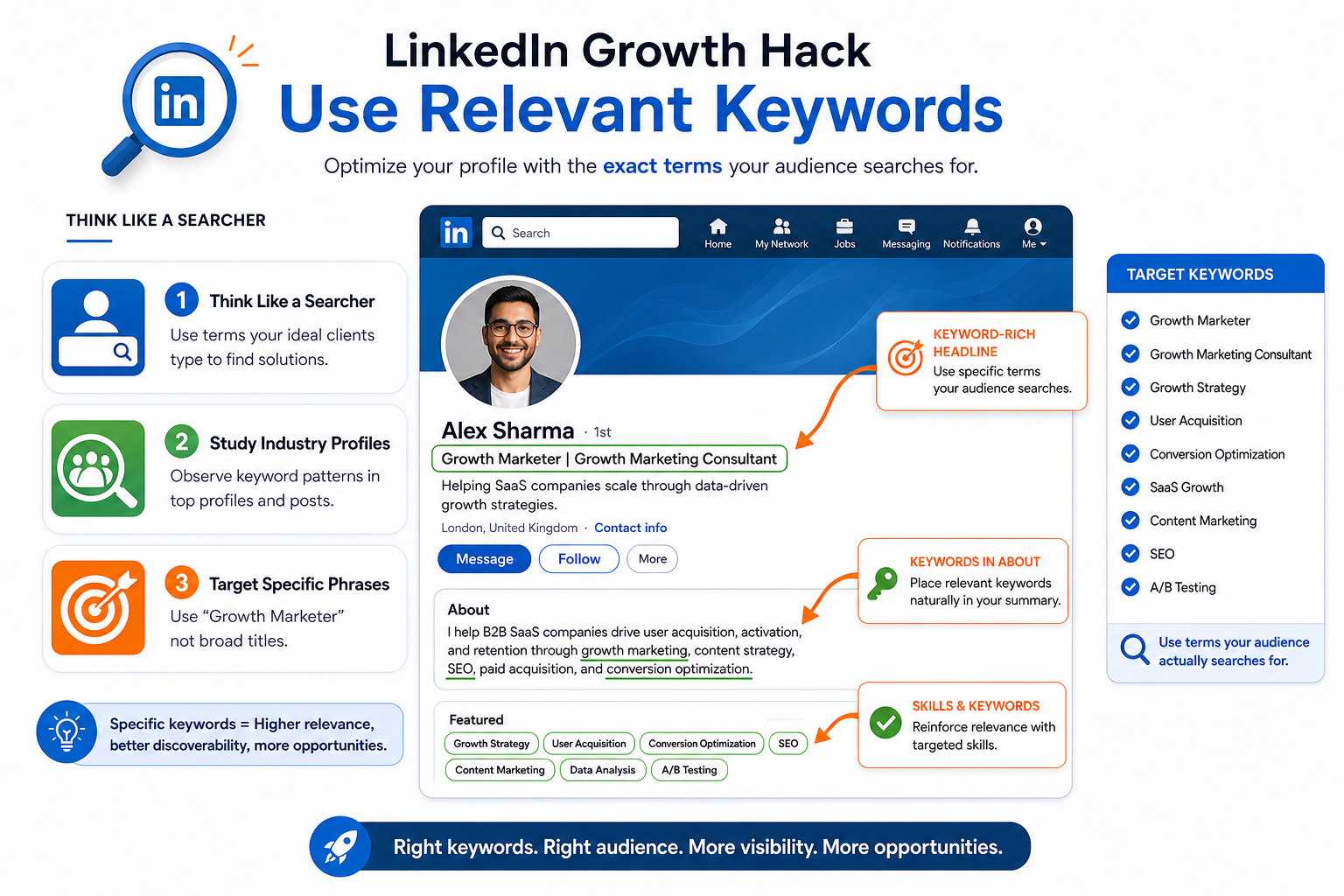
The core idea behind using relevant keywords on LinkedIn mirrors classic SEO: you optimize a page for the terms your audience actively searches for. In the framework of the 27 LinkedIn growth hacks, this hack centers on making your profile a precise match for the queries your ideal clients or collaborators use when looking for expertise like yours. Think of your profile as a living search engine result that needs to reflect the language your audience actually uses.
Practical mindset shifts to adopt:
- Think like a searcher about the terms a buyer or partner would type into a search box when trying to solve their problem. If you deliver growth related services, you want phrases that capture intent rather than generic titles alone.
- Study industry profiles to observe patterns in keyword usage. Look at peers, competitors, and potential partners to learn which terms consistently appear in strong profiles and high performing posts.
- Target specific phrases over broad titles for higher relevance. For example, use “Growth Marketer” or “Growth Marketing Consultant” instead of a broad title like “Marketing Executive.” Narrow terms tend to align with actionable search intent and niche audiences.
How to implement this on your LinkedIn profile:
- Keyword research without a dedicated tool:
- Scan top profiles in your niche and note recurring terms.
- Identify phrases that describe outcomes your clients care about, such as specific metrics or industries.
- Cross reference with audience personas to ensure alignment with their pain points.
- Embed keywords into key sections:
- Headline that communicates result oriented value, for example, “Growth Marketer helping B2B SaaS achieve scalable pipeline.”
- About section presents your value proposition using the identified keywords in natural phrasing.
- Experience entries incorporate role related terms and outcomes that reflect the audience’s search terms.
- Balance readability with optimization:
- Use keywords organically; avoid keyword stuffing that harms narrative flow.
- Maintain a conversational tone while signaling relevance to your target audience.
A simple starter checklist you can apply today:
| Element | What to Do | Examples |
|---|---|---|
| Headline | Incorporate a specific keyword or keyword phrase that describes your outcome or audience | Growth Marketer for B2B SaaS | 3x pipeline uplift |
| About section | Describe your approach using target phrases naturally, with a clear client outcome | Specialize in driving qualified MRR through targeted growth experiments for mid market SaaS |
| Experience descriptions | Include role aligned keywords and measurable results | Led growth experiments resulting in 2x trial-to-paid conversion |
| Skills and endorsements | Add niche keywords as skills that reflect your expertise | Growth Marketing, Pipeline Optimization, Niche Lead Generation |
By aligning your profile language with the terms your target audience searches for, you increase the probability that your profile will surface in relevant searches on LinkedIn and in external search engines. This approach is a foundational element of the broader LinkedIn Growth Tactics framework, reinforcing how purposeful keyword optimization supports higher quality engagement, more qualified inbound inquiries, and a stronger professional brand presence over time.
Remember, the objective is not simply to attract more views, but to attract the right views. When you articulate your niche with precise keywords, you invite conversations that feel tailor made for your audience, setting the stage for meaningful connections and sustainable growth.
LinkedIn Growth Hack – Custom LinkedIn Profile URL
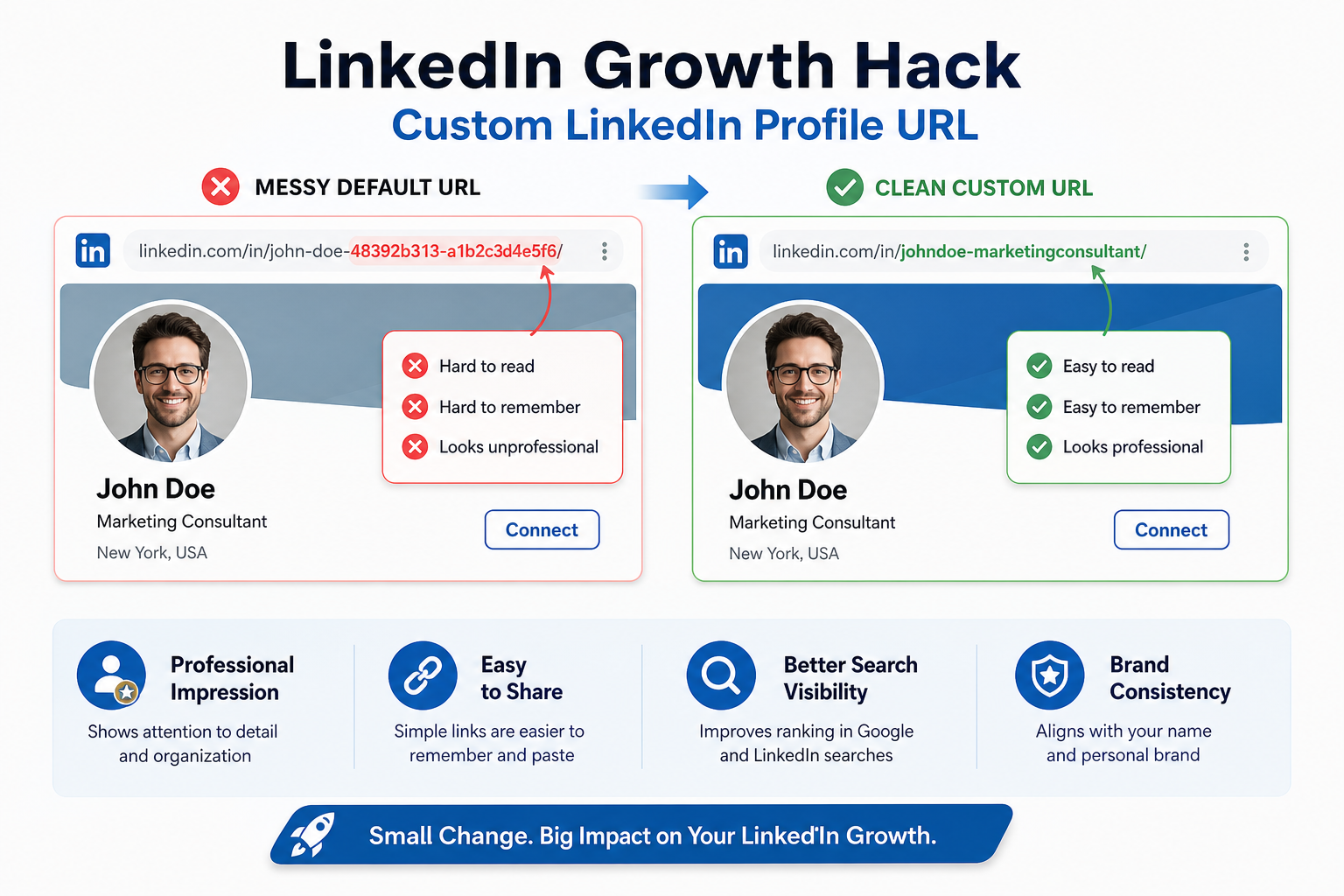
A foundational yet often overlooked upgrade on LinkedIn is replacing the default, cluttered profile URL with a clean, customized link. When you open a profile that ends in a string of random numbers and characters, it signals a lack of polish and attention to detail. A tidy URL, on the other hand, communicates professionalism at a glance and aligns with the same care you put into your headline and banner.
The shift from a messy default URL to a concise, personalized one has tangible effects beyond aesthetics. First, it improves perceived credibility with potential clients, partners, and recruiters who associate cleaner URLs with thoughtful branding. Second, it enhances discoverability. Customized URLs are easier to remember and share, increasing the likelihood that people will type or copy them accurately in searches or messages.
Regarding search visibility, a well crafted custom URL can contribute to better indexing in both Google and LinkedIn search results. While LinkedIn itself favors profile signals such as keywords and engagement, a clean URL reduces friction for external searches, making it more likely that a profile surfaces when someone searches for your name or niche terms.
- Professional impression: A short, readable URL suggests organization and attention to detail.
- Shareability: Clean links are easier to remember and paste into emails, messages, and bios.
- Brand consistency: A URL that aligns with your name or core offering reinforces your personal brand across channels.
How to implement this optimization:
- Choose a concise form: Use your full name if available, or a clear variation such as firstname-lastname or firstname-lin plus a relevant keyword if your name alone is taken.
- Update in profile settings: Navigate to the profile URL editing option, typically found near the top of your LinkedIn profile under your current URL.
- Test the URL: After saving, copy the new URL and verify it opens your profile correctly across devices. Share it in signature lines, portfolios, and guest posts.
Practical example:
| Original URL Character | Suggested Custom URL | Rationale |
|---|---|---|
| https://www.linkedin.com/in/john-doe-123456 | https://www.linkedin.com/in/john-doe | Straightforward, memorable, brand-aligned |
| https://www.linkedin.com/in/j-d | https://www.linkedin.com/in/john-doe | Brandable, easier to recall |
| https://www.linkedin.com/in/mark-s-87 | https://www.linkedin.com/in/mark-schaefer | Leverages full name for credibility |
Once you have a clean URL, consider updating your external profiles and email signatures to include it. Consistent use across touchpoints reinforces recognition and searchability. Remember, this is a small investment that yields compounding trust and accessibility as part of your broader LinkedIn Growth Tactics framework.
LinkedIn Growth Hack – Professional Picture
LinkedIn Growth Hack – Professional Picture
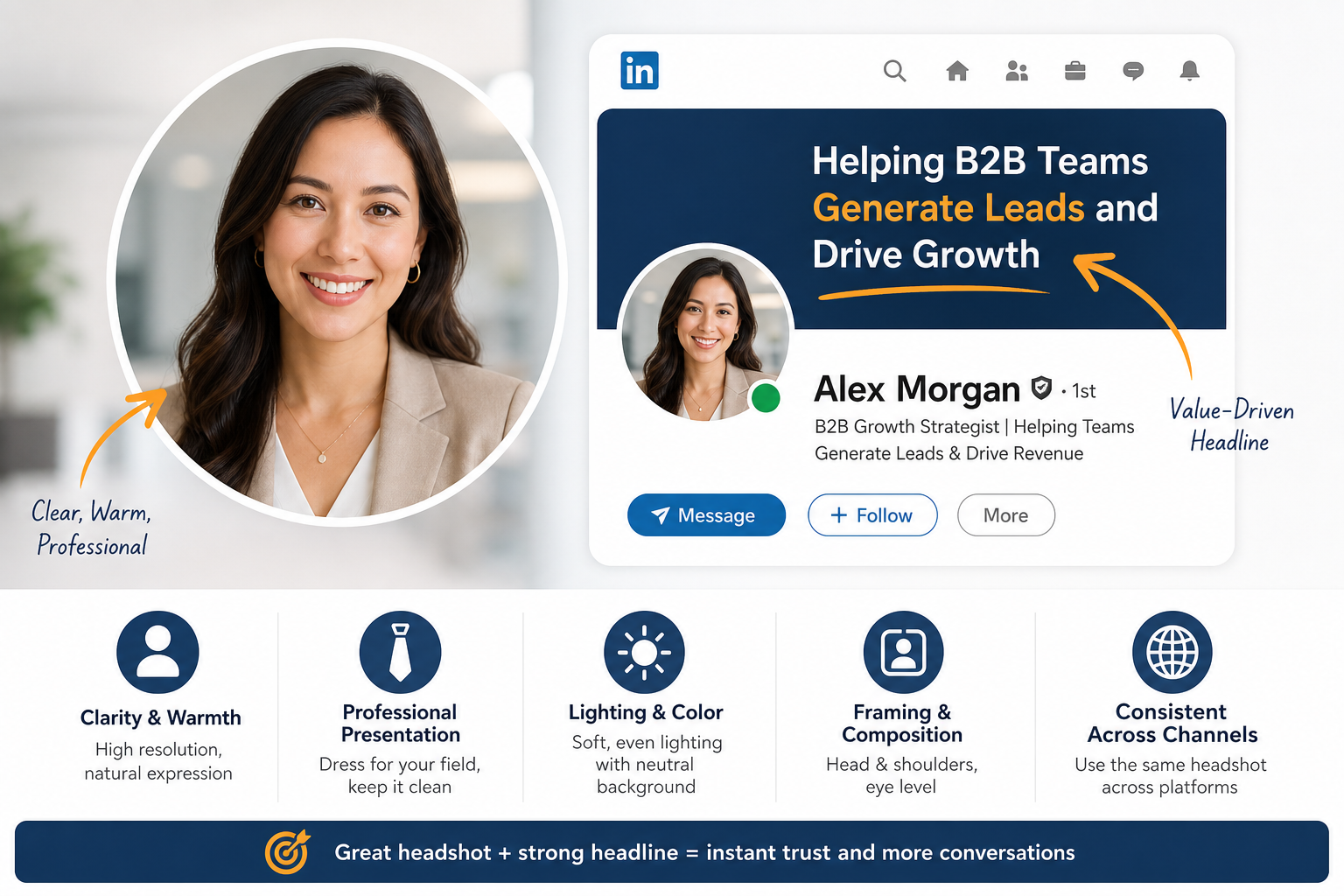
A clear, warm, professional headshot is more than a cosmetic detail. It is a first impression cue that signals credibility, approachability, and readiness to engage. When your photo aligns with a value driven headline, you create an immediate sense of trust that helps you stand out in a crowded feed where countless profiles compete for attention.
In practice, your headshot should invite connection before any text is read. A genuine expression paired with a polished presentation sets the stage for the value you promise in your headline. This combination accelerates the journey from scroll to conversation, increasing the likelihood that a profile visitor becomes a meaningful lead or collaborator.
- Clarity and warmth: Choose a high resolution image where your face is clearly visible with a natural, friendly expression.
- Professional presentation: Dress in attire that reflects your field and the level of formality you want to convey. Aim for a clean, uncluttered look that does not distract from your face.
- Lighting and color: Use soft, even lighting that reduces harsh shadows. Neutral or softly colored backgrounds help keep the focus on you.
- Framing and composition: The shot should be taken at eye level, with your head and shoulders in frame. Leave a little space above your head for balance.
- Consistency across channels: Use the same headshot across LinkedIn and other professional networks to reinforce recognition.
Practical guidelines to implement today:
- Capture with intention: Ask a friend to take multiple shots in natural light, then select the one that conveys confidence and approachability.
- Background matters: Choose a simple background that contrasts with your clothing to avoid visual noise.
- Resolution and crop: Use a square or near square crop at 4000 x 4000 pixels for flexibility in different display contexts.
- Refresh regularly: Update your photo every 2–3 years or after a significant professional change to keep your presence current.
Quick comparison checklist to evaluate any headshot:
| Criterion | Meets Standard | Notes |
|---|---|---|
| Facial clarity | Yes / No | Face is sharp and prominent. |
| Expression | Yes / No | Warm, open, and approachable. |
| Background | Simple and non distracting | Neutral or softly colored backdrop. |
| Lighting | Even illumination | No harsh shadows on face. |
| Framing | Head and shoulders, eye level | Proper margin above head. |
| Consistency | Used across platforms | Same image on LinkedIn and other profiles. |
When you pair a high quality, friendly headshot with a value driven, benefit oriented headline, you create an instantly credible and compelling profile. Prospects who see you quickly form an impression of both competence and approachability, making them more likely to read your bio, engage with your content, and explore the opportunities you present. This is a foundational element of the LinkedIn Growth Tactics framework, reinforcing how visual presence and narrative alignment drive meaningful connections over time.
LinkedIn Growth Hack – Contact Information
LinkedIn Growth Hack – Contact Information
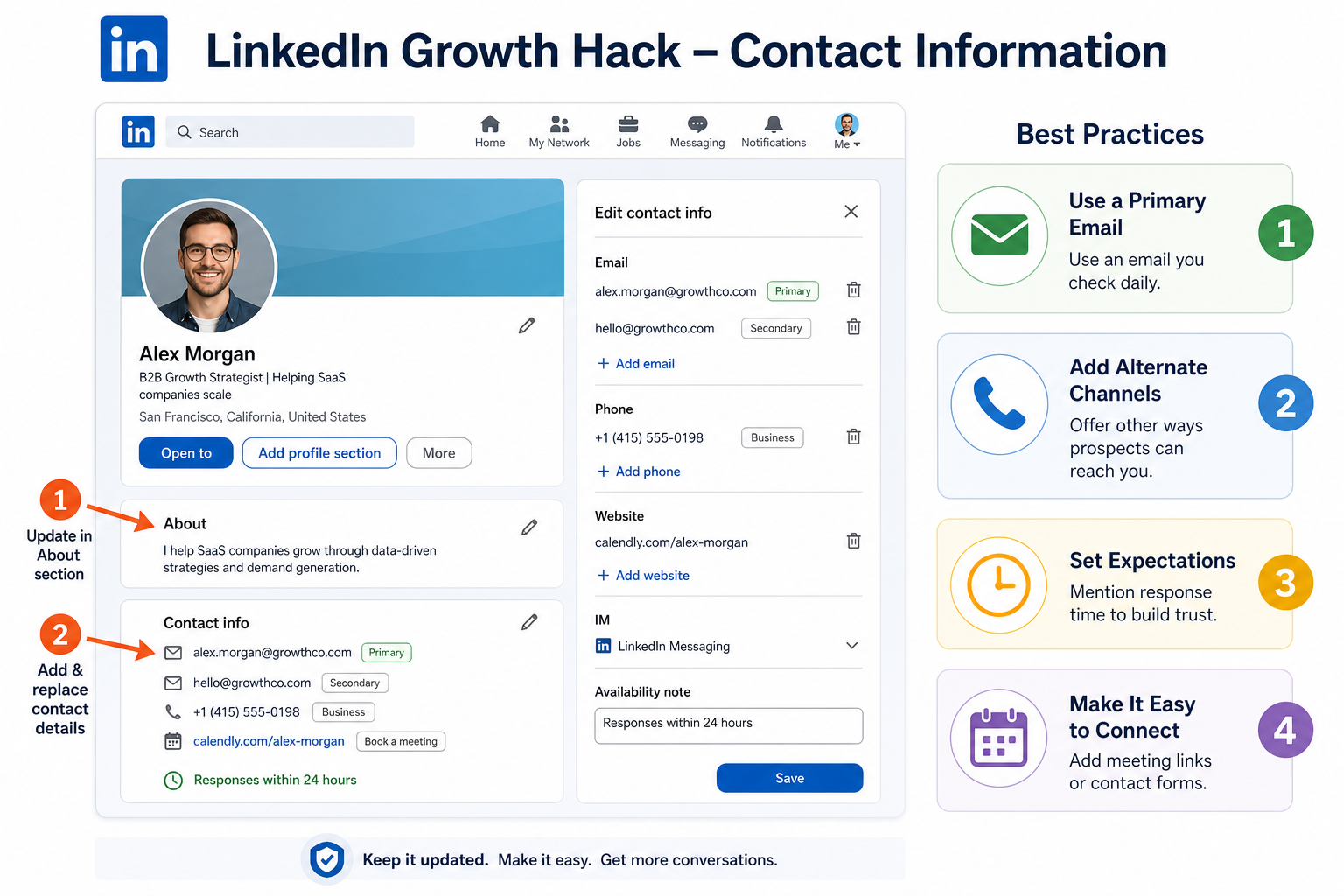
Your contact information is a critical bridge between attention and action. If a prospect lands on your profile and cannot reach you quickly, you lose the chance to convert interest into conversation. This section explains practical steps to ensure your contact details are current, accessible, and easy to act upon.
The core idea is straightforward: replace outdated contact points with channels you actively monitor and respond to. A clean, reliable contact setup reduces friction and signals professionalism to potential clients, partners, and collaborators.
- Prioritize a primary, responsive email: Use an address you check daily and can manage efficiently. Avoid shared or generic inboxes for primary contact.
- Add alternate channels thoughtfully: Include a secondary email, professional phone line, or a dedicated business messaging option if you have one. Each channel should have clear expectations for response time.
- Mention availability and response time: A brief note such as “responses within 24 hours” helps set expectations and reduces follow up friction.
How to implement updates across the profile:
- Update contact details in the About and Contact info sections:
- Replace outdated emails with current addresses that you actively monitor.
- Add a preferred contact method, such as a business email or a contact form link.
- If you use a calendar link for meetings, include a concise note about scheduling expectations.
- Verify every channel is functional:
- Send a test message to each address and confirm you receive it.
- Test any booking links or forms to ensure they route correctly to your workflow.
- Keep privacy and security in mind:
- Avoid exposing personal phone numbers or private addresses publicly unless necessary.
- Use business-specific channels to compartmentalize inquiries and protect personal data.
Practical update checklist:
| Element | Action | Best Practice |
|---|---|---|
| Email address | Replace old address with current, monitored inbox | Use a professional domain if possible |
| Secondary contact | Add alternate email or business phone | Ensure response times are realistic and communicated |
| Contact link | Insert a direct contact method or calendar link | Link should open a new message or scheduling page, not require extra steps |
| Response expectations | State expected response window | Examples: “Replies within 24 hours on business days” |
Why this matters for LinkedIn Growth Tactics:
- Reduces friction: Prospects can reach you quickly without hunting for a contact method.
- Improves trust signals: Transparent and current contact details reinforce credibility.
- Supports lead capture: Clear channels help nurture inquiries into conversations and opportunities.
- Aligns with responsiveness metrics: When you publicly commit to timely replies, you set expectations that can increase converted conversations.
Final reminder: periodically audit your contact information every 3 to 6 months or after any major role or address change. A small maintenance task today pays dividends in higher quality connections and faster lead escalation tomorrow.
LinkedIn Growth Hack – Post Regularly to Keep People Interested
LinkedIn Growth Hack – Post Regularly to Keep People Interested
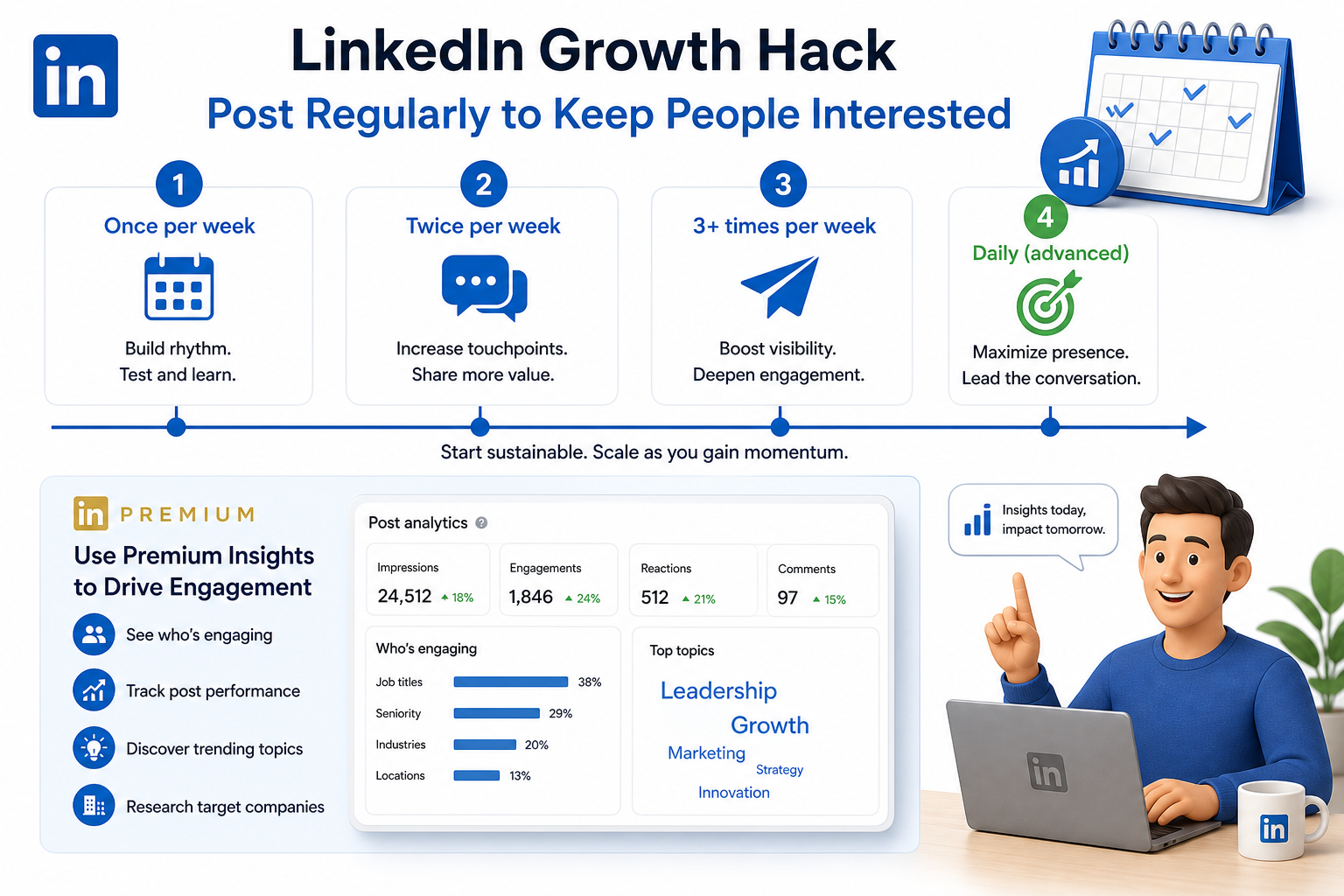
Consistency is a core signal the LinkedIn algorithm uses to gauge value and reliability. Rather than relying on sporadic bursts of posts, a disciplined cadence helps you show up in the feeds of your audience at predictable intervals, which in turn boosts familiarity, trust, and ongoing engagement. The underlying principle is simple: regular, high quality contributions keep your profile active in the minds of your network and attract more meaningful conversations over time.
What changes is not just the volume of content, but the opportunity you have to refine your message, test formats, and deepen relationships. When you post consistently, you create a narrative rhythm that your audience can anticipate. The algorithm favors content that demonstrates sustained presence and ongoing relevance, especially when early engagement signals begin to accrue.
Cadence is a spectrum. The idea is to start at a sustainable level and scale up as you gain momentum, rather than attempting a sensational push that burns out quickly. Below is a staged cadence you can adapt to your capacity and audience response.
- Stage 1 — once per week: Establish a predictable rhythm and test one solid, value-driven post per week. Aim for a tight hook, a clear takeaway, and a single actionable insight. This stage helps you learn what topics resonate without overwhelming yourself.
- Stage 2 — twice per week: Introduce a second post that complements the first, such as a quick tip and a related case study or an actionable framework. Monitor how your audience responds to different formats (text post, carousel, short video).
- Stage 3 — three times per week: Increase variety with a mix of formats and angles. Consider a weekly thematic thread, a behind the scenes look, and a practical how-to post. This stage builds depth and keeps your content fresh.
- Stage 4 — four times per week: Add a midweek post that prompts conversation, plus a short-form video or carousel to boost engagement signals. Begin to schedule in advance where possible to maintain consistency even during busy periods.
- Stage 5 — five times per week or more: Sustain a high-velocity rhythm with diverse formats, while prioritizing quality over quantity. Use data from prior stages to optimize topics, posting times, and audience targeting. Reserve time for meaningful replies to comments to nurture conversations.
Practical guidelines to maximize the cadence:
- Quality over quantity: If a post does not clearly deliver value or spark discussion within the first hours, consider refining your approach before adding more posts.
- Timebox creation: Block dedicated writing or recording sessions. Batch creation tends to improve consistency and voice cohesion across your posts.
- Format mix: Rotate between text posts, carousels, short videos, and polls to keep the feed dynamic and to test what resonates best with your audience.
- Engagement after posting: Allocate at least 15 to 30 minutes post publication to respond to comments. Prompt replies amplify early engagement signals and help extend reach.
How LinkedIn Premium insights can aid engagement:
- Audience analytics: Premium analytics reveal who is engaging with your content, including job roles, industries, and seniority. Use these signals to tailor future posts to your most receptive segments.
- Post performance breakdown: Deeper metrics show which formats, headlines, and topics drive longer viewing times and more comments. Use this to prioritize what to post next.
- Engagement windows: Premium features highlight when your audience is most active. Align posting times with peak windows to maximize visibility in the initial hours after publication.
- Saved conversations: With insights into saves and shares, you can identify content that resonates beyond transient likes and use it to guide longer form content or follow-up posts.
A practical implementation approach:
| Stage | Recommended Frequency | Focus Areas |
|---|---|---|
| Stage 1 | 1x per week | Core value post, clear takeaway, beginner engagement |
| Stage 2 | 2x per week | Complementary formats, topic pairing |
| Stage 3 | 3x per week | Themed thread, how-to, case study mix |
| Stage 4 | 4x per week | Midweek post, engaging formats, prompt replies |
| Stage 5 | 5x per week | Data-informed topics, advanced formats, strategic timing |
Final reminder: commit to a sustainable cadence that fits your bandwidth and audience appetite. The goal is a steady stream of meaningful contributions that build momentum over months, not a single viral moment that fades quickly. With disciplined posting and smart use of LinkedIn Premium insights, you can cultivate consistent visibility, richer conversations, and a more reliable path to opportunities.
LinkedIn Growth Hack – Use Visuals in Your Posts
LinkedIn Growth Hack – Use Visuals in Your Posts
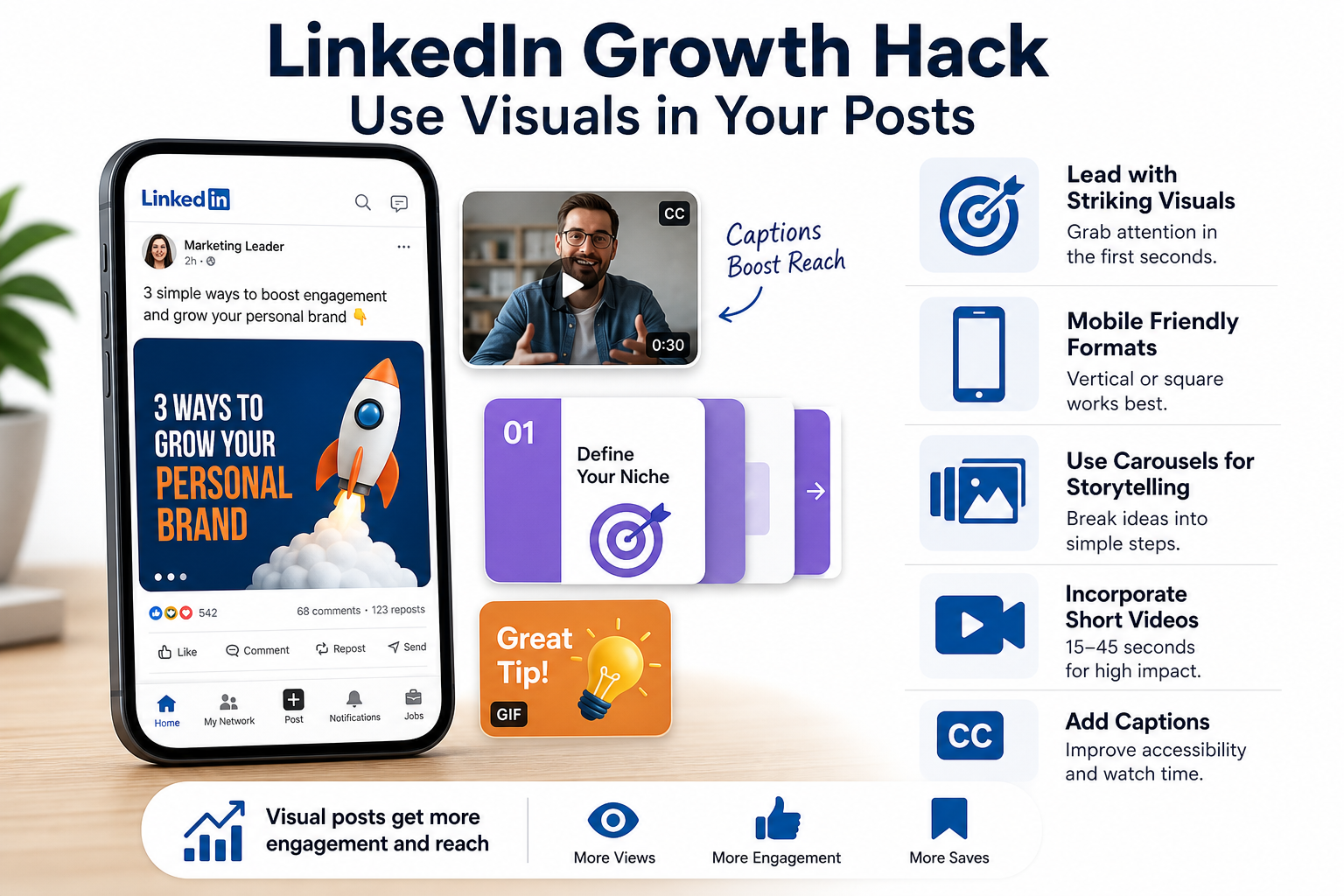
In a feed driven by quick scans and mobile thumb scrolling, visuals are your first and most powerful hook. Scroll-stopping content relies on eye-catching imagery, dynamic formats, and accessible design choices. When you pair concise text with compelling visuals, you invite a deeper level of engagement and reduce cognitive load, making it easier for your audience to absorb value within seconds.
The reach of video on LinkedIn has expanded significantly in recent years. Short-form, captioned videos catch attention in sound-off environments and perform well in feeds that favor native, familiar formats. Visuals such as GIFs and animated carousels can convey complex ideas quickly, breaking down processes into digestible steps that are easy to skim and save.
Practical guidelines to maximize visual impact:
- Lead with a striking visual: Use a bold image, color contrast, and a clear focal point to draw the eye within the first few seconds.
- Prefer mobile-friendly formats: Vertical or square visuals perform better on mobile screens and stay legible as users scroll.
- Use carousels for storytelling: A sequence of slides can walk readers through a concept, framework, or case study in a linear, scrollable format.
- Incorporate short videos: 15 to 45 seconds can be enough to convey a core idea, a quick demo, or a hot tip with high engagement potential.
Accessibility matters as much as aesthetics. Captions make your content accessible to users who watch without sound and improve overall comprehension. A captioned video is more inclusive and often yields higher completion rates.
- Add captions to all video content: Provide on-screen text that summarizes spoken content. Use your video editor to generate captions or upload a caption file.
- Choose legible typography: High-contrast text, ample line height, and large font sizes boost readability on small screens.
- Keep visuals simple: Avoid overcrowded frames. One idea per visual frame helps viewers grasp the takeaway quickly.
- Test pacing and length: Start with 15 to 30 second clips, then experiment with slightly longer formats as you learn what your audience tolerates and prefers.
Content formats that consistently perform well with visuals:
- Short videos with captions and a crisp hook in the first 3 seconds
- Vertical infographics that distill a process into 3 to 6 steps
- GIFs and motion graphics to illustrate transitions or comparisons
- Carousel explainers that guide readers through a problem, solution, and result
Implementation checklist you can apply today:
| Element | Action | Best Practice |
|---|---|---|
| Thumbnail | Create a bold, uncluttered thumbnail image | High contrast, single focal point |
| Video captioning | Add accurate captions for all videos | Synced captions, readable font |
| Carousel slides | Design a logical sequence with 3 to 6 slides | Clear takeaway on the final slide |
| Text overlay | Use minimal text overlays to reinforce key points | One message per slide |
Final note: combine visuals with concise, outcome-focused copy to reinforce value. When visuals enhance clarity and accessibility, you increase the likelihood that your post is saved, shared, and revisited, contributing to durable visibility and stronger engagement over time.
LinkedIn Growth Hack – Create Carousels
LinkedIn Growth Hack – Create Carousels
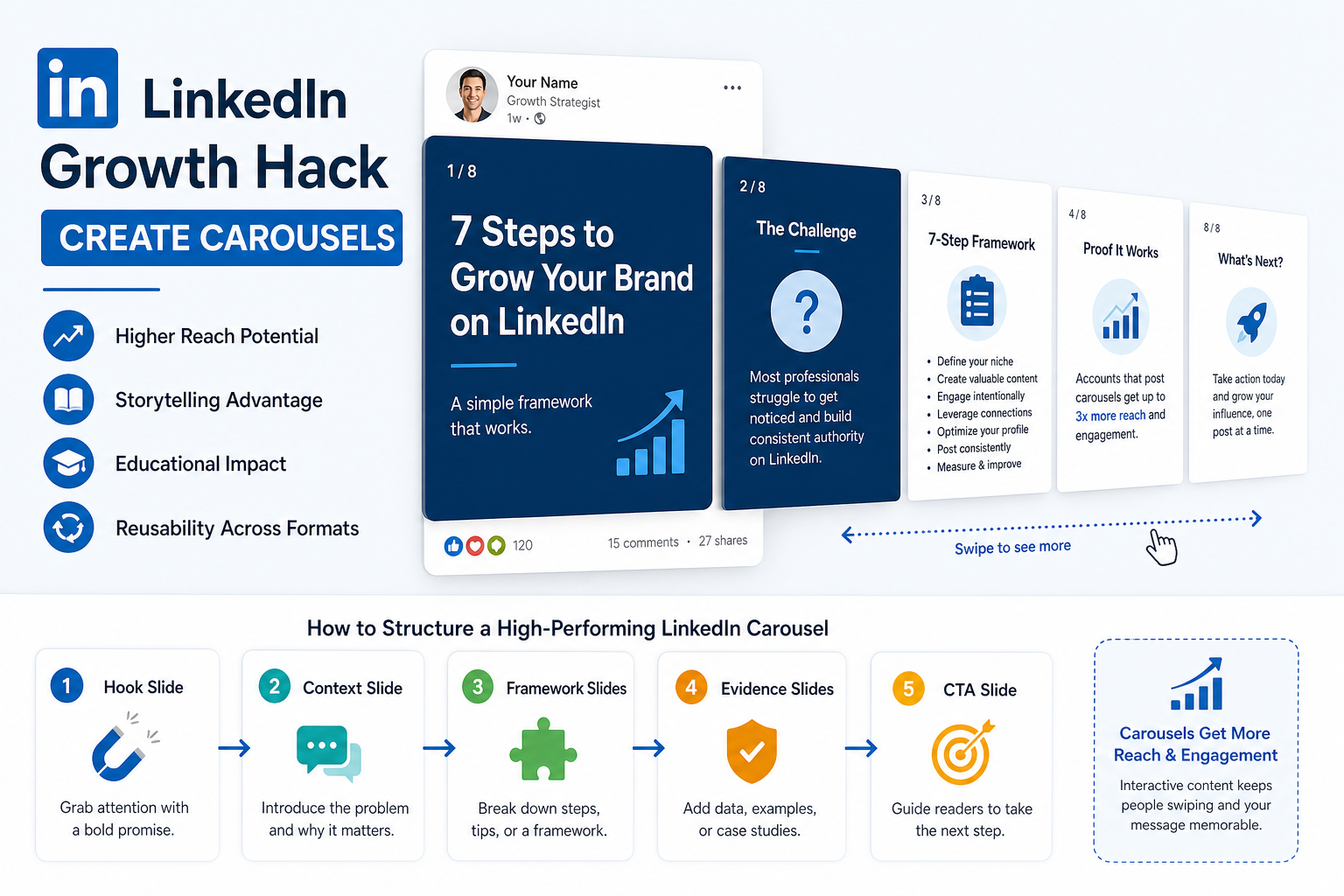
Carousels are a core LinkedIn Growth Tactics element because they fuse concise, scannable text with a sequence of slides that users can actively engage with. In feeds that favor quick glances, carousel posts invite readers to swipe through a narrative, gradually absorbing a message that unfolds across slides. When designed well, carousels outperform plain text posts by delivering clearer value steps, visual reinforcement, and a sense of progression that keeps readers on the page longer.
Practical benefits of embracing carousels include:
- Higher reach potential: The interactive format encourages sustained engagement as users swipe through multiple slides.
- Storytelling advantage: Carousels enable a structured narrative, making complex concepts easier to digest.
- Educational impact: Step-by-step frameworks, checklists, and process diagrams convert readers into action takers.
- Reusability: A single carousel can be repurposed into micro-guides, checklists, or social snippets for distribution across formats.
How to structure a high-performing LinkedIn carousel:
- Hook slide: Open with a bold headline or question that promises a tangible result.
- Context slide: Briefly set up the problem your audience faces and why it matters.
- Framework slides: Present a repeatable process, framework, or set of steps in a clear sequence.
- Evidence slides: Include a quick example, before/after, or data point that validates your method.
- Action slide: End with a concrete next step, resource, or invitation to engage.
Design best practices to maximize readability and impact:
- Visual hierarchy: Use large, legible headings on each slide and keep body text concise.
- Consistent branding: Apply your color palette and typography consistently to reinforce recognition.
- Minimal text per slide: Aim for one idea or takeaway per slide to reduce cognitive load.
- Captions for accessibility: Include on-screen text or captions so the message is comprehensible without sound.
Creative formats to experiment with in your carousels:
- Step-by-step how-to: A practical, play-by-play guide for a repeatable outcome, such as a five-step workflow.
- Framework explanations: Break down a proven model or methodology with each slide dedicated to a component.
- Before and after case studies: Show a problem state contrasted with the results after applying your approach.
- Checklist style: Turn a process into a slide-by-slide checklist that readers can save and reference.
A quick workflow to create a carousel in under 60 minutes:
- Define the outcome: Decide the single, concrete result readers will gain.
- Outline slides: Draft 6 to 8 slides with a logical flow from hook to action.
- Write concise copy: Limit each slide to a few lines of text and a clear takeaway.
- Design for mobile: Use tall, legible slides with ample white space and large visuals.
- Add visuals: Include simple diagrams, icons, or charts that illustrate each step.
- Caption and publish: Write a compelling post caption that previews the carousel and invites comments.
To illustrate the impact of carousels within the LinkedIn Growth Tactics framework, consider the following anatomy:
| Slide | Content Focus | Engagement Focus |
|---|---|---|
| 1 | Hook headline and promise | Curiosity, saves, shares |
| 2 | Context and problem | Relevance, relatability |
| 3 | Framework or step 1 | Clarity, forward momentum |
| 4 | Step 2 | Progression, credibility |
| 5 | Step 3 | Practical takeaway |
| 6 | Evidence or result | Social proof, impact |
| 7 | Optional bonus or extension | Engagement extension |
| Final | Call to action | Conversions, comments |
Measurement and iteration are essential parts of your LinkedIn Growth Tactics. Track key signals such as saves, shares, comments with meaningful dialogue, and click-throughs to any resource you promote within the carousel. Use these insights to refine your topics, formats, and posting times, and gradually build a library of high-performing carousels that compounds reach over time.
Quick-start checklist for creating your next carousel:
| Action | Best Practice | Metric to Watch |
|---|---|---|
| Define outcome | One clear result readers can achieve | Topic resonance, saves |
| Draft slides | 6 to 8 slides with a tight flow | Completion rate (swipes) |
| Design | Mobile first, legible typography | Time on slide, share rate |
| Publish with caption | Compelling preview text and question to prompt comments | Comments, starts conversations |
In the broader framework of LinkedIn Growth Tactics, carousels offer a repeatable format to educate, persuade, and move readers from awareness to action. By delivering compact, actionable value across slides, you create a durable asset that audiences can reference, save, and share, reinforcing your authority and boosting long-term visibility.
Be Strategic About Connection Building
Be Strategic About Connection Building
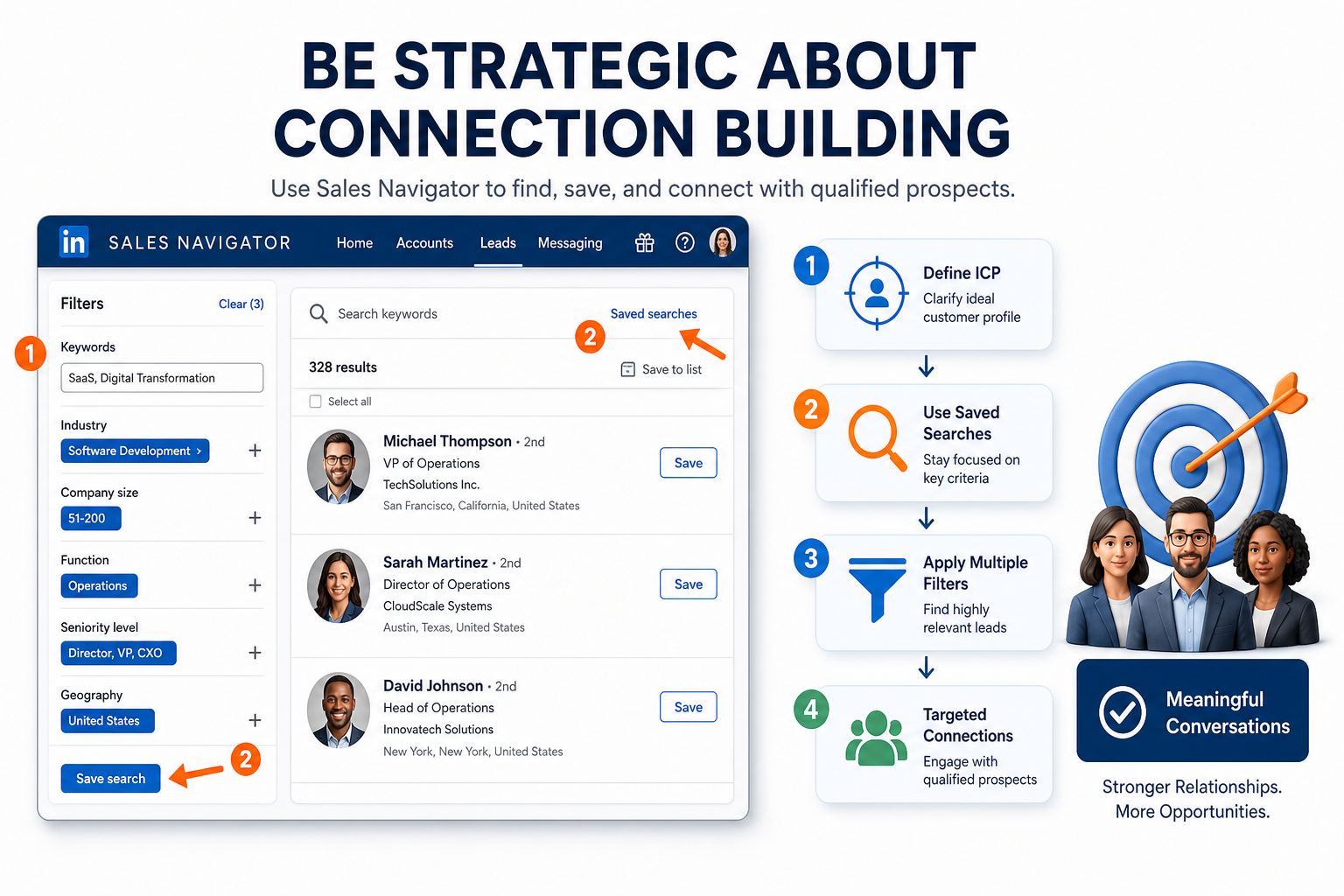
Turning connections into meaningful business opportunities starts long before you send an invitation. Be strategic about who you connect with by using LinkedIn Sales Navigator to curate a focused, high intent network. The goal is to engage with qualified prospects, decision makers, and industry peers who align with your target outcomes, rather than accepting random viewers who may never move your pipeline forward.
The core idea is to replace scattergun networking with intentional, criteria driven outreach. Sales Navigator provides advanced search capabilities, filters, and organization tools that let you build a living list of ideal connections. When you approach connection building as a structured process, you improve acceptance rates, shorten the time to meaningful conversations, and create a more actionable ecosystem around your content.
- Define your ICP upfront: Create a precise profile of your ideal customer profile, including firmographics, roles, seniority, and pain points you solve.
- Use saved searches to maintain focus: Save searches for key criteria such as industry, company size, function, and geographic region to receive fresh prospects without redoing work.
- Leverage multiple criteria for precision: Combine role seniority, function, and keywords that indicate a need for your solutions to surface highly relevant targets.
Practical workflow to implement this approach:
- Create a clear target set:
- Draft 3 to 5 ICP variants to cover adjacent segments you can serve.
- Specify outcome signals you expect to see from a good fit, such as recent activity, funding, or role changes.
- Set up saved searches:
- Configure filters for industry, seniority, company size, geography, and keywords that imply a need for your offering.
- Name each search clearly and add notes about why this profile matters for your growth goals.
- Build a target list and segment:
- Organize prospects into tiers (Tier A for high fit, Tier B for near fits) to prioritize outreach.
- Attach notes about each target’s likely pain points and potential entry points for conversation.
- Personalized connection requests:
- Use a brief, relevant hook that references a shared context, recent accomplishment, or mutual interest.
- Aim for a 6 to 12 word personalization that demonstrates relevance before a formal value proposition.
- Message sequencing and cadence:
- After connecting, follow a structured outreach sequence that starts with value and ends with a clear next step.
- Space messages to avoid pressuring the recipient; adjust cadence based on engagement signals.
Why this approach compounds over time:
- Quality over quantity: Fewer, higher quality connections generate more meaningful conversations and faster pipeline movement.
- Contextual credibility: Prospects see your alignment with their world, which increases acceptance and reply rates.
- Accountable tracking: Saved searches and notes create a repeatable process that you can refine, scale, and hand off if needed.
Implementation tips to keep connection building ethical and effective:
- Respect response expectations: If a target asks not to be contacted further, honor it promptly to preserve your brand’s integrity.
- Avoid over messaging: Prioritize meaningful contributions in comments and on others’ posts before direct outreach to warm up familiarity.
- Measure what matters: Track accepted connections, replies, and the quality of conversations rather than vanity metrics such as the total number of connections.
Quick-start checklist for Be Strategic About Connection Building:
| Element | Action | Success Metric |
|---|---|---|
| ICP definition | Document 3 to 5 ideal customer profiles with criteria | Clear target criteria and ready-to-save searches |
| Saved searches | Set up and name each search, with daily or weekly refresh | New, relevant prospects surfaced regularly |
| Target list | Segment into Tier A and Tier B with notes | Prioritized outreach plan |
| Connection requests | Personalize with a concise hook | Higher acceptance rate |
| Outreach cadence | Structured sequence after connection | Meaningful conversations initiated |
As you adopt a Sales Navigator led process, you create a durable engine for high quality engagement. You shift from chasing every passerby to cultivating a network of prospects who are genuinely receptive to your value, which in turn elevates the relevance and effectiveness of your LinkedIn Growth Tactics over time.
Launch a LinkedIn Newsletter
The Long-Term, Consistent Growth Mindset
The long path to sustained LinkedIn growth is not about rapid spikes in followers or a single viral moment. It is built on a steady, reliable cadence of value that compounds over time. This mindset starts with recognizing that audience-building is a marathon, not a sprint, and that authority on the platform is earned through years of consistent, high quality content and authentic engagement.
Consistency creates familiarity, and familiarity builds trust. When your audience sees your name appear regularly in their feeds with content that clearly helps them move forward, you become a dependable reference. Over time, this trust translates into more thoughtful conversations, higher engagement quality, and a pipeline of opportunities that arises almost as a natural consequence of your ongoing presence.
Key drivers of a long-term growth mindset
- Audience over vanity metrics: Prioritize the quality of connections and the relevance of your audience. A small, highly engaged group is more valuable than a large, loosely connected one.
- Regular content, not rare breakthroughs: Years of dependable content creation establishes you as a steady source of insight, which compounds into increased reach and inbound opportunities.
- Value dominated content strategy: Focus on evergreen value, actionable frameworks, and timeless skills that resonate across moments and trends.
The compound effect of a long-term approach can be observed in three dimensions:
- Reach compounding: Each quality post has the potential to be discovered by new audiences through shares, saves, and comments from engaged readers who keep returning for more.
- Relationship depth: Ongoing dialogue with a core group of followers deepens trust and translates into meaningful conversations over time.
- Opportunity velocity: As authority grows, inbound inquiries, speaking opportunities, and collaboration offers tend to arrive with increasing frequency and relevance.
A practical path to cultivate this mindset in daily practice:
- Set a multi-year content plan: Map out core themes and staggered milestones that you want to cover over 12 to 24 months. Revisit and refine quarterly.
- Invest in quality, not just frequency: Allocate time for research, synthesis, and clear storytelling. A single well-crafted post can outperform several mediocre ones.
- Document progress publicly: Share learnings, experiments, and outcomes, including what did not work. Transparency reinforces credibility and invites constructive dialogue.
The changing algorithm and the evolving content landscape reward patience. Rather than chasing the latest quick hack, a deliberate, principled approach to content creation builds an enduring asset: a personal brand with authority that grows stronger year after year.
To maintain momentum, couple content with meaningful interactions. Respond thoughtfully to comments, engage with peers in relevant conversations, and contribute to the broader community. When you participate as a consistent, value-driven member of the ecosystem, you become a trusted node in a network that continues to fuel your growth over time.
In summary, the long-term, consistent growth mindset hinges on treating LinkedIn as a durable channel for relationship building and knowledge sharing. By prioritizing audience quality, committing to a steady cadence, and delivering ongoing value, you create a self-reinforcing loop where authority, trust, and opportunity reinforce one another across years.
The Field's Key Takeaways for 2025–2026
The Field’s Key Takeaways for 2025–2026
As the LinkedIn growth landscape evolves through 2025 and into 2026, the field converges on a core set of practical takeaways. The guiding framework remains LinkedIn Growth Tactics, but success now hinges on precision, relationship building, and durable content assets rather than quick wins. The most effective practitioners balance niche focus with broad accessibility, ensuring every post earns a meaningful conversation and moves real business goals forward.
A primary takeaway is the imperative to sharpen your niche. Narrow focus does not mean narrowing opportunity; it means aligning your content with a well defined audience whose problems you can solve with measurable outcomes. When you lead with specificity, the algorithm surfaces your content to the right people, and your messages land with greater resonance.
- Niche focus over broad reach: Identify a tightly defined audience and tailor value propositions, case studies, and methods to that group. This improves relevance and long term visibility.
- Engagement as the growth signal: Prioritize conversations, comments with depth, and thoughtful replies over vanity metrics like likes and impressions. Early engagement drives wider distribution and trust.
- Mobile first, multi format: Craft posts that read well on phones. Use short paragraphs, scannable lines, and a mix of text, carousels, and short videos to maximize accessibility.
- Personal profiles drive amplification: Individual voices outperform company broadcasts. Invest in authentic storytelling through your profile and personal posts to expand reach beyond followers.
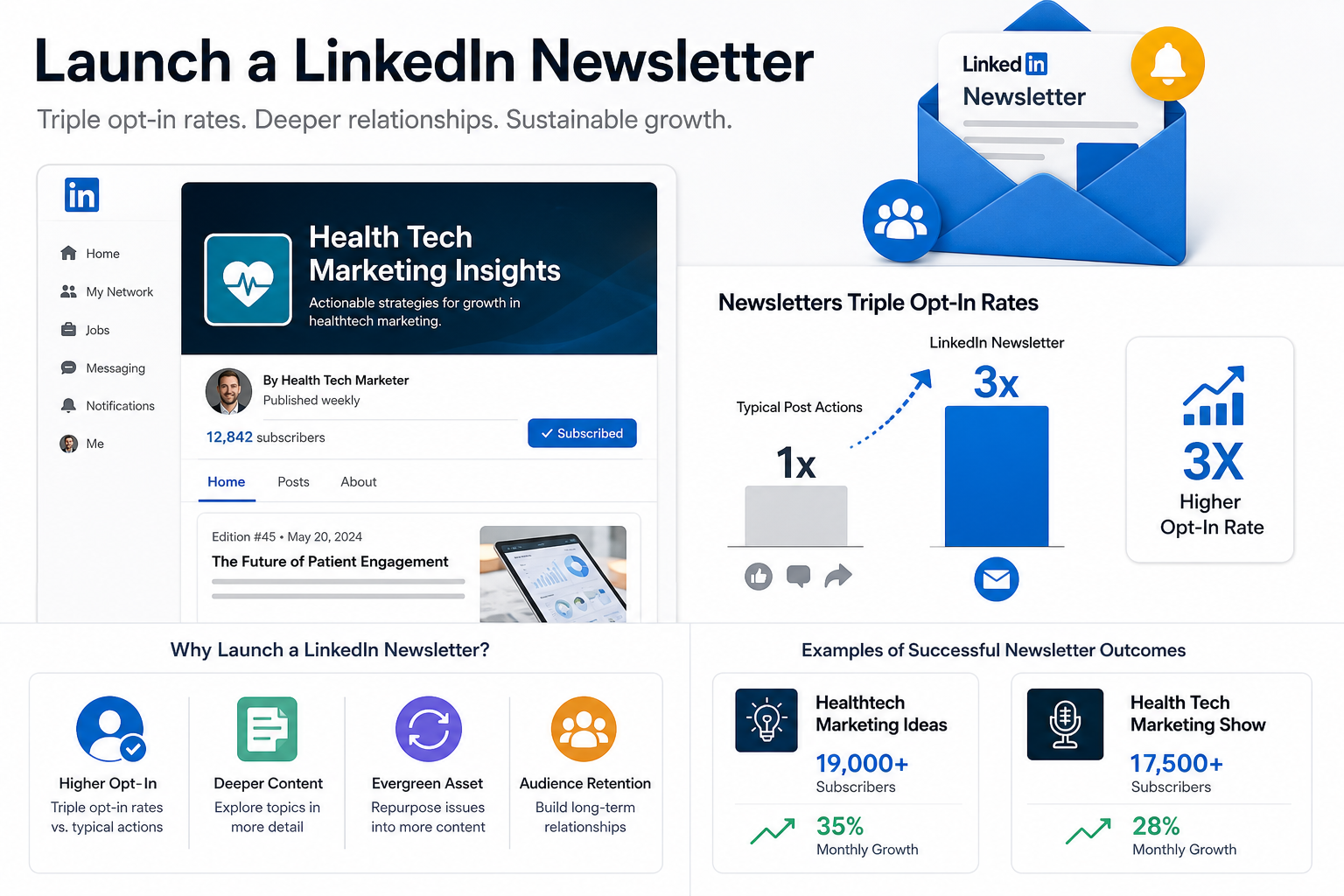
- Newsletters as depth channels: Treat newsletters as durable, permission based assets that deepen relationships, improve opt in rates, and yield evergreen reference content.
The field also reinforces a practical decision framework for LinkedIn Growth Tactics that emphasizes long term momentum. Rather than chasing algorithm quirks, you build a coherent system that compounds over time: a narrow focus informs content plans, engagement fuels distribution, and newsletters provide a home for deeper exploration.
| Area | Practical Guideline | Impact on Growth |
|---|---|---|
| Niche Focus | Define a precise ICP and tailor content to their pain points and outcomes | Higher relevance, stronger signals to the algorithm, better lead quality |
| Engagement over Vanity Metrics | Design posts to solicit meaningful comments and conversations | Improved distribution, deeper relationships, measurable business impact |
| Mobile First | Use short, scannable copy; leverage carousels and short videos | Better readability, higher completion and saves |
| Personal Profile Impact | Optimize headline, banner, and about section around clear outcomes | Stronger first impression, higher profile CTR, more inbound inquiries |
| Newsletters | Launch a regular newsletter to deliver deeper value | Tripled opt-in potential, durable audience, recurring engagement |
For practitioners implementing LinkedIn Growth Tactics, the practical path is clear:
- Audit for niche alignment: Evaluate current content against your defined ICP and adjust topics to address their specific goals.
- Build a conversation engine: End posts with concrete questions and respond promptly to cultivate ongoing dialogue.
- Adopt a mobile centric design: Break ideas into digestible segments, and test formats such as carousels and bite sized videos.
- Invest in the durable asset of newsletters: Plan a cadence, define topics, and measure open rates and long term engagement to drive deeper relationships.
In summary, the field’s key takeaways for 2025 to 2026 emphasize disciplined consistency, a refined audience focus, and the strategic use of depth channels. By blending niche articulation, conversation driven content, and durable formats like newsletters, you create a growth engine on LinkedIn that compounds over years rather than compacts in months.