Why LinkedIn Growth Matters for Your Brand
We believe that LinkedIn growth is more than a vanity metric. It forms a strategic foundation for brand authority and cost efficient awareness. When we build a sustainable presence on LinkedIn, we cultivate trust with our audience over time, turning followers into advocates and conversations into opportunities. Organic growth creates a durable asset: a community that engages with our ideas, internalizes our value proposition, and stays connected to our mission long after a single post has faded from the feed.
Our approach centers on three interconnected benefits that matter most for modern brands:
- Community and credibility: By consistently delivering value, we earn the right to be heard. A loyal community validates our expertise and elevates our reputation beyond isolated campaigns or one-off announcements.
- Long term engagement: Organic growth supports ongoing conversations that compound over time. Each thoughtful post, comment, and interaction deepens relationships with decision makers, partners, and potential customers.
- Cost efficient awareness: While paid strategies can accelerate reach, organic engagement builds a self-sustaining awareness engine. We reduce reliance on paid spend by leveraging meaningful, transferable interactions that persist beyond a single advertising cycle.
Global usage patterns reinforce the value of organic LinkedIn activity. More than 1 billion professionals access the platform, creating a vast but targeted ecosystem where meaningful interactions trump broad, paid reach. Rather than chasing scale through paid ads alone, we prioritize relevance—connecting with the right people, in the right context, at the right time.
In practice, our strategy emphasizes community building, credibility development, and authentic engagement. The payoff is not just impressions, but relationships that translate into conversations, collaborations, and measurable business outcomes over the long run.
| Aspect | Organic Growth | Paid Growth |
|---|---|---|
| Core value | Builds trust through consistent value and community | Immediate reach through targeted ads |
| Engagement nature | Conversation driven, long tail | Click through and conversions driven by ads |
| Cost impact | Low marginal cost, scalable via content engine | Direct cost per impression and per lead |
| Shelf life | Content compounds over time | Short term, campaign based visibility |
| Audience quality | Higher emphasis on ICPs and meaningful interactions | Broader reach, potentially lower alignment |
For our brand, the combined approach means we use LinkedIn to establish thought leadership and trusted relationships while reserving targeted paid efforts for amplified activities that align with our organic momentum. We see organic growth as the soil that nourishes every later paid initiative, ensuring that when we invest, we invest in audiences that already recognize our value.
To translate this into action, we focus on three practical pillars that power Linkedin Growth Tactics for our brand:
- Value first: produce content that educates, inspires, or solves real problems for our ICPs, not just promotional messages.
- Consistency with quality: maintain a steady cadence of thoughtful posts and authentic interactions to keep the community engaged.
- Community choreography: actively comment, share, and collaborate with others in our niche to expand reach through meaningful connections.
As we continue to grow, our aim is to convert audience attention into conversations and collaborations that move our brand forward. By combining credible, long term organic growth with selective amplification, we create a durable presence on LinkedIn that scales with our brand today and supports our ambitions for tomorrow.
For more strategies and practical playbooks, we invite readers to explore our deeper guides at our blog. You can visit us at linqin.ai/blog to learn how we implement these LinkedIn Growth Tactics in real world contexts.
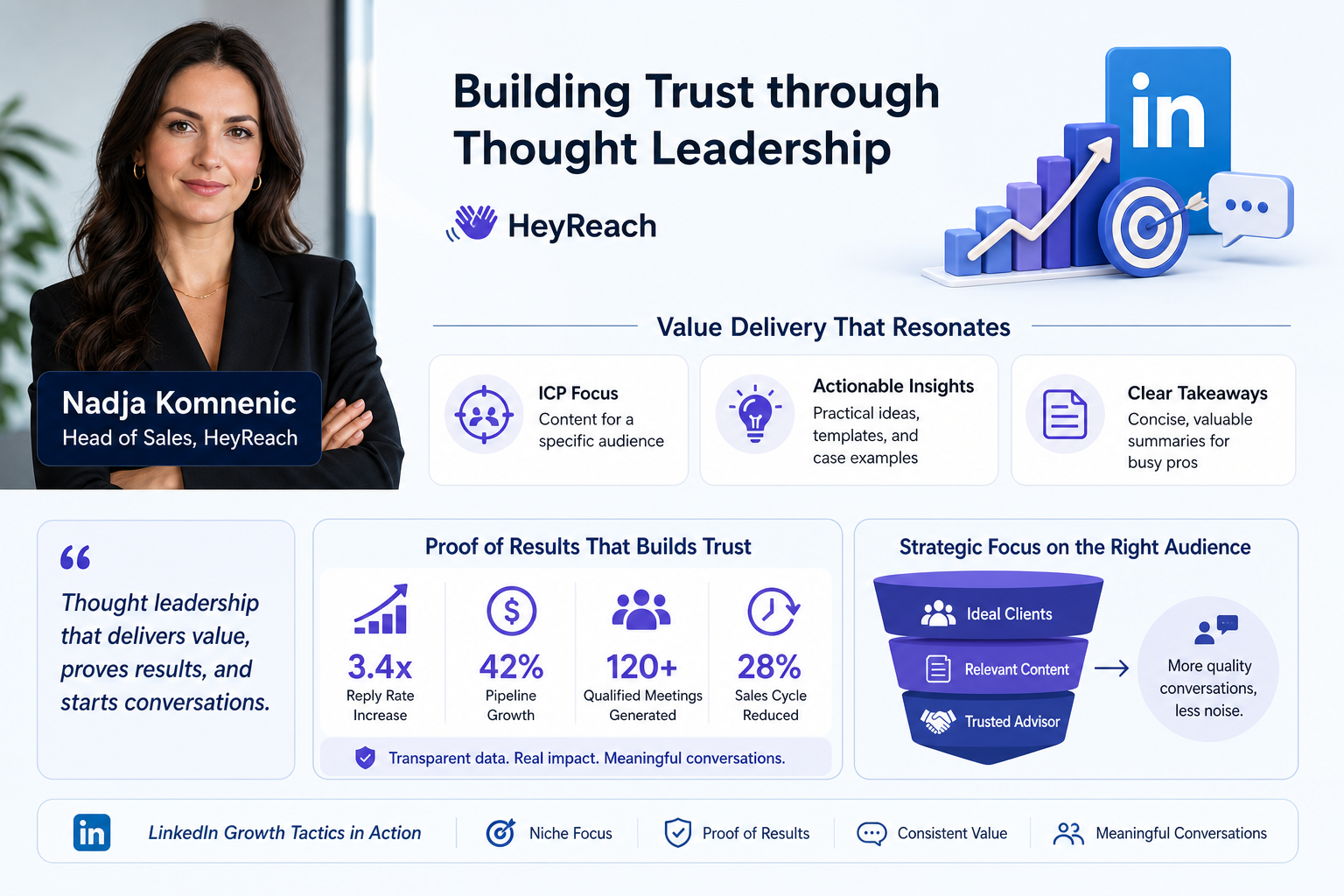
Nadja Komnenic — Building Trust through Thought Leadership
Nadja Komnenic, Head of Sales at HeyReach, shows how a tightly focused thought leadership approach turns into tangible conversations on LinkedIn. Her strategy centers on delivering measurable value to a clearly defined audience, backed by concrete results, and presented through a persona that resonates with decision makers in her niche.
Key elements of her approach include a disciplined focus on a specific ICP, transparent sharing of outcomes, and a consistency that earns credibility over time. By aligning content with audience needs and proving impact with real data, Nadja turns thought leadership into a reliable entry point for meaningful conversations rather than empty engagement.
Value delivery that resonates
- Frames content around practical problems facing the target audience, not generic marketing advice.
- Offers actionable insights, templates, and case examples that readers can apply immediately.
- Balances educational content with concise, takeaway oriented summaries suitable for busy professionals.
Proof of results that builds trust
Her posts consistently integrate verifiable outcomes, such as performance improvements, process optimizations, or revenue related milestones. The transparent sharing of numbers and the context around them creates credibility and invites further dialogue.
| Proof Element | What It Demonstrates | How It Persuades Conversation |
|---|---|---|
| Client outcome snapshots | Clearest indicators of value delivered to ICPs | Encourages peers to ask for the methodology and reps from real cases |
| Before and after metrics | Showcases measurable impact in a compact form | Opens doors for deeper discussions about methodology and implementation |
| Process insights | Reveals the thinking behind the results, not just the numbers | Invites dialogue on best practices and repeatable playbooks |
Audience focus that anchors credibility
Nadja positions her content to speak directly to decision makers in growth, sales, and go to market roles who face scalable challenges. This narrow focus ensures that every post is relevant to the reader, increasing engagement quality and encouraging conversations that move toward potential collaboration.
Conversation friendly through clear CTAs
She uses purposeful calls to action that invite commentary, question sharing, or requests for templates, rather than generic prompts. This approach lowers friction for readers to respond and helps convert passive readers into active participants in the dialogue.
Takeaway blueprint
- Define the ICP clearly and tailor every post to that audience’s pain points.
- Show and tell with concrete outcomes and the context that made them possible.
- Share process insights to demonstrate competence and invite collaboration.
- Prompt thoughtful dialogue with specific questions or templates that readers can apply.
By aligning value delivery with verifiable results and a tightly scoped audience, Nadja cultivates credibility and attracts conversations that extend beyond individual posts. Her LinkedIn presence shows how credible thought leadership can function as a reliable gateway to meaningful, opportunity-rich interactions on the platform.
Diandra Escobar — Speaking Directly to Decision Makers
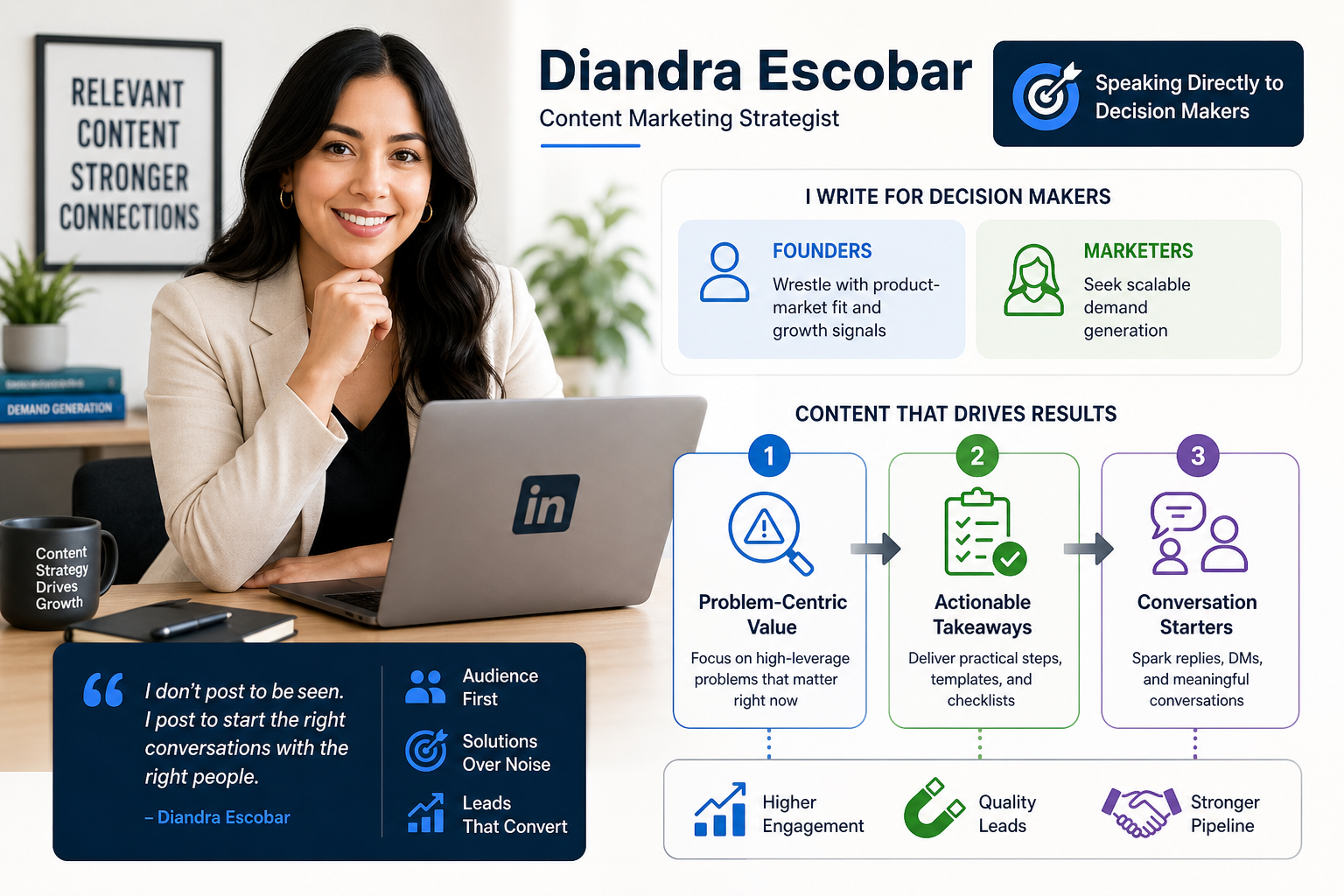
Diandra Escobar, a Content Marketing Strategist, shows how addressing decision makers can lead to meaningful engagement and high-quality leads on LinkedIn. Her approach centers on content that speaks to the distinct pain points of founders and senior marketers, rather than generic best practices. By tackling core challenges with concrete, practical steps, she moves readers from passive scrolling to active consideration and conversation.
Key to Diandra’s method is aligning audience insight with content outcomes. She identifies two primary archetypes: founders facing product-market fit and growth signals, and marketers pursuing scalable demand generation. Each piece speaks their language, acknowledges their constraints, and offers tactics they can implement without heavy resources or complex approvals.
Her content rests on three pillars that drive engagement and quality leads:
- Problem-centric value: Each post focuses on a specific, high-leverage problem the ICP faces, not a list of generic tips. This clarity helps founders see relevance and marketers recognize impact on growth metrics.
- Actionable takeaways: Diandra provides crisp, repeatable steps, templates, and checklists that readers can apply within their workflows, shortening the path from awareness to action.
- Outcome storytelling: She pairs insights with tangible results or scenario-driven examples, making the potential outcomes concrete for decision makers.
To illustrate the impact, a typical post might open with a precise challenge—such as accelerating early customer validation or turning product insights into demand generation. The narrative then moves to a concrete framework, a mini-template, or a practical process that founders and marketers can implement within a single quarter. The call to action invites readers to share experiences or request a ready-to-use template, fostering dialogue and positioning Diandra as a trusted advisor rather than a passive information source.
Content that communicates directly to decision makers
- ICP-first language: Use terms and metrics that matter to founders and marketers, such as ARR impact, conversion lift, or time-to-value, instead of abstract marketing concepts.
- Concise formats with high resonance: Favor short, scannable posts that still deliver a clear takeaway, followed by a deeper dive option for those who want more detail.
- Proof through context: Include brief case-like illustrations or mini case studies that reveal the conditions under which the suggested approach worked.
Concrete examples and templates you can reuse
Diandra often provides readers with ready-to-implement assets, such as
- Template outlines for outreach or content calendars tailored to startup growth cycles
- A concise framework for transforming product insights into demand generation plays
- Checklists that keep messaging aligned with ICP pain points across channels
These assets lower the friction for decision makers to respond. When readers can readily apply a proven approach, they are more likely to engage in dialogue, request further resources, or start conversations that lead to qualified opportunities.
Diandra also emphasizes a disciplined feedback loop. She invites readers to share what worked, what didn’t, and what would help them take the next step. This ongoing exchange reinforces credibility and helps refine the content strategy to address evolving founder and marketer priorities.
Takeaway blueprint
- Define the ICP explicitly and tailor every post to the unique pain points of founders and marketers.
- Lead with impact by highlighting outcomes readers can achieve with minimal resistance.
- Provide executable assets such as templates and checklists that shorten the path to results.
- Invite dialogue with targeted questions or prompts that solicit real-world feedback and case-sharing.
By framing content around decision makers’ needs and delivering practical, provable solutions, Diandra Escobar shows how LinkedIn can generate not just engagement, but high-quality leads and productive conversations. Her approach demonstrates how thoughtful targeting, clear value, and actionable resources turn audience attention into meaningful business momentum.
Bojana Vojnović — Demonstrating Real Content Strategy in Practice
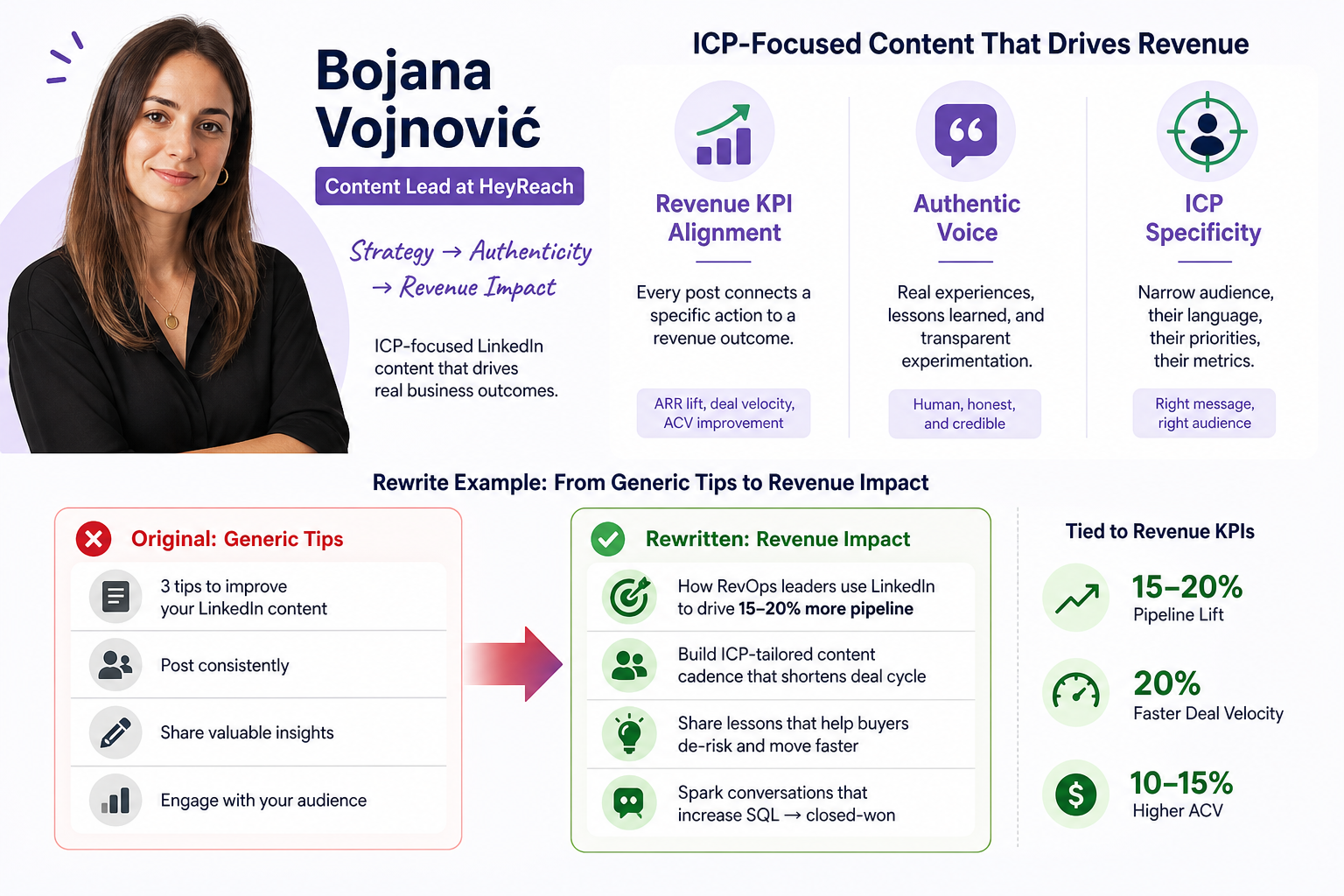
Bojana Vojnović, Content Lead at HeyReach, shows how to translate a revenue-focused strategy into authentic, ICP-centered LinkedIn content that stands out in a crowded feed. Her approach emphasizes real, human-driven storytelling that ties everyday actions to measurable outcomes, while keeping the spotlight on the defined ICPs. This combination helps a brand differentiate itself through credibility rather than purely promotional messaging.
Central to Bojana’s method is rewriting the strategy around revenue KPIs in a way that preserves authenticity. Rather than presenting generic tips or hype, she reframes content so every post speaks to how a specific audience segment can improve top and bottom line outcomes. The result is content that feels earned rather than manufactured, which in turn drives higher engagement quality and more meaningful conversations with decision makers.
Core elements of Bojana’s ICP focused content
- Revenue KPI alignment: Each post links a concrete action to a revenue outcome such as ARR lift, deal velocity, or average contract value improvement.
- Authentic voice: Content centers on genuine experiences, lessons learned, and transparent experimentation rather than generic playbooks.
- ICP specificity: Messaging targets a narrow, well defined audience with language they use and metrics that matter to them.
Rewrite example: from generic tips to revenue impact
Original post concept (simplified):
Promote content around building a content strategy, focusing on consistency and best practices for posting on LinkedIn.
Rewritten strategy concept by Bojana:
- Headline focus: From “How to build a content strategy” to “How one 90 day content plan increased Q2 revenue by 15 percent for high ICPs in SaaS.”
- Narrative shift: Replace general tips with a real revenue impact example tailored to ICPs, including context, actions, and measurable results.
- Actionable ICP outcome: Include a concrete model showing how a sequence of LinkedIn content touches can shorten the sales cycle and lift pipeline velocity for the target ICPs.
Applied rewrite framework in practice:
- Diagnose the ICP pain: Identify top revenue pressure points for the ICP, such as accelerating forecast accuracy or increasing MRR from new logos.
- Map content to revenue steps: Tie each content piece to a revenue step, for example, content that educates a founder on improving win rates by 20 percent within three quarters.
- Show the math: Include a brief before/after scenario with numbers that illustrate potential impact, while staying grounded and credible.
Example post structure Bojana might deploy:
| Component | What it communicates | Revenue focus |
|---|---|---|
| Opening hook | Identifies a concrete ICP pain point in their language | Sets up revenue relevance |
| Context and challenge | Brief scenario tying the pain to current business pressures | Links to potential revenue risk or opportunity |
| Actual steps or framework | 3 to 5 practical actions the ICP can implement | Directly tied to measurable outcomes |
| Proof point | One concrete result or benchmark from a similar ICP | Illustrates potential revenue lift |
| CTA | Invite discussion or request for a tailored plan | Opens a pathway to conversation and opportunity |
In practice, Bojana anchors posts in authentic, data-informed stories rather than generic advice. For example, a post might describe how a revenue KPI—like quarterly recurring revenue—was affected by a targeted content sequence that educated the ICP on price value, leading to faster deals and a 12 percent increase in close rate within a defined segment. This approach makes the content feel earned and relevant, not promotional.
Authenticity as a differentiator
Authenticity is not a buzzword for Bojana; it is a practical constraint and a differentiator. She leans into transparent experimentation, sharing what worked and what did not, including the tradeoffs involved in pursuing certain ICPs over others. By narrating her thought process and the concrete outcomes, she builds trust with the audience while maintaining a strong, recognizable voice that stands apart from generic guidance.
To operationalize this approach, Bojana offers three actionable steps for teams seeking to differentiate on LinkedIn through revenue-minded content:
- Define the ICP revenue priorities and align every post to a specific KPI such as lead velocity, win rate, or renewal value.
- Tell real stories with data by sharing a recent client or internal result, including the conditions that made the outcome possible and the exact actions taken.
- Maintain an authentic voice by sharing lessons learned, including missteps, while keeping language simple and audience focused.
Impact comes from content that is believable, relevant, and actionable. Bojana’s approach shows that a brand can differentiate itself on LinkedIn by foregrounding revenue-driven outcomes, keeping authenticity, and delivering ICP-tailored insights that feel practical and trustworthy rather than purely aspirational.
For further exploration of practical, revenue-aligned content strategies and ICP-centered storytelling, readers can consult broader playbooks and case studies in industry discussions and thought leadership resources. The core idea remains: when content speaks directly to revenue concerns of a defined audience with credible, actionable steps, differentiation follows naturally and conversations begin to turn into opportunities.
LinkedIn Creator Mode and External Content Partnerships
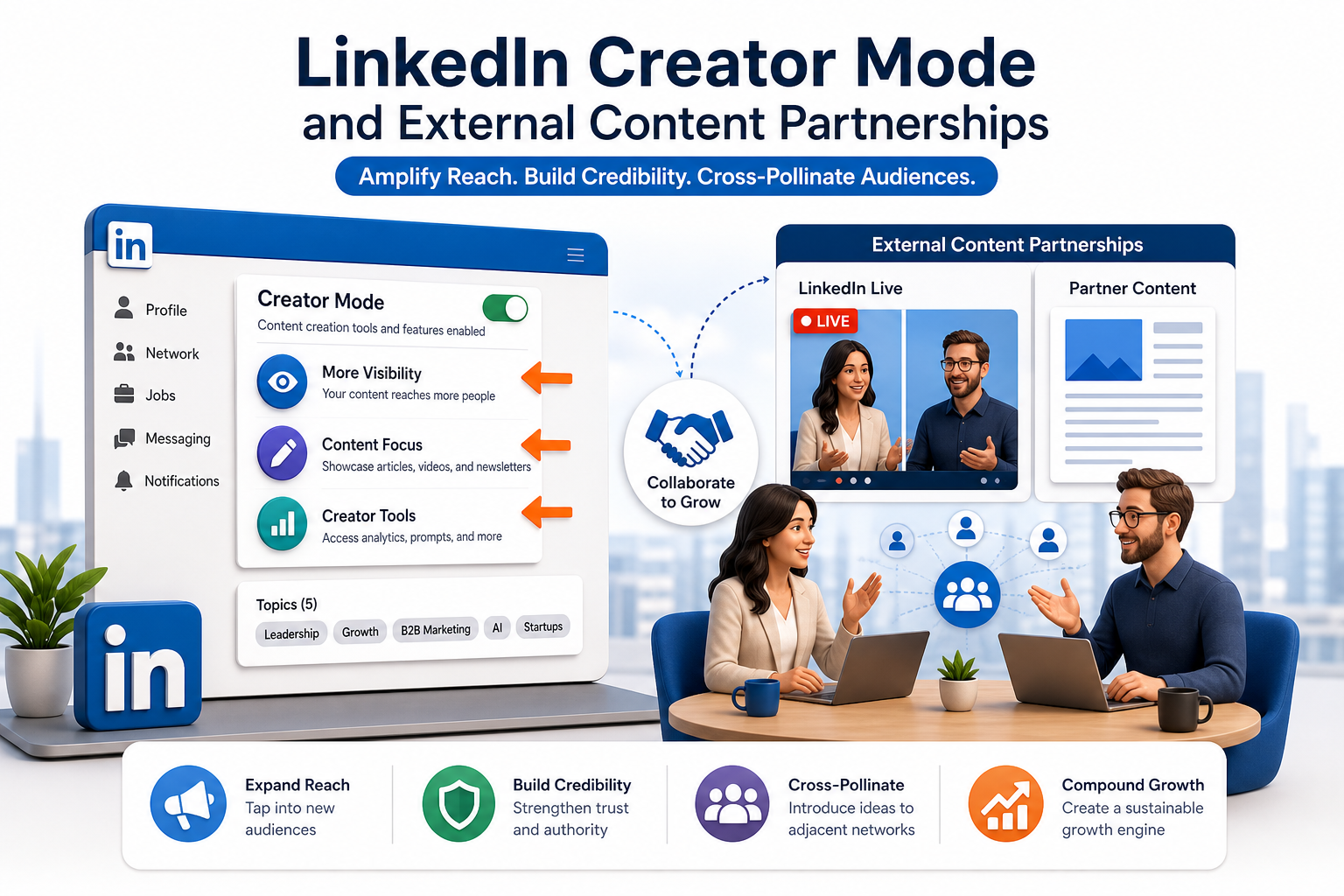
Activating LinkedIn Creator Mode and forming external content partnerships are practical, high leverage tactics for expanding reach, enhancing credibility, and driving cross pollination across audiences.
Creator Mode shifts how your personal or company page is discovered and prioritized, while collaborations such as LinkedIn Live events or partner content introduce your ideas to adjacent networks. Used together, they create a disciplined growth engine that compounds over time.
Creator Mode: what it does and how to use it
Creator Mode is a setting on LinkedIn profiles that emphasizes content creation over traditional personal branding.
When enabled, it often boosts the visibility of your content, expands the topics you can be discovered for, and surfaces creator tools that streamline posting. This makes it easier for your target ICPs and peers to find, consume, and engage with your posts.
- Visibility ramp: Your posts appear prominently in followers’ feeds, which increases impressions and engagement opportunities for each new piece of content.
- Content focus: The profile highlights content creation activities such as newsletters, articles, videos, and live events, signaling thought leadership to the right audience.
- Creator tools: Access to features like Creator Mode prompts, topic tagging, and enhanced analytics helps refine your growth plan.
Best practices for leveraging Creator Mode include:
- Clarify your value proposition in your headline and About section so new visitors immediately understand the problems you solve.
- Publish a predictable cadence with a mix of short-form posts, carousels, and long-form content to keep the feed active and diverse.
- Use topic shelves and hashtags strategically to position your content within your ICPs’ interests without appearing spammy.
External content partnerships: expanding reach through collaboration
External content partnerships encompass co authored posts, joint LinkedIn Live events, and cross posts with complementary brands or creators.
These partnerships enable cross pollination of audiences, allowing you to tap into new segments while lending credibility through association with trusted voices in adjacent domains.
- Joint content formats: co authored articles, interview style posts, and joint carousels that distill shared insights for both audiences.
- LinkedIn Live collaborations: co hosting live sessions with partners to discuss industry trends, case studies, or tactical playbooks in real time.
- Cross promotion: mutually sharing content to each partner’s network, while maintaining authentic value and avoiding overt promotion.
Key benefits include:
- Expanded reach: Access partner audiences who may not yet be familiar with your work.
- Credibility boost: Association with respected peers or brands signals endorsement and expertise.
- Content variety: Diverse formats from interviews to live Q&As keep the content calendar fresh and engaging.
Practical playbook: how to implement Creator Mode and partnerships
- Assess readiness: Confirm you have a consistent posting rhythm and a library of value driven content before enabling Creator Mode.
- Enable Creator Mode: In your LinkedIn profile settings, toggle Creator Mode and select topics that align with your ICPs. Ensure your banner and About section reinforce your focus.
- Define collaboration targets: Identify 2 to 3 potential partners whose audiences overlap with yours but are not direct competitors. Create a mutual value proposition for collaboration.
- Plan formats: Map out a quarterly calendar that includes at least one LinkedIn Live event per quarter and two co authored pieces or cross posts per month.
- Co create content: Develop a joint content brief that covers objective, audience, key messages, formats, CTAs, and success metrics. Ensure both sides contribute equally in value and exposure.
- Promote responsibly: Promote collaboration content to both networks with respectful framing. Avoid over saturation and keep messaging focused on insights and outcomes.
- Measure and optimize: Track impressions, engagement, follower growth, and downstream conversations. Use learnings to refine future partnerships and content topics.
Impact metrics to monitor
| Metric | What it indicates | How to optimize |
|---|---|---|
| Impressions per post | Reach and visibility of your content | Increase posting cadence and diversify formats |
| Engagement rate | Quality of interactions and relevance | Refine hooks, provide clear CTAs, and highlight tangible outcomes |
| Follower growth from collaborations | Audience expansion from cross posts and Live events | Target partnerships with overlapping but growth oriented ICPs |
| Conversation velocity | Speed at which posts generate messages, inquiries, or opportunities | Include concrete next steps and templates in CTAs |
| Live event attendance and outcomes | Direct engagement and lead generation from Live sessions | Prepare high value agendas and post event follow ups with actionable assets |
Operational considerations and ethics
To maintain authenticity and avoid fatigue,
- Maintain transparency: Clearly disclose any co creation arrangements to the audience and ensure the collaboration aligns with your brand values.
- Respect audience needs: Prioritize topics that solve real problems for your ICPs and avoid excessive cross promotion.
- Quality over quantity: Focus on delivering meaningful insights rather than simply increasing post volume.
When executed thoughtfully, Creator Mode combined with external partnerships accelerates authority building and invites new conversations from diverse segments. The result is a more resilient growth engine where your content travels farther, credibility grows, and audiences are invited to engage in highly relevant, value driven dialogues.
Buffer and Timing Insights for Posting
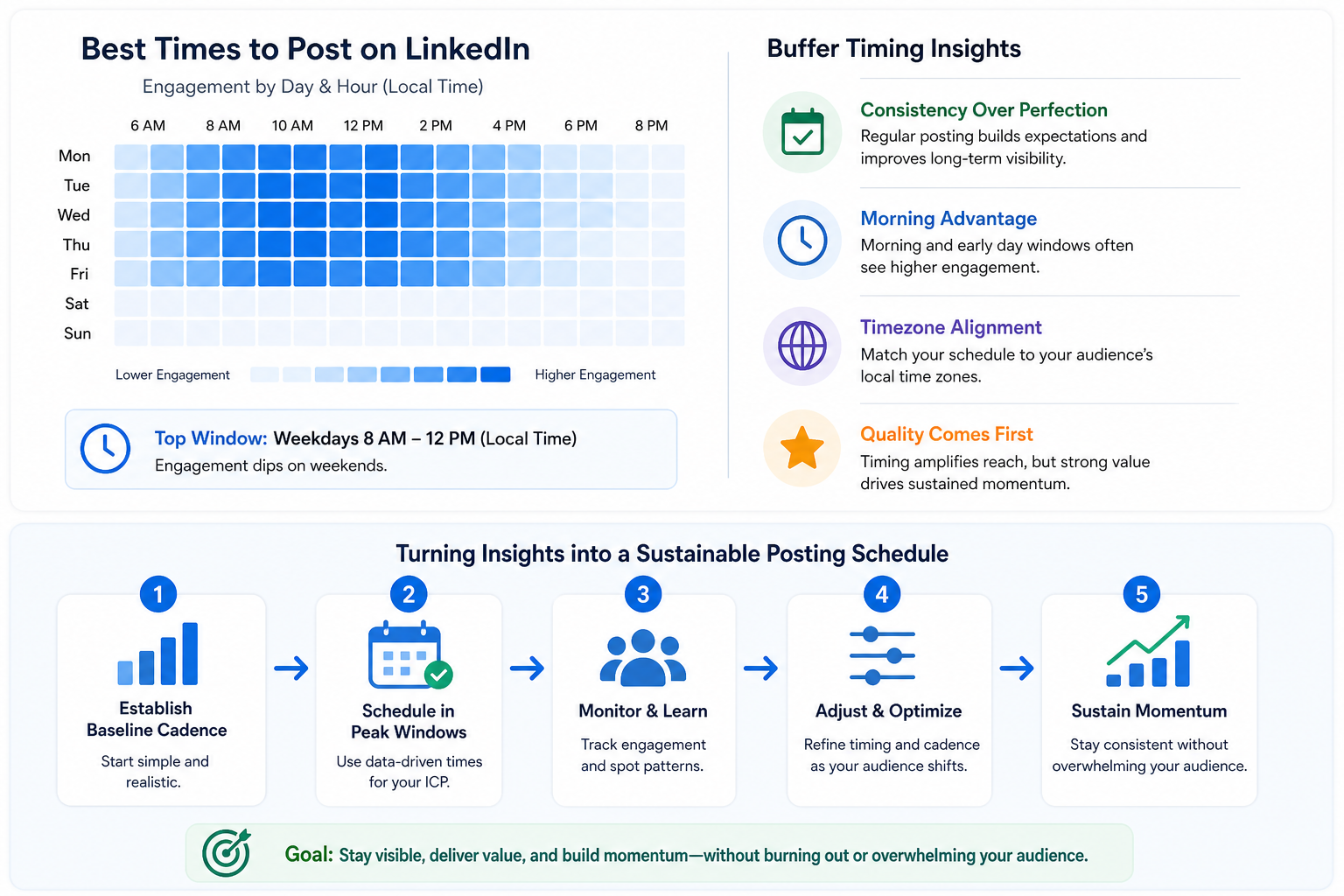
Buffer’s large scale study of LinkedIn activity analyzed millions of posts to distill patterns about when audiences are most receptive. The takeaway is not a single magic hour but a window of consistent activity that varies by audience and time zone. Across many professional audiences, engagement tends to cluster on weekdays during typical workday hours, with engagement dipping on weekends. The key insight is that regular, predictable timing helps your content ride the momentum of active network activity rather than fighting for attention in quiet periods.
What the study suggests about timing includes:
- Consistency beats perfection: posting at regular intervals trains the algorithm and your audience to expect your content, which can improve long term visibility.
- Morning and early day windows often show higher engagement, as professionals review feeds before deep work sessions and meetings.
- Timezone alignment matters: schedule posts to match the peak activity of the majority of your ICP in their local time zones, then adjust as your audience shifts.
- Quality should accompany timing: timing amplifies reach, but strong value in each post drives sustained momentum beyond a single peak window.
Translating timing data into a sustainable posting schedule involves combining data-driven windows with a realistic cadence. The goal is to maintain visibility without overwhelming your audience or burning out your team.
- Establish a baseline cadence: start with a modest, sustainable schedule such as 3 posts per week and gradually increase if you can maintain quality and engagement.
- Map timing to audience activity: identify your ICP’s peak activity days and times using platform analytics and any available third party insights, then align the bulk of your content to those windows.
- Diversify formats within timing windows: rotate text posts, carousels, and short videos within the chosen time slots to maximize engagement without flooding the feed.
- Batch planning and batching execution: plan content in batches for a week or two, then publish on a consistent schedule to avoid last minute scrambles.
- Monitor, then optimize: track impressions, engagements, and follower moves relative to posting times. If certain slots underperform, reallocate posts to higher performing windows.
Practical cadence examples you can adapt include:
| Cadence | Days | Notes |
|---|---|---|
| Foundation | Mon, Wed, Fri | 3 posts per week to establish momentum and learn audience preferences. |
| Enhanced | Tue, Thu, Sat | Introduce a weekend slot for lighter, more digestible content where appropriate. |
| Balanced | Mon, Tue, Thu | Maintain steady rhythm with a mix of formats; adjust times to peak audience activity. |
As you apply Buffer’s timing insights, remember that the ultimate goal is a sustainable rhythm that keeps your audience engaged without causing fatigue. Start with a prudent schedule, validate with your engagement data, and iterate toward a cadence that preserves momentum while honoring the bandwidth of your team and the attention span of your ICPs.
Sprout Social and Earned Media Value in Employee Advocacy
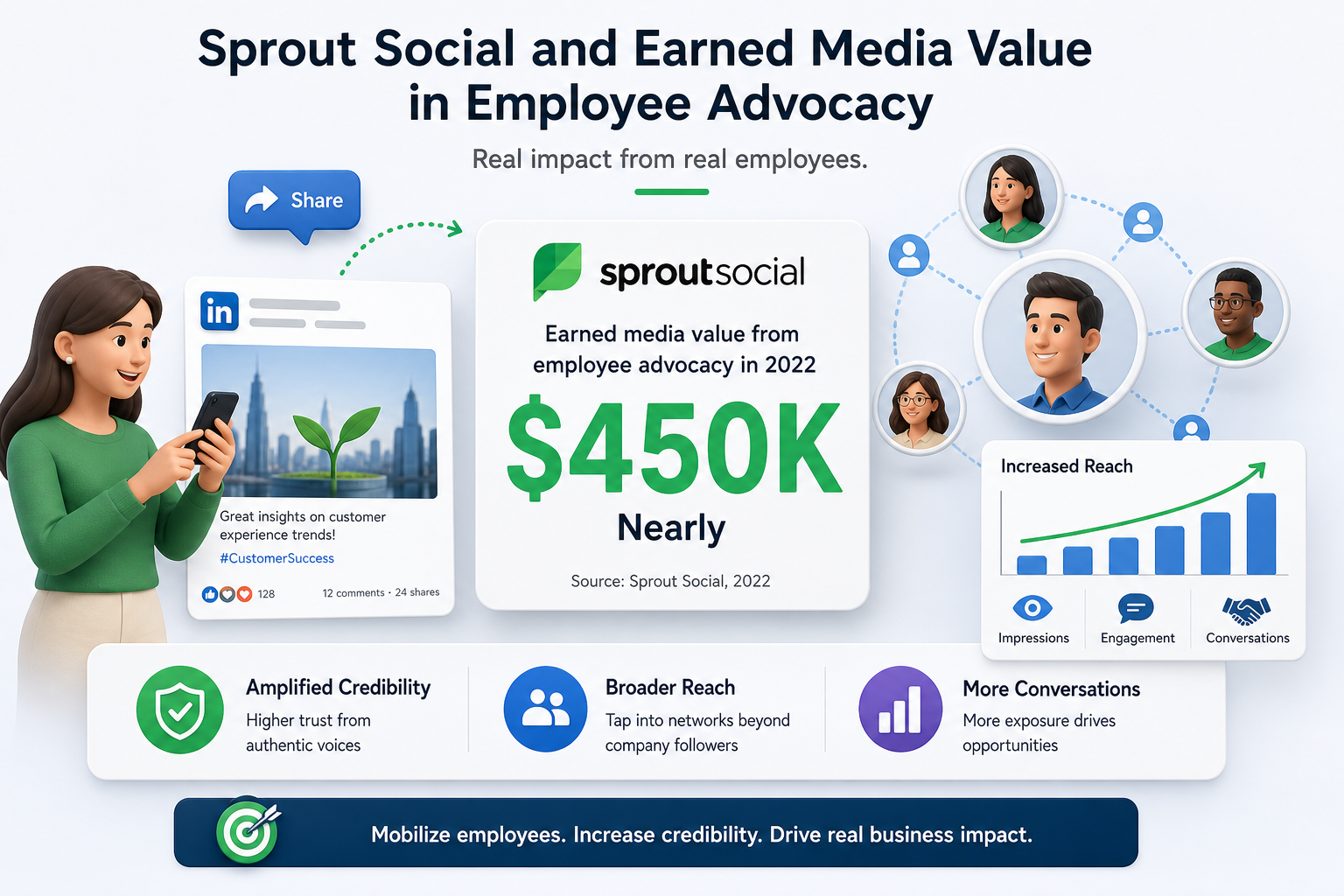
Employee advocacy is more than a feel good initiative. When colleagues share valuable content, it expands reach, builds credibility, and speeds up conversations with potential buyers. A clear example comes from Sprout Social, which documented the tangible value created when employees participate in advocacy programs.
In 2022, Sprout Social reported that earned media value from employee advocacy approached nearly $450,000. This figure reflects the combined impact of more impressions, more authentic engagement, and the trust audiences place in recommendations from real employees rather than traditional brand channels.
Key takeaways from this data point include:
- Amplified credibility: Content shared by employees often feels more authentic, which can lift engagement quality and trust signals with target accounts.
- Broader reach at lower cost: Employee shares extend beyond the company’s follower base, reaching networks that are hard to access without paid amplification.
- Momentum for conversations: Greater exposure typically leads to more inbound conversations, opportunities, and social proof for sales and partnerships.
To translate this into practical execution, organizations can design lightweight, opt-in advocacy programs that equip employees with ready-to-share assets, provide clear guidance on compliant and respectful sharing, and create a simple tracking framework to attribute impact. By aligning employee participation with broader content goals and ICP targets, a brand can turn casual shares into meaningful engagement and measurable outcomes.
When evaluating potential returns from employee advocacy, consider the following framework:
- Set clear objectives for reach, engagement quality, and downstream conversations.
- Provide ready assets such as templates, carousels, and framework posts teammates can customize quickly.
- Track in context with attribution models that connect shares to engagements, inquiries, and opportunities.
- Iterate responsibly refine prompts and guidance based on what resonates with different audiences and roles.
In sum, Sprout Social’s earned media value figures illustrate a strong economic case for employee advocacy as a multiplier of reach and credibility. When thoughtfully implemented, mobilizing your team to participate in content sharing can amplify your LinkedIn growth tactics by turning everyday employees into credible multipliers of your message.
Canva and Visual Content for Consistent Formats
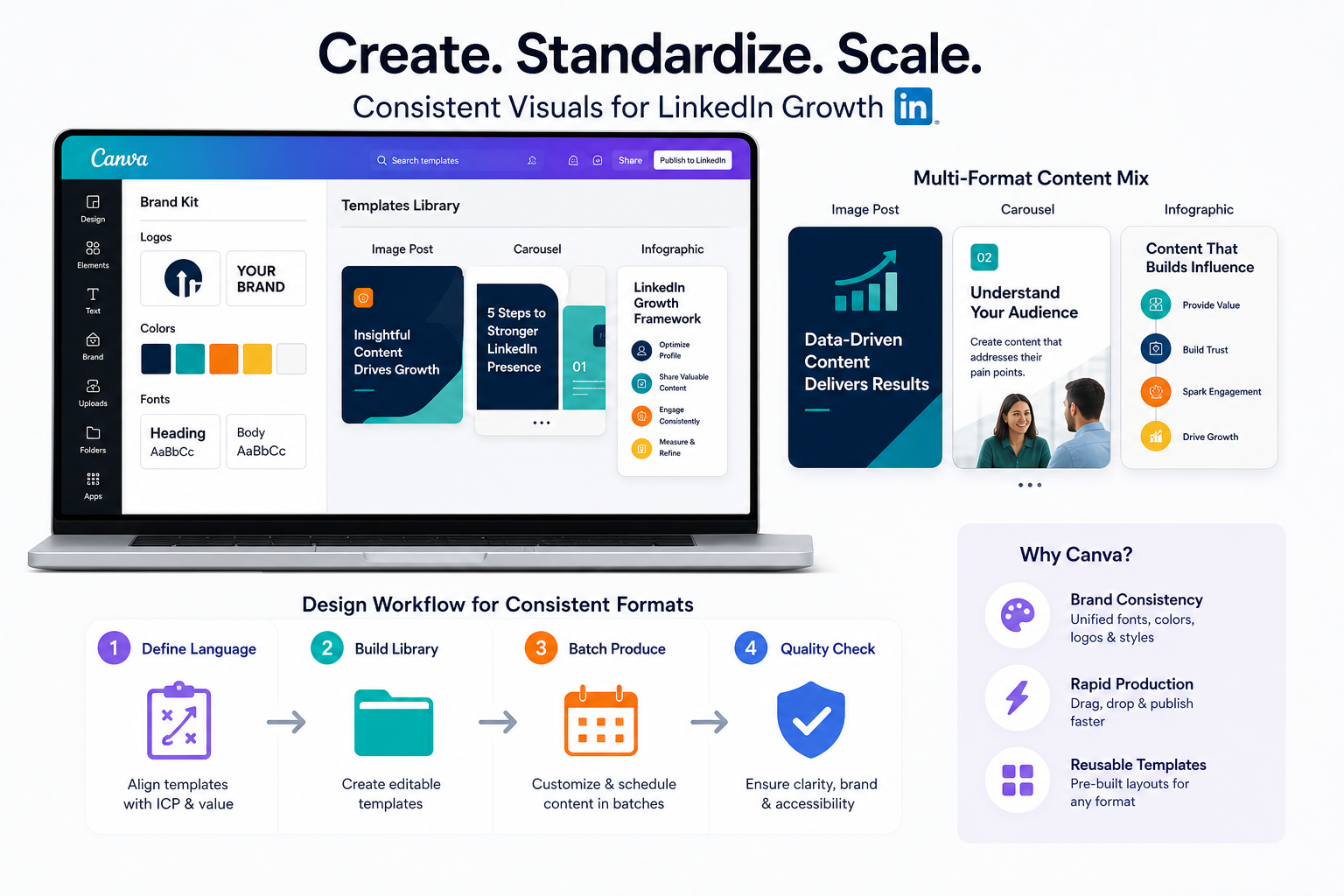
Visual content anchors a diverse LinkedIn growth plan. Using Canva to produce consistent, high-quality visuals lets your team sustain a multi format content mix that includes images, carousels, and infographics. This consistency helps engagement and retention by creating a recognizable visual language your ICPs can quickly interpret and trust.
Why Canva supports a sustainable visuals library
- Brand consistency: A centralized brand kit keeps fonts, colors, logos, and style rules uniform across visuals, reducing creative friction.
- Rapid production: Drag and drop simplicity speeds up ideation, approval, and publishing, letting your team scale output without sacrificing quality.
- Reusable templates: Pre built layouts for posts, carousels, and infographics accelerate ideation while preserving a premium feel.
Design workflow for consistent formats
- Define the visual language: Establish a handful of templates for each format (single image, carousel, infographic) that align with your ICPs and value proposition.
- Create a templates library: Build editable Canva templates with placeholder copy and imagery, so contributors can swap in new content without breaking the layout.
- Batch production: Schedule dedicated blocks to customize templates for different topics or campaigns, then publish on a regular cadence.
- Quality checks: Implement a quick review step to ensure accessibility, readability, and brand alignment before posting.
Format specifics and best practices
| Format | Recommended size | Usage | Design tips |
|---|---|---|---|
| LinkedIn image post | 1200 x 628 px | Single image updates | Keep essential text within safe margins; use bold headlines; optimize for mobile viewing |
| LinkedIn carousel | 1080 x 1080 px per slide | Educational or step by step posts | Limit text per slide; use a consistent color cue per slide; design for sequential storytelling |
| Infographic | 800 x 2000 px (tall) or 1200 x 1800 px | Data heavy insights | Show one idea per section; use icons and data visualizations; ensure legibility at small sizes |
| Short video thumbnail | 16:9 aspect ratio, 1280 x 720 px | Video posts or teasers | Include a clear title in the thumbnail; maintain brand colors; keep motion minimal but engaging |
Practical Canva tips for non designers
- Use a brand kit: Upload logo, fonts, and color palette once, then apply automatically to all templates.
- Leverage grids: Align elements with grid guides to achieve clean, scannable layouts.
- Incorporate readable typography: Pair a bold headline font with a lighter body font; maintain contrast against backgrounds.
- Apply accessible color contrast: Check contrast ratios to ensure readability for all audiences.
- Incorporate actionable copy: Pair visuals with concise, benefit oriented text that supports a strong CTA.
Maintaining engagement through a diversified visuals mix
To keep audiences engaged over time, rotate formats to match the message and the stage of the customer journey. For example:
- Images: Quick, scannable insights or quotes that invite comments
- Carousels: Step by step guides, checklists, or frameworks that invite saves and shares
- Infographics: Data driven narratives that establish credibility and encourage bookmarkable references
Accessibility and discoverability
Make visuals more accessible by:
- Using high contrast text and backgrounds
- Including descriptive alt text for each image
- Keeping text legible at smaller sizes and on mobile devices
Operational tips for teams
- Editorial calendar alignment: Tie visual templates to the content calendar so visuals arrive with accompanying copy and CTAs.
- Asset tracking: Maintain a simple inventory of templates, color codes, and approved assets to avoid duplicated effort.
- Performance feedback loop: Track which formats and templates drive the most saves, shares, and conversions, then refine templates accordingly.
By adopting Canva as the central tool for a consistent visual language, your LinkedIn Growth Tactics become more scalable and effective. High quality visuals support a diversified format strategy, enhance retention, and amplify the impact of each post within your content engine.
Creating a Content Engine with Real Examples
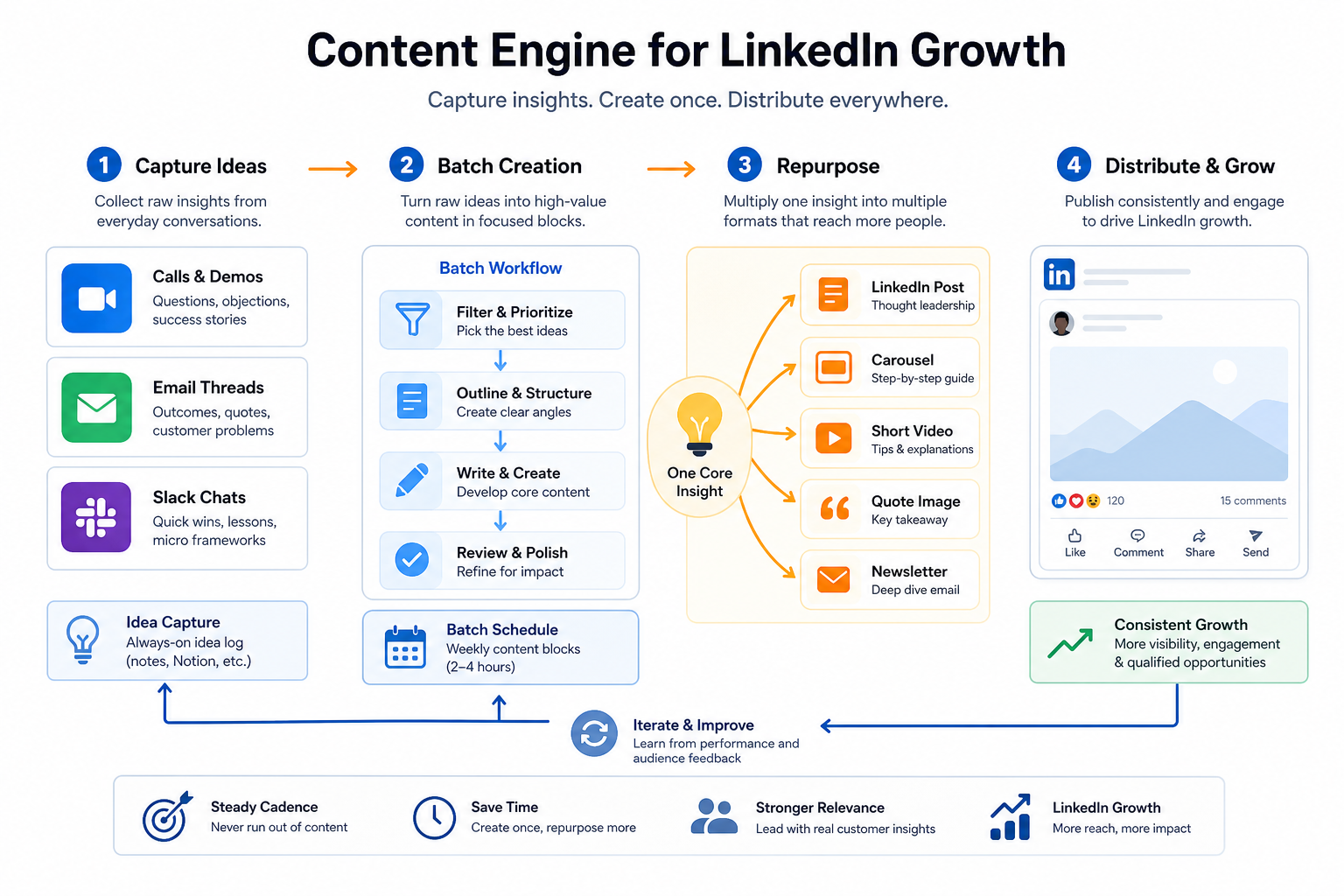
A content engine is a repeatable system that turns everyday conversations and observations into a steady stream of high value LinkedIn content. The goal is to remove creative friction by capturing ideas where they naturally arise, organizing them into a scalable workflow, and repurposing a single insight into multiple formats that resonate with your ICPs. When you treat content creation as a structured process rather than a one off sprint, you can sustain momentum without burning out your team.
Ideas come from real interactions and observations. Capture them as they happen, then shape them into a predictable process that feeds multiple formats over time. This approach keeps output relevant and authentic while helping your team stay focused and energized.
Key sources for ideas include:
- Calls and demos: Spot recurring questions, objections, and success stories that illustrate value.
- Email threads: Extract measurable outcomes, customer quotes, and the exact problems your product solves.
- Slack and internal chats: Capture quick wins, lessons learned, and micro frameworks that can be explained visually.
Core components of a content engine include batching, repurposing, and a clear mapping from insight to format. Each component is designed to maximize return on time spent while maintaining authenticity and relevance to your audience.
Batching creation for consistency
Batching means setting aside dedicated blocks of time to transform raw insights into publishable assets. Instead of writing posts ad hoc, you prepare a batch of content at once and then schedule its release. This approach reduces context switching, improves copy quality, and helps you maintain a predictable cadence.
With a routine batch, you can quickly move ideas from capture to drafts to publishing, keeping your calendar steady and your message on point.
- Idea capture: Maintain a living ideas list in a shared note or project board with tags for ICP, topic, and potential format.
- Batch processing: Allocate a weekly or biweekly window to convert ideas into drafts, visuals, and headlines.
- Batch scheduling: Use a content calendar to plan a sequence of posts across formats, ensuring variety and coverage of key topics.
Repurposing across formats
Turn a single insight into multiple assets to maximize reach and engagement. A practical approach is to create a core narrative and then adapt it for different formats, such as text posts, carousels, short videos, and infographics. This diversification helps you meet different audience preferences and keeps the content calendar fresh.
By framing one idea in several ways, you can extend its usefulness and reinforce your message across the feed.
| Insight Source | Format 1 | Format 2 | Format 3 |
|---|---|---|---|
| Concrete client outcome from a call | 1 paragraph post with a strong hook | Carousel outlining steps and the sequence that led to the outcome | Short video summarizing the result and next steps |
| Common objection addressed in email thread | Single image with a takeaway and CTA | Infographic showing the before and after metrics | LinkedIn article expanding the framework and including a mini template |
| Team lesson from Slack discussion | Text post with a quotable line and context | Checklist post detailing actions to replicate the result | Template post with fillable fields for readers to customize |
A practical workflow you can implement
- Capture in real time: Use a single capture surface (a notebook, a shared doc, or a note app) to jot down observable problems, quotes, and outcomes from every meeting or chat.
- Clarify with context: For each idea, add 2–3 sentences that explain why it matters to your ICP and what outcome it implies.
- Create in batches: Convert 4–6 ideas into draft assets in a single session, choosing a mix of formats for balance.
- Catalog with tags: Label assets by ICP, outcome type, and format so you can recombine later.
- Publish on a cadence: Schedule posts over a 2–3 week window to maintain momentum and avoid peak fatigue.
- Analyze and iterate: Track engagement and downstream conversations to identify which formats and topics perform best, then refine your batch plan accordingly.
A real example of a content engine in action
Scenario: A product team discovers that onboarding time is a major friction point for ICPs. The insight is distilled into a sequence of content assets optimized for LinkedIn growth tactics.
Idea capture focuses on onboarding time, time to first value, friction points, and customer feedback from a recent call. Draft assets include posts and a multi-slide carousel with actionable steps and concrete examples.
- Idea capture: Onboarding time, time to first value, friction points, and a slice of customer feedback from a recent call.
- Draft assets:
- Post 1: Hooked text post explaining the onboarding friction and its impact on time to value.
- Post 2: Carousel with 5 steps to accelerate onboarding, each slide containing a practical tip and a quick example.
- Post 3: Short video demo showing a concrete tweak that reduced onboarding time by a measurable margin.
- Repurposing: Convert the carousel into an infographic and split the video into a micro clip for a short teaser.
- Publish sequence: Schedule over two weeks with complementary CTAs inviting readers to share their onboarding bottlenecks or request a template.
- Measure: Track saves, comments, and the number of inquiries about onboarding optimization; use learnings to inform the next batch.
By treating content creation as a managed system rather than a random several posts per week activity, you create a dependable engine that scales with your brand. The emphasis on capturing authentic experiences, batching production, and repurposing across formats yields a steady stream of value that keeps your LinkedIn Growth Tactics fresh and credible.
LinkedIn Live and 8-Step Growth Tactics in Practice
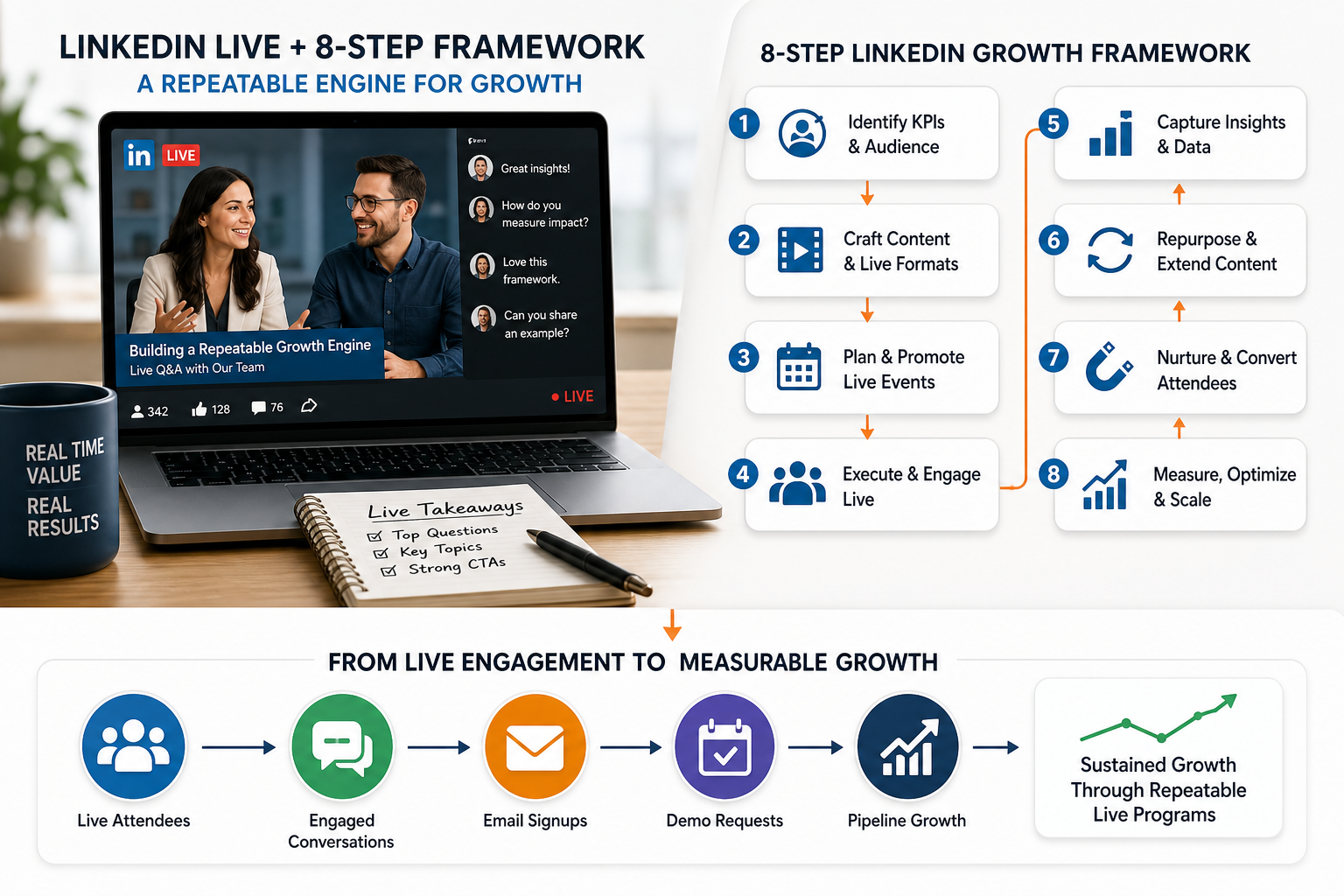
LinkedIn Live events paired with a disciplined eight step growth framework create a reliable, repeatable engine for ongoing brand visibility, credibility, and pipeline. Live video accelerates reach by delivering real time value, authentic connection, and interactive engagement that static posts cannot match. When you couple live formats with a structured, stepwise playbook, you can scale learning, optimize contribution from teammates, and translate momentum into measurable outcomes across the eight steps used in startup guides.
Step 1 — Identify the KPIs and audience through live experimentation
Launch a baseline LinkedIn Live session to observe how your target ICP engages with real time content. Use this session to validate which metrics move most: views, watch time, live chat questions, post-event follow ups, or demo requests. Establish a simple KPI set for Live programs such as:
- Live attendance: number of unique attendees per session
- Engagement rate: comments and reactions per viewer
- Conversion signals: email signups, demo requests, or downloads attributed to the event
Practical exercise: conduct a 45 minute pilot LinkedIn Live with 1 co host from your team. After the session, summarize in bullet points:
- Which ICPs joined or watched the recording
- Which topics generated the most questions
- Which CTAs yielded actual conversations or conversations scheduled
Step 2 — Craft content mix and live formats
Live sessions work best when they are part of a diversified content engine. Combine educational webinars, live Q&As, product deep dives, and partner interviews. Each format should tie back to a core problem your ICP faces and present a clear, actionable outcome.
- Educational live: 30 to 40 minutes with a structured agenda and a takeaway one-pager
- Live Q&A: 20 minutes, audience questions drive the flow
- Partner live: co hosted with an aligned but non competing partner
Exercise: draft a quarterly Live calendar with two anchor topics per month, plus one partner session. Prepare a one-page brief for each session including goals, ICP focus, and pre show promos.
Step 3 — Let your brand shine through live storytelling
Live formats offer a unique opportunity to demonstrate brand voice and practical impact. Maintain a consistent tone, include success stories, and invite practical demonstrations when possible. Use live polls, on screen questions, and real time screen sharing to reinforce credibility.
- Voice: authentic, helpful, and action oriented
- Visuals: bold on screen summaries, callouts for ICP pain points, and live demos
- Interaction: prompt viewers to share their experiences and post event follow ups
Exercise: script a five minute Live outline that opens with a problem statement, shares a concrete example, and closes with a specific next step for attendees.
Step 4 — Determine posting frequency and live cadence
Consistency matters for Live programs just as it does for posts. Establish a cadence that suits your capacity and audience habits. Start with a predictable rhythm, such as one live per month plus weekly short clips or highlights from the sessions.
- Cadence options: monthly anchor, biweekly deep dive, and weekly clips
- Promotional plan: 2 posts before each live, 1 reminder on the day, and a recap afterwards
Exercise: create a quarterly Live calendar with dates, topics, hosts, and a pre promotional plan. Include a 24 hour reminder post and a post event wrap up with downloadable resources.
Step 5 — Deploy employee advocates for live amplification
Employee advocates can dramatically extend the reach of Live sessions when they share prompts, quotes, and key takeaways with their networks. Equip employees with a short briefing, a ready to post highlight reel, and a CTA that invites colleagues to join the next session.
- Advocacy playbook: brief, compliant guidelines and a few ready assets
- Tracking: attribution for attendees and post event engagement
Exercise: identify 2 to 3 employee advocates, assign pre event teaser posts, and define measurement criteria for their contributions to Live reach and engagement.
Step 6 — Partner with external voices for co created Live content
Collaborations expand the audience and add credibility. Plan joint lives with industry peers, customers, or complementary brands to present a shared framework or case study.
- Formats: co hosted sessions, panel discussions, or interview style streams
- Mutual value: cross promotion and access to adjacent ICPs
Exercise: draft a partner outreach plan describing two potential partners, proposed topics, and a mutual value exchange. Create a simple joint content brief for one test session.
Step 7 — Analyze data to adapt the live strategy
Live data informs optimization across the eight step framework. Track attendance, engagement quality, post session conversations, and downstream opportunities. Use insights to refine topics, format mix, and CTAs.
- Key metrics: attendance rate, average watch time, chat participation, post event inquiries
- Iteration principles: double down on formats and topics with clear revenue or product impact
Exercise: after each Live, compile a mini post event report with 3 actionable learnings and 2 experiments for the next session.
Step 8 — Adapt and scale the Live program with a repeatable playbook
Turn the insights from multiple Live sessions into a scalable playbook. Document templates, checklists, and decision rules so new hosts can ramp quickly and consistently deliver value.
- Playbook contents: session structure, prompts, visual assets checklist, pre and post event workflows
- Onboarding: quick training for new hosts and co hosts to maintain quality
Exercise: create a master Live playbook outline including the opening structure, recommended prompts, visual cues, and a post event follow up framework with assets and CTAs.
Practical integration tips
- On screen prompts: prepare 3 to 5 questions to drive audience participation in every Live
- Post event resources: deliver a succinct one pager or checklist to attendees
- Accessibility: include captions or transcripts and ensure clear audio for diverse audiences
By integrating LinkedIn Live into the eight step growth framework, startups gain a repeatable, measurable, and scalable way to educate, engage, and convert their target ICPs. The live format accelerates trust and credibility while the eight step playbook keeps the momentum purposeful and aligned with real business outcomes.
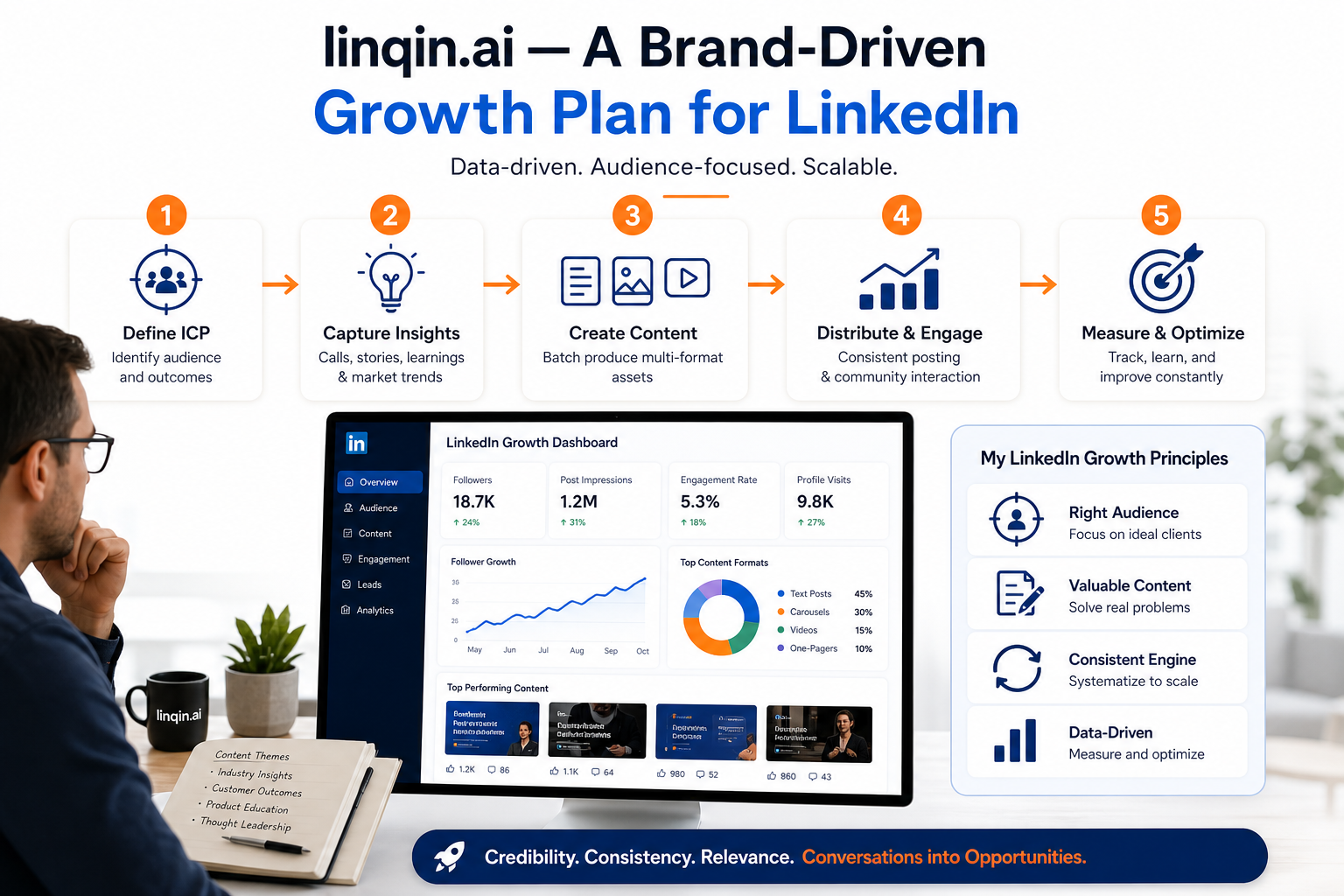
linqin.ai — A Brand-Driven Growth Plan for LinkedIn
At linqin.ai, my approach to LinkedIn growth is grounded in a data driven mindset, a clear audience focus, and scalable processes that compound over time. I view LinkedIn as a platform where credibility, consistency, and relevance converge to create lasting relationships with decision makers. Rather than chasing quick virality, I build a growth system that reliably expands reach, deepens engagement, and converts conversations into opportunities.
First principles drive every decision. I start by identifying the exact ICPs and the outcomes that matter most to them. I outline 3 to 5 core value propositions that address high impact pain points, then translate these into content themes, formats, and CTAs that align with our brand narrative. This ensures every post is purposeful, measurable, and positioned to move the needle for the right audience.
A data driven content engine that scales
To scale efficiently, I build a content engine that captures real world insights and transforms them into multiple formats. This engine rests on three pillars:
- Insight capture: I pull knowledge from calls, customer stories, product learnings, and market observations. Each insight is tagged by ICP, business impact, and the preferred content format.
- Batch production: I convert 4 to 6 insights into a mini content sprint, producing text posts, carousels, micro videos, and one page briefs that can be shared across channels or repurposed in other campaigns.
- Format diversification: I ensure a balanced mix of short hooks, practical frameworks, and outcome stories to accommodate different learning preferences within the target audience.
Table: Core formats and their purpose
| Format | Audience Benefit | When to Use |
|---|---|---|
| Text posts with hooks | Rapid adoption, quick value checks | Early engagement and hypothesis testing |
| Carousels | Step by step guidance, reusable learnings | Educational moments and process explanations |
| Short videos | Authenticity, credibility, personality | Demonstrating methods, sharing behind the scenes |
| Long form articles | Thought leadership, in depth rationale | Authority building and SEO value |
With this engine, I plan content cadence around ICP aligned themes and seasons in the market. I start with a baseline of 3 posts per week, varying formats to satisfy different engagement signals, and I continually monitor performance to optimize topics, formats, and timing.
Audience alignment and value delivery
Every piece of content is anchored in audience value. I map each post to a specific ICP need and a measurable outcome, such as increased efficiency, faster time to value, or higher win probability. By pairing each insight with a concrete action or template, I reduce friction for the reader to apply what they learn and begin a conversation with us.
Practical steps I would take:
- ICP clarity: Define the most relevant buyer personas and document their top three pain points and success metrics.
- Problem to plan mapping: For each ICP pain, create a brief content plan that includes a hook, a 3 to 5 step framework, and a CTA that invites next steps (demo, template, or discussion).
- Evidence and credibility: Include verifiable data points, client outcomes, or experiment results to support claims in every relevant post.
Creator Mode and partnerships as force multipliers
To extend reach without sacrificing depth, I leverage Creator Mode to emphasize content creation, and I pursue external partnerships that add credibility and access new audiences. My approach includes:
- Strategic partnerships: Co authored posts or Live sessions with non competing peers who share ICPs, providing fresh perspectives and broader exposure.
- Live amplification: Encourage employees and partners to participate in live events by providing ready to post snippets and clear CTAs to join the discussion.
- Ethical collaboration: Maintain transparency about collaborations and ensure all content remains aligned with our brand values and audience needs.
When combined with data driven content and a scalable production process, Creator Mode and external partnerships act as accelerants, helping us reach new segments while preserving the integrity and usefulness of every interaction.
Measurement and adaptation
I believe in a test and learn culture. I establish a simple KPI framework that tracks reach, engagement quality, and downstream conversations such as requests for more information, demos, or partnerships opportunities. I monitor weekly and adjust the content mix, topics, and CTAs based on results.
| Metric | What it indicates | Optimization action |
|---|---|---|
| Impressions | Top of funnel visibility | Increase posting cadence, test new formats |
| Engagement rate | Content resonance with ICPs | Refine hooks, strengthen value propositions, add clear CTAs |
| Comments and shares | Conversation quality and reach extension | Ask provocative questions, invite case studies, and encourage collaboration |
| Downstream conversations | Leads, demos, partnerships | Harden CTAs with easy next steps and templates for attendees |
In sum, linqin.ai’s brand driven growth plan for LinkedIn is a disciplined fusion of audience clarity, data informed content, scalable production, and partner enabled amplification. It aims to turn every piece of content into an opportunity to educate, build trust, and move the relationship closer to a meaningful business outcome. If implemented with rigor and patience, this approach scales with the brand and sustains momentum beyond individual campaigns.
Optimizing Your LinkedIn Profile as a Conversion-Driven Landing Page
Think of your LinkedIn profile as a high converting landing page rather than a static digital business card. Visitors arrive with intent, and the profile should answer the question, “What value can you deliver, and what should I do next?” The backbone of conversion on LinkedIn rests on three interconnected elements: headline clarity, a compelling About section, and a strategic Featured section. When these are aligned with your ICPs and your brand narrative, profile visits translate into conversations, invitations to connect, and inbound opportunities.
Focus on how each section reinforces your value and prompts action. A clear headline sets expectations at a glance. The About section expands on outcomes and credibility. The Featured area showcases proof and concrete next steps. Together, they create a cohesive path for visitors to engage.
Headline clarity that communicates value quickly
A crisp, outcome oriented headline is your first impression and a prime real estate for positioning. Move beyond job titles and craft a value proposition that signals the problem you solve and the audience you serve. For example, a strong headline could be:
- “Marketing Strategist helping SaaS startups increase conversion rates by 40%”
- “Growth leader enabling go to market teams to shorten time to value for ICPs”
In practice, Nadja Komnenic demonstrates how a headline can set the context immediately. Her profile positioning communicates who she helps and the results she delivers, creating a bridge from the reader’s problem to the solution you offer. This clarity invites the visitor to read further and reduces hesitation.
About section: speak directly to your ICP with proof in plain language
The About section should read as a direct conversation with your target audience. Speak in the first person where appropriate, outline the specific problems you solve, and include measurable outcomes or credible proof. A well crafted About section typically covers:
- Who you help (ICP) and why it matters
- The exact problems you solve and the scope of impact
- Concrete examples or metrics that demonstrate credibility
- A clear next step, such as scheduling a call, downloading a resource, or reviewing a case study
In Nadja Komnenic’s example, the About section is augmented by evidence of revenue growth, founder experience, and media appearances, which substantiates her claims and builds trust with decision makers. When you pair a compelling narrative with tangible proof, readers are more likely to initiate conversations and request further detail.
Featured section: curate trust building assets that drive conversations
The Featured section acts as a portable showroom of credibility. Include items that readers can immediately act on, such as:
- Case studies with measurable outcomes
- Templates, frameworks, or checklists
- Links to launch-ready resources or media appearances
Effective Featured content should reinforce the About section and headline by offering a tangible path to engagement. Nadja’s approach shows how highlighting a mix of proven outcomes and accessible assets can convert profile visits into conversations. The key is to present assets that readers can apply quickly or reference in a real world context.
Visual branding that supports credibility
Images and banners are not decoration; they are part of the conversion path. Use a clean profile photo, a banner that communicates your value proposition, and a design language that aligns with your brand. A cohesive visual identity reduces friction and signals professionalism, increasing the likelihood that visitors stay to learn more.
Images and banners are not decoration; they are part of the conversion path. Use a clean profile photo, a banner that communicates your value proposition, and a design language that aligns with your brand.
A cohesive visual identity reduces friction and signals professionalism, increasing the likelihood that visitors stay to learn more.
Practical checklist to optimize for conversions
Reviewing these checkpoints helps you tighten your profile. Use the items below as concrete actions you can take today.
- Audit ICP alignment: Do you clearly state who you help and the outcome you drive?
- Sharpen the headline: Is the value proposition immediately evident in 5 seconds or less?
- Enhance the About section: Does it describe the problem, showcase proof, and present a concrete next step?
- Curate the Featured section: Are there at least 3 assets that readers can act on today?
- Validate CTAs: Are your CTAs specific and frictionless, such as “book a 15 minute call” or “download the case study”?
- Test and iterate: Regularly review metrics like profile views to connection rate and message inbound to identify optimization opportunities.
Real world inspiration drawn from Nadja and peers
Nadja Komnenic provides a blueprint for credibility that blends tight audience focus with verifiable results. Her profile shows how a strong headline, a narrative About section, and a purposeful Featured set can turn curiosity into conversations. Other practitioners in the space reinforce the same patterns:
- ICP driven language: Speak the decision maker’s language and focus on outcomes they care about.
- Proof points: Use numbers, case outcomes, and media appearances to validate claims.
- Clear next steps: Offer specific actions that reduce friction for engagement.
By aligning these elements into a cohesive profile conversion path, you create a self accelerating funnel where each visitor who lands on your page can quickly determine value and take the next step toward a meaningful conversation.
For more practical playbooks on profile optimization and conversion driven growth, consider reviewing examples and frameworks demonstrated across expert profiles and thought leadership content in the LinkedIn growth ecosystem.
Headlines, About Sections, and Featured Content that Convert
Your LinkedIn profile is a compact conversion machine. The headline, About section, and Featured area work together to hook visitors, establish credibility, and guide them toward the next step. Use these actionable guidelines to craft each element with audience focus and measurable impact.
A disciplined approach helps you compare results over time and refine what works.
Compelling LinkedIn Headlines that capture attention
- Lead with outcome, not title: Replace generic job titles with a clear value proposition that addresses an ICP need. Example structure:
Role + Helping ICPs achieve X or Outcome for ICPs + Example of impact. - Specify the target audience: Include the primary buyer or stakeholder you serve to filter the right visitors. Examples:
“Growth strategist for B2B SaaS teams” or “Sales leader enabling enterprise go to market acceleration”. - Highlight measurable results: If possible, weave a metric into the headline to signal credibility. Examples:
“Increases trial conversions by 40% for SaaS startups” or “Cuts onboarding time by 30% for B2B tech teams”. - Keep it scannable: Use that prime real estate to convey value in a single glance. Aim for 10 to 14 words and avoid jargon that only insiders understand.
- Iterate with data: A/B test variations of your headline and monitor profile views, connection requests, and message inquiries to identify which phrasing resonates most.
Practical headline templates you can adapt:
- Template A: “[Outcome] for [ICP] using [Approach]” e.g. “Boosting renewal rates for B2B tech teams using outcomes-based storytelling”
- Template B: “[Number]% [Result] for [ICP] in [Industry]” e.g. “35% faster time to value for enterprise software buyers”
- Template C: “Helping [ICP] achieve [Impact] with [Method]” e.g. “Helping founders achieve faster product market fit with ICP-aligned content”
Audience-focused About Section that converts
- Open with ICP and problem statement: In the first 2–3 sentences, name the audience and the core challenge you solve. This ensures visitors instantly recognize relevance.
- Frame value with outcomes and proof: List 2–4 concrete results you’ve delivered, including context and the scale of impact. Quantify where possible.
- Narrative voice that resonates: Write in the first person where appropriate, keeping the tone helpful, credible, and specific. Avoid buzzword heavy paragraphs.
- Structure for skimmability: Use short paragraphs, bullet points, and clearly labeled sections such as Who I help, The problems I solve, How I help, and Next steps.
- Strategic CTAs: End with a clear next step that lowers friction, such as a calendar link, a downloadable resource, or an invitation to a quick diagnostic chat.
- Keywords and discoverability: Naturally weave relevant keywords your ICP might search for, without keyword stuffing. This helps with LinkedIn and external search visibility.
Effective About section anatomy you can model:
- Opening line: Who you help and why it matters in one sentence.
- Three problem areas: The top 3 ICP pain points you address.
- Proof points: 2–3 concise metrics or micro-case notes that demonstrate credibility.
- How you help: A short framework or method that shows your approach in action.
- CTA: A simple action to start a conversation or access a resource.
Featured content that builds credibility and drives next steps
- Prioritize credibility assets: Feature case studies, data sheets, client outcomes, or peer endorsements that are directly relevant to your ICP. Each item should have a one-line takeaway and a clear CTA.
- Diverse formats for different intents: Include at least one item for quick value (a checklist or template), one for deeper learning (a case study or article), and one for immediate action (a demo or consultation offer).
- Contextual labels and descriptions: Add short, outcome-focused descriptions to each asset so visitors know why it matters before clicking.
- Accessibility and readability: Ensure alt text for images, descriptive links, and concise copy that remains legible on mobile.
- Regular updates: Refresh Featured items every 6–8 weeks to reflect current capabilities and outcomes, and retire assets that have lower relevance or engagement.
CommonFeatured content you can assemble quickly:
- Case study snapshots: One paragraph framing the client problem, actions taken, and a measurable result.
- Templates and checklists: Ready-to-use assets that ICPs can apply immediately, such as a demand generation playbook or onboarding checklist.
- Data dashboards or proofs: Visuals or brief data slides illustrating impact, with a link to a fuller report if applicable.
- Short videos or reels: Quick demonstrations of a framework or a before-and-after outcome.
Implementation checklist for headlines, About, and Featured:
- Headline tested and optimized: At least two variations tested over 2–4 weeks, track profile views and message inquiries.
- About section aligned with ICP: Confirm the narrative speaks to the target buyer and validates with concrete results.
- Featured assets mapped to the buyer journey: Ensure there is a clear path from profile to next step via the Featured items.
- CTA clarity across sections: CTAs in headline, About, and Featured should feel cohesive and complementary rather than duplicative.
By treating headlines, About sections, and Featured content as a cohesive conversion path, you create a profile that not only attracts the right visitors but also accelerates them toward meaningful conversations and opportunities. Use the templates and structures above to experiment, measure, and refine until your profile reliably converts visitors into valuable connections.
Content Strategy to Support a Consistent Growth Engine
A robust content engine is a repeatable system that sustains growth by turning everyday work moments into valuable LinkedIn assets. The goal is to capture real world insights, organize them into a scalable workflow, and repurpose a single idea across multiple formats so your audience of ICPs experiences consistent value over time. When you treat content creation as a discipline rather than a one off effort, you build momentum that compounds and strengthens your authority in the market.
A robust content engine is a repeatable system that sustains growth by turning everyday work moments into valuable LinkedIn assets. The goal is to capture real world insights, organize them into a scalable workflow, and repurpose a single idea across multiple formats so your audience of ICPs experiences consistent value over time. When you treat content creation as a discipline rather than a one off effort, you build momentum that compounds and strengthens your authority in the market.
Insight capture from daily work
Start by collecting the small and large signals that shape your conversations with customers and prospects. These signals live in calls, emails, product feedback, support tickets, sales demos, and even internal discussions. The key is to tag each insight by ICP, the business impact, and the preferred content format. This disciplined capture creates a living library of propellants you can pull from when you plan new posts.
- ICP tagging: Identify who benefits most from the insight and label accordingly (for example, “SaaS buyers in mid market” or “enterprise IT leaders”).
- Impact framing: Distill the insight to a concrete outcome, such as time saved, revenue impact, or risk reduction.
- Format readiness: Note potential formats for each insight (text post, carousel, short video, or long form article) to simplify later production.
Batch production: turning ideas into assets
Batching turns scattered ideas into a structured output. Instead of writing content content in a vacuum, dedicate regular windows to convert a handful of insights into multiple formats. A single insight can yield a sequence of assets such as a hook, a short tip post, a carousel with steps, and a concise video recap. This approach reduces context switching, improves copy quality, and creates a predictable cadence for your audience.
- Idea to draft: Convert 4 to 6 insights into draft assets in a single session, selecting formats that complement each other.
- Format diversification: Plan a mix of text posts, carousels, and videos so your feed offers variety while maintaining a coherent narrative.
- Batch review: Run a quick internal critique to ensure clarity, accuracy, and alignment with ICP pain points before publishing.
Format mix that sustains growth and authority
A healthy growth engine leverages a spectrum of formats to address different learning preferences and attention spans. Each format plays a distinct role in building authority and driving engagement.
| Format | Primary Benefit | Ideal Use |
|---|---|---|
| Text posts with hooks | Fast to produce, high engagement potential | Quick insights, questions, or micro frameworks |
| Carousels | Step by step guidance, scannable value | Process explanations, checklists, and frameworks |
| Short videos | Personality and credibility, higher reach in feeds | Demos, behind the scenes, or quick how-to tips |
| Long form articles | Authority building, deeper reasoning | Complex topics, thought leadership, case studies |
| Polls and interactive formats | Audience insights, engagement signals | Trends, preferences, and validation of ideas |
Editorial calendar and governance
Translate the batch outputs into a disciplined publishing calendar. An editorial calendar should map formats to topics, ICPs, and campaigns, while leaving room for timely commentary on industry news. Governance ensures quality and consistency through lightweight review processes and clear ownership for each asset.
- Cadence alignment: Set a sustainable baseline (for example, 3 posts per week) and increase gradually as the library grows.
- Ownership clarity: Assign a content owner for every asset type (text, carousel, video) to maintain accountability.
- Quality controls: Implement quick checks for accessibility, readability, and brand alignment before publication.
Measurement and continuous improvement
Track indicators that reveal whether your content engine is moving the needle. Core metrics include impressions, engagement rate, saves, comments, and downstream conversations such as inquiries or demo requests. Use these signals to decide what to amplify, refine, or retire.
- Baseline metrics: Establish initial targets for each format and adjust as the library matures.
- Format performance: Identify which formats consistently drive the right ICP interactions and scale those assets.
- Iteration loop: After every batch, document what worked, what didn’t, and 2 to 3 experiments to test next time.
By building a content engine around deliberate insight capture, batch production, and a diversified format mix, you create a scalable growth machine. The result is steady authority, more meaningful conversations, and a predictable path from audience attention to substantive outcomes.
Posting Frequency, Timing, and Hashtag Tactics
Consistent posting cadence, aligned timing, and a thoughtful hashtag approach are essential levers for sustaining reach and engagement on LinkedIn.
The goal is to create a reliable rhythm that your audience anticipates while ensuring each post lands in the right moments and discoverability signals are optimized without feeling spammy.
Posting cadence and scheduling
Adopt a sustainable baseline cadence and scale up only when you can preserve quality. A practical framework is:
- Foundation cadence: 3 posts per week to establish momentum and learn audience preferences.
- Balanced cadence: 3 to 4 posts per week with a mix of formats (text hooks, carousels, short videos) to keep the feed diverse.
- Growth cadence: If resources permit, 4 to 5 posts per week, maintaining a clear content mix and avoiding content fatigue.
Table below shows example cadences and suggested spacing:
| Cadence | Recommended days | Notes |
|---|---|---|
| Foundation | Mon, Wed, Fri | Good for learning audience preferences and testing formats. |
| Balanced | Mon, Tue, Thu | Maintains steady presence with varied content types. |
| Enhanced | Mon, Tue, Thu, Sat | Maximizes reach if you can sustain higher output without quality loss. |
Optimal posting times by audience timezone
Timing is about aligning with when your ICPs are active. Use a data driven approach to identify peak windows in their local time zones. General patterns to guide initial planning include:
- Weekday mornings: 8:00 to 10:00 local time tend to capture early feeders before deep work begins.
- Lunchtime windows: 11:30 to 1:30 local time can hit audiences during breaks when scroll depth is higher.
- Late afternoon: 4:00 to 6:00 local time often sees engagement as people wrap up tasks and check feeds before close.
Implementation steps to refine timing:
- Start with a baseline: Schedule posts at three consistent daily windows in the target audience time zones.
- Leverage analytics: Use platform insights to detect which slots produce higher impressions and engagement, then adjust.
- Adjust for audience shifts: If your ICPs span multiple time zones, rotate your primary slots to cover the largest segments while preserving at least one overlapping window.
- Batch planning: Build content in batches and schedule for the chosen windows to maintain discipline and reduce last minute rush.
Hashtag strategy for reach without spamminess
Hashtags help surface content to relevant communities, but overuse or generic terms can dilute value. A disciplined approach yields discoverability while preserving content quality.
- Limit to a purposeful set: Use a maximum of 5 targeted hashtags per post. Mix broad industry tags with narrower niche tags.
- Research and relevance: Choose hashtags your ICP follows and that reflect the post topic. Update regularly to reflect evolving conversations in your niche.
- Mix of intent: Combine discovery tags (broad) with topic tags (specific) to balance reach and relevance.
- Avoid repetitive patterns: Rotate hashtags to prevent shadowing and maintain steady reach across topics.
- Placement and behavior: Place hashtags at the end of the post text or in the first comment to reduce visual clutter in the main message, while still enabling discovery.
Example hashtag framework for a post about ICP focused content strategy:
- Broad tags: #B2BMarketing, #LinkedInMarketing
- Topic tags: #ICPStrategy, #ContentEngine, #GrowthMarketing
- Niche tags: #SaaSMarketing, #EnterpriseSalesOps
Practical workflow tips for hashtags:
- Template approach: Create a reusable hashtag template per content theme and adapt as needed.
- Monitor impact: Track post performance by hashtag group to identify which tags correlate with higher saves, shares, or inquiries.
- Quality over quantity: If a post performs well without hashtags, keep it lean; add tags only when they demonstrably expand reach.
By aligning cadence with capacity, tuning timing to audience time zones, and applying a disciplined hashtag framework, you maintain reach and engagement momentum while avoiding the pitfalls of over posting or hashtag spamming. The outcome is a predictable, scalable pattern that supports a sustained growth trajectory on LinkedIn.
Content Formats that Drive Engagement on LinkedIn
To meet diverse learning preferences and keep your audience engaged, it is essential to diversify the formats you publish on LinkedIn. Each format serves a different cognitive style and storytelling purpose, helping you convey value in ways that resonate with a broader slice of your ICPs.
Carousels for structured learning and step by step guidance
Carousels shine when you want to walk readers through a process, framework, or checklist in a scannable sequence. They support incremental understanding and keep readers swiping to the final takeaway. Use carousels for:
- Step by step playbooks that readers can save and reference later
- Process diagrams that translate complex concepts into actionable actions
- Checklists and templates that ICPs can apply immediately
Design tip: limit text per slide and use a consistent visual cue or color palette to guide readers through the narrative. End with a clear next step or CTA such as “download the template” or “comment your experience.”
Short videos for authenticity and quick value
Short videos deliver personality, credibility, and fast demonstrations of ideas or techniques. They are ideal for:
- Tutorials and micro demonstrations that can be consumed in under 60 seconds
- Live-like insights where you share behind the scenes of a method or workflow
- Quick reframes of common industry challenges with a concrete takeaway
Production note: even smartphone videos perform well when the content is concise, the audio is clear, and the message is tangible. End with a specific action such as trying the technique and sharing results in the comments.
Polls to spark engagement and gather audience insights
Polls are powerful for quick engagement while generating actionable data about audience preferences. Use polls to:
- Gauge opinions on industry trends or priorities
- Kick off a debate that you can address in a follow up post
- Identify the most pressing ICP pain points to inform future content
Tip: accompany polls with a short post that analyzes the results and outlines your takeaways. This approach turns a simple engagement tool into a content asset with ongoing relevance.
Long form articles for authority and in depth reasoning
Long form articles are ideal when you want to establish thought leadership, present a rigorous argument, or provide a comprehensive framework. They work well for:
- Complex topics that benefit from context, citations, and examples
- Foundational narratives that anchor your brand voice and value proposition
- SEO benefits for external visibility while delivering credible, shareable insights
Strategy tip: structure the article with a strong opening hook, clearly defined sections, and a concise takeaway at the end. Include a CTA that directs readers to a resource, a conversation, or a relevant next post.
Behind the scenes content for authenticity and human connection
Behind the scenes content humanizes your brand and makes your process transparent. Use this format to reveal:
- How you work with clients, including challenges and learning moments
- Internal workflows, decision making, and the evolution of a project
- Real world outcomes and the practical steps that led to results
Guidance: pair behind the scenes posts with actionable takeaways, and consider a follow up post that formalizes the lesson into a reusable framework or template for ICPs to apply.
Balancing formats within your content engine
To maximize impact, deploy a balanced mix that aligns with audience intent and your growth goals. A practical distribution approach might resemble the following:
| Format | Primary purpose | Ideal frequency | Example topics |
|---|---|---|---|
| Carousels | Structured guidance | 2 3 per week | ICP step by step playbook, process walkthrough |
| Short videos | Credibility and quick wins | 2 4 per week | One minute tips, behind the scenes, micro demos |
| Polls | Audience insight and engagement | 1 2 per week | Trends, preferences, validation questions |
| Long form articles | Authority and depth | 1 per week | In depth framework, research driven analysis |
| Behind the scenes | Human connection and transparency | 1 2 per week | Project retrospectives, team workflows, client journeys |
Remember, the goal is not more content just for the sake of posting. The aim is to match formats to the learning style of your ICPs, reinforce your core value proposition, and create a cohesive content engine where each piece feeds into the next. Use performance data to adjust the mix over time, increasing formats that generate more meaningful conversations and downshifting those that underperform.
Measurement and Adaptation: A Data-Driven Growth Plan
A disciplined measurement and adaptation process turns raw audience signals into a reliable growth engine. The core idea is simple: track the right metrics, interpret what they reveal about audience resonance and intent, and iterate your content, formats, and CTAs to move more people from interest to action. When you treat data as a strategic asset, you shift from reactive posting to purposeful experimentation that compounds over time.
These metrics help you gauge both reach and intent over time. Regular tracking clarifies what resonates, informs tweaks, and keeps you aligned with your growth hypotheses.
Key KPIs to monitor
To understand both reach and conversion potential, you should routinely track a core set of metrics. Each KPI serves a distinct purpose in validating your growth hypotheses and guiding optimization efforts:
- Impressions: The total number of times your content is displayed. Indicates reach and potential top of funnel visibility.
- Engagements: A combined measure of likes, reactions, comments, shares, and saves. Signals how compelling and relevant your content is to the audience.
- Shares: How often your content is redistributed by others. Reflects perceived value and can amplify reach beyond your immediate network.
- Comments: The depth of audience interaction and the quality of conversation. Often correlates with algorithmic visibility and trust signals.
- Click-throughs (CTR): The rate at which readers click a link or CTA within or accompanying the post. Indicates action readiness and interest in deeper content or offers.
- Followers (or net follower growth): The trajectory of people who elect to see your future content. A proxy for audience building and long term reach.
Beyond surface metrics, track downstream outcomes that connect content to business impact, such as:
- Demonstrations or consultations scheduled
- Asset downloads or template requests
- Newsletter signups or event registrations
- Qualified conversations or opportunities opened with ICPs
A practical measurement framework
Use a lightweight, repeatable framework to attribute impact and inform optimization decisions. A common approach is:
- Baseline assessment: Establish 4 to 6 weeks of initial metrics to set realistic targets for each format and topic.
- Qualitative insight: Review top performing posts to identify hooks, formats, and CTAs that drive engagement and conversions.
- Iterative tests: Run small, controlled experiments varying one element at a time (hook, format, CTA, time of posting) to isolate impact.
- Attribution: Track how engagement translates into downstream actions, ensuring you can connect a post to leads, demos, or deals where possible.
- Learning beats vanity: Prioritize improvements that meaningfully shift ICP engagement and conversion rates rather than chasing high impression counts alone.
Experimentation and adaptation playbooks
Adopt a formal approach to testing content and timing. Examples include:
- Hook experiments: Test two alternative opening lines for the same concept and compare engagement and comment quality.
- Format tests: Compare a carousel versus a short video for the same insight to see which format yields higher saves and follow up actions.
- CTA experiments: Evaluate different CTAs such as asking for a comment vs inviting a download or scheduling a call.
- Timing tests: Shift posting windows by 1 to 2 hours to identify peak responsiveness without sacrificing quality.
A simple quarterly dashboard you can adopt
The following table provides a compact way to summarize performance and guide decisions. Adapt the metrics to your own business context.
| KPI | Definition | Target (quarter) | Optimization focus |
|---|---|---|---|
| Impressions | Reach of content in feeds | +15 to 25 percent | Increase cadence, test new formats |
| Engagement rate | Engagements divided by impressions | +0.5 to 1.5 percentage points | Refine hooks and value delivery |
| Shares | Number of times content is reshared | +10 to 30 percent | Craft more provocative value, encourage commentary |
| Comments | Level of discussion and quality | Increase by 20 percent | Ask targeted questions, invite case sharing |
| Click-through rate | Clicks on links or CTAs | +2 to 5 percentage points | Improve CTA clarity and relevance |
| Followers | Net new followers over the period | +8 to 18 percent | Leverage partnerships and creator modes |
| Downstream conversions | Demonstrations, downloads, or inquiries | tangible pipeline lift | Optimize CTAs and asset quality |
Turning data into action
Data should drive action, not overwhelm teams with numbers. Translate insights into concrete next steps, such as updating a hook, rewriting an About section, or redesigning a visual format. Establish a cadence for review meetings where the team debates the implications of the latest metrics and commits to 2 to 3 experiments for the next cycle.
In summary, a data backed growth plan hinges on clarity around what you measure, disciplined interpretation of what the metrics mean for ICP engagement and conversion, and a systematic approach to testing and refinement. When executed consistently, this loop expands reach, deepens engagement, and accelerates conversions, turning content insights into measurable business momentum.