You've probably seen this already. The company page posts regularly, the creative looks polished, and the engagement still feels thin. A few likes from employees, maybe a comment from a partner, then the post disappears. Meanwhile, one account executive, marketer, or founder writes a quick personal post or leaves a sharp comment on the right conversation and gets actual replies, profile views, and inbound interest.
That gap is why LinkedIn employee advocacy matters. Not as an HR initiative. Not as a “please share this” side project. As a revenue system.
Most programs fail for two reasons. First, employees can't prove what their activity did for them or for the business. Second, teams scale by handing everyone the same draft, which kills authenticity and weakens trust. If you want a program that lasts, you need to solve both.
Table of Contents
- Beyond Brand Posts to Trusted Voices
- Laying the Foundation for Advocacy Success
- Fueling the Engine with Authentic Content
- Scaling the Program with Intelligent Automation
- Measuring What Matters and Proving Individual ROI
- Common Pitfalls and How to Avoid Them
Beyond Brand Posts to Trusted Voices
The basic problem with LinkedIn distribution is simple. Buyers trust people more than logos, and the platform reflects that. Corporate pages can still play a role, but they rarely carry the whole load if your goal is pipeline, recruiting advantage, or category visibility.
Why company page distribution stalls
A brand page usually speaks in approved language, posts on a fixed schedule, and sounds safe. Safe content rarely gets remembered. It may explain the product clearly, but it doesn't trigger the kind of response that starts a conversation.
Employee voices work differently because they carry context. A sales rep can explain what prospects are asking. A product marketer can frame why a launch matters. A solutions engineer can turn a feature into a practical story. That's the difference between content that gets seen and content that gets discussed.
Practical rule: If your LinkedIn strategy depends on the company page doing the heavy lifting, you're building on the weakest distribution layer.
The business case is stronger than often understood. Brand messages are re-shared 24x more frequently when distributed by employees, and content they share generates 8x more engagement than when shared directly by the brand. Ultimately, leads generated from these efforts are 7x more likely to convert, according to Oktopost's roundup of employee advocacy statistics.
Why employee voices convert better
Those numbers matter because they force a strategic decision. You can keep treating advocacy as optional behavior, or you can build it as an operating system for trust. In B2B, trust usually shows up before a demo request does. It starts when someone sees a person they recognize saying something useful in their feed.
That doesn't mean every employee should become a creator. It means the business should stop relying on branded posts alone to carry reach, credibility, and commercial intent. The smart move is to help the right employees become visible in ways that feel native to how they already speak online.
If you want employees to build that visibility well, start with a practical framework for LinkedIn personal branding growth. The strongest advocacy programs don't separate company outcomes from personal reputation. They stack them.
A good LinkedIn employee advocacy program turns that into process. It gives employees topics, context, and support. It also respects the fact that their networks belong to them. That's why the best programs don't feel like distribution mandates. They feel like a boost.
Laying the Foundation for Advocacy Success
Many teams move too fast here. They collect content, invite employees into a Slack channel, and hope activity follows. Then they discover that nobody agrees on the goal, nobody knows what good looks like, and the loudest participants shape the program by default.
Start with business goals, not social activity
Set the objective before you talk about posting frequency, templates, or tools. Different goals need different operating rules.
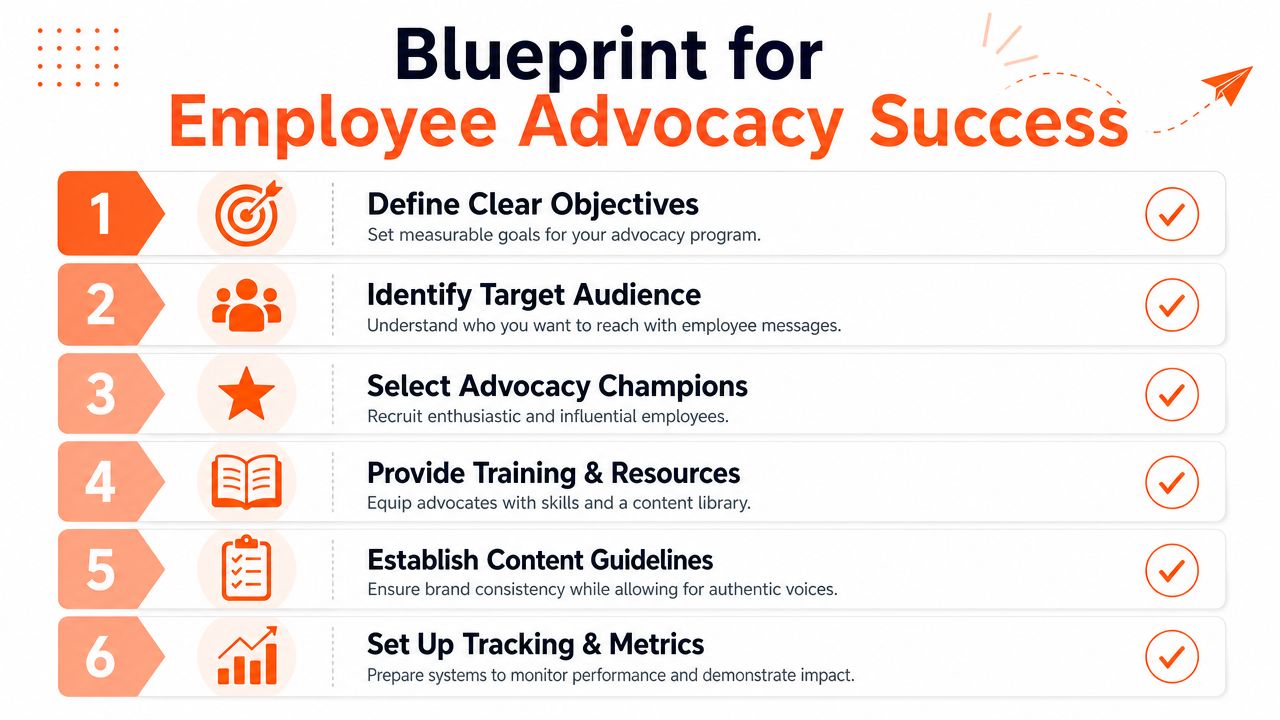
A practical way to frame it:
| Goal | What to look for | Who should lead |
|---|---|---|
| Brand awareness | More conversation around core themes, stronger visibility on relevant posts | Marketing, founders, subject matter experts |
| Lead generation | Inbound interest, warmer replies, profile visits that turn into sales conversations | Sales, leadership, customer-facing specialists |
| Talent attraction | Better candidate quality, stronger employer reputation, employee stories that resonate | Hiring managers, HR, team leads |
For longer programs, milestone reviews help. Supergrow's guidance on LinkedIn employee advocacy recommends setting milestones at 30, 90, and 180 days and mapping objectives such as brand awareness and lead generation to concrete metrics like impressions, earned media value, and leads generated.
That's useful because it stops teams from treating all engagement as equal. A recruiting-heavy program will prioritize different content and participants than a sales-heavy one.
Build guardrails that people will actually use
Policy matters, but the wrong policy kills participation. Employees don't need a legal brief disguised as a social media guide. They need confidence.
Keep the framework short and practical:
- What to do: add your own point of view, disclose your relationship to the company when needed, stay inside your area of expertise.
- What to avoid: confidential information, exaggerated claims, arguments that can escalate publicly.
- How to post: use plain language, explain why the topic matters, and write like a person, not a brochure.
The source material for training should include examples of strong comments, thoughtful reactions to industry posts, customer-safe storytelling, and clean ways to discuss product updates. If you're training non-marketers, show before-and-after examples. Abstract advice won't stick.
Sell the personal upside honestly
Employees participate longer when the program helps them, not just the brand. That isn't a soft incentive. It's the core one.
In 2026, 94% of employee advocates reported that posting on LinkedIn specifically benefited their personal careers, according to LinkedIn-focused employee advocacy benchmarks published by Jody Leon. That's why the message to employees shouldn't be “help marketing.” It should be “build visibility around your expertise.”
A durable program starts with a credible answer to one employee question: what's in this for me?
Start with a pilot, not a company-wide launch. Pick the people who already post, comment, or engage with some consistency. Give them stronger support, learn what formats work, then expand. That approach creates examples others can trust instead of instructions they ignore.
Fueling the Engine with Authentic Content
The fastest way to ruin LinkedIn employee advocacy is to make everyone sound the same. Organizations don't do this intentionally. They create a content library, give employees suggested copy, and try to reduce friction. Then the feed fills with near-identical posts that read like recycled campaign text.
Why shared drafts often backfire
That kind of uniformity signals corporate choreography. Buyers notice it. Employees notice it too, which is why they stop posting or strip out all the original messaging and write from scratch.
The core bottleneck isn't access to content. It's the tension between consistency and individuality. The primary bottleneck for scaling employee advocacy is the tension between brand consistency and individual authenticity. The standard advice to "customise drafts" fails under time pressure, leading to robotic uniformity that kills trust. The technical solution involves AI voice training to enforce personalization, as noted in LinkedGrow's playbook on LinkedIn employee advocacy.
That point matters more than most companies admit. A shared brand kit is useful. A shared voice is not.
A content workflow that protects voice
The better model is controlled flexibility. Central teams prepare inputs, then employees adapt them in ways that match their role, expertise, and cadence.
Use a content mix like this:
- Company moments: launches, hires, events, partnerships, product updates.
- Field insight: what sales teams hear, what customer success sees, what product teams are learning.
- Third-party perspective: industry articles, trend analysis, customer-relevant discussion.
- Personal proof: lessons learned, operating principles, behind-the-scenes stories.
The workflow should separate content approval from wording approval. Approve the claims, references, and positioning centrally. Let the advocate shape the language. That's where voice stays intact.
A simple operating model looks like this:
- Marketing or leadership provides the source material.
- The employee chooses the angle that fits their role.
- The draft gets personalized for tone, examples, and emphasis.
- Sensitive posts get reviewed. Low-risk posts move quickly.
- Performance gets tracked so the team learns what kind of authenticity works.
Employees who need inspiration often do better with prompts than with finished copy. A prompt like “What did a customer misunderstanding teach you about this problem?” produces stronger posts than “Share this feature announcement.”
If your team needs a steady stream of prompts, angles, and formats, a practical guide to LinkedIn content ideas helps reduce blank-page friction without forcing everyone into the same structure.
Authenticity at scale doesn't come from giving everyone the same draft. It comes from giving everyone the same truth, then letting them say it differently.
Scaling the Program with Intelligent Automation
It usually breaks the same way. A few employees post for two weeks, engagement looks promising, then client work takes priority and the program stalls. The issue is rarely intent. The issue is that the workflow asks busy people to behave like full-time creators.
Manual advocacy also creates a measurement problem. If participation depends on spare time and personal discipline, output becomes inconsistent, and inconsistent output makes individual ROI harder to prove later. You cannot tell whether someone failed because the channel does not work for them or because the system never gave them a realistic way to show up consistently.
Manual advocacy breaks under workload
A lot of B2B teams overbuild around posting to the employee's own feed. That approach can work, but it is demanding. Every advocate has to come up with ideas, write cleanly, publish at the right time, and hope the post gets enough early traction to travel.
Comments are often the better scaling unit.
A comments-first model lets employees participate where attention already exists. Instead of starting from zero with every post, they add perspective to conversations their buyers, peers, and future hires are already reading. That lowers the effort per interaction and raises the odds that the right people see the contribution.
This short walkthrough shows what that looks like in practice:
That matters for authenticity too. A strong operator, account executive, or solutions engineer may never want to publish thought leadership twice a week. Many of them are far better in context, responding to a customer problem, a market claim, or a bad take with something specific and useful. That is still advocacy, and in many cases it produces better commercial signals than generic brand amplification.
A healthy cadence still matters. Blue Archer's advice on improving employee advocacy on LinkedIn emphasizes consistent posting, authenticity, storytelling, and adding personal perspective instead of resharing links without context.
How to automate without sounding automated
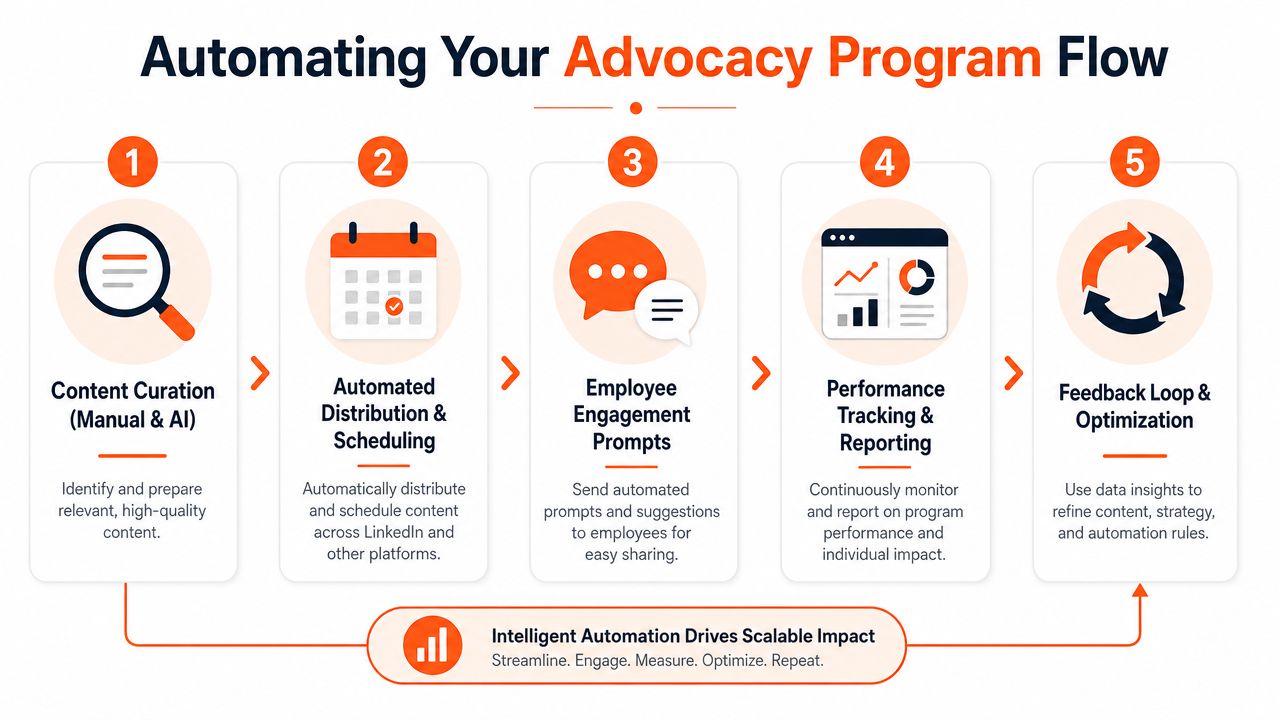
Automation should reduce friction in four places: finding the right conversations, preparing a first draft, reminding employees to act, and routing higher-risk activity for review. It should not replace judgment, experience, or voice.
The practical setup looks like this:
- Conversation discovery: surface relevant posts from customers, prospects, partners, and category voices tied to specific themes.
- Draft assistance: generate starting points based on the full post and the employee's role, so the comment sounds informed instead of generic.
- Timing and reminders: prompt employees when opportunities are fresh, not three days after the thread has gone cold.
- Review controls: send sensitive topics to marketing, legal, or leadership, while letting low-risk engagement move fast.
If you want that process inside the platform employees already use, a Chrome extension for LinkedIn writing and commenting helps reduce context switching and makes adoption easier.
There is a trade-off here. More automation increases consistency, but too much of it makes every advocate sound like the same person. The fix is simple. Automate discovery and first drafts. Require the employee to add the final layer: a point of view, a real example, or a clear disagreement. That keeps the program efficient without turning it into a copy-paste machine.
The goal is not more activity. The goal is more qualified conversations, more profile visits from the right people, and more repeatable participation from employees who still have a day job.
Measuring What Matters and Proving Individual ROI
If you can't connect advocacy activity to outcomes people care about, the program eventually turns into theater. Leadership sees impressions. Employees see effort. Nobody can prove whether the work is worth continuing.
Three levels of measurement
You need measurement at three levels, and they shouldn't be mixed together.
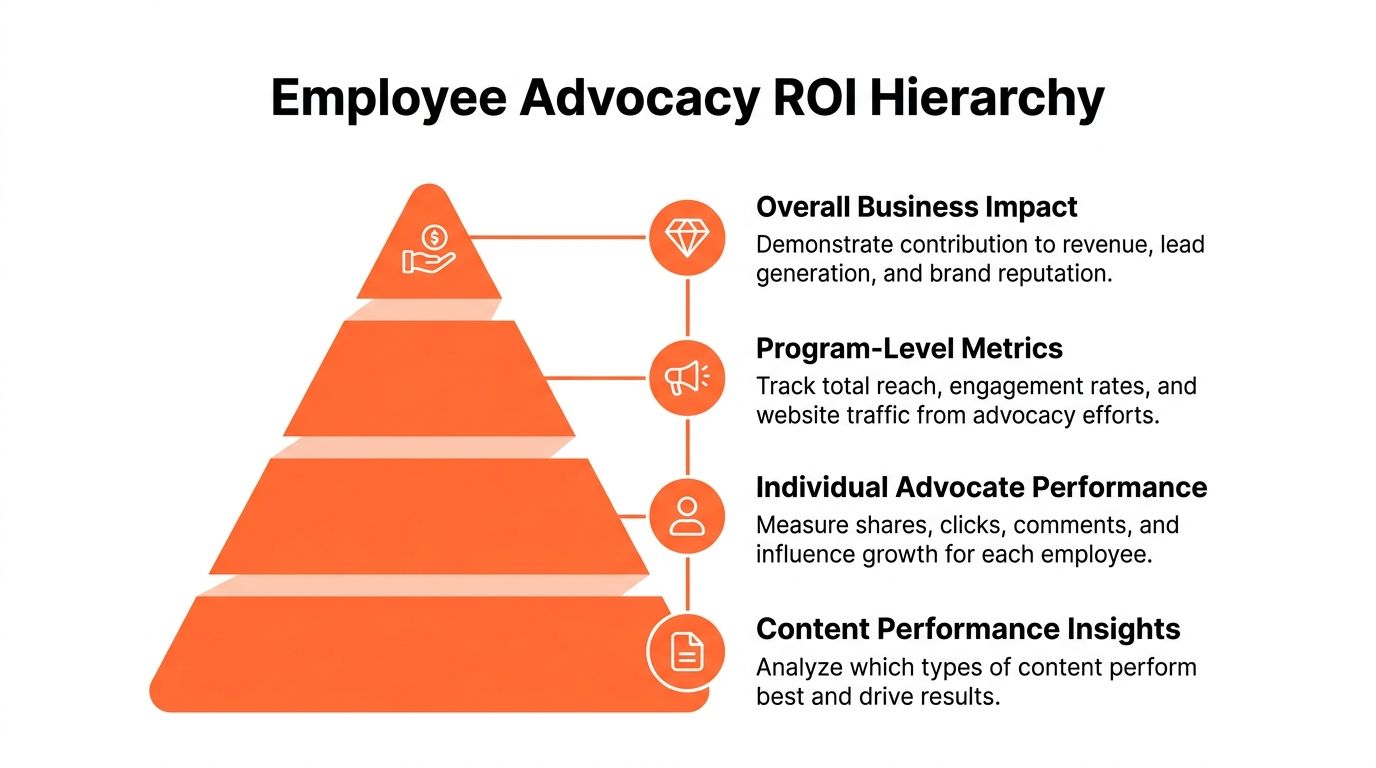
Program level asks whether advocacy is strengthening the company's overall presence. This includes visibility, engagement trends, traffic quality, and whether the content themes are gaining traction.
Team level asks which functions are contributing and which are stalling. Sales may drive conversations that lead to pipeline. Recruiting may drive candidate interest. Product and leadership may shape authority in the market.
Individual level is the one most programs neglect. Did this person's activity produce profile visits, inbound messages, meetings, or useful new relationships? If the employee can't see the answer, motivation fades.
The attribution problem that kills momentum
This is the hardest part, and it's where weak programs lose credibility. The critical gap in employee advocacy is attributing a specific lead to a specific comment or post. While program-level reach is easy to measure, the "first wave of enthusiasm" collapses when individual employees cannot answer "What did this post do for me?". Modern tools solve this by connecting inbound messages to the single AI-generated comment that drove them, according to Oktopost's guide to launching a LinkedIn employee advocacy program.
That's the measurement standard to aim for. Not broad correlation. Action-level attribution.
If an employee creates demand and the program can't show it, the program teaches them that effort disappears into a black box.
This changes behavior quickly. When employees can tie an inbound reply, profile visit, or warm lead to a specific post or comment, they stop treating LinkedIn as vague brand work. They start treating it as a repeatable business channel.
What to review every month
A monthly review should answer a few direct questions:
- Which content themes led to meaningful conversations: not just reactions, but replies and inbound interest.
- Which advocates are building momentum: who's finding a voice and where support is needed.
- Which format is working best by role: comments, original posts, event reactions, customer stories, or curated takes.
- Which activity maps to commercial outcomes: meetings, talent conversations, partnerships, or deal influence.
A useful measurement stack combines engagement, activation, and business outcomes. GaggleAMP's employee advocacy statistics and measurement guidance highlights those three categories and notes business impact markers including 44.9% increased inbound traffic reported by 96% of firms that introduced advocacy programs, alongside visibility and brand recognition gains.
Use that kind of structure, but don't stop at the program dashboard. The monthly report should let each advocate see what they did, what happened next, and what to repeat.
Common Pitfalls and How to Avoid Them
Poor advocacy programs usually don't fail because LinkedIn stopped working. They fail because the operating choices are wrong.
What breaks programs early
The first mistake is forcing participation. That creates resentful activity, weak posts, and low trust inside the company. A common pitfall is making advocacy mandatory, which causes forced participation to fail. Successful programs facilitate opt-in participation by first identifying the top 30% of naturally engaged employees for a pilot, providing shared brand kits, and using informal channels like Slack to send engagement requests, according to Sociabble's employee advocacy statistics and implementation guidance.
The second mistake is sending employees generic instructions like “please share this.” That pushes the hardest part of the work onto them. They still have to decide what to say, how to frame it, and whether the post is worth attaching their name to.
The third mistake is treating consistency as sameness. Consistency should apply to claims, positioning, and standards. It shouldn't force everyone into one voice.
What sustainable programs do differently
Strong programs solve those issues with practical systems:
- Start with volunteers: pick the employees who already show interest and help them win early.
- Give context, not just assets: explain why the content matters, who it's for, and what angle an employee could take.
- Keep feedback loops active: review performance, ask employees what feels awkward, and remove friction quickly.
- Protect personal ownership: an employee account is not another brand channel. It's a professional asset the employee is lending to the program.
One more point gets overlooked. Employees don't stay active because leadership says LinkedIn matters. They stay active because the work produces something they can feel. Better conversations. Better visibility. Better opportunities. The minute a program loses that link, participation drops.
LinkedIn employee advocacy works when it respects both sides of the exchange. The company gets trust and reach. The employee gets reputation and opportunity. If either side is missing, the program won't hold.
Linqin helps teams turn LinkedIn employee advocacy into a measurable growth system. It automates commenting and posting in each user's voice, tracks which actions led to profile visits and inbound messages, and gives teams shared workflows without forcing identical content. If you want to grow your LinkedIn while you sleep, start with Linqin.