Foundation: Optimize Your LinkedIn Profile for Maximum Impact
Your LinkedIn profile is more than a digital resume; it is the anchor of your growth strategy. A well-optimized profile communicates your unique value proposition, aligns with the target audience’s needs, and drives profile views, messages, and connections. When done thoughtfully, every element works in harmony to attract the right people and set the stage for meaningful conversations.
Below is a robust plan you can implement today to elevate your profile and accelerate LinkedIn growth on your path to authority and opportunity.
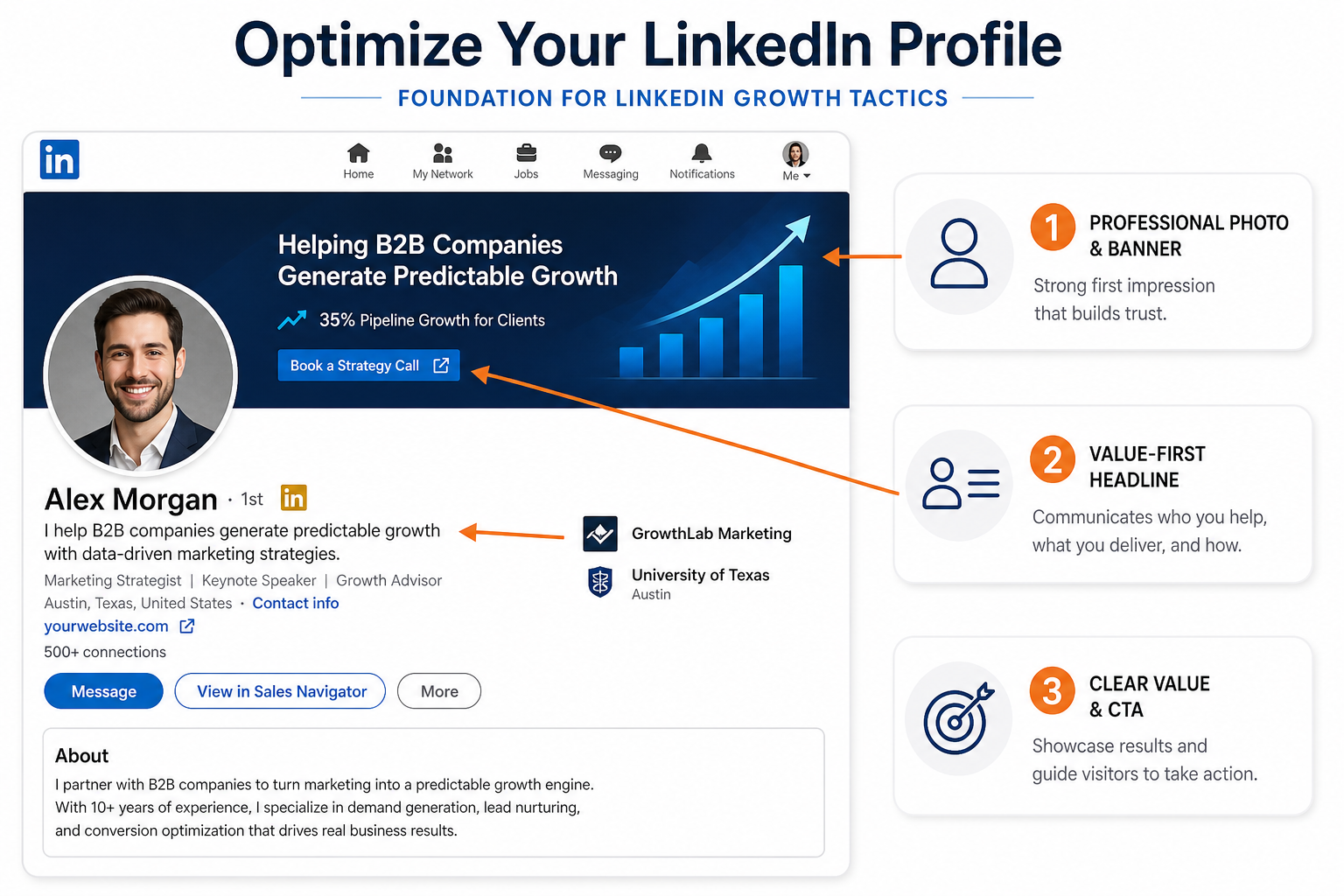
Visual first impression: professional photo and banner
A strong photo increases credibility and invites clicks. Use a clear, high-resolution image with a neutral background and a approachable, confident expression. Pair it with a banner that reinforces your value proposition.
- Professional headshot: Use a clear, high-resolution image with a neutral background. Your facial expression should be approachable and confident. A strong photo increases credibility and click-through rate to your profile.
- Brand aligned banner: Create a banner that reinforces your value proposition. It should reflect your niche, showcase a key result, and include a subtle CTA or URL you want visitors to remember. Keep text minimal to avoid clutter.
With these elements in place, your profile makes a confident first impression and invites further exploration.
Headline that communicates value at a glance
Your headline is prime real estate because it appears beside every post you publish.
Move beyond a job title and craft a statement that answers the audience’s core question: What problem do you solve and for whom?
- Example structure: Who you help + What you deliver + How you do it.
- Concrete formats: Helping B2B SaaS teams increase ARR by X% through LinkedIn driven demand or Marketing strategist enabling professional services firms to win more high-value clients.
Custom LinkedIn URL: clean and memorable
A customized URL improves professional appeal and search discoverability.
Aim for a simple pattern like linkedin.com/in/yourname. Include this URL in your email signature and business cards to boost cross-channel visibility.
About (Summary) section: tell a compelling story
Craft the About section as a tailored narrative that speaks directly to your target audience. Use a concise storytelling framework to connect readers and guide them toward a clear next step.
Hook readers with a pain point or bold claim they recognize. Then show how you solve the problem with tangible steps. Share credible results, client outcomes, or relevant metrics to prove your approach. Finish with a low-friction CTA, such as a calendar slot, a downloadable resource, or a direct message.
Beyond storytelling, weave in keywords your audience uses in searches. A well-optimized About section improves visibility in LinkedIn search and external search engines, helping you attract qualified profiles, clients, or opportunities.
Visual branding and Creator Mode
Background consistency: align your banner, profile photo, and recent content with a consistent color palette and typography you use in other channels.
Creator Mode activation: if you publish frequently, enabling Creator Mode can elevate your content visibility, making it easier for new followers to discover your posts and topics.
Profile sections: order and emphasis
LinkedIn sections should be arranged to present the most compelling information first. A practical approach is to place elements in this order:
| Section | Why It Matters | Best Practice |
|---|---|---|
| Featured | Showcases your top offers, case studies, or free resources at a glance. | Include 2 to 3 high quality items with clear titles and outcomes. Update quarterly to reflect current focus. |
| About | Sets context and demonstrates your understanding of audience pain. | Use a 4 paragraph structure: hook, solution, proof, CTA. Include keywords naturally. |
| Experience | Demonstrates credibility and progression with measurable outcomes. | Focus on impact rather than responsibilities. Add quantified results where possible. |
| Skills & Endorsements | Signals expertise and improves searchability within LinkedIn. | Prioritize core skills that align with your niche. Seek endorsements from aligned colleagues or clients. |
This order helps readers scan quickly and focus on outcomes. Update the Featured and Experience sections as your goals shift.
Public visibility and search optimization
Setting your profile to public expands reach beyond your first degree connections and helps it surface in Google and LinkedIn searches. A public profile creates more inbound opportunities and improves your accuracy in audience targeting.
- Public visibility: ensure key sections are visible to non-logged-in users and search engines.
- Keyword integration: sprinkle relevant keywords throughout your About, Experience, and Skills sections without keyword stuffing.
- Consistency across channels: mirror your professional narrative across your website, portfolio, and social profiles to reinforce your positioning.
Review your profile visibility regularly to confirm you are surfaced in searches and to monitor who visits your profile.
Actionable optimization checklist
- Update profile photo to a high quality, industry appropriate image with a neutral background.
- Refresh headline with a value driven statement that answers who you help and how you help them.
- Customize URL to linkedin.com/in/yourname and add this to your signature and bios.
- Rewrite About section using the hook, solution, proof, CTA framework and include a few strategic keywords.
- Revise Featured to showcase your top offers, case studies, or resources with clear benefits.
- Arrange sections to place Featured and About above experience, ensuring your core message is immediately visible.
- Enable Creator Mode if you publish regularly to maximize content reach.
- Set profile to public to improve discovery and external search results.
By applying these optimization principles, you lay a sturdy foundation for all LinkedIn Growth Tactics to follow.
Your profile becomes a conversion engine that not only attracts attention but also initiates valuable conversations, propelling you toward faster follower growth and stronger professional relationships.
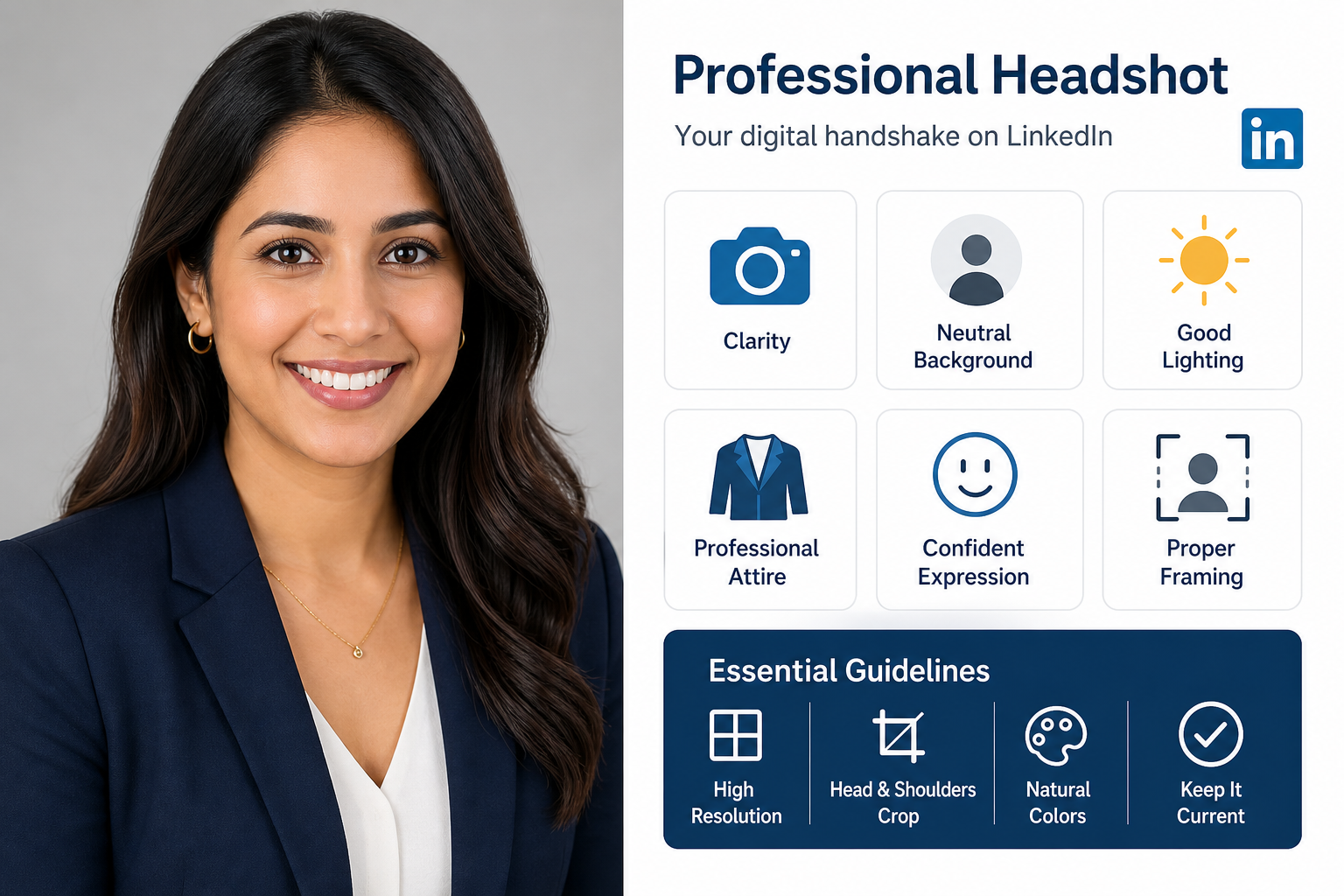
Professional Headshot
Professional Headshot is your digital handshake. A clear, high quality image on a neutral background creates a strong first impression, signals professionalism, and makes you immediately approachable. Profiles with professional photos receive significantly more views and messages, which translates into stronger engagement and faster network growth. Investing in a compelling headshot is one of the most cost effective ways to boost your LinkedIn presence.
Key attributes of a high performing headshot:
- Clarity – Use a high resolution image without pixelation or blur. The face should be easily recognizable in thumbnail size.
- Neutral background – A simple backdrop minimizes distractions and keeps the focus on you.
- Lighting – Soft, natural light that evenly illuminates the face prevents harsh shadows and unflattering contrasts.
- Attire – Dress in professional, industry appropriate clothing that aligns with your personal brand and audience expectations.
- Expression – A warm, confident expression communicates approachability and trustworthiness.
- Framing – Crop from the shoulders or mid chest, with the eyes near the upper third of the frame for optimal composition.
Practical guidelines you can apply right away:
| Specification | Best Practice | Why it matters |
|---|---|---|
| Resolution | Minimum 4000 x 4000 pixels; higher is fine | Ensures clean display across devices and zoom levels without pixelation |
| Background | Solid neutral color or soft gradient | Reduces visual noise and keeps focus on your face |
| Lighting | Natural light from the front or a diffused studio light | Prevents harsh shadows and highlights, producing a flattering look |
| Framing | Cropped to just above the head and below the shoulders | Balanced composition suitable for profile and thumbnail views |
| Expression | Genuine smile or relaxed, confident expression | Conveys approachability and trust, encouraging connections |
| Attire | Professional outfit aligned with your industry norms | Reinforces credibility and aligns with audience expectations |
Optional enhancements to maximize impact without compromising authenticity:
- Color consistency – Use colors that harmonize with your personal brand and LinkedIn banner.
- Subtle retouching – Gentle adjustments to brightness, contrast, and sharpness can improve clarity without creating an unrealistic look.
- Consistency across channels – Use the same or very similar headshot on your website, portfolio, and other social profiles to reinforce recognition.
Implementation checklist for you to act on today:
- Audit existing photo – Is it clear, well lit, and professional looking at thumbnail size?
- Plan a shot – Choose a plain background, stable lighting source, and appropriate wardrobe.
- Coordinate with a photographer or use a high quality camera – Ensure you can export at the required resolution and color balance.
- Upload and verify – Update LinkedIn with the new image and view your profile on desktop and mobile to confirm how it renders.
By prioritizing a professional headshot, you establish credibility from the very first moment a profile visitor arrives. A strong image makes it more likely that viewers will read your About section, engage with your posts, and initiate meaningful connections, accelerating your overall LinkedIn Growth Tactics efforts.
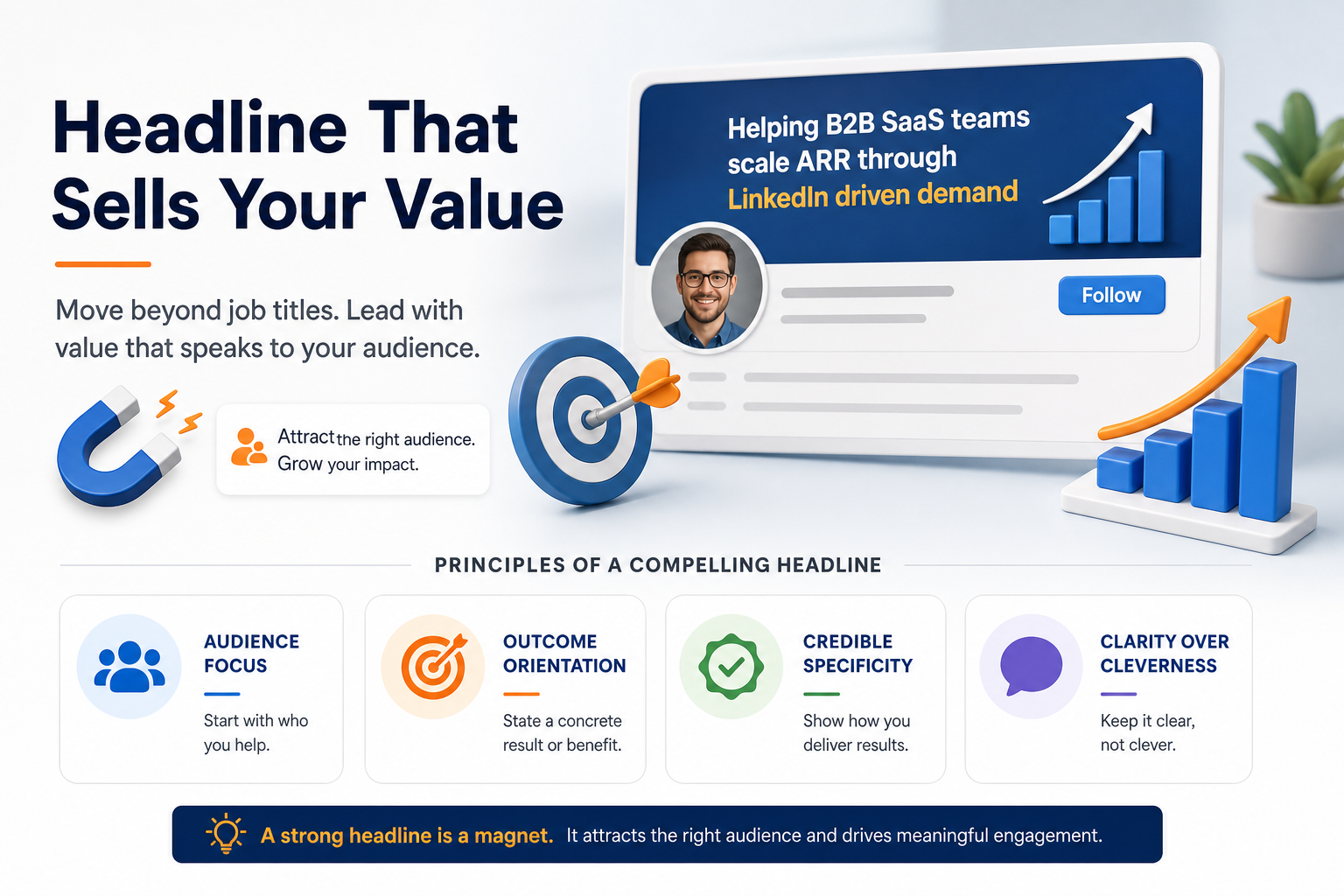
Headline That Sells Your Value
Headline That Sells Your Value is your prime real estate for immediate impact. Instead of listing a job title, craft a concise statement that communicates the problem you solve, the audience, and the tangible outcome you help achieve. When readers grasp your relevance quickly, they are likelier to follow you, engage with your posts, and view your profile. A value-driven headline acts like a magnet, drawing the right audience in a crowded feed.
To create a headline that resonates, follow these guiding principles:
- Audience focus: Start with who you help. This clarifies your target and increases relevance for viewers in your niche.
- Outcome orientation: State a concrete result or benefit that matters to your audience’s goals or pains.
- Credible specificity: Include a hint of how you deliver the outcome, such as a method or approach, without overselling.
- Clarity over cleverness: Prioritize clear communication over flamboyant phrasing. If readers must decode your meaning, they may scroll past.
Practical headline templates you can adapt today:
| Template | Example | When to Use |
|---|---|---|
| Who you help + What you deliver + How you do it | Helping B2B SaaS teams scale ARR through LinkedIn driven demand | When you serve a specific customer group and deliver a measurable outcome |
| Outcome + Audience + Approach | Increase qualified MQLs for professional services firms with targeted content strategies | When you want to emphasize result plus client segment |
| Result focused + Context | Book 10-30 B2B meetings per month using LinkedIn messaging | When you have a clear, auditable activity metric |
| Value proposition + Proof hint | Helping teams reduce CAC by 25 percent with content led outreach | When you want to imply credibility without listing clients |
Examples you can tailor to your niche:
- Helping manufacturing startups shorten sales cycles by 30 percent with LinkedIn focused outreach
- Guiding professional services firms to attract high value clients using targeted content strategies
- Empowering HR leaders to fill critical roles faster through networked recruiting and outreach
Tips for testing and refining your headline:
- AB test phrases: rotate 2 to 3 variations for a few weeks and monitor profile views and connection requests.
- Check readability: read aloud and ensure it makes sense within the first glance of a profile card.
- Align with content: ensure your headline echoes the themes you consistently publish about.
- Avoid vague claims: steer clear of generic adjectives that do not convey value or outcomes.
A clear, relevant headline opens the path to deeper engagement and supports the broader LinkedIn Growth Tactics you use to attract the right audience and speed follower growth.
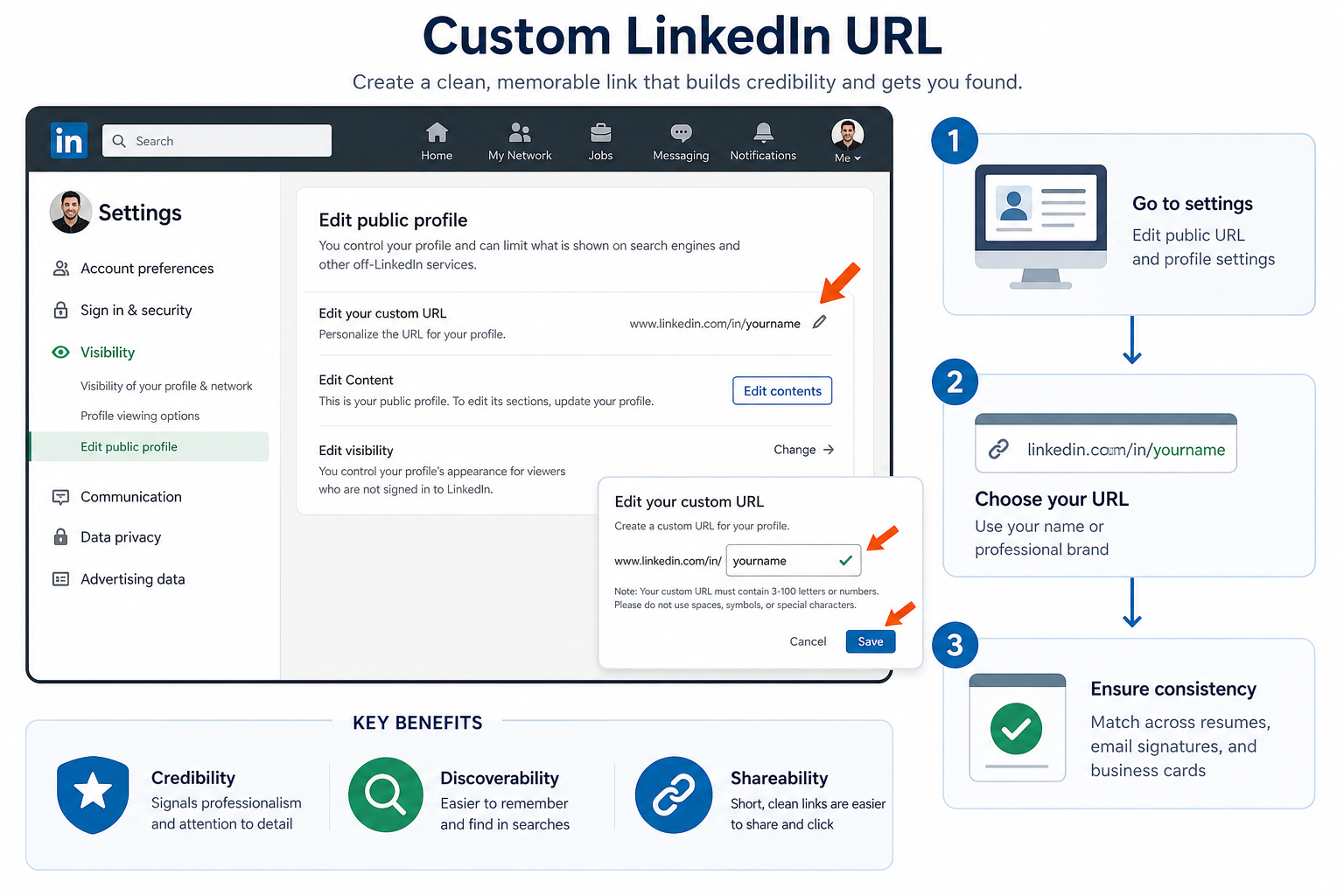
Custom LinkedIn URL
Custom LinkedIn URL Personalizing your LinkedIn URL creates a clean, memorable address that signals professionalism and makes it easier for others to find and share your profile. A well crafted URL reduces friction when you reference yourself in emails, resumes, business cards, or outreach messages, and it helps you appear more credible in search results both on LinkedIn and in external search engines.
Key benefits of a custom URL include:
- Credibility A tidy URL reflects attention to detail and professionalism in your personal brand.
- Discoverability A concise URL is easier for people to remember and locate in searches.
- Shareability Short, clean links are more likely to be clicked and less prone to being truncated in messages or documents.
Implementation guidance to get a clean URL that aligns with your personal brand:
| Step | Action | Best Practice |
|---|---|---|
| Step 1 | Navigate to your LinkedIn profile > Edit public URL and profile settings | Choose a simple pattern that resembles your name or professional brand |
| Step 2 | Pick a URL format like linkedin.com/in/YourName or linkedin.com/in/YourName-Profession | Avoid numbers, unnecessary characters, or unrelated words |
| Step 3 | Test for consistency across materials | Ensure the chosen URL matches how you list yourself on resumes, email signatures, and business cards |
| Step 4 | Update references where you share your profile | Replace old links in signatures, bios, and portfolios with the new URL |
Practical tips to maximize impact:
- Consistency matters Use the same handle across other social profiles when possible to reinforce recognition.
- Keyword alignment If appropriate, include a keyword in your profession as part of the URL format, such as your name plus a field identifier, while keeping it natural and readable.
- Public visibility Ensure your profile remains public so the URL is easily discoverable by search engines and visitors outside your network.
Actionable optimization checklist for Custom LinkedIn URL:
- Open profile settings and locate the Public URL editor.
- Choose a clean version that mirrors your professional name and brand.
- Update all materials including email signatures, resume PDFs, business cards, and personal website bios.
- Verify accessibility paste the URL in a browser to confirm it lands on your profile and renders correctly.
By adopting a concise and memorable custom LinkedIn URL, you lay a solid foundation for all LinkedIn Growth Tactics to follow. A professional URL not only improves how you appear in search results but also makes it effortless for your audience to connect with you, accelerating your overall growth trajectory on the platform.
About Section: Tell Your Story
About Section: Tell Your Story
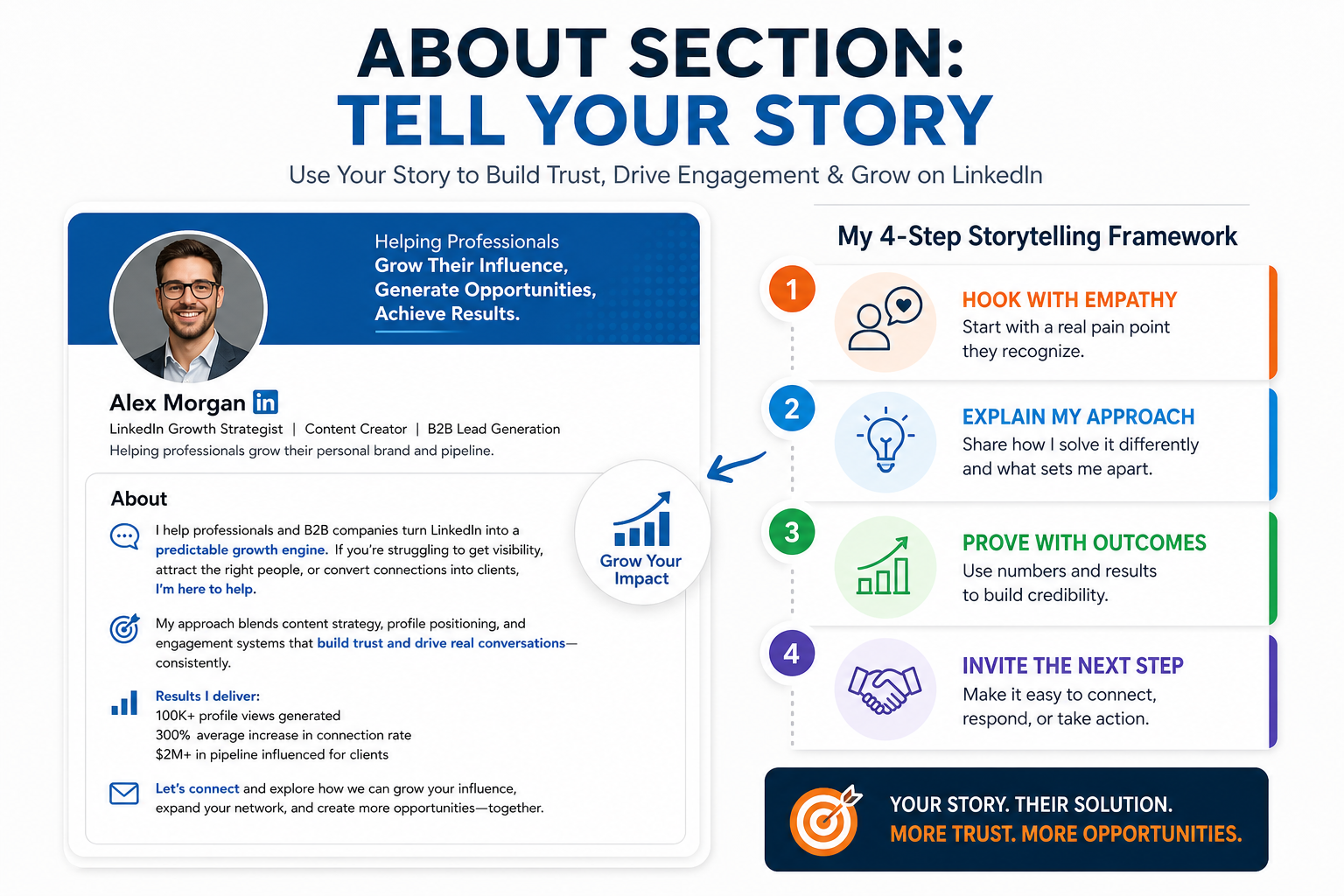
I am sharing my approach to the About section because this is where your personal narrative begins to unlock trust, authority, and meaningful engagement. The About section is not a dry summary; it is a purposeful sales page written from the first person that guides readers toward a decisive next step. When you craft this area with clarity and intention, you illuminate the problems you solve and the tangible outcomes you deliver, while weaving in keywords that boost visibility in both LinkedIn search and Google results.
Here is how I structure my storytelling to align with the core goals of Linkedin Growth Tactics and to resonate with your ideal audience.
- Hook with empathy I start with a real pain point or a scenario your audience recognizes. This signals that I understand their challenge and sets the stage for a credible, relevant dialogue.
- Explain my unique approach I describe how I tackle the problem differently, highlighting the methods, frameworks, or perspectives that set me apart without resorting to generic claims.
- Prove with outcomes I share specific results I have helped others achieve, using concrete numbers, case examples, or verifiable milestones to establish credibility.
- Invite the next step I finish with a clear, low friction call to action, such as inviting readers to book a brief conversation, download a resource, or reply to this post with a question.
To improve discoverability, I weave in keywords that my audience uses when searching for expertise within Linkedin Growth Tactics and related topics. This includes terms like lead generation on LinkedIn, profile optimization, content strategy for professionals, and thought leadership on LinkedIn. The goal is not keyword stuffing, but natural inclusion that helps search engines understand who I help and why it matters to them.
My narrative emphasizes the problems I solve and the outcomes I deliver in language that is accessible to both decision-makers and individual professionals. By focusing on real world impact—such as shorter sales cycles, increased inbound inquiries, and greater meeting booked rates—I create a compelling value proposition that aligns with the broader strategy of Linkedin Growth Tactics.
In practice, your About section should read like a concise, persuasive story that readers can skim quickly and still grasp your core promise. Use short paragraphs, bolded phrases for emphasis, and a few bullet points that crystallize your capabilities. Remember, the objective is to convert passive readers into engaged followers who see you as a credible, helpful resource in your niche.
If you apply these principles consistently, your About section will serve as a reliable driver of profile views, connection requests, and meaningful conversations. This is the beating heart of your LinkedIn presence and a foundational element of the broader Linkedin Growth Tactics you deploy to attract the right audience and accelerate growth.
Visual Branding Elements
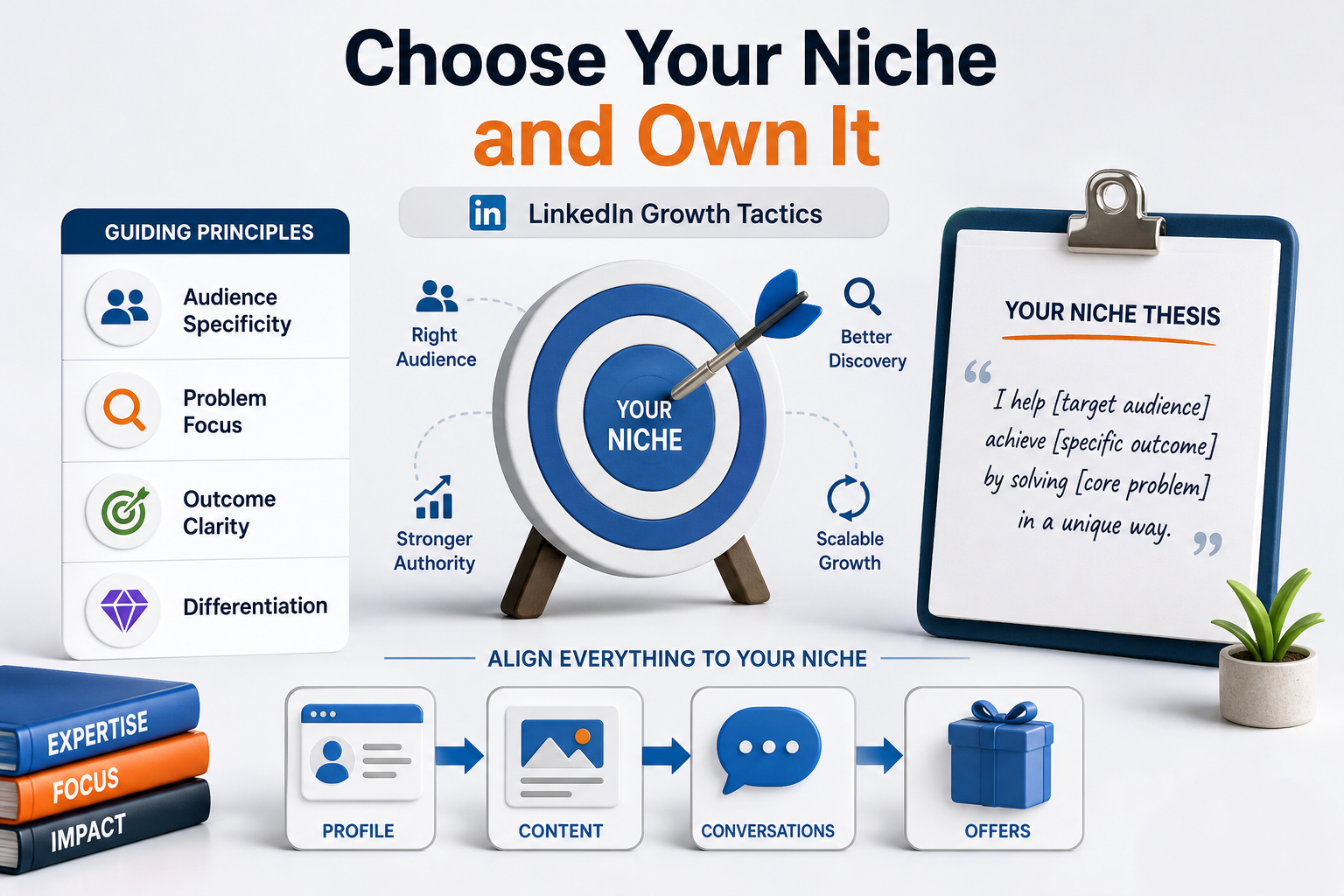
Visual Branding Elements form the visual memory of your LinkedIn presence. A cohesive, purpose-driven banner paired with strategic Creator Mode activation creates a recognizable, professional identity that differentiates you in a crowded feed. This section explains how to design a banner that reinforces your value proposition and how to enable Creator Mode to amplify your content visibility, making it easier for new followers to discover and engage with your posts.
Banner design guidelines to reinforce your value proposition:
- Dimensions and layout: Use a banner image sized to 1584 by 396 pixels. Ensure important elements stay within the safe central area to avoid cropping on different devices.
- Clear value proposition: Convey your core benefit in a concise, scannable line that viewers can grasp in a single glance.
- Visual harmony: Align banner colors, typography, and imagery with your profile photo and overall brand palette for a unified look.
- Minimal text: Limit copy to a few impactful words or a short headline. Use legible fonts and high contrast against the background.
- Strategic CTA or cue: If space allows, include a subtle call to action or a URL you want visitors to remember, such as a resource or landing page that complements your LinkedIn content strategy.
Creator Mode activation to boost content visibility:
- What Creator Mode does: Increases distribution of your content and makes it easier for new followers to discover your topics of expertise.
- When to enable: Activate if you publish frequently, want to highlight your content, and aim to attract followers who engage with your posts regularly.
- How to enable:
- Go to your profile and open the Tools or Creator Mode settings.
- Toggle Creator Mode to On.
- Choose topics you publish about most to curate your content focus.
- Adjust your following preferences to optimize who can engage with your posts.
Why visual branding matters for follower growth:
- First impression impact: A compelling banner and consistent visuals increase recognition and trust, encouraging profile visitors to follow and engage.
- Content discoverability: Creator Mode helps your posts appear more prominently in feeds and topic pages, enlarging reach beyond your immediate connections.
- Brand cohesion: Consistent visuals across your profile, posts, and external channels reinforce your position and make it easier for followers to recall you.
Implementation checklist you can act on today:
- Audit current visuals – Assess whether your banner reflects your value proposition and if it visually aligns with your profile photo.
- Design or refresh the banner – Create a banner at 1584 x 396 pixels with a concise value statement and minimal text.
- Choose a consistent color palette – Pick 2 to 3 brand colors and apply them across imagery and text in your posts.
- Enable Creator Mode – Turn on Creator Mode and select primary topics to guide content discovery.
- Test and iterate – Monitor engagement and follower growth after changes, and refine visuals based on performance data.
By investing in thoughtful visual branding and using Creator Mode, you create a distinctive, trustworthy presence that invites new followers to engage with your content and participate in your growing LinkedIn community.
Optimization for Search
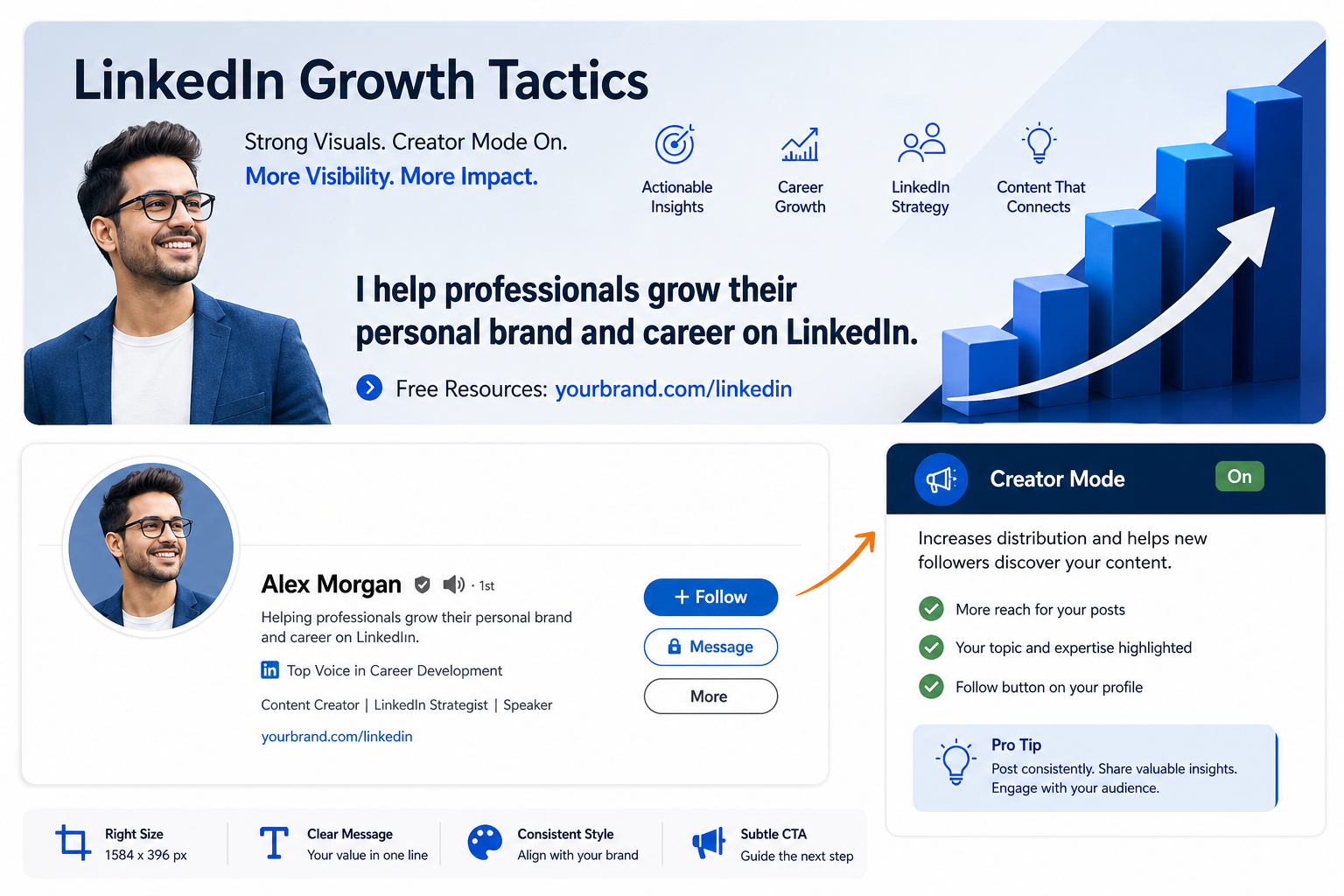
Optimization for Search is a pivotal element in the LinkedIn Growth Tactics framework. By weaving relevant keywords into your profile and ensuring your presence is visible to search engines, you unlock a broader audience of professionals who are actively seeking expertise like yours. When your profile surfaces in external searches, you gain qualified profile views and more meaningful connection requests, all without paid distribution.
Strategically embedding keywords throughout your profile does not mean keyword stuffing. The goal is natural, contextually appropriate placement that helps both LinkedIn search and external search engines understand who you are, who you help, and how you deliver results. Think about the terms your ideal connections would type when looking for someone with your capabilities, and integrate those terms into your About section, Experience entries, Skills, and even your banner copy where appropriate.
Key areas to optimize for search include:
- Profile headline and About section with target keywords that describe your niche, audience, and outcomes.
- Experience descriptions that incorporate role related terms and measurable results aligned to your niche.
- Skills and endorsements featuring core competencies that mirror your target search queries.
- Custom LinkedIn URL and public visibility settings to ensure search engines can index your profile effectively.
Implementation guidance to maximize external search visibility:
| Action Area | Practical Tactics | Why It Helps |
|---|---|---|
| Keywords in Profile | Research 10 to 15 top search terms your target audience uses; weave them naturally into the About, Experience, and Skills sections. | Improves LinkedIn search discoverability and increases chance of external search indexing catching your profile. |
| Public Visibility | Set your profile to Public in Settings and Privacy; verify key sections remain visible to non logged in visitors. | External search engines can index your profile, expanding reach beyond your first degree connections. |
| Custom URL Relevance | Use a clean linkedin.com/in/YourName format that mirrors your professional identity and keywords where natural. | Enhances click through from search results and reinforces consistency across channels. |
| About Section Optimization | Incorporate target keywords within a readable narrative that explains who you help, what you deliver, and how you do it. | Improves visibility in both LinkedIn search and general search engines while maintaining reader engagement. |
| Experience and Projects | Describe roles and outcomes using industry terms and client oriented language that potential collaborators search for. | Boosts relevance signals for recruiters, clients, and partners conducting topic based searches. |
| Banner and Visual Cues | Include a concise value proposition in the banner that reinforces keywords, such as niche focus or service outcomes. | Supports quick recognition and reinforces your searchable identity in profile visits. |
Practical keyword integration tips:
- Natural inclusion – Place keywords where they flow with your narrative rather than forcing them into every sentence.
- Synonyms and variations – Use related terms and alternative phrasing to capture a wider range of search queries.
- Context over frequency – Prioritize meaningful context over stuffing for long term ranking and readability.
- Regular audits – Review profile analytics quarterly to identify which terms drive views and adjust accordingly.
When implemented thoughtfully, profile optimization for search compounds with other LinkedIn Growth Tactics to increase qualified profile views, boost connection requests, and attract the right audience to engage with your content. A search-optimized profile acts as a durable asset that compounds your reach over time, supporting sustained follower growth and stronger professional opportunities.
Content Strategy for Consistent, High-Value LinkedIn Posts
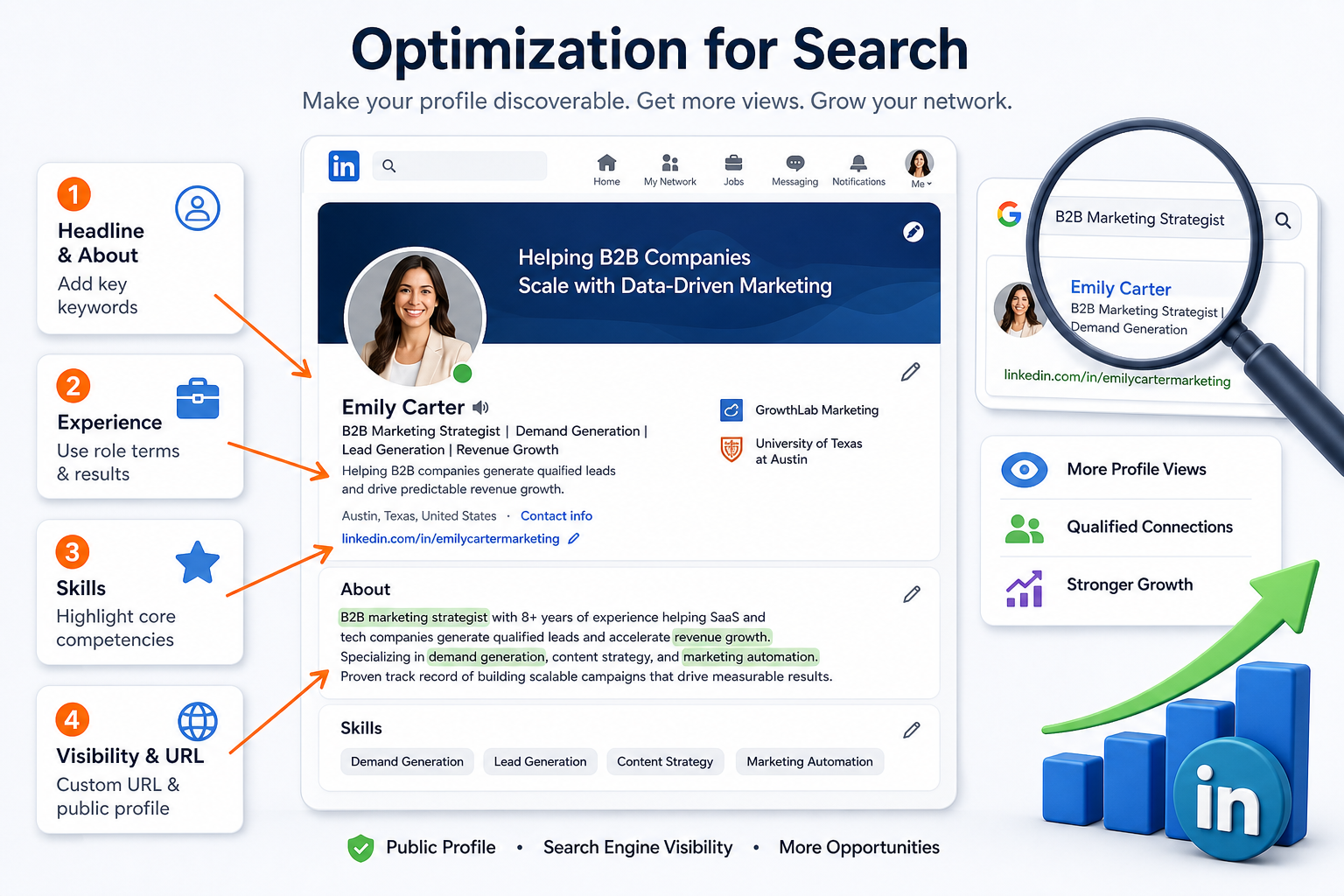
Content is the engine that drives growth on LinkedIn. A focused niche and a steady stream of valuable posts build authority, attract the right audience, and sustain engagement over time. This section outlines a practical framework you can implement to ensure every post stacks up to long term growth rather than short term spikes.
A focused niche and a steady stream of valuable posts build authority, attract the right audience, and sustain engagement over time. This section outlines a practical framework you can implement to ensure every post stacks up to long term growth rather than short term spikes.
Define your niche and your promise
Before you publish, crystallize who you serve and what you consistently deliver. A well defined niche acts like a beacon that attracts the people who truly benefit from your expertise. Your promise should be specific, measurable, and situation appropriate for your audience.
A clear niche guides what you publish and when you engage. It also helps you stay focused as you build credibility over time.
- Niche clarity: Identify a primary audience segment and a specific problem you solve within that segment.
- Value proposition: Articulate the outcome you help achieve, not just the activity you perform.
- Content thesis: Create a one sentence thesis that ties your posts together (for example, “I help B2B founders shorten their sales cycles through concise, data driven narratives”).
Posting cadence that sustains growth
Consistency beats intensity. Establish a sustainable rhythm that you can maintain over months. Use a mix of formats to keep the feed fresh and to accommodate different learning preferences.
Pair your cadence with feedback from your audience to stay relevant and approachable as your topics evolve.
- Baseline cadence: Start with 3 posts per week and adjust based on engagement signals.
- Weekly rhythm: Designate days for specific formats (for example, Monday for insights, Wednesday for how tos, Friday for industry commentary).
- Quality threshold: Only publish posts that deliver clear value or present a new perspective; prune weak content quickly.
Hook design: stop the scroll, invite reading
First impressions decide whether someone reads your post or scrolls on. Craft hooks that promise a result, pose a provocative question, or share a surprising stat relevant to your niche.
- Clarity : State the benefit in the first 125 characters.
- Relevance : Align the hook with a pain point your audience recognizes.
- Curiosity : Tease a solution or insight that your post will deliver.
Pair a sharp hook with a clear lead that connects to a reader’s problem. Keep the promise credible and avoid overstatement so readers feel compelled to continue.
Content formats that drive engagement
Diversify your content to address different learning styles and to maximize reach.
Each format serves a distinct purpose in building authority and generating conversation.
| Format | Why It Works | Best Use |
|---|---|---|
| Short posts | Fast to read, easy to share, quick feedback loop | Share a concise insight, bold claim, or situational advice |
| Carousels | High engagement through interactive slides and visual storytelling | Explain a process step by step or present a framework |
| Videos | Authenticity and higher reach; enables nuanced explanations | Quick tutorials, behind the scenes, or client success highlights |
| Polls | Encourages participation and yields audience insights | Gauge preferences, validate assumptions, drive discussion |
| Long form articles | Establishes authority and depth in your niche | Dive into complex topics with data, case studies, and frameworks |
Content calendar and repurposing playbook
A disciplined calendar keeps you from scrambling.
It also helps maintain momentum by planning in cycles and recycling high performing ideas across formats.
- Idea backlog: Maintain a running list of topics mapped to audience pain points and outcomes.
- Weekly planning: Choose 3 to 5 topics for the coming week and decide formats for each.
- Repurposing rules: Repackage a successful post into a carousel, extract a quote for a short post, and convert a core insight into a short video.
Engagement strategies that compound reach
Engagement signals drive organic distribution. The goal is to create meaningful conversations, not just comments.
These tactics build trust and visibility over time by inviting genuine input from your audience and peers.
- Ask thoughtful questions: End posts with a question that invites specific experiences or case studies.
- Respond promptly: Reply to comments quickly to sustain momentum and encourage further interaction.
- Comment on others: Leave valuable, relevant comments on posts from your ICPs, partners, and thought leaders.
- Invite deeper conversations: Offer a low friction next step such as a quick call or a resource download when appropriate.
Quality signals: signals that you are a reliable creator
Quality content builds a durable audience.
Focus on accuracy, practical takeaways, and consistent tone.
- Accuracy: Cite sources or share data when possible to enhance credibility.
- Practicality: Provide actionable steps readers can implement in their context.
- Consistency: Maintain a recognizable voice and visual style across posts.
Metrics to track progress
Track metrics that reflect resonance, not vanity.
Use these core indicators to steer your strategy over time.
- Engagement rate (likes, comments, shares per post relative to impressions)
- Follower growth pace (weekly or monthly)
- Save and share actions (they indicate deeper value and potential amplification)
- Profile view to follower conversion (how many readers convert to followers)
Practical implementation checklist
- Define niche and promise and document your content thesis.
- Set a sustainable cadence and block time for creation, not just posting.
- Build a diverse content mix using at least 3 formats per week.
- Develop a simple calendar outlining topics, formats, and posting times.
- Create a feedback loop review engagement data weekly and iterate on formats and topics.
By aligning your content strategy with a clear niche, disciplined cadence, and deliberate engagement practices, you lay a strong foundation for ongoing growth. Your posts become reliable signals of value, attracting the right audience, accelerating authority, and sustaining LinkedIn Growth Tactics over the long term.
Focus on consistency and relevance. Small, steady improvements compound as you refine what resonates with your audience and what moves conversations forward.
Choose Your Niche and Own It
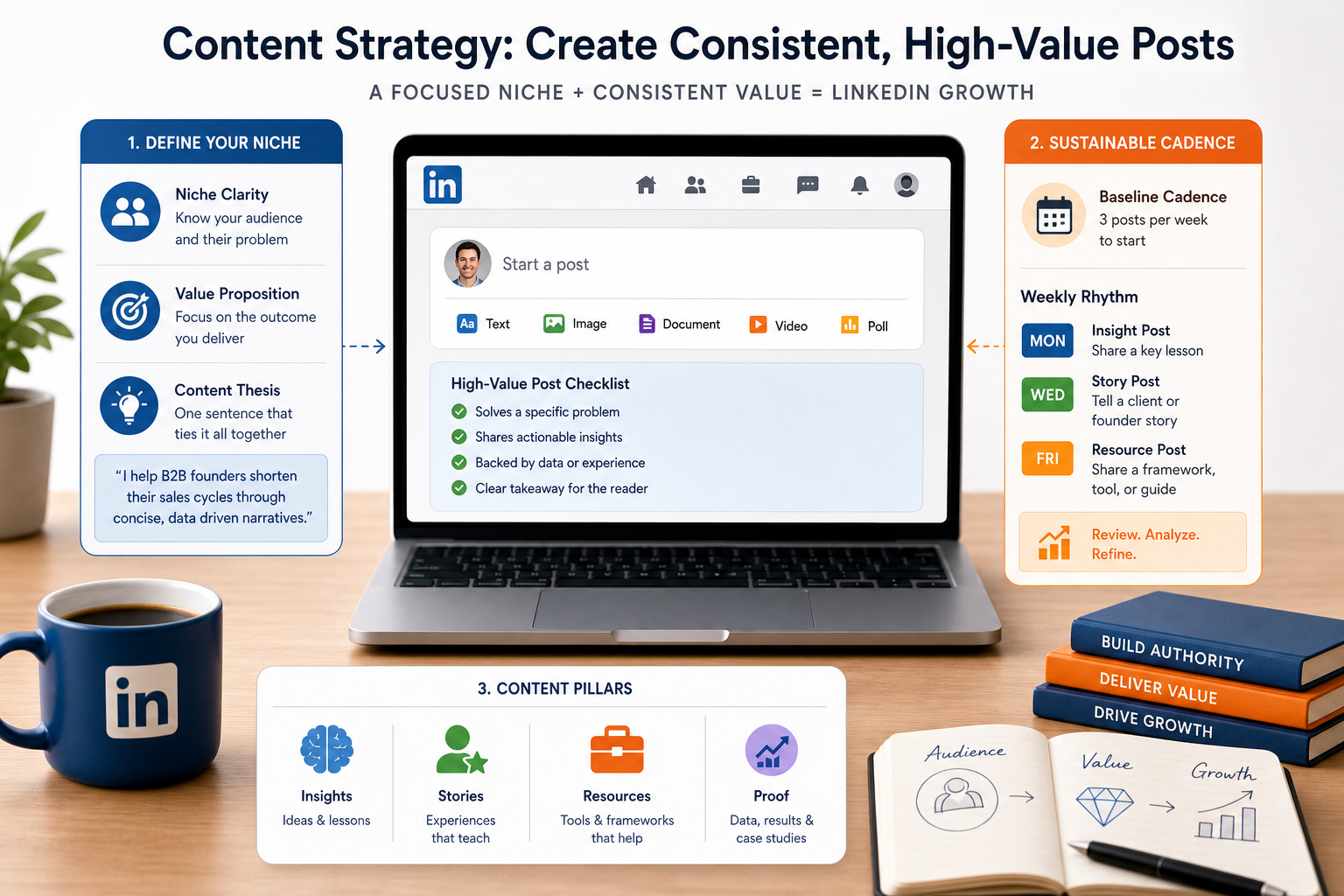
Choose Your Niche and Own It Specializing rather than generalizing is the fastest path to becoming the go to expert in a defined area. When you carve out a precise focus, you improve discovery by the right audience, build stronger thought leadership, and reduce the noise that comes from trying to be everything to everyone. The result is a more scalable growth flywheel where your content, conversations, and offers align around a clear, differentiated promise.
To turn specialization into a growth lever, start with a tight definition of your niche and then consistently reinforce it across your LinkedIn profile and content. A well defined niche is not just a topic, it is a problem you solve for a specific group in a way that matters to them. This clarity makes it easier for your audience to recognize you as the right resource and for search algorithms to surface you in relevant contexts.
Guiding principles for niche selection
- Audience specificity: Identify a target segment with shared needs, constraints, or goals.
- Problem focus: Pinpoint the core problem you help solve, not just the activities you perform.
- Outcome clarity: Define the tangible result your audience cares about achieving.
- Differentiation: Determine what you do differently or more effectively than others in this space.
Constructing your niche content thesis
Craft a one sentence thesis that ties your posts together and serves as a north star for all content decisions. Examples you can adapt include:
- Helping mid market software teams shorten their adoption cycles with data driven storytelling
- Guiding professional services firms to win more high value clients through targeted content strategies
- Empowering HR leaders to fill critical roles faster with networked recruiting and outreach
Practical steps to own your niche
- Define your ICP and the top 3 pains they experience that you can alleviate.
- Articulate the outcome you deliver in a measurable way that resonates with your audience.
- Publish a focused content plan around core topics that address the pains and outcomes you highlighted.
- Audit and prune content quarterly to ensure every post reinforces your niche and avoids drift.
How specialization accelerates discovery
When you speak to a precise audience with a specific problem, you appear more frequently in relevant searches and feeds. Your posts will be more likely saved, shared, and invited into conversations by people who recognize themselves in your niche. Over time, this concentration builds authority, increases inbound inquiries, and creates a community that values your unique perspective.
Examples of focused positioning to inspire your own framing include:
- LinkedIn marketing for B2B SaaS instead of generic marketing tips for tech companies
- Content strategies for professional services rather than broad social media guidance
- Talent acquisition for fast growing startups instead of general recruiting advice
Implementation checklist
- Niche clarity – Define target audience, core problem, and measurable outcome in one sentence.
- Profile alignment – Update headline, About section, and banner to reflect your niche focus.
- Content alignment – Plan posts that consistently address the niche pains and outcomes.
- Measurement – Track niche related metrics such as targeted impressions, engagement from ICPs, and follower growth within the segment.
By choosing a clear niche and owning it with consistency and credibility, you lay the groundwork for sustainable growth. Your authority compounds as you publish, engage, and expand within a defined space, making LinkedIn Growth Tactics more efficient and more impactful for you and your audience.
Posting Frequency and Timing
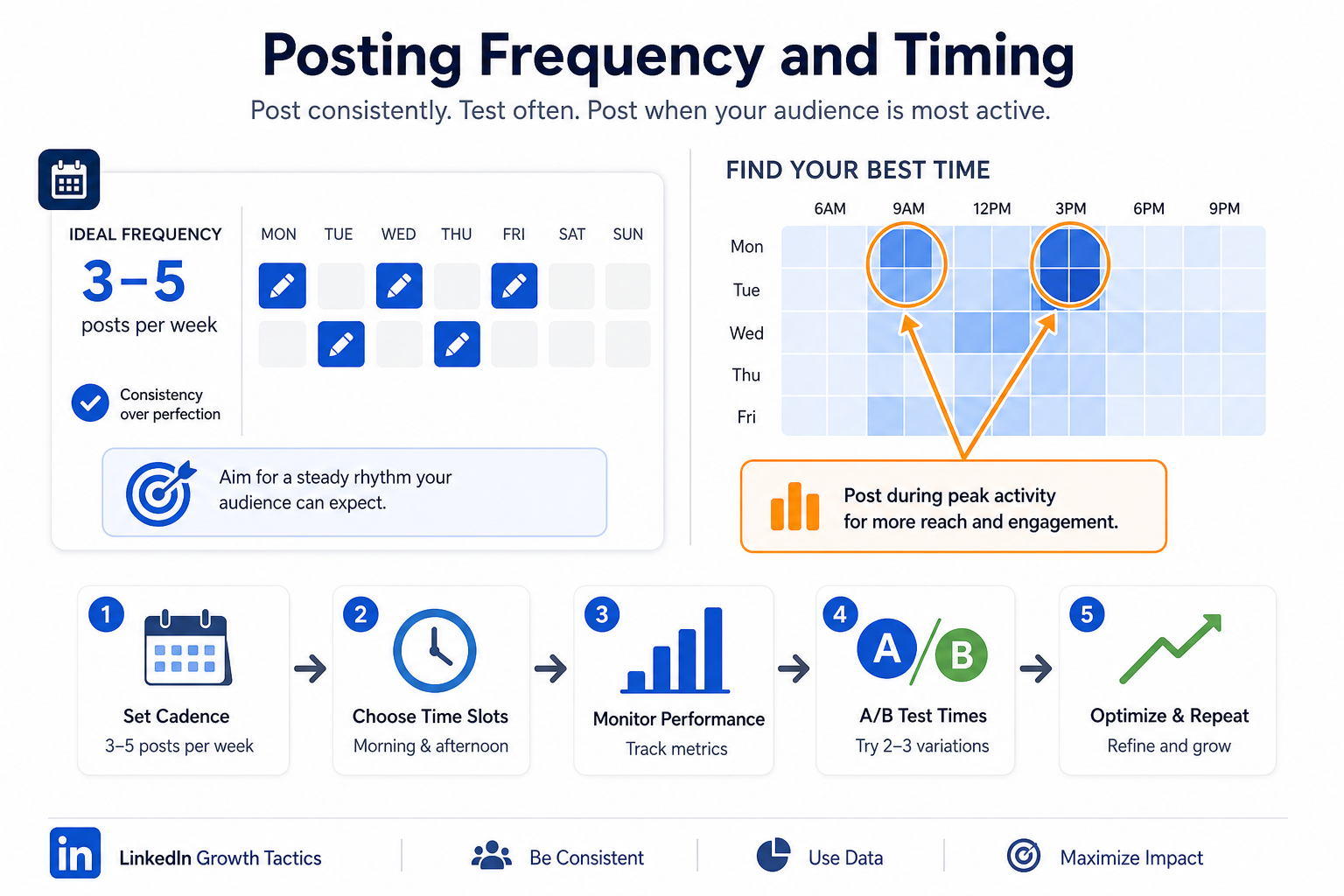
Posting Frequency and Timing is a foundational discipline in the content engine for LinkedIn Growth Tactics. The goal is consistency over bursts of intensity. Regular presence trains your audience to expect value and signals to the algorithm that you are a reliable contributor, which in turn sustains visibility and engagement over time.
Guiding principle: consistency matters more than perfection. It is better to publish a steady stream of solid posts than to chase a single viral moment. A practical starting point is a routine of 3 to 5 posts per week. This cadence keeps you top of mind without overwhelming your audience or your creative capacity.
Optimization through data is essential. Use your analytics to test and refine posting times. Look for windows where your audience is most active and engaged, and adjust your schedule to align with those peaks. Over time, small shifts based on real data compound into meaningful gains in reach and interaction.
Implementation steps
- Set a baseline cadence choose 3 to 5 posts per week and commit to a repeating schedule that your team can sustain.
- Identify initial time slots start with a general mid morning and mid afternoon window in your target audience’s time zone, such as two posts on weekdays spread across the morning and afternoon.
- Monitor performance track impressions, engagements, and follower growth for each post, noting the day and time of publication.
- AB test times experiment with 2 to 3 different time blocks for a 2 to 4 week period to gather enough data for reliable conclusions.
- Refine your schedule lock in the best performing time slots and maintain the cadence, rechecking quarterly or after major changes in audience behavior.
Best practices to maximize impact within the cadence:
- Consistency in format maintain a recognizable structure or theme for posts on specific days to build anticipation.
- Quality over quantity ensure each post delivers a clear takeaway, whether it is a tip, a framework, or a thought-provoking question.
- Mix formats incorporate a blend of short insights, carousels, videos, and polls to appeal to different preferences and to diversify reach.
- Engage promptly respond to comments within the first few hours to sustain momentum and improve post performance in the feed.
Notes on audience behavior and seasonality:
- Professional networks often show higher activity on weekdays, with reduced posting effectiveness on holidays or vacation seasons in your target region.
- Industry events or product launches can shift attention windows; adjust timing to align with relevant moments in your niche.
- Time zone considerations matter when addressing a multi regional audience; consider staggered slots to maximize global reach.
Two practical templates you can adopt right away:
| Cadence Template | Ideal Time Blocks | Notes |
|---|---|---|
| Balanced Week | Mon, Wed, Fri at 9:30 am; Tue at 2:00 pm | Good baseline for steady visibility without fatigue |
| Focused Pairing | Tue at 8:00 am and 4:00 pm; Thu at 11:30 am | Tests two distinct time pockets while maintaining cadence |
In summary, a disciplined approach to posting frequency and timing accelerates steady growth. By prioritizing a sustainable cadence, validating time slots with analytics, and iterating based on results, you create a reliable pattern that compounds reach, engagement, and follower growth over the long term.
Craft Compelling Hooks
Craft Compelling Hooks is the art and science of stopping scrolls and inviting readers into your message. The first 125 characters set the frame for how your audience perceives your entire post. Use provocative questions, surprising data, or bold statements to grab attention, then deliver clear value that keeps people reading. Accessibility matters, so keep language straightforward enough for professionals outside your exact specialty to understand quickly.
Strong hooks shape perception and guide readers toward the takeaway. They set expectations for what comes next and invite further exploration without losing momentum.
Why hooks matter
- Immediate relevance: A strong hook signals the topic and outcome within seconds.
- Algorithm signals: Engagement starts with a compelling opening, prompting likes, comments, and shares.
- Audience accessibility: Plain language broadens reach beyond niche groups.
Effective hook strategies you can deploy
- Provocative questions that touch a common pain or a counterintuitive insight. Example: What if your LinkedIn posts are failing because you publish too many ideas at once?
- Surprising data that reframes a belief or reveals a quick win. Example: Most LinkedIn profiles lose 60 percent of their potential hits because they never test headline variants.
- Bold statements that promise a clear outcome or reveal a common mistake. Example: You are probably wasting 10 minutes a day that could compound into more meetings.
Hook formats by objective
| Goal | Hook Template | Example |
|---|---|---|
| Drive curiosity | Question + hint of benefit | What if a 5 minute daily practice could double your response rate this quarter? |
| Highlight a problem | Pain point statement | Many teams struggle with six week sales cycles and missed forecasts. Here is a faster path. |
| Share a quick insight | Data point + practical takeaway | 3 data points show email open rates rise when you customize subject lines with names. |
| Make a bold claim | Outcome focused | Book 8 to 12 qualified meetings per month using a simple LinkedIn messaging framework. |
Clear and accessible language tips
- Use everyday words: Replace jargon with terms your target audience uses in their daily work.
- Be concrete: If you promise a result, hint at how it will be achieved without overloading the reader with technical steps.
- Short sentences: Aim for punchy lines that can be scanned in a glance.
Hook examples you can adapt
- Question: Are you missing opportunities because your posts don’t show the value you offer?
- Data: 72 percent of replies on LinkedIn come from posts with a specific, external statistic in the first line.
- Bold claim: A 10 minute daily post can drive 2x more conversations than a weekly long thread.
- Mini case tease: Here is the exact format I used to convert 5% of readers into booked meetings last month.
Practical hook writing checklist
- Limit to one idea: Focus the hook on a single, powerful premise.
- Lead with benefit: Frontload what the reader gains by reading further.
- Preview value: Give a glimpse of the answer or outcome without giving away everything.
- Test variations: Try 2 to 3 opening lines and compare engagement over a two week window.
Implementation notes
When you craft a hook, it should align with the post’s content and the audience you aim to attract. If your hook promises one outcome, ensure the body delivers a practical path to that outcome with clear steps, examples, or data. Use accessible language so readers at different experience levels can follow your argument and feel invited to participate in the discussion.
By mastering compelling hooks, you set the stage for higher initial engagement, more meaningful conversations, and a smoother path to growing your LinkedIn following within the framework of LinkedIn Growth Tactics.
Authenticity Drives Engagement
Authenticity Drives Engagement Real connection on LinkedIn starts with showing up as a real person, not a perfectly curated brand. Readers crave stories that reveal the human side behind the expertise, the struggles behind the wins, and the daily rhythms that shape how you work. By sharing personal experiences and behind the scenes moments, you invite others to see themselves in your narrative and to participate in a genuine dialogue rather than a one way broadcast.
Key principles to guide authentic storytelling:
- Bare your process: Walk readers through your decision making, not just the final outcomes. Describe the uncertainties you faced, the pivots you considered, and the lessons you learned along the way.
- Own your mistakes: Own missteps openly and concisely. When you acknowledge errors and show how you recovered, you demonstrate resilience and credibility that resonate with professionals facing similar challenges.
- Share practical, behind the scenes details: Show the daily routines, tools, and rituals you rely on. This demystifies your work and provides actionable takeaways for others to try.
- Be vulnerable in a controlled way: Reveal moments of doubt or setback, but frame them in a constructive light that guides readers toward growth rather than discomfort.
Story formats that deepen connection:
- Cooking up a project post: Narrate a project from kickoff to completion, highlighting the tiny decisions that moved the needle and the surprising findings along the way.
- Day in the life: Share a snapshot of your routine, including time blocks for deep work, meetings, and learning moments, to illustrate how you sustain momentum.
- Behind the scenes: Post images or short clips of your workspace, note-taking methods, or a whiteboard session that reveals your thinking process.
- Failure to learning: Describe a setback, the actions you took to course correct, and the measurable improvement that followed.
Engagement techniques that align with authentic storytelling:
- Ask for perspectives: Conclude with an open question that invites others to share their similar experiences or alternate approaches.
- Invite collaboration: Propose a low friction collaboration idea, such as a short co writing session or a shared reflection piece, to deepen connections.
- Respond with context: When commenters share their stories, reply with empathy and add concise refinements or additional insights based on your experiences.
Examples of authentic post elements you can incorporate:
- Quoted learnings: A short, memorable takeaway you discovered during a tough week, framed as a direct quote you would reuse in future posts.
- Progress updates: Document incremental progress on a milestone, including the small wins that accumulate over time.
- Conflict and resolution: Recount a disagreement or conflicting viewpoint you encountered, and explain how you aligned with a constructive path forward.
How authenticity benefits your long term engagement:
- Trust building: Consistent, transparent storytelling cultivates trust, making followers more likely to engage, share, and seek your perspective.
- Relationship depth: Personal narratives invite richer conversations, turning casual readers into meaningful connections.
- Retention and advocacy: Audiences who feel understood and represented in your content become advocates who return for new insights and support your growth alongside you.
Practical takeaway
- Identify a recent behind the scenes moment that reveals your approach, not just the outcome.
- Draft a concise narrative that includes the context, actions, results, and a takeaway your audience can apply.
- Publish with a clear call to conversation such as inviting readers to share a similar experience or to offer an alternate approach.
Incorporating authenticity into your LinkedIn Growth Tactics creates a durable differentiate that attracts the right people, sustains engagement, and accelerates meaningful conversations over time. When your content reflects the real workflow behind your expertise, you transform passive viewers into active participants in your professional community.
Strategic Call-to-Actions
Strategic Call-to-Actions are the connective tissue between valuable content and meaningful conversation. A well crafted CTA does more than request a like; it invites readers to share perspectives, reveal their experiences, and continue the dialogue in a way that signals to the algorithm that your post is worth distributing. The goal is to spark thoughtful comments, generate diverse viewpoints, and convert passive readers into engaged participants who contribute to the momentum of your LinkedIn Growth Tactics.
Principles of effective CTAs
- Clarity: Tell readers exactly what you want them to do and what they will gain by doing it.
- Specificity: Pose a concrete question or request a concrete action rather than a vague invitation.
- Low friction: Make it easy to respond with a short comment, a quick story, or a simple vote in a poll.
- Value exchange: Emphasize mutual benefit, such as learning from others, validating an idea, or collecting diverse experiences.
CTA formats that drive conversations
- Conversation prompts – End with a pointed question that invites narrative responses.
- Experience shares – Ask readers to share a relevant anecdote or lesson learned.
- Polls and quick votes – Use a poll to surface opinions or preferences and invite rationale in comments.
- Feedback requests – Invite readers to critique a framework, headline, or approach you presented.
- Collaboration calls – Propose a lightweight collaboration idea, such as co writing a future post or a joint brainstorm session.
- Resource invites – Offer a downloadable checklist or template in exchange for a comment or share with a takeaway.
Prompts you can drop into posts today
- <strongQuestion CTA: “What is one small change you would make to this approach based on your experience?”
- Experience CTA: “Share a moment when a simple tweak led to a measurable win in your own practice.”
- Opinion CTA: “Do you agree with the proposed framework? Why or why not?”
- Comparison CTA: “Which would you trial first for your team and why: A or B?”
- Action CTA: “Comment with your next step, and I will respond with a quick outline you can apply.”
CTAs that encourage public engagement while protecting time
- Time-bound prompts: “Share your insight in the next 90 minutes to join a live comment thread.”
- Limited-response prompts: “Give me a one sentence takeaway and one example from your work.”
- Resource linkage: “If you found this helpful, comment ‘ELABORATE’ and I will share a printable checklist in the comments.”
Conversation optimization techniques
- Pin early insights in the first 3 lines and then invite deeper discussion in the closing lines.
- Acknowledge responses promptly with a thoughtful follow-up that invites additional anecdotes.
- Highlight diverse viewpoints by explicitly inviting counterpoints or different industry perspectives.
- Moderation with generosity steer conversations constructively without stifling genuine disagreement.
Public vs private engagement considerations
Encourage public commentary to maximize algorithmic reach, but provide a clear path for private conversations when readers have sensitive questions. Proposals like, “If you have a confidential scenario, drop a DM and we can discuss privately,” can balance openness with discretion.
Implementation checklist for Strategic Call-to-Actions:
- Define the CTA goal before you publish: comments, votes, or a collaboration idea.
- Craft a clear prompt in the closing lines that connects to the post’s main idea.
- Offer value in exchange for engagement such as a mini template, a checklists, or a quick critique.
- Set a response plan outline how you will engage with top comments within the first 4 hours after posting.
- Test and refine try 2 to 3 CTA variants over a few weeks and compare engagement quality and quantity.
By weaving Strategic Call-to-Actions into your content with clarity, specificity, and a focus on mutual value, you amplify engagement signals, encourage meaningful conversations, and expand your reach through authentic reader participation. This approach aligns with the broader framework of LinkedIn Growth Tactics and helps convert readers into active contributors who propel your profile visibility and follower growth.
Hashtag Strategy
Hashtag Strategy is a focused discipline inside your LinkedIn Growth Tactics. When used thoughtfully, hashtags help your content surface to the right audiences without feeling spammy. The key is restraint, relevance, and alignment with the interests of the people you want to reach. This section outlines practical rules and actionable steps to implement a hashtag approach that enhances discovery and engagement.
A thoughtful hashtag plan helps your posts show up in feeds that matter, without nagging readers with irrelevant tags. By keeping to a clear set of tags, you support readability while still guiding the conversation toward your niche.
Guiding principles
- Limit to five hashtags per post to avoid clutter and maintain a clean reading experience.
- Choose niche aligned tags that mirror the exact interests of your ICPs and niche topics.
- Balance broad and specific tags to capture both category level searches and highly targeted queries.
- Monitor performance and replace underperforming tags with more relevant options over time.
How to select hashtags
- Research your audience’s language: review posts from peers and ICPs to see which tags they consistently follow.
- Test a mix: combine 1 to 2 broad tags with 2 to 3 niche tags that describe the post precisely.
- Evaluate intent: use tags that signal a clear topic, such as a framework, industry, or problem area.
- Avoid overused generic tags: tags like #marketing or #business may be too broad for niche targeting.
Hashtag structure table
| Tag Type | Purpose | Example |
|---|---|---|
| Broad category | Increase exposure within a large audience | #LinkedInMarketing |
| Niche topic | Reach practitioners who care about a specific topic | #B2BSaaSContent |
| Industry focus | Align with sector specific conversations | #ProfessionalServices |
| Problem or framework | Signal a concrete angle or method | #LeadGenFramework |
| Location or community | Capture regional or community related discussions | #APACTech |
Posting examples
- Post example: A concise insight on content strategy for B2B services. Hashtags: #ContentStrategy #B2BMarketing #ProfessionalServices #LeadGeneration #LinkedInTips
- Post example: A guide to using carousels for educational posts. Hashtags: #CarouselPost #EducationalContent #ContentMarketing #B2BContent #LinkedInGrowth
Common pitfalls to avoid
- Using too many hashtags can look spammy and dilute signal.
- Recycling the same tags across every post reduces discovery value over time.
- Ignoring relevance tags that do not connect to the audience you intend to reach.
Actionable checklist
- Select 5 hashtags per post that align with the content and audience interests.
- Prioritize relevance over popularity for niche applicability.
- Rotate tags every few posts to test resonance and reach.
- Track outcomes by noting impressions and engagement for posts with each tag set.
In summary, a disciplined five-tag limit, carefully chosen to reflect audience interests, boosts discoverability without compromising readability. Use hashtags as precise signposts that help the right professionals find your content and join the conversation, reinforcing the broader Hashtag Strategy within LinkedIn Growth Tactics.
Link Placement Strategy
Link Placement Strategy is a practical approach designed to preserve organic reach on LinkedIn while still guiding readers toward valuable resources. By sharing external links in the comments rather than in the original post, you reduce the algorithmic friction that often suppresses posts containing external URLs. This keeps your main post clean, readable, and more likely to be shown to a broader audience, while still providing access to deeper content for interested readers.
Rationale and benefits include:
- Maintains higher initial visibility for your post by avoiding abrupt link drops that can trigger reach fatigue.
- Encourages ongoing engagement in the comments, which signals value and sustains conversation momentum.
- Creates a natural workflow for readers who want quick insights first and deeper resources second.
Implementation steps you can apply today:
- Publish with value first: Create a post that delivers a clear takeaway, insight, or provocative question without linking out.
- Add the link in a follow up comment: Immediately after posting, add a comment containing the resource link and a concise description.
- Reference the comment in the post: In the post, invite readers to check the comment for the resource, using a simple prompt such as “See the resource in the second comment.”
- Monitor and respond: Track engagement on both the post and the comment, and answer questions in the thread to keep momentum.
Best practices for link placement and follow up:
- Be specific in the comment: Use a short, informative description of what the reader will find if they click the link.
- Lead with value: The comment should reinforce why the resource matters and how it complements the post.
- Avoid link spamming: Do not post multiple links in rapid succession in the same thread or across posts.
- Tag relevant readers: If possible, reference ICPs or topics discussed in the post to increase perceived relevance.
Table: Post versus Comment Link Strategy
| Aspect | Post Placement | Comment Placement |
|---|---|---|
| Reach | Higher baseline reach without external links | Slightly delayed reach for the link, but maintains post visibility |
| Engagement | Engagement focused on content and discussion | Engagement shifts to the comment thread around the resource |
| User journey | Quick insight with optional follow up | Structured path from post to resource via comment |
| Algorithm signals | Content signals drive distribution | Comment signals reinforce continued interaction |
Practical prompts you can adapt for your posts and comments:
- Prompt: “If you want the detailed guide, check the second comment for the resource.”
- Clarifying question: “What part of this approach would you like to explore further in the linked resource?”
- Context anchor: “The resource in the comment builds on the example I shared above.”
Notes on risk management and etiquette:
- Always ensure the linked resource is high value and relevant to the post topic.
- Acknowledge readers who engage in the post and invite them to continue the conversation in the comments.
- Avoid posting multiple links in a single thread; space out resources to maintain trust and readability.
By integrating a disciplined link placement strategy, you preserve organic reach, sustain reader engagement, and still guide your audience to deeper materials. This approach aligns with LinkedIn Growth Tactics by balancing immediate post impact with thoughtful pathways to additional value.
Content Types and Education: Carousel Posts, Short Videos, Polls, and More
Content Types That Drive Engagement Diversifying your content formats helps accommodate different learning styles and extend reach across LinkedIn. By mixing visually rich carousels, authentic short videos, interactive polls, in-depth long-form articles, behind-the-scenes glimpses, and timely industry commentary, you can establish authority while keeping your audience engaged.
Carousel Posts for structured learning
Carousels combine multiple slides to tell a cohesive story, explain a process, or present a framework in a scannable format. They tend to earn higher engagement because readers swipe through at their own pace and absorb step-by-step insights.
- Use case: Step-by-step guides, checklists, or data visualizations.
- Best practice: 5 to 10 slides with a clear narrative and a takeaway on the final slide.
Short videos for rapid impact
Short-form video boosts authenticity and reach. Even smartphone clips can perform well when they convey practical value or a behind-the-scenes look at your work.
- Length: 15 to 60 seconds for quick tips; 60 to 90 seconds for a compact tutorial.
- Best practice: Open with a strong visual hook, deliver one actionable insight, and close with a question or CTA.
Polls for quick insights and engagement
Polls invite participation, generate conversation, and surface audience preferences. They also provide a low-friction entry point for new followers to engage.
- Use case: Validate assumptions, prioritize topics, or crowdsource best practices.
- Best practice: Keep polls simple, include a brief prompt, and encourage reasoning in comments.
Long form articles for authority
Long-form articles let you dive deep into complex topics, present data, and showcase frameworks. They have a longer shelf life and can drive sustained traffic to your profile.
- Use case: Thought leadership, case studies, or a detailed methodology.
- Best practice: Structure with a strong intro, clear sections, data or examples, and a concise conclusion with a CTA.
Behind the scenes content for human connection
Behind-the-scenes material humanizes your brand and makes your process transparent. This content tends to foster trust and invites deeper conversations.
- Formats: Workspace tours, workflow snippets, tool stacks, or day-in-the-life snapshots.
- Best practice: Highlight decision points, learnings, and practical tips viewers can apply.
Timely industry commentary to reinforce relevance
Timely commentary positions you as a current voice within your niche. Reacting to trends, news, or emerging practices keeps your content fresh and shows that you stay informed.
- Approach: Provide a unique perspective, connect it to audience pain points, and offer actionable implications.
- Best practice: Cite credible sources, keep the tone constructive, and invite discussion in comments.
Format mix and scheduling
To maximize reach, plan a balanced weekly mix. A practical template might be:
| Format | Ideal Use | Suggested Frequency |
|---|---|---|
| Carousels | Educational content, step-by-step guides | 1 to 2 per week |
| Short videos | Quick tips, behind the scenes, quick wins | 2 to 3 per week |
| Polls | Audience insights, topic validation | 1 to 2 per week |
| Long form articles | Authority building, data-driven analysis | 1 per month |
| Behind the scenes | Humanizing your workflow, process transparency | 1 per week |
| Industry commentary | Thought leadership, trend analysis | Weekly or biweekly |
Key principles to guide use of multiple formats:
- Consistency: Maintain a recognizable voice and visual style across formats.
- Value first: Each post should deliver a concrete takeaway or insight.
- Repurposing: Repackage high-performing ideas into additional formats to extend reach.
- Accessibility: Use clear language, legible visuals, and captions for video content.
Incorporating these content types into a cohesive strategy helps you build authority, expand reach, and cultivate a motivated community around your LinkedIn Growth Tactics framework.
Carousel Posts for Education
Carousel Posts for Education Carousel posts are a powerful format for teaching complex concepts in a digestible, visually engaging way. By breaking information into a sequence of slides, you guide readers step by step, building understanding and increasing time spent on your content. Carousels tend to achieve higher engagement because users interact with multiple frames, which signals value to the LinkedIn algorithm and expands your reach beyond your immediate connections.
Key benefits of using carousels for education:
- Structured learning: Present a clear progression from introduction to application, making it easier for readers to absorb dense topics.
- Visual reinforcement: Combine text with charts, diagrams, and callouts to reinforce concepts and improve recall.
- Shareability: Valuable step-by-step guides are more likely to be saved and shared, extending your reach.
- Versatility: Adaptable for frameworks, checklists, workflows, data storytelling, and process maps.
Recommended slide count and structure:
- Slide 1 — Hook and objective: State the problem and the outcome readers will achieve by the end.
- Slides 2–4 — Core concepts: Introduce the key ideas with concise text and supporting visuals.
- Slides 5–7 — Steps or framework: Break down a process into actionable steps with examples.
- Slide 8 — Case or example: Show a concrete application or mini case study.
- Slide 9 — Takeaway and recap: Summarize the core learning in a single sentence or graphic.
- Slide 10 — Next step: Include a non-promotional CTA such as inviting questions or offering a downloadable checklist.
Design and content best practices for educational carousels:
- Keep text per slide concise: Aim for a single idea or data point per slide to avoid cognitive overload.
- Use consistent visual language: Maintain a uniform color palette, typography, and iconography across slides.
- Leverage visuals over walls of text: Replace long paragraphs with bullet points, diagrams, and labeled illustrations.
- Highlight takeaways: Use bold or contrasting callouts to emphasize the most important insight on each slide.
- Accessible design: Ensure readable font sizes, alt text for images, and captions when videos appear in the carousel.
Practical slide content blueprint you can reuse today:
| Slide | Content Focus | Design Cues |
|---|---|---|
| Slide 1 | Problem statement and desired outcome | Bold headline, a single data point, and a simple image |
| Slide 2 | Key concept or framework introduced | Icon plus 2–3 bullet points |
| Slide 3 | Step 1 or element of the framework | Numbered callouts and a labeled diagram |
| Slide 4 | Step 2 or next element | Flow arrows showing progression |
| Slide 5 | Step 3 or practical tip | Checklists or tick icons |
| Slide 6 | Data or evidence supporting the method | Small chart or chart fragment |
| Slide 7 | Application example or mini case | Before and after visuals |
| Slide 8 | Key takeaway | Bold, single line summary |
| Slide 9 | CTA or prompt for reader action | Question mark and invite to comment |
| Slide 10 | Optional extra insight or resource | Resource icon or link cue |
Example use case you can adapt to your niche:
- Topic: A data-driven framework for improving LinkedIn post performance. Slides cover the problem, the framework steps, an example post, metrics to track, and a simple checklist to implement next week.
- Audience: B2B software marketers seeking higher engagement and more qualified leads on LinkedIn.
Publishing notes to maximize impact:
- Captions matter: Add a concise caption that reinforces the carousel’s learning and invites comments or saves.
- Timing: Post when your ICPs are most active to encourage early engagement that signals value to the algorithm.
- Experiment: Test 2 to 3 carousel topics per month and compare performance across formats.
Overall, Carousel Posts for Education are a scalable method to distill complexity into a teachable, repeatable visual journey. When designed with a clear progression, tight copy, and compelling visuals, they become a core component of the LinkedIn Growth Tactics playbook, accelerating learning, authority, and follower growth without relying on promotional messaging.
Video Content for Maximum Visibility
Video is a magnet for attention on LinkedIn feeds. Short, authentic clips capture more screen time, convey nuance faster, and frequently achieve higher reach than text alone. This section outlines practical approaches to creating video that feels human, delivers value quickly, and encourages meaningful engagement with your audience.
Video content typically outperforms other formats:
- Higher engagement: Viewers spend more time on video, which signals value to the LinkedIn algorithm.
- Authenticity and trust: Seeing a real person share tips or behind the scenes builds credibility and relatability.
- Accessible on multiple devices: Short clips play well on mobile and desktop, increasing the likelihood of completion and shares.
Best practices for short, authentic videos
- Length: 15 to 60 seconds for quick tips; 60 to 90 seconds for a compact tutorial or behind the scenes snippet.
- Opening: Lead with a compelling visual or speaking line within the first 3 seconds to reduce drop-off.
- Framing and audio: Shoot with a stable camera, good lighting, and clear audio. Use captions to improve accessibility and retention.
- One clear takeaway: Each video should deliver a single, actionable insight or reveal a behind the scenes lesson.
- Authenticity over polish: Imperfect but genuine videos often outperform highly produced clips, as audiences connect with realness.
Content ideas that work well in video form
- Quick tips: A step by step approach to a common challenge in your niche.
- Behind the scenes: Show your workflow, decision points, or the tools you rely on day to day.
- Mini tutorials: Demonstrate a technique or framework in a concise format with a clear outcome.
- Myth busting: Debunk a prevalent misconception with a simple counterexample or data point.
- Interview style: A rapid one on one with a collaborator or peer sharing a contrasting viewpoint or shareable tip.
Technical tips to improve clarity and reach
- Lighting: Use natural light or a neutral artificial light source to avoid harsh shadows.
- Audio: Minimize background noise; consider a lavalier mic for clearer sound when possible.
- Background: Choose a tidy, non distracting setting that reinforces your professional brand.
- Captions: Add on screen captions to ensure your message is accessible even when muted.
- Thumbnails: Use a clear, eye catching thumbnail frame that hints at the video’s value.
Editing and posting workflow
- Plan: Script or outline a 3 point structure with a strong opening, middle, and closing CTA.
- Shoot: Record vertical video when possible to align with mobile viewing habits on LinkedIn.
- Edit: Trim to keep the pace tight; add captions and a simple lower third with your name and niche.
- Caption: Write a concise caption that reinforces the main takeaway and invites a comment or question.
- Post: Publish at times when your ICPs are most active; experiment with 2 to 3 daily or weekly slots.
Optimization and measurement
- Track signals: Monitor views, completion rate, comments, and shares to gauge resonance.
- A/B testing: Test variations in opening lines, topics, and formats to identify what moves your audience most.
- Repurposing: Turn high performing videos into shorter clips for captions or create carousel summaries to extend reach.
Implementation checklist you can act on today
- Define video brief for a 15 to 60 second tip or behind the scenes insight.
- Prepare a simple setup with adequate lighting, quiet audio, and a clean background.
- Record with captions or plan to add them during editing.
- Add a clear CTA such as inviting comments, sharing a resource, or prompting followers to vote in a poll in a follow up post.
- Publish and monitor the video, noting engagement patterns and optimal posting times for future clips.
Video content for maximum visibility is a scalable way to extend your reach on LinkedIn. By delivering concise, authentic moments that educate or reveal behind the scenes elements of your work, you create durable signals of value that attract more followers and deepen engagement within the LinkedIn Growth Tactics framework.
LinkedIn Polls for Interaction
LinkedIn Polls for Interaction Polls are a lightweight yet powerful tool to spark curiosity, invite participation, and surface actionable insights from your audience. By asking focused questions, you can generate meaningful conversations, validate assumptions, and steer future content to precisely match what your network cares about. Polls also contribute to how the LinkedIn algorithm prioritizes content, often increasing visibility when they prompt engagement and thoughtful responses.
Why polls work well in a growth strategy
- Low friction participation: Quick to answer, reducing barriers to engagement and increasing completion rates.
- Audience intelligence: Directly reveals preferences, challenges, and priorities of ICPs.
- Content guidance: Results inform future posts, formats, and topics with real time feedback.
- Conversation starter: Poll results spark follow up posts, threads, and cross pollination with other formats.
Best practices for crafting effective polls
- Clear objective: Define what you want to learn or prove before writing the question.
- Specific options: Offer 3 to 5 well considered answers that cover the likely spectrum of views.
- Open the door for nuance: Include a space for a brief comment or a follow up question to deepen insights.
- Align with content themes: Ensure poll topics connect to your niche, value proposition, or ongoing series.
- Promote discussion: After the poll closes, publish a short post analyzing the results and outlining next steps.
Poll design guidelines to maximize engagement and quality signals
- Timeframe: Run polls for 24 to 72 hours to balance momentum with timely feedback.
- Wording: Use neutral language that invites honest opinions rather than leading statements.
- Incentives: Avoid heavy promotions; focus on learning and shared insights.
- Accessibility: Keep options concise and include captions or descriptive text when promoting the poll in posts.
Sample poll ideas you can adapt today
- Which content format delivers the most value for your role this quarter: Carousels, Short videos, or Long form articles?
- What is the biggest bottleneck in your LinkedIn growth right now: Consistent ideas, creation process, or distribution strategy?
- Which topic would you like a detailed guide on next: Lead generation tactics, Personal branding, or Profile optimization?
- Which metric do you monitor most often to gauge content success: Impressions, Engagement rate, Saves, or Follows?
How to turn poll results into actionable content
- Publish follow ups: Create a post that analyzes the top answers and explains how you will address them in upcoming content.
- Create a mini series: Use the results as the backbone for a short multi post sequence exploring each option in depth.
- Invite guest perspectives: Reach out to respondents or thought leaders for quick quotes or mini interviews to enrich the narrative.
- Repurpose insights: Transform poll outcomes into a quick carousel with each slide detailing a representative view and recommended actions.
Implementation steps you can apply now
- Define the objective and draft a concise question aligned with your niche goals.
- Create 3 to 5 answer options that cover the likely spectrum of viewpoints.
- Post with context briefly explain why you are asking and what you will do with the results.
- Monitor and engage respond to comments, thank participants, and acknowledge diverse opinions.
Common pitfalls to avoid
- Overly broad questions that dilute insights and produce misleading conclusions.
- Too many options which can confuse respondents and dilute signal.
- Ignoring the results by not producing a meaningful follow up or content plan.
When executed thoughtfully, LinkedIn Polls for Interaction become a repeating mechanism for community input, audience alignment, and content velocity. They help you validate hypotheses, generate new ideas, and cultivate a feedback loop that accelerates your LinkedIn Growth Tactics over time.
Long-form Articles for Authority
Long-form Articles for Authority Long-form articles are a cornerstone of credible thought leadership on LinkedIn. They allow you to dive deeply into complex topics, present rigorous analysis, and showcase a structured methodology with supporting data. When executed well, these pieces have a longer shelf life than short posts and can continue to attract profile views, new connections, and inbound inquiries over weeks or even months. The goal is to position yourself as a trusted expert whose reasoning, evidence, and frameworks deserve sustained attention, even as other formats come and go.
Why long-form content compounds authority
- Depth over breadth: You can illuminate nuances, edge cases, and tradeoffs that shorter posts cannot capture.
- Evergreen value: Thorough analyses often remain relevant as foundational references for readers revisiting the topic.
- Search visibility: Rich, well structured content with clear signals can rank in LinkedIn search and external search engines, drawing ongoing traffic.
- Evidence and credibility: Data, citations, case examples, and reproducible frameworks bolster trust and recall.
Foundational structure for authority building
An effective long-form article typically follows a clear arc from context to conclusion.
Use a consistent anatomy to improve readability and scannability for busy readers:
| Section | Purpose | Best Practices |
|---|---|---|
| Hook and Context | Set the scene and explain why the topic matters now. | Lead with a relevant question or data point; connect to audience pain points. |
| Problem Framing | Define the problem space and boundaries of the discussion. | Clarify assumptions; outline what will be addressed and what will be left out. |
| Methods and Framework | Present the approach you will use to analyze the topic. | Describe steps, models, or criteria with concise visuals or bullet points. |
| Evidence and Analysis | Provide data, case studies, and reasoning to support conclusions. | Use labeled charts, tables, and quotes. Attribute sources where appropriate. |
| Practical Implications | Translate insights into actionable takeaways for readers. | Offer frameworks, checklists, or templates readers can apply immediately. |
| Counterpoints and Nuance | Acknowledge alternative perspectives to reinforce credibility. | Briefly present plausible objections and explain why your stance remains valid. |
| Conclusion and CTA | Summarize the core thesis and invite continued dialogue. | End with a specific, low friction invitation such as sharing a perspective, downloading a resource, or starting a discussion thread. |
Topics that lend themselves to long-form exploration
- Data driven frameworks: Present a step by step methodology for diagnosing a problem and measuring outcomes.
- Case study deep dives: Walk through a real world scenario with milestones, decisions, and quantified results.
- Industry shifts and forecasts: Analyze trends, drivers, and scenarios with scenario planning.
- Process optimization: Break down a complex process into repeatable phases, with checklists and metrics.
- Strategic narratives: Build a cohesive argument about a new approach, including why it matters and how to implement it at scale.
Practical article architecture you can reuse
- Title: Craft a headline that communicates the outcome and audience impact without ambiguity.
- Introduction: State the problem, hook readers with a concrete scenario, and preview the thesis.
- Context and background: Provide essential context, definitions, and scope to set expectations.
- Thesis and argument: Present your central claim supported by sections of analysis.
- Evidence blocks: Each block contains a claim, data, example, and a takeaway.
- Actionable takeaways: Translate analysis into concrete steps, templates, or checklists readers can implement.
- Conclusion: Reiterate the value proposition and invite discussion or collaboration.
Writing craft and readability considerations
- Clear, accessible language: Aim for clarity over cleverness; avoid unnecessary jargon.
- Chunked formatting: Use subheads, short paragraphs, and bullet lists to aid scanning.
- Visual aids: Integrate simple charts, diagrams, or infographics that illustrate key points.
- Citation and credibility: Attribute data sources and include quotations or expert perspectives where relevant.
Promoting long-form work without promotional clutter
- <strongValue-first framing: Lead with insights rather than endorsements; readers should perceive direct benefit.
- Ethical cross posting: Share excerpts or summaries on LinkedIn with a link to the full piece on your own site or a persistent LinkedIn article, if available, while avoiding spammy prompts.
- Engagement after publish: Respond to comments with additional nuance, invite counterpoints, and link to related sections within the article to deepen learning.
A practical template you can customize
Article concept: A rigorous framework for improving LinkedIn lead generation through content strategy
- Hook: A bold statement about typical lead generation bottlenecks on LinkedIn and the potential uplift from a structured approach.
- Framework: Outline a four step process—diagnose, design, deploy, and document results—with checkpoints and metrics.
- Evidence: Include a mini case example or a composite of anonymized outcomes to illustrate impact.
- Takeaways: A ready-to-implement checklist and a suggested testing plan for readers to start this week.
Measurement and iteration for long-form content
- Engagement quality: Track comments quality, time spent reading, and shares as indicators of depth and resonance.
- Traffic signals: Monitor referral traffic to the article and subsequent profile views or message inquiries.
- Content evolution: Update and expand older articles when new data or case studies emerge to preserve relevance.
Long-form articles, when treated as living assets, can compound your visibility and authority over time. They serve as authoritative reference points for your audience and as durable signals to search and discovery systems about your expertise. By pairing rigorous analysis with practical takeaways and thoughtful promotion within the LinkedIn Growth Tactics framework, you can elevate your thought leadership and sustain meaningful growth for years to come.
Behind-the-Scenes Content
Behind-the-Scenes Content uncovers the real process behind your results. This category of content humanizes your brand by showing how you think, how you work, and how you navigate challenges in real time. With minimal setup, you can illuminate decision points, workflows, and the daily rhythms that shape your outcomes. Authentic BTS material builds trust, reduces perceived distance with your audience, and invites you into conversations that matter.
Why BTS content matters in the context of LinkedIn Growth Tactics:
- Human connection human moments foster empathy and make it easier for others to engage with your ideas.
- Credibility through transparency showing your method and thinking process demonstrates competence and accountability.
- Educational value readers learn practical techniques by watching how you approach problems step by step.
What to share and how to share it
- Decision points: Describe a key choice you faced, the options you considered, and the rationale behind the final path.
- Tool stacks: Reveal the tools and processes you rely on, including brief why and how you use them.
- Day in the life snapshots: Outline a typical day with time blocks, focus periods, and routines that drive consistency.
- Progress milestones: Highlight small wins and the steps that led to them, even if the outcome is not yet complete.
Content formats that work well for BTS material:
| Format | What it Shows | Best Use |
|---|---|---|
| Short video | A quick tour of your workspace or a minutes long walkthrough of a process | Fast, engaging insight into daily work habits |
| Behind the scenes post | Narrative thread detailing a recent project moment and the decisions involved | Authentic storytelling with actionable takeaways |
| Workflow screenshots | Annotated images showing steps, checklists, or dashboards | Concrete process learning that followers can imitate |
Practical BTS content ideas you can implement this week:
- Weekly process highlight share a recurring routine that helps you stay productive and deliver results.
- Tool tip post reveal one underrated feature of a favorite tool and how it saves time.
- Conflict to resolution describe a challenge you faced, the misstep, and the corrective action that yielded a better outcome.
- Live Q and A invite questions about your workflow and respond with a short BTS video or annotated screenshots.
Engagement tips for BTS content:
- Ask for perspectives end posts with a question about alternative approaches readers might take in similar situations.
- Invite collaboration propose a mini co creation, such as a shared workflow improvement or a joint tutorial.
- Be explicit about learnings summarize the key takeaway in a single sentence to anchor the discussion.
Implementation checklist for BTS content readiness:
- Identify a recent project moment that illustrates your approach or a decision you made.
- Prepare lightweight visuals such as a photo of your workspace, a screen capture, or a short clip explaining a step.
- Draft a concise narrative that reveals the context, actions, and outcomes without oversharing sensitive information.
- Post with a clear CTA inviting readers to share their own BTS experiences or ask a question about your method.
By integrating behind the scenes content into your LinkedIn Growth Tactics, you invite your audience to participate in your journey. This transparency strengthens trust, accelerates relationship building, and creates a durable resonance that complements more polished, strategy focused posts. When readers see the real work behind your expertise, they are more likely to stay engaged, follow consistently, and exchange insights that elevate your professional community.
Industry Commentary
Industry Commentary is a disciplined practice of sharing thoughtful perspectives on current events, trends, and shifts within your niche. Instead of reacting to every headline, you provide context, synthesize implications for practitioners, and offer actionable takeaways. This approach helps you be seen as a credible commentator who helps your audience interpret complexity and make informed decisions.
Why industry commentary matters for LinkedIn Growth Tactics:
- Signal credibility: Consistently weighing in on trends demonstrates mastery and builds trust in your judgment.
- Stimulate deeper discussion: Provocative yet constructive viewpoints invite dialogue, boosting engagement and visibility.
- Future focus: Observing early indicators and forecasting implications helps your audience prepare for what comes next.
How to develop unique, valuable commentary
- Choose relevant signals: Pick news or trends that directly impact your ICPs and their goals.
- Synthesize, not summarize: Go beyond repeating headlines; connect dots, contrast viewpoints, and derive practical implications.
- Ground in data: Support your perspective with credible data, case studies, or credible industry sources.
- Offer a forward edge: Propose concrete actions, experiments, or checks readers can apply in their context.
Commentary formats that perform well
| Format | Why it works | Best use |
|---|---|---|
| Insight thread | Short, sharp observations that build a thesis piece by piece | Reacting to a trending topic with a clear point of view |
| Data driven reaction | Combines a timely claim with a data point or chart for credibility | Disputes or confirms prevailing narratives with evidence |
| Opinion mini-essay | Coherent argument framed around a specific question or dilemma | Exploring strategic implications and recommended actions |
| Comparative analysis | Places current developments alongside past trends to reveal patterns | Highlighting long term implications and risk factors |
Practical structure for a commentary post
- Hook: Lead with a provocative question or a striking data point relevant to the trend.
- Context: Briefly explain what changed and why it matters now.
- Analysis: Present your interpretation, including competing viewpoints and your reasoning.
- Implications: Clearly outline what this means for practitioners, teams, or strategies.
- CTA: Invite comments with a specific prompt, such as “What would you test next in response to this trend?”
Common pitfalls to avoid in industry commentary:
- Overgeneralizing: Don’t imply universal rules from a single event or limited data.
- Confirmation bias: Be willing to acknowledge data that challenges your thesis.
- Noise over signal: Focus on meaningful implications rather than repeating every headline.
Engagement strategies to maximize impact while maintaining credibility:
- Cite sources: Attribute data, reports, or expert opinions to reinforce trust.
- Invite diverse perspectives: Encourage readers from different roles to share how the trend affects their context.
- Host follow-up discussions: Create a thread that invites updates as the trend evolves, reinforcing ongoing engagement within your LinkedIn Growth Tactics framework.
Example prompts you can adapt today to kick off an industry commentary thread:
- Prompt: “What will this shift mean for early adopters versus late entrants in our space?”
- Prompt: “Which metrics will you prioritize to validate the impact of this trend in the coming quarter?”
- Prompt: “Which strategy changes would you test first to align with this trend?”
Implementation checklist for publishing thoughtful industry commentary:
- Define the trend and its audience impact in one sentence.
- Craft a clear thesis about what should change next and why.
- Support with evidence using data or credible sources.
- Offer actionable implications with 2–3 concrete steps readers can apply.
- End with a specific prompt to stimulate discussion and ongoing engagement.
By delivering measured, data-informed, and practitioner-focused industry commentary, you establish yourself as a thoughtful leader whose insights help others navigate uncertainty. This builds credibility, attracts engaged followers, and reinforces your standing within the broader LinkedIn Growth Tactics ecosystem.
Growth Tactics: Practical Execution for 2026
Growth Tactics: Practical Execution for 2026 is a concise, scalable playbook designed to convert profile optimization, content variety, and community engagement into accelerated follower growth on LinkedIn. This section distills actionable steps you can implement this quarter, with a clear rhythm for testing, learning, and compounding results across the year. The emphasis is on repeatable systems, not one-off hacks, so you can build durable growth using the LinkedIn Growth Tactics framework.
Use this framework to organize your experiments. Start with a tight objective, define the metric you’ll track, and set a modest test window. Then implement, observe, and iterate. The goal is steady improvement rather than a single big win. Keep the cadence consistent so you can compare results over time.
Foundation to scale: repeatable processes
Growth starts with reliable processes you can delegate, track, and improve. Build a weekly cadence that covers optimization, content planning, engagement, and measurement. Each pillar should feed the next, creating a virtuous loop where insights from engagement inform profile tweaks, and profile improvements uplift content performance.
Consistency matters. A simple, repeatable weekly ritual gives your team a clear rhythm and keeps your audience engaged over time.
- Weekly optimization sprint: audit one profile element (headline, About, Featured) and align it with the week’s content themes.
- Content planning block: map 3 to 5 topics to formats (carousels, videos, polls) aligned to your niche promise.
- Engagement orbit: schedule daily engagement sessions to comment meaningfully on ICPs and partners.
- Measurement loop: track a core set of metrics (impressions, engagement rate, follower growth, profile views) and adjust the plan weekly.
Optimized profile as a growth engine
Your profile should act as a conversion engine that converts curiosity into follows and conversations. Priorities for 2026 focus on visibility, clarity, and credibility while preserving authenticity.
A strong profile supports every step of the journey. Clear messaging, credible proof, and a straightforward next step help visitors decide to engage.
| Element | Action | Success Metric |
|---|---|---|
| Headline | Refine to a value proposition that states who you help, the outcome, and the approach. | Increase in profile CTR and new connections per week. |
| About Section | Use a narrative structure with keywords, proof, and a clear next step. | Higher message rate and more appointment bookings or resource downloads. |
| Featured | Showcase 2 to 3 core offers or case studies with tangible outcomes. | More profile visits converting to meaningful conversations. |
| Banner and Creator Mode | Banner communicates core value; Creator Mode highlights your topics and followers. | Increased follower growth velocity and content reach. |
Content strategy: diversified formats that compound
Variety fuels reach and keeps your audience engaged. Use a balanced mix that plays to different learning preferences while reinforcing your niche authority.
Diversifying formats helps you meet followers where they are while keeping your message cohesive.
| Format | Why It Works | Best Use |
|---|---|---|
| Carousels | Interactive, scannable learning with clear steps. | Explain frameworks, processes, checklists; 1 to 2 per week. |
| Short videos | Authenticity and higher reach; quick to consume. | Tips, behind the scenes, client outcomes; 2 to 3 per week. |
| Polls | Low friction participation and audience insights. | Topic validation and prioritization; 1 per week. |
| Long form articles | Authority and evergreen value. | Deeper dives into niche topics; 1 per month. |
| Behind the scenes | Humanizes your brand and builds trust. | Weekly BTS snippets or workflow explainers. |
Engagement system that compounds reach
Engagement is the catalyst for distribution. Design engagement rituals that scale and feel authentic rather than transactional.
Build a repeatable rhythm that invites dialogue and demonstrates value from every interaction.
- Daily ICP comments: spend 15 to 20 minutes commenting on a curated set of ICPs and partners, delivering value with every remark.
- Conversation prompts: end posts with targeted questions or invites for case studies to spark dialogue.
- Prompt responses: reply within the first few hours to sustain momentum and signal value to the algorithm.
Table: Engagement tactics that scale
| Tactic | Implementation | Impact Indicator |
|---|---|---|
| Strategic commenting | Comment on 15 to 25 profiles per session across influencers, ICPs, and peers | Impressions and profile visits from comment links |
| Conversation CTAs | Ask for stories, experiences, or input at the end of posts | Comment volume and depth of replies |
| Collaborative posts | Coordinate with peers or partners on joint posts or Live sessions | Cross follower growth and shared audience reach |
| Ask for UGC | Invite followers to share their frameworks or templates as replies | Quality of user generated content and saves |
Experimentation and optimization playbook
Apply a scientific approach to growth by running small, reversible tests.
You should test one variable at a time, document outcomes, and scale the successful ideas.
- Headline variants: AB test 2 to 3 versions for a month, track profile views and connection requests.
- Post timing: Test two time blocks per week for 2 to 4 weeks to identify peak periods.
- Format mix: Rotate formats monthly to discover which resonate most with ICPs.
- CTA styles: Experiment with different call to actions and measure response quality.
Measurement and governance: what to track
Track the right metrics.
Avoid vanity traps and observe momentum that matters.
| Metric | Definition | Target Trend |
|---|---|---|
| Follower growth rate | New followers accrued weekly or monthly | Positive trend each month |
| Engagement rate | Engagement actions divided by impressions | Consistently rising with quality content |
| Profile views | Number of views to your profile | Steady increase as content reach expands |
| CTR to introduced resources | Clicks on resources or links in comments or posts | Improving as value signals strengthen |
Practical execution checklist
- Define quarterly objectives: set measurable follower growth and engagement targets.
- Audit and align: verify profile, banner, and About reflect current niche and outcomes.
- Plan content mix: outline 3 to 5 topics per week with formats and CTAs.
- Install engagement rituals: schedule daily comment sessions and weekly collaboration windows.
- Run 2 to 3 tests: document results and decide scaling decisions based on data.
By following this practical playbook, you establish a scalable velocity for LinkedIn Growth Tactics in 2026. The approach blends profile optimization, varied content, and disciplined community engagement to create compounding follower growth, higher quality conversations, and a durable presence on the platform.
Start with a minimum viable routine and expand as you learn what resonates. Track progress weekly and adjust your plan based on what the data shows. This approach builds a steady cadence that you can sustain over time.
Use Relevant Keywords
Use Relevant Keywords is the core of LinkedIn search optimization. Think of your profile as a living landing page that surfaces when your target audience searches for terms they associate with your expertise. By identifying the exact words and phrases your ICPs use, and weaving them naturally into your headline, About section, experience descriptions, and skills, you improve both LinkedIn and external search visibility. The result is more qualified profile views, more connection requests from the right people, and a clearer path to growth within the LinkedIn Growth Tactics framework.
How to approach LinkedIn SEO through keywords:
- Audience first research: Start by listing the problems your audience is trying to solve and the outcomes they chase. Turn those into candidate keywords and phrases you can reasonably rank for.
- Intent alignment: Distinguish between broad terms and niche terms. Prioritize phrases that signal intent, such as “lead generation on LinkedIn for B2B SaaS” over generic “marketing.”
- Natural integration: Place keywords where they fit naturally within your copy. Avoid keyword stuffing which harms readability and credibility.
- Contextual relevance: Use keywords in a way that supports your value proposition. Each keyword should reinforce what you actually deliver for your audience.
Placement strategies that maximize visibility without compromising readability:
| Profile Area | Keyword Use | Why It Helps |
|---|---|---|
| Headline | Incorporate 1 to 3 core keywords that describe your niche, outcome, and approach | Immediate signal to visitors and the algorithm about who you help and how |
| About Section | Weave keywords into a readable narrative that explains problems solved, methods, and results | Improves searchability while maintaining engaging storytelling |
| Experience Descriptions | Include role related terms and client outcomes that align with your niche keywords | Strengthens relevance for topic based searches and recruiter queries |
| Skills & Endorsements | List core competencies that mirror common search queries in your field | Boosts searchability within LinkedIn and aids in profile rankings |
| Banner Copy | Short value oriented phrase including a keyword when natural | Reinforces your niche at a glance and supports quick recognition |
Practical keyword building steps you can execute this week:
- Harvest 10 to 15 target terms your ICP would type when seeking expertise like yours. Include variations and synonyms to capture related searches.
- Map keywords to sections create a simple matrix that assigns 1 to 3 keywords per profile area (Headline, About, Experience, Skills).
- Write for clarity first ensure each keyword enhances understanding of your value rather than hindering readability.
- Audit and adjust quarterly review profile analytics to identify which terms drive profile views and connection requests, then refine accordingly.
Keyword best practices to keep in mind:
- Long tail over generic terms tend to convert better and surface in more specific searches.
- Variety and coverage include both niche phrases and broader categories to maximize reach while preserving relevance.
- Context matters embed keywords in stories, outcomes, and methods rather than listing them in isolation.
- A/B test language try two headline variants with different keyword framings and compare profile visitor metrics over several weeks.
Outcome focus summary: by aligning your LinkedIn keyword strategy with your audience’s search behavior, you create a durable visibility engine. This supports faster follower growth, higher quality connections, and a stronger foundation for all subsequent LinkedIn Growth Tactics you deploy.
Custom LinkedIn Profile URL
Custom LinkedIn URL is a small detail with a big impact on professional appeal and discoverability. By replacing a cluttered default URL with a clean, memorable path, you signal credibility and make it easier for others to share and remember your profile. A well crafted custom URL also aligns with your personal brand, helping you rank for relevant searches both on LinkedIn and in external search engines.
Key benefits of a clean URL include:
- Credibility A concise, name based URL conveys professionalism and attention to detail.
- Discoverability Short, readable URLs are easier to recall and type, increasing profile views from referrals and offline materials.
- Shareability Clean links resist truncation in emails, resumes, business cards, and slides, improving click through rates.
Implementation guidance to craft a clean URL that matches your personal brand:
| Step | Action | Best Practice |
|---|---|---|
| Step 1 | Navigate to Profile Settings and open Public URL editor | Choose a simple format that resembles your name or professional brand |
| Step 2 | Pick a URL pattern like linkedin.com/in/YourName or linkedin.com/in/YourName-Profession | Avoid random numbers or unrelated terms |
| Step 3 | Test consistency across materials | Ensure the URL matches how you present yourself on resumes, signatures, and cards |
| Step 4 | Update references where you share your profile | Replace old links in signatures, bios, and portfolios with the new URL |
Practical tips to maximize impact:
- Consistency matters Use the same handle across other profiles when possible to reinforce recognition.
- Keyword alignment If appropriate, include a keyword in your URL format, such as your name plus a field identifier, while keeping it natural and readable.
- Public visibility Ensure your profile remains public so the URL is easily discoverable by search engines and visitors outside your network.
Actionable optimization checklist for Custom LinkedIn URL:
- Open profile settings and locate the Public URL editor.
- Choose a clean version that mirrors your professional name and brand.
- Update all materials including email signatures, resume PDFs, business cards, and personal website bios.
- Verify accessibility paste the URL in a browser to confirm it lands on your profile and renders correctly.
By adopting a concise and memorable custom LinkedIn URL, you lay a solid foundation for all LinkedIn Growth Tactics to follow. A professional URL not only improves how you appear in search results but also makes it effortless for your audience to connect with you, accelerating your overall growth trajectory on the platform.
Strong Headline
Strong Headline is your first impression in the LinkedIn feed and on every post preview. It should clearly state who you help, the outcome you enable, and a glimpse of your approach. When your headline communicates a tangible value to a precise audience, you win more follows, more clicks, and more meaningful conversations. This section provides practical guidance and ready-to-use templates to craft headlines that resonate immediately.
Guiding principles for a headline that sells your value:
- Audience focus: Lead with the people you serve to signal immediate relevance to readers who match your ICPs.
- Outcome orientation: State a measurable result or concrete benefit that matters to your audience.
- Credible specificity: Hint at your method or approach without over promising or sounding generic.
- Clarity over cleverness: Prioritize clear communication so readers understand the value at a glance.
Headline templates you can adapt today. Replace the brackets with your specifics to create a compelling value proposition:
| Template | Example | When to Use |
|---|---|---|
| Who you help + What you deliver + How you do it | Helping B2B SaaS teams scale ARR through LinkedIn driven demand | Use when you serve a specific customer group with a measurable outcome and a clear method |
| Outcome + Audience + Approach | Increase qualified MQLs for professional services firms with targeted content strategies | Use when you want to emphasize result plus client segment and method |
| Result focused + Context | Book 10-30 B2B meetings per month using LinkedIn messaging | Use when you have a clear, auditable activity metric |
| Value proposition + Proof hint | Helping teams reduce CAC by 25 percent with content led outreach | Use when you want to imply credibility without listing clients |
Examples you can tailor to your niche. Replace the placeholders with your specifics to fit your audience and outcomes:
- Helping manufacturing startups shorten sales cycles by 30 percent with LinkedIn focused outreach
- Guiding professional services firms to attract high value clients using targeted content strategies
- Empowering HR leaders to fill critical roles faster through networked recruiting and outreach
Tips for testing and refining your headline:
- AB test phrases: Rotate 2 to 3 variations for a couple of weeks and monitor profile views and connection requests.
- Check readability: Read aloud to ensure it makes sense within the small profile card and at a glance.
- Align with your content: Ensure your headline echoes the themes you publish about most often.
- Avoid vague claims: Steer clear of generic adjectives that do not convey outcomes or specificity.
In summary, a strong headline communicates exactly who you help, what outcome you enable, and how you approach it. It acts as a beacon that guides the right audience toward your content and conversations, forming a crucial foundation for the broader LinkedIn Growth Tactics you deploy to accelerate follower growth and engagement.
Professional Picture
Professional Picture is your digital handshake and first visual impression in the feed. Pairing a sharp, high quality photo with a value driven headline creates an instant sense of credibility and approachability that invites connections. The goal is to project professionalism while signaling that you are open, collaborative, and ready to engage. When visitors see a strong image alongside a headline that clearly communicates value, they are more likely to stop scrolling, view your profile, and consider connecting or learning more.
How to optimize your profile photo for maximum impact:
- Clarity : Use a high resolution headshot where your face is clearly visible even at thumbnail size.
- Background : Choose a neutral or softly blurred background to minimize distraction and keep focus on you.
- Lighting : Favor natural light or diffused studio lighting that evenly illuminates your features without harsh shadows.
- Framing : Frame from the shoulders or mid chest, with your eyes placed near the upper third of the frame.
- Expression : A warm, approachable expression conveys openness and trustworthiness.
- Attire : Wear attire appropriate for your industry that aligns with your personal brand and the audience you want to attract.
Value driven headline pairing guidelines:
- Anchor : Create a headline that says who you help, the outcome you deliver, and hints at your approach, so the image and copy work together to convey impact.
- Clarity over cleverness : Prefer straightforward language that communicates tangible value within a glance.
- Consistency : Ensure the headline resonates with the themes you publish about and the value you offer.
- Approachability : Use positive, inviting language that lowers social distance and invites messages.
Practical specifications your photographer or you can implement today:
| Specification | Best Practice | Why It Matters |
|---|---|---|
| Resolution | Minimum 4000 x 4000 pixels | Ensures crisp rendering on desktop and mobile without pixelation |
| Background | Solid neutral color or soft gradient | Reduces distraction and keeps focus on you |
| Lighting | Diffuse or natural window light from the front | Prevents harsh shadows and creates flattering detail |
| Framing | Shoulders to mid chest; eyes near top third | Balanced composition that fits profile thumbnails well |
| Expression | Genuine, approachable smile or confident neutral | Conveys warmth and trust, encouraging connections |
| Attire | Industry appropriate, brand-aligned clothing | Reinforces credibility and professional alignment |
Optional refinements to elevate impact without sacrificing authenticity:
- Color harmony – Use tones that align with your banner and overall brand palette for a cohesive profile look.
- Gentle retouching – Slight enhancements to brightness and contrast can improve clarity without creating an artificial appearance.
- Consistency across channels – Use the same or a very similar headshot on your website and other social profiles to reinforce recognition.
Implementation checklist you can act on today:
- Audit current photo – Check for clarity, background, lighting, and whether the image reads well at thumbnail size.
- Plan a shoot or upgrade – Choose a clean setting with stable lighting and a wardrobe that matches your niche norms.
- Coordinate with a photographer or use a high quality camera – Ensure you can export at suitable resolution and color balance.
- Upload and verify – Update LinkedIn with the new image and review how it renders on both desktop and mobile.
By prioritizing a sharp professional picture paired with a value driven headline, you establish immediate credibility and approachability. This combination lowers friction for new connections, increases profile engagement, and amplifies the effectiveness of your broader LinkedIn Growth Tactics strategy.
LinkedIn Banner
LinkedIn Banner is the prime real estate on your profile to communicate your value proposition at a glance. A well crafted banner acts as a concise elevator pitch, reinforcing who you serve, the core problem you solve, and the tangible outcomes you help clients achieve. Used effectively, this banner becomes a scalable asset that accelerates interest, credibility, and follower growth by clarifying your services and inviting action without requiring visitors to scroll for context.
How to leverage the banner space effectively:
- Summarize services in a single, scannable line or two that map directly to the needs of your ICP. Focus on outcomes and the primary methods you employ.
- Show the problem you solve with a short value cue that resonates with your audience’s pain points, such as “shortening complex sales cycles” or “driving qualified leads on LinkedIn.”
- Guide visitors with a clear CTA Include a minimal but actionable cue such as a URL, a prompt to download a resource, or an invitation to book a quick intro call. Keep text legible and avoid clutter.
Banner design blueprint
| Banner Element | Purpose | Best Practice |
|---|---|---|
| Core value line | Immediately communicates your primary service and outcome | One concise line in a large, high contrast font; avoid jargon |
| Target audience cue | Signals the specific group you serve | Include a phrase like “for B2B software teams” or similar audience descriptor |
| Visual harmony | Reinforces your personal brand | Ensure color palette, typography, and imagery align with your profile photo and website |
| CTA or next-step cue | Directs action without being promotional | Use a subtle CTA such as “Download the checklist” or “Book a 15 min intro” with a short URL |
| Safe content area | Prevents important information from being cropped | Place critical text within the central safe zone; test on desktop and mobile |
Banner copy and layout examples you can adapt:
- Example 1: LinkedIn growth coaching for B2B tech teams | Shorten sales cycles by 30 percent | Download the 5 step playbook
- Example 2: Content strategies for professional services | Turn insights into high value client conversations | Book a 15 minute intro
Implementation tips to maximize impact:
- Dimensions and safe zone Use 1584 by 396 pixels and keep essential elements within the central area to avoid cropping on different devices.
- Typography and contrast Choose a bold headline with strong contrast against the background; ensure readability at thumbnail sizes.
- Test variations Create 2 banner variants and observe which drives more profile visits and message starts over 2 to 4 weeks.
- Align with elsewhere Ensure the banner messaging echoes your headline, About section and supported content to reinforce your positioning.
Why this matters for LinkedIn Growth Tactics: a purposeful banner accelerates recognition, reduces friction for new visitors, and complements your profile optimization and content strategy. When the banner clearly states who you help, the outcome and the path to action, visitors are more likely to follow, connect, and move toward deeper engagement with your content and services.
Featured Section
Featured Section on your LinkedIn profile is a high-impact area that showcases your best value propositions quickly. When someone lands on your page, a well-crafted Featured area reveals case studies, offers, and resources that demonstrate credibility and drive action. This section guides how to curate and present your Featured items so they align with your niche, audiences, and growth goals within the LinkedIn Growth Tactics framework.
Keep the focus tight. A strong Featured area signals what you deliver and why it matters to your audience.
What to include in Featured
- Case studies or project highlights that show quantified outcomes you delivered for clients or collaborators.
- Lead magnets such as templates, checklists, or mini guides that visitors can download with one click.
- Mini offers like a 30-minute strategy session, a discovery call, or a low-commitment audit that lowers the barrier to engagement.
- Video or visual explainers that summarize frameworks or processes you want prospects to grasp quickly.
- Press or publication mentions that validate your expertise, when relevant and credible.
How to structure each Featured item
| Feature Type | What It Includes | CTA or Next Step |
|---|---|---|
| Case Study | Brief problem, approach, and measurable results with before/after visuals | Link to full case study or a downloadable one-page summary |
| Lead Magnet | Concise resource that delivers immediate value (template, checklist, cheat sheet) | Download button or form for email capture |
| Strategy Session | Short summary of what you offer, typical outcomes, and client fit | Calendar scheduling button or booking link |
| Video Explainer | One to two minute walkthrough of a framework or process | Watch now with optional companion resource |
| Publication or Media | Highlights from articles, podcasts, or speaking engagements | View full piece or listen/watch the interview |
Best practices for curation
- Quality above quantity: Feature a tight set of assets that deliver clear value.
- Clear value signaling: Each item should convey the outcome visitors can expect.
- Consistent branding: Use the same visuals, title styles, and microcopy to reinforce your niche and credibility.
- Timely updates: Refresh Featured items quarterly to reflect current services, recent wins, and new resources.
Implementation checklist
- Audit existing Featured items for relevance, quality, and alignment with your current niche promises.
- Prioritize top assets choose 2 to 4 items that best demonstrate outcomes and value.
- Design consistent thumbnails create cohesive visuals that render well in the LinkedIn grid and on mobile.
- Craft concise titles that clearly communicate the benefit or outcome of each item.
- Link and CTA consistency ensure each item links to a credible destination and includes a clear call to action.
By assembling and maintaining a focused Featured Section, you provide visitors with immediate, persuasive evidence of your capabilities. This builds trust, clarifies your value proposition, and increases the chance that new followers take the next step in your LinkedIn Growth Tactics journey.
Make Your Profile Public
Make Your Profile Public is a simple yet powerful lever for visibility. A public profile can be discovered not only by LinkedIn members who are connected to you, but also by people who arrive via external search engines or inquiries about your niche. When your profile is accessible to non-users, you reach a broader audience, increase inbound profile views, and create more opportunities for meaningful connections, partnerships, and inquiries.
The core benefits of public visibility include:
- Expanded reach: External search engines index public profiles, boosting discovery beyond LinkedIn’s native network.
- Higher credibility: A public profile signals transparency and professionalism to potential collaborators, clients, and recruiters.
- Improved targeting: People searching for your expertise can find you more easily, accelerating follower growth and relevant connections.
Implementation guidance to ensure effective public visibility:
- Set profile to public: In LinkedIn Settings and Privacy, enable Public profile so your profile is visible to non-LI users.
- Check what is public: Review which sections are visible to the public, and ensure your key value propositions, headline, and about section are accessible without login.
- Optimize for external search: Include a concise, keyword-rich About section and a public headline that clearly communicates your niche and outcomes.
- Monitor indexing: After enabling public visibility, periodically search for your name in major search engines to verify your profile appears and is current.
Best practices to maximize the benefits of public visibility:
- Keep core messaging public: Ensure the most compelling value propositions and calls to action are visible without requiring a login.
- Respect privacy: Public does not mean exposing sensitive information; share value-driven content while maintaining professional boundaries.
- Align across channels: Mirror your public LinkedIn narrative with your website, portfolio, and other social profiles to reinforce your positioning.
Practical visibility checklist you can act on today:
- Enable public profile in Settings and Privacy, then verify you can view your profile as a non-logged-in user.
- Review visibility of sections Make sure About, Headline, and Featured are accessible publicly and accurately reflect your value.
- Enhance discoverability Integrate a few targeted keywords naturally into your About and Headline to improve search indexing.
- Test across devices Check how your public profile renders on desktop and mobile, adjusting formatting if needed.
By keeping your LinkedIn profile publicly visible, you create a durable growth asset that compounds your reach. Public visibility strengthens the impact of all LinkedIn Growth Tactics you implement, helping attract the right followers, generate inbound inquiries, and grow your authority in your niche.
Post Regularly to Stay Visible
Post Regularly to Stay Visible is a foundational habit that sustains visibility, nurtures relationships, and signals to LinkedIn that you are an active contributor. Consistency creates familiarity, which in turn drives higher engagement, more profile visits, and a steady flow of new followers. The goal is to establish a sustainable rhythm that your audience can expect and rely on, then gradually increase capacity as you maintain high quality and momentum.
Starting with a realistic schedule helps you build confidence and preserves your ability to deliver value with every post. It is better to publish consistently a few solid posts each week than to chase irregular bursts that leave your audience waiting and your energy depleted.
Recommended cadence and how to scale
| Cadence | Ideal Frequency | Primary Focus |
|---|---|---|
| Baseline | 3 posts per week | Quality over quantity; establish a predictable pattern |
| Steady growth | 4 posts per week | Broaden formats and topics within your niche |
| Momentum phase | 5 posts per week | Increase experimentation with new formats while maintaining depth |
| Targeted bursts | 6 to 7 posts per week for limited periods | Active campaigns around a theme or series, then pause to regroup |
Guiding principles for sustainable posting
- Quality threshold: Ensure every post delivers a clear takeaway, insight, or actionable step.
- Format diversity: Mix carousels, short posts, videos, polls, and long form articles to accommodate different preferences.
- Audience alignment: Stay anchored to your niche and the outcomes you help clients achieve.
- Engagement mindset: Aim to spark conversations, not just log impressions.
Practical steps to implement today
- Set a baseline — commit to 3 posts per week and block calendar time for creation and posting.
- Define content blocks — assign each post to a format and a topic cluster to ensure coherence.
- Create a quick review ritual — after every post to assess what worked and what did not, informing the next publish.
- Plan for consistency — prepare 1 to 2 weeks of content in advance where possible to reduce last minute stress.
- Monitor signals — track engagement quality, not just volume, to ensure you are growing a meaningful audience.
Another practical guideline is to align posting times with when your audience is most active. Use LinkedIn analytics to identify optimal windows and adjust your schedule accordingly. Remember, the objective is to stay present in your audience’s feed with meaningful, valuable content rather than to overwhelm them with noise.
In short, posting regularly compounds your reach and strengthens your relationship with your network. By starting with a manageable cadence and gradually increasing it as you sustain quality and momentum, you create a durable framework that scales with your capacity.
Lead Magnets
Lead Magnets are powerful catalysts for attracting high quality leads at scale. A well crafted magnet offers immediate value in exchange for contact information or a minimal commitment, enabling you to segment and nurture prospects who are genuinely interested in your niche. When designed and positioned correctly, magnets can generate thousands of qualified leads without relying on paid advertising or intrusive outreach. This section outlines practical magnet concepts, creation guidelines, and deployment playbooks that align with the broader LinkedIn Growth Tactics framework.
Types of high impact magnets
- Checklists and cheat sheets – Concise, action oriented references that readers can implement immediately. Example: a 1 page, step by step LinkedIn optimization checklist.
- Templates and swipe files – Ready to customize assets such as outreach templates, pitch decks, or content calendars that save time and improve performance.
- Framework cards – Visual summaries of a proven method or decision framework that readers can apply to their own work.
- Audit and assessment worksheets – Quick self assessments that reveal gaps and provide tailored improvement paths.
- Mini courses or email courses – A short sequence delivering actionable lessons over 3 to 7 days, often delivered via email or a gated page.
- Case study one pagers – Compact, outcome driven snapshots that demonstrate real world impact and usable takeaways.
- Tool and resource bundles – Bundles of dashboards, templates, and reference materials curated for a specific audience.
Principles for magnet design that converts
- Narrow focus – Target a precise ICP and problem so the magnet feels tailored and highly relevant.
- Immediate value – Ensure readers can implement the first step within minutes of download or access.
- Clear outcome – State the result or transformation readers will achieve by using the magnet.
- Low friction access – Require minimal steps to obtain the magnet; avoid asking for too many fields upfront.
- Quality packaging – Present attractive visuals, readable copy, and a trustworthy landing experience to reinforce credibility.
Landing strategy and placement
- Where magnets live – Place magnets on a dedicated landing page or within your LinkedIn profile features, as a post attachment, or via a well mocked up lead capture in the comments where appropriate.
- CTA alignment – The magnet should align with a single clear action, such as a calendar booking, email opt-in, or access to a resource library.
- Value preface – In your post or banner, preface what the magnet delivers and the outcome readers can expect, to boost click-through and completion rates.
Gating and access patterns
- Un gated previews – Offer a teaser or sample of the magnet to demonstrate value before collecting contact data.
- Full access on signup – Require an email or LinkedIn message to retrieve the magnet, depending on your audience’s preferences.
- Progressive access – If the magnet is a course or a multi part resource, unlock subsequent modules only after completing prior steps to maintain momentum.
Distribution playbook
- Audit audience pain points – Start with research to identify the most painful, high impact problems your ICP is actively seeking solutions for.
- Create a focused magnet – Build one magnet per quarter that tightly addresses a core problem in your niche.
- Promote via posts and messages – Share the magnet in value driven LinkedIn posts, comments, and direct outreach to ICPs who engaged with related content.
- Nurture pathway – Use the magnet as the entry point to a nurture sequence that surfaces additional assets and meetings over time.
Measurement and optimization
Track the magnets with a simple funnel and iterate based on data. Suggested metrics include:
- Opt in rate – percentage of readers who provide contact information after exposure to the magnet.
- Conversion quality – downstream actions such as booking a call, subscribing to a longer course, or requesting a demo.
- Lead velocity – number of qualified leads generated per week or month.
- Engagement lift – changes in post impressions, saves, shares, and comments when magnets are promoted.
Practical magnet creation blueprint
- Define the outcome – Decide the exact transformation the magnet enables for your ICP.
- Draft the value proposition – Write a concise headline and subhead that communicates the benefit and target audience.
- Choose the format – Pick a magnet type that fits the outcome and your delivery capability (for example, a checklist or a 5 day mini course).
- Build the asset – Create the document, template, or course with clean visuals, scannable sections, and practical steps.
- Set access and tracking – Implement a simple capture mechanism and a tagging scheme to categorize leads by magnet type and audience segment.
Example magnet ideas you can adapt today:
- LinkedIn profile optimization checklist tailored for B2B services
- Outreach email and LinkedIn message templates pack with 15 proven variants
- Content calendar template plus a 4 week posting plan for a defined niche
- 4 step framework for diagnosing a marketing funnel and identifying quick wins
- Lead generation audit worksheet to benchmark current performance and identify improvements
By combining tight targeting, high value, and effortless access, lead magnets become a scalable engine for attracting the right followers and converting them into meaningful engagements. When executed with discipline and aligned to your niche, magnets can produce durable growth and a robust pipeline within the LinkedIn Growth Tactics framework.
Employee Advocates
Employee Advocates means empowering your team to share your content and viewpoints. This expands reach, builds credibility, and boosts engagement beyond official channels. When employees voice insights aligned with your brand, their networks carry authentic signals that often outperform traditional promotion. This approach yields earned media value and contributes to a more positive brand sentiment across your professional ecosystem.
Key benefits of an active employee advocacy program include:
- Earned media value: Employee shares can outsell paid amplification by delivering trusted impressions from within your organization.
- Brand sentiment uplift: Broad participation by diverse voices tends to strengthen perceptions of transparency and reliability.
- Extended reach: Employees reach audiences that leadership and corporate channels may not always access.
- Content velocity: A network of advocates accelerates content distribution and engagement without additional ad spend.
Implementation framework
- Define the advocacy goals: Align on target outcomes such as increased post impressions, profile views, or inbound conversations from ICPs.
- Provide ready to share assets: Create a library of bite sized posts, captions, and visuals that employees can customize quickly.
- Offer clear guidelines: Establish do’s and don’ts, brand voice boundaries, and compliance considerations to ensure consistent messaging.
- Enable lightweight participation: Permit employees to share approved content with minimal friction, and encourage participation through simple prompts.
- Recognize and reward: Acknowledge contributions publicly, celebrate milestones, and highlight notable advocates to sustain momentum.
- Measure impact: Track reach, engagement, and downstream outcomes such as new connections or conversations generated by employee activity.
Suggested program components
- Advocacy kits: A set of ready to post messages tailored to different roles, plus optional visuals and hashtags.
- Content rotation: A quarterly calendar of prompts that encourage employees to share experiences, lessons learned, and customer outcomes.
- Guidelines: Brief, practical guidelines on professionalism, confidentiality, and respectful engagement to avoid missteps.
- Feedback loop: A lightweight channel for employees to suggest new content ideas based on their frontline experiences.
Measurement and governance
| Metric | What It Indicates | Target Insight |
|---|---|---|
| Employee share rate | Percentage of relevant employees who share approved content | Baseline participation; tracks program health |
| Impressions from advocacy | Reach generated by employee posts and reshares | Exposure expansion beyond corporate channels |
| Engagement quality | Comments, saves, and meaningful conversations sparked by employee content | Signal of value and resonance with ICPs |
| Qualified conversations | Direct messages or comments from ICPs resulting from advocacy activity | Indicator of pipeline and relationship building |
Practical prompts you can deploy today
- Prompt: “Share a recent client win or a practical tip your team found valuable this quarter.”
- Prompt: “Post a behind the scenes moment that illustrates how you deliver value for customers.”
- Prompt: “Commentary from a cross functional peer on a trending topic relevant to our ICPs.”
Risk management and best practices
- Confidentiality first: Do not disclose client names, sensitive data, or proprietary processes without explicit permission.
- Authenticity over amplification: Encourage genuine insights rather than scripted promotional lines.
- Consistency: Maintain a cohesive voice that aligns with your brand while empowering individual perspectives.
- Respectful engagement: Foster constructive dialogue and avoid negative or confrontational exchanges in public spaces.
When executed thoughtfully, employee advocacy becomes a sustainable engine for credibility, reach, and meaningful engagement. It complements the broader LinkedIn Growth Tactics by turning your collective expertise into amplified influence, enhancing both perception and performance across your professional network.
Partner with External Individuals and Companies
Partner with External Individuals and Companies Collaborations extend reach by cross pollinating audiences. Featuring customers or partners on your LinkedIn page can build credibility and widen exposure, helping you tap into networks that already trust the other party. This practice amplifies authority, accelerates follower growth, and creates opportunities for joint value delivery without relying solely on organic reach.
Benefits of external partnerships at a glance:
- Audience extension: Access the partner’s followers and fans who may become new followers yourself.
- Credibility lift: Endorsements from respected customers or peers boost perceived expertise and reliability.
- Content velocity: Co created posts, events, and live sessions accelerate publishing cadence with fewer resources spent per asset.
- Social proof: Showcasing collaborations provides tangible demonstrations of market traction and real world impact.
Collaboration formats to consider
- Co authored posts: Publish joint insights or case narratives that feature both parties’ perspectives.
- Joint LinkedIn Live events: Host a panel, interview, or AMA to drive live engagement and cross promotion.
- Customer spotlights: Feature a client success story with quotes, data points, and a practical takeaway.
- Guest content: Invite a partner or customer to contribute a post or article on your page.
- Co created resources: Develop a checklist, framework, or template together and offer it to both audiences.
Outreach and collaboration playbook
- Identify alignment: Look for partners whose audiences overlap with yours and whose values complement your niche.
- Articulate shared value: Define what both sides gain from the collaboration, such as shared reach, new leads, or enhanced credibility.
- Propose a lightweight concept: Suggest a specific collaboration format, timeline, and deliverables that require manageable effort from both sides.
- Agree on governance: Set ownership for content, dates, promotion plan, and measurement metrics to avoid ambiguity.
- Execute with clarity: Produce the asset or event with professional standards and clear branding that respects both parties.
Best practices for successful partnerships
- Mutual leverage: Choose collaborators whose audiences complement yours rather than simply overlap.
- Transparency: Communicate expectations, roles, and timing openly to prevent misalignment.
- Co brand guidelines: Align visual identity and messaging while preserving each party’s brand voice.
- Reciprocal promotion: Ensure both sides actively promote the joint content or event to maximize reach.
Measurement and governance
| Metric | Definition | Target Insight |
|---|---|---|
| Joint reach | Estimated audience size reached by both brands through the collaboration | Indicator of audience expansion potential |
| Engagement lift | Combined engagement on co created assets vs. solo content | Shows resonance of the partnership message |
| New followers | Follower growth attributed to the collaboration period | Measures incremental audience gain |
| Qualitative signals | Comments quality, new collaboration proposals, and inbound inquiries | Assesses deeper interest and credibility transfer |
Quick start checklist
- List 3 potential partners whose audiences align with your niche and who share relevant values.
- Draft a joint value proposition that clearly states why both audiences will care.
- Propose a specific format with a draft outline, dates, and required assets.
- Assign owners designate a primary point of contact from each side and a single launch owner for coordination.
- Publish and promote coordinate cross posting, timing, and follow up conversations to maximize impact.
Collaborations are a scalable way to accelerate growth by leveraging trust, authority, and networks beyond your own reach. By approaching external partnerships with clear value, well defined formats, and disciplined governance, you can create durable extensions of your LinkedIn Growth Tactics that compound over time without overburdening your resources.
Analyze Data to Adapt the Strategy
Analyzing data is turning numbers into action. It is not a set-it-and-forget-it task; LinkedIn growth needs an ongoing feedback loop where insights about what works guide profile optimization, content mix, posting cadence, and engagement tactics.
An agile mindset helps you double down on what works and sunset underperforming ideas, building a path to sustained follower growth and richer conversations.
Why data driven adaptation matters
- Signal versus noise: Distinguish real engagement signals from random fluctuations by tracking consistent patterns over time.
- Compound effects: Small improvements in reach or conversion rate can compound into meaningful growth when applied across weeks and months.
- Risk reduction: Pivoting away from underperforming tactics reduces wasted effort and preserves energy for higher impact activities.
Over time, this approach sharpens focus and helps you allocate effort where it moves the needle the most.
Key metrics to monitor regularly
- Impressions and reach: Baseline visibility across formats and moments in time.
- Engagement rate: Total interactions divided by impressions, indicating resonance.
- Follower growth velocity: Net new followers per week or month, contextualized by content output.
- Profile view to follower conversion: Percentage of profile visitors who choose to follow.
- Click through rate on resources: How often readers engage with links, comments, or lead magnets.
- Content format performance: Which formats (carousels, video, polls, long-form) deliver the best lift for your niche.
Pair metrics with your objectives to keep the focus on what matters for your niche and audience.
How to run rapid, data informed tests
- Define the hypothesis: Example – “Carousels will generate 20% more saves when combined with a clear takeaway on the final slide.”
- Isolate one variable: Change only the element you want to test (format, hook, posting time, CTA type) to attribute impact accurately.
- Set a measurement window: Run the test for 2–4 weeks to collect enough data across multiple posts.
- Compare against a control: Maintain a baseline post or format to gauge incremental improvement.
- Act on the result: If the test wins, scale the approach; if it loses, deprioritize and reallocate effort.
Document results and share learnings with the team to reinforce what moves engagement and growth.
A practical data adaptation framework
| Step | Action | Audience Impact |
|---|---|---|
| 1 | Review last 8–12 weeks of content performance by format | Identify top performers and decline points |
| 2 | Clone successful formats with minor variations (hook, length, CTA) | Test scalability of proven concepts |
| 3 | Adjust posting cadence to align with peak engagement windows | Sharpen reach and conversation opportunities |
| 4 | Broaden or narrow niche focus based on audience response | Improve relevance and authority within your ICP |
| 5 | Document learnings in a living playbook for the team | Creates alignment and accelerates future iterations |
Use the framework to guide quarterly adjustments and keep everyone aligned on what drives results.
A sample quarterly adaptation plan
- <strongAudit current profile, banner, and About alignment with the latest content themes.
- Prioritize formats pick 2 high performing formats to scale over the quarter.
- Test schedule establish a 6 to 8 week testing calendar with weekly checkpoints.
- Review and iterate at the end of the quarter, consolidate insights, and plan the next cycle.
Keep the plan visible and adjust based on what the data shows about resonance and reach.
Governance and documentation
Maintain a simple, centralized record of experiments, outcomes, and decisions. A lightweight template can include:
- Test name and objective
- Hypothesis and metrics to track
- Timeframe and sample size
- Result and interpretation
- Action taken and next steps
Having a clear history helps teams align on next steps and keep momentum between cycles.
By embedding data analysis into your daily workflow, you cultivate an adaptive growth mindset. The most successful LinkedIn growth efforts in 2026 will be defined by how quickly teams observe what works, drop what does not, and scale the strategies that deliver meaningful impact for their niche. This agile discipline is the engine behind sustainable follower growth, higher engagement quality, and more valuable conversations within your LinkedIn Growth Tactics framework.