Foundational Principles for LinkedIn Growth
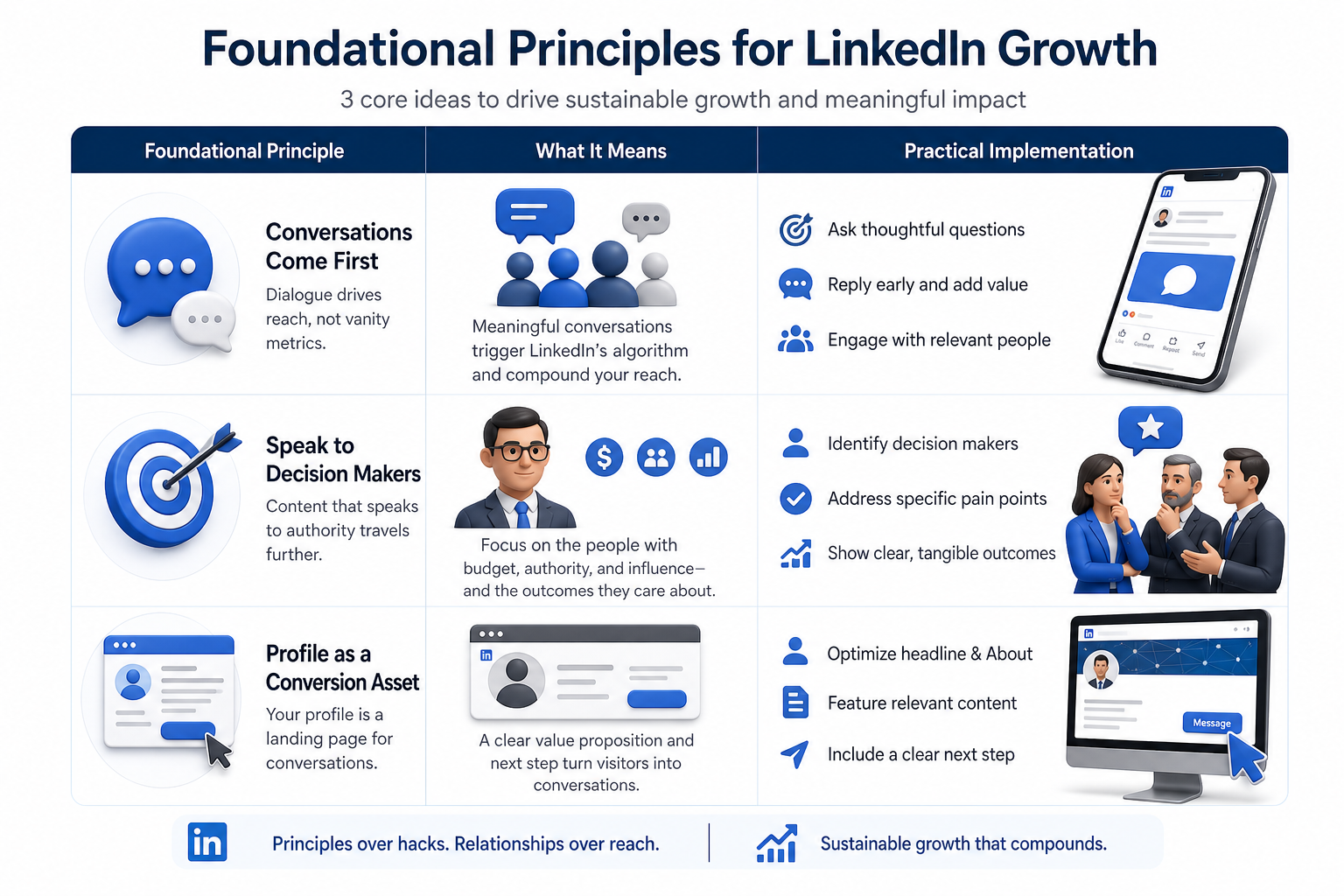
Foundational principles shape sustainable LinkedIn growth tactics that scale beyond a single viral post. At the core is the idea that conversations fuel reach more reliably than vanity metrics. When you design content to spark thoughtful dialogue in the early hours after posting, you unlock organic distribution that compounds over time. This approach shifts the goal from chasing likes to cultivating meaningful interactions that LinkedIn recognizes as genuine engagement.
The second pillar is speaking to decision makers. Content that speaks directly to the people who hold budget, authority, and influence tends to travel farther and faster. By articulating clear value, identifying specific pain points, and demonstrating tangible outcomes, you position yourself as a credible partner rather than a generic authority. This focus helps you build a trusted audience of potential collaborators, clients, or employers who are primed to move from awareness to action.
The third foundational idea is treating your profile presence as a conversion oriented asset. A profile is not only a showcase of credentials; it is a landing page that converts visitors into conversations. When the headline, About section, and featured content align with your target audience and a clear next step, you reduce friction and accelerate the path from impression to inquiry.
| Foundational Principle | What It Means | Practical Implementation |
|---|---|---|
| Conversations First | Prioritize posts that invite discussion and evolve into ongoing dialogue. Early conversations signal the algorithm to broaden reach. |
|
| Audience is Decision Makers | Content should speak in the language of the people who can authorize, fund, or deploy what you offer. |
|
| Profile as a Conversion Asset | Your profile acts as a dedicated landing page that converts curiosity into inquiry. |
|
These principles work together to create a durable growth loop. When you start conversations, you attract attention from the right people. Those decision makers visit your profile and see a compelling, conversion oriented presence. They follow up, engage, or reach out, creating a steady rhythm of referrals and opportunities. Over time, this disciplined approach compounds, turning steady, purposeful activity into durable growth rather than sporadic spikes.
Actionable quick wins to embed these principles this week:
- Conversations you can start today: post with a concise insight and end with a question your ICP would answer.
- Decision maker focus exercise: rewrite the first sentence of your last three posts to address a specific pain point faced by your ICP.
- Profile audit checklist: ensure your headline states who you help and the outcome, your About section includes a brief proof narrative, and your Featured section highlights one case study and one resource.
Adopting these foundational principles creates a durable framework for LinkedIn growth tactics that scale. By centering conversations, targeting decision makers, and treating your profile as a conversion asset, you set up a predictable path from visibility to relationships that last.
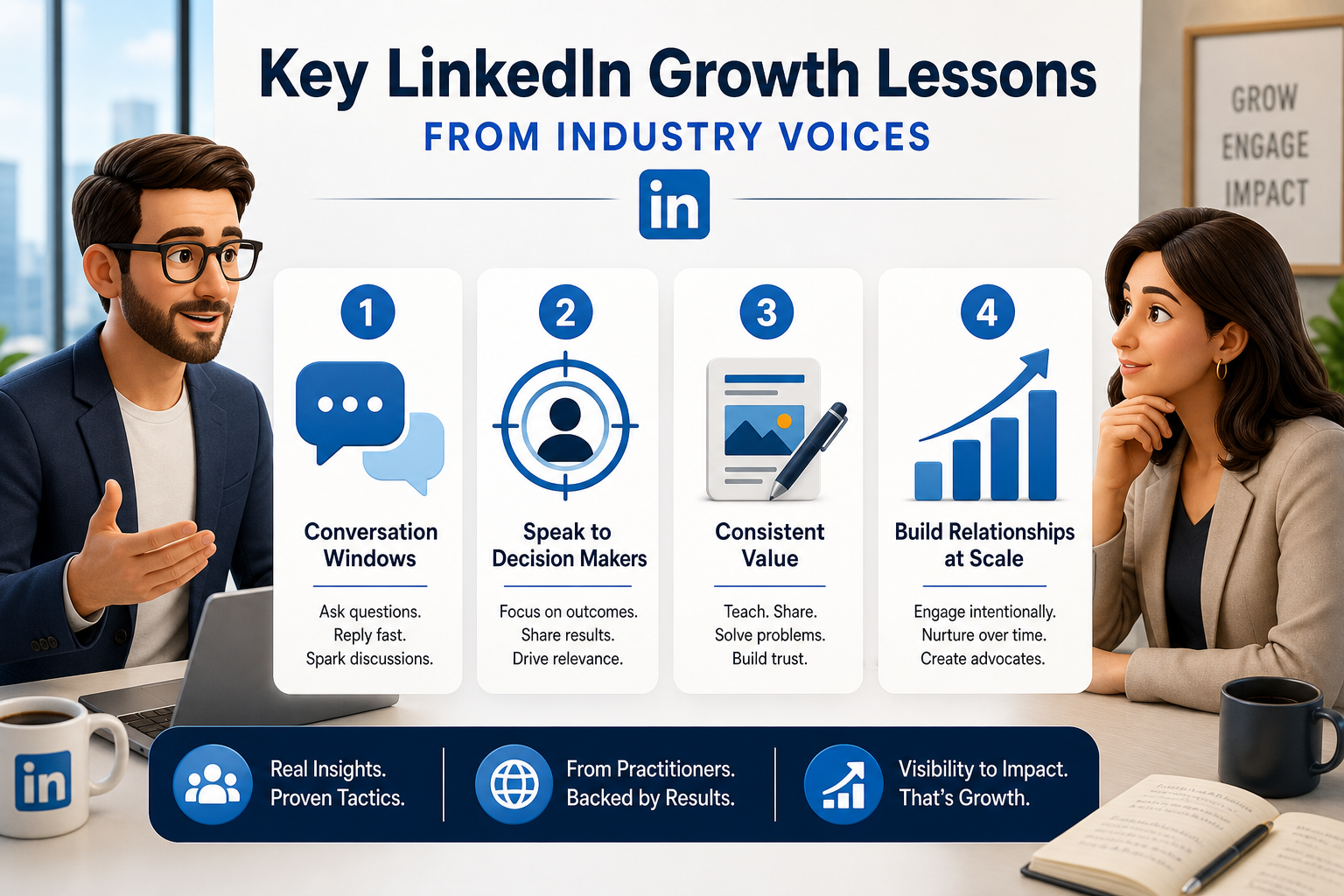
Key LinkedIn Growth Lessons from Industry Voices
Real world insights from seasoned practitioners and global brands illuminate practical pathways for LinkedIn growth tactics. The following lessons surface from observed outcomes, tested strategies, and candid reflections from experts who consistently turn visibility into meaningful relationships. These points ground growth in experience rather than hype.
Real world insights from seasoned practitioners and global brands illuminate practical pathways for LinkedIn growth tactics. The following lessons surface from observed outcomes, tested strategies, and candid reflections from experts who consistently turn visibility into meaningful relationships. These points ground growth in experience rather than hype.
Lesson 1: Conversation windows drive scale
Industry voices repeatedly emphasize that the first hours after posting determine whether content will gain traction. The logic is simple: LinkedIn tests your post with a small audience to see who engages in conversation. When readers leave thoughtful comments, the algorithm broadens distribution. This is why many successful practitioners end posts with a compelling question and respond rapidly to replies.
Real world examples:
- An early post by a longtime creator sparked a cascade of comments by ending with a relatable prompt, then achieved sustained reach as each reply invited further discussion.
- Seasoned professionals who respond within minutes to comments consistently see higher-quality conversations, not just more likes.
Lesson 2: Speak to decision makers, not the choir
Voices across the industry echo the importance of crafting content for the people who can authorize, fund, or implement solutions. When posts describe concrete outcomes, quantified results, and actionable takeaways relevant to executives, they travel farther and faster.
Real world examples:
- Thought leaders who foreground ICP pain points and tie content to real business impact tend to attract followers who convert into inquiries and collaborations.
- Posts that avoid internal jargon and speak in the reader’s language tend to resonate more with decision makers who skim for clarity and ROI.
Lesson 3: Your profile is a credible landing page
Across industry case studies, profiles that clearly state who is helped, the problem solved, and the next steps convert curiosity into conversations. A strong headline, a compelling About section, and a curated Featured shelf build trust and create opportunities.
Real world examples:
- Profiles that showcase measurable outcomes and a straightforward CTA in the About section tend to convert profile views into messages.
- High quality imagery and a cohesive visual identity reinforce credibility and align with the content audience expects to see.
Lesson 4: Build a repeatable content engine
Founders and creators favor systems over one-off posts. A repeatable process for turning everyday conversations into multiple post formats keeps content flowing without burnout.
Real world examples:
- Capturing learnings from client calls and repurposing them into a mix of text posts, short videos, and carousels creates a steady pipeline of content ideas.
- Batch creation and an ideas backlog enable steady publishing without last minute scrambling.
Lesson 5: Use diverse formats to sustain attention
Industry voices advise mixing formats to keep feeds engaging and to learn what resonates with the audience.
Real-world examples:
- Teams that rotate through three or four formats per week report stronger engagement patterns and a broader reach across segments.
- Carousels that distill a concept into scannable steps often outperform long form in initial impressions, especially for busy decision makers.
Lesson 6: Build authentic leadership through point of view
Thought leaders consistently emphasize that a clear, distinctive point of view creates a moat. When you state your stance, share your decision process, and reveal practical methods, your content becomes memorable and credible.
Real-world examples:
- Voices that openly discuss disagreements with standard industry wisdom attract engaged audiences who want to hear more about the reasoning behind the stance.
- Content that demonstrates a process, including what worked and what did not, tends to attract followers who value transparency and practical guidance.
Lesson 7: Measure what matters, then adapt quickly
Top practitioners balance attention with targeted metrics and a readiness to pivot. They monitor conversations, relevance, and qualitative signals alongside vanity metrics to steer the strategy toward durable results.
Real world examples:
- Focusing on data that shows which topics spark meaningful dialogue helps shift effort to high-impact themes.
- Adjusting the content plan by dropping underperforming formats and doubling down on successful ones supports steadier growth over time.
Lesson 8: Elevate collaboration and social proof
Collaborating with peers, partners, and credible voices builds social proof and broadens reach. Co-authored posts, joint live sessions, and featuring client experiences increase trust and bring in fresh perspectives.
Real world examples:
- Joint content that taps into complementary audiences tends to bring in new followers who are already receptive to the value offered.
- Showcasing client stories or partner successes provides credibility and tangible evidence of outcomes.
Practical takeaways from industry voices
| Aspect | What industry voices advise | Actionable steps |
|---|---|---|
| Conversation windows | Lead with a question, respond quickly, prioritize meaningful dialogue over vanity metrics. |
|
| Audience targeting | Address decision makers with clear value and outcomes. |
|
| Profile optimization | Profile is a conversion asset that supports the post narrative. |
|
| Content engine | Turn everyday work into a repeatable content flow across formats. |
|
| Format diversity | Combine text, video, carousels, and visuals to sustain interest. |
|
Across these industry voices, the through line is clear: growth on LinkedIn comes from purposeful, repeatable actions that prioritize real conversations, targeted messaging, and a credible presence. By integrating these lessons into your Linkedin Growth Tactics playbook, you can translate visibility into relationships, opportunities, and lasting momentum.
Try this quick synthesis exercise:
- Pick two lessons you want to own this month and write a 2 minute video outline for each.
- Rewrite your next three posts to address a specific decision maker and include a measurable outcome.
- Audit one profile and one post against the lessons above, noting gaps and quick wins.
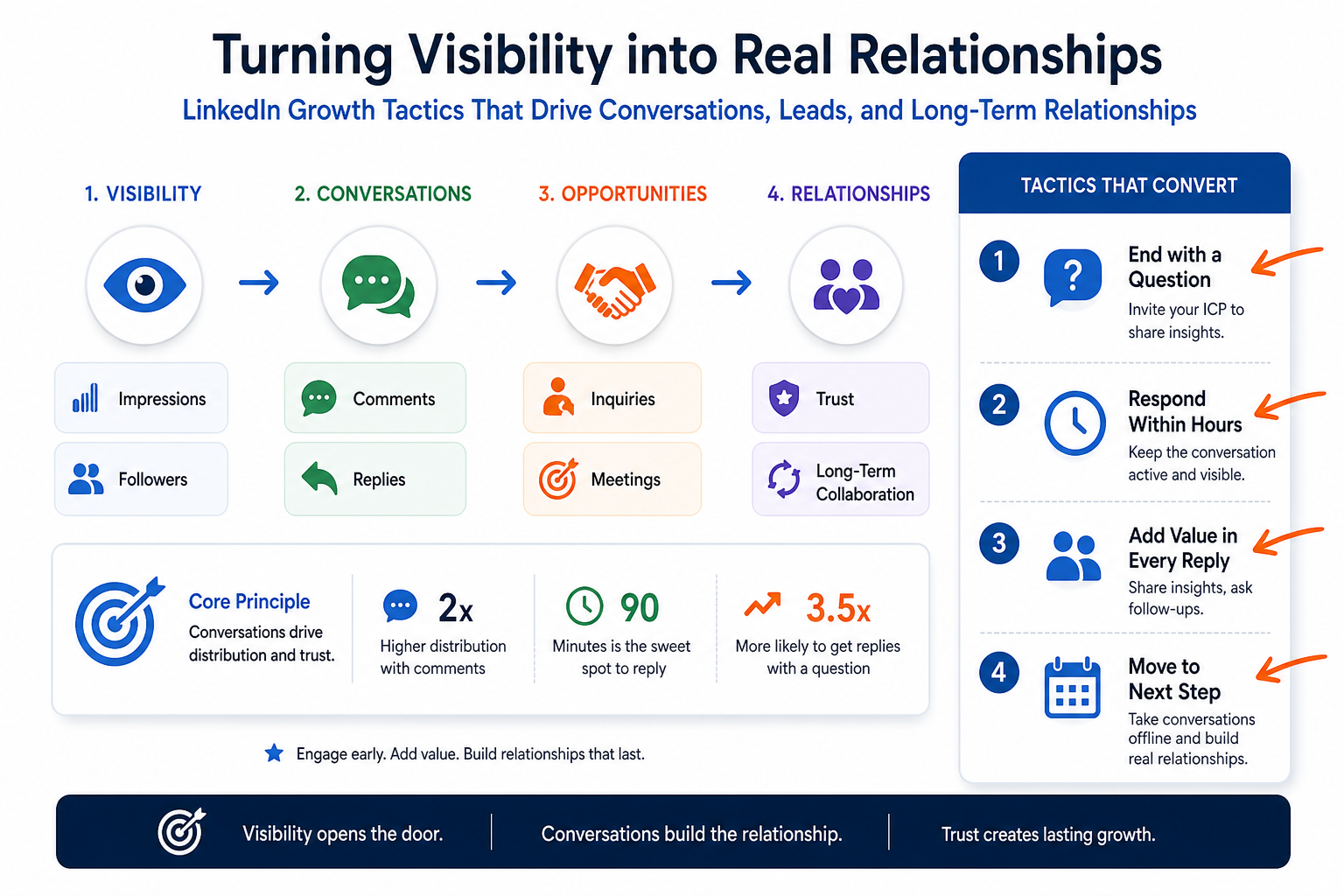
Turning Visibility into Real Relationships with Trusted Tactics
Turning Visibility into Real Relationships with Trusted Tactics
Building durable relationships on LinkedIn starts with moving beyond vanity metrics and into conversations that matter.
Impressions and followers are useful signals, but the true value appears when those signals translate into inquiries, opportunities, and ongoing collaboration. The most effective growth playbooks treat visibility as the entry point for trust, clarity, and measurable outcomes. Below is a practical framework drawn from proven methods and real world data to help you convert visibility into lasting relationships.
Core principle: conversations drive distribution
The first hours after you publish are a gate. LinkedIn evaluates early engagement to decide how broadly to share your content.
Posts that spark thoughtful comments tend to receive a wider distribution, while posts that end with a question routinely invite replies. Responding quickly sustains momentum and signals the algorithm that the conversation is active.
| Mechanic | Why it matters | Recommended action |
|---|---|---|
| End with a question | Encourages comments and jumpstarts conversation | Close posts with a specific prompt for your ICP and related decision points |
| Respond within hours | Keeps dialogue lively and signals engagement to the algorithm | Aim for a rapid first reply and maintain timely follow ups |
| Highlight top insights in follow ups | Extends the conversation beyond the initial post | Create a second post that synthesizes comments into concrete takeaways |
Turn impressions into conversations with a clear value narrative
Content that speaks directly to a decision maker’s pain and outcome increases the chances that someone will engage and move from impression to inquiry.
When your message clearly articulates the problem, the impact, and the path to a solution, you position yourself as a credible partner rather than a generic advisor.
- Audience targeting: Write for ICPs who hold authority to decide, fund, or deploy your solution. Use concrete outcomes and real world metrics your audience cares about.
- Problem to payoff framing: Present a tangible outcome early in the post to create anchors for the reader.
- Clear CTA path: Include a direct next step, such as a short discovery call, a resource download, or a request for a conversation.
Profile optimization as the conversion surface
Your profile acts as a dedicated landing page that converts attention into conversations. A cohesive, conversion oriented profile reduces friction and accelerates the path from view to inquiry.
| Profile Element | Conversion role | Best practices |
|---|---|---|
| Headline | States who you help and the outcome you deliver | Use a clear value proposition and target audience keywords |
| About section | Proof of impact plus a direct CTA | Include measurable results, context, and a single, specific next step |
| Featured | Credibility signals through case studies and resources | Highlight one client success and one practical resource |
In addition, a professional, approachable profile photo and a cohesive banner reinforce credibility. When visitors can quickly answer who you help, what problem you solve, and what to do next, they are more likely to initiate a conversation.
Build a repeatable content engine to sustain momentum
A content engine turns everyday work conversations into a steady stream of post ideas across formats. The goal is to capture insights from calls, emails, and messages and transform them into multiple posts that educate, illustrate outcomes, and show the process.
| Engine Element | What it yields | Practical steps |
|---|---|---|
| Idea capture | A backlog of topics aligned with ICP pains | Keep a running list in a notes app; capture client wins and insights |
| Batch creation | Consistency without burnout | Block time weekly to write and design across formats |
| Format mix | Engagement across different reader styles | Plan text posts, short videos, carousels, and infographics in rotation |
A strong content engine compounds its impact. The more you publish with intention, the more your target audience sees you as a knowledgeable resource. That visibility shortens the distance from awareness to outreach.
Measure what matters and adapt quickly
Smart growth requires a balance of qualitative signals and focused metrics. Track conversations, relevance, and the quality of interactions in addition to vanity metrics. Use data to guide which topics to deepen and which formats to expand.
| Metric Type | What to monitor | Action if signals are weak |
|---|---|---|
| Conversation quality | Depth of comments, relevance, and follow up questions | Revise hooks and CTAs to target ICP pain points more precisely |
| Format effectiveness | Engagement and sustained reach across formats | Shift emphasis toward the formats with higher resonance |
| Profile conversion rate | Visits-to-conversations ratio | Refine headline, About, and CTA if conversions lag |
Practical takeaway: pair attention with action. For example, a post that ends with a clear request for a 15 minute discovery call can convert curious readers into booked conversations, especially when the profile reinforces the value proposition and next steps.
Scale relationships through collaboration and social proof
Relationships deepen when you invite collaboration and feature credible voices. Co authored posts, joint live sessions, and stories from clients amplify trust and broaden reach. These tactics expand your audience with highly qualified followers who are primed for the value you offer.
| tactic | Benefit | Examples to try |
|---|---|---|
| Joint content with partners | Cross pollinates audiences and adds credibility | Co authored posts, partner case studies, or shared case webinars |
| Client stories in your feed | Demonstrates real outcomes and builds trust | Feature a client win with measurable impact and a quote |
| Live sessions | Interactive engagement and immediate feedback | Host a LinkedIn Live with a partner and field questions from both audiences |
By combining these trusted tactics, you convert visibility into conversations, conversations into leads, and leads into long term relationships. The path is repeatable, data informed, and scalable when you align your content engine with a clear target audience, a credible profile, and collaborative social proof.
Quick start checklist:
- Review and tighten your profile headline, About section, and Featured blocks to reflect a precise ICP and measurable outcomes.
- End every post with a specific question and a clear next step tailored to decision makers.
- Build a weekly content batch that rotates through text, video, and carousel formats.
- Identify one potential partner or client to feature in a collaborative post or live session this month.
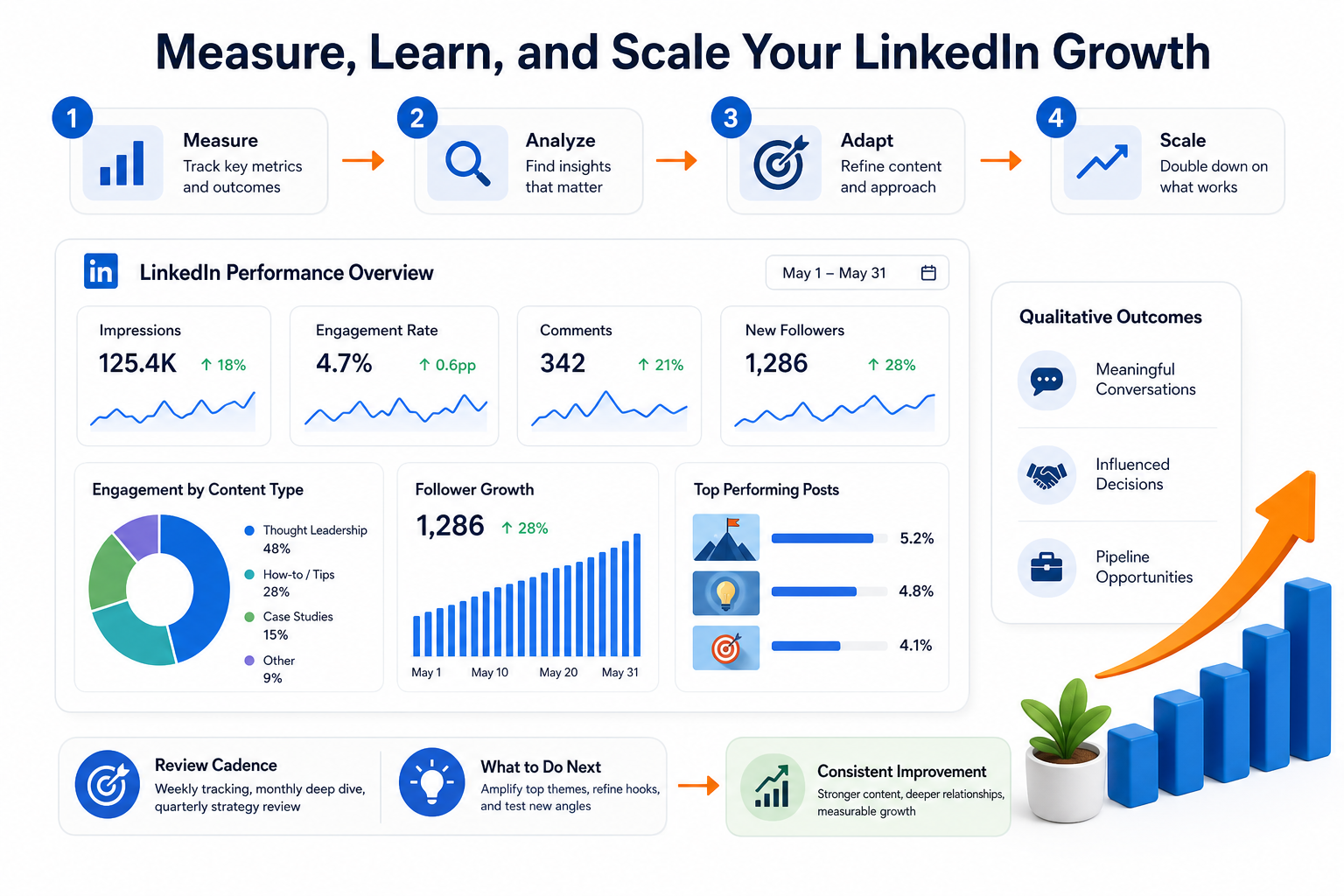
Measuring Impact and Scaling Your LinkedIn Efforts
Measuring impact on LinkedIn goes beyond vanity metrics to reveal how your content shifts understanding, interest, and action among your target audience.
A disciplined approach combines quantitative signals such as engagement and reach with qualitative outcomes like conversations, influenced decisions, and real opportunities. When you integrate these insights into a regular review cadence, you can scale your LinkedIn efforts with confidence and clarity.
Key engagement metrics and what they mean
Engagement metrics help you gauge resonance and intent.
Read them with a structured lens to interpret them and avoid chasing numbers in isolation.
| Metric | What it signals | How to optimize |
|---|---|---|
| Impressions / Reach | How broadly your content is viewed; early indicator of potential distribution | Refine targeting in the hook and opening lines; test clear ICP alignment in the first 1 to 2 sentences |
| Engagement rate (comments, likes, shares per impression) | Quality of resonance and willingness to interact | Craft prompts that invite thoughtful responses; reduce filler and increase clarity around a single outcome |
| Comments and conversation depth | Quality signals about relevance and potential for deeper relationships | End posts with a specific question for decision makers; respond promptly with value-added replies |
| Saves | Internalization and future reference; signals practical value | Provide actionable takeaways and downloadable resources to encourage saving |
| Click-throughs from posts | Interest in deeper content or next steps | Pair posts with a clear CTA and relevant landing pages or resources |
| Follower growth rate | Growing audience size and potential reach over time | Balance quality and quantity; nurture inbound followers with consistent value and profile alignment |
Qualitative outcomes that matter
Qualitative outcomes capture the real world impact of your LinkedIn presence.
Track signals that indicate trust, credibility, and opportunity beyond metrics.
- Inquiries and discovery conversations: Number and quality of messages requesting a call or proposal.
- Partnerships and collaborations: Joint webinars, guest articles, or co authored content with credible peers.
- Client or project opportunities: Leads converted to opportunities or closed deals attributed to LinkedIn activity.
- Brand lift signals: Increases in direct traffic to related content, mentions in conversations, or referrals from mutual connections.
Measuring impact over time
Adoption of a time horizons approach helps separate short term fluctuations from durable progress.
Tracking signals weekly, monthly, and quarterly keeps you oriented toward lasting outcomes and steady improvement.
- Weekly pulse: Review impressions, engagements, saves, and comments. Note any shifts in topics or formats that sparked momentum.
- Monthly assessment: Analyze follower growth quality, inquiry rate, and content mix performance. Identify top three themes driving conversations.
- Quarterly attribution review: Map content to outcomes such as discovery calls, partnerships, or project opportunities. Estimate rough contribution to revenue or pipeline where possible.
Adaptive strategy framework
Use a lightweight experimentation loop to continuously refine your approach. A simple framework can be used every sprint.
Implement small tests, learn from results, and adjust your plan accordingly to stay aligned with objectives.
| Phase | What you do | Output |
|---|---|---|
| Hypothesis | Formulate a clear assumption about what content, format, or hook will drive a specific outcome for ICPs. | 1 to 2 sentence statement plus a measurable goal (e.g., increase comments by 20 percent). |
| Test design | Select one variable to change at a time (hook, format, CTA, posting time) and keep others constant. | Specifically defined post or mini campaign with a control reference. |
| Data collection | Track the chosen metrics for a fixed window (e.g., 7 to 14 days) and collect qualitative notes from comments. | A compact results sheet summarizing lift, learnings, and next steps. |
| Decision | Decide whether to amplify, adjust, or pivot based on results and ICP impact. | Actionable plan for the next sprint with updated hypotheses. |
A practical quick-start for measuring impact
- Define three ICP aligned outcomes you want to move this quarter (for example, discovery calls, partnerships, or inbound inquiries).
- Set a weekly reporting habit that includes top three posts by engagement and any notable qualitative signals from comments.
- Implement a lightweight attribution method such as asking new inquiries how they found you or which post influenced their decision to reach out.
Scaling your LinkedIn efforts hinges on turning data into action. By balancing quantitative signals with qualitative outcomes and maintaining a disciplined review cadence, you can refine your approach, extend reach with purpose, and progressively convert visibility into valuable relationships.
Keep the cadence steady and act on what you learn. Regular reflection helps you spot winning formats and refine messaging over time.
Quick reference checklist
Use this snapshot to stay on track and test ideas quickly.
- Review engagement trends and identify the top three performing formats each month.
- Track inquiries and opportunities attributed to LinkedIn conversations, not just post views.
- Maintain a monthly plan for content experiments and document the results.
- Align profile updates with evolving ICP needs and demonstrate tangible outcomes.
Review results each month and adjust your plan to keep evolving with your audience.
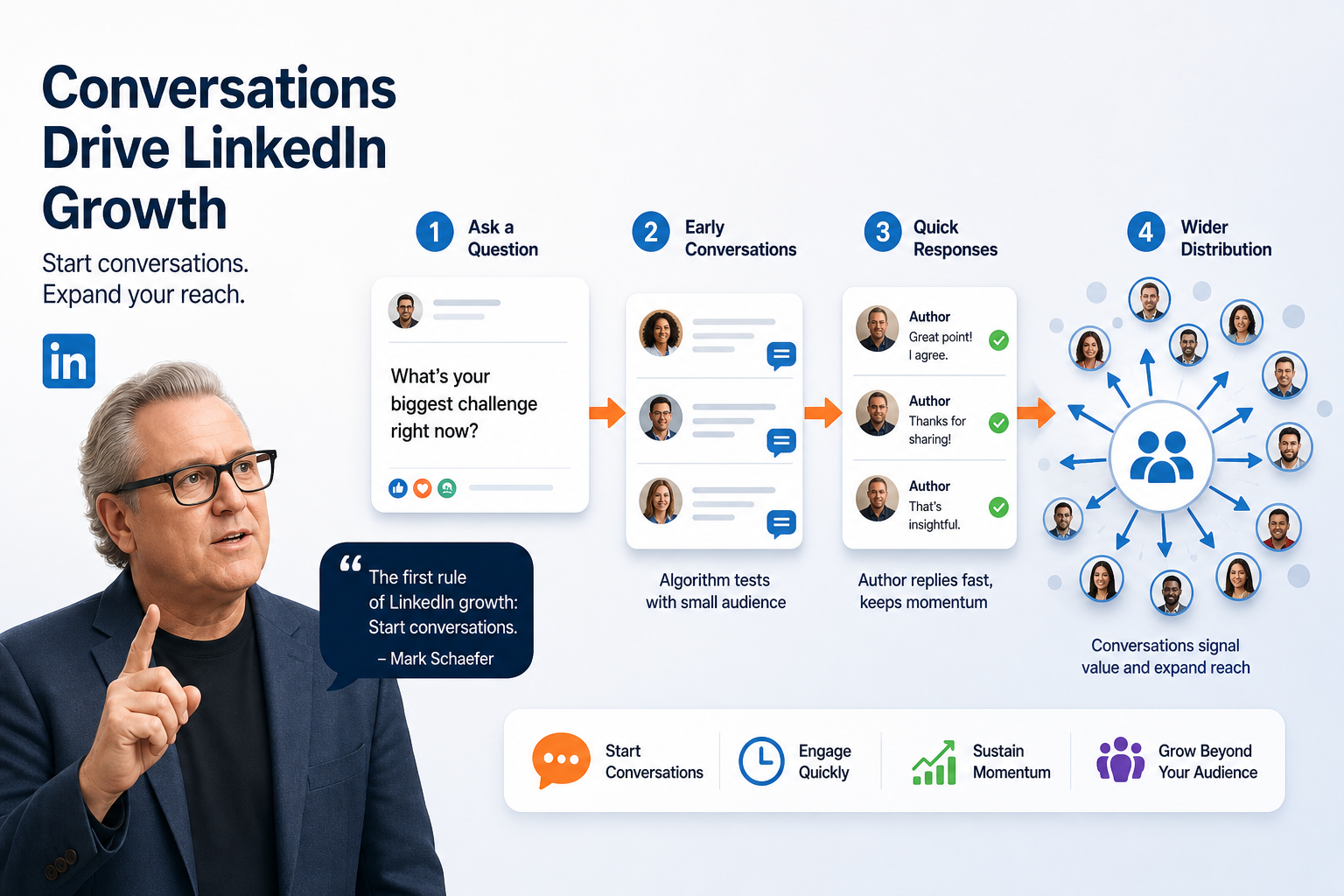
Mark Schaefer — The First Rule of LinkedIn Growth: Start Conversations
Mark Schaefer emphasizes that the engine of LinkedIn growth is conversations, not vanity metrics. He argues that reach on the platform expands when posts inspire meaningful dialogue, especially in the hours immediately after publishing. The logic is straightforward: LinkedIn tests a new post with a small audience to see if there are thoughtful responses.
A post that sparks genuine conversations signals the algorithm to distribute to a wider group of followers. In practice this means prioritizing prompts that invite replies, and then actively engaging in the discussion. Schaefer notes that the best way to ignite these conversations is to end posts with a question or a point that invites reflection from the reader.
Quick responses are a critical multiplier. When authors reply promptly, they sustain momentum, keep the conversation alive, and signal to LinkedIn that the discussion is active. This rapid engagement compounds over time, increasing the likelihood that the post is shown to additional audiences beyond the initial testers.
The takeaway is clear: conversations are the true growth lever on LinkedIn. Rather than chasing likes or shares in isolation, focus on generating and sustaining thoughtful dialogue in the early moments after posting. This approach creates a ripple effect that can push a post beyond the original audience and into broader visibility.
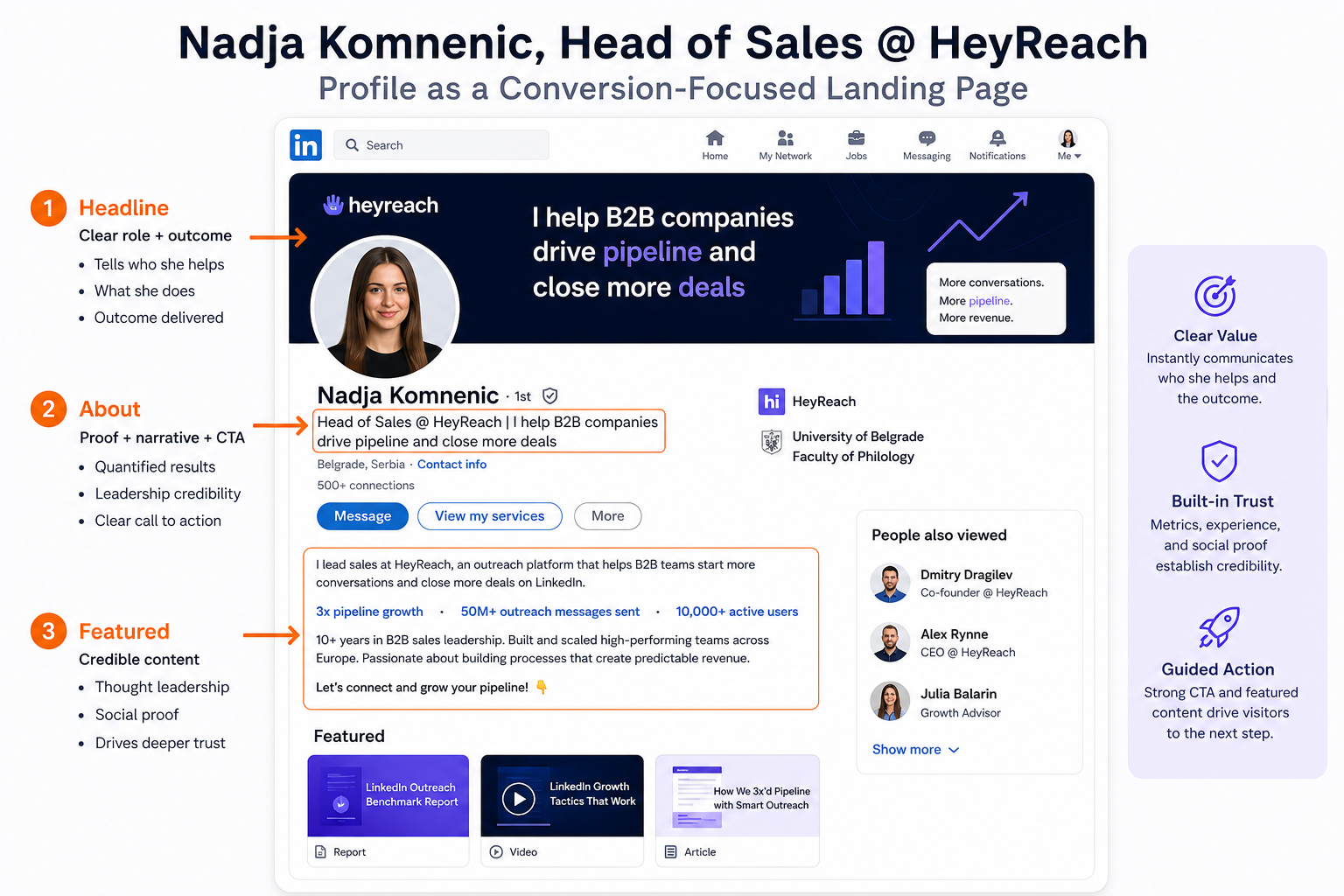
Nadja Komnenic, Head of Sales @ HeyReach — Profile as a Conversion-Focused Landing Page
This section highlights how a profile can be crafted to function like a dedicated conversion surface. By ensuring the headline, About section, and Featured content work in harmony, visitors move from curiosity to conversations with clarity and confidence.
Headline that communicates what she does and the outcome
A strong headline on this profile clearly states who is helped and the outcome delivered. The example demonstrates a concise value proposition that signals authority and relevance to the target audience in a single glance.
- Structure: A crisp statement of role, core focus, and the impact achieved for customers or partners.
- Clarity: Avoids jargon and uses outcome-focused language that decision makers recognize and trust.
- Keywords: Integrates audience-facing terms that a prospective connection would search for or identify with.
About section with proof and a clear CTA
The About section should read as a compelling narrative that proves capability and guides the reader toward the next step. In this example, the About area includes concrete metrics and credentials that establish credibility and finish with a direct call to action.
- Proof points: Mention quantified outcomes, leadership experience, and track record to date.
- Narrative focus: Speak to the decision maker’s needs, outline the problem solved, and illustrate the pathway to success.
- CTA: End with a specific, low-friction next step such as scheduling a brief discovery call or downloading a resource.
Example proof language drawn from the profile concept includes references like revenue growth numbers, founder experience, and notable appearances, all tied to real business impact. The CTA invites the reader to take the next step in a direct, unambiguous way.
Featured section directing to credible content
The Featured shelf should curate high value content that reinforces credibility and demonstrates practical outcomes. In this approach, the featured items point toward credible content such as case studies, win stories, or practical resources that a visitor can consume to validate the claims in the headline and About section.
- Case studies or client wins: A concise, outcome-focused case that illustrates how a problem was solved and what results followed.
- Practical resources: A downloadable or viewable resource that offers actionable steps or frameworks relevant to the ICP.
- Clear navigation: Each featured item includes a direct link and a one-line context so readers understand why it matters.
When headline clarity, proof backed by real results, and a credible featured library align with a clear CTA, the profile becomes a powerful conversion anchor. Visitors understand who Nadja helps, what outcomes are achievable, and exactly how to engage further.
Bojana Vojnović, Content Lead @ HeyReach — Rebuilding Content Strategy to Revenue KPIs
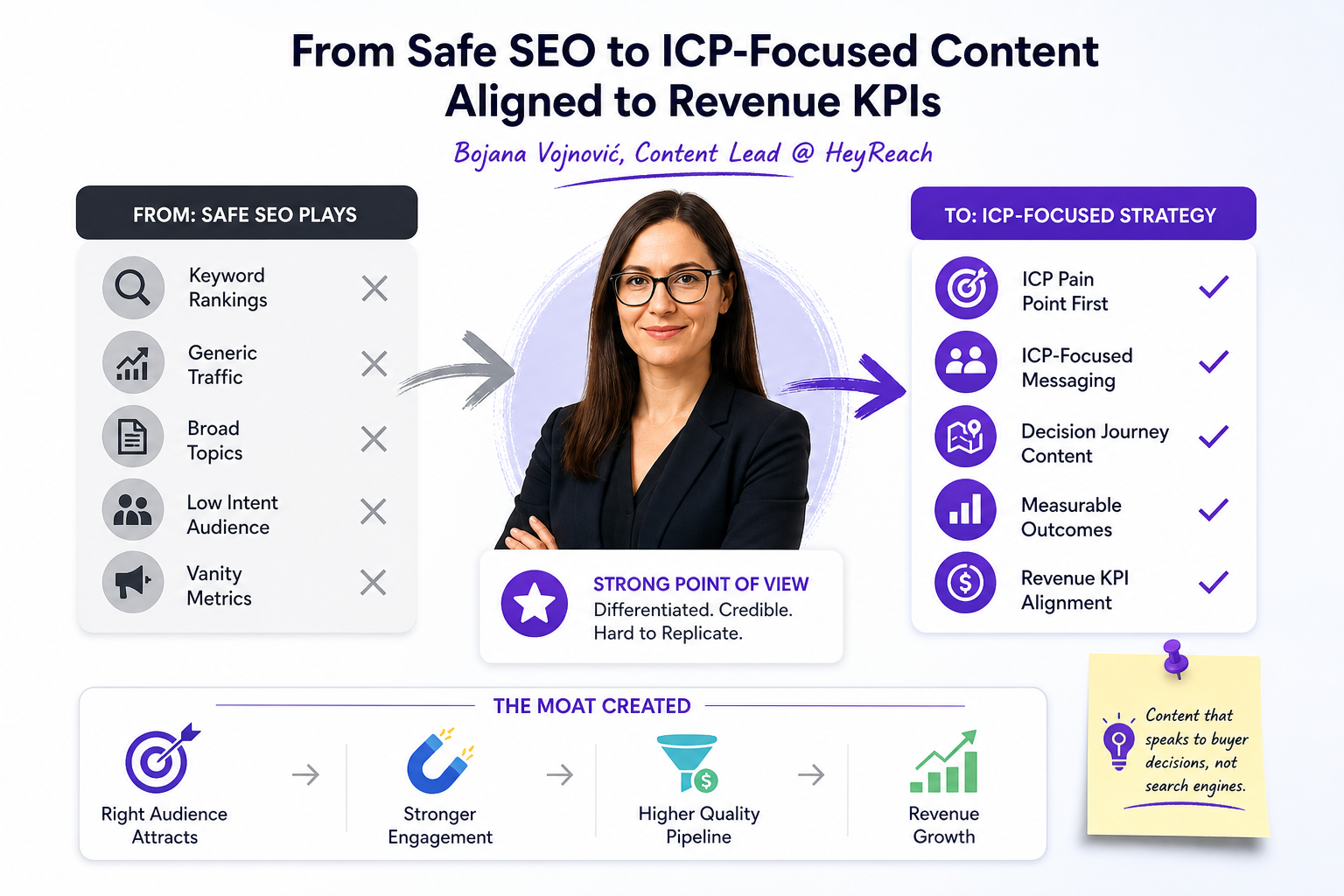
Bojana journeyed from a comfort zone built on safe SEO plays to a unit of content explicitly aligned with ICP driven revenue KPIs. Instead of optimizing for rankings and generic traffic, she reframed content around the decisions, constraints, and outcomes that matter to the people who buy and influence purchases in her target market. This shift created a durable moat around her LinkedIn presence: a clear point of view that resonates with the right audience, and messaging that speaks directly to their goals.
The core move was to articulate a distinct point of view that challenges conventional abundance of generic tactics and places greater emphasis on measurable business value. By demonstrating how specific content investments translate into pipeline and revenue, Bojana established a credible narrative that differentiates her from routine optimization chatter and positions her as a partner who understands real buyer priorities.
A practical consequence of this shift was an explicit pivot away from purely SEO driven topics to ICP oriented themes such as lead quality, cost per opportunity, and time to value. This meant content that not only informs but also moves the ICP along a decision journey with tangible milestones.
- Clear ICP focus: Each piece starts with a defined ICP pain point and a measurable outcome the reader can expect.
- Outcome driven storytelling: Posts showcase real world results with concrete numbers and credible context.
- Process transparency: Bojana shares the decision process behind content choices, including what was tested, what failed, and what landed.
Real examples underpin the moat. For instance, Bojana repurposed a client engagement debrief into a multi format sequence:
| Example Input | Content Output | KPIs and Outcome |
|---|---|---|
| Client engagement reveal from a 15 minute call |
|
Impressions up 28 percent, comments with actionable questions, and a measured increase in discovery calls by 14 percent over two weeks |
| Internal KPI review showing SEO traffic not translating to opportunities |
|
Inbound inquiries more closely aligned with ICP segments; qualified leads increased by 22 percent month over month |
The moat from a strong point of view emerged as a clear differentiator in the content landscape. By taking a stance on how to measure content success and by tying messaging to revenue outcomes, Bojana created a recognizable voice that influencers, peers, and ICPs could trust. This approach discourages generic engagement chasing and instead fosters purposeful conversations with the right buyers.
To operationalize this mindset, Bojana implemented a three pillar framework:
- Pillar 1: ICP led value stories that quantify potential outcomes and provide a credible ROI narrative.
- Pillar 2: Evidence backed content with documented outcomes, client context, and explicit next steps.
- Pillar 3: Transparent testing logs that reveal why certain formats work better for ICPs and how results were measured.
The result is a LinkedIn content engine that not only attracts attention but also demonstrates a clear path from content consumption to opportunity creation. This strategy builds resilience against algorithmic volatility by maintaining relevance to decision makers and maintaining a steady drumbeat of revenue aligned messaging.
Actionable quick wins inspired by Bojana’s approach:
- Identify three ICP pain points with measurable outcomes and craft one post per point that demonstrates a concrete ROI effect.
- Transform one successful client engagement into a short, data rich case study post with a simple CTA for a discovery call.
- Archive three SEO heavy topics that do not clearly connect to ICP revenue KPIs and replace them with revenue KPI driven narratives.
Diandra Escobar, Content Marketing Strategist — Speaking to Founders and Marketers with Direct Solutions
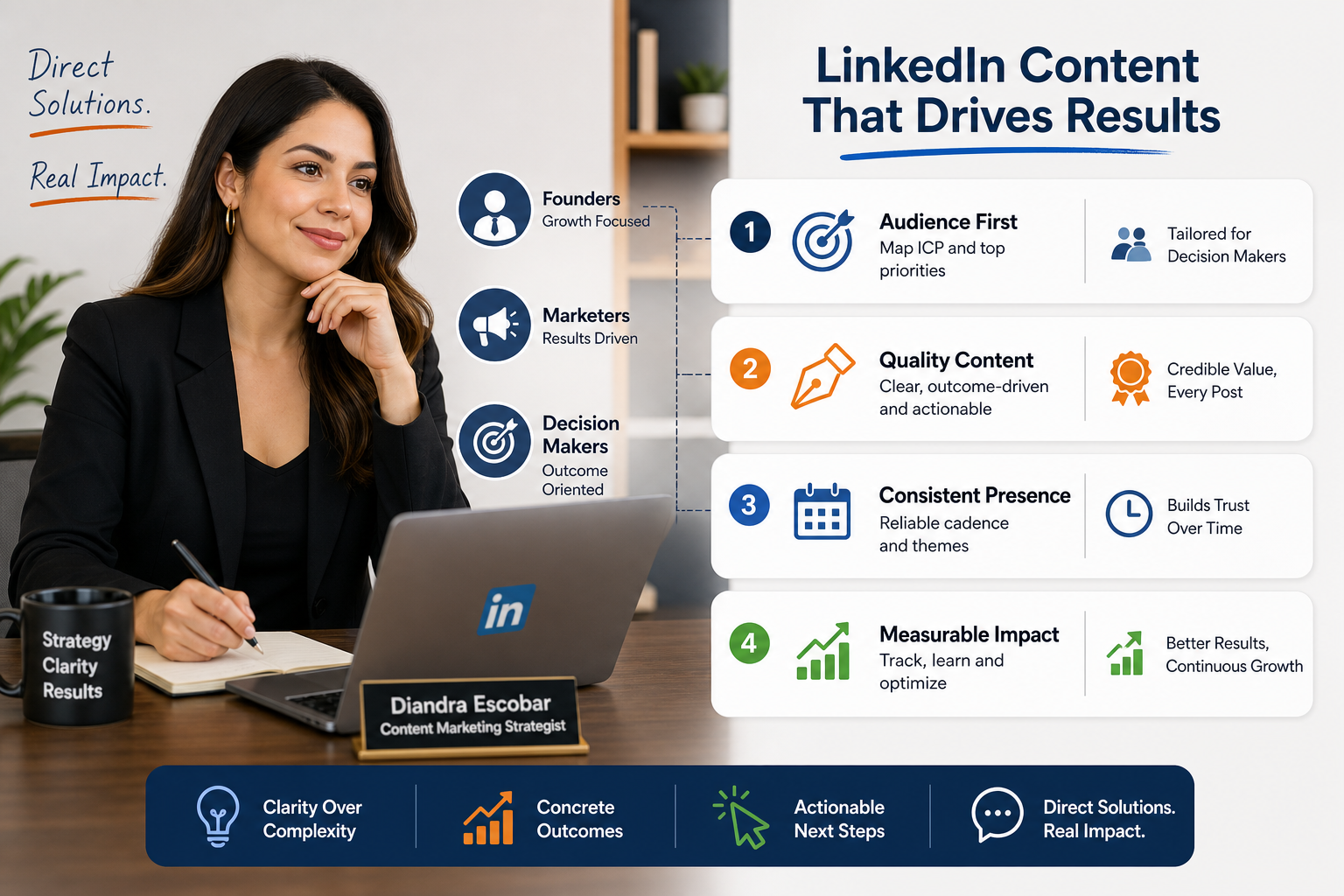
We approach LinkedIn content with a founder and marketer mindset, recognizing that decision makers want clarity, practicality, and immediate relevance. As a Content Marketing Strategist, I tailor every post so it speaks directly to founders and marketing leaders who are responsible for growth, budgets, and outcomes. The core idea is to move beyond generic tactics and deliver messages that feel tailor made for their context.
My method starts with a precise audience lens. I map each post to a specific ICP, identify their top priorities, and surface the exact outcomes they care about. Rather than chasing broad appeal, I focus on crafting language that resonates with the daily realities of decision makers, such as time constraints, resource limitations, and the need for tangible ROI.
On content quality, I treat every post as an opportunity to demonstrate credible value. I prioritize:
- Clarity over complexity: I avoid industry slang and unnecessary jargon, choosing direct, outcome oriented language that a founder can grasp in seconds.
- Concrete outcomes: I anchor ideas with measurable results, real world examples, and practical takeaways that leaders can apply immediately.
- Actionable next steps: Each post ends with a clear, low friction CTA that aligns with the reader’s decision making process, such as scheduling a short discovery call or reviewing a valuable resource.
Consistency is the backbone of credible messaging. To prevent content from fading into the noise, I design a repeatable cadence and a content engine that turns everyday work into multiple publishable formats. This ensures founders and marketers see a dependable stream of insights rather than sporadic bursts of ideas.
Instead of generic content, I emphasize three pillars that keep posts useful and differentiating:
- Specificity: I name the exact problems and tie them to concrete, practical remedies that leaders can verify in their own context.
- Process transparency: I share decision processes behind content choices, including what worked, what failed, and why a particular approach landed with the ICP.
- Audience alignment: I continually refine the messaging to reflect the priorities of founders and marketers who control budgets and strategic direction.
A memorable example is a post built from a real client scenario where I unpacked a common hurdle for CEOs and marketing leads. The piece translated high level concepts into a step by step plan with quantified impact, followed by a direct invitation to connect for a tailored discussion. The result was a steady stream of high quality comments and messages from decision makers who saw a clear pathway to applying the guidance.
If you want to emulate this approach, start with these practical steps:
- Define the decision maker you are speaking to: articulate their role, their primary KPI, and the one outcome that would justify a next step.
- Lead with a core challenge and a crisp solution: present a problem followed by a concrete remedy that can be implemented today.
- Close with a precise CTA: invite a discovery chat, a short assessment, or access to a targeted resource that directly supports their goals.
By centering the audience, maintaining quality, and avoiding generic chatter, we create LinkedIn content that founders and marketers not only notice but act on. This is how we transform visibility into meaningful conversations and measurable outcomes.
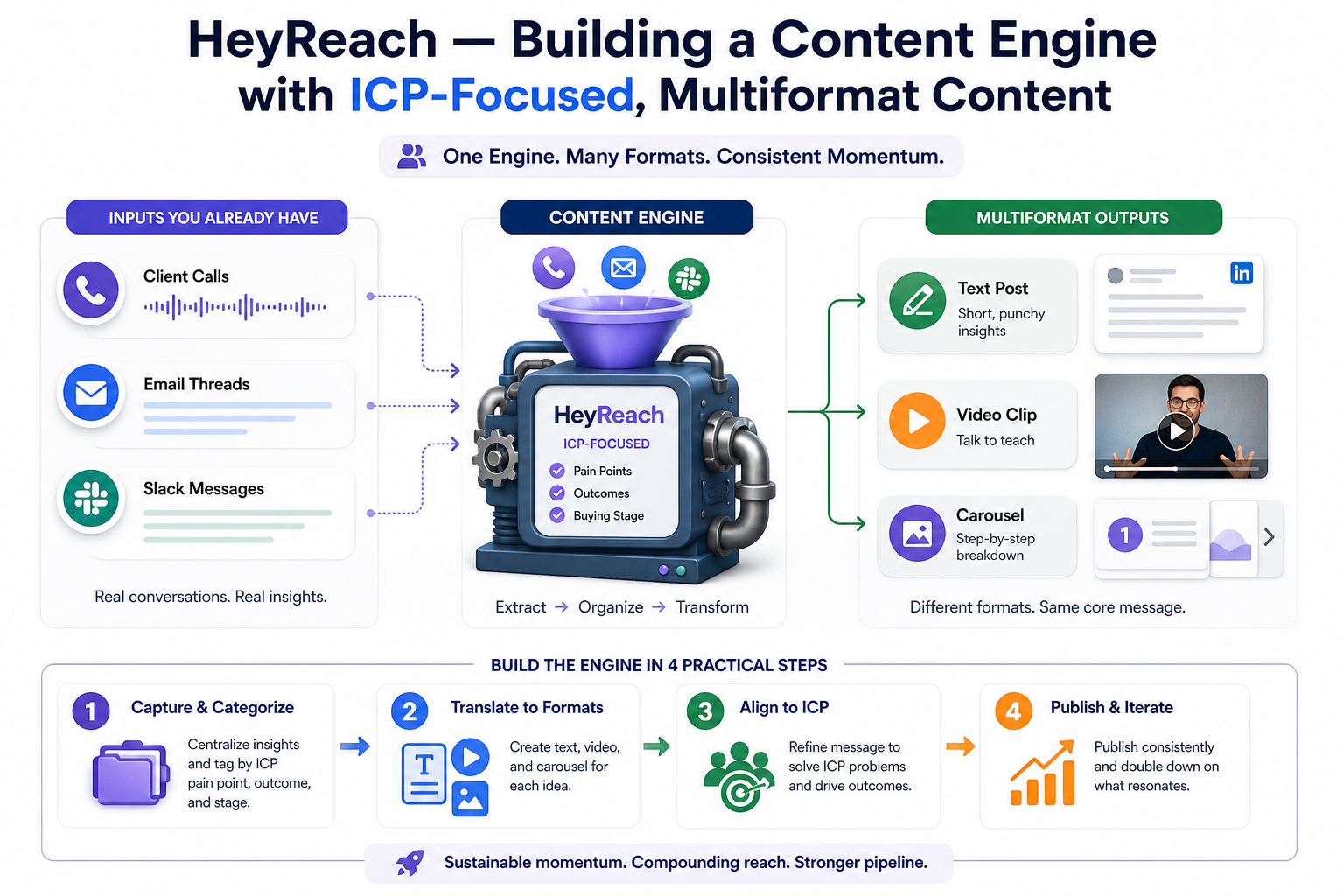
HeyReach — Building a Content Engine with ICP-Focused, Multiformat Content
A well-tuned content engine keeps momentum alive without forcing you to reinvent ideas each week. The core concept is simple: extract value from everyday work conversations and translate it into a steady stream of high quality content in multiple formats. When you align this engine with your ICP, you create messages that resonate, compounding reach and relevance over time.
The inputs you already generate every day are a gold mine. Calls with clients, email threads, and Slack conversations capture real world problems, decision milestones, and outcomes. By systematically capturing and organizing these signals, you can produce a diverse set of content formats that educate, persuade, and nudge ICPs toward a next step.
The multiformat approach matters because ICPs consume information differently. Some prefer quick consumables like text posts, others engage more with short videos or carousels that break down a process. A strong content engine produces a balance of formats that signals value across reading styles and time constraints.
How to build the engine in 4 practical steps
- Capture and categorize: Create a centralized notes hub (digital notebook, wiki, or project document) where you drop insights from calls, emails, and Slack summaries. Tag by ICP pain point, outcome, and relevance to a buying stage.
-
Translate signals into formats: For each idea, draft one of each format:
- Text post that states the problem and a concrete takeaway.
- Short video (under 60 seconds) explaining the root cause and quick fix.
- Carousel that walks through steps, metrics, or a decision framework.
- Batch creation: Schedule a block of time weekly to turn collected signals into drafts across formats. This keeps momentum without burning out on daily content requirements.
-
Quality gate and feedback loop: Before publishing, run each piece through a quick ICP check:
- Does it address a concrete ICP pain point?
- Is there a measurable outcome or actionable next step?
- Is the tone aligned with ICP language and decision making?
Example of a single input flowing into multiple formats
| Source | ICP Pain Point | Outputs | Next Step |
|---|---|---|---|
| Client call debrief | Lead quality concerns and time to value |
|
Invite ICP audience to a 15 minute discovery call |
Best practices for ICP focus
- ICP alignment: Each piece should reference a specific ICP persona, their authority level, and a decision milestone.
- Outcome framing: Lead with a measurable outcome or a step toward value realization familiar to the ICP.
- Lifecycle awareness: Create content that supports awareness, consideration, and conversion stages without relying on hard selling.
Workflow checklist for your content engine
- Inputs: Collect 5 to 10 concise signals from the past week of calls, emails, and Slack threads.
- Format mapping: Assign each signal to at least two formats (one long form and one bite sized piece).
- Batch schedule: Block 2 hours for content creation, once per week, rotating through text, video, and carousel outputs.
- Publish cadence: Start with 3 posts per week across formats and adjust based on ICP engagement.
The result of a disciplined content engine is a steady rhythm of value drawn from real-world conversations. As your ICP sees repeated, relevant guidance across formats, you establish credibility and reduce friction for engagement. This approach preserves energy while amplifying impact, enabling sustained momentum rather than sporadic bursts.
Quick wins to implement this week:
- Set up a central notes hub and migrate the last month of calls, emails, and Slack summaries into it with ICP tags.
- Create a template for a 60 second video and a 4 panel carousel, then convert one signal into both formats.
- Schedule a weekly content batch block and commit to publishing three pieces in rotating formats.
By building a content engine that centers ICP needs and leverages existing conversations, you keep the momentum alive and create a scalable pipeline of actionable content that moves ICPs along their decision journey.
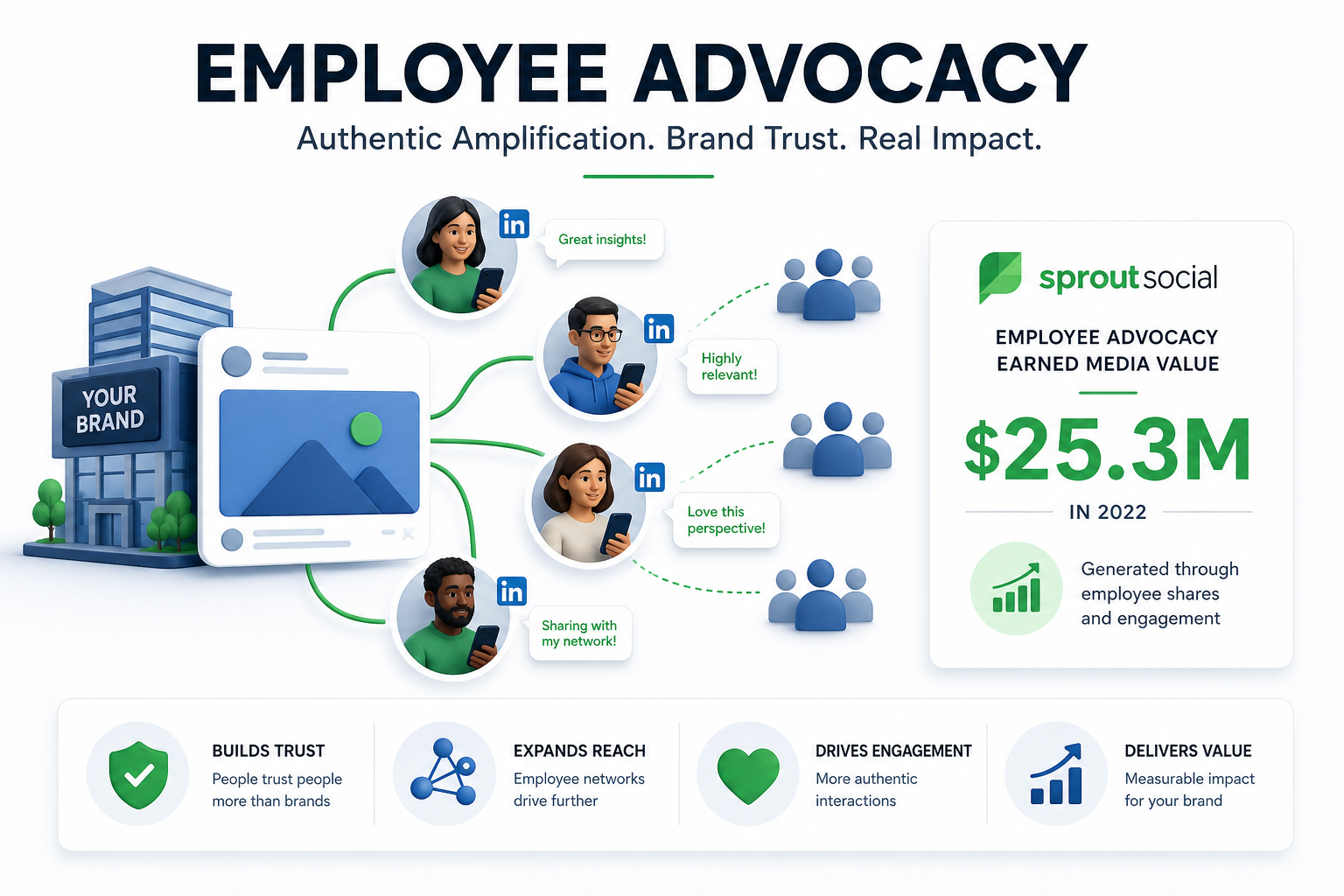
Sprout Social — Employee Advocacy and Earned Media Value
Employee advocacy acts as a strong multiplier for authentic amplification and brand trust on LinkedIn. When employees share your content, they lend credibility that external voices often cannot, creating a more trustworthy signal to audiences and to the LinkedIn algorithm. This approach shifts amplification from a marketing tactic to a collective capability, turning your workforce into a distributed content engine.
A key reason employee advocacy matters is social proof. People tend to trust recommendations from people they know more than they trust corporate messages. By empowering employees to share relevant insights, success stories, and practical guidance, you generate credible touchpoints that feel less promotional and more experiential. This fosters durable relationships with audiences who are genuinely interested in the outcomes you help achieve.
In 2022, Sprout Social highlighted the earned media value generated by employee advocacy as a meaningful indicator of impact. The figure demonstrates how authentic employee participation translates into tangible value for the brand, providing a measurable lens for teams evaluating their advocacy programs. While the exact dollar amount is contextual to campaigns and company size, the underlying takeaway remains consistent: employee voices expand reach, reinforce trust, and contribute to a broader, more credible narrative.
| Aspect | What it signals | Why it matters for LinkedIn Growth Tactics |
|---|---|---|
| Authentic amplification | Messages travel further when employees share insights from the inside perspective | Expands reach without appearing overtly promotional, increasing engagement quality |
| Credible social proof | Peer-backed recommendations reinforce trust with decision makers | Improves conversion potential from viewers to conversations and opportunities |
| Media value signals | Earned media value indicates the strategic impact of employee participation | Justifies investment in advocacy programs and informs governance and governance-friendly practices |
Practical steps to leverage employee advocacy while maintaining authenticity:
- Empower a clear, simple sharing framework: provide ready-to-share formats such as short insights, client win summaries, and practical how-tos aligned with ICP pain points.
- Offer lightweight approvals and guidelines: establish quick review processes that avoid bottlenecks while ensuring accuracy and brand safety.
- Highlight relevant outcomes and lessons: encourage employees to share real results, learnings, and customer-centric perspectives that resonate with peers and potential clients.
When designed thoughtfully, employee advocacy not only expands reach but also reinforces a culture of expertise. It helps your LinkedIn presence feel more human, credible, and trustworthy, which supports durable relationships and higher quality engagements over time.
Buffer — Best Times to Post on LinkedIn
At linqin.ai we value data driven scheduling to keep our LinkedIn visibility consistent without overextending resources. Buffer conducted a comprehensive study on the best times to post on LinkedIn, based on millions of posts across multiple industries. Their findings help us identify reliable posting windows that maximize reach and engagement while fitting a lean content cadence. By aligning our publishing schedule with these benchmarks, we can maintain steady visibility, avoid burnout, and still leave room for other high impact tasks.
Buffer findings in brief
Buffer analyzed engagement patterns across weekdays and weekends to determine when LinkedIn users are most active. The core takeaway is that there are consistent, repeatable windows where posts tend to perform better. Rather than random timing, we can anchor our content calendar to these windows and still experiment with our unique ICP focused messages.
| Day | Recommended Windows | Rationale |
|---|---|---|
| Monday | 8:30 to 10:00 am, 12:00 to 1:00 pm | People kick off the week with strategic reading and quick decisions during mid morning and lunch hours. |
| Tuesday | 9:00 to 11:00 am, 2:00 to 3:00 pm | Active professional engagement tends to peak mid morning and early afternoon as teams settle into tasks. |
| Wednesday | 8:00 to 10:00 am, 12:00 to 1:00 pm | Mid week momentum supports thoughtful comment threads and shares during these slots. |
| Thursday | 9:00 to 11:00 am, 1:00 to 2:00 pm | Audience activity remains strong before the week closes, with opportunities for surge moments. |
| Friday | 9:00 to 11:00 am | Early in the day activity tends to be robust as people wrap up tasks and plan next steps. |
| Weekend | Saturday mid morning generally lighter; Sunday late morning can show a small uplift | Engagement can be irregular, so rely on these windows sparingly or use them for testing content that compels preservation in feeds. |
How we apply Buffer’s timing guidance
- Batch planning and scheduling: We batch write and schedule posts for the identified windows to ensure a consistent cadence without daily pressure.
- ICP aligned content in prime slots: We reserve our strongest, most ICP relevant posts for the windows with the highest expected visibility.
- Experimentation framework: We run small controlled tests by varying format and hook within a window to learn which combinations yield the best conversations for our ICP.
- Cadence balance: We maintain a sustainable frequency that supports our content engine without sacrificing quality or team energy.
Practical quick start for Buffer aligned posting
- Map your ICP friendly windows: Choose two to three weekly posting slots from Buffer’s guidance that best fit your audience.
- Batch content ahead: Set aside a weekly block for writing, designing, and scheduling posts for the chosen windows.
- Run a 4 week mini experiment: Alternate post formats (text, video, carousel, infographic) within the same window to observe what resonates.
- Review and iterate: At the end of each month, compare performance by window and format, then adjust your calendar accordingly.
By anchoring our LinkedIn activity to Buffer’s optimal posting times, we deliver consistent visibility while preserving time and resources for high value activities. This approach empowers us to scale throughput, nurture conversations, and keep our Linkedin Growth Tactics program both sustainable and effective.
8 Steps to Create a LinkedIn Organic Growth Strategy — RightSideUp
The RightSideUp eight step framework for organic growth on LinkedIn centers on a disciplined approach that begins with clarity on goals and audience, then builds a diverse content mix, and finally sustains momentum through consistency and measurement. This summary distills the core ideas into actionable guidance you can apply to your LinkedIn growth playbook.
The framework starts with defining goals and identifying the right audience. It then emphasizes a diverse content mix and a steady posting cadence to keep momentum going.
-
Identify KPIs and audience
- Decide which metrics matter most for your business goals, such as impressions, engagements, saves, click throughs, and new followers.
- Define your ideal customer profiles (ICPs) and map content to the needs and priorities of those decision makers.
-
Craft a diverse content mix
- Move beyond link previews and create a balanced portfolio of text posts, short videos, carousels, and visuals.
- Repurpose existing content from blogs, guides, webinars, and reports into multiple formats to maximize reach.
-
Align content with ICP pain points and outcomes
- Lead with problems your ICP cares about and anchor with measurable outcomes or ROI.
- Avoid internal jargon and speak in decision maker language to improve resonance and clarity.
-
Develop a consistent posting cadence
- Establish a sustainable rhythm such as a fixed number of posts per week and a predictable publishing schedule.
- Use data to identify optimal times and days for your audience, then adjust as needed.
-
Build a content engine
- Capture ideas from calls, emails, and chats in a centralized notes hub categorized by ICP and outcome.
- Batch create content across formats to maintain momentum and reduce last minute stress.
-
Incorporate audience targeting into every post
- Write for the decision maker who can authorize or fund solutions, not just your peers.
- Include a clear next step and a tangible takeaway to move readers toward action.
-
Leverage consistency to compound reach
- Publish regularly to build familiarity, credibility, and a library of content that compounds over time.
- Ensure each post reinforces your ICP focus and your unique point of view.
-
Measure, learn, and adapt quickly
- Track both quantitative signals (impressions, engagements, saves) and qualitative outcomes (inquiries, conversations, partnerships).
- Run small tests to refine hooks, formats, and CTAs, then scale what works and prune what does not.
Quick reference table
| Step | Focus | Key Actions |
|---|---|---|
| 1 | KPIs and audience | Set measurable goals; define ICPs; map content to ICP needs |
| 2 | Content mix | Create text, video, carousel; repurpose existing assets |
| 3 | Pain points and outcomes | Lead with problems; show measurable ROI |
| 4 | Posting cadence | Establish sustainable schedule; test timing |
| 5 | Content engine | Capture signals; batch create; organize by ICP |
| 6 | Audience targeting | Write for decision makers; include clear next steps |
| 7 | Consistency | Publish regularly; reinforce ICP focus |
| 8 | Measurement and adaptation | Track metrics and outcomes; run quick experiments; scale what works |
This RightSideUp framework emphasizes clarity on KPIs and ICPs, a diverse and repurposable content mix, and a disciplined approach to audience targeting and consistency. By following these eight steps, you can build a scalable, organic growth program on LinkedIn that translates visibility into meaningful relationships and opportunities.