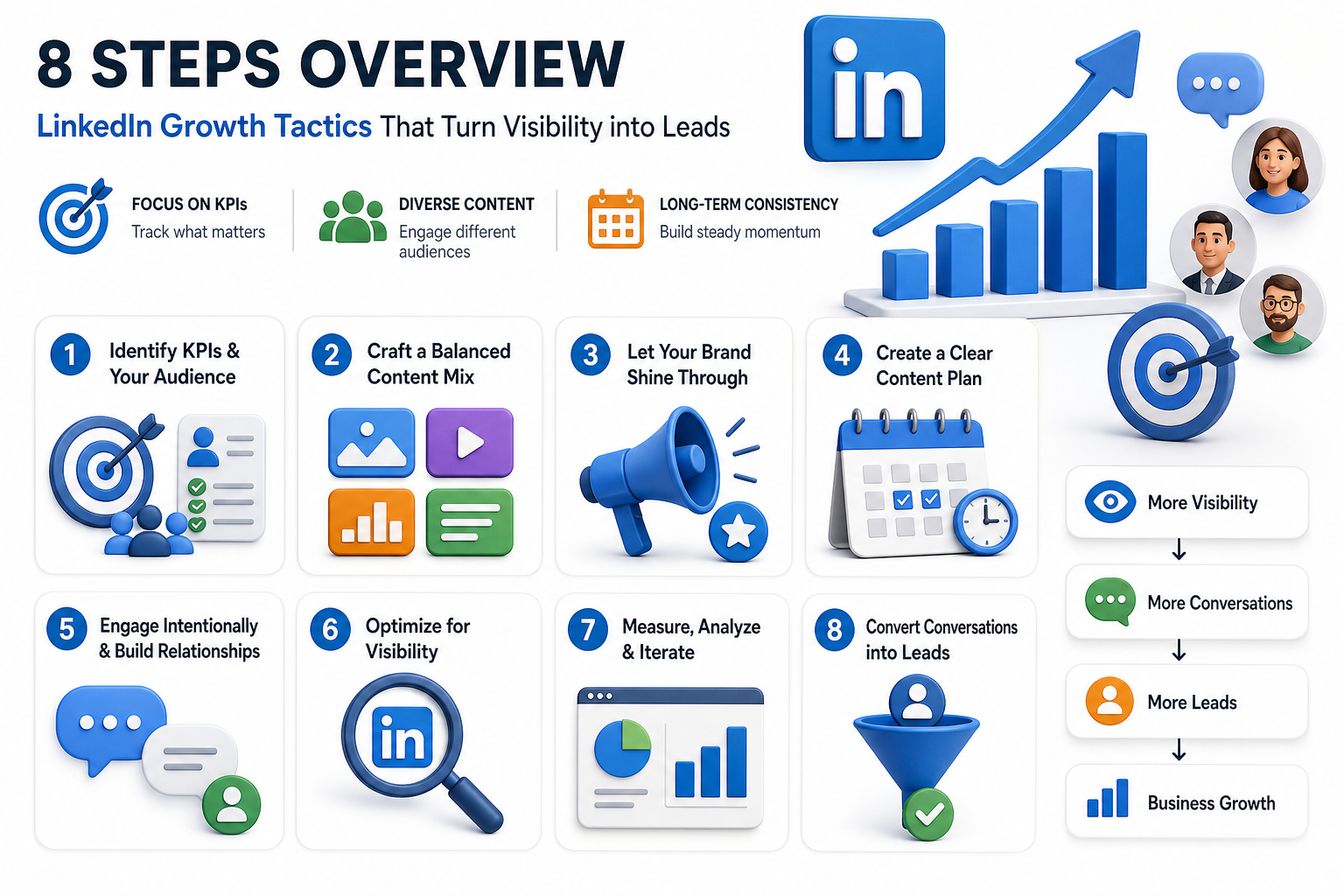
8 Steps Overview
This section outlines eight practical steps you can implement to create a sustainable LinkedIn organic growth plan. The focus is on driving real outcomes by aligning on key performance indicators, ensuring a diverse content mix, and preserving long term consistency. By turning visibility into conversations and eventually into leads, you can build steady momentum without relying on paid amplification.
- Identify KPIs and define your audience
Begin by selecting a core set of metrics that reflect your business priorities. Common LinkedIn KPIs include impressions, engagements, shares, comments, click throughs, and followers. Pair these with precise audience targeting by ICPs and buyer personas to ensure every post speaks to the right people.
Tip: map each KPI to a tangible outcome, such as inbound inquiries or pipeline advancement, so progress is easy to track over time.
- Craft a balanced content mix
A vibrant LinkedIn presence needs variety. Move beyond link previews and incorporate a mix of multimedia formats such as carousels, short videos, infographics, and text posts. Diversifying formats helps you capture attention in different ways and reduces audience fatigue.
Tip: repurpose existing content from webinars, guides, and reports into multi format assets that fit your content engine.
- Let your brand shine through
Your tone, visuals, and messaging should reflect your website and broader brand experiences. Inject personality while staying professional, and use visuals that reinforce your core value proposition. Consistency across posts strengthens recognition and trust over time.
- Set a sustainable posting cadence
Establish a realistic schedule that you can maintain. Consistency beats intensity. Start with a manageable rhythm, such as one post per day or 3 to 4 posts per week, and adjust based on performance data. Use proven windows for engagement but prioritize steady output over sporadic bursts.
Tip: run a two to four week pilot to identify which days and times yield the best response from your target audience.
- Leverage employee advocates
Empower team members to share and amplify content. Employee advocacy expands reach, builds credibility, and accelerates organic growth without large spend. Provide simple guidelines and ready to share assets to keep messages aligned with your brand voice.
- Collaborate with external partners
Collaborations can unlock new audiences. Consider guest thought pieces, joint webinars, or LinkedIn Live events with customers, partners, or industry peers. Cross promotion introduces your framework to new networks and reinforces credibility through association.
- Build a content engine for scale
Create a repeatable process to turn everyday conversations into multiple posts. Capture insights from calls, emails, and team chats, then batch produce content across formats. A well oiled content engine reduces last minute stress and signals reliability to your audience.
- Analyze data and adapt
Regularly review performance to identify what resonates and what falls flat. Use analytics to double down on successful formats, topics, and posting times, while pruning activities that do not move your KPIs. Adaptation keeps your plan relevant as algorithms and audience preferences evolve.
Tip: document hypotheses and test them in short cycles to build a continuous improvement loop.
By following these eight steps, you position your LinkedIn presence to grow organically in a sustainable way. The emphasis on clear KPIs, diverse content, and consistent execution creates a foundation where visibility naturally evolves into conversations, relationships, and eventually measurable leads.
| Step | Focus Area | Why it matters |
|---|---|---|
| 1 | KPIs and Audience | Aligns efforts with measurable outcomes and precise targeting. |
| 2 | Content Mix | Increases engagement by meeting audience preferences across formats. |
| 3 | Brand Consistency | Builds recognition and trust through a cohesive voice and visuals. |
| 4 | Posting Cadence | Maintains momentum without burnout; supports algorithmic reach. |
| 5 | Employee Advocates | Amplifies reach and credibility with authentic voices. |
| 6 | External Partnerships | Expands audience pools and adds social proof through collaboration. |
| 7 | Content Engine | Scales production with a repeatable process and efficient workflows. |
| 8 | Data and Adaptation | Optimizes the plan and sustains growth in a changing landscape. |
This framework aligns with broader LinkedIn Growth Tactics that balance owned content, audience engagement, and practical conversion paths. Use it as a living blueprint, revisiting each step quarterly to ensure your strategy remains aligned with business goals and audience needs.
Step 1: Identify the KPIs and audience
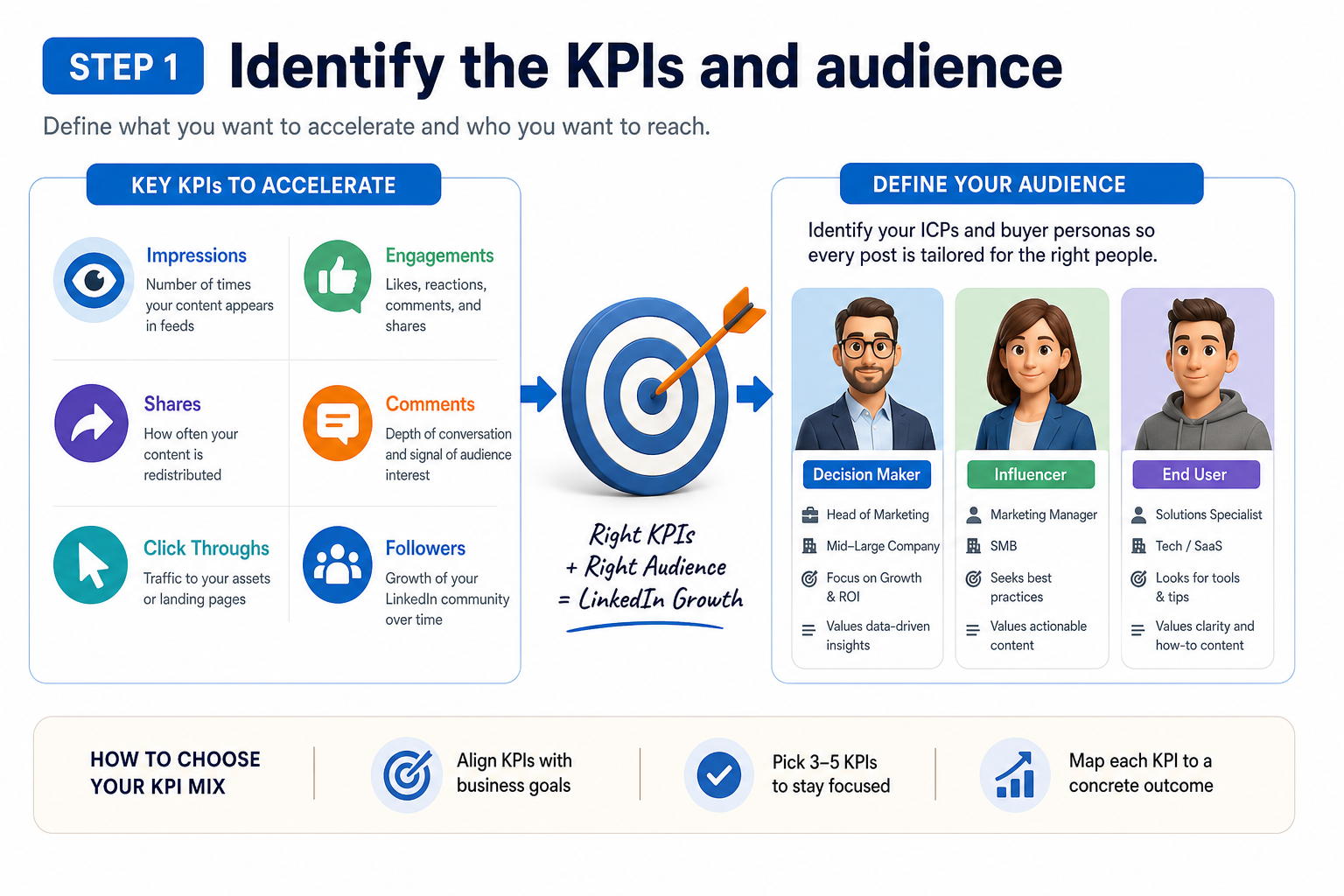
Step 1 lays the foundation for your entire LinkedIn Growth Tactics plan by clarifying what you want to move and who you want to reach. Start by defining a compact, cohesive set of key performance indicators that you want to accelerate. Common choices include impressions, engagements, shares, comments, click throughs, and followers. Each KPI should connect to a tangible outcome for your business, such as pipeline progress, lead generation, or brand authority.
The next pillar is audience definition. Your goal is to identify your ideal customer profiles (ICPs) and buyer personas so every post is tailored for the right people. When content is crafted with a precise audience in mind, you increase the likelihood of meaningful interactions, which in turn amplifies your reach through organic LinkedIn growth tactics.
Key KPIs to consider
- Impressions – the number of times your content appears in feeds
- Engagements – likes, reactions, comments, and shares
- Shares – how often your content is redistributed by others
- Comments – depth of conversation and signal of audience interest
- Click throughs – traffic to your assets or landing pages
- Followers – growth of your LinkedIn community over time
How to choose your KPI mix
- Align KPIs with business goals, not vanity metrics alone.
- Pick a small set (3 to 5) to maintain focus and clarity.
- Map each KPI to a concrete outcome, such as qualified inquiries or opportunity creation.
- Evaluate KPI interdependencies; for example, higher impressions often correlate with more engagement and followers.
Defining your audience with ICPs and buyer personas
- ICP criteria – firmographics or organizational traits that describe your ideal customer’s company (industry, company size, region, tech stack, buying role).
- Buyer personas – the people inside those organizations who influence or make purchasing decisions. Include job titles, responsibilities, pain points, and decision criteria.
- Content alignment – tailor content themes, formats, and CTAs to address the specific problems and outcomes your ICPs and personas care about.
Tip: create a one-page KPI and audience brief that you can reference before every post. This keeps your LinkedIn Growth Tactics rooted in measurable progress and audience relevance.
By clearly defining KPIs and sharpening audience targeting, you establish a repeatable, outcome-driven framework for your LinkedIn content. This clarity helps your team stay aligned, measure momentum accurately, and continuously refine messaging to convert visibility into conversations and opportunities.
Step 2: Craft content mix and repurpose existing assets
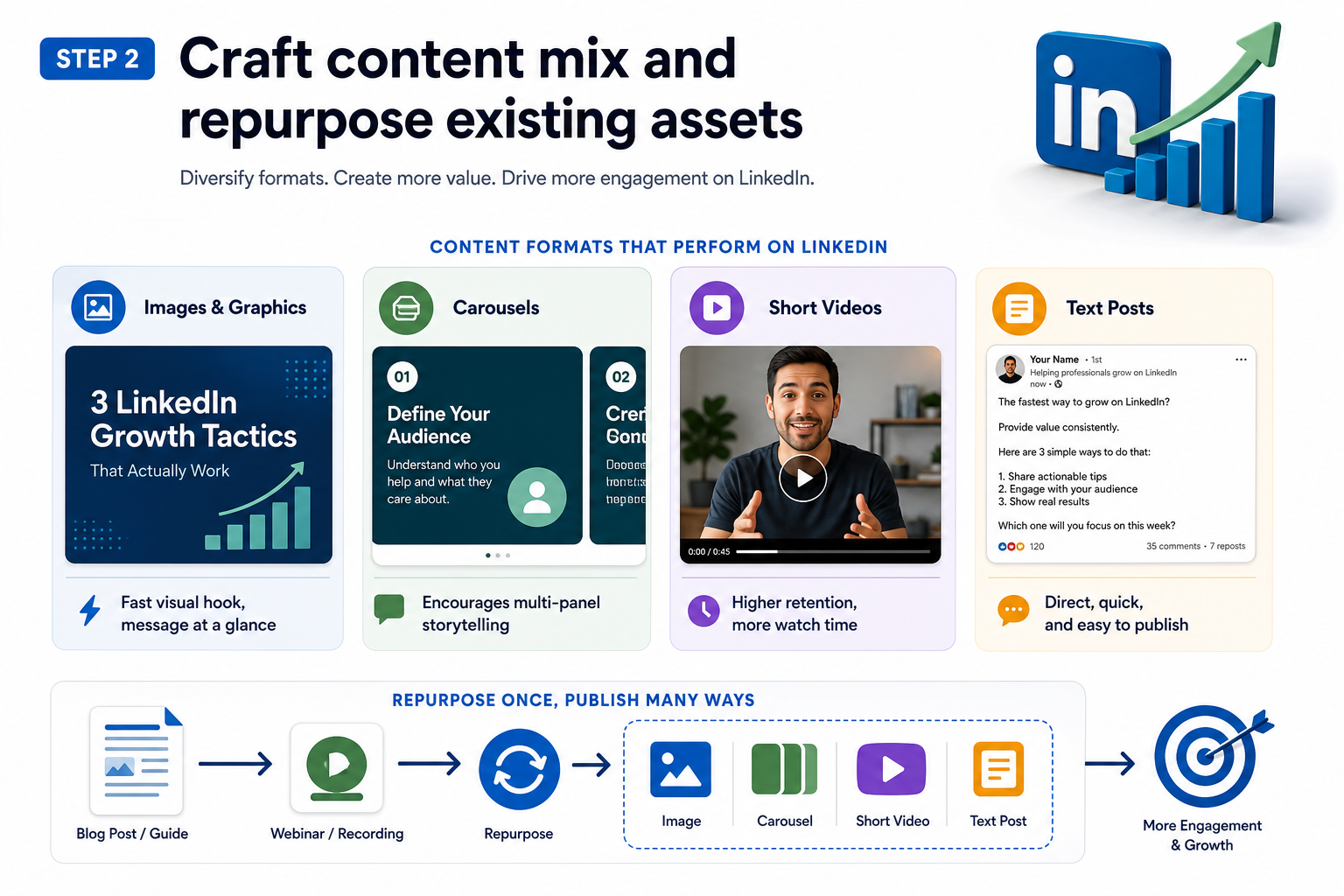
Step 2 centers on diversifying your LinkedIn content mix rather than defaulting to link previews of blog posts or landing pages. Multimodal formats capture attention in different ways and are favored by the platform for organic reach and on‑platform engagement.
To keep the feed engaging and align with how LinkedIn rewards meaningful interactions, rotate through a core set of formats that work well in feeds. Below is a practical breakdown you can implement quickly:
| Format | Why it works | Best use cases | Tips |
|---|---|---|---|
| Images and graphics | Fast visual hooks that convey a message at a glance | Key takeaways, data points, checklists | Use bold typography, crisp visuals, and a clear value proposition in the image itself |
| Carousels | Encourages multi-panel storytelling and longer engagement times | Step-by-step guides, frameworks, before/after scenarios | Limit each slide to one idea; include a strong CTA on the final slide |
| Short videos | Higher retention and more meaningful time on platform | Live tips, quick demonstrations, micro-tips | Capture value in the first 3 seconds; keep videos under 60 seconds if possible |
| Text posts | Directly communicative and easy to publish quickly | Thought leadership insights, questions, prompts for discussion | Lead with a concrete claim or question to spark conversations |
| Infographics and data visuals | Credibility through data and concise storytelling | Key metrics, research findings, comparisons | Focus on a single takeaway per graphic; cite sources where meaningful |
Repurposing existing assets accelerates content production while preserving quality. Look at the materials you already own and extract value in smaller, snackable formats. Common sources include:
- Blog posts → 1) a summarized image series, 2) a carousel highlighting three to five tips, 3) a short video recapping the main idea
- Webinars → 1) a multi-slide carousel with takeaways, 2) short clips or micro-videos from the Q&A, 3) a downloadable infographic that distills the insights
- Guides and reports → 1) visual quotes or data points as images, 2) a carousel outlining a step-by-step framework, 3) a short video synthesizing the core recommendations
A quick sequencing approach can look like this:
- Week 1 publish 2 image posts, 1 carousel, and 1 short video derived from a single long asset.
- Week 2 release a data visual from your latest report plus a text post inviting audience perspective on the topic.
- Week 3 rotate back to another set of repurposed insights, ensuring you refresh visuals and headlines to maintain curiosity.
Practical guidelines to maximize on platform engagement:
- Prioritize staying on the platform. Link previews may underperform compared with fully native assets.
- Use multi‑line captions to complement visuals, guiding readers through the key takeaways.
- Include a clear call to action on each post, such as inviting comments, asking a question, or directing to a resource within LinkedIn.
- Maintain visual consistency with your brand identity so assets feel cohesive on the feed.
By expanding beyond link previews and deliberately repurposing existing assets into diverse multimedia formats, you create a more engaging, on platform experience. This approach not only improves immediate engagement metrics but also supports a sustainable growth trajectory on LinkedIn through richer audience interactions.
Step 3: Let your brand shine through
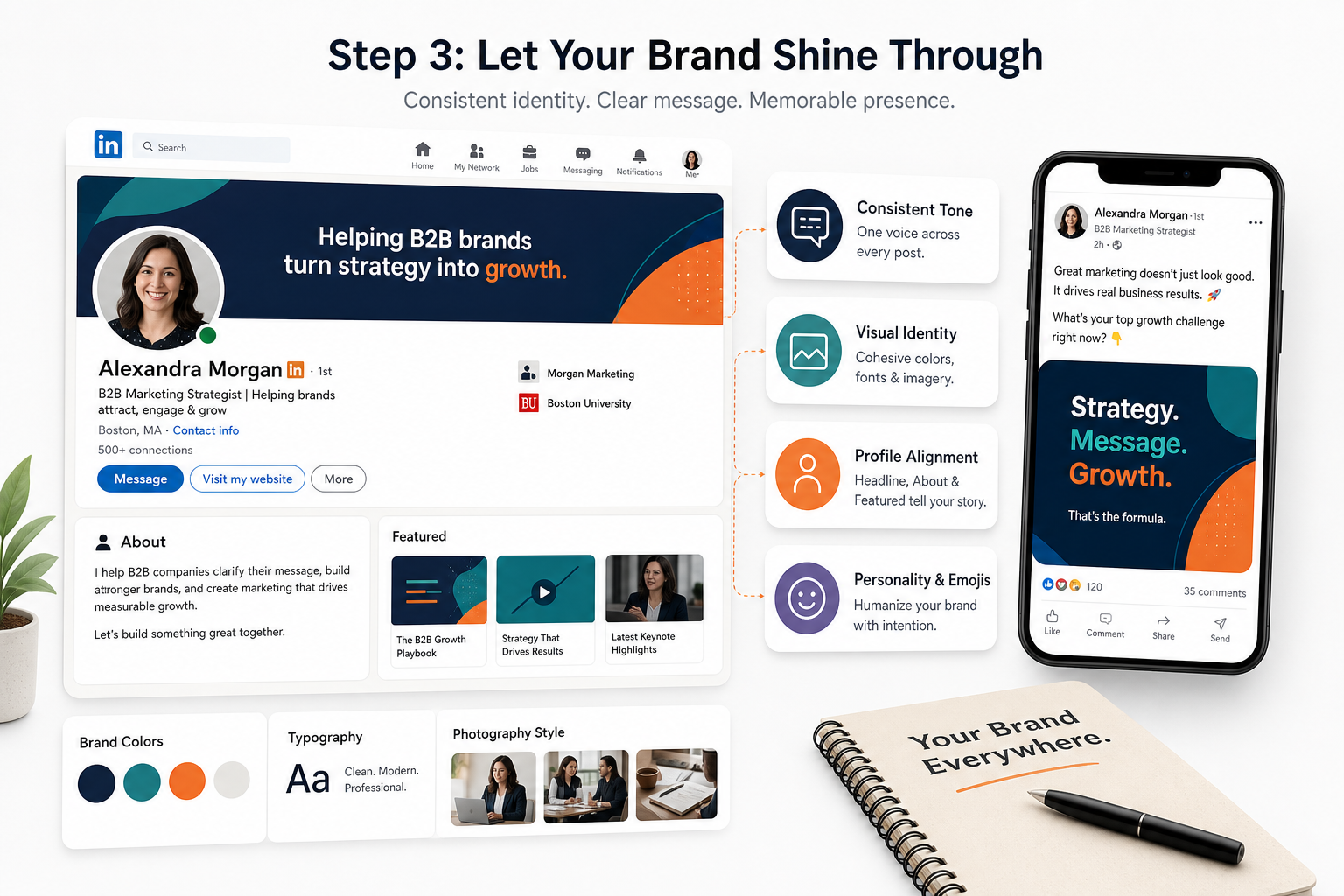
Your LinkedIn presence should feel like a cohesive extension of your brand. Step 3 focuses on ensuring that every touchpoint – from your profile to your posts – reflects a consistent identity in tone, messaging, and visuals. When your audience encounters your content, they should immediately recognize the brand you represent, even before they read a word.
To achieve this, treat your LinkedIn profile and content as a unified brand experience. A clear alignment across your website, marketing materials, and social posts builds trust and strengthens recognition. The goal is not to imitate a corporate brochure but to convey the same value proposition with a human and credible voice.
- Consistent tone and messaging – Define a brand voice that fits your audience and remains steady across posts. Whether you are informative, provocative, or supportive, maintain that stance and avoid mixed signals.
- Visual identity – Use a cohesive color palette, typography, and imagery that echo your brand guidelines. Your profile banner, headshot style, and post graphics should feel like they belong to the same family.
- Profile alignment – Craft your headline, About section, and Featured content to reflect your brand story. Each element should reinforce who you help, how you solve problems, and why you matter.
- Thoughtful use of emojis and personality – Sprinkle personality where appropriate to humanize your brand, but keep it professional and aligned with your audience’s expectations.
- Media strategy – Leverage visuals and formats that reinforce your identity. Consistent templates for images, carousels, and videos help followers recognize your content at a glance.
Practical ways to let your brand shine through include:
- Audit and synchronize – Review your current posts and profile assets. Create a quick brand brief that outlines your tone, messaging pillars, and visual rules, then apply it to new content.
- Profile and banner optimization – Ensure your headline clearly states who you help and the outcomes you deliver. Use the About section to tell a concise brand story with proof points, and select a banner that visually communicates your value proposition.
- Content templates – Develop a small library of post templates that reflect your brand. For example, a thought leadership card series, a data visualization style, and a customer story carousel, all using the same color cues and typography.
- Visual consistency – Maintain a shared look across media. Use standardized colors, font pairings, and layout patterns to create instant recognition.
- Personality with purpose – When adding lighthearted elements, tie them to your value offering or a relatable scenario. Keep the humor and warmth aligned with the professional expectations of your audience.
Remember that your LinkedIn brand is an invitation to trust and engage. By harmonizing tone, messaging, and visuals, you create a platform presence that stands out for its clarity and credibility, not merely for its frequency. This coherence is a powerful undercurrent that supports sustainable growth through meaningful connections, conversations, and opportunities.
Step 4: Determine posting frequency and schedule
Establishing a sustainable posting cadence is key to maintaining momentum without overburdening your team. The right rhythm keeps your LinkedIn presence active and reliable, while preventing burnout and content fatigue. Aim for a cadence that you can consistently maintain over weeks and months, rather than chasing explosive bursts that require heroic effort.
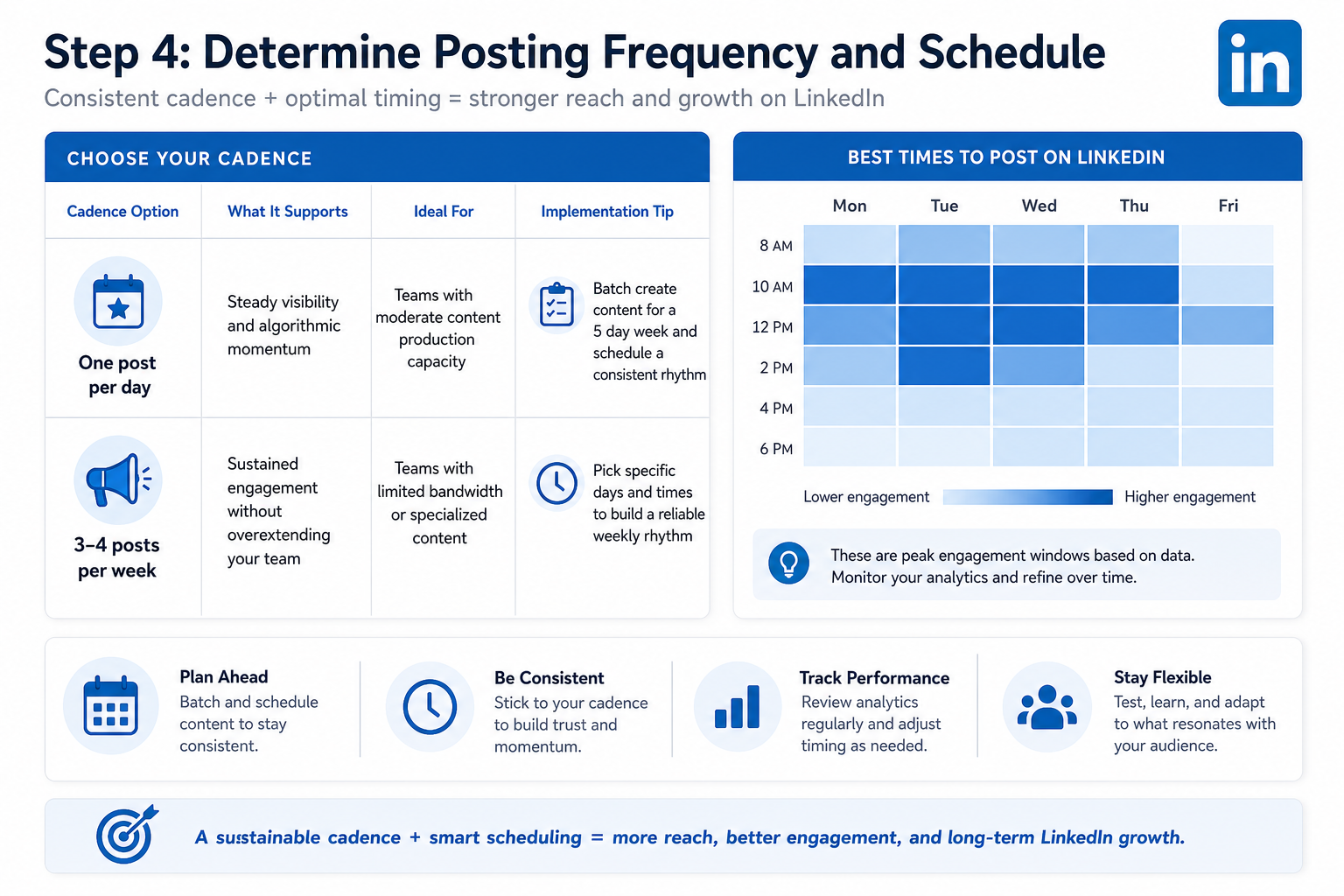
A disciplined cadence can take several practical forms. Many teams find a baseline of one post per day effective, while others prefer three to four posts per week. The key is consistency: choose a pattern that fits your resources and sticks to it. Regularity signals reliability to your audience and helps the LinkedIn algorithm recognize your ongoing value.
Anchor your schedule to times when your audience is most receptive. Data from studies on LinkedIn engagement shows that certain windows tend to yield better reach. Use these insights as a starting point, then monitor performance and refine your timing based on your own analytics.
| Cadence option | What it supports | Ideal for | Implementation tip |
|---|---|---|---|
| One post per day | Steady visibility and algorithmic momentum | Teams with moderate content production capacity | Batch create content for a 5 day week and schedule a consistent rhythm |
| Three to four posts per week | Balanced energy with lower production load | Small teams or solo operators maintaining quality | Map content to a two week cycle and reuse formats to maintain variety |
| Five to six posts per week | High cadence with strong reach potential | Teams with a strong content engine | Plan a rotation of formats and ensure feedback loops to improve quality |
Timing optimization approach:
- Start with proven windows for engagement, then tailor to your audience. Common starting points include mid morning and early afternoon on weekdays, but performance varies by sector and region.
- Use a consistent weekly pattern. For example, post on Monday, Wednesday, and Friday at fixed times to establish predictability.
- Track the impact of timing changes. If impressions are steady but engagement shifts, small timing adjustments can unlock additional resonance.
- Prioritize native content. Posts that live on the platform often outperform link previews in reach and engagement, so plan times that align with a native content strategy.
Practical workflow suggestions to keep cadence sustainable:
- Batch content creation – set aside dedicated blocks to draft several posts at once, then schedule them across the coming weeks.
- Use a simple calendar – maintain a lightweight content calendar to rotate formats and topics, preventing repetition and content gaps.
- Automate with care – while scheduling can save time, ensure you maintain a human touch by reviewing posts before they go live and responding to comments promptly.
Remember, the objective is to sustain momentum over time. A well planned cadence supports consistent visibility, dependable audience expectations, and a clearer path to meaningful conversations. By aligning frequency with available resources and adapting to performance data, you establish a reliable foundation for ongoing LinkedIn growth without overextending your team.
Step 5: Deploy employee advocates
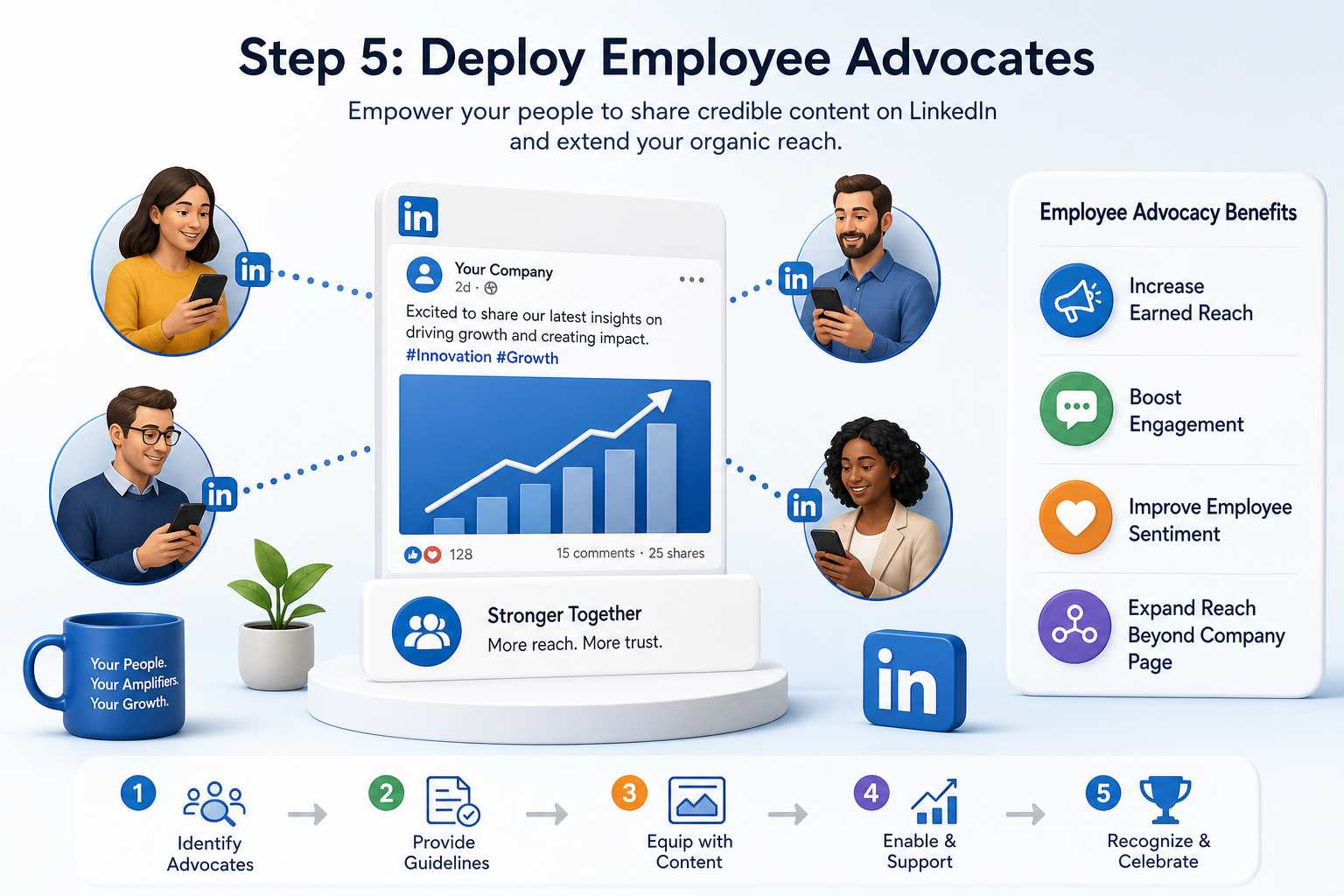
Step 5 focuses on unlocking the potential of your people to extend organic reach on LinkedIn. Employee advocacy turns employees into authentic amplifiers who share credible content, helping to boost reach, engagement, and perceived trust. When done well, advocacy programs improve not only external metrics but internal sentiment and alignment with the company’s LinkedIn Growth Tactics.
A well designed program gives staff a simple, repeatable way to participate without feeling overwhelmed or misaligned with brand guidelines. By equipping employees with clear rules, ready to share assets, and a supportive framework, you can spark consistent participation that scales over time.
At Linqin.ai we support programs that empower staff to share credible content on LinkedIn. A thoughtful approach respects individual voices while maintaining guardrails that protect brand integrity and ensure that shared content remains relevant to your audience.
Key benefits of employee advocacy
- Increases earned media value by leveraging internal credibility at a lower cost per impression
- Improves engagement signals as real employees comment, react, and share from their networks
- Enhances employee sentiment and alignment with company goals
- Expands reach beyond the company page by tapping diverse networks
Practical steps to deploy an advocacy program
- Identify advocates – select employees who are active on LinkedIn, have credible subject matter expertise, and represent a cross section of functions and regions.
- Provide clear guidelines – create a concise content policy, dos and donts, and examples of approved posts to reduce hesitation and errors.
- Build a ready to share toolkit – supply a library of assets such as one thought leadership post, a data visual, and a customer story snippet, plus short captions tailored for LinkedIn.
- Offer training and prompts – run short sessions on effective posting, engagement etiquette, and how to respond to comments in a professional way.
- Establish governance – set rules for participation, track performance, and maintain alignment with brand voice and compliance requirements.
- Motivate and recognize – acknowledge top contributors, celebrate milestone posts, and share learnings across the organization.
What to measure:
| Metric | Why it matters | How to measure |
|---|---|---|
| Shares per advocate | Indicates willingness to amplify content | Count posts shared by advocates and reach generated |
| Engagement per post | Signals quality and resonance of the content | Track likes, comments, and shares on advocate posts |
| New followers from advocacy | Shows audience growth driven by employee activity | Compare follower growth from advocate posts vs baseline |
| Leads and pipeline impact | Connects advocacy to business outcomes | Associate leads to specific advocate shares or campaigns |
Try this quick exercise:
- Pick three to five key roles across your organization to seed the program
- Provide each ambassador with a starter post and a data point or two they can reference
- Launch a two week pilot and review what resonated, then scale gradually
By methodically enabling employees to participate and by maintaining clear guardrails, you can realize meaningful gains in LinkedIn Growth Tactics without compromising brand integrity.
Step 6: Partner with external experts and organizations
Step 6 focuses on expanding your influence by partnering with external individuals and organizations. Collaborations with customers, champions, and strategic partners let you co-create LinkedIn content or host live events that feel authentic and valuable. These partnerships broaden exposure, cross-pollinate audiences, and reinforce your thought leadership without relying solely on your internal voice.
When done well, external collaborations amplify credibility because trusted third parties vouch for your expertise. The goal is to design joint content experiences that feel mutually beneficial, align with your brand voice, and offer practical takeaways for both audiences. Think of it as a collaborative amplification mechanism that extends your reach while preserving quality and relevance.
Benefits of external partnerships
- Exposure to new, relevant audiences through partner networks
- Enhanced credibility via endorsements from customers and champions
- Fresh content formats and ideas that keep your feed engaging
- Opportunity to co-host events that generate live engagement and conversations
Practical formats to consider
- Co-created posts and articles – write pieces jointly with customers or partners that highlight shared problems and clear solutions.
- LinkedIn Live and webinars – host live sessions featuring a customer story, a partner integration, or a panel of experts to discuss industry trends.
- Joint case studies and success stories – publish assets that showcase outcomes produced by collaboration and invite partners to share the content within their networks.
- Guest thought leadership – invite champions or customers to publish a post on your page or contribute to a series that demonstrates real world impact.
How to identify and engage the right collaborators
- Map potential partners by audience alignment and mutual value, not just brand affinity
- Look for customers with a story that illustrates tangible outcomes your audience cares about
- Survey champions and advocates who regularly engage with your content about collaboration ideas
- Reach out with a clear collaboration proposal, including objectives, format, timelines, and what each party gains
Governance and best practices
- Establish collaboration guidelines to maintain brand voice and compliance
- Define roles, approvals, and review timelines to keep launches smooth
- Ensure attribution and consent for any third party content
- Coordinate promotion across both networks to maximize reach while preserving authenticity
Measurement and learning
- Track engagement metrics such as comments, shares, and view times on co-created assets
- Monitor audience growth and new followers attributed to collaborative content
- Assess downstream outcomes like conversations, inquiries, or opportunities generated
By actively seeking and stewarding external partnerships, you can accelerate your LinkedIn Growth Tactics with credible voices and diverse perspectives. The best collaborations feel natural to the audience, deliver clear value, and reinforce thought leadership through shared expertise.
Step 7: Analyze data to adapt the strategy
Step 7 centers on using data to refine and enhance your LinkedIn Growth Tactics plan. The core idea is to adopt a continuous improvement mindset: identify what is working, pull back from activities that underperform, and stay agile enough to pivot as signals change. Regular measurement powers scale, helping you amplify strong ideas while discarding wasted effort.
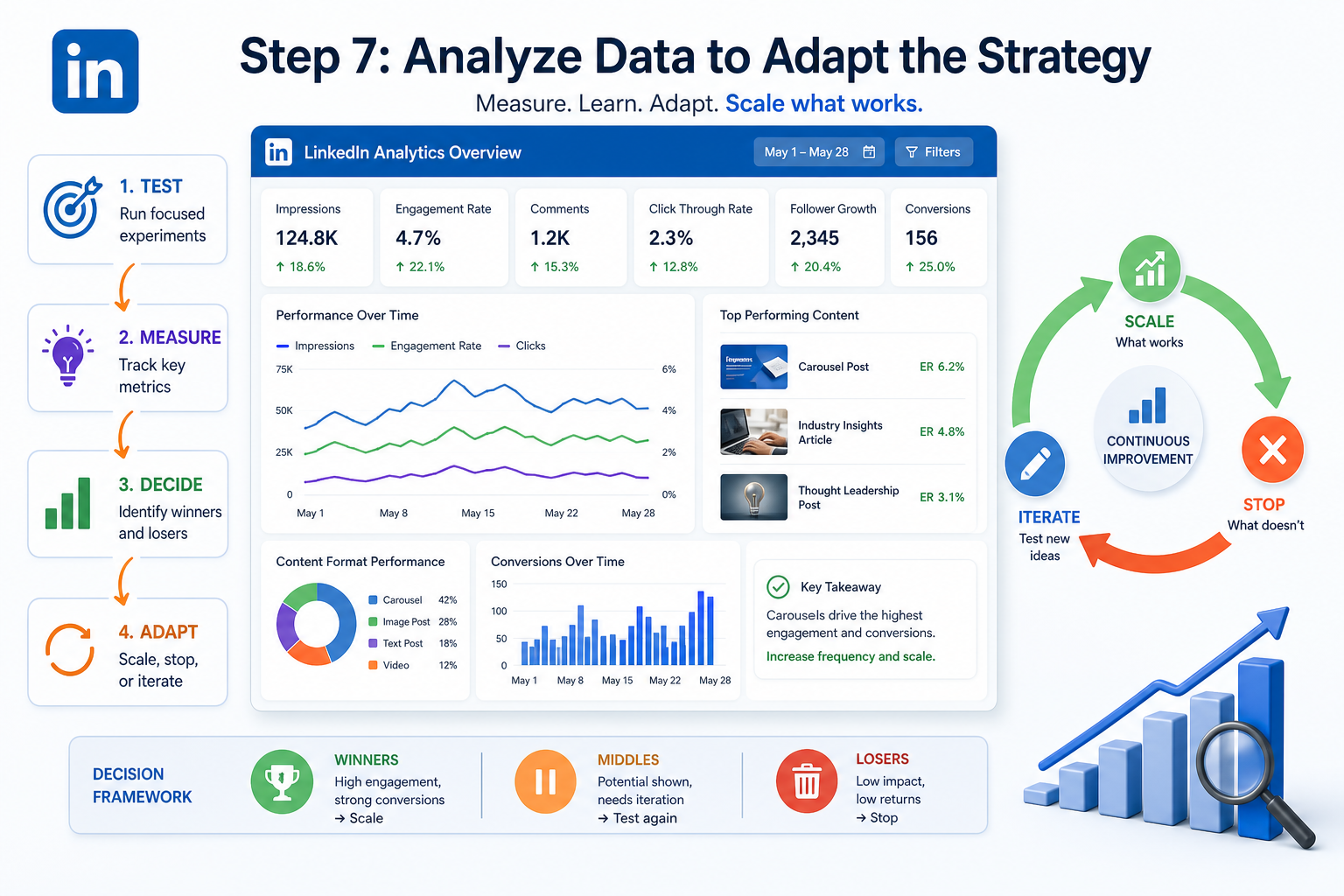
Adopt a test and learn cadence:
- Set up short, well-scoped experiments focused on one variable at a time, such as a single content format, headline structure, or posting time.
- Define a clear hypothesis before testing, for example, “Carousels will generate longer dwell time and more saves than single image posts.”
- Run experiments for a minimum of 2 to 3 weeks to account for weekly seasonality and to gather enough data.
Key metrics to monitor:
- Impressions and reach – indicate exposure and potential top-of-funnel activity.
- Engagement rate – the ratio of likes, comments, and shares to impressions, signaling resonance.
- Comments quality and depth – reveals meaningful conversations and intent.
- Click-through rate on any embedded CTAs or link previews (when used carefully on LinkedIn).
- Follower growth – tracks audience expansion and potential for future reach.
- Conversion signals – inquiries, meetings scheduled, downloads, or other defined next steps.
Decision framework:
- Identify winners – look for formats, topics, or CTAs that consistently outperform others on multiple cycles.
- Scale the winners – increase distribution, allocate more resources, or reuse the successful pattern with fresh angles.
- Phase out losers – reduce or pause activities that show minimal lift or negative engagement trends.
Practical workflow for iteration:
- Compile a monthly performance snapshot that compares against the previous period.
- Document each hypothesis and the observed outcome in a simple log to build a knowledge base over time.
- Use a lightweight dashboard to track the most meaningful KPIs for your goals, updating it as you learn what matters most.
When to pivot quickly:
- Impressions are rising but engagement remains flat for a sustained period.
- New formats or topics consistently underperform across multiple cycles.
- Audience feedback or demand indicates a shift in priorities or pain points.
Remember that adaptability is the core of sustainable growth. By treating data as a guiding compass rather than a verdict, you can continuously improve your content mix, posting cadence, and audience targeting to compound your LinkedIn organic growth over time.
Step 8: Maintain sustainability and long-term momentum
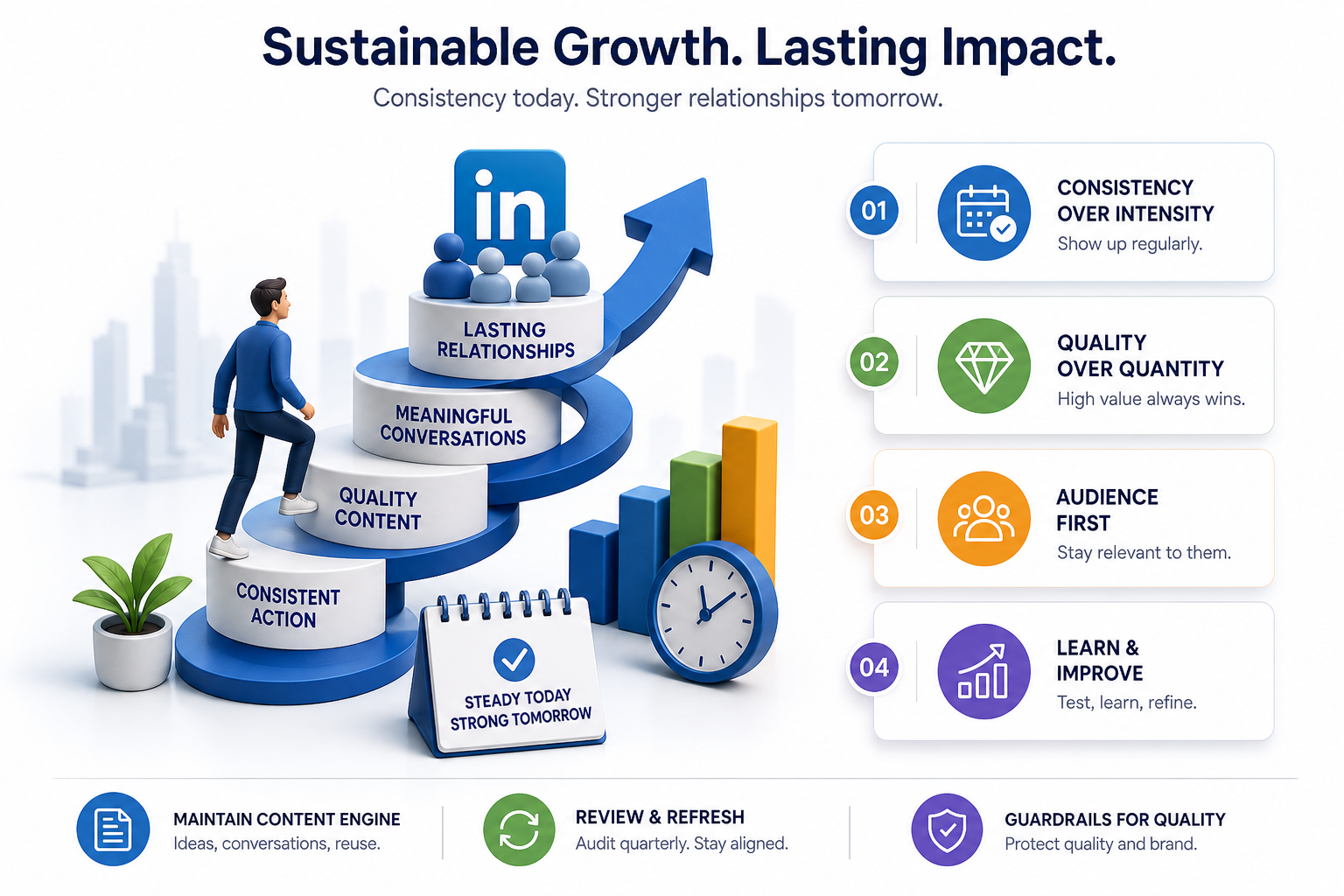
Organic LinkedIn growth is a long game that rewards perseverance and consistency. By maintaining a steady content engine and continuously refining your approach, you convert visibility into conversations and lasting relationships.
The core idea is to build sustainable momentum that can weather shifts in algorithms, audience preferences, or market conditions. This means prioritizing reliability over bursts of momentum and treating every post as a step toward a durable, trusted presence on the platform.
Principles for sustainable growth
- Consistency over intensity — regular, predictable activity builds familiarity and trust with your audience.
- Quality over quantity — a smaller number of high-value posts often yields better long-term results than a flood of mediocre content.
- Audience first thinking — continuously align content with ICPs and buyer personas to stay relevant.
- Learning mindset — view every post as a test, capture the outcomes, and apply lessons quickly.
Practical steps to sustain momentum
- Maintain the content engine — keep a living library of ideas, record resonant conversations, and reuse insights across formats to feed future posts.
- Review and refresh — quarterly audits of your content pillars, formats, and performance help you stay aligned with evolving goals.
- Guardrails for quality — establish a lightweight review process to ensure posts meet brand voice, accuracy, and compliance standards without stifling speed.
- Balance experimentation and reliability — schedule a small portion of posts for new formats or angles, while preserving a steady core cadence.
Cadence and content mix considerations
| Aspect | Guideline | Why it matters |
|---|---|---|
| Cadence | One to five posts per week depending on resources | Keeps presence steady without overwhelming the team |
| Format mix | Combo of images, carousels, short videos, and text | Serves different audience preferences and algorithm preferences |
| Quality checks | Lightweight review before publishing | Protects brand integrity while maintaining speed |
| Measurement | Track a core KPI set and a few leading indicators | Signals whether you are moving toward meaningful outcomes |
Governance and team alignment
- Roles and responsibilities — define who creates, reviews, and engages with comments to prevent bottlenecks.
- Content calendar discipline — maintain a light calendar that covers topics, formats, and posting windows.
- Feedback loops — gather qualitative feedback from the audience and internal stakeholders to inform iterations.
Risk management for long-term momentum
- Algorithm changes — stay flexible and ready to adjust formats that lose resonance.
- Audience fatigue — rotate topics and maintain fresh angles to avoid wear out.
- Compliance and guardrails — monitor regulatory or policy requirements to keep content safe and compliant.
In practice, maintain momentum by treating your LinkedIn presence as a living asset. Continually invest in your audience, nourish your content engine, and iterate with purpose. Over time, this disciplined approach turns occasional visibility into ongoing conversations, trusted relationships, and sustainable organic growth.