The Value of Organic Growth on LinkedIn in 2026
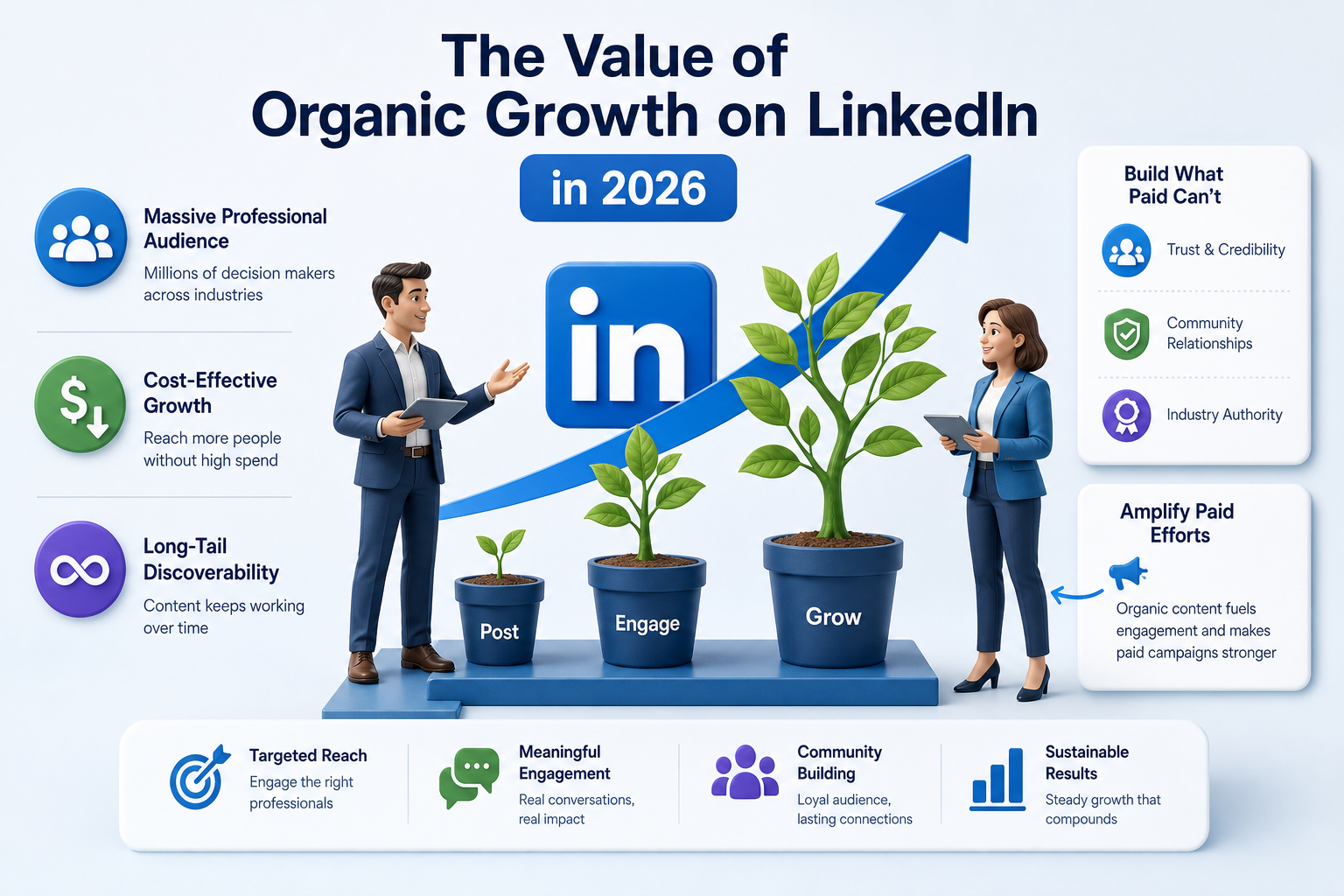
LinkedIn remains the premier platform for professional relationship building at scale, making organic growth a strategic cornerstone in 2026. With a global professional audience that continues to expand, the platform offers reach, credibility, and cost efficiency that paid media alone cannot replicate. Organizations that invest in a disciplined organic strategy can cultivate a loyal community, establish authority in their niche, and create a steady stream of high quality engagements that amplify paid campaigns rather than replace them.
At the core of this value proposition is the platform’s scale. LinkedIn connects millions of decision makers, analysts, and practitioners in every industry, which means even niche topics can find an engaged audience without prohibitive spend. This scale translates into two practical advantages:
- Targeted reach without excessive cost — Organic content reaches people who have shown interest in your domain, reducing wasted impressions and making every engagement more valuable.
- Long tail discoverability — Content that resonates can continue to accrue reach over weeks or months through re-shares, comments, and algorithmic visibility boosts, extending the life of an initial effort.
Engagement is not merely a vanity metric on LinkedIn; it signals that your content resonates with a professional audience. In 2026, thoughtful organic posts that balance insight, practicality, and storytelling tend to outperform sporadic, promotional updates. Community building flourishes when content consistently delivers learning, invites discussion, and recognizes audience contributions. This creates a virtuous cycle where engaged followers become advocates who generate earned visibility through comments, shares, and direct responses.
Organic content also plays a pivotal role in complementing paid efforts. While paid campaigns can accelerate reach and test creative ideas, organic content builds trust and authority that make paid impressions more effective. When audiences recognize expertise and authenticity from your organic posts, paid messaging serves as a natural extension rather than a disruptive interruption. The synergy between organic and paid is strongest when you treat organic as the front door to your thought leadership, and paid as the amplifier that reaches new segments.
To harness this value, consider these strategic imperatives for 2026:
| Imperative | Why it matters | Recommended action |
|---|---|---|
| Consistency with quality | Algorithms reward regular, high quality contributions that demonstrate expertise and reliability. | Establish a sustainable cadence (for example, 3 to 5 posts per week) and maintain a clear value proposition in every piece. |
| Audience alignment | Content that speaks to ICPs and buyer personas drives meaningful engagement and inquiry. | Map content themes to audience needs, pains, and outcomes; test variations to refine messaging. |
| Multimedia diversity | Different formats capture different learning preferences and expand reach. | Mix carousels, short videos, polls, and long form thoughtfully; repurpose top performers across formats. |
| Community signals | Comments, shares and conversations boost algorithmic visibility and credibility. | Proactively invite discussion with questions, prompts, and conversation starters; respond promptly to comments. |
| Measurement and iteration | Data-informed adjustments prevent stagnation and misaligned efforts. | Track a small set of KPIs (impressions, engagements, followers, click-throughs) and iterate weekly. |
Key performance indicators for a healthy LinkedIn organic strategy typically include impressions, engagement rate, follower growth quality, share of voice within your niche, and the velocity of meaningful conversations. In 2026, the emphasis has shifted toward engagement quality and conversation depth, with the expectation that thoughtful discussions lead to more durable relationships and higher probability of conversion when the audience is ready to move forward.
Finally, organic growth is inherently a trust-building mechanism. Audiences are more likely to engage with content from profiles and pages they perceive as credible and human. By combining authentic storytelling with practical insights and transparent outcomes, you create a profile that attracts like minded professionals and nurtures a community that values your input over time. This is the essence of sustainable LinkedIn growth in 2026.
Overall, organic growth on LinkedIn in 2026 offers unmatched reach efficiency, the opportunity to build an enduring community, and a powerful complement to paid strategies. When executed with consistency, audience focus, and multimedia variety, organic content not only proves its worth as a cost effective channel but also elevates overall marketing performance by increasing trust, credibility, and conversation within your target professional ecosystem.
The 7 LinkedIn Growth Tactics
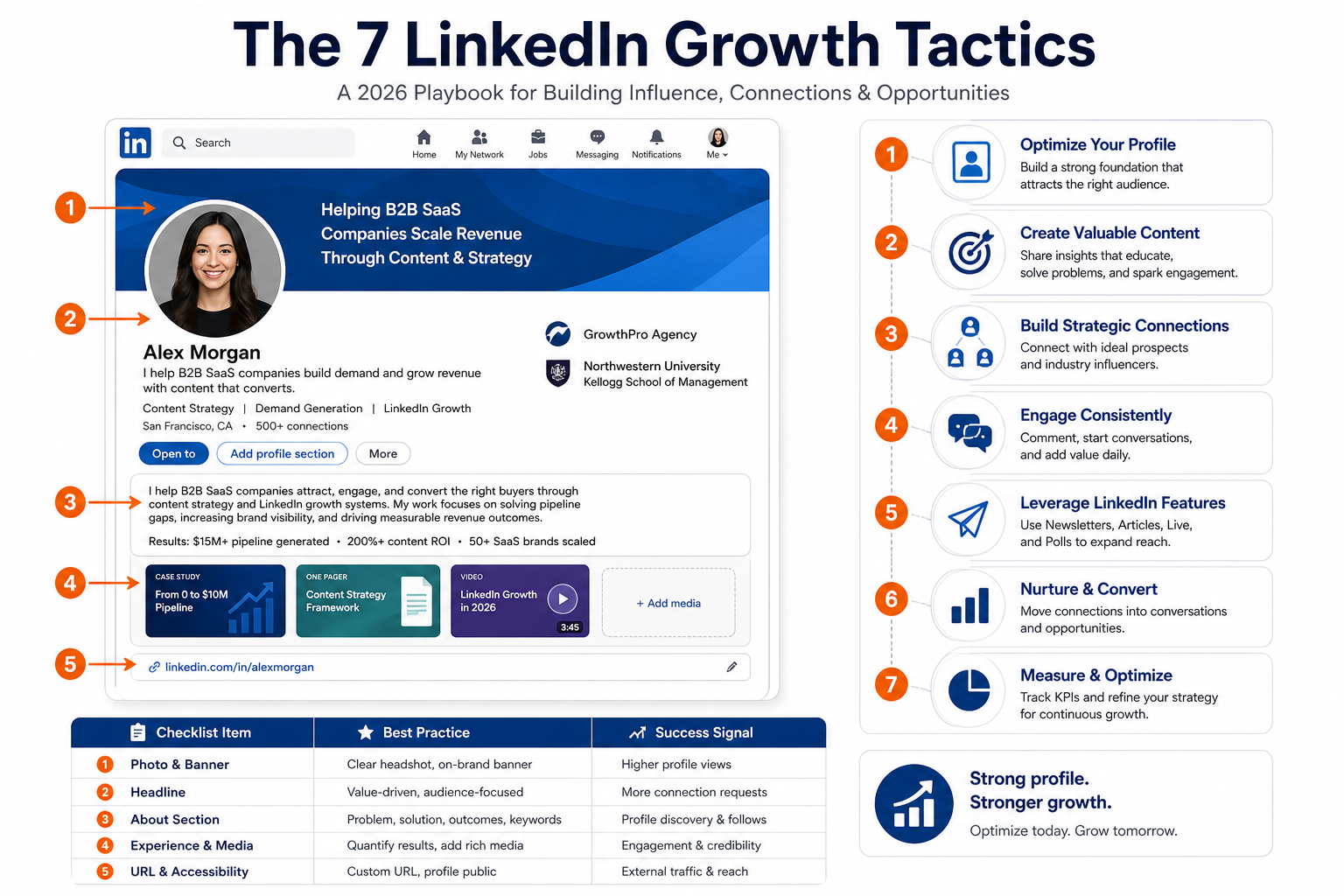
The 7 LinkedIn Growth Tactics presents a structured playbook drawn from 2026 LinkedIn strategy guidance. Each tactic below is a self contained sub section that explains the rationale, practical actions, and measurement criteria. Use this as a modular toolkit to accelerate growth on LinkedIn while maintaining authenticity and professional credibility.
1. Optimize Your LinkedIn Profile for Growth
Think of your profile as the foundation of your growth strategy. A polished profile signals credibility and converts passive visitors into followers and connections. Every element should reinforce your value proposition and make it easy for the right audience to engage.
A strong profile acts as a steady invitation. When people land on your page, they should immediately grasp who you help and how you help them succeed.
- Photo and banner: Use a clear headshot on a professional background and an on brand banner that communicates your niche quickly.
- Headline that sells: Move beyond job title. Craft a value oriented headline that states how you help a specific audience achieve outcomes.
- About section: Write in the first person, describe problems you solve, the outcomes you deliver, and the audience you serve. Include keywords for discoverability.
- Experience and media: Include concise results and add rich media such as case studies, one pagers, and short clips.
- URL and accessibility: Customize your LinkedIn URL and ensure your profile is public for external discovery.
| Checklist item | Best practice | Success signal |
|---|---|---|
| Profile photo | Professional headshot with neutral background | A higher rate of profile views and connection requests |
| Headline | Value driven, audience specific | Increased profile clicks from posts |
| About | Clear problems and outcomes, keywords included | Direct messages from interested prospects |
2. Craft a Rich Content Mix
A diversified content mix keeps the feed dynamic and appeals to different learning preferences. Relying on link previews alone reduces reach, so combine media formats that stay on platform and invite engagement.
Consistency across formats helps your audience recognize your message. Mix light and detailed content so readers can engage quickly or dive deeper when they wish.
- Multimedia core: Carousels, short videos, images, and polls outperform simple link posts.
- Repurpose wisely: Turn long form content into snackable formats without losing core value.
- On platform preference: Favor posts that keep readers on LinkedIn rather than driving them off site.
- Engagement loop: End each piece with a question or prompt to invite comments.
| Format | Use case | Goal |
|---|---|---|
| Carousel | Educational, step by step guidance | Higher dwell time and saves |
| Video | Tips, behind the scenes | Greater reach and authenticity |
| Poll | Audience insights and interaction | Early engagement signals |
3. Establish Brand Voice and Visual Identity
Your brand voice and visuals should be consistent across all posts and interactions. A strong identity helps your content stand out in a crowded feed and builds trust with a professional audience.
- Voice guidelines: Decide on tone, level of formality, and use of emojis or icons in moderation.
- Visual kit: Create a color palette, typography choices, and reusable templates for carousels and banners.
- Creator mode and features: Enable Creator Mode when appropriate to improve content discovery.
Measurement tip: Track consistency scores by auditing a sample of posts every two weeks and adjusting as needed.
4. Consistent Cadence and Scheduling
Establish a steady posting rhythm and test when your audience is most active. Let data guide your cadence rather than guesswork.
Start with a practical baseline such as 3 to 5 posts per week. Choose a fixed schedule (for example, Monday, Wednesday, Friday) and stick to it for at least six weeks. Review performance weekly and adjust timing based on engagement patterns.
- Start with a practical baseline such as 3 to 5 posts per week.
- Choose a fixed schedule (for example, Monday, Wednesday, Friday) and stick to it for at least 6 weeks.
- Review performance weekly and adjust timing based on engagement patterns.
| Cadence | Rationale | Milestone |
|---|---|---|
| 3 posts per week | Balanced visibility without oversaturation | Stable follower growth |
| Timing window | Aligns with when your audience is active | Improved engagement rate |
5. Empower Employee Advocates
Employees are trusted voices who can extend reach. An advocate program helps convert participants into brand ambassadors who share insights and experiences with their networks.
- Guidelines and training: Offer simple, non-promotional templates and best practices for professional sharing.
- Content rotation: Encourage employees to share and comment on company content. This boosts visibility.
- Recognition: Acknowledge and reward active advocates to sustain participation.
What you gain: increased earned media value and stronger internal sentiment around the brand. Start with a pilot group and scale based on results.
6. Collaborate with External Partners
External collaborations extend reach and introduce new audiences. Co-authored posts, LinkedIn Live events, and cross-promotions create mutual benefits for all involved.
- Partner selection: Align with customers, industry peers, or complementary service providers.
- Co-creation plan: Agree on topics, format, and promotion timeline in advance.
- Cross-pollination: Tag partners, invite comments, and share combined content to maximize exposure.
Measurement focus: joint engagement rate, follower growth from collaborations, and quality of leads generated from partner content.
7. Data Driven Iteration and Optimization
Continuous improvement relies on rigorous data analysis. Track a concise set of KPIs, learn from what works, and iteratively refine your approach to increase impact over time.
- Core KPIs: Impressions, engagements, follower growth, and click throughs.
- Experiment framework: Run controlled tests such as format or hook variants and compare results.
- Weekly reviews: Hold a brief review to decide what to scale and what to pause.
Aim for higher engagement quality, deeper conversations, and more qualified followers who align with your ICPs.
Identify KPIs and Audience
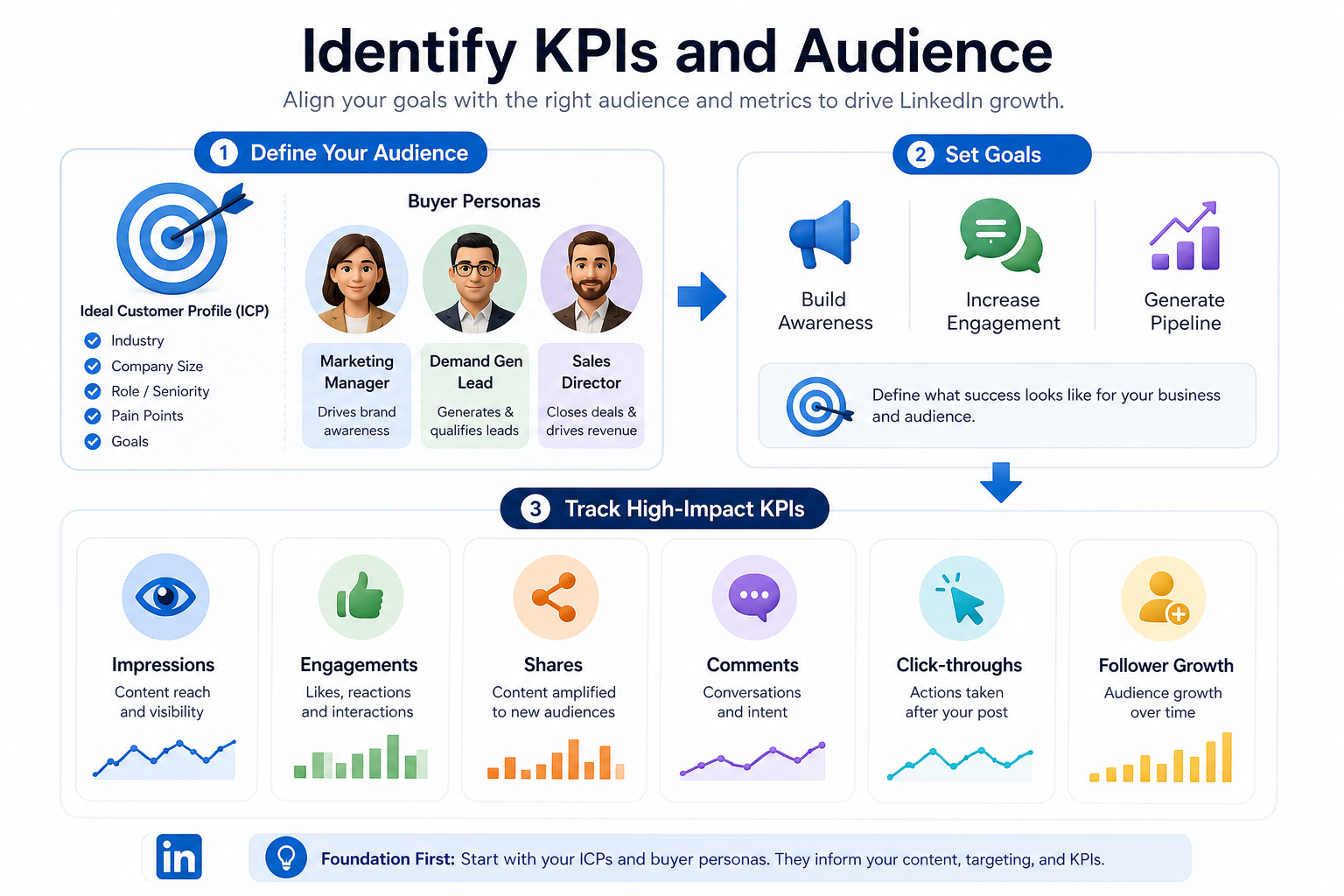
Identify KPIs and Audience is the foundational step in any LinkedIn growth program. The goal is to translate business aims into measurable signals that drive action. Start by clarifying what success looks like in tangible terms, then map those outcomes to the right metrics. This alignment makes every post and interaction move toward a clear objective, whether that is awareness, engagement, or pipeline creation.
Starting point for KPI selection rests on two pillars: the audience you want to reach and the actions you want them to take. Pick a compact, high-impact set of metrics that you can track weekly and act upon. The most common KPIs for organic LinkedIn growth include:
- Impressions – the total times your content is displayed. Signals reach and visibility that set the stage for deeper engagement.
- Engagements – total interactions such as likes, comments, and shares. A proxy for resonance and relevance.
- Shares – when others distribute your content to their networks. A key amplifier of reach and credibility.
- Comments – the depth of conversation and audience intent. Indicates discussion quality and community signals.
- Click-throughs – readers who take a next action after your post, such as visiting a resource or your profile. Measures content to action effectiveness.
- Follower growth – expanding your audience over time. Reflects ongoing interest and potential for future engagement.
Audience targeting and ICPs form the other half of the equation. Focus on ideal customer profiles (ICPs) and buyer personas to ensure content speaks directly to the people who matter most. When you tailor content to ICPs, you improve relevance, shorten the path to conversion, and increase the likelihood of meaningful interactions.
Practical guidance to shape audience inputs includes:
- Define ICPs clearly by industry, company size, seniority, geography, and typical challenges your product or service solves.
- Document buyer personas with their goals, objections, information needs, and preferred content formats.
- Map content themes to ICP needs so every post addresses a concrete problem and a measurable outcome.
- Use laddered targeting starting with broad visibility metrics (impressions and reach) and progressively narrowing to depth metrics (comments and direct messages) as you identify resonance.
- Set weekly review criteria to assess whether your audience signals are moving toward your ICPs and buyer personas, and adjust creative or targeting accordingly.
Measurement structure helps you stay focused. Create a lightweight dashboard that tracks a small set of KPIs across content themes or formats. A typical starter framework includes:
| KPI | Definition | Actionable Insight | Target Example |
|---|---|---|---|
| Impressions | Times your content is shown | Identify which topics and formats deliver broader visibility | Increase weekly impressions by 15 percent |
| Engagements | Total likes, comments, and shares | Gauge resonance and learning value | Improve engagement rate by 2 percentage points |
| Shares | Number of times your post is shared | Measure content value and advocacy | Boost shares by 20 percent month over month |
| Comments | Quantified depth of discussion | Assess conversation quality and need for follow up | Achieve a 25 percent increase in meaningful comments |
| Click-throughs | Clicks to external resources or profile | Evaluate the effectiveness of a CTA or link placement | Lift CTR by 1.5x for posts with a strong CTA |
| Follower growth | New followers gained over a period | Track audience expansion and audience quality | Reach 500 new targeted followers per month |
Putting it all together is about balancing reach and depth with audience alignment. Start with a core set of metrics that matter to your business goals, tie each metric to a concrete ICP or persona, and run small, rapid experiments to learn what moves the needle for your specific audience. Remember that impressions raise awareness while engagements, comments, and shares build community signals, and click-throughs plus follower growth indicate a healthy path from discovery to relationship building. By anchoring KPI selection in ICPs and buyer personas, you create a repeatable, scalable framework for sustained LinkedIn growth.
Craft Content Mix and Repurpose What You Have
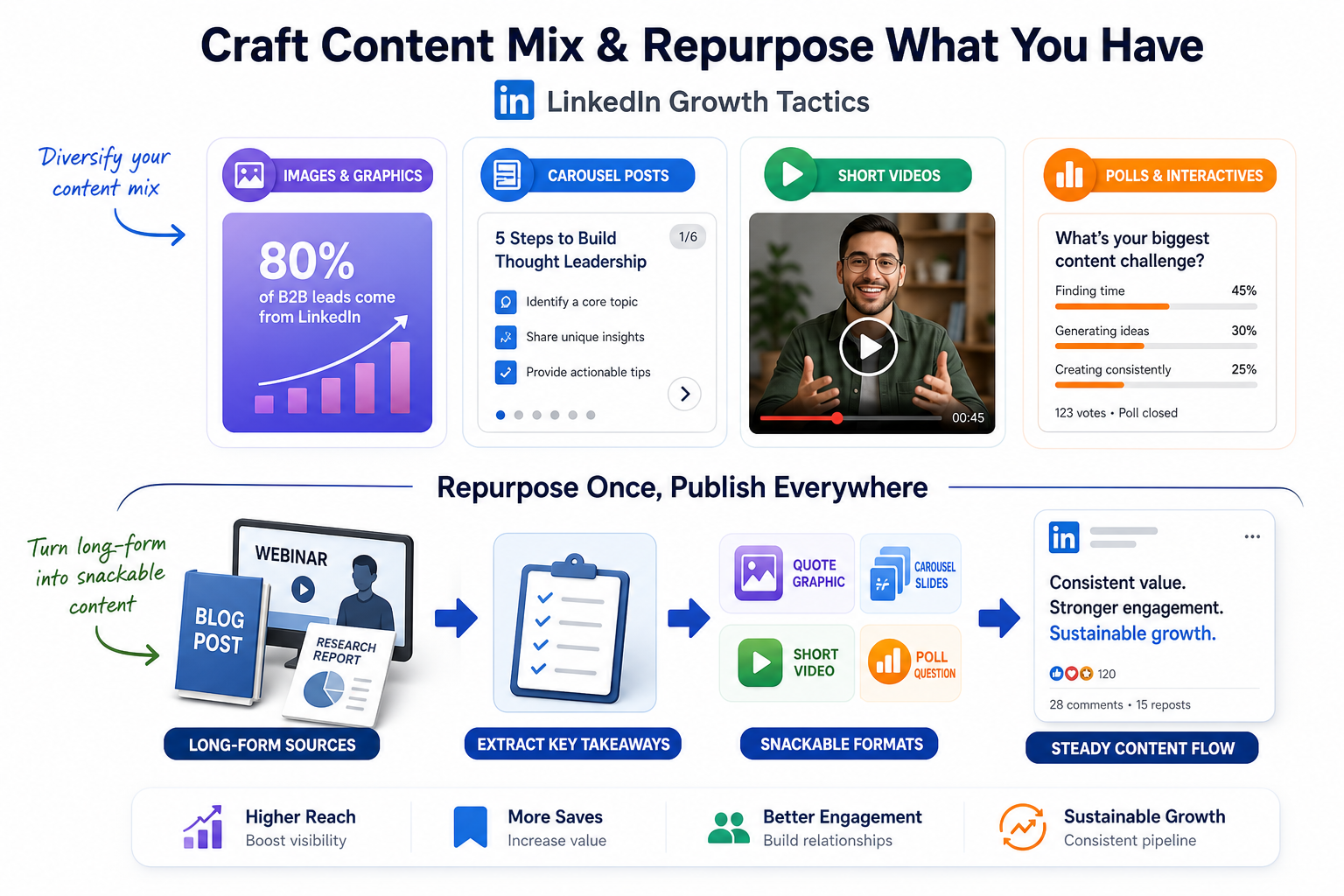
Craft Content Mix and Repurpose What You Have Diversifying content helps capture attention in a crowded LinkedIn feed. Relying solely on link previews to blog posts or landing pages often leads to limited reach and diminishing engagement. Instead, center on a multimedia core that keeps readers on the platform while delivering clear value. By pairing fresh formats with smart repurposing, you can sustain a steady, scalable content flow that resonates with your ICPs.
To maximize on platform behavior, design a content architecture that prioritizes on platform strengths. Visual formats such as images, carousels, and short videos typically outperform plain link posts in reach and engagement. Each format serves a distinct learning style and scroll-stopping capability, which helps your audience absorb key ideas without leaving LinkedIn.
- Images and graphics: Use clean, bold visuals that convey a single idea or takeaway. These work well for quick concepts, statistics, and checklists.
- Carousel posts: Break complex processes into 5 to 10 slides that guide followers step by step. Carousels encourage saves and allow for deeper education without overwhelming the reader.
- Short videos: Record concise clips (30 to 90 seconds) that deliver a practical tip, a quick demo, or a behind the scenes glimpse. Authenticity matters; natural lighting and clear audio win.
- Polls and interactive elements: Use polls to generate engagement while gathering audience insights that inform future content.
Repurposing existing assets is a time-efficient way to maintain consistency without reinventing the wheel. Start with high value content you already own and adapt it into multiple on platform formats. This approach preserves core insights while optimizing for engagement and reach.
Practical repurposing pathways include:
- Blog posts into snackable content — Extract 3 to 5 key takeaways, create a short multi-image graphic or a caption series that highlights each takeaway, and finish with a compelling question to invite discussion.
- Webinars into short videos — Clip the most impactful moments into 15 to 60 second videos that address a specific problem and include a call to action to view the full recording on demand if appropriate on LinkedIn.
- Guides and playbooks into carousels — Convert stepwise instructions into a carousel that readers can swipe through, each slide delivering a concrete action plus a concise example.
- Reports and data insights into visuals — Turn dashboards or charts into infographic panels or animated visuals that summarize the top insights with labeled axes and a clear takeaway.
Implementation tips to sustain a steady cadence include:
| Tactic | Format and Approach | On Platform Benefit |
|---|---|---|
| Images | One idea per image with a bold headline; include a short caption | Fast attention, high shareability, easy to consume |
| Carousel | 5 to 10 slides; logical progression; end with a CTA or question | Increased dwell time and saves, repeat viewing |
| Video | Short, actionable tips; natural setup; subtitles enabled | Higher reach, stronger storytelling, better on-platform persistence |
| Polls | Make it relevant to trends or decisions your audience faces | Early engagement signals and audience insights |
When planning the content mix, keep these guiding questions in mind:
- What problem am I solving in this post? Align each piece with a concrete outcome for your audience.
- Which format fits the message best? Choose the medium that conveys the idea most efficiently while encouraging action.
- How can I keep readers on the platform? Favor formats that stay on LinkedIn and minimize external link friction unless absolutely necessary.
- How will I prompt engagement? End with a provocative question, a request for a specific example, or a call to share the post with a colleague.
By combining a multimedia core with thoughtful repurposing of existing content, you create a sustainable engine for LinkedIn growth. This approach not only expands reach and engagement but also reinforces your expertise in a way that feels natural and value driven for your professional audience.
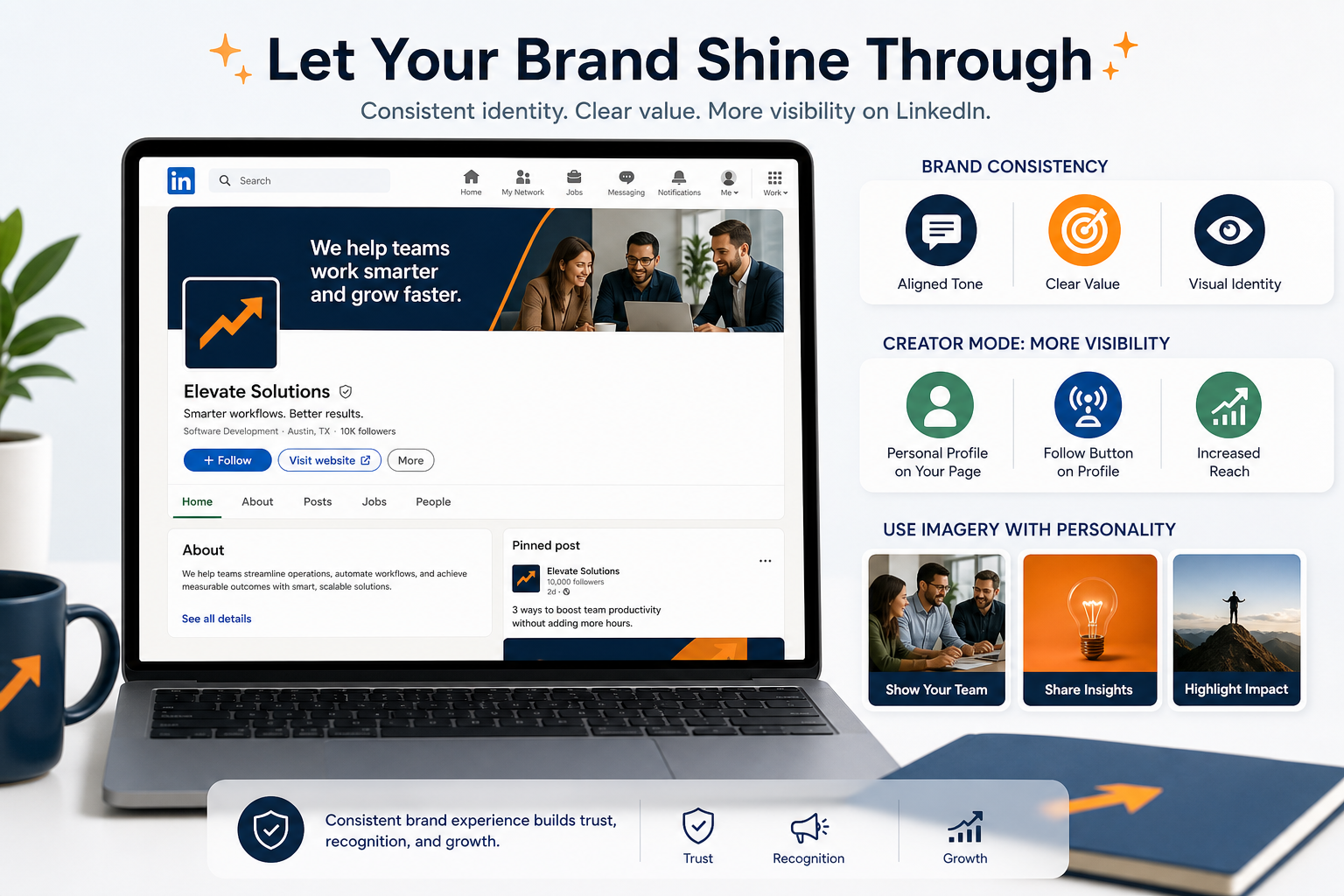
Let Your Brand Shine Through
Let Your Brand Shine Through is about making your LinkedIn presence instantly recognizable as a reflection of your company’s identity. Consistency in tone, value proposition, and visual elements builds trust and helps your audience understand what you stand for at a glance. When your brand voice and visuals align with your website and other touchpoints, you create a cohesive experience that accelerates recognition, recall, and credibility across the LinkedIn feed.
Tone and value proposition:
Craft a messaging framework that communicates who you are, whom you serve, and the tangible outcomes you enable. Your tone should be aligned with your brand personality while remaining appropriate for a professional network. Consider a simple matrix to guide every post:
| Guiding question | Practical example | |
|---|---|---|
| Voice | What is the personality behind the words? | Confident, approachable, and data-driven without jargon overload |
| Value proposition | What problem do you solve for whom? | Help mid market teams reduce onboarding time by delivering practical playbooks |
| Tone balance | How formal or informal should posts read? | Professional with occasional warmth and human anecdotes when relevant |
Visual identity anchors your posts in a recognizable frame. A strong visual kit makes content instantly identifiable and reinforces your message. Apply these visual guidelines consistently across all formats:
- Brand kit: Maintain a shared color palette, typography choices, and logo usage rules. Use these in banners, thumbnails, and carousels to create a uniform look.
- Backgrounds and banners: Use on-brand banner imagery that communicates your niche and value at a glance. Ensure banners align with the overall color system and messaging.
- Templates for recurring formats: Create reusable templates for carousels, videos, and image posts so readers recognize your content instantly.
- Accessibility and clarity: Choose high contrast, legible fonts, and descriptive alt text for images to reach a broader audience.
Using personality with imagery elevates engagement when it feels authentic rather than manufactured. You can introduce personality through imagery and copy without compromising professionalism:
- Human elements: Include team moments, behind the scenes, or client collaboration shots where appropriate to convey culture and process.
- Warmth in visuals: Subtle smiles, candid poses, and natural lighting add approachability without undermining credibility.
- Consistent motifs: Use recurring visual motifs (icons, framing, or illustration style) that underpin your brand narrative.
- Emoji and icons: Use sparingly to punctuate tone, not dominate the message. Favor professional icons that support readability.
Creator Mode as a visibility accelerator:
Creator Mode increases content discovery and helps prioritize content creators in the LinkedIn ecosystem. When appropriate for your brand, enable Creator Mode to showcase topics you regularly publish about and to surface followers who care about your niche. Consider these practical steps and benefits:
- Enable Creator Mode: Turn on Creator Mode in profile settings when you want to emphasize content creation over broad connection growth.
- Hashtag emphasis: Choose 4 to 8 relevant, non overlapping hashtags that reflect your niche and include them in your profile and posts to boost discoverability.
- Content emphasis: Structure posts to foreground expertise areas, using consistent headers or formats so readers recognize your specialization immediately.
- Creator features: Leverage creator focused tools like newsletters, live events, and more prominent post visibility to reach new audiences with your brand message.
Measurement and governance:
- Consistency audit: Periodically review a sample of posts for alignment with tone, value proposition, and visuals.
- Brand alignment metrics: Track qualitative signals such as sentiment and perceived credibility, in addition to quantitative measures like engagement and follower quality.
- Creator Mode impact: If enabled, compare reach, impressions, and follower growth before and after activation to quantify visibility gains.
By harmonizing tone, value proposition, and visuals, and by responsibly leveraging Creator Mode, your LinkedIn Page can become a reliable, recognizable gateway to your expertise. This consistency not only reinforces trust with your professional audience but also accelerates the journey from discovery to meaningful engagement across your network.
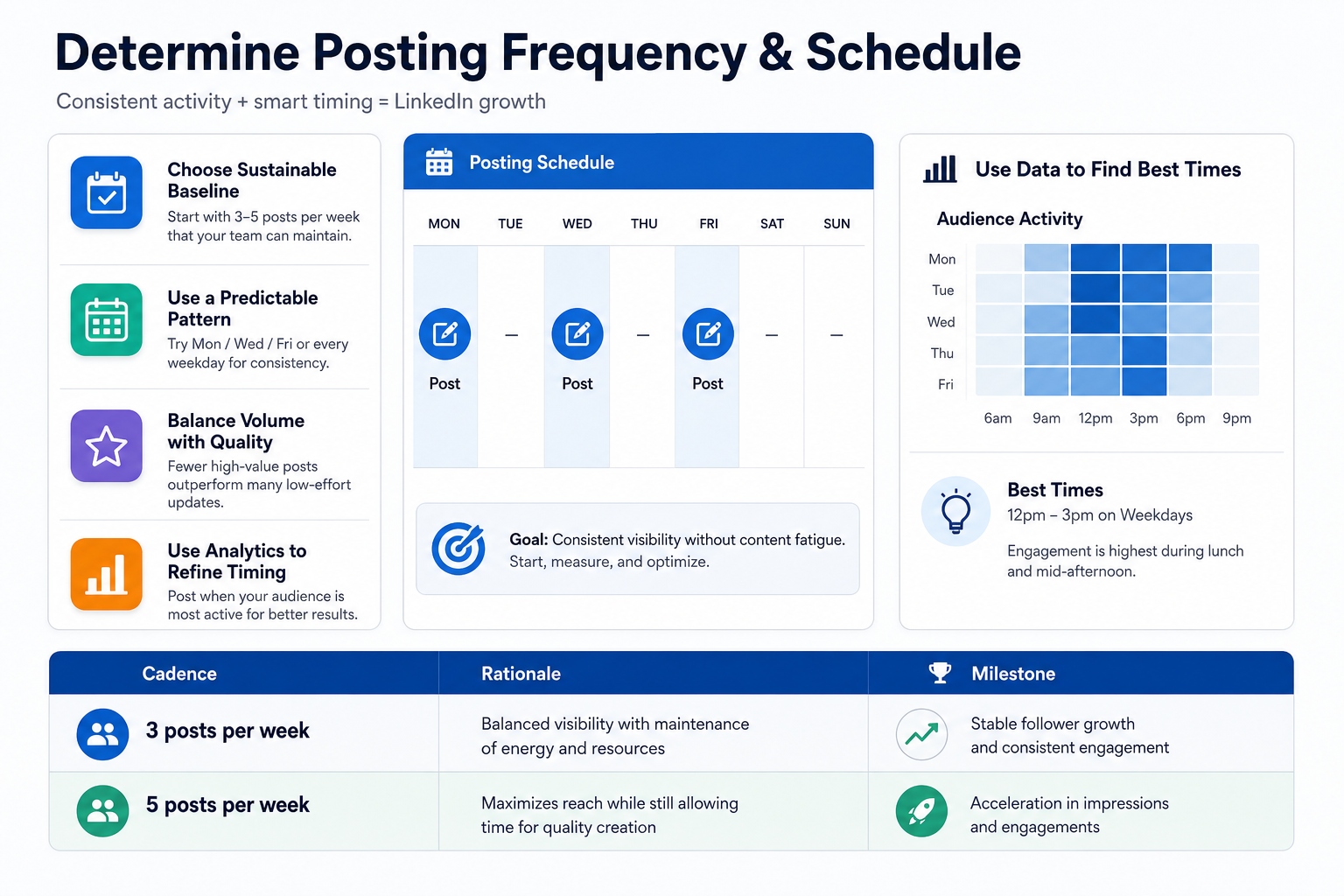
Determine Posting Frequency and Schedule
Momentum on LinkedIn comes from regular, sustainable activity your team can maintain. The goal is a cadence that keeps you visible without creating content fatigue. Start with a practical baseline and adjust based on performance data and available resources.
Choose a sustainable baseline that fits your capacity. A common starting point is 3 to 5 posts per week, which keeps you in the feeds consistently without overwhelming your team.
Consider a predictable pattern. A simple approach is Monday, Wednesday, Friday, or every weekday if you have the bandwidth. Consistency helps your audience anticipate and engage with your content.
Balance volume with quality. It is better to publish fewer high value posts than many low effort updates. Use your editorial calendar to plan and review content before publishing.
Use analytics to refine timing. Regularly review when your audience is most active and adjust your posting times accordingly. Small timing shifts can yield meaningful gains in reach and engagement.
- Choose a sustainable baseline that fits your capacity. A common starting point is 3 to 5 posts per week, which keeps you in the feeds consistently without overwhelming your team.
- Consider a predictable pattern. A simple approach is Monday, Wednesday, Friday or every weekday if you have the bandwidth. Consistency helps your audience anticipate and engage with your content.
- Balance volume with quality. It is better to publish fewer high value posts than many low effort updates. Use your editorial calendar to plan and review content before publishing.
- Use analytics to refine timing. Regularly review when your audience is most active and adjust your posting times accordingly. Small timing shifts can yield meaningful gains in reach and engagement.
| Cadence | Rationale | Milestone |
|---|---|---|
| 3 posts per week | Balanced visibility with maintenance of energy and resources | Stable follower growth and consistent engagement |
| 5 posts per week | Maximizes reach while still allowing time for quality creation | Acceleration in impressions and engagements |
| Daily posting (weekday only) | Top of funnel momentum with opportunities for depth over time | Steady growth in followers and sustained conversations |
Timing recommendations are data driven. Use platform analytics to identify when your audience is most active and experiment with small shifts to find the sweet spot for your topics and formats. Several industry studies share common patterns, though results can vary by niche. Consider these practical timing considerations as a starting point:
- Midweek activity tends to be higher on LinkedIn, with engagement often strongest on Tuesday, Wednesday, and Thursday.
- Morning windows around 8 to 10 AM in your target audience’s time zone frequently capture people checking the platform before work or during morning routines.
- Lunchtime and late afternoon slots around 12 to 1 PM and 4 to 6 PM can also yield solid engagement as professionals take a break or wrap up the day.
- Test and iterate start with a baseline and run controlled tests by posting similar content at different times across a few weeks. Compare impressions, engagements, and follower responses to identify the most reliable patterns.
Practical workflow tips to sustain momentum:
- Editorial calendar: Map themes, formats, and posting times at least two weeks in advance to reduce friction.
- Batch creation: Produce multiple posts in a single session to maintain consistency even on busy days.
- Buffer for emergencies: Reserve one evergreen post per week that can fill gaps if a last minute opportunity or constraint arises.
- Cross platform alignment: Align LinkedIn cadence with other channels to maintain a cohesive content rhythm without duplication.
By combining a clear cadence with data driven timing, you can sustain momentum, improve audience signals, and steadily grow your presence on LinkedIn. Remember that the best schedule is the one you can consistently execute while delivering value to your ICPs and buyer personas.
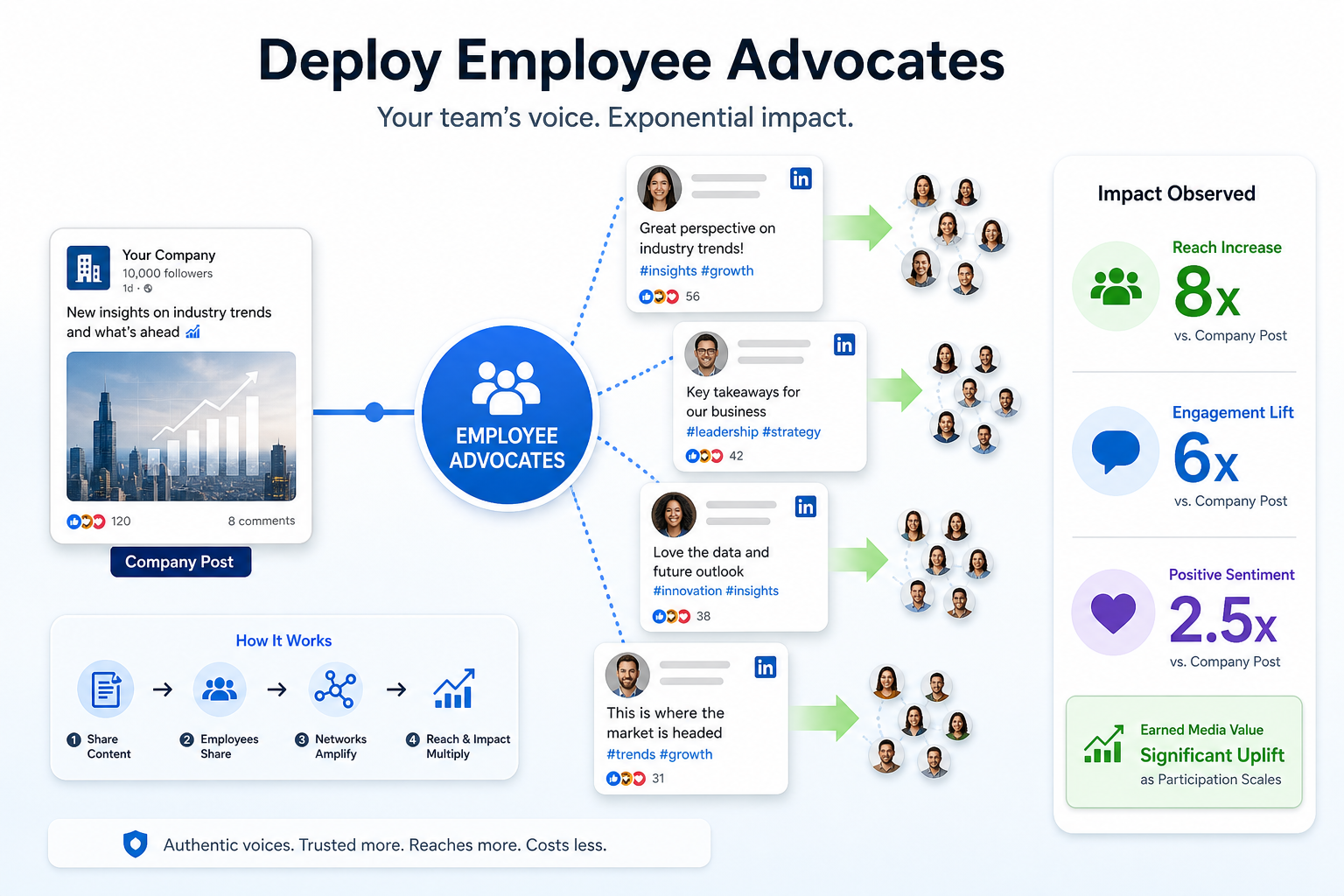
Deploy Employee Advocates
Deploy Employee Advocates Employee advocacy uses the authentic voices of your team to extend reach beyond official company channels. When colleagues share insights, case studies, and practical takeaways, you gain credibility that often feels more trusted than corporate messaging. This broadens your content footprint across networks in a cost effective way and speeds the journey from awareness to consideration.
Historical benchmarks and observations from early adopter programs show tangible gains in reach, engagement, and earned media value. For example, formal employee advocacy initiatives have demonstrated multiples of on‑platform reach compared with standard corporate posts, with a lift in engagement quality and sentiment. Results vary by industry and program design, but the economics remain compelling: a modest number of active advocates can create outsized impact relative to the effort required to run the program.
- Earned media value uplift: Employee shares, comments, and testimonials can generate earned exposure that rivals paid reach, with a lower entry cost. Early benchmarks from mature programs indicate meaningful earned media value growth as participation scales.
- Reach amplification: Advocates tap into networks outside the company’s immediate follower base, creating a multiplier effect on impressions and increasing the probability of new followers and inbound conversations.
- Engagement quality: Content amplified by employees tends to attract more thoughtful comments and higher quality interactions, driven by personal relevance and credibility from an insider perspective.
Impact on engagement and sentiment when employees participate tends to follow a positive arc but requires careful governance. Programs that provide lightweight guidelines, permissioning, and opt‑in participation generally see:
- Higher authentic engagement as audiences respond to relatable perspectives and practical experiences shared by real people.
- Improved sentiment signals with more constructive discussions and fewer promotional signals, when employees share in ways that emphasize value and learning.
- More consistent posting cadence through a rotating slate of contributors, reducing the burden on any single person and maintaining recurring visibility.
Practical steps to deploy an effective employee advocacy program:
- Guidelines and training: Provide simple, non-promotional templates, baseline best practices for professional sharing, and examples of what to post and what not to post.
- Content rotation: Create a content calendar that features a mix of customer stories, product insights, industry commentary, and behind-the-scenes perspectives, ensuring a steady stream of share-worthy material from multiple voices.
- Participation incentives: Recognize and celebrate active advocates, whether through internal shout-outs, lightweight rewards, or opportunities to contribute to more strategic content formats.
- Governance and approval: Establish clear but lightweight approval workflows to protect brand safety while preserving the spontaneity that makes employee voices compelling.
Measurement focus for employee advocacy should track both reach and quality. Consider these indicators:
| definition | signal of success | |
|---|---|---|
| Advocate participation rate | Percentage of eligible employees who share or engage with company content | Steady or rising participation across teams |
| Incremental reach from advocates | Additional impressions generated by employee shares beyond baseline company posts | Measured lift in total impressions per week or month |
| Engagement quality | Average comments, shares, and saves on advocate amplified posts | Higher than baseline engagement rate and more meaningful conversations |
| Lead and pipeline signals | Clicks, direct messages, or inquiries originating from advocate content | Visible increases in qualified conversations and pipeline indicators |
To summarize, a well designed employee advocacy program can transform your LinkedIn presence from a standard publishing channel into a living ecosystem of trusted voices. By enabling employees to share purposeful content, you extend reach, lift earned media value, and cultivate a more vibrant, authentic community around your expertise. Start with a small pilot, establish clear guidelines, and scale as you learn what resonates with your audience and your people.
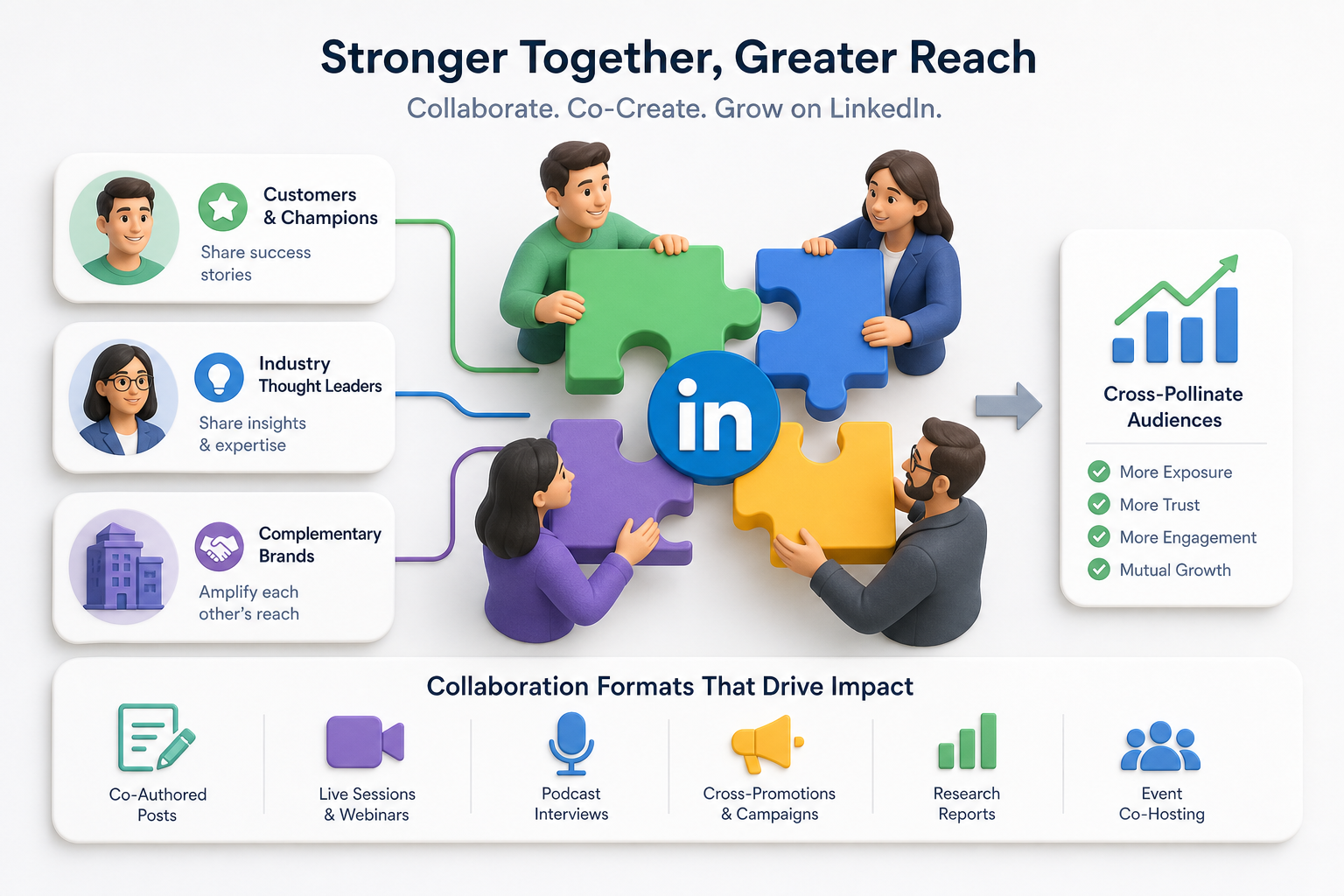
Partner with External Individuals and Companies
Partner with External Individuals and Companies External collaboration extends reach beyond your own channels and adds fresh perspectives to your audience. By strategically engaging customers, brand champions, and partner brands, you can co create content that feels authentic, expands credibility, and exposes both networks to new value. The result is a virtuous loop of cross pollination where each collaboration lifts awareness, trust, and engagement for all involved.
Key collaborator archetypes and how to work with them:
- Customers and client champions — Invite highly satisfied customers to share their success stories, participate in case studies, or co host a live session that explores the problems, the approach, and the outcomes they achieved with your solution.
- Industry thought leaders and practitioners — Partner with analysts, consultants, or practitioners who speak to your ICPs’ priorities. Co authored posts, jointly moderated panels, or shared commentary on industry developments can yield high credibility and deeper engagement.
- Complementary brands — Identify non competing brands serving a similar audience. Align on topics, co produce content, or run cross branded campaigns that highlight how each solution complements the other.
Practical collaboration formats to consider:
- Co authored posts — Draft a joint post or article that presents a shared perspective, a research finding, or a practical framework. Tag partners and invite engagement from both audiences.
- LinkedIn Live events — Host a live conversation with a customer, sponsor or partner to discuss trends, challenges, and best practices. Use a clear agenda, roles, and a strong CTA to drive post event conversations.
- Joint thought leadership articles — Publish long form pieces or curated playbooks that combine your expertise with your collaborator’s insights, then promote across both networks.
- Cross promoted micro content — Create bite sized clips, carousels, or polls that feature partner quotes, data points, or perspectives, then distribute across each brand’s channels.
Operational guidelines to ensure smooth collaboration and brand safety:
| Governance area | Best practice | Success signal |
|---|---|---|
| Partner selection | Align with customers, industry peers, or complementary service providers that share your ICPs and values | High relevance, strong audience overlap, and mutual interest |
| Co creation plan | Agree on topics, format, promotion timeline, and role assignments before content starts | Clear milestones and publish dates |
| Content governance | Set brand safety checks, disclosure, and approval steps that preserve authenticity while protecting reputation | Content approved within timelines and without compliance issues |
| Promotion and tagging | Tag collaborators, share cross posted content, and use joint hashtags where appropriate | Increased reach and cross audience engagement |
| Measurement | Track joint engagement rate, follower growth from collaborations, and quality of leads or conversations | Demonstrable lift in target metrics compared to solo content |
Measurement focus and success metrics to monitor collaboration impact:
- Joint reach and impressions — Compare combined impressions from collaborative content versus individual content to quantify audience expansion.
- Engagement quality — Look for deeper conversations, increased comments from relevant decision makers, and higher save ratios on joint posts.
- Audience cross over — Track how many new followers come from partner audiences and how many of those followers engage with future content.
- Lead and pipeline signals — Monitor click throughs, direct messages, or inquiries that originate from collaborative assets.
Best practices to maximize cross pollination:
- Co align on a shared narrative that resonates with both audiences rather than duplicating existing content.
- Provide value first in every collaboration; avoid overt promotion and emphasize learning, case studies, and executable insights.
- Repurpose collaboration assets into multiple formats to extend shelf life and reach across formats and channels.
- Leverage community momentum by encouraging partners to participate in follow up discussions, comments, and additional content.
By weaving external voices into your LinkedIn growth playbook, you gain new credibility, access to fresh networks, and a richer content ecosystem. When collaborations are thoughtfully planned and measured, cross pollination becomes a scalable engine for sustained exposure and meaningful engagement with your ICPs.
Analyze Data to Adapt the Strategy
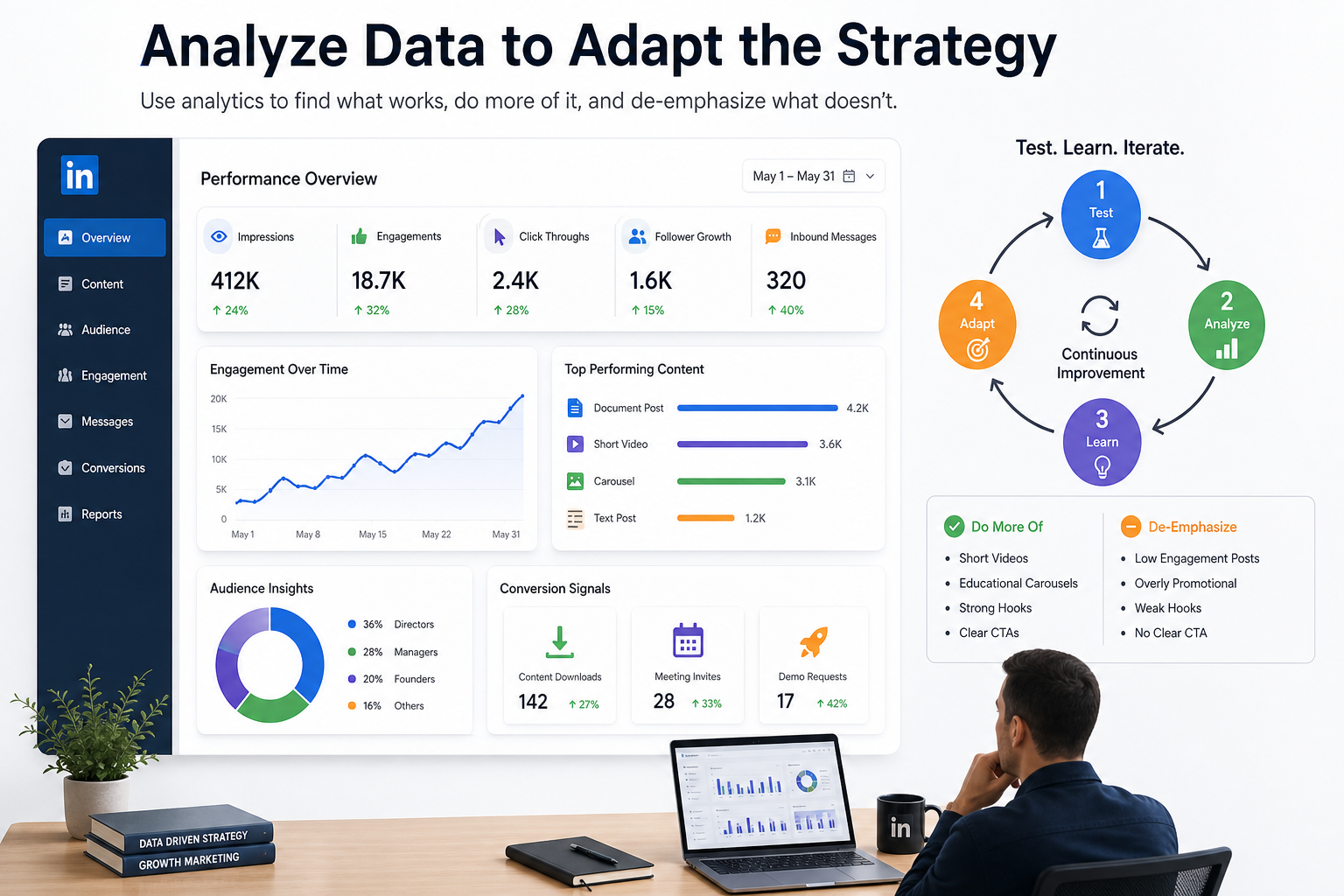
Analyze Data to Adapt the Strategy Analytics should drive decisions, not opinions. A disciplined data practice helps you identify which elements of your LinkedIn growth plan are delivering value, which formats resonate with your ICPs, and where to reallocate effort for the longest impact. The goal is to move from vanity metrics to actionable insights that improve long term performance.
Begin with a lightweight analytics scaffold that tracks a focused set of KPIs aligned to your ICPs and buyer journeys. Prioritize metrics that signal progress toward your top objectives, such as engagement quality, audience depth, and pipeline signals, rather than chasing raw reach alone.
- Core signal set: impressions, engagements, comments, shares, click throughs, follower growth, and direct messages relating to conversion or inquiry.
- Quality indicators: meaningful comments, post saves, questions raised, and the number of long form reads or video watch time.
- Value indicators: inbound messages, meeting invites, demo requests, or content downloads initiated from LinkedIn.
Adopt a simple test and learn framework to run controlled experiments. Treat each experiment as a small, time bound test that isolates one variable at a time, such as format, hook, or CTA placement. Compare results against a clear baseline and use the findings to inform the next iteration.
What works now
Use data to confirm which formats, topics, and hooks consistently outperform others. Document these patterns and scale them where appropriate. Consider the following evaluation criteria:
- Format performance: which formats deliver the highest dwell time, saves, and discussion quality?
- Topic resonance: which themes drive comments and direct messages from ICPs?
- Hook effectiveness: which opening lines convert views into engagement, and which CTAs convert readers into inquiries?
- Timing consistency: are there persistent windows where engagement is highest for your audience?
When a pattern repeats across multiple posts and weeks, treat it as a signal to scale. For example, if short form videos consistently outperform other formats for a given topic, plan a higher volume of videos around that topic cluster and allocate more production resources there.
What to do more of
Translate proven signals into scalable actions. Operationalize successful elements into repeatable playbooks and governance rules:
- Replicate high performers: package successful formats and hooks into templates your team can reuse with new content.
- Increase audience alignment: invest more in content that directly addresses ICP pains and desired outcomes, supported by data on engagement quality.
- Amplify meaningful conversations: allocate moderation time to responses on high value threads and use prompts that deepen discussion.
Scale should be deliberate and data informed, not reckless. Build a prioritized backlog of experiments with clear hypotheses, success criteria, and resource estimates. Review the backlog on a regular cadence and advance only the experiments with the strongest expected impact.
What to de-emphasize or pause
Not every tactic remains valuable forever. Use objective criteria to prune underperforming activities while freeing up energy for higher ROI efforts:
- Underperforming formats: pause or reduce frequency for formats that show little engagement or poor alignment with ICP needs.
- Low relevance topics: deprioritize themes that consistently yield low resonance or audience questions, unless you can reframe them to add value.
- High friction links: when link heavy posts suppress reach, reduce reliance on external redirects and increase on platform media that keeps users on LinkedIn.
Documentation and governance are essential. Maintain a simple analytics journal with entries that capture the hypothesis, data snapshot, interpretation, and next steps. Create a weekly review ritual where the team aligns on what moved, what needs adjustment, and what to pause. Over time, this disciplined rhythm converts data into predictable improvements in reach, engagement quality, and pipeline signals.
Practical measurement toolkit
| KPI | Definition | Decision driver | Action |
|---|---|---|---|
| Engagement rate | Engagements divided by impressions | Signal of resonance and content quality | Scale formats with rising engagement rate and refine hooks for those with stable or rising rate |
| Comments depth | Average length and relevance of comments | Quality of conversations and audience intent | Increase prompts and questions to deepen discussion |
| Saves and shares | Bookmarks and distribution of content | Content value and advocacy potential | Create more education oriented carousels and checklists |
| Click throughs | Clicks to resources or profile from posts | CTA effectiveness and content to action flow | Experiment with CTA wording and placement; consider comment links as a workaround |
| Follower growth quality | New followers aligned with ICPs and engagement trajectory | Audience fit and long term value | Refine ICP targeting and prioritise content that attracts ICP aligned followers |
| Lead and pipeline signals | Direct inquiries or messages originating from LinkedIn | Commercial impact and ROI | Increase integration of proven offers and targeted messages in posts |
Overall, analyze data with a bias toward action. Identify what works across formats and topics, amplify those elements, prune what does not serve your ICPs, and continuously test with disciplined rigor. A mature data practice turns insights into enduring LinkedIn growth, helping you build a sustainable engine for awareness, engagement, and opportunity over the long horizon.
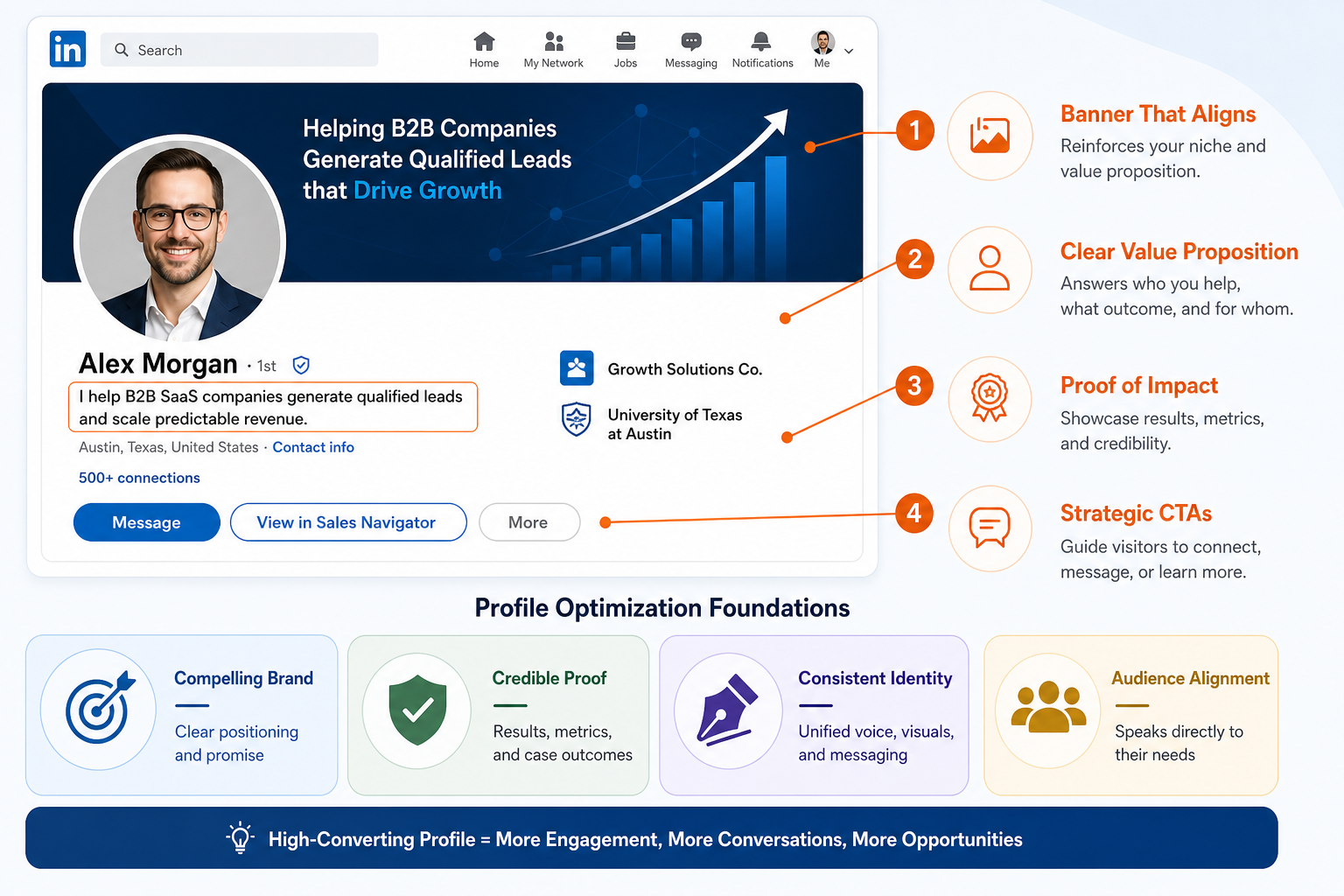
Profile Optimization Foundations
Profile Optimization Foundations A high converting LinkedIn profile serves as the anchor for your growth system. It is not just a digital resume; it is a dynamic landing page that communicates who you are, who you help, and how you deliver value. When your personal branding aligns with the expectations of your ICPs, every visitor is more likely to engage, follow, and initiate conversations that move them closer to your goals.
When your personal branding aligns with the expectations of your ICPs, every visitor is more likely to engage, follow, and initiate conversations that move them closer to your goals.
Craft a Compelling Personal Brand
Your personal brand is the mental model your audience forms when they encounter your profile. It should be distinctive, credible, and instantly understandable. Build it around three pillars:
Keep your messaging concise and human. People skim profiles, so highlight how you help, the outcomes you enable, and who benefits most.
- Value proposition in a single, scannable sentence that answers: who you help, what outcome you enable, and for whom.
- Proof of capability through concrete results, case outcomes, or tangible metrics that demonstrate impact.
- Consistency across touchpoints by mirroring your brand voice, visuals, and messaging from your website, portfolio, and other social profiles.
Profile Photo, Banner, and Visual Identity
First impressions matter. Use visuals that reflect professionalism and your niche without sacrificing approachability.
Aim for a cohesive look across your profile. The photo, banner, and overall color scheme should reinforce your niche and value proposition while staying approachable.
- Profile photo — a clear, high-resolution headshot with a neutral background and appropriate attire for your industry.
- Banner image — a banner that reinforces your niche and value proposition. It should complement your headline and About section, not clutter the frame.
- Visual consistency — align colors, typography cues, and iconography with your brand kit to create immediate recognition across posts and messages.
Headline and About Section that Convert
These two elements are prime real estate for signaling relevance and inviting action. Move beyond job titles and craft language that speaks directly to your ICPs.
A clear message helps you attract the right audience and invites engagement without turning the content into a generic pitch.
- Headline — a value oriented statement that communicates outcome and audience. Example structure: Helping [ICP] achieve [outcome] through [approach].
- About section — write in the first person, tell a concise story, describe the problems you solve, the measurable results you deliver, and who benefits. Include keywords your audience might search for to boost discoverability.
Experience, Media, and Social Proof
Show rather than tell by pairing each role or project with tangible evidence of impact. Leverage media and pro tips below.
Concrete examples and public references help others understand how you work and the outcomes you create.
- Experience details — include brief context, the challenges faced, the actions you took, and the outcomes achieved with metrics where possible.
- Rich media — case studies, one pagers, brief video clips, or slide decks that illustrate results and processes.
- Recommendations — curate 2 to 4 credible testimonials from colleagues, clients, or collaborators that reinforce your credibility and collaboration style.
URL, Visibility, and Accessibility
Optimize discoverability and ease of connection with clean, shareable access points and inclusive design.
Clear profile structure helps people find you quickly and engage with your content and value.
- Custom URL — personalize your LinkedIn URL to a concise, professional handle that matches your name or brand.
- Public visibility — ensure your profile is publicly accessible so external search indexes and potential collaborators can find you.
- Accessibility — use descriptive alt text for media, captions for videos, and clear language that is understandable to a broad professional audience.
Key Elements Checklist
This checklist helps you target each profile area and track what matters most for visibility and engagement.
Review the items, apply the best practices, and update your profile to attract qualified interactions.
| Element | Best Practice | Success Signal |
|---|---|---|
| Profile photo | Professional headshot, neutral background, appropriate attire | A higher rate of profile views and connection requests |
| Banner | On brand, communicates niche and value proposition | Increased click-throughs to your About or website links |
| Headline | Audience specific, outcome focused | More profile visits from relevant searches and posts |
| About | First person narrative, problems solved, outcomes, ICPs, keywords | Direct messages from prospects and inbound connections |
| Experience and media | Concise results, relevant media, measurable impact | Qualifying conversations and requests for more detail |
| URL and visibility | Custom URL, profile public, accessible media | External traffic and profile impressions from search |
Alignment with Audience Expectations
Maintaining alignment means continuously mapping profile messaging to ICP needs and buyer personas. Apply these practices to stay relevant and credible:
- ICP mapping — periodically refresh your ICP definitions and ensure your profile speaks to their stage in the buyer journey.
- Problem outcome framing — emphasize the problems you help solve and the concrete outcomes clients achieve, not just activities you perform.
- Search intent alignment — embed keywords that your ICP would search for, but prioritize natural, compelling copy over keyword stuffing.
- Social proof cadence — refresh recommendations and media to reflect current capabilities and client successes.
A converting profile reads as a compact narrative: who you help, how you help, and why it matters now. When every profile element reinforces that story, you create a smooth handoff from discovery to engagement, laying a solid foundation for all subsequent LinkedIn growth tactics.
Professional Headshot
Professional Headshot A clear, high-quality headshot is the quickest way to establish credibility and invite engagement on LinkedIn. Your photo is often the first impression visitors form before they read your headline or About section, and it can significantly influence both profile views and inbound messages. A strong headshot signals professionalism, approachability, and attention to detail, which together increase the likelihood that curious visitors become connections or inquiries.
Impact snapshot – Profiles with polished, professional headshots tend to attract more interest. Data from professional networking research indicates that well-presented photos correlate with higher view rates and more direct messages compared to lower quality images. In practice this means more inbound conversations and faster movement along the buyer journey when the photo communicates competence and trustworthiness at a glance.
Guidelines for a professional presentation:
- Lighting — use soft, natural light or diffused artificial lighting to avoid harsh shadows. Lighting from the front or slightly to the side creates a bright, flattering appearance without glare.
- Background — choose a clean, neutral background that does not distract from your face. Subtle gradients or solid colors that complement your branding work well.
- Framing — frame from just above the chest to the top of the head with a small amount of space above. Center your face and maintain headroom that feels balanced in the frame.
- Attire — wear professional, industry appropriate attire. Solid colors often photograph best and avoid busy patterns that can distract in thumbnails.
- Expression — project approachable confidence with a natural, light smile. A friendly expression helps invite connections and conversations.
- Resolution and cropping — save the image at high resolution (at least 2000 pixels on the long edge) and export in a standard format (JPEG or PNG). Ensure the crop remains clear when LinkedIn scales it to a thumbnail.
- Consistency across presence — align the headshot style with your personal brand. If you use a particular color palette or mood in your visuals, consider a photo that harmonizes with that identity.
- Accessibility — add descriptive alt text such as “Portrait of [Your Name], professional headshot in a neutral background.” This helps screen readers convey context to users with visual impairments.
Practical implementation tips:
- Choose a photographer or a solid self capture — if using a photographer, share the brand mood and background options to ensure alignment with your profile. If self shooting, use a tripod or stable surface, a natural pose, and a high-quality camera or smartphone with portrait mode.
- A/B testing potential — if you maintain multiple personas or audiences, consider testing two headshots to observe which one yields higher profile views and message volume.
- Update cadence — refresh your headshot periodically to reflect your current role, industry and branding, typically every 1 to 2 years or after a significant branding shift.
Success signals — monitor changes in profile views, inbound messages, and connection requests after updating your headshot. A positive shift indicates the image is resonating with your ICPs and reinforcing your professional narrative.
Headline That Sells Your Value
Headline That Sells Your Value is the front door to your LinkedIn presence. It should instantly answer three questions for your target audience: who you serve, what outcome you deliver, and how you help. Move beyond a bare job title and craft a value driven statement that positions you as the solution to a concrete problem your ICP cares about.
Guiding principles for your headline:
- Audience first: Speak directly to the needs of your ICP, not just your role.
- Outcome orientation: Highlight a tangible result, metric, or capability you enable.
- Specificity over generality: Avoid vague titles; choose a precise framing that people can immediately relate to.
- Clarity over cleverness: Be memorable through clarity, not overly clever phrasing.
Structured headline formulas you can adapt today:
- Outcome for ICP through a method: Helping [ICP] achieve [outcome] through [approach]
- Role plus value proposition: [Role] enabling [ICP] to [outcome] with [method]
- Problem to solution framing: To [ICP], I turn [pain] into [result]
- Quantified impact: [Outcome] for [ICP] in [time period] using [technique]
Practical examples you can model or tailor:
- Example 1: Helping SaaS startups increase activation rates by 30 percent through rapid onboarding playbooks
- Example 2: Marketing leaders reduce cost per acquisition by 40 percent with data driven content systems
- Example 3: Senior sales teams shorten deal cycles by delivering buyer intent playbooks
- Example 4: Finance teams accelerate close processes using automated consolidation templates
Implementation tips to optimize your headline quickly:
- Draft multiple variants: write 4 to 6 headline options and test which resonates best with your ICPs.
- Embed a value signal: include a specific outcome or metric to anchor credibility.
- Align with your About section: ensure the headline sets expectations that your full narrative delivers.
- A/B testing approach: periodically rotate between 2 headline variants and monitor profile view to connection rate and message volume.
Measurement cues to know you have a selling headline:
| Signal | What it indicates | How to respond |
|---|---|---|
| Increase in profile views | More people are curious about your value proposition | Maintain consistency with your About section and call to action |
| Higher connection rate | ICP identify resonates and initiates conversations | Refine the wording to sharpen alignment with ICP needs |
| More inbound messages referencing the headline | Audience recognizes you as a potential solution | Prepare a concise, clear response path to conversations |
| Engagement on headline related posts | Readers engage when the value proposition is spot on | Iterate on the framing and supporting content in posts |
In sum, the Headline That Sells Your Value acts as a concise promise to your ICPs. Use a stable framework, anchor it in a measurable outcome, and iterate based on real audience signals. When done well, your headline not only attracts attention but also primes readers to engage with the rest of your profile and your content ecosystem.
Custom LinkedIn URL
Custom LinkedIn URL is a small but powerful branding element that can dramatically improve your discoverability and professionalism across channels. A clean, memorable URL makes it easier for people to find you, remember your profile, and share your link in emails, presentations, and marketing materials. When done well, it reduces friction for inbound connections and reinforces your personal or brand identity every time you appear online.
- Choose a simple, stable handle — use your full name if possible, or a concise combination such as first initial and last name. Avoid numerals unless they are part of your official brand or there is unavoidable ambiguity.
- Consistency is key — align your LinkedIn URL with other public identifiers (for example, your website domain or professional social handles) to reinforce recognition and ease of recall.
- Check availability and alternatives — if your preferred URL is taken, consider minimal variations like adding a middle initial, profession tag, or location in a way that remains clean and memorable.
- Keep it public when appropriate — ensure the URL points to a profile that is accessible to people who are not logged in, improving external discoverability through search.
Best practices for implementing and leveraging your Custom LinkedIn URL include:
| Action | Best practice | Success signal |
|---|---|---|
| Choose URL | Use your full name or a clear, minimal variant without numbers or punctuation | Unique, easy to read, and memorable URL |
| Update materials | Place the URL on email signatures, business cards, resume, website bio, and social profiles | Increased external clicks and profile visits from non LinkedIn sources |
| Public visibility | Set profile visibility to public and ensure the URL is indexable by search engines | Higher appearance in searches for your name or brand |
| Monitoring | periodically verify that the URL remains the same after updates to your profile | No broken or outdated links in external communications |
Practical tips for ongoing optimization and usage:
- Promote consistently at touchpoints — include your custom URL in signature blocks, speaker bios, slide decks, and outbound outreach to streamline connections.
- A/B test anchor placements — experiment with placing the URL near your call to action, or within a brief bio paragraph, to see where it drives more profile visits.
- Align with search intent — when people search for your name, ensure your profile is discoverable by keeping your About section and headline aligned with common name-based queries.
- Accessibility considerations — provide descriptive link text where the URL is used in long-form content, so readers understand what they will access when they click.
In summary, a well crafted Custom LinkedIn URL is a foundational asset that supports credible personal branding and easier network growth. When you pair a clean URL with consistent cross channel usage, you reduce friction for prospects and peers to connect, learn, and engage with your content and offerings.
About Section
About Section written in first person is my personal storytelling hub on LinkedIn. I speak directly to the audience I serve, outlining the problems I solve, the measurable results I deliver, and the exact roles I help them play. This section acts as a compass for visitors, guiding them to understand how my expertise aligns with their goals within the framework of LinkedIn Growth Tactics.
I begin with a concise, audience specific statement that answers three essential questions:
- Whom I help — I clarify the target audience using clear ICP language such as industry, company size, seniority, and role responsibilities. This helps the reader instantly identify relevance.
- What problem I solve — I name the core pains or bottlenecks my work addresses, from missing visibility to inefficient content strategies, to illustrate immediate value.
- How I help them achieve outcomes — I articulate the approach, whether it is strategic content systems, personal branding, or data driven optimization, and the concrete outcomes they can expect.
In practice, I structure the About section around three pillars that reinforce credibility and intent:
- Problems solved — I describe the specific challenges my ICP faces, such as low organic reach, inconsistent posting cadence, and a lack of compelling hooks that convert views into conversations.
- Results delivered — I share tangible outcomes like increased impression share, higher engagement quality, faster lead qualification, and stronger pipeline signals, with numbers where appropriate to anchor credibility.
- Audience focus — I address the exact buyer personas and ICPs I serve, ensuring every sentence speaks to their stage in the professional journey and their information needs on LinkedIn.
Strategic keyword inclusion is woven into a natural narrative to support discoverability without sounding mechanical. For example, I integrate terms like LinkedIn Growth Tactics, organic LinkedIn strategy, profile optimization, and content strategy for LinkedIn in a way that reads fluently and remains audience centric. This helps both readers and search engines understand my specialization and the value I provide.
When readers finish the About section, they should feel confidence in my capabilities and clarity about how we might work together. The language stays human, the tone remains professional, and the message aligns with the broader LinkedIn Growth Tactics framework by emphasizing outcomes, practical methodologies, and a client focused mindset.
Example structure cues I follow:
- Short, outcome oriented positioning that resonates with ICP needs.
- Evidence of impact through brief results and credible metrics.
- A callout to the kinds of collaborations or engagements I pursue that align with the reader’s objectives.
In sum, the About section is your credibility engine in the LinkedIn Growth Tactics playbook. It translates interest into trust, positions you as a credible problem solver, and sets the stage for meaningful conversations with your ideal audience.
Visual Branding Elements and Creator Mode
Visual Branding Elements and Creator Mode focuses on building a cohesive visual language that accelerates recognition and leverages LinkedIn’s enhanced visibility features. By combining Canva designed visuals with Creator Mode, you can reinforce your brand identity while increasing the reach and resonance of your content on the platform.
Canva designed visuals that reinforce brand identity
Canva is a versatile tool for producing on platform visuals that are on brand, scalable, and quick to iterate. Use it to create a consistent suite of templates that support your LinkedIn Growth Tactics framework.
- Brand kit and templates — establish a shared color palette, typography, and logo usage rules in Canva. Create reusable templates for carousels, image posts, and banners so readers instantly recognize your content.
- Carousel design system — design 5 to 10 slide carousels with a logical progression, clear typography, and a consistent end slide that invites engagement or a CTA.
- Image and infographic basics — use bold, scannable headlines, ample white space, and concise data visuals. Ensure charts and icons are legible at LinkedIn thumbnail sizes.
- Video thumbnails — create uniform thumbnails for on platform videos, featuring a small headshot, a short value statement, and a branded color bar for quick recognition.
- Accessibility by design — apply high contrast, large readable fonts, descriptive alt text for all visuals, and captions for videos to improve accessibility and reach.
Practical Canva workflow:
- Start with a master brand template: header, body, and footer that carry your logo and key color accents.
- Duplicate and tailor templates for different formats (carousels, single image, video cover) while preserving core elements.
- Export in appropriate sizes for LinkedIn: square for posts, 16:9 for banners and video covers, and vertical for carousel slides where applicable.
Creator Mode and how to leverage it
Creator Mode is a LinkedIn setting that boosts visibility for content creators and concentrates attention on your thought leadership topics. When activated, Creator Mode amplifies your reach for the topics you publish about and surfaces you to followers who engage with similar content.
- When to enable — use Creator Mode if your strategy centers on consistent content creation, niche expertise, and audience education rather than broad connection growth.
- Hashtag emphasis — select 4 to 8 relevant hashtags that define your niche and feature them prominently in your profile to boost discovery.
- Content emphasis — structure posts to foreground your expertise areas. Use consistent headers, formats, and visual motifs so readers recognize your specialization immediately.
- Creator features — take advantage of newsletters, LinkedIn Live, and more prominent post visibility to reach new audiences with your brand message.
Implementation steps:
- Navigate to your profile settings and enable Creator Mode when the focus is on content creation and audience building.
- Choose 4 to 8 hashtags that align with your ICPs and content themes; add these to your profile headline and about sections as appropriate.
- Refactor your content structure so each post clearly highlights your core topics, with a predictable format that your audience can follow.
- Experiment with Creator Mode tools like newsletters and live sessions to diversify content formats and deepen engagement.
Measuring impact of visuals and Creator Mode
- Visual consistency — track perception and recognition by monitoring profile visits, content saves, and direct messages that reference your branding.
- Creator Mode lift — compare reach, impression share, and follower growth before and after activation to quantify visibility gains.
- Format performance — assess engagement, saves, comments, and click throughs across Canva designed templates to identify which visuals drive the strongest action.
- Accessibility signals — monitor accessibility metrics such as alt text usage and caption engagement to ensure inclusivity does not come at the expense of impact.
Best practices checklist
| Element | Best Practice | Success Signal |
|---|---|---|
| Brand kit in Canva | Defined colors, typography, logo usage; ready-to-edit templates | Faster production and consistent visuals across posts |
| Carousel system | 5 to 10 slides, cohesive sequence, strong end CTA | Higher saves and longer dwell time |
| On platform media | Media that keeps readers on LinkedIn, minimal external links | Increased reach and engagement signals |
| Accessibility | Descriptive alt text, captions, legible typography | Broader audience including accessibility minded users |
| Creator Mode configuration | 4 to 8 niche hashtags, emphasis on topics, newsletters if relevant | Improved topic discovery and follower growth within target ICPs |
In sum, using Canva designed visuals consistently with a well configured Creator Mode creates a recognizable, credible, and scalable content engine. This combination not only strengthens brand identity but also accelerates content discovery and engagement within your target professional ecosystem.
Optimization for Search
Optimization for Search centers on making your LinkedIn profile discoverable within the LinkedIn ecosystem and on external search engines like Google. When done well, your profile becomes a highly visible entry point that attracts the right audience and speeds up connection requests, inquiries, and opportunities. The aim is to blend platform native search signals with external search intent while preserving a human, audience-centric narrative.
Key principles to apply across the profile include:
- Public visibility — keep the profile public so search engines can index your content and surface your profile in relevant queries. Public visibility also enables external visitors to view your About section, posts, and media without friction.
- Strategic keyword integration — identify terms your ICPs would search for, and weave them naturally into your headline, About section, Experience descriptions, and media captions. Avoid keyword stuffing and prioritize readability and relevance.
- On page tuning inside LinkedIn — tune core sections that drive search within LinkedIn: Headline, About, Experience, Skills, and Recommendations. Each area should reinforce your value proposition and incorporate relevant keywords.
- External discoverability — craft content that aligns with both LinkedIn search intent and Google search queries. This creates a cohesive signal that helps you appear in both internal and external results.
Practical steps to tune search on LinkedIn and beyond:
| Element | Strategy | Success signal |
|---|---|---|
| Headline | Incorporate a primary keyword or two that describe your niche and outcome, while keeping it client focused. Example: “LinkedIn Growth Strategist helping B2B SaaS teams accelerate pipeline with data driven content systems.” | A higher rate of profile views and suggested connections from relevant searches |
| About section | Write in the first person and embed keywords naturally while addressing ICP pains and outcomes. Include a concise value proposition and a few long tail terms people might search for. | Queries and messages from prospects finding you through search intent |
| Experience descriptions | Describe roles with outcome oriented bullets and integrate role related keywords where relevant. Use metrics to strengthen credibility. | Profile visitors who read the full experience section and reach out for specifics |
| Skills and endorsements | List the most impactful skills that reflect your niche and ICP needs. Align keywords with what your audience searches for. | Endorsements from peers and more keyword aligned search matches |
| Media and content | Use descriptive alt text for images and captions that include relevant terms. Publish long form articles or PDFs that answer common ICP questions and include keyword variants. | Indexed media in external search results and longer average time on profile |
| Public link and accessibility | Ensure the public URL is clean and easy to share. Verify accessibility features like alt text and captions to improve visibility and inclusivity. | Higher external click through from search results and better user experience |
Common keywords to consider, tailored to your ICPs, might include combinations of the following themes:
- Industry and role specific terms (for example, LinkedIn Growth Tactics, organic LinkedIn strategy, profile optimization).
- Outcomes and metrics (for example, lead generation, faster onboarding, higher engagement).
- Format and format specific terms (for example, carousels, LinkedIn Live, creator mode).
Implementation tips to keep search tuning practical and durable:
- Perform keyword research focused on your ICPs and buyer personas. Use terms they would type when seeking the services you provide.
- Audit your profile quarterly to refresh keywords, update metrics, and reflect new capabilities or services.
- Maintain natural language and readability. Content that reads clearly performs better with both human readers and search engines.
- Balance short tail and long tail terms. Short phrases improve general discoverability, while long tail terms attract highly qualified visitors.
By aligning your LinkedIn profile content with search intent and keeping the profile publicly accessible, you expand your reach beyond LinkedIn and improve your chances of appearing in Google and other search engines. This foundational tuning supports all other LinkedIn Growth Tactics by increasing inbound discovery and enabling smoother pathways from discovery to engagement.
Content Strategy: Create Consistent, High-Value Posts
Content Strategy: Create Consistent, High-Value Posts functions as the engine that turns a well crafted profile into a trusted authority. The aim is to establish deep expertise in a specific niche while delivering actionable value that resonates with your ICPs. This framework emphasizes clarity, consistency, and measurable outcomes, ensuring every post advances your position as a go-to resource rather than simply generating attention.
To keep momentum, publish content that speaks directly to problems your audience faces. Build a rhythm that feels natural and genuine. Each post should reinforce your core message and invite meaningful engagement without feeling forced.
Think in terms of a few recurring formats. Mix educational threads, concise tips, and real-world case studies. When you share results, include the steps you took and the lessons learned. This approach helps readers see practical value, not just ideas.
Create a content calendar that mirrors your audience’s priorities. Plan topics around common ICP questions, product updates, and industry trends. The calendar should be flexible enough to accommodate timely insights as they arise.
Engagement matters as much as publishing. Respond to comments, thank people for insights, and acknowledge differing viewpoints. This builds a community around your expertise and invites ongoing dialogue.
Tracking impact is essential. Monitor metrics such as post reach, saves, comments, and inbound inquiries. Use these signals to refine your approach and improve future results.
Define Your Niche and Own It
Depth beats breadth in professional networks. By choosing a tightly scoped niche and a clear sub niche, you create recognizable expertise that stands out in a crowded feed. A well defined focus helps you attract the right followers, invites meaningful conversations, and accelerates the path from awareness to engagement.
- Niche clarity: articulate the specific domain you cover and the unique angle you bring.
- Sub niche precision: break the topic into a focused specialty to distinguish you from generalists.
- Audience alignment: map content to the ICPs and buyer personas most likely to seek your insights.
With clarity comes momentum. When you consistently show up with a clear niche, your content becomes recognizable and conversations begin to form around your posts.
Value Framework: Learn, Apply, Validate
Structure your posts around a simple three-act framework that consistently delivers value. This approach helps readers extract practical takeaways and signals to the LinkedIn algorithm that your content is useful and reliable.
| Stage | Purpose | What to Deliver |
|---|---|---|
| Learn | Introduce a concept, framework, or insight. | Concise explanation, context, and a reference point readers can recall. |
| Apply | Provide actionable steps readers can implement immediately. | Step by step guide, checklists, templates, or playbooks. |
| Validate | Confirm outcomes and invite reflection to deepen trust. | Examples, case outcomes, prompts for readers to share their results. |
This rhythm helps followers know what to expect and makes your value repeatable.
Posting Cadence: Consistency Over Intensity
Consistency is the heartbeat of growth on LinkedIn. A sustainable cadence keeps you top of mind and signals reliability to your audience and the algorithm. Define a baseline that your team can maintain over weeks and months, then scale thoughtfully as you learn what resonates.
Start with a baseline you can sustain for weeks. Reassess as you gather data on what resonates with your audience.
- Choose a practical baseline such as 3 to 5 posts per week.
- Establish a predictable pattern (for example, Monday, Wednesday, Friday) and adhere to it for at least 6 to 8 weeks.
- Balance quantity with quality; never sacrifice meaning for the sake of frequency.
- Use a content calendar to plan themes, formats, and CTAs in advance.
| Cadence | Rationale | Milestone |
|---|---|---|
| 3 posts per week | Steady visibility without overwhelming readers | Stable follower growth |
| 4 to 5 posts per week | Increased reach with manageable workload | Accelerated impressions and engagement |
| Daily, alternating formats | Maximizes presence while testing format effectiveness | Identification of high performing formats |
Content Formats: Diversify for Different Learning Styles
Different formats capture attention in different ways. A balanced mix keeps your feed dynamic and ensures your core messages land with various audience segments. Prioritize formats that stay on platform to maximize reach and engagement.
Using a variety keeps your content from feeling repetitive and helps reach people who prefer different styles of learning.
- Carousels: educator friendly, step by step, and highly savable.
- Short videos: authentic insights, quick demos, behind the scenes.
- Images and graphics: bold, single idea visuals that convey a takeaway at a glance.
- Polls and interactive content: rapid insights and early engagement signals.
- Long form articles: authority building and depth for readers who want a comprehensive view.
Hooks, Tones, and CTAs: Driving Initial Engagement
The opening hook, the tone, and a clear call to action determine whether a post earns a second glance, a comment, or a share. Aim for hooks that promise value within the first 125 characters, keep a professional yet approachable voice, and end with a question that invites discussion.
Consistent emphasis on hooks, tone, and CTAs helps readers recognize your pattern and respond more often.
- Hooks: pose a question, reveal a surprising stat, or present a practical dilemma.
- Tone: confident, credible, and human; avoid jargon overload and maintain accessibility.
- CTA: invite comments, request examples, or prompt readers to save or share for future reference.
Quality Control: Standards for every piece
Quality is non negotiable. Establish a lightweight review process that emphasizes clarity, accuracy, and relevance to your ICPs. Use checklists to ensure consistency across posts and formats.
Apply the same standards to every piece, so readers know what to expect.
| Checklist item | Best practice | Success signal |
|---|---|---|
| Clarity | Clear takeaway in the first line; simple language | Readers grasp the value quickly |
| Relevance | Directly addresses ICP pains and outcomes | Comments mention real world applicability |
| Evidence | Include data points, examples, or references where possible | Post contains tangible proof and credibility |
| Actionability | Provide clear steps, templates, or frameworks | Readers implement and report results |
| Formatting | Skimmable sections, bullet lists, and visuals | Higher dwell time and saves |
Measurement and Iteration: Data-Driven Content Mastery
A disciplined approach to measurement turns content into a repeatable system. Track a focused set of KPIs for each post type and use weekly reviews to decide what to scale, tweak, or retire.
Keep the process simple. Regular checks reveal what resonates and where to improve, so your cadence stays aligned with audience needs.
- Core KPIs: impressions, engagements, saves, comments, click throughs, and follower growth.
- Quality signals: depth of comments, time spent reading, and audience questions raised.
- Iteration cadence: implement a quarterly content experiment plan with hypotheses, indicators, and resource estimates.
Practical Examples: From Idea to Impact
Turn topics you already understand into repeatable post templates. For each niche cluster, create a mini playbook that you can reuse with fresh data and examples.
Build a library of patterns—templates, formats, and prompts—that you can mix and match as your audience evolves.
- Idea to post: a carousel that walks through a 5 step framework for a common ICP challenge, ending with a prompt for discussion.
- Case snippet: a short video or image post highlighting a recent outcome and the exact approach used.
- Toolkit post: share a downloadable checklist or template that readers can apply immediately.
In essence, a consistent approach to posting provides a repeatable system for building expertise. By defining a precise niche, applying a value-driven framework, maintaining a sustainable cadence, and measuring results, you create a reliable engine for growth that scales with your audience’s evolving needs.
Choose Your Niche and Own It
Choose Your Niche and Own It Depth beats breadth in the crowded LinkedIn feed. By selecting a clearly defined niche and a precise sub niche, you position yourself as the go to expert for a specific audience. This focused authority accelerates trust, reduces competing messages, and improves the relevance of every post you publish.
Start by identifying a high value intersection where your expertise, customer pains, and market demand align. Then narrow further into a sub niche that differentiates you from generalists. The goal is to become the first name that professionals in that segment think of when they need practical guidance, not just a generic voice in a broad field.
How to define your niche in three steps:
- Map problems to outcomes — list the top pains your ICPs face and the concrete results you help them achieve.
- Assess audience size and competition — ensure there is a sizable audience but limited direct competition focused on your precise angle.
- Test a narrow hypothesis — publish content within a tight theme for 4 to 6 weeks and observe engagement quality and follower alignment.
Concrete niche examples to differentiate you:
- LinkedIn growth for B2B SaaS onboarding teams — focus on activation, time to first value, and onboarding playbooks tailored to SaaS buyers.
- Content systems for field sales teams in mid market — strategies that shorten sales cycles, align marketing and sales, and accelerate pipeline with demo driven content.
- Organic visibility for manufacturing procurement leaders — best practices for supplier communications, RFP content refinement, and niche industry storytelling.
- Executive personal branding for early stage fintech founders — positioning, investor storytelling, and regulatory friendly thought leadership in fintech.
- Recruiting and employer branding for health care startups — content systems that attract nursing and clinical talent while communicating culture and impact.
- LinkedIn strategy for professional services junior partners — tips for thought leadership, client education, and practice area differentiation.
Measurement prompts to validate your niche choice include tracking the rate at which new followers opt in for deeper content related to your focus, the level of comments that reveal topic interest, and the quality of inbound inquiries that reference your specialized topic.
By intentionally narrowing your focus and consistently delivering practical value in a tightly scoped domain, you create a recognizable, trusted identity that stands out in a crowded feed. This is the foundation for scalable growth using the LinkedIn Growth Tactics framework.
Posting Frequency and Timing
Posting Frequency and Timing sustaining a regular cadence is essential for visibility and credibility on LinkedIn. The goal is to establish a rhythm that keeps you top of mind without causing content fatigue for your team or audience. A practical, sustainable baseline is three to five posts per week, tuned to the needs and behavior of your target audience in their local time zones.
- Start with a manageable baseline such as 3 to 5 posts per week. This cadence delivers steady presence while minimizing burnout and content quality risk.
- Adopt a fixed pattern. For example, publish on Monday, Wednesday, and Friday or every weekday if you have the bandwidth. Predictability helps your audience anticipate and engage with your content.
- Balance volume with value. It is better to publish fewer high quality posts than many low effort updates. Use an editorial calendar to plan themes, formats, and CTAs in advance.
- Leverage analytics to refine timing. Regularly review when your audience is most active and adjust posting times accordingly. Small timing shifts can yield meaningful gains in reach and engagement.
| Cadence | Rationale | Milestone |
|---|---|---|
| 3 posts per week | Steady visibility without overwhelming readers | Stable follower growth and reliable engagement |
| 4 to 5 posts per week | Increased reach while maintaining quality control | Accelerated impressions and engagements |
| Daily posting (weekday only) | Top of funnel momentum with opportunities for depth over time | Sustained growth in followers and ongoing conversations |
Timing considerations should be data driven. Use platform analytics to identify when your audience is most active and experiment with small shifts to locate the optimal windows. While results can vary by niche, several practical patterns often emerge as starting points:
- Midweek activity tends to be higher on LinkedIn, with engagement often strongest on Tuesday, Wednesday, and Thursday.
- Morning windows around 8 to 10 AM in the target audience’s time zone frequently capture professionals checking the platform before work.
- Lunchtime and late afternoon slots around 12 to 1 PM and 4 to 6 PM can also yield solid engagement as people take breaks or wrap up the day.
- Test and iterate start with a baseline and run controlled tests by posting similar content at different times over a few weeks. Compare impressions, engagements, and follower responses to identify reliable patterns.
Practical workflow tips to sustain momentum:
- Editorial calendar: Map themes, formats, and posting times at least two weeks in advance to reduce planning friction.
- Batch creation: Produce multiple posts in a single session to preserve cadence during busy periods.
- Buffer for gaps: Reserve one evergreen post per week to fill gaps if opportunities arise or constraints appear.
- Cross platform alignment: Align LinkedIn cadence with other channels to maintain a cohesive rhythm without duplicating content.
By pairing a clear posting cadence with data-driven timing, you can sustain momentum, improve audience signals, and steadily grow your presence on LinkedIn. The best schedule is the one your team can consistently execute while delivering value to your ICPs and buyer personas.
Craft Compelling Hooks
Craft Compelling Hooks is the art of seizing attention in the first 125 characters. A strong hook sets the frame for value, credibility, and curiosity, inviting readers to stay and engage. Use a mix of questions, surprising statistics, and bold statements to stop the scroll and pull your ICP into the narrative that follows.
Capture attention quickly by combining curiosity with a clear promise. The right opening primes readers for the practical value, data, or framework that follows.
Questions that trigger curiosity
- Pose a problem or decision your audience faces, framed around their context. Example: What if onboarding could cut your time to value by 50 percent in just one week?
- Ask a provocative but relevant question that invites personal reflection. Example: Are you accidentally losing impact with every LinkedIn post you publish?
- Use a hypothetical that implies a concrete outcome. Example: If you could improve lead quality with one adjustment, would you try it today?
Statistics that establish credibility
- Lead with a precise stat that resonates with ICP goals. Example: Teams that publish three times weekly see a 34 percent increase in qualified conversations.
- Pair the stat with a contrast to highlight impact. Example: Most posts are ignored after 90 seconds; ours convert in under 2 minutes.
- Use ranges when exact numbers aren’t available. Example: Early results show a 20 to 40 percent improvement in engagement with this approach.
Bold statements that promise value
- Lead with a clear outcome that speaks to ICP priorities. Example: Turn 5 minute content into 5x more meetings.
- Make a contrast that signals a smarter path. Example: Stop posting for reach. Start posting for conversations that convert.
- State a principle or framework succinctly. Example: Clarity beats cleverness in every headline.
Framing and structure tips
- Keep it tight — aim for a single idea and one clear value promise within the first 125 characters.
- Lead with the outcome — reveal the result readers can expect to achieve by reading further.
- Set reader expectations — hint at how the post will deliver practical steps, data, or a framework.
- Use on platform cues — favor phrasing that hints at on LinkedIn value, such as a quick tip, a takeaway, or a bite sized insight.
Practical hook frameworks you can reuse
- Outcome hook — How to cut onboarding time by half this quarter
- Question hook — What single change would double your post impressions this week?
- Statistic hook — Only 1 in 5 posts earns meaningful comments; here is the format that wins
- Bold claim hook — Most growth posts ignore this one lever and miss 60 percent of opportunity
Testing and iteration
- Develop a small set of 4 to 6 hook variants per topic and test over a short window to gauge resonance.
- Track which hook types generate more saves, comments, and click throughs, then prioritize those styles.
- Rotate hooks periodically to prevent fatigue and discover which angles continuously perform for your ICPs.
Measurement cues for hooks include improvements in early engagement, higher save rates, and increased bookmark or share actions. When hooks consistently outperform others, you’ll see stronger initial scroll stops, longer dwell times, and more meaningful conversations that drive downstream outcomes.
Authenticity Drives Engagement
Authenticity Drives Engagement In a crowded feed, audiences crave stories that feel real and human. Sharing personal experiences, lessons learned, and behind the scenes glimpses creates a bridge of trust between you and your audience. When readers sense honesty and vulnerability, they are more inclined to comment, ask questions, and engage in meaningful dialogue that moves conversations forward.
Authenticity resonates when you balance openness with professionalism and relevance to your audience.
- Share real stories from your professional journey, including challenges you faced, what you tried, and the outcomes. Highlight both successes and missteps to provide a balanced, relatable narrative.
- Show behind the scenes give a peek into your daily workflow, decision making, or the process behind a key project. Visuals such as quick clips, photos from the workspace, or notebook sketches can humanize your content.
- Discuss learnings and pivots Talk openly about what did not work, why it happened, and how you adjusted. Audiences appreciate transparency and practical wisdom that comes from iteration.
- Lead with curiosity pose honest questions about industry norms, invite counterpoints, and demonstrate receptiveness to feedback. This invites dialogue rather than a one way broadcast.
Guidelines to maintain credibility while sharing personal content:
- Relevance ensure every personal insight ties back to a tangible takeaway for your ICPs or audience goals.
- Boundaries protect sensitive information and respect confidences while still being authentic.
- Consistency align personal storytelling with your brand voice and the broader LinkedIn Growth Tactics framework.
- Value before vanity focus on lessons, frameworks, or prompts your audience can apply, not just anecdotes.
Engagement techniques that amplify authenticity:
- Open loops and questions end posts with a thoughtful prompt that invites readers to share their own experiences or outcomes.
- Comment prompts respond to comments with additional context or ask follow up questions to deepen the discussion.
- Community acknowledgement call out reader contributions, examples, or diverse perspectives to foster a collaborative atmosphere.
Sample prompts to spark authentic dialogue:
- What is the hardest professional lesson you learned this quarter, and how did it change your approach?
- Can you share a behind the scenes moment when a project nearly derailed and how you recovered?
- Which small, practical change had the biggest impact on your daily work recently?
Measurement focus for authenticity driven engagement:
- Comment quality and depth of discussion in response to personal narrative posts.
- Conversation velocity the rate at which thoughtful replies accumulate within the first 24 to 48 hours.
- Audience resonance whether followers with similar ICPs engage more frequently after authentic storytelling posts.
Ultimately, authenticity is a differentiator that humanizes your LinkedIn presence and elevates your content from information sharing to relationship building. By thoughtfully revealing real experiences and behind the scenes insights, you invite your audience to see you as a credible partner in their own professional journeys.
Strategic Call-to-Actions
Strategic Call-to-Actions CTAs are the levers that turn passive viewing into active engagement. When designed thoughtfully, CTAs invite meaningful comments, encourage shares, and spark conversations that signal value to the LinkedIn algorithm. The goal is not to shout promotional messages, but to invite interactions that reflect genuine utility and curiosity within your ICPs.
Clear prompts invite action. They should feel natural to the post and the reader’s journey.
Key principles for effective CTAs include:
- Clarity over cleverness — state exactly what you want readers to do and why it matters to them.
- Specificity — replace vague prompts like “engage” with concrete actions such as “comment with your top takeaway” or “share this with a teammate who would benefit.”
- Value signaling — imply or state the benefit readers gain from taking the action, such as gaining a new perspective, a practical template, or a next-step resource.
- Intent alignment — tailor the CTA to the post format and the stage of the reader’s journey (awareness, consideration, decision).
CTA frameworks you can reuse in posts:
- Comment to refine — What is your #1 takeaway and how would you apply it this week?
- Ask for examples — Share a concrete example from your own experience to illustrate this concept.
- Decision prompt — If you were to implement one change next week, which would it be and why?
- Resource request — Comment to receive a complimentary one page playbook you can customize.
- Tag to connect — Tag a colleague who would benefit from this approach and start a joint discussion in the comments.
Post design considerations to maximize CTA effectiveness:
- Phrasing in the first line — hint at the CTA early so readers know the action they are invited to take without scrolling.
- CTA placement — place the CTA near the end of the post when readers are primed to react, or in a dedicated closing line that stands out.
- Visual prompts — use on platform media (carousels, images, video overlays) that echo the CTA and guide the user toward the action.
- CTA cadence — mix lower friction CTAs (e.g., “comment below”) with higher value prompts (e.g., “download the template in the comments”).
Measuring CTAs and their impact on algorithm signals:
| Metric to Track | What It Signals | Iteration Idea | |
|---|---|---|---|
| Comment prompts | Number of comments, comment quality, replies per thread | Depth of engagement and conversation intensity | Test question prompts vs. open ended prompts to find the most engaging phrasing |
| Share prompts | Shares, new followers from shared posts, referral comments | Content value propagation and advocacy signals | Compare CTA asking for shares against CTAs asking for comments alone |
| Direct action CTAs | Clicks to resources, downloads, or brief signups | CTA strength and perceived utility | Rotate between free templates and case studies to measure lift |
| Conversation milestones | Messages or meeting requests initiated | Pipeline or relationship progression initiated from LinkedIn | Pair CTAs with follow up prompts to sustain dialogue |
Practical examples you can adapt today:
- Comment driven — Comment with your one question for further clarification and I will respond with a tailored tip
- Conversation starter — What is one practical step you can take this week to apply this framework? Share a mini plan in two bullet points
- CTA for collaboration — If you would like to explore this topic together, reply with “interested” and I will reach out to coordinate a time
Guidance for avoiding CTA fatigue and maintaining authenticity:
- Ashamed frequency — avoid calling for engagement in every post; reserve calls to action for content that truly invites dialogue or requires reader input.
- Relevance alignment — ensure each CTA ties directly to the content, the ICP needs, and the stated outcomes of the post.
- Transparency — if actions require time or effort, be explicit about what readers should expect in return (e.g., a template, a checklist, a preview of results).
In sum, Strategic Call-to-Actions transforms passive readers into an active, value seeking community. When CTAs are clear, specific, and aligned with reader outcomes, they reinforce your value proposition to the LinkedIn algorithm and accelerate the momentum of conversations, connections, and trusted relationships within your ICPs.
Hashtag Strategy
Hashtag Strategy A disciplined approach to hashtags helps you surface your content to the right professionals without looking spammy. Use a balanced set of targeted hashtags (up to five) that reflect your niche, ICP, and content theme.
Limit to five to keep signals clear and avoid diluting reach with broad tags.
- Limit to five to keep signals clear and avoid diluting reach with broad tags.
- Mix reach and specificity combine 1 or 2 broad industry tags with 2 or 3 niche tags that your ICP follows.
- Avoid repetition rotate hashtags across posts to prevent algorithm fatigue and to explore new audience pockets.
- Relevance first choose tags that directly relate to the content and the problems you address.
- Monitor and adapt track which hashtags drive impressions and engagement, then refresh monthly.
Implementation tips:
- Hashtag placement include them at the end of the post or in the first comment to keep the main copy clean while preserving discovery signals.
- Creator Mode alignment when Creator Mode is enabled, curate a set of 4 to 8 hashtags that define your topic focus and include them in your profile where appropriate.
Link Placement Strategy
Link Placement Strategy aims to preserve reach on LinkedIn while guiding readers to valuable external content. The core idea is to minimize external links in the main post copy, which can suppress reach due to platform algorithms, and instead place links in the comments where readers can discover them without sacrificing visibility. This approach keeps broad exposure while directing interested readers to deeper resources, signups, or content hosted off the platform.
Why this strategy matters:
- Algorithm friendliness posts that rely on on-platform media and engaging hooks tend to achieve higher impressions and engagement. External links in feed posts can trigger friction signals that reduce distribution.
- Reader experience keeping the main post focused on value and conversation makes it easier for readers to engage, comment, and share without being diverted by off-platform destinations.
- Controlled content flow placing links in the comments gives you a single, centralized place to update or replace the destination without editing the original post, preserving performance while still delivering the next step for readers.
Best practices for implementing link placement in LinkedIn content:
- Lead with value open with a clear takeaway, insight, or prompt that encourages engagement before mentioning any links in the comments.
- Comment strategy post the external link in the first comment and reference it in the main post with a prompt such as “Link in the first comment for a deeper dive.”
- Comment timing publish the link comment soon after the post goes live to capture readers who are actively engaging and asking for more resources.
- Anchor text and context in the main post can describe what readers will find in the comments, such as “download the full playbook in the comment below.”
- Consistency across posts establish a repeatable pattern so your audience understands where to look for external content without being prompted to scroll away from the post.
Operational workflow to implement link placement effectively:
| Step | Action | Measurement |
|---|---|---|
| Step 1 | Draft the post copy focused on value, with a mention that an external resource is available in the comments. | Post engagement rate within the first 48 hours |
| Step 2 | Publish the post and immediately add a first comment containing the external link and a brief description. | Comment engagement and click-throughs from the link |
| Step 3 | Monitor replies and questions; respond with additional context and, if appropriate, additional links in replies rather than the main post. | Comment depth and follow up actions, such as signups or demos |
| Step 4 | Periodically audit past posts to ensure links remain accurate and aligned with current offers or resources. | Link validity and ongoing relevance |
Guidance for when to place links in comments versus the post body:
- New content formats use comments for links to maximize reach during the initial deployment window.
- Evergreen resources consider linking in the post only if the content is intrinsically linked and non-promotional; otherwise, prefer the comment approach.
- Promotional or gated assets usually perform better when linked in comments to reduce feed friction while still enabling readers to take the next step.
Reader journey considerations:
- Clarity ensure readers understand there is a high-value resource available in the comments without feeling manipulated.
- Transparency briefly explain what readers will gain by visiting the link, such as a checklist, template, or in-depth analysis.
- Ethical prompting avoid misleading statements to entice clicks; keep the promise of the linked content obvious and relevant to the post topic.
In summary, the Link Placement Strategy preserves reach on LinkedIn while still guiding readers to additional content. By prioritizing on-platform value in the post, placing external destinations in the comments, and maintaining a consistent, reader-centric approach, you can sustain high distribution while driving meaningful actions from your ICPs.
Carousel Posts for Education
Carousel Posts for Education are a powerful on-platform format for delivering structured, incremental learning. A well-crafted 5 to 10 slide carousel acts like a mini course, guiding readers from a clear problem through a practical solution, with each slide building on the last. This format increases dwell time, encourages saves, and creates a reusable asset you can adapt across topics and ICPs.
Key principles to maximize impact:
- Single through line — ensure the entire carousel centers on one core learning objective, so readers can follow without cognitive overload.
- Digestible pacing — break the topic into 5 to 10 discrete steps or ideas, each on its own slide with a concise takeaway.
- On-platform readability — use large text, bold headlines, and high contrast. Remember readers may view on mobile with small screens.
- Actionable endcap — close with a concrete next step, template, or prompt that prompts discussion or implementation.
Slide architecture and practical workflow:
| Slide | Content Focus | Visual Cue | Takeaway |
|---|---|---|---|
| Slide 1 | Hook and problem framing | Bold headline + a provocative stat or question | Clarify the value readers will gain |
| Slide 2 | Context and relevance | Simple graphic that illustrates the scenario | Readers see how the topic touches their work |
| Slides 3-4 | Core concept or framework | Step visuals, icons, or a mini diagram | Introduce the mechanism or method |
| Slides 5-7 | Actionable steps | Checklist visuals or numbered steps | Provide a clear path to implementation |
| Slide 8 | Examples or mini case | Before/after or side by side comparison | Ground concepts in practical reality |
| Slide 9 | Tips and best practices | Bullet callouts with icons | Highlight common pitfalls and how to avoid them |
| Slide 10 | CTA and next step | Clear prompt or template download | Encourage saves, shares, or a follow up action |
Execution checklist to produce a high-performing carousel:
| Checklist item | Guidance | Success signal |
|---|---|---|
| Topic clarity | Choose one actionable outcome readers can apply within 24 hours | Comments share immediate takeaways and starter actions |
| Slide count | Aim for 5 to 10 slides depending on complexity | Completion rate through the final slide |
| Visual hierarchy | Large, scannable headlines; consistent typography | Higher saves and dwell time |
| On-platform framing | Minimize external links in the body; keep readers on LinkedIn | Stronger reach and engagement signals |
| End cap CTA | Offer a practical next step such as a checklist, template, or invitation to comment | Direct responses and follow up conversations |
Best practices for storytelling within carousels:
- Narrative arc — set up a tension, reveal a framework, and deliver a resolution you can measure.
- Visual consistency — use a repeatable template with a recognizable end slide to reinforce brand cues.
- Data vantage — weave a supporting stat or data point on one slide to boost credibility without overwhelming the reader.
- Accessibility — include alt text for images and ensure captions are legible for users with visual impairments.
Measurement and iteration ideas:
- Performance signals — track impressions, saves, shares, and comments specifically on carousel posts.
- A/B test hooks — try two different opening hooks on separate carousel posts to gauge which draws more early attention.
- Topic saturation — monitor which topics yield repeatable engagement when packaged as carousels and scale those themes.
In sum, Carousel Posts for Education enable you to package complex knowledge into a concise, engaging learning journey on LinkedIn. When designed with a clear through line, a practical step set, and a strong end CTA, carousels become a dependable instrument for education, credibility, and audience growth within your LinkedIn Growth Tactics toolkit.
Video Content for Maximum Visibility
Video Content for Maximum Visibility centers on short, authentic videos that grab attention, convey credibility, and stay on LinkedIn. The goal is to deliver actionable value in a format that is easy to produce with everyday gear, so you can publish frequently without friction. When videos feel genuine and useful, they outperform static posts in reach and engagement, especially in feeds that favor native on platform media.
Why video matters in 2026
- On platform priority: Short videos occupy more feed space, increasing visibility and dwell time.
- Trust and clarity: Seeing you speak helps audiences connect with your persona, expertise, and tone.
- Efficiency wins: Quick tips and demonstrations compress complex ideas into digestible moments that are reusable across campaigns.
Practical tips for capturing value with minimal equipment
- Gear light — use a smartphone with a clean lens, a simple tripod or stable surface, and natural light when possible.
- Lighting and audio — shoot facing a window or use a small affordable ring light; speak clearly and minimize background noise. If you can, add a lavalier or wireless mic for crisp audio.
- Framing and background — place yourself in the left third of the frame with a clean, non distracting background that hints at your niche.
- On screen presence — practice a calm, friendly delivery, steady pacing, and a warm, confident tone. Look at the camera to simulate eye contact.
- Captions for accessibility — always include on screen captions or subtitles to cater to viewers who watch without sound.
Video formats and suggested lengths
| Format | Use case | Suggested length | On platform benefit |
|---|---|---|---|
| Short tip | One practical takeaway or micro technique | 15 to 45 seconds | High completion and shareability |
| Behind the scenes | Show your process, mindset, or a day in the life | 45 to 90 seconds | Authenticity and trust |
| Dive deep mini demo | Step by step on a specific tactic | 60 to 120 seconds | Stronger educational value and saves |
| Micro interview | Quick insights from a partner or client | 90 seconds to 2 minutes | Credibility and diverse viewpoints |
Crafting compelling on platform video narratives
- Hook fast — capture attention in the first 5 to 7 seconds with a bold claim, question, or stat.
- Value upfront — state the outcome or learning audiences will gain within the opening lines.
- Clear CTA — end with a lightweight call to action such as a prompt to comment, save, or check a resource in the comments.
Workflow to sustain a steady video output with minimal friction
- Batch topic planning for 4 weeks of short videos.
- Record in predictable sessions using a simple script or talking points to reduce editing time.
- Always add captions and a thumbnail with a consistent visual style.
- Publish and test variations in length, hook style, and CTA to learn what resonates with your ICPs.
Measurement and optimization for video effectiveness
- Core metrics: average watch time, 3-second, 10-second, and 60-second completion rates, and engagement rate.
- Engagement quality signals: comments with thoughtful questions, saves, and shares indicating resonance.
- Audience feedback: qualitative notes from comments and direct messages about usefulness and applicability.
Content ideas that scale with minimal production
- 30 to 60 second tip rounds: weekly quick wins your ICP can apply immediately.
- Short demonstrations of templates, checklists, or playbooks you reference in posts.
- Reaction clips to industry news with a concrete takeaway or framework.
Accessibility and inclusivity in video
- Use high contrast visuals, legible text overlays, and readable font sizes.
- Provide descriptive captions and consider multilingual captions if your audience is global.
Overall, Video Content for Maximum Visibility advocates concise, authentic video practice that leverages simple gear to produce consistent value. By focusing on practical tips, on platform optimization, and a repeatable production workflow, you can generate reliable visibility, stronger engagement, and a more compelling personal or brand narrative on LinkedIn.
LinkedIn Polls for Interaction
LinkedIn Polls for Interaction shows how a simple question can ignite curiosity, surface latent opinions, and fuel ongoing conversations around industry topics. Polls are lightweight to create, quick for your audience to answer, and they generate valuable signals for your content strategy by highlighting what your ICPs care about in real time. Used thoughtfully, polls become a focal point for discussion, a source of fresh insights, and a dependable mechanism to nurture relationships with your network.
How polls drive value in your LinkedIn growth playbook:
- Curiosity spark — a well framed question prompts readers to pause, vote, and reflect, increasing initial engagement without requiring a long read.
- Audience insight — poll responses reveal the priorities, preferences, and pain points of your ICPs, helping you tailor future content and CTAs.
- Conversation starter — follow up posts and comments can dig deeper into the poll topic, turning a single vote into an extended dialogue.
- Content ideation — use poll results to inform subsequent formats such as carousels, short videos, or long form articles that address the most discussed themes.
Poll design best practices
- Clear, specific question — ask about a concrete decision, trend, or outcome relevant to your ICPs.
- Relevant choices — provide 4 options that cover the likely spectrum of opinions and keep responses mutually exclusive when possible.
- Balanced options — avoid leading language or biased phrasing; aim for neutral framing that invites diverse viewpoints.
- Descriptive context — include a brief line explaining why you’re asking and how you’ll use the results to inform future content.
- On platform orientation — design polls to keep readers on LinkedIn by limiting external links in the poll card and using comments for deeper discussion.
Crafting poll prompts that yield actionable insights
- Trend check — Which trend do you expect to move fastest this year in your industry: A, B, C, or D?
- Priority dilemma — For a typical quarterly planning cycle, which will have the biggest impact on results: people, process, or product?
- Best practice debate — Which approach delivers higher quality outcomes in your team: structured playbooks or lightweight experiments?
- Tooling preference — When optimizing for speed, do you rely more on templates, frameworks, or templates plus frameworks?
Practical follow ups to extend the poll value beyond a single vote:
- Post a results recap — a short post that highlights top takeaways and what they imply for practitioners in your ICP.
- Publish a complementary asset — create a checklist, a mini playbook, or a framework that addresses the poll topic and offers immediate utility.
- Invite expert commentary — in the comments, invite peers to share their experiences or add data points that enrich the discussion.
- Schedule a follow up poll — build a content loop where each poll informs the next, creating anticipation and sustained engagement.
Measurement and optimization
| Metric | Definition | Success signal |
|---|---|---|
| Poll participation rate | Votes divided by your total audience exposure to the poll | Indicates resonance of the topic with your ICP |
| Comment velocity | Number of comments and replies within the first 24 to 48 hours | Depth of discussion and willingness to share perspectives |
| Post reach and impressions | Total views generated by the poll post | Visibility growth and potential new followers |
| Follow up engagement | Engagement on subsequent posts that reference poll results | Sustained conversation and content ecosystem momentum |
| Content ideation yield | Number of future posts derived from poll insights | Efficient topic generation and higher relevance |
Implementation tips to maximize poll effectiveness:
- Pin poll timing to peak moments — publish when your audience is most active to maximize participation.
- Leverage visuals — accompany polls with a concise image or carousel slide that reinforces the topic and invites clicks.
- Coordinate with other formats — weave poll themes into carousels or short videos to deepen the exploration of the topic.
- Be explicit about next steps — tell readers how you will use the results and what kind of content to expect next.
Overall, LinkedIn Polls for Interaction are a lightweight, high leverage method to spark curiosity, collect real time audience insights, and sustain an ongoing dialogue around industry topics. When paired with thoughtful follow ups and disciplined measurement, polls become a reliable engine for continuous engagement and content refinement within your LinkedIn Growth Tactics toolkit.
Long-form Articles for Authority
Long-form Articles for Authority anchor the growth strategy on LinkedIn. While short posts capture attention and drive quick interactions, long-form articles provide depth, context, and credibility that establish you as a trusted expert in your niche. These pieces act as evergreen assets that continue to attract readers and spark thoughtful conversations, extending the life of your ideas beyond the typical post cycle.
Key advantages of long-form articles include:
- In-depth knowledge — walk readers through complex concepts, frameworks, and data with nuance and rigor.
- Searchable archive — long-form content often ranks in external search engines and within LinkedIn search, attracting ICPs who are actively researching topics over time.
- Thought leadership — well articulated analyses, case studies, and data interpretations signal authority and reliability to a professional audience.
- Content compounding — each article can be repurposed into multiple formats (summaries, carousels, videos, checklists) to fuel ongoing engagement across formats.
Structure that consistently compels readers to stay and convert:
- Compelling headline and subhead — craft a precise, outcome oriented headline that promises value, followed by a subhead that outlines the article’s scope.
- Executive summary — a short opening paragraph that frames the problem, why it matters now, and what readers will learn.
- Context and literature — situate the topic within current industry trends, include relevant benchmarks or research, and acknowledge opposing viewpoints where appropriate.
- Framework or thesis — present a clear, repeatable framework, model, or hypothesis that guides the rest of the piece.
- Evidence and storytelling — blend data points, case snippets, and narrative illustrations to make the analysis tangible and memorable.
- Practical takeaways — end with concrete steps, checklists, templates, or playbooks readers can apply immediately.
- CTA for continuation — invite readers to comment with their experiences, download a supplementary resource, or subscribe to a newsletter for ongoing insights.
Content strategies to maximize reach and impact with long-form articles:
| tactic | why it works | practical action |
|---|---|---|
| Deep dives on niche topics | Addresses precise ICP questions and builds authority through rigorous exploration | Outline a 4 to 6 point framework and fill with data, examples, and visuals |
| Data driven analysis | Readers trust insights backed by evidence and transparent methodology | Include a methods section, sources, and a reproducible takeaway |
| Case study narratives | Concrete proof of value that readers can emulate | Describe the problem, approach, metrics, and observed results with permission where required |
| Repurposing potential | One long form piece becomes multiple assets, increasing reach per unit of effort | Extract key insights into carousel slides, a checklist, and a short video script |
Writing guidance to maintain readability and engagement in a long article:
- Clarity over complexity — avoid unnecessary jargon; aim for precise terminology that a broad professional audience can grasp.
- Readable formatting — use subheads, bullet lists, and short paragraphs to reduce cognitive load and improve skimmability.
- Visuals that support argument — add data visualizations, annotated screenshots, and diagrams to illustrate key points without overwhelming the reader.
- SEO friendly without sacrificing readability — weave relevant keywords naturally in headings and body text while preserving a human friendly narrative.
Measurement and optimization considerations for long-form content:
- Engagement signals — monitor average time on page, scroll depth, and shares to gauge reader commitment.
- Traffic quality — track the reader journey from the article to key actions such as newsletter signups, resource downloads, or consultation requests.
- Audience feedback — solicit reader questions and observations in the comments to refine future iterations and topic selection.
Practical rollout plan for integrating long-form articles into your LinkedIn Growth Tactics:
- Publication cadence — aim for one high quality long-form article per month, supplemented by shorter supporting pieces weekly.
- Topic nomination — choose topics that align with your ICPs most pressing questions and where you can contribute unique, data backed perspectives.
- Promotion framework — announce the article with a mapped teaser post, highlight a key insight in a follow up post, and share a downloadable companion resource in the comments.
- Feedback loop — capture reader reactions, questions, and additional data needs to inform your next piece.
Examples of long-form article archetypes you can adapt:
- Niche playbook deep dives — a complete guide to mastering a specific process within your ICPs’ workflow, including templates and step by step instructions.
- Analytical roundups — syntheses of recent industry data, contrasting viewpoints, and implications for practice.
- Future casting essays — scenarios and strategic implications of emerging trends, with action oriented recommendations.
Together, long-form articles transform occasional readers into loyal followers by delivering durable knowledge, credibility, and practical value. They extend your content footprint, improve search discoverability, and deepen the trust readers place in your expertise. When integrated with a disciplined publishing and repurposing workflow, long-form articles become a cornerstone of sustainable LinkedIn growth that compounds over time.
Behind-the-Scenes Content
Behind the Scenes Content humanizes a brand by pulling back the curtain on real workflows, decision making, and journeys that shape how your work is delivered. Audiences connect with you not just for outcomes, but for the human effort, methods, and everyday habits that make those outcomes possible. When you share authentic processes, you invite your audience into the authentic rhythms of your work, turning abstract results into tangible experiences they can relate to.
Transforming internal routines into external stories starts with visibility into your daily operations. Rather than presenting polished outcomes alone, reveal the sequence that leads to those results. Show how you prioritize tasks, how you triage competing demands, and how you validate learning before you scale. This transparency builds credibility because it communicates how you think, not just what you achieve.
Practical approaches to bring behind the scenes content to life include:
- Workflow snapshots — share visual or narrative summaries of your standard operating procedures, from initial intake to final delivery, highlighting decision points and quality checks.
- Week in the life formats — create short posts or micro vlogs that trace a typical week, emphasizing routines, collaboration rituals, and learning moments.
- Tool and method showcases — describe the templates, checklists, or frameworks you rely on, and explain why they work in your context without naming proprietary assets.
- Pain point to solution journeys — narrate a recent challenge, the brainstorming process, experiments conducted, and the iteration that produced the final result.
Authenticity in behind the scenes content does not mean disclosure of sensitive information. It means revealing the human elements that influence outcomes while preserving confidentiality and professionalism. Consider these guardrails to maintain trust while staying transparent:
- Boundaries — share learning and process details without exposing client data, internal metrics that are sensitive, or strategic plans not yet ready for public view.
- Intent — frame each post around value for the audience, such as a lesson learned, a workflow improvement, or a practical takeaway they can apply.
- Balance — mix candid storytelling with structured insights to ensure the content remains useful and credible.
- Respect for teammates — feature collaborative moments with proper consent and give credit where due, fostering a culture of appreciation.
Content formats that excel for behind the scenes storytelling include:
| Format | What it reveals | Engagement outcome |
|---|---|---|
| Short narrative post | A concise walkthrough of a recent sprint or decision point | Early engagement and curiosity about your process |
| Process carousel | A step by step depiction of a workflow with key decisions highlighted | Higher saves and shares due to actionable structure |
| Mini documentary or day in the life | Context on how you approach work, collaboration rituals, and learning moments | Deeper emotional connection and trust building |
| Live Q and A about a recent project | Real time answers to audience questions about your approach | Direct audience participation and stronger relationship signals |
Measurement considerations for behind the scenes content:
- Engagement quality — track comments that probe into processes, not just reactions.
- Saved content — higher saves indicate perceived value and practical applicability.
- Conversation depth — monitor the length and usefulness of threads that arise from behind the scenes posts.
- Follow on actions — look for inquiries, requests for templates, or invitations to collaborate that stem from the reveal.
Framing to maximize resonance with your ICPs while preserving authenticity:
- Tell the why — explain why a particular process exists and how it serves the audience or customers you care about.
- Show iterative thinking — describe the trials, errors, and adjustments that led to the current approach.
- Offer practical value — accompany behind the scenes posts with a downloadable template, checklist, or playbook that readers can apply immediately.
In sum, Behind the Scenes Content becomes a potent catalyst for trust, empathy, and connection. When you illuminate the human efforts behind outcomes, you invite your audience into a shared journey of growth, learning, and collaboration that strengthens the relationship over time.
Industry Commentary
Industry Commentary is about more than reacting to every news item. It is a disciplined practice of sharing informed, original perspectives on industry developments that matter to your ICPs. When done well, industry commentary positions you as a thought leader who can interpret signals, connect dots, and anticipate implications. The goal is credible insight that invites discussion rather than generic commentary that blends into the noise.
Key principles to guide impactful industry commentary:
- Original interpretation — offer a viewpoint that goes beyond restating the facts. Explain why the development matters, who is affected, and what it could mean for strategy or operations.
- Evidence and context — anchor opinions in data, benchmarks, or observed outcomes. Reference credible sources, but translate them into practical implications for your audience.
- Relevance to ICPs — align commentary with the problems, risks, and opportunities your ideal customers care about. Tie insights to tangible decisions or actions.
- Constructive tone — critique respectfully, acknowledge alternative viewpoints, and invite dialogue rather than attacking competitors or players.
Practical formats for delivering industry commentary that resonates:
- Brief perspectives — a concise post (3 to 6 sentences) that interprets a single trend and leads to a practical takeaway.
- Commentary threads — a short multi-post thread that builds a chain of reasoning, ending with a discussion prompt or a question to the audience.
- LinkedIn Live or video take — a short video where you articulate a trend, forecast implications, and invite questions in real time.
- LinkedIn articles — deeper analyses that combine data points, case examples, and a forward looking framework with actionable steps.
Measurement criteria to gauge the effectiveness of industry commentary:
| Metric | Definition | Success signal |
|---|---|---|
| Comment quality | Depth and thoughtfulness of replies and audience prompts | Elevated discussion and new perspectives from peers and ICPs |
| Engagement with the post | Likes, shares, and comment velocity on viewpoint posts | Sustained or accelerating engagement over time |
| Audience growth of authority signals | A rising share of followers engaging with related content and long form articles | Increase in profile visits and inquiries related to the topic area |
| Contextual relevance | Responses from ICPs that reference how the trend impacts their own operations | Direct messages or comments requesting deeper analysis or collaboration |
| Thought leadership velocity | Frequency and speed of publish cycles around core topics | Consistent pipeline of insights that build credibility over weeks and months |
Guidelines for maintaining integrity while commenting on industry news:
- Time it right — publish timely insights but avoid knee-jerk reactions. Take a moment to synthesize before posting.
- Credit sources — attribute data points and viewpoints to credible sources and be transparent about any assumptions.
- Balance breadth and depth — cover macro trends while also drilling into the implications for specific ICPs or use cases.
- Offer a clear next step — each piece should suggest what readers can do differently, test, or evaluate in their own context.
Industry commentary as a practice can be structured around a repeatable framework. Consider the following template to generate consistent, high quality perspectives:
| Framework element | What to include | Sample prompt |
|---|---|---|
| Trend identification | State the trend clearly with a quick data point or signal | What does the latest report imply for mid market B2B brands? |
| Implications | Explain who is affected and how outcomes shift | How will this trend alter lead qualification timelines for ICPs in manufacturing? |
| Opportunity or risk | Spot opportunities to act or risks to mitigate | What new capability should teams build to stay competitive? |
| Actionable takeaway | Provide a concrete step, checklist, or framework readers can apply | Try a 2 week pilot to test a revised content workflow aligned with the trend. |
Typical cadence examples for industry commentary programs:
- Weekly quick take — a short post summarizing one trend and its immediate implication.
- Biweekly depth piece — a longer analysis with a framework and a practical playbook.
- Monthly synthesis — a compilation of the month’s top developments with cross topic connections.
Incorporating industry commentary into your LinkedIn Growth Tactics framework helps you move from passive presence to active thought leadership. By delivering unique perspectives grounded in data, you build credibility, invite meaningful dialogue, and shape the conversation in a way that benefits your ICPs and professional ecosystem.
Content Performance Metrics and Real-World Impact
Content Performance Metrics and Real World Impact connects the dots between on-page signals, audience behavior, and bottom-line outcomes. By combining rigorous measurement with practical benchmarks drawn from LinkedIn growth studies, you can quantify how each tactic moves awareness, engagement, and pipeline. This section outlines concrete metrics you can track, the signals they provide, and how to translate those signals into business impact.
Trackable metrics help you see what works, where to adjust, and how activities contribute to broader goals. Start with visibility into reach and engagement, then connect those signals to pipeline and revenue outcomes. The result is a clearer picture of how your content drives growth on LinkedIn.
Core Engagement Signals to Monitor
Monitor the actions people take when they encounter your content. These signals reveal how your message resonates and how the platform may decide who sees your posts. Tracking them helps you adjust topics, formats, and timing.
Key indicators include impressions, engagements, comments depth, shares, and click-throughs. Each one sheds light on reach, relevance, conversation quality, and the effectiveness of calls to action.
- Impressions — total times your content is displayed. A baseline gauge for reach and the potential for downstream actions.
- Engagements — likes, comments, shares, and saves. Reflect resonance and the likelihood of algorithmic amplification.
- Comments depth — length and relevance of conversations. Indicates audience intent and topic alignment.
- Shares — how often others distribute your post. Amplifies reach through networks outside your direct connections.
- Click Throughs (CTR) — clicks to external resources or your profile. Measures the effectiveness of a call to action and content to action flow.
Profile Optimization Gains You Can Expect
Improving your LinkedIn profile strengthens first impressions and invites deeper engagement. A well-presented profile helps others understand what you offer and why it matters to them. Small changes can improve visibility and response rates over time.
Focusing on core elements—photo, headline, About section, and public visibility—can increase profile visits and meaningful interactions. When these areas align with the needs of your target audience, you’ll see more inbound messages and opportunities.
- Professional headshot impact — profiles with polished, professional headshots correlate with higher view rates and more inbound messages. In practical terms, expect increases in profile views and connection requests when the photo conveys credibility and approachability.
- Headline and About alignment — a value driven headline and an About section that speaks to ICP pains typically drive more profile visits from relevant searches and higher inbound message volume.
- Public visibility — customized URL and public profile visibility increase external discovery, often raising external click traffic and broader search impressions.
Content Format Performance Benchmarks
Formats prove durable on LinkedIn. Carousel posts tend to hold attention, save ideas for later, and deepen instructional value. Short videos reach more people and stay visible on the platform longer. Polls spark immediate signals from the audience, while long-form articles reinforce authority and improve search visibility.
Track signals like impressions, saves, reach, watch time, and time on page to gauge performance and align with goals. Use these metrics to understand where each format fits your content strategy and audience needs.
| Format | Typical Advantage | Key Metric Signals | Example Outcome |
|---|---|---|---|
| Carousel | High dwell time, saves, and instructional depth | Impressions, saves, comments per slide | Increased content saves and longer average viewed slides |
| Video (short form) | Greater reach, authenticity, on platform persistence | Reach, average watch time, completion rates | Broader reach with stronger viewer retention |
| Polls | Immediate engagement signals and audience insights | Poll participation rate, comments on results | Fresh data to guide topic selection and formats |
| Long form articles | Authority and search visibility | Time on page, reading depth, downstream actions | Steady traffic from LinkedIn search and external sources |
Quantifying Business Impact
These metrics translate into pipeline movement when content aligns with audience intent and ICP. Track how signals translate into engagement that nudges potential buyers toward action.
Monitoring shifts in CTR, direct messages, demonstration requests, and meeting invites helps attribute growth to organic LinkedIn activity over time.
- Lead generation lift — LinkedIn generates a significantly higher lead rate for B2B than some other social channels. A documented figure shows LinkedIn generating about 300 percent more B2B leads than other social platforms, illustrating its efficiency as a pipeline channel when content is optimized for intent and ICP alignment.
- Earned media value — employee advocacy and authentic creator content often yield substantial earned media relative to the effort required, sometimes rivaling paid reach at a fraction of the cost. Tracking advocate driven impressions and engagement helps quantify this lift over time.
- Conversion signals — CTR, direct messages, demonstration requests, and meeting invites from LinkedIn content signal movement along the pipeline. When these metrics trend upward, you can attribute a growing portion of pipeline to organic LinkedIn activity.
Measurement Framework and Dashboards
A practical measurement approach uses a lightweight dashboard that ties content signals to ICPs and stages in the buyer journey. Core components include:
Organizations can tailor metrics to reflect ICP stages and buying signals, ensuring the data stays actionable for real-time decisions.
| Metric | Definition | LinkedIn Signal | Business Translation |
|---|---|---|---|
| Impressions | Times content is shown | Reach and awareness potential | Top of funnel growth opportunities |
| Engagement rate | Engagements divided by impressions | Resonance and content quality | Prioritize high engagement formats and hooks |
| Comments depth | Quality and length of comments | Conversation quality and audience intent | Deeper relationships and lead qualification signals |
| Saves and shares | Bookmarks and distribution | Advocacy potential and reach | Content with evergreen value and spillover to new audiences |
| Click throughs | Clicks to resources or profile | CTA effectiveness and content to action flow | Directs readers to high value next steps |
| Follower growth quality | New followers aligned with ICPs | Audience fit and long term value | Content that compounds into pipeline opportunities |
| Lead and pipeline signals | Inquiries, comments, or DMs originating from LinkedIn | Commercial impact | Quantifiable contribution to opportunities and revenue |
Regular reviews keep the dashboard aligned with goals and help identify patterns that lead to growth.
From Signals to Strategy Adjustments
Translate data into actionable iterations with a weekly review rhythm. When a particular format or hook consistently lifts engagement quality and pipeline signals, scale that pattern. Use controlled tests to isolate variables such as format, topic, hook, or CTA placement, and document the outcomes to inform future playbooks. This disciplined approach converts data into repeatable growth and a stronger, more predictable LinkedIn performance over time.
Establish a simple feedback loop that feeds learnings back into content planning, and monitor how changes resonate with the audience over successive weeks.
Sample KPI Targets (illustrative)
| KPI | Target (monthly) | What success looks like | Data source |
|---|---|---|---|
| Impressions | 50,000 to 150,000 | Steady visibility growth across topics | LinkedIn analytics |
| Engagement rate | 2.5% to 4.5% | Consistent resonance with ICPs | Post analytics |
| Comments depth | 15 to 40 meaningful comments per post cluster | Quality conversations and potential discovery | Comment thread analysis |
| CTR | 1.5% to 4.0% | Read through to resources or profile | Link analytics and UTM tagged resources |
| New targeted followers | 300 to 700 | Audience expansion with ICP alignment | Follower growth dashboard |
| Leads / meetings | 20 to 60 qualified inquiries | Demonstrable pipeline contribution | CRM handoffs and meeting notes |
In practice, you don’t need to chase every metric. Start with a compact KPI set anchored to ICPs and buyer journeys, run weekly experiments, and scale the formats and topics that prove the strongest business value. The goal is a measurable, repeatable growth engine where content signals translate into awareness, engagement, and revenue opportunities on LinkedIn.
Focus on a tight set of indicators first, then expand as you confirm which formats drive real impact. By keeping the scope small, you can learn quickly and adjust without being overwhelmed. This approach helps teams build momentum that scales over time.
Real-World Benchmarks and Stats
Real World Benchmarks and Stats On LinkedIn, the opportunity for professional growth and pipeline acceleration is grounded in large scale adoption and proven performance patterns. The platform now serves a global audience that exceeds one billion users, creating a vast potential for reach, credibility, and business impact.
Key leads on the value of LinkedIn for B2B growth include a notable lead generation advantage: LinkedIn generates approximately 300 percent more B2B leads than other social platforms. This delta reflects the platform’s ability to connect decision makers, practitioners, and influencers in a professional context and to support content that advances the buyer journey with credibility and relevance.
Visual proof points underscore the power of strong media. When content features compelling visuals and media, profile performance significantly improves. Observational benchmarks show that profiles with well crafted visuals can achieve:
- 21 times more profile views than profiles with lower quality imagery, indicating that visuals dramatically increase first impressions and curiosity about value.
- 36 times more messages from prospects and peers, illustrating the way strong visuals amplify trust and inquiry as people feel better connected to the person or brand.
Taken together, these benchmarks illustrate why a disciplined focus on audience alignment, media quality, and consistent value delivery translates into meaningful increases in reach, engagement, and inbound conversations. In practical terms, teams that invest in multimedia content, audience-focused messaging, and a measurable growth cadence can expect to see durable improvements in impressions, engagement signals, and direct outreach from qualified prospects.
How Linqin.ai Applies a 2026 LinkedIn Content Strategy
A streamlined approach to LinkedIn growth This section outlines how a modern LinkedIn growth program comes to life within our team. We emphasize an authentic voice, creator centricity, and a cohesive visual identity powered by Canva templates and Creator Mode.
The result is a sustainable, scalable engine that increases visibility, builds credibility, and accelerates meaningful connections with our target ICPs without resorting to promotional fatigue.
Authentic voice that resonates
We treat LinkedIn as a professional narrative space where credibility is earned through honesty, practical learning, and transparent iteration. Our content framework centers on real experiences, actionable takeaways, and a clearly defined value proposition for our ICPs. The tone blends confidence with approachability, avoiding jargon overload while still delivering precise, applicable guidance.
- Narrative constants — consistently tie posts back to problems our audience faces, the outcomes they seek, and the steps to get there.
- Behind the scenes flavor — share decision making, process checks, and lessons learned to illustrate how outcomes are produced.
- Conversation triggers — end pieces with targeted prompts that invite thoughtful comments and questions from our network.
These elements keep conversations grounded in value and invite ongoing engagement from our community.
Creator centric approach and Creator Mode
Creator Mode is central to how we surface Linqin.ai topics and topics aligned with our niche. We use it to foreground our expertise areas, increase discovery within the creator ecosystem, and organize content around recurring themes rather than isolated posts. Our approach includes:
This structure helps teammates align on priorities and reduces content drift as we publish consistently across formats.
- Topic emphasis — select 4 to 8 core Hashtags that define our niche and feature them prominently in our profile while organizing content around these themes.
- Structured content streams — publish in predictable formats (short insights, carousels, and mini videos) that readers can expect and subscribe to.
- Newsletter and live formats — when appropriate, experiment with LinkedIn newsletters and Live sessions to deepen engagement and foster community dialogue.
Visual branding powered by Canva
Visual branding is the quick path to recognition in a crowded feed. We rely on Canva to produce on platform visuals that are on brand, scalable, and easy to iterate. Our Canva workflow centers on a modular design system that ensures consistency while enabling fast production cycles.
This approach keeps visuals cohesive as we scale and helps audiences identify our posts at a glance.
- Brand kit in Canva — a shared color palette, typography, and logo usage rules embedded in templates used for carousels, images, and banners.
- Carousel design system — 5 to 10 slides with a clear through line, cohesive typography, and a consistent end slide inviting engagement.
- Video thumbnails and captions — uniform thumbnails featuring a small headshot, a concise value statement, and a branded color bar for instant recognition; captions auto-generated to ensure accessibility.
- Accessibility first — high contrast visuals, legible type, and descriptive alt text for all media.
Workflow: from idea to impact
Our weekly rhythm blends ideation, creation, publishing, and measurement.
We batch content themes two weeks ahead, produce assets in Canva, and schedule posts at optimal times based on audience activity data. The cycle emphasizes learning from what resonates and quickly applying those insights to future content.
| Step | Action | Measurement |
|---|---|---|
| 1. Plan | Define 2 week themes, select formats, and assign creators | Editorial calendar coverage and topic coverage |
| 2. Create | Produce Canva templates, write copy, and record short videos | Asset quality and alignment with brand voice |
| 3. Publish | Distribute on schedule, with Creator Mode optimization | Initial engagement signals and reach |
| 4. Learn | Analyze KPI signals, gather audience feedback, and identify winners | Post performance benchmarks and qualitative insights |
| 5. Adapt | Update templates, adjust topics, and scale formats that perform | Improved engagement quality and audience alignment |
Measurement and governance
We track a lean set of KPIs aligned to ICPs and buyer journeys, with a weekly review cadence to decide what to scale or pause.
Our governance emphasizes brand safety, authenticity, and value delivery.
- Core KPIs — impressions, engagements, comments depth, saves, and follower growth within our niche.
- Qualitative signals — sentiment of comments, relevance of questions, and evidence of practical application by readers.
- Pipeline signals — direct messages, meeting invites, and content downloads originating from LinkedIn activity.
Realizing authentic impact on LinkedIn
Through authentic voice, creator centric tactics, and Canva driven visuals, Linqin.ai embraces the 2026 LinkedIn Growth Tactics framework as a living practice.
The combination amplifies visibility while preserving trust. It supports rapid experimentation with formats and hooks, and ensures visuals consistently communicate our value proposition. This approach turns content into a repeatable engine for awareness, engagement, and meaningful conversations with our ICPs over the long horizon.
Our 2026 Execution Roadmap
Our 2026 Execution Roadmap outlines a practical, stepwise plan for Linqin.ai to implement the LinkedIn Growth Tactics framework across the year. The roadmap emphasizes disciplined calendars, creator workflows, and strategic partnerships to drive consistent, credible growth.
The plan prioritizes clear calendars, defined creator workflows, and selective partnerships that preserve authenticity while tracking progress.
1. Content Calendar Structure
Build a quarterly planning cadence anchored by core themes, ICP needs, and on platform formats. The calendar should balance evergreen pillars with timely industry topics, ensuring a steady stream of value and experimentation.
- Quarterly themes — define 2 to 3 overarching themes per quarter aligned with ICP pain points and strategic outcomes (awareness, engagement, pipeline).
- Weekly rhythm — implement a predictable pattern such as:
- Monday: educational carousel or long-form hook post
- Wednesday: short video or poll to spark discussion
- Friday: behind the scenes or industry commentary
- Format mix — allocate a balanced mix of carousels, videos, images, polls, and long-form articles to cover different learning styles and stay on platform.
- Content blocks — create two weeks of ready-to-publish assets at a time, plus one evergreen post per week that can be swapped if needed.
| Period | Theme | Format mix | Key outcomes |
|---|---|---|---|
| Q1 | Define and validate ICP focus; establish brand voice | Carousels, videos, polls, articles | Audience clarity; library of high performing assets |
| Q2 | Content systems optimization; creator mode calibration | Short videos, behind the scenes, live sessions | Increased creator visibility; improved on platform discovery |
| Q3 | Partnership driven content and live formats | Co authored posts, LinkedIn Live, joint articles | Cross audience exposure; stronger social proof |
| Q4 | Measurement discipline; scaling playbooks | Long-form articles, templates, playbooks | Repeatable growth engine; documented learnings |
2. Creator Workflows
Establish repeatable processes that reduce friction, accelerate production, and maintain quality. Assign roles, artifacts, and rituals that keep the team aligned.
- Roles — Content Lead (strategy and quality), Creator (drafts and media), Editor (polish and governance), Designer (visual assets), Platform Manager (scheduling and distribution).
- Weekly cycle — plan topics, draft in batch, create visuals, record on platform media if applicable, queue for publishing, and review performance.
- Batch creation — dedicate 1 day per week to produce 2 weeks of content, plus separate sessions for video and carousels to optimize focus.
- Templates and checklists — maintain reusable templates for headlines, hooks, carousels structure, and caption formats; use a lightweight content checklist before publishing.
| Stage | Activity | Owner | Output |
|---|---|---|---|
| Planning | Topic selection, ICP alignment, format decisions | Content Lead | Mini content plan and validation checklist |
| Creation | Draft copy, record videos, design visuals | Creator + Designer | Drafts, raw media, templates |
| Review | Editorial review, compliance, tone, and branding check | Editor | Polished posts and media |
| Publish | Schedule posts, enable Creator Mode optimizations if applicable | Platform Manager | Published content with tracking |
| Learn | Analyze KPI signals, extract winners, capture insights | All roles | Performance brief and action plan |
3. Partner Collaboration Ideas
Leverage external voices to broaden reach, credibility, and relevance while maintaining control over brand safety and quality.
- Co authored posts — pair with a partner to present a shared framework or case study; tag collaborators and cross promote across networks.
- LinkedIn Live collaborations — host live sessions with customers, analysts, or complementary brands to discuss trends, challenges, and solutions.
- Joint thought leadership articles — publish long form pieces that blend perspectives and data from both parties; share to both audiences.
- Cross promoted micro content — create short clips, quotes, or carousels featuring partner insights and distribute across both brands.
| Collab Type | Collaborator Profiles | Format | Promotion Plan | Success Signals |
|---|---|---|---|---|
| Co authored post | Customers, industry peers, aligned service partners | Article or post with joint perspectives | Cross-post, cross-tag, announce in advance | Joint reach, increased engagement, new ICP exposure |
| LinkedIn Live | Customer champions, thought leaders, sponsors | Live discussion | Pre live promotion, on air prompts, post event recap | Live viewership, post event conversations, qualitative feedback |
| Joint article series | Complementary brands with ICP overlap | Long form + repurposed assets | Co distribution plan, mutual links, guest inputs | Cross audience growth, shared leads, higher authority signals |
| Micro content drip | Partner quotes and data points | Short clips and graphics | Co branded visuals, shared posting schedule | Increased saves, new followers from partner communities |
4. Measurement Cadence
Adopt a lean, weekly rhythm to review progress, iterate, and scale the most effective elements.
- Weekly review — KPI snapshot (impressions, engagements, comments, shares, CTR, follower growth) plus qualitative signals from audience feedback.
- Biweekly performance brief — highlight top performing formats, themes, and hooks; identify 1 to 2 improvements to test next cycle.
- Monthly governance check — ensure brand safety, creator mode alignment, and partner collaborations meet quality standards.
5. Risk and Governance
Embed guardrails to protect credibility while maintaining agility.
- Brand safety — pre approve partner content, disclose collaborations, and avoid misleading claims.
- Consent and attribution — secure permission for customer stories and clearly attribute sources.
- Accessibility and inclusivity — ensure all media have alt text, captions, and clear language for broad reach.
By implementing this execution roadmap, Linqin.ai can translate the LinkedIn Growth Tactics framework into a concrete, repeatable system that scales with confidence, maintains authenticity, and delivers measurable results across audiences and formats.