The 9 LinkedIn Growth Hacks You Should Use in 2026
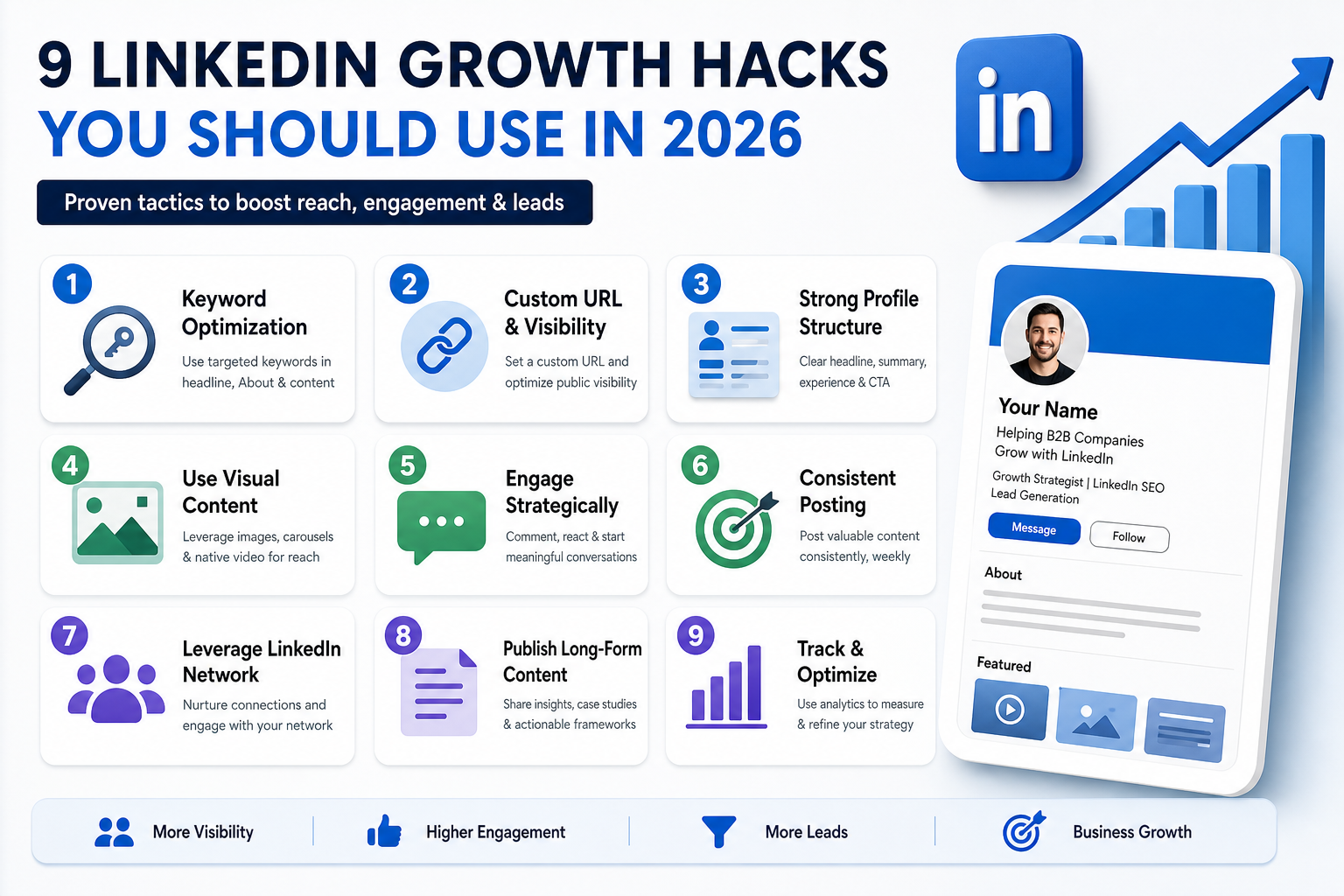
Here is a concise set of LinkedIn growth tactics you can apply in 2026 to boost reach, engagement, and qualified leads. Each tactic comes from proven patterns in profile structure, visual content, and strategic engagement.
-
Keyword Optimized Profile and Keywords in Content
Treat your LinkedIn profile like a landing page. Use targeted keywords throughout your headline, About section, and experience. Match the terms your ideal audience searches for. This acts as LinkedIn SEO for discovery and relevance.
- Identify 5 to 7 core keywords your ICP would search for.
- Incorporate them naturally in the headline, About, and featured sections.
- Review competitor profiles to identify common phrases and terms.
Area to Optimize Example Keyword Vectors Quick Action Profile Headline Helping B2B companies generate $5K MRR via cold outreach Rewrite current headline with a clear outcome, target audience, and delivery method About Section LinkedIn SEO, growth marketing, hospital tech buyers Draft a 3 sentence hook, then weave in 2 to 3 keywords naturally Experience Descriptions Lead generation, content marketing, LinkedIn outreach Insert keywords where outcomes are described -
Custom LinkedIn Profile URL and Public Visibility
A clean, public profile URL improves perceived professionalism and discoverability on LinkedIn and Google. Ensure your profile is public so that searches surface your expertise.
- Customize the URL to include your name or brand
- Enable public viewing and ensure key sections load quickly
-
Strong, Value Driven Headline
Move beyond titles like CEO or Founder. Craft a headline that communicates the value you deliver and for whom, plus the method you use.
- Format: What you do + for whom + how you do it
- Example: “Helping B2B teams generate $5K MRR through targeted LinkedIn outreach.”
-
Mobile First Content and Scannable Formats
With a majority of users on mobile, design posts for quick reading. Break ideas into short blocks, use white space, and front load the key idea in the first 125 characters.
- Adopt the PASC framework: Problem, Anecdote, Solution, Call to Action
- Use vertical visuals and captions for videos
-
Carousels and Visual Storytelling
Carousels tend to outperform standard posts by offering interactive, digestible content. Use them to explain processes, frameworks, or step by step guides.
- Include 5 to 9 slides with bold headings and clear visuals
- End with a strong call to action or a lead magnet
-
Engagement as a Core Practice
Active participation in your network compounds reach. Focus on meaningful comments and audience conversations rather than raw post impressions.
- Spend 30 minutes daily commenting on prospects and peers
- Ask specific, expert questions that invite thoughtful responses
-
Strategic Connection Building
Build a targeted network rather than amassing contacts. Use tools like Sales Navigator to identify ICPs and engage with relevant profiles consistently.
- Save searches for defined criteria
- Prioritize connections that align with your content and offerings
-
Lead Magnets and Content Offers
Offer high value resources in exchange for contact information to consistently generate qualified leads from LinkedIn activity.
- Promote a free PDF, checklist, or newsletter signup within posts or the Featured section
- Pair lead magnets with a simple, low friction CTA
-
Newsletter Launch for Deeper Engagement
LinkedIn newsletters create deeper relationships and often higher opt-in rates than one off posts. They provide a reliable channel for long form value delivery.
- Publish regular newsletters on topics aligned with your niche
- Invite connections to subscribe and grow your engaged audience over time
Implementation Roadmap
- Week 1 audit and optimize profile with targeted keywords; craft a compelling headline and About section using the 4D value outline (Diagnostic hook, Desired outcome, Demonstrable proof, Direct CTA).
- Week 2 design 3 to 5 carousels and two short mobile friendly posts; implement a mobile-first formatting plan and captioned video where applicable.
- Week 3 launch a lead magnet and update the Featured section; begin a newsletter with a single pilot issue and a clear subscribe CTA.
- Month 2 grow a targeted network using Sales Navigator, engage actively in comment threads, and refine keywords based on profile views and search signals.
These nine tactics form a cohesive growth framework for 2026. They emphasize clarity, relevance, and durable relationship building, rather than one off virality. Use them together to create a predictable pipeline of reach, engagement, and qualified leads on LinkedIn.
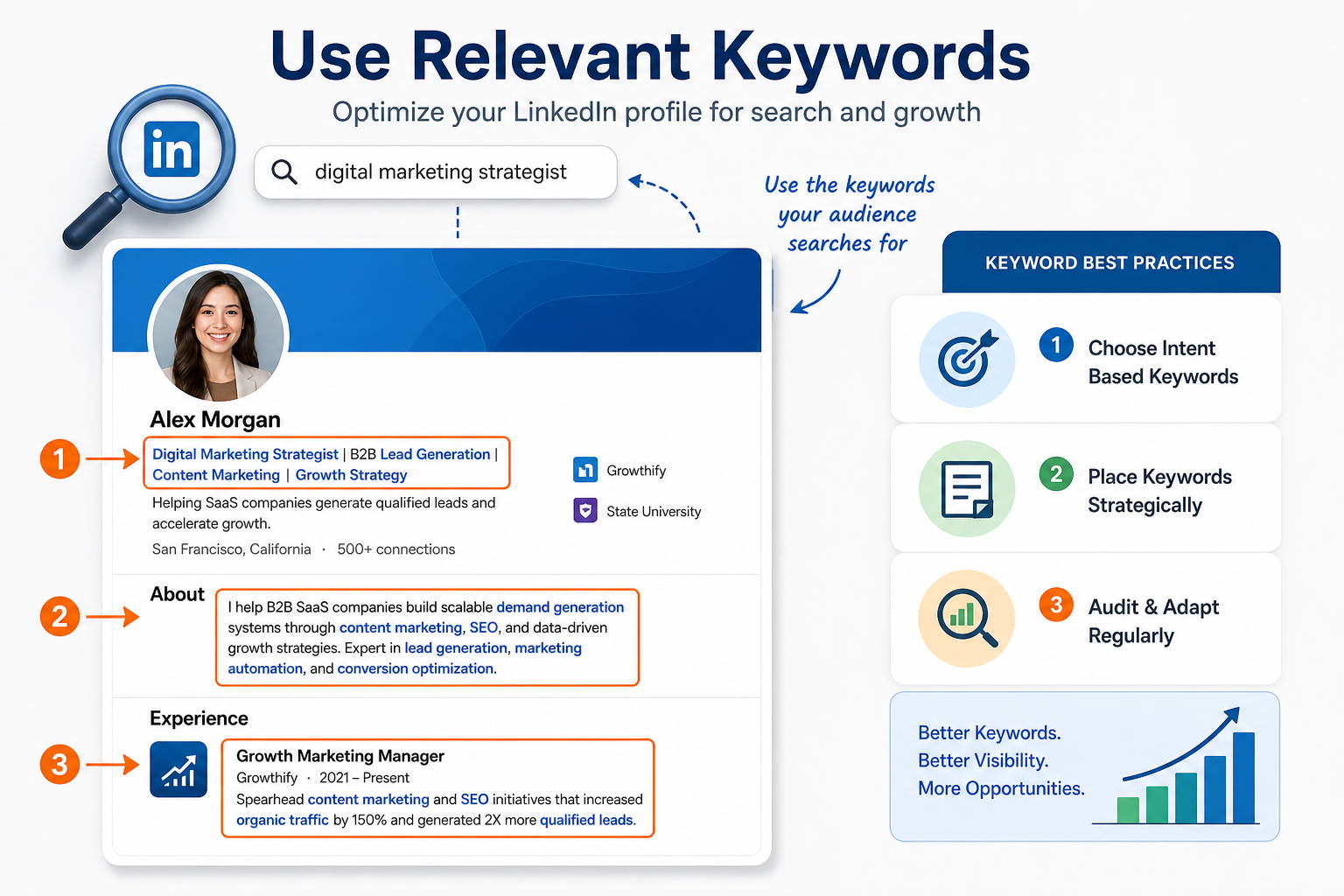
Use Relevant Keywords is the cornerstone of a resilient LinkedIn growth strategy. Treat your profile as a specialized landing page that signals to the algorithm and to human visitors what problems you solve and for whom. This approach aligns with the broader concept of LinkedIn SEO, where discoverability hinges on the words you use in strategic places like your headline, About section, and experience descriptions. By selecting keywords your target audience actively searches for, you increase the likelihood that your profile appears in relevant searches and in feed recommendations.
To operationalize this, start by identifying the phrases your ideal customers or collaborators would type into LinkedIn search bars. Look beyond generic titles and focus on outcome-oriented terms that reflect tangible results, industry jargon, and buyer personas. The goal is to create a coherent, keyword-rich narrative that flows naturally inside your profile rather than stuffing terms in awkwardly. The right keywords help you appear in both LinkedIn search and external search engines, expanding your reach across platforms.
- Choose 5 to 7 core keywords that capture your ICP’s intent, such as specific problems, industries, and delivery methods.
- Distribute keywords evenly across the headline, About section, and experience entries to reinforce relevance without compromising readability.
- Regularly audit profiles of peers and competitors to spot emerging terms you should adopt or adapt.
| Profile Area | Keyword Vectors | Practical Implementation |
|---|---|---|
| Headline | Growth strategy for B2B SaaS, pipeline acceleration, LinkedIn lead generation | Rewrite the headline to clearly state the outcome and audience, for example, “Help B2B SaaS teams accelerate pipeline with LinkedIn lead generation.” |
| About Section | LinkedIn SEO, content marketing, demand generation, persona targeting | Craft a 3 to 4 sentence hook that weaves 2 to 3 keywords naturally, then demonstrate how you apply them with brief, outcome-focused bullets. |
| Experience Descriptions | lead generation, outbound outreach, account-based marketing, sales enablement | Describe each role with an emphasis on measurable results and integrate relevant keywords where you discuss outcomes. |
Beyond the table, embed keyword strategy into daily activity. When you publish content, mention the core terms in a way that feels authentic and helpful. For example, a post about LinkedIn lead generation might include a quick framework, a mini case study, and a call to action that points to a related resource addressing outbound outreach challenges. The objective is to align your content with the same keywords that shape discovery while preserving human readability and value.
Use keywords as an ongoing practice. It is not a one-time rewrite; it is a living optimization that fuels LinkedIn Growth Tactics by boosting discoverability, clarifying value, and guiding your audience to the next steps you offer. Regular refreshes, keyword-aware formatting, and consistent alignment across your profile keep you visible as audiences evolve and search patterns shift.
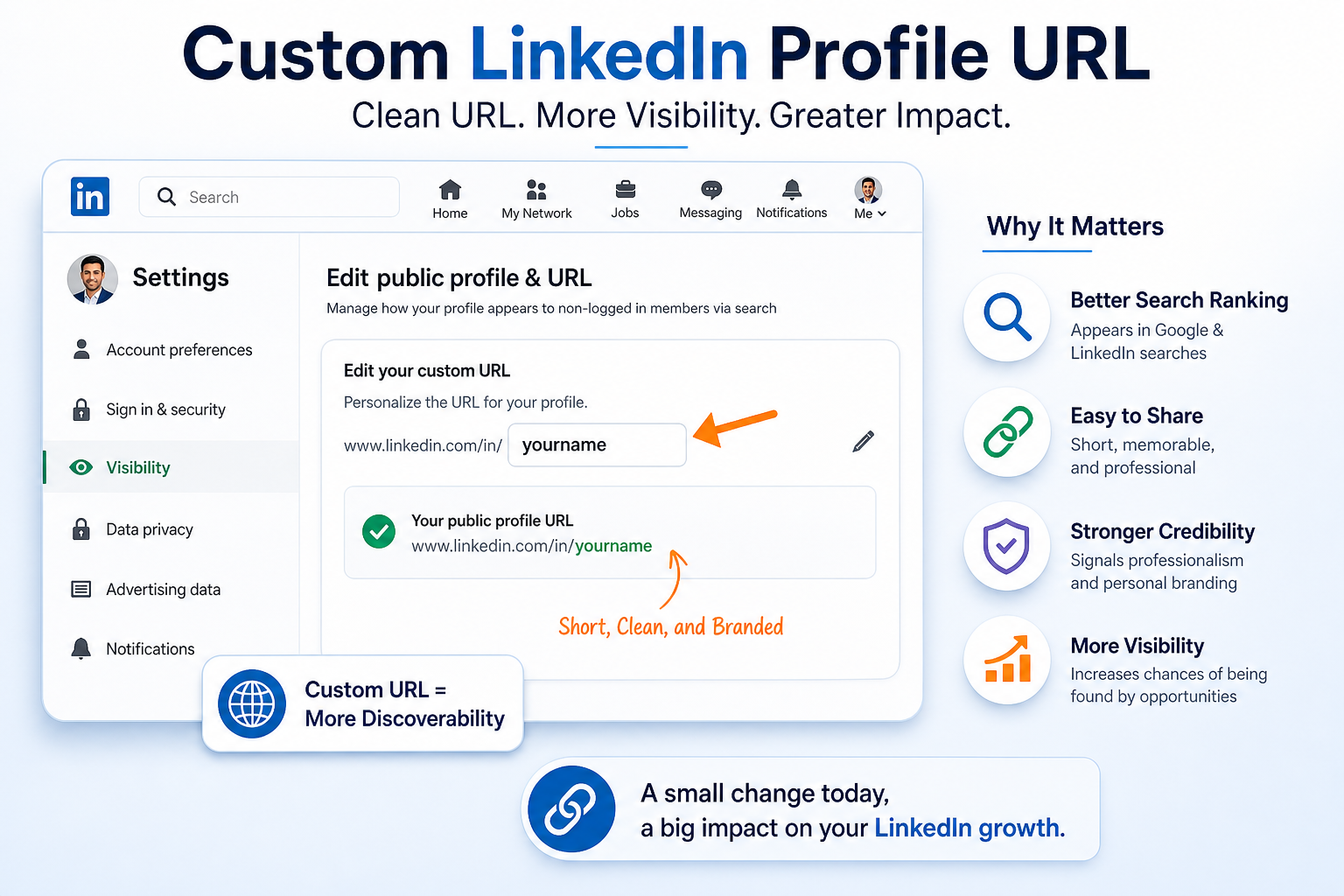
Custom LinkedIn Profile URL
Custom LinkedIn Profile URL is an effective tweak that signals professionalism and improves discoverability. When your URL is clean and branded, it conveys credibility at a glance and makes your profile easier to remember, share, and reference. Beyond aesthetics, a customized URL also plays a meaningful role in search engine optimization on both Google and LinkedIn, helping you appear more prominently for your name or brand terms in relevant searches.
How personalization affects ranking and visibility is straightforward. LinkedIn treats profile URLs as stable identifiers tied to a person or brand. A concise, keyword aligned URL reinforces your topical relevance in the eyes of the platform and search engines. When someone searches for you by name or a key service you provide, a well crafted URL increases the likelihood that your profile surfaces in the results alongside the traditional profile metadata.
To maximize impact, follow these practical steps to implement a strong Custom LinkedIn Profile URL:
- Choose a clean, recognizable URL that uses your name, brand, or a short variant that is easy to spell and remember.
- Avoid extra characters such as numbers or random strings that do not add clarity or value.
- Consistency across channels align your LinkedIn URL with other public identifiers like your website domain or Twitter handle where possible.
- Test accessibility open a private browser or log out to verify that the URL loads without errors and shows a complete profile preview.
Implementation details and best practices can be found in the following reference actions:
| Action | Why it matters | How to execute |
|---|---|---|
| Customize URL to include your name | Improves personal branding and direct recognition by searchers | Go to your profile > Edit public profile and URL > enter a clean version such as linkedin.com/in/YourName |
| Keep it short and memorable | Facilitates sharing and reduces errors when typed manually | Aim for one to three words, avoid underscores if possible |
| Ensure public visibility | Maximizes reach in LinkedIn search results and external search engines | Enable Public Profile and ensure key sections load quickly |
| Match other identifiers | Strengthens cross channel recognition and SEO coherence | Align with your website URL or professional handles used elsewhere |
After you set a strong Custom LinkedIn Profile URL, monitor impact in two dimensions:
- Profile discoverability check how often your profile appears in searches for your name and related keywords.
- Professional perception assess whether profile visits convert into connections or inquiries, indicating improved trust and accessibility.
Overall, a Custom LinkedIn Profile URL is a compact, high-leverage element of your LinkedIn Growth Tactics. It elevates perceived professionalism, aids direct sharing, and supports search visibility on both LinkedIn and Google. Treat it as a foundational best practice that harmonizes with keyword strategy and profile optimization to create a cohesive, easily reachable personal brand presence.
Strong Headline
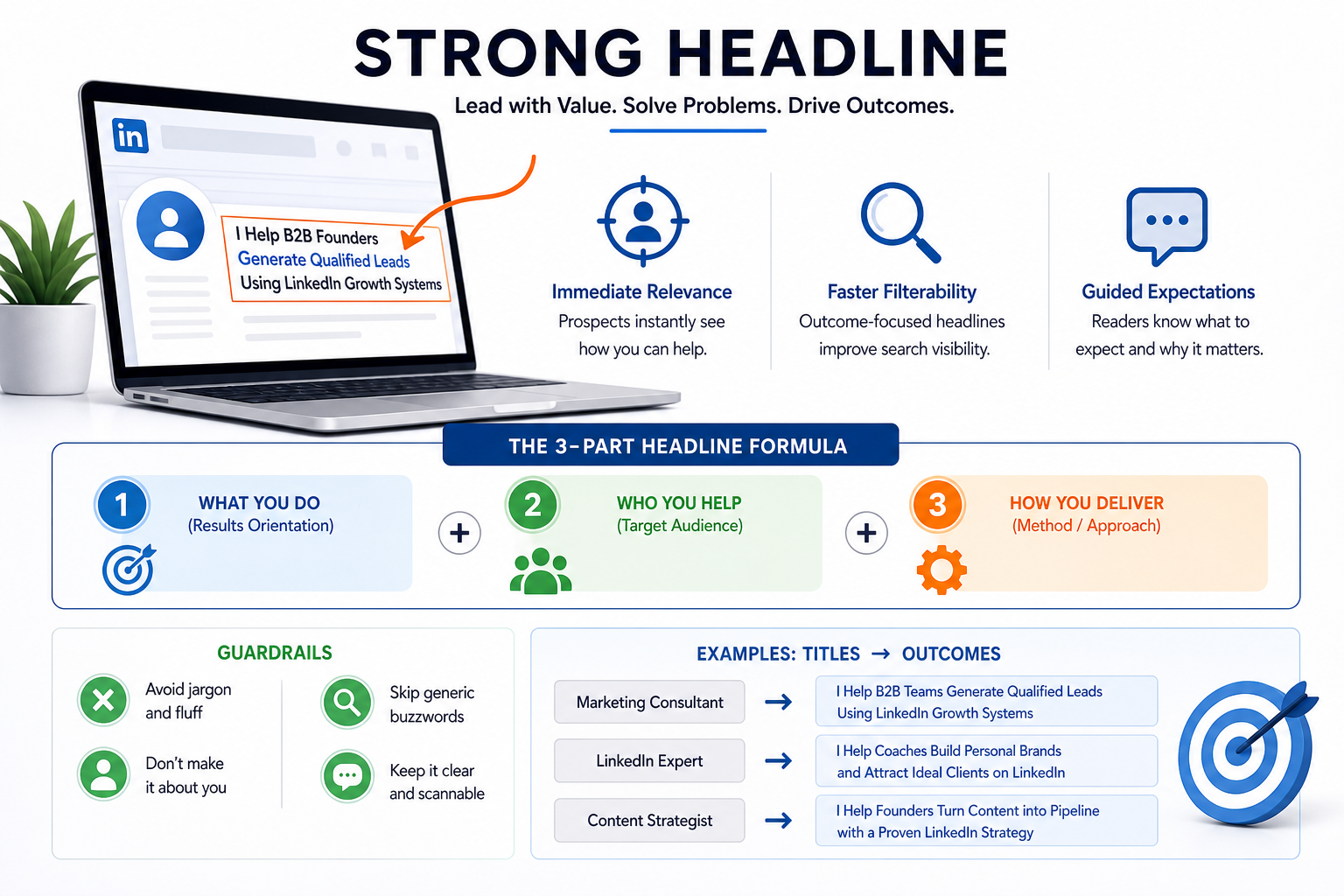
Strong Headline is the first signal you send to a scrolling audience. It is not merely a job title or a display of credentials; it is a concise promise about the concrete value you deliver. A benefit-focused headline speaks directly to your target audience’s pain points and shows how you help them move from problem to outcome. When readers immediately understand the outcome you enable, they are far more likely to stop, read your profile, and engage. This makes the headline one of the most high-leverage elements of your LinkedIn Growth Tactics.
Key reasons to craft a benefit-oriented headline rather than a traditional title:
- Immediate relevance: Prospects scan headlines in a split second. A clear outcome helps them self-select whether your expertise aligns with their needs.
- Faster filterability: When your headline contains outcome language and a target audience, your profile surfaces in more relevant searches and recommendations.
- Guided expectations: Readers know what to expect from your content and outreach, reducing friction and increasing the likelihood of meaningful conversations.
A practical framework to craft your headline is a simple three-part formula:
- What you do with a results orientation
- Who you help or the target audience
- How you deliver or the method you use
Applying this structure, here are some guardrails and examples that illustrate how to translate titles into outcomes:
- Guardrails:
- Avoid generic terms that describe roles without outcomes.
- Include a tangible metric or delivering method when possible.
- Keep it concise and scannable; aim for 12 words or fewer if possible.
- Examples:
- Helping B2B teams generate qualified SQL through targeted LinkedIn outreach
- Accelerate pipeline with LinkedIn lead generation for SaaS founders
- Increase inbound inquiries by 3x using paid and organic LinkedIn strategies
- Turn engaged followers into customers with structured content and outreach systems
To customize your own strong headline, follow these concrete steps:
- Identify the primary outcome your audience cares about in their role or industry. What measurable change do they seek? Examples include increased revenue, faster onboarding, or higher pipeline velocity.
- Define the target audience with precision. Use IA terms like “B2B SaaS teams,” “healthcare marketers,” or “enterprise sales leaders” to narrow who benefits.
- Describe the delivery mechanism such as “via LinkedIn outreach,” “through content-driven campaigns,” or “with data-backed strategies.”
- Test and refine by swapping elements and watching how often your profile is saved, viewed, or messaged. Small changes can yield meaningful boosts in relevance.
Implementation checklist you can use today:
- Audit your current headline for clarity, specificity, and outcome orientation.
- Create 3 alternative headlines using the three-part formula and rank them by which one most clearly communicates a value proposition.
- Ask for feedback from trusted colleagues or a mentor on which headline resonates most with your ICP.
- Update and monitor your headline for 2 weeks and compare profile metrics such as views, saves, and connection requests.
When you speak in benefits rather than titles, your profile becomes a value proposition rather than a résumé. The goal is to invite the reader into a conversation about solving their problem, not to broadcast your credentials. A well crafted strong headline acts as a doorway to deeper engagement and a predictable path toward meaningful conversations and business opportunities.
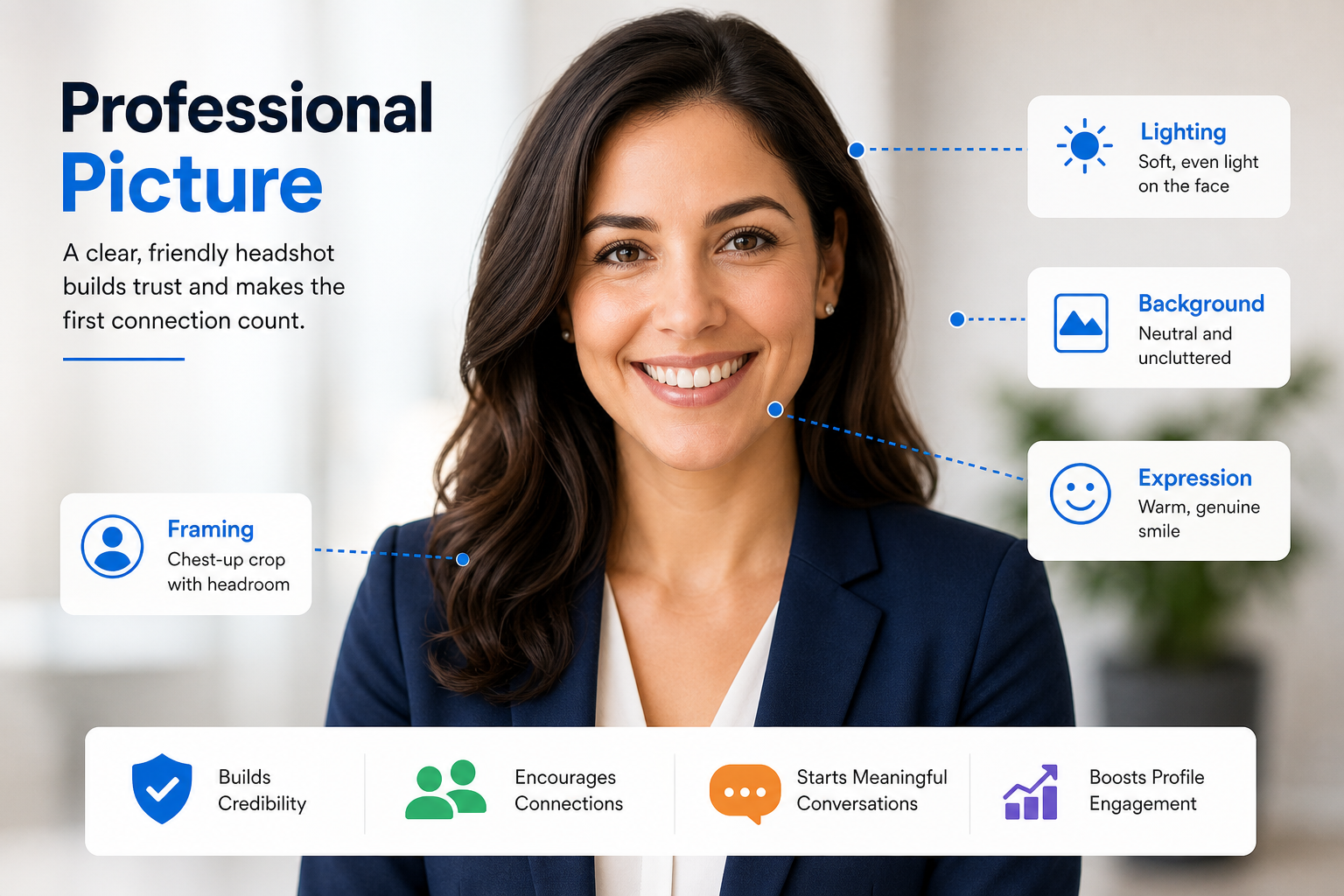
Professional Picture
Professional Picture is often the first visual cue a prospect uses to judge credibility and approachability. A clear, friendly headshot signals openness, trust, and professionalism in an instant. This can be the difference between a profile that is skimmed and one that is explored. On LinkedIn, where users make quick judgments while scrolling, a high quality portrait becomes the doorway to deeper engagement and meaningful conversations.
Several elements influence the impact of a LinkedIn headshot beyond just a sharp image. Lighting, background, facial expression, and framing work together to create an impression that aligns with your intended personal brand. When a profile photo communicates warmth and competence, visitors are more likely to stop, view your summary, and consider you for connections or conversations. In other words, the headshot sets the tone for every subsequent interaction you have on the platform.
- Lighting: Use soft, natural light or a diffused source to avoid harsh shadows. The face should be evenly lit with clear visibility of eyes and smile.
- Background: Choose a neutral, uncluttered backdrop that does not distract from your face. Subtle textures or solid colors work best.
- Expression: A warm, approachable expression often wins more connections. Aim for a genuine smile that feels authentic to your personality.
- Framing: Crop from the chest up so the eyes are roughly one third from the top of the frame. Ensure there is enough headroom without excessive negative space.
- Resolution: Use a high resolution image (at least 4000 x 4000 pixels recommended) to maintain clarity across devices and zoom levels.
To optimize your professional headshot for LinkedIn, follow this practical checklist:
| Checklist Item | Best Practice | Impact |
|---|---|---|
| Camera angle | Eye level or slightly above; avoid extreme angles | Projects confidence and approachability |
| Attire | Solid colors, professional but comfortable; avoid busy patterns | Reinforces professionalism without distracting |
| Pose | Relaxed shoulders, slight lean toward the camera | Conveys engagement and openness |
| Framing | Head and shoulders with clear eye line alignment | Ensures recognizability at small sizes |
If you are updating an existing photo, test how it renders in small sizes. On LinkedIn, your image appears as a small circle in feeds and search results, so the most important facial features should be discernible even at reduced dimensions. A portrait that is crisp, friendly, and consistent with your personal brand increases the likelihood that visitors will proceed to read your bio and consider a connection or message.
Overall, a well crafted professional headshot is not a vanity asset; it is a strategic instrument in LinkedIn Growth Tactics. It anchors trust, signals approachability, and primes visitors for the value you offer. Treat your picture as a component of your branding that works in harmony with your headline, About section, and activity to create a cohesive, credible presence.
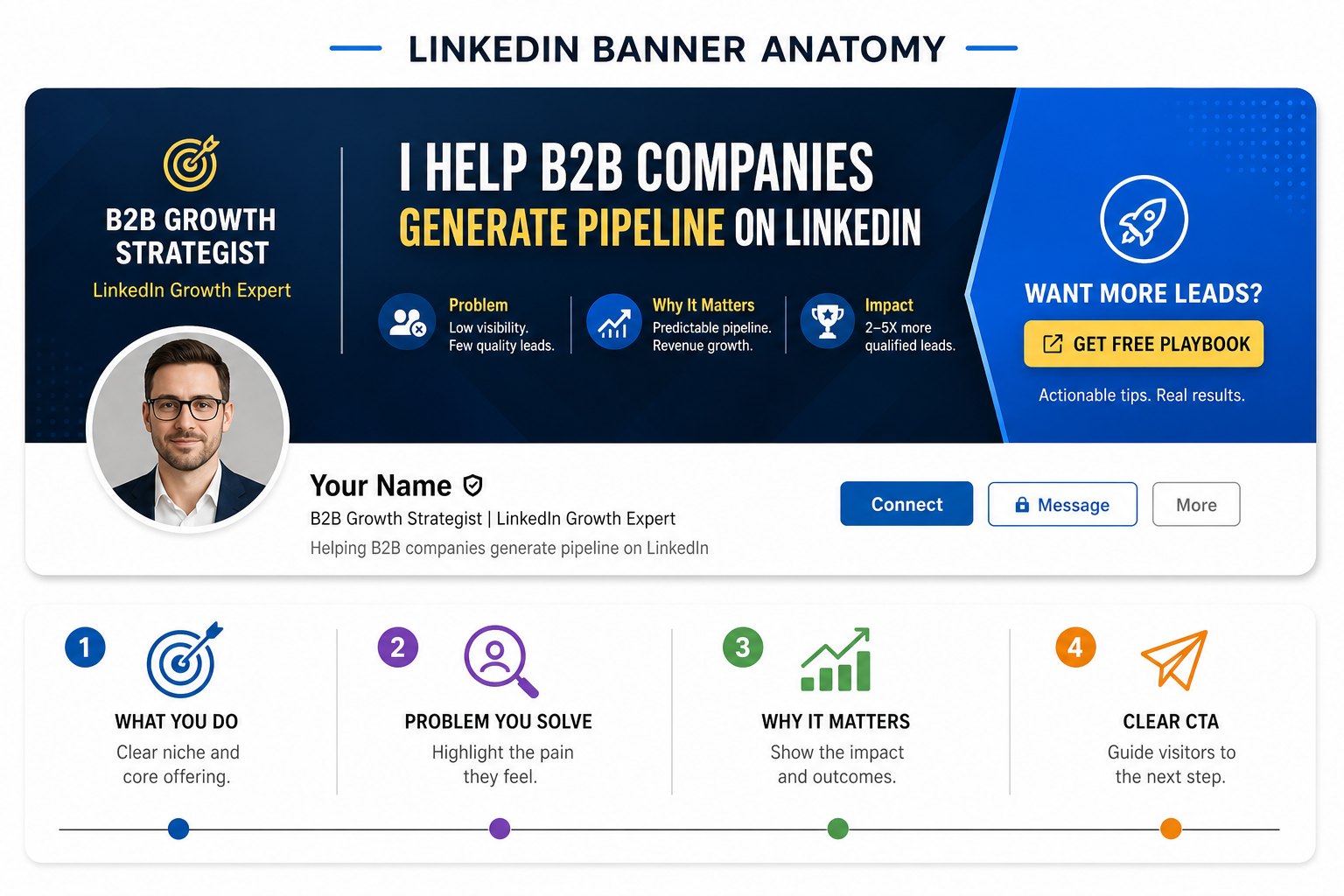
LinkedIn Banner
LinkedIn Banner is prime real estate on your profile header. It is the visual first impression you give to visitors, and a well designed banner can instantly communicate who you serve, the problem you solve, why it matters, and the next step you want them to take. Treat this space as a concise mini landing page that works in harmony with your headline and About section to reinforce your value proposition.
Approach for banner composition:
- What you do in a single, scannable line that mirrors your core offering. Use a bold, readable font and ensure the message is legible at smaller screen sizes.
- The problem you solve frame a tangible pain point. This helps visitors immediately understand relevance and urgency.
- Why it matters include a brief outcome or impact, such as a metric, milestone, or consequence of addressing the problem.
- Clear call to action invite a next step that aligns with your content strategy, such as visiting a resource, subscribing to a newsletter, or booking a brief consultation.
Practical banner anatomy you can implement today:
- Left side one to two nouns or a short phrase describing your niche, for example “B2B SaaS growth strategist” or “Healthcare tech demand generation.”
- Center a crisp value statement that connects the niche to the outcome, such as “Accelerate pipeline with targeted LinkedIn outreach.”
- Right side a strong call to action in a single line, for example “Learn how in a 10 minute read” or “Subscribe to the weekly growth briefing.”
Best practices to maximize impact:
- Brand alignment use colors, typography, and imagery that reflect your personal or company brand to create visual cohesion with your profile.
- Readability ensure high contrast between text and background, and keep the copy to a maximum of two short lines to maintain clarity on mobile screens.
- Imagery and icons include simple icons or subtle imagery that illustrate the service area without cluttering the design.
- CTA clarity the banner should point to a specific action, such as a link in your About section or a subscribe form, with a direct cue like “Tap to download” or “Watch the quick guide.”
Implementation notes you can follow:
- Dimensions aim for a banner that scales well on desktop and mobile, with text kept within the central safe zone.
- Copy length keep to one to two lines of text plus a minimal supporting line if needed.
- Testing preview the banner on different devices to confirm legibility and alignment, and update if you notice any cropping issues.
Overall, a purpose driven LinkedIn banner is a straightforward yet powerful enhancement. When it communicates who you help, the problem you solve, why it matters, and where to take the next step, it supports your growth Tactics by reinforcing your narrative and guiding visitors toward meaningful engagement.
Featured Section
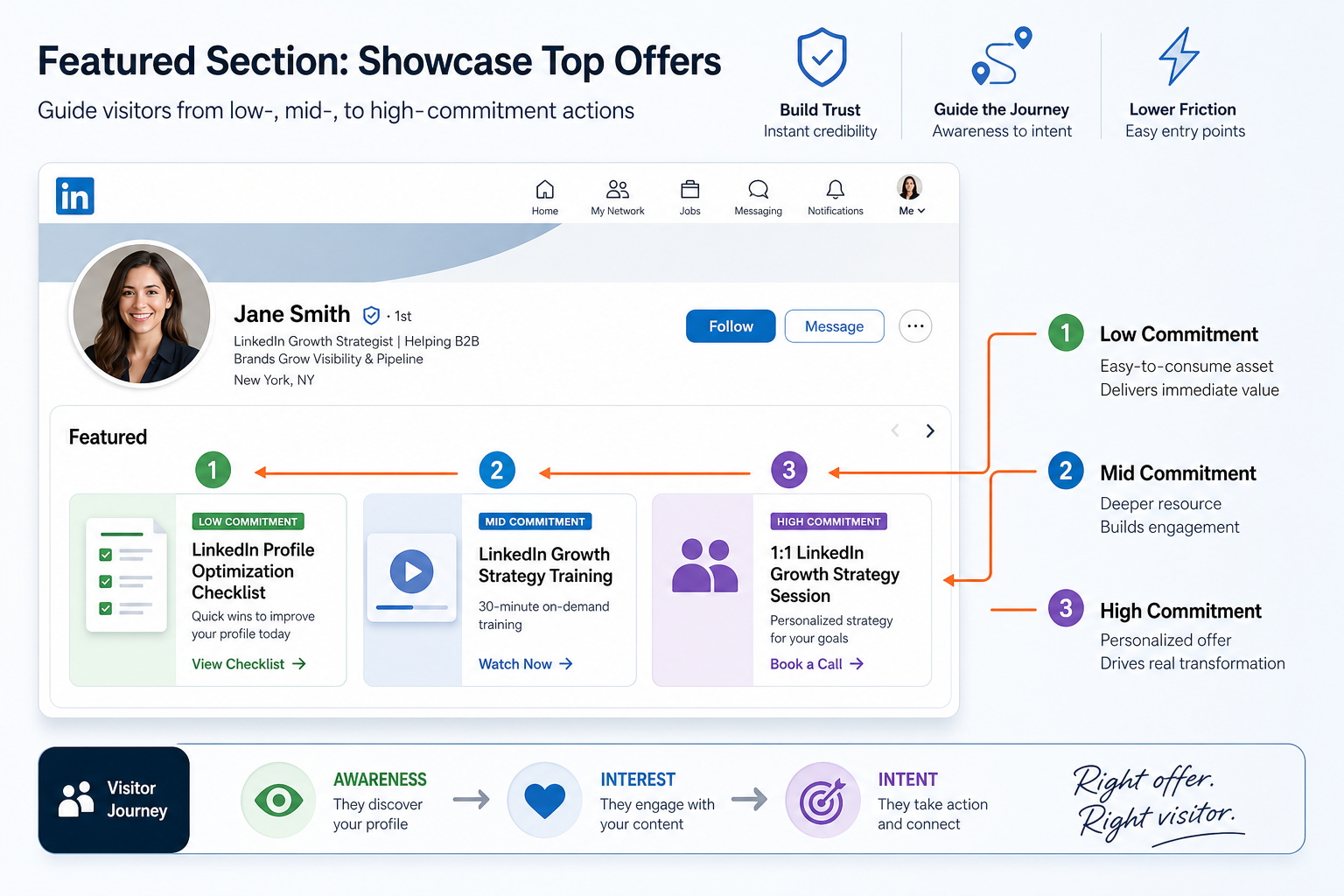
Featured Section is a pivotal area on your LinkedIn profile that many visitors overlook. When used strategically, it becomes a compact storefront for your value propositions, guiding visitors from initial curiosity to specific actions. The goal is to curate a small, high leverage set of offers that accommodate different levels of commitment, so curious browsers can engage immediately on their terms.
Used thoughtfully, the Featured area acts as a clear pathway for visitors. It highlights what you bring to the table and shows how they can take the next step without feeling pushed into a hard sell.
Why the Featured section matters
- Immediate credibility: Featuring validated assets such as case studies, templates, or guides signals trust and competence within seconds of a profile visit.
- Story sequencing: A thoughtful sequence moves a visitor from awareness to interest to intent, without forcing a hard sell on the first interaction.
- Low friction entry points: Visitors can opt in with minimal effort, such as downloading a resource or subscribing to a newsletter, which lowers resistance to engagement.
How to structure top offers in the Featured section
- Low-commitment asset that delivers immediate value and demonstrates expertise. Examples include a practical worksheet, a checklist, or a short cheat sheet. This should require little time to consume and no long commitment to adopt.
- Mid-commitment resource such as a short on demand training, a templates pack, or an invitation to a webinar or workshop. This nudges visitors toward a deeper level of engagement while still maintaining accessibility.
- High-commitment offering like a 1-on-1 strategy session, a detailed audit, or a paid program. This is reserved for visitors who actively demonstrate readiness to invest in a solution and can be presented as an optional next step after the lower friction options.
Implementation guidelines for a balanced Featured lineup
- Limit the number of items: Aim for 3 to 5 Featured items to avoid choice overload and keep the page scannable.
- Prioritize relevance: Place the assets that align most closely with your core audience and your current content strategy at the top.
- Clear CTAs: Each item should have a succinct call to action, such as Download now, Register for the webinar, or Book a 20 minute call.
- Consistent branding: Use consistent design language, typography, and colors to reinforce your value proposition.
Practical examples of how to populate the Featured section without naming specific promotions
- Low-commitment – A checklist that helps your ICP diagnose a common problem and identify next steps. CTA: Get the checklist
- Mid-commitment – A concise, actionable guide or template bundle that can be used immediately. CTA: Download the guide
- High-commitment – An invitation to a paid workshop or a consultative session with a structured agenda. CTA: Reserve your seat
Best practices for maximizing impact
- Preview text matters: Ensure the cover image and title convey a concrete outcome so visitors understand why they should click.
- Mobile readability: Design assets so that key messages remain legible on small screens, with bold headlines and concise descriptions.
- Update cadence: Refresh or rotate items periodically to reflect new insights, case studies, or seasonal topics, keeping the profile dynamic.
- Measurement mindset: Track which Featured items receive the most clicks and engagements, and optimize placement and copy accordingly.
Implementation checklist you can apply today
- <strongAudit your current Featured items and remove any assets that no longer reflect your current positioning or offer.
- Add three new assets aligned to low, mid, and high commitment levels with clear CTAs.
- Write concise, outcome-driven titles for each item that answer the visitor’s implicit question, “What will I gain by clicking this?”
- Test and optimize after two weeks, swapping order or rewriting copy to improve click-through and subsequent conversions.
In summary, the Featured section should act as a guided pathway for visitors who land on your profile. By highlighting top offers across low, mid, and high commitment levels, you create a frictionless journey from curiosity to action. When these assets are thoughtfully selected, tagged, and positioned, they become a scalable component of your LinkedIn Growth Tactics that accelerates qualified leads and meaningful conversations.
Contact Information
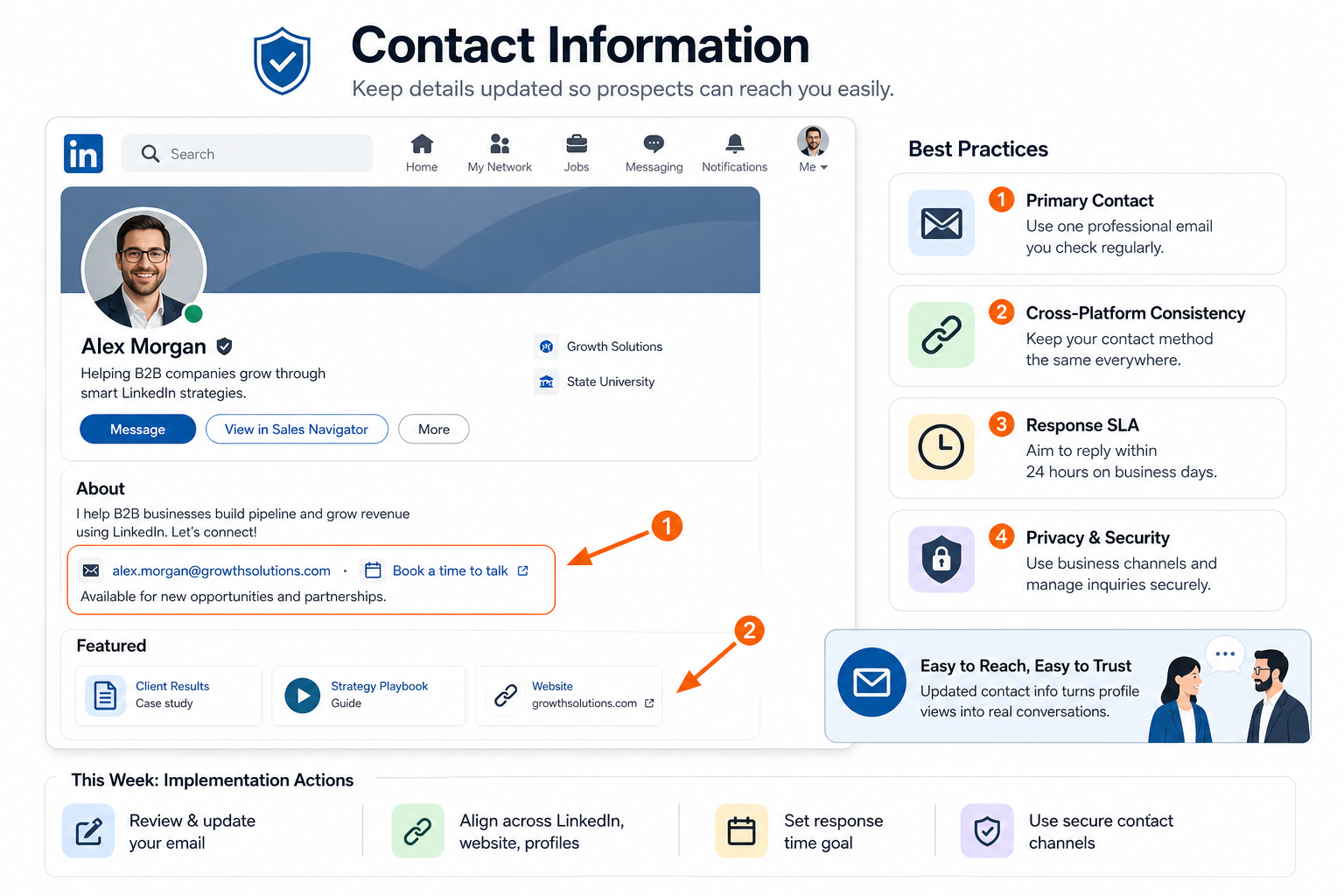
Contact Information is a critical touchpoint for converting profile views into meaningful conversations. When prospects can reach you easily, you reduce friction and accelerate the path from awareness to engagement. Keeping contact details current is not a one time task; it is an ongoing practice that reinforces trust and accessibility as your LinkedIn Growth Tactics evolve.
Accessible contact details help keep conversations flowing. A straightforward setup reduces hesitation and invites inquiries.
Best practices for maintaining accessible contact details:
- Primary contact method: Use a single, professional email address that you check regularly. Consider a contact channel that matches your workflow, such as a dedicated inbox or a simple scheduling link.
- Cross platform consistency: Ensure your preferred contact method is the same across your LinkedIn About section, Featured items, and any external profiles or websites.
- Response SLA: Establish an internal guideline for response times, such as replying within 24 hours on business days, to maintain momentum with new inquiries.
- Privacy and security: Balance accessibility with privacy. Use a business contact method rather than a personal phone number, and consider routing inquiries through a form or scheduling tool to manage volume.
Implementation actions you can take this week:
- Audit contact channels review all public contact options on your profile. Replace outdated emails and remove dead links.
- Add a scheduling option integrate a simple Calendly or equivalent link to convert inquiries into calendar invites without back and forth.
- Update the About section include a clear call to action with your preferred contact method, such as “Book a 15 minute intro call” or “Email hello at yourdomain dot com.”
- Test accessibility open a private browser session to verify that contact links load correctly and do not require extra navigation to reach your inbox or calendar.
Table of recommended contact details and how to present them:
| Contact Element | Best Practice | Implementation Tip |
|---|---|---|
| Email address | Use a professional domain or brand email that you monitor daily | Display as a mailto link in About and in Featured if appropriate |
| Scheduling link | Offer a quick way to book time without back and forth | Place prominently in About and in Featured if you run sessions |
| Website or portfolio | Provide a destination for richer information and case studies | Link label: View portfolio or Visit website |
| Social handles | Optional secondary channels for credibility | Keep handles consistent and up to date across profiles |
| Contact form | Reduces direct inbox load and filters inquiries | Embed or link to a simple form with essential fields only |
Measurement and governance:
- Response rate: Track how quickly you respond to inquiries and aim to improve week over week.
- Inquiry quality: Periodically assess the relevance of inquiries to refine your profile messaging and target audience.
- Link health: Regularly check that all links lead to active destinations and not to error pages.
In summary, keep contact information simple, accurate, and easy to use. By making it effortless for prospects to reach you, you reinforce the reliability of your LinkedIn Growth Tactics and keep the momentum moving toward qualified conversations and opportunities.
About Section with AIDA
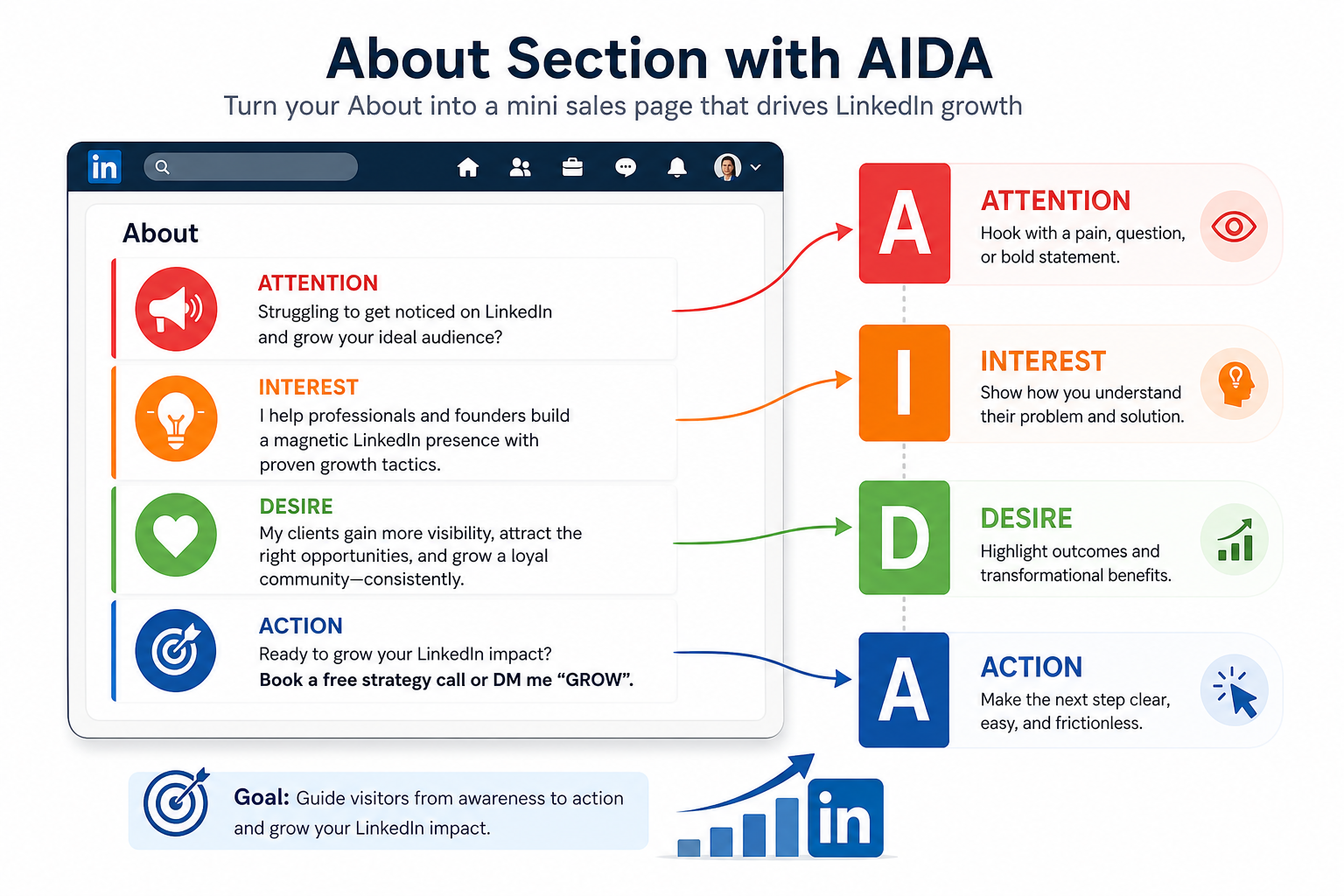
About Section with AIDA is a foundational element of your LinkedIn growth playbook. When written as a compact mini sales page, it guides visitors from noticing a problem to taking a concrete next step. This section should illuminate your understanding of the audience, demonstrate value, and reduce friction by outlining exactly how you help and how to engage further. Treat the About section as a living, evolving asset that mirrors your messaging across profile, posts, and offers.
Attention
Capture immediate interest with a tight opening that acknowledges a common pain, aspiration, or time relevant challenge. The goal is to make your ICP feel seen within the first three to five seconds of reading. Use a bold statement, a provocative question, or a succinct outcome to stop the scroll.
A clear, concise hook keeps readers engaged and sets the tone for what follows.
- <strongHook examples: “Struggling to turn LinkedIn views into qualified leads?”
- <strongOutcome hint: “I help B2B teams convert pipeline moments into predictable growth.”
- <strongAudience cue: “For healthcare tech buyers and their teams.”
Interest
Build interest by outlining your approach, domain expertise, and the gap you fill. Move from the problem to the unique lens you apply, and provide a brief sense of methodology without revealing proprietary processes. Establish credibility with concise proof points and a pattern of outcomes you enable.
Keep the focus on clarity and relevance to the reader, then transition to how you deliver results.
- <strongValue proposition: State what you do, for whom, and the primary method you use.
- <strongEvidence: Include 1–2 concrete results, case clues, or indicators of success (without naming clients if not appropriate).
- <strongDifferentiator: Highlight what makes your approach distinctive and repeatable.
Desire
Translate interest into desire by mapping your capability to the audience’s tangible goals. Paint a vivid picture of outcomes and the transformation your work enables. Use outcome-focused language, metrics, and a short narrative that helps readers imagine using your approach in their context.
Readers should envision how your method supports their priorities and milestones.
- <strongOutcome language: Focus on revenue velocity, time saved, or decision acceleration.
- <strongSocial proof: Mention qualitative signals like increased confidence, clearer strategy, or faster time to first win.
- <strongNarrative anchor: A short client-like scenario or hypothetical scenario that resonates with your ICP.
Action
Close with a clear, low friction call to action that aligns with your overall conversion plan. Replace generic prompts with specific next steps your audience can take to continue the conversation. The action should be easy to execute and trackable.
Position the next step as a simple, verifiable action that moves the conversation forward.
- <strongPrimary CTA Examples: Book a 15 minute intro call, Download the free starter guide, or Join the weekly growth briefing.
- <strongSecondary cues: Invite readers to comment a topic they want covered or to follow for a shared cadence of insights.
- <strongAccessibility: Include a Calendly link, email, or form in a way that is easy to click on both desktop and mobile.
Implementation blueprint for an effective About section using AIDA:
| AIDA Element | Purpose | Practical Craft |
|---|---|---|
| Attention | Stop the scroll with a relevant problem or bold outcome | Opening sentence that speaks to a critical pain point your ICP faces today |
| Interest | Explain how you approach the problem with credibility | Two to three sentences describing your method and domain know-how |
| Desire | Make the reader envision outcomes and value | Include a short result snippet or scenario that mirrors reader context |
| Action | Move to a measurable next step | Link to a calendar, form, or resource with a clear CTA |
Concrete copy patterns you can adapt today:
- <strongAttention pattern: “If your goal is to accelerate your B2B pipeline without adding headcount, you are in the right place.”
- Interest pattern: “I combine audience insights, content signaling, and targeted outreach to turn interest into conversations.”
- Desire pattern: “Imagine a week where your outbound messages generate qualified replies and booked meetings.”
- Action pattern: “Let us measure potential in a 15 minute call. Schedule here.”
Guiding principles for tone and structure:
- Clarity before cleverness: Prioritize straightforward language that reflects outcomes and relevance.
- Outcome orientation: Emphasize what the reader achieves, not just what you do.
- Scannability: Use short paragraphs, bullet lists, and bolded phrases to highlight key ideas.
- Consistency: Align the About section tone with your posts and featured assets to reinforce your value proposition.
Small example structure you can customize in under an hour:
- <strongOpening hook: One sentence that mirrors a common ICP pain or ambition.
- <strongValue proposition: Two lines that state who you help and why your approach works.
- <strongProof snippet: A brief metric or qualitative impact statement.
- <strongMethod overview: Bullet points summarizing your approach in 3–5 items.
- <strongCTA: A specific action with a calendar link or lead magnet.
In summary, the About Section with AIDA reframes your profile into a persuasive mini sales page. It builds immediate relevance, sustains interest with credible approach, elevates desire through tangible outcomes, and guides readers to a clear next step. When executed with discipline, this section becomes a reliable engine for conversations, qualified inquiries, and longer-term relationships within your LinkedIn Growth Tactics framework.
Re-Order Sections
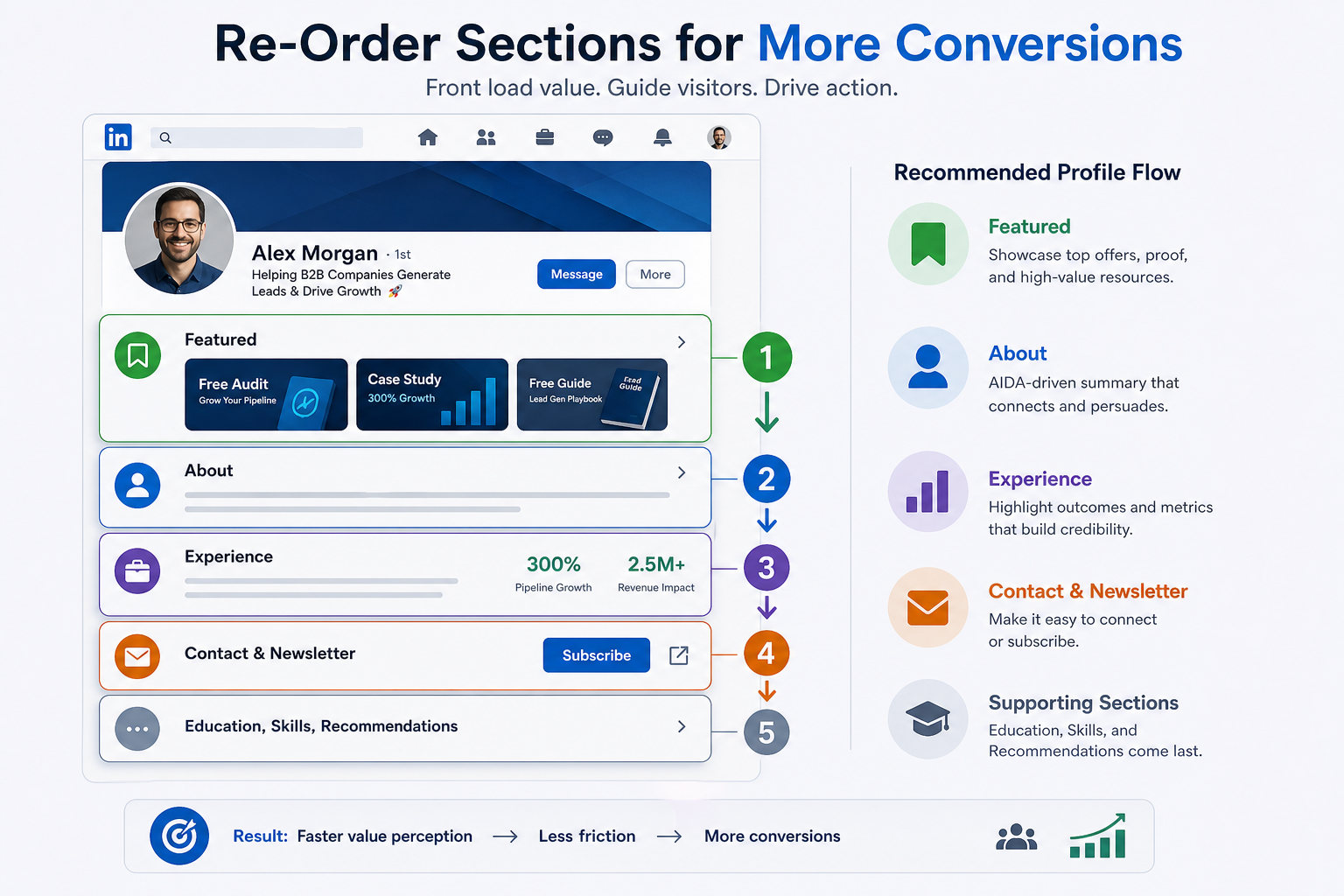
Re-Order Sections is a practical adjustment you can make to instantly boost conversion on your LinkedIn profile. By front loading the most action oriented and credibility building elements, you guide visitors through a logical, high value narrative from the moment they land on your page. The core idea is to treat your profile as a mini sales page, where the first screen communicates clear value and a path to engagement.
Recommended profile flow emphasizes outcomes, proof, and easy next steps. Start with
- Featured to immediately showcase top offers, proof of impact, or high value resources. This section acts as a storefront and sets expectations for what visitors can do next.
- About with a concise AIDA oriented narrative. This should bridge the gap from the initial offer to the specifics of how you help, why it matters, and what a visitor should do to engage further.
- Experience with outcomes and metrics, prioritized to reinforce credibility and relevance for your ICP. Highlight roles and results that align with the visitor’s interests.
- Contact Information and Newsletter or Lead Magnets integration where applicable, ensuring visitors can take a low friction step to connect or subscribe.
- Other sections such as Education, Skills, and Recommendations should support the main narrative without competing for attention at the top.
The concrete gains of this ordering are twofold: faster perception of value and reduced friction to convert. When visitors arrive at a profile that immediately signals credibility through a strong Featured lineup, they are more inclined to read the About section with purpose. A clear progression from showcased assets to a narrative that explains your approach and outcomes increases the likelihood of a direct message, calendar booking, or download action.
Implementation steps you can apply this week:
- <strongAudit current order: Note which sections appear first above the fold and which actions they prompt. Identify gaps where critical proof or offers are buried.
- Move Featured to the top: Ensure your three to five most compelling assets are visible without scrolling. Include a mix of a case snippet, a resource, and a low friction action.
- <strongRewrite About for flow: Adapt the About section to follow the first interaction with a short bridge that invites readers to explore your approach and results, using a clear call to action.
- Prioritize testimonials and proof: If you have recommendations or case results, place concise proof near the top of the Experience or About sections to reinforce trust early in the visit.
- Test and iterate: Use a two week window to compare engagement signals such as saves, messages, and click-throughs before and after reordering.
Table: Suggested top to bottom ordering and rationale
| Profile Section | Rationale | Key Metrics to Watch |
|---|---|---|
| Featured | Shows concrete value offers and proof upfront, guiding expectations and driving initial engagement. | Clicks on items, saves, initial follow-up actions |
| About | Provides a bridge from the offer to the method and outcomes you deliver, establishing relevance. | Profile visits that translate into messages or calendar bookings |
| Experience | Aligns your professional narrative with the needs of your ICP, reinforcing credibility with measurable results. | Views of job-related outcomes, time to first result, inquiries related to roles |
| Contact Information | Low friction CTA points to reach you, schedule a call, or access a resource. | Scheduling clicks, email replies, direct messages |
| Additional sections | Supportive context that strengthens the main narrative without competing for top attention. | Engagement on skills, recommendations, and education content |
Practical copy considerations for the reordered layout:
- Featured items: Write concise, outcome-focused titles and subheadings. Use clear CTAs like “Download the starter guide” or “View case summary.”
- About section: Open with a problem statement that mirrors your ICP’s reality, then present your approach and a brief proof narrative before the CTA.
- Experience highlights: Transform bullets into outcome statements with metrics where possible, and align them with the problems your audience faces.
In summary, re ordering profile sections to begin with Featured and followed by About creates a conversion oriented experience. It reduces noise, accelerates the reader to actions that matter, and anchors your LinkedIn Growth Tactics in a clear, measurable framework. Apply the change, monitor results, and iterate to maintain resonance with your evolving audience.
Make Your Profile Public
Make Your Profile Public is a foundational visibility lever in the LinkedIn Growth Tactics framework. When your profile is public, it becomes discoverable not only to other LinkedIn users but also to external search engines like Google. This dual visibility multiplies the chances that your profile appears in relevant searches, recommended feeds, and referral traffic from outside LinkedIn. In 2026, a public profile acts as a permanent, searchable asset that works around the clock to attract qualified attention and inbound inquiries.
Key reasons to prioritize public visibility:
- Expanded reach: Public profiles surface in Google and other search engines, extending your presence beyond LinkedIn.
- Enhanced credibility: A well public profile signals professionalism and accessibility to prospects, partners, and potential collaborators.
- Stronger search signals: Public content and complete profile sections improve the likelihood of appearing in both LinkedIn search results and external queries.
Implementation checklist to maximize public exposure:
- Enable Public Profile: Within LinkedIn Settings and Privacy, turn on the option that makes your profile visible to everyone, including search engines.
- Customize visibility scope: Choose which sections are visible to public viewers, prioritizing those that showcase your value and credibility (headline, About, experience, recommendations).
- Control privacy trade offs: Balance public visibility with privacy needs by adjusting what personal details are exposed and what stays private.
- Verify search indexing: After enabling public visibility, perform a private browser check to confirm that your profile appears in search results for your name or key keywords.
Practical steps you can take this week to optimize for public discovery:
- Set a clean public URL: Ensure your profile URL is concise and easy to share, which helps search engines and readers remember it.
- Highlight core keywords: Integrate target keywords in your headline and About section so public crawlers associate your profile with relevant queries.
- Publish a public snippet: Add a brief, outcome-focused summary in the About section that mirrors the phrases your ICP would search for.
- Audit media visibility: Make sure media, documents, and featured assets you want discovered are set to public access where appropriate.
Table: Public visibility settings and impact
| Setting | Recommended Option | Impact on Visibility |
|---|---|---|
| Public profile viewing | Enabled for everyone | High — allows external users to access your profile from search engines and URLs |
| Profile sections exposed | Headline, About, Experience, Recommendations visible | Moderate to high — ensures key value signals are accessible to public viewers |
| Media visibility | Public attachments and featured items enabled | Moderate — boosts credibility with tangible proof for public readers |
| Activity visibility | Public activity feed on | Low to moderate — demonstrates ongoing engagement to public visitors |
Monitoring and measurement:
- Profile search impressions: Track how often your profile appears in LinkedIn and Google searches for your name or niche keywords.
- Traffic to profile: Use UTM tagged links to monitor traffic referrals from external sources to your LinkedIn profile when shared on other channels.
- Connection and outreach yield: Assess whether public visibility correlates with higher acceptance rates, messages, and calendar bookings.
Public visibility is a high-leverage, low-friction optimization in your LinkedIn Growth Tactics. It unlocks external discovery, reinforces credibility, and creates a scalable channel for inbound inquiries. Apply public visibility thoughtfully, monitor its impact, and iterate on how you present your value to maintain alignment with evolving audience needs and search behavior.
Post Regularly
Posting regularly on LinkedIn is a cornerstone of visibility and trust. Consistency signals reliability to both the algorithm and your audience, helping you stay top of mind and gradually build a compendium of value. Rather than chasing sporadic bursts, a steady cadence creates expected touchpoints that turn passive readers into engaged followers and, over time, qualified leads.
Rather than aiming for perfect, infrequent content, focus on a sustainable rhythm that matches your capacity. A predictable schedule reduces the friction of creation and improves your ability to experiment with formats, topics, and calls to action. When your audience learns to expect regular, useful insights, you gain a reliable stream of opportunities for conversation, feedback, and collaboration.
Scaling frequency with precision is the key. Below is a practical ladder you can adapt to your own context, with guidance on how to use LinkedIn premium features to deepen insights as you grow.
- Baseline cadence: Start with 1 post per week. Keep it tight, high value, and mobile friendly. Use simple formats like short insights, quick frameworks, or a mini case study.
- Incremental increase: Move to 2 posts per week once your first monthly cycle shows consistent engagement, such as stable comments and saves. Maintain quality even as you increase quantity.
- Moderate cadence: Increase to 3 posts per week. Mix formats to learn what resonates most, including carousels, short videos, and concise write ups with practical takeaways.
- Higher cadence with guardrails: If you can sustain 4 to 5 posts weekly, pair each post with a clear value proposition and a specific CTA. Always protect space for audience conversation in comments.
Leveraging LinkedIn Premium for deeper insights helps you optimize frequency without sacrificing quality. Key advantages include:
- Audience insights: Premium analytics reveal who is engaging with your content, how they found you, and what topics attract the most attention.
- Content performance trends: Access trend data that highlights which formats, topics, and posting times yield stronger engagement over a defined period.
- Increased visibility through experiments: Use premium features to run controlled experiments, such as posting at different times or varying post lengths, and compare outcomes with built in benchmarks.
- Expanded reach with monthly reports: Generate longer term reports that help you plan future cadence and topic clusters with confidence.
Implementation tips to apply these ideas today:
- Create a simple content calendar: Map one month of topics, formats, and CTAs to ensure variety and consistency.
- Experiment with formats: Alternate between paragraphs, bullet lists, carousels, and short videos to see what your audience prefers.
- Monitor early signals: In the first 24 to 48 hours, note saves and comments to gauge potential reach and adjust timing if needed.
- Protect quality: If engagement drops or you feel quality slipping, pause and refocus on a few high value posts rather than forcing volume.
A disciplined posting rhythm supported by premium analytics can transform posting from a solo activity into a measured growth engine. Start with a sustainable baseline, progressively increase cadence as you learn what resonates, and harness premium insights to refine timing, format, and topics. This balanced approach aligns with the broader LinkedIn Growth Tactics by turning consistent content into consistent opportunities.
Use Visuals in Posts
Use Visuals in Posts is a practical, high-impact habit for a fast-moving feed. On LinkedIn, users scroll through a mix of text and media, and eye-catching visuals act as a stop signal that draws attention, communicates core ideas in seconds, and primes readers for deeper engagement. Relying on text alone often leads to missed opportunities; pairing concise messaging with compelling visuals dramatically improves early engagement, saves, and comments, which in turn boosts the reach of your posts.
Incorporating visuals should be purposeful and aligned with your value proposition. Visuals are not decorative; they are strategic shortcuts that convey authority, simplify complex ideas, and reinforce your brand. The most effective posts combine a clear central idea with a visual that validates or illustrates that idea. When done well, visuals reduce cognitive load and invite readers to stop, skim, and decide to learn more.
- Eye catching images: Use high contrast, bold typography, and a single focal point. Choose images that reflect your niche and the outcome you offer. Keep text overlays to concise, outcome oriented phrases that are readable on mobile.
- GIFs and short animations: Animated elements draw attention without requiring the reader to pause long. Use subtle motion to highlight a process step, a before/after comparison, or a quick framework root idea.
- Video content with captions: Captioned videos perform better because many users watch without sound. Add a concise subtitle track and a one line summary in the first few seconds to convey the core takeaway even without audio.
- Carousel posts for step by step clarity: Carousels break complex ideas into digestible slides. Use 5 to 9 slides with consistent visual language, bold headings, and a logical flow from problem to solution to next step.
- Brand alignment: Maintain consistent color palettes, typography, and logo usage to reinforce recognition and trust across your visuals.
Practical guidelines to maximize scroll stopping potential:
- First 125 characters: Front load the most compelling message in the initial text that accompanies the visual, so viewers understand the point without tapping to read more.
- Mobile readability: Design with vertical layouts and large, legible type. Ensure crucial details stay within the central safe zone so they are not cropped on smaller screens.
- Alt text and accessibility: Include descriptive alt text for all visuals to improve accessibility and indexability.
- Tests and variants: Create 2 to 3 visual variants for a post and compare performance to identify what resonates with your audience.
Recommended visual formats and when to use them:
| Format | When to Use | Best Practices |
|---|---|---|
| Single image | Clear, immediate concept or result | High contrast, minimal text, central message aligned to post copy |
| Carousel | Step by step guides, frameworks, process visuals | 5 to 9 slides, consistent branding, strong end with CTA |
| GIF or short animation | Explaining a dynamic concept or transition | Keep animations subtle; avoid distraction from core idea |
| Video captioned | Thought leadership, quick tutorial, or framework | Open with value, add captions, include a clear CTA |
Implementation checklist you can apply today:
- Draft a visual brief: For each post, decide the central idea, the visual format, and the expected outcome for the reader.
- Create templates: Build 2 or 3 reusable templates for images, carousels, and videos to speed up production and maintain consistency.
- Caption as a mini narrative: Write captions that summarize the visual in 2–3 sentences and end with a concrete CTA.
- Batch content creation: Produce a handful of visuals in one session to sustain a regular posting cadence without last minute scrambling.
Overall, visuals are a practical accelerator for LinkedIn Growth Tactics in a fast-moving feed. By leveraging eye-catching images, GIFs, and captioned videos that align with your messaging, you increase the likelihood that readers stop, absorb your core idea, and take the next step in your content or outreach journey. Treat visuals as integral to your value proposition and test continuously to refine what resonates most with your audience.
Create Carousels
Create Carousels posts tend to achieve higher reach by offering interactive, multi-slide storytelling. Carousels invite readers to swipe through a sequence, which signals the algorithm that the post is engaging and worth expanding to more feeds. When each slide presents a clear step, point, or insight, your audience stays on the post longer and is more likely to save, comment, or share. This format is especially effective for explaining processes, frameworks, or complex workflows in a digestible, visual way.
Key reasons carousels perform well
- Sequential engagement: Each slide builds on the previous one, encouraging continued viewing.
- Actionable storytelling: Readers can follow a step by step path to a concrete outcome.
- Higher save potential: Valuable frameworks and checklists on multiple slides are often saved for later reference.
- Visual learning: Carousels combine text with visuals, helping readers grasp complex ideas quickly.
Practical structure for a carousel post
- Slide 1 or cover: Present the headline and outcome in a bold, scannable way.
- Slide 2–4: Outline the core steps or components of your framework with concise copy and supportive visuals.
- Slide 5: Provide a practical example or mini case study that demonstrates application.
- Final slide: Clear CTA that invites saves, comments, or a link to a resource.
Design and copy best practices
- Slide count: Aim for 5 to 9 slides to balance depth with scrollability.
- Consistent visuals: Use a cohesive color palette, typography, and layout across slides.
- Readable copy: Keep text large enough to read on mobile and limit each slide to a single idea.
- Strong headlines per slide: Each slide should convey a discrete takeaway that connects to the overall story.
- Captions and context: Use the post caption to set up the carousel and to summarize the takeaway with a CTA.
Optimization tips to maximize reach
- Mobile first: Design with vertical scrolling in mind; ensure essential elements fit within the visible area without excessive scrolling.
- Early value: Deliver a tangible insight within the first two slides to hook readers quickly.
- CTA on the last slide: Direct readers to a resource, a newsletter, or a calendar link for next steps.
- A/B testing: Create two variants with slight copy or visual differences and compare engagement metrics over two weeks.
Implementation checklist
- Plan the storyline: Write a one paragraph overview of the carousel arc before designing slides.
- Outline slides: Draft 5 to 9 slide titles and a short 1 to 2 sentence copy for each.
- Create visuals: Produce clean, legible slides with high contrast and minimal clutter.
- Write the caption: Compose a compelling caption that invites engagement and provides a clear CTA.
- Publish and iterate: Monitor saves, shares, and comments; use insights to improve future carousels.
Example slide topics you can adapt
| Slide Topic | What to Convey | CTA |
|---|---|---|
| Framework overview | Present the core steps of a repeatable process | Save this framework and apply it to your workflow |
| Step by step guide | Detail each step with a practical tip | Try the steps and comment one result you achieved |
| Before and after | Show the transformation with concise data or visuals | Download the accompanying checklist |
| Case study mini | Illustrate a real world application without naming clients | Learn more with a related resource |
The carousel format blends narrative flow with visuals to deliver practical insights. Apply a disciplined carousel framework to explain processes step by step, and pair each post with a strong caption and CTA to drive momentum.
Hashtags
Hashtags on LinkedIn are not just for posts; when used thoughtfully they can aid profile discovery by signaling your skills and areas of expertise. While LinkedIn search and the algorithm prioritize context and quality, hashtags embedded in your About section help the platform understand your niche and improve visibility to people looking for those competencies. This does not replace keyword optimization in your headline or About copy, but it provides an additional signal that can attract the right audience when they visit your profile.
Guiding principles for using hashtags on your profile:
- Align with core skills: Choose hashtags that mirror the primary capabilities you want prospects to associate with you, such as specific domains, tools, or outcomes.
- Keep it concise: Use a small, highly relevant set of hashtags rather than a long list. Three to five targeted hashtags are typically sufficient.
- Consistency across sections: Include the same or closely related hashtags in your About, Experience, and Featured items to reinforce identity.
- Avoid overloading: Hashtags in the About section should feel natural and not like keyword stuffing. Prioritize readability and usefulness over volume.
Practical placement strategies:
- About section integration: Add a short line near the end of the About text that naturally incorporates 2 to 3 hashtags, for example #LinkedInSEO #B2BGrowth #LeadGeneration.
- Experience context: When describing roles or accomplishments, weave relevant hashtags into bullet points where they fit organically, not as a separate block.
- Media and documents: If you publish a resource or slide deck, include a hashtagged caption or slide title to reinforce discoverability in related searches.
Table: Hashtag strategy at a glance
| # Hashtag | Intended Signal | Best Placement |
|---|---|---|
| #LinkedInSEO | Signal expertise in profile optimization and discoverability on LinkedIn | About section end or near a skills paragraph |
| #B2BGrowth | Positions focus on business to business growth and pipeline acceleration | Experience bullets or a short closing statement in About |
| #LeadGeneration | Highlights capability in generating qualified leads | Bullet points under relevant roles or in a dedicated projects line |
| #ContentStrategy | Frames value as content driven, with repeatable frameworks | About or Featured section description of approach |
| #Carousels | Indicates proficiency with carousel storytelling on LinkedIn | Media descriptions or post-related resources mention |
Practical copy patterns you can adapt today:
- About line pattern: Focused on #LinkedInSEO and #LeadGeneration to drive measurable pipeline growth.
- Profile narrative: Integrate hashtags as anchors for your expertise, for example, “Specializing in B2B growth with a bias toward #ContentStrategy and #Carousels.”
- Resource descriptions: When listing resources in Featured, add a hashtag at the end of the caption to improve relevance in searches, e.g., “Download the 5 step framework. #LinkedInSEO #GrowthHacking.”
Key cautions to keep in mind:
- Avoid redundancy: Do not repeat the same hashtags across every section; vary to cover related concepts without redundancy.
- Quality over quantity: Hashtags should clearly reflect your expertise and be recognizable to your ICP, not just trendy terms.
- Monitor and adjust: Track whether changes to hashtags correlate with profile views or message requests, and refine over time.
Hashtags can aid profile discovery when used in the About section as a complementary signal to your keyword strategy. They help people find your skills and expertise in context, support your broader LinkedIn Growth Tactics, and should be used thoughtfully and succinctly to maximize clarity and impact.
Add Comments
Add Comments is a disciplined tactic to expand reach, spark meaningful conversations, and signal authority within your LinkedIn network. A purposeful commenting routine helps you appear in more feeds, attracts attention from your ICP, and builds credibility through thoughtful, value-driven contributions. The goal is not to chase vanity metrics but to cultivate quality interactions that lead to connections, inbound inquiries, and opportunities over time.
Core principles to guide your commenting practice:
- Quality over quantity: Aim for insights, not generic praise.
- Relevance first: Comment where your expertise adds clear value to the discussion.
- Consistency: Show up regularly to become a familiar, trusted presence.
- Time-boxed effort: Protect time for commenting as a daily habit, not as an afterthought.
Disciplined daily routine overview
- Session length: Schedule a fixed 30 minute window each business day for comment activity.
- Three-pass approach:
- First pass: skim for high relevance to your ICP and influencers in your niche.
- Second pass: craft 1 to 3 high quality comments that add unique perspective.
- Third pass: engage with follow-up questions to invite conversation.
- Quality bar: Each comment should extend the thread with new insight, a clarifying question, or a practical tip.
- Timing: Prioritize early engagement on posts published within the last 24 hours for maximum visibility.
Profiling framework for targeting with comments
Segment profiles into three categories to structure your outreach and ensure balanced coverage:
| Category | Purpose | Commenting Guidelines |
|---|---|---|
| Influencers | Boost reach through their audience, establish authority, and attract attention from peers who follow them. | Provide thoughtful, non promotional insights. Ask a specific, expert question that invites others to weigh in. Reference their framework or a point they made with a brief addendum. |
| ICP or Target Prospects | Engage potential customers or decision makers who fit your ideal client profile, driving relevance and momentum. | Address a real challenge they face, share a resource tip, or pose a data driven question that prompts a reply or a DM. |
| Industry Peers | Build reciprocal relationships, learn from adjacent practitioners, and discover collaboration opportunities. | Offer corroborating evidence, share a counterpoint respectfully, and invite co creation of content or a small pilot discussion. |
Daily session template you can copy
- Pre-session prep open your listening feed and pull 6 to 12 posts that clearly relate to your niche, your ICP, or adjacent topics.
- Selection criteria choose posts with recent activity, clear questions, or provocative angles that invite discussion.
- Comment craft write 1 to 3 comments per post:
- Begin with a concise takeaway or agreement to establish relevance.
- Add 1 to 2 sentences of value, such as a practical tip, a data point, or a mini case example.
- End with a question or invite others to share their approach to keep the thread alive.
- Post-session follow up review responses to comments you left, reply promptly to new replies, and add additional context if needed.
Measurement and refinement
- Track outcomes: Monitor the number of new connections, profile views, messages started, and follow up discussions that arise from comments.
- Quality signals: Note the depth of conversations and whether comments trigger meaningful engagement beyond the thread.
- Adjust focus: If you notice low impact from influencer comments, shift a portion of time to ICP and peer interactions and swap topics accordingly.
Commenting cadence blueprint for a typical workweek
| Day | Focus | Target Actions | Expected Outcomes |
|---|---|---|---|
| Monday | ICP deep dive | Comment on 3 ICP posts with tailored value and a clarifying question | Inquiries, connections, and early conversations |
| Tuesday | Influencer amplification | Comment on 3 influencer posts with a unique insight and a bridge to your framework | Increased visibility to broader audiences |
| Wednesday | Industry peers | Engage in 3 peer threads, offer a counterpoint or collaboration idea | Collaborative opportunities and mutual amplification |
| Thursday | ICP recontact and nurture | Comment on 3 new ICP posts, invite to a short call or share a relevant resource | qualified conversations and calendar invites |
| Friday | Review and optimize | Audit comments from the week, identify top performing patterns, plan Next Week’s focus | Improved targeting and higher impact loops |
Best practices to protect your reputation while commenting aggressively
- Be precise: avoid generic comments like “great post.” Instead, reference a specific point and add value.
- Credit and tone: acknowledge the author’s work and maintain a constructive, respectful tone even when disagreeing.
- Avoid self promotion: focus on helpful contributions rather than linking to your services in every comment.
- Document learnings: save or snapshot particularly useful comments to reuse as micro case studies in your own posts later.
Add Comments is a repeatable technique that, when executed with discipline and intention, expands reach, strengthens credibility, and accelerates meaningful conversations. By adopting a structured daily routine and routinely categorizing profiles into Influencers, ICP, and Industry Peers, you create a balanced, scalable approach to engagement that supports the broader LinkedIn Growth Tactics you are building.
Lead Magnets
Lead Magnets are targeted, high value resources offered in exchange for contact information. When designed thoughtfully, they act as scalable entry points that attract a large volume of leads while preserving quality. The core idea is to provide something so useful that a prospective buyer or partner is willing to share their details to access it. In a LinkedIn Growth Tactics framework, lead magnets can accelerate pipeline velocity by systematically converting profile visitors and content readers into engaged prospects.
Effective lead magnets share several common characteristics:
- Specificity: They address a well defined problem for a clearly defined audience.
- Actionability: They deliver a concrete outcome, such as a checklist, template, or framework that can be applied immediately.
- Low friction: Access requires minimal time and effort, such as a single form field or a quick download.
- Immediate value: The user experiences a tangible benefit within minutes of access, increasing the likelihood of continued engagement.
Implementation pattern to generate high quality leads at scale:
- <strongIdentify the ICP and their most urgent needs: Start with a precise problem statement that your magnet will solve, ensuring relevance to your target audience.
- <strongDesign a compact, outcome oriented resource: Create a practical asset such as a checklist, worksheet, template pack, or short playbook that can be consumed quickly and implemented immediately.
- <strongDefine the capture flow: Use a simple form with 2 to 3 fields to minimize friction (for example, name, email, and company size or role). Consider a calendar link as an optional next step for qualified leads.
- <strongAutomate delivery and follow up: After submission, deliver the magnet instantly and initiate a follow up sequence that adds more value and invites a next action, such as a short consult or invitation to a webinar.
- <strongQualify and segment: Attach a lightweight qualification question or tag leads by their expressed interest so you can route them to the appropriate nurture path or sales queue.
Common lead magnet formats that tend to perform well on LinkedIn include:
- Checklists that diagnose a problem and prescribe next steps
- Templates and worksheets that streamline a repeatable process
- Mini guides or one page frameworks that distill complex ideas into a repeatable approach
- Cheat sheets and quick references that save time and reduce cognitive load
- Free audits or quick assessments that provide a snapshot of current performance with recommended improvements
Table: Lead magnet design considerations
| Magnet Type | Audience Need | Delivery Method | CTA |
|---|---|---|---|
| Checklist | Diagnose a specific bottleneck in the buyer’s process | PDF download after form submission | Get the checklist |
| Template Pack | Provide ready to use assets for immediate implementation | Zip file or Google Drive link via email | Download templates |
| One Page Framework | Offer a proven approach that reduces decision fatigue | Interactive or printable PDF | Access the framework |
| Audit or Assessment | Deliver a personalized snapshot of current performance | Survey based and emailed report | Get your audit report |
Operational considerations to maximize lead quality:
- <strongOffer positioning: Tie the magnet to a clear value proposition that aligns with your core services and prove how it leads to a next step in the customer journey.
- <strongLead routing: Define what happens after capture. A fast, relevant follow up with tailored insights increases the likelihood of a booked conversation.
- <strongNurture cadence: Schedule a sequence that blends education with targeted calls to action, not a hard sell in the first touch.
- Measurement framework: Track conversion rate from magnet impressions to form fills, time to first response, and downstream engagement like messages or calendar bookings.
Implementation blueprint you can adopt this month:
- <strongChoose 1 magnet type that best matches your audience’s immediacy and willingness to engage.
- Create a high quality asset that is visually accessible and easy to consume on mobile devices.
- Set up a simple capture page with minimal fields and a clear privacy message.
- Integrate with your outreach by including magnet links in posts, in the About section, and in your Featured items where relevant.
- Analyze and iterate after two weeks, testing variation in headlines, CTA copy, and placement to lift conversions.
In summary, lead magnets are a scalable lever within LinkedIn Growth Tactics for bulk lead collection without sacrificing quality. When thoughtfully designed and integrated into a disciplined capture and follow up process, they can yield a steady stream of high intent inquiries that enrich your pipeline and accelerate growth.
Content Strategy
Content Strategy is the disciplined plan that aligns every post, article, and asset with a clear objective: drive qualified traffic to your LinkedIn profile and your website without wasting effort. A well crafted strategy acts as a compass, ensuring that time spent creating content yields measurable engagement, profile visits, and ultimately conversions. When content is intentional rather than random, you attract the right audience, build trust, and accelerate movement along the buyer journey.
Define your purpose and audience
Begin with a concise statement of purpose and a precise audience definition. This sharp focus prevents scope creep and keeps you aligned with what matters most to your ICP.
- Purpose: Are you aiming to generate inbound inquiries, nurture relationships with potential partners, or drive traffic to a resource page?
- Audience: Specify roles, industries, and pain points. Example targets include health tech buyers, growth leaders in SaaS, or enterprise marketing decision makers.
- Outcome: Attach a concrete metric to each content type, such as profile visits, newsletter signups, or calendar bookings.
Map content formats to funnel stages
Use a structured mix of formats that move readers from awareness to action. The goal is to provide value in a way that encourages profile exploration and site visits.
| Format | Funnel Stage | Primary Objective | Typical CTA |
|---|---|---|---|
| Short insights and micro frameworks | Awareness | Demonstrate expertise and daily value | Visit profile for more depth |
| Carousels | Consideration | Explain a process or framework step by step | Download a related worksheet |
| Long form articles | Decision | Provide in depth understanding and substantiated results | Subscribe to newsletter or book a call |
| Video with captions | Engagement and reach | Increase retention and shareability | Click through to a resource or landing page |
Align content with traffic objectives
Each piece of content should have a clear path to a destination. Whether that is your LinkedIn profile, a blog post, a landing page, or a resource, the link should be logical and friction free. Avoid content that is interesting but does not move people toward a measurable action.
- Profile discovery Create content that surfaces keywords and topics your ICP searches for. Use narrative hooks that align with anticipated queries like “how to accelerate pipeline” or “LinkedIn outreach for healthcare tech.”
- Website traffic Include a logical bridge from LinkedIn to your site. Use posts with strong benefit statements and a clear CTA that invites readers to learn more on your domain.
- Lead capture Pair content with a low friction magnet or form, so interested readers can convert without leaving their workflow.
Content calendar and workflow
A durable rhythm reduces waste and builds momentum. Establish a repeatable process that accommodates testing and learning.
- <strongCadence: Start with 2 to 3 posts per week and scale when you have proven formats that resonate.
- <strongPlanning: Develop a quarterly theme aligned with ICP needs and seasonal considerations.
- Production: Create templates for captions, slides, and video captions to speed up production.
- Review: Set a weekly review window to assess performance signals such as saves, shares, comments, and profile visits.
Measurement and optimization
Track leading indicators that correlate with traffic and conversions. Use a simple dashboard to keep focus on what matters and iterate quickly.
- Traffic signals: Profile views, click through rate from posts, and visits to landing pages.
- Engagement quality: Comments with depth, saves, and shares indicate relevance and intent.
- Conversion events: Subscriptions, downloads, or calendar bookings sourced from LinkedIn traffic.
Practical tactics to maximize traffic without waste
- Keyword integration: Weave ICP oriented terms into headlines, hooks, and post bodies to improve discoverability.
- Intent first: Lead with a compelling outcome in the opening line to encourage continued reading and profile exploration.
- Anchor content: Create a core resource hub piece that you reference repeatedly in posts and comments to centralize value.
- Cross channel consistency: Mirror messaging and keywords across your About, featured assets, and external channels to reinforce identity.
Implementation checklist
- <strongDefine 1 to 2 traffic goals for the quarter, such as increasing profile visits by 20 percent or driving 200 new page visits to a resource.
- Create a 6 week content plan with a mix of formats that align to your funnel stages.
- Prepare templates for captions, slides, and video summaries to accelerate production.
- Set up measurement a simple dashboard with sources, medium, and actions to monitor progress.
In summary, Content Strategy for LinkedIn Growth Tactics is about purposeful, audience centered content that drives measurable traffic to profiles and websites. By defining clear objectives, mapping formats to funnel stages, and maintaining disciplined production and measurement, you avoid wasted effort and create a reliable engine for inbound traffic and meaningful conversations.
Lead the Conversation with a Short Post Ending in a Question
Lead the Conversation with a Short Post Ending in a Question echoes Mark Schaefer’s approach to LinkedIn growth. The idea is to start conversations rather than broadcast statements. Deliver a concise, authentic message that resonates, then end with a specific, open invitation. Invite others to share their perspective. When you craft posts that prompt thoughtful commentary, you trigger early engagement. The algorithm rewards this with broader distribution and lasting visibility.
Why a short post works for conversation starting
- Digestibility: Busy audiences skim, so a compact message lands quickly and clearly.
- Vulnerability over polish: Honest, human moments cut through noise and invite empathy and replies.
- Question as a magnet: A well framed question encourages meaningful responses and first comments from diverse voices.
Practical guidelines to craft your short post
- <strongLead with a concrete insight: State a sharp observation or a tiny win that others can relate to.
- Keep it under 100 words: The shorter, the more clickable and scannable in feeds.
- End with a provocatively specific question: Ask for experiences, best practices, or a singular opinion that invites detail in replies.
- Invite concise commentary: Frame the question to solicit short, thoughtful responses rather than broad statements.
Reference style inspired by Mark Schaefer
- Open with a contrarian or vulnerable line: “I almost stopped posting on LinkedIn last year because I felt invisible.”
- Jump to a concrete point: “Then I tested a 60 word post ending with a question and saw immediate conversation.”
- Close with a specific prompt: “What tiny change did you try this week that shifted engagement for you?”
Template you can adapt for immediate use
- Post template:
I tried a 60 word post today and it sparked a real conversation. Outcome: more meaningful comments and a few DMs. Question to you: [specific angle or scenario]?
Example prompts by niche
- For growth marketers: What is the single tactic that moved your pipeline this quarter, and why do you think it worked?
- For sales leaders: What early signal tells you a prospect is genuinely ready to engage in a solution discussion?
- For product teams: Which user insight surprised you most this month and how did you adapt your roadmap?
Engagement discipline to maximize impact
- Publish timing: Post during a window when your ICP is active, then monitor early responses for at least 2 hours.
- Respond rapidly: Reply to the first few comments within the first hour to keep the dialogue moving.
- Curate follow ups: Turn 1 to 2 compelling comments into mini threads by asking additional clarifying questions.
Measurement and learning
- Comment velocity: Track how quickly the post attracts comments and whether replies invite new topics.
- Quality of engagement: Assess whether replies add value, not just volume.
- Leads and opportunities: Note any inbound messages or calendar bookings that originate from the post.
In summary, leading the conversation with a short post that ends in a precise question is a powerful, no-fluff tactic within the LinkedIn Growth Tactics framework. It aligns with Mark Schaefer’s style by prioritizing conversation, authenticity, and actionable prompts, turning quick posts into lasting engagement and incremental opportunity.
Respond Immediately to Comments
Respond Immediately to Comments is a disciplined practice that strengthens conversations and signals to the LinkedIn algorithm that your content is active, engaged, and valuable. Prompt replies keep the dialogue flowing, sustain momentum, and invite deeper interactions with both commenters and their networks. In a feed where early engagement often determines reach, timely responses matter; quick replies help your post break out of the initial bubble and reach broader audiences.
Why speed matters in LinkedIn engagement
- Early momentum: The first hours after posting are when LinkedIn tests your post with a small audience. Quick responses amplify this signal and encourage further distribution.
- Conversation quality: Timely replies invite additional perspectives, questions, and depth, turning simple comments into meaningful exchanges.
- Credibility signals: Rapid engagement signals credibility and responsiveness, which can influence how prospects perceive you.
Best practices for fast and effective responses
- Aim for a 60 to 180 minute window: Monitor notifications closely during the first hours and prioritize responses within this window.
- Prioritize substantive replies: Favor thoughtful, specific comments that add value, answer questions, or provide a concrete next step rather than generic thanks.
- Address every meaningful comment: Even if a commenter asks a simple question, respond with clarity and invite further dialogue.
- Balance speed with quality: If you cannot craft a high-quality reply immediately, acknowledge the comment and return with a more detailed response shortly after.
Structured response approach you can adopt
- Acknowledge: Thank the commenter and acknowledge their point or question.
- Add value: Provide a short, relevant insight, tip, or resource that advances the conversation.
- Invite continuation: End with a question or prompt to keep the thread alive, such as asking for their experience or offering to explore a related framework.
Practical examples you can adapt
- Commenter asks for a tip: “Great question. A quick approach you can try is [tip]. How did this work in your context when you tried it last quarter?”
- Commenter shares data: “Nice data point. Based on this, I’d test [alternative angle] and compare results. What metric would you watch most closely in your environment?”
- Requester for a next step: “Happy to dive deeper. If you’re open, we can schedule a 15-minute chat to map a quick plan around [their challenge].”
Measurement and governance
- Response time: Track average time to first reply and aim to reduce it week over week.
- Comment-to-conversation ratio: Monitor how many replies generate further comments or questions within 24 hours.
- Impact on reach: Compare the reach of posts with rapid replies against those with slower responses to understand algorithmic sensitivity.
Implementation checklist for your team or workflow
- Set notification expectations: Ensure you receive alerts for new comments and allocate time blocks to respond promptly.
- Create response templates: Develop a small library of reply templates that you can customize quickly to maintain consistency and speed.
- Assign ownership: If you manage a team, designate who handles initial replies and who follows up for deeper conversations.
- Review and refine: After each post, review which replies generated the most engagement and refine your approach accordingly.
In summary, Respond Immediately to Comments is a simple yet potent lever in your LinkedIn Growth Tactics. By prioritizing prompt, valuable, and contextually rich responses, you sustain conversations, extend reach, and signal to the algorithm that your content matters. Make responsiveness a foundational habit and watch how it compounds engagement and opportunities over time.
Publish as a Conversation Starter
Publish as a Conversation Starter means shaping LinkedIn posts to feel like authentic, real-time conversations you would have at a networking event. The goal is to invite participation, spark meaningful dialogue, and help content spread through lively, value-driven exchanges. When your post mirrors natural conversation, you attract thoughtful responses, broader visibility, and a higher chance of turning engagement into relationships and opportunities.
Core principles to guide conversation-oriented posts:
- Lead with human candor: Open with a relatable moment, a small win, a struggle, or a sharp observation that invites others to comment from their experience.
- Ask a specific question: End with a precise prompt that needs expertise or a concrete viewpoint rather than a generic reaction.
- Frame as a mini networking moment: Write as if you are at a live event, inviting colleagues, peers, and ICPs to share takeaways, alternatives, or tips.
- Encourage viewpoints beyond your own: Invite dissenting opinions or different frameworks to broaden the discussion and surface new angles.
Crafting a post with conversation in mind uses a simple three-part structure:
- Hook that acknowledges a real scenario, pain point, or aspirational moment relevant to your audience.
- Context that anchors the idea in a tangible setting, including a brief anecdote or data point to establish credibility.
- Prompt that invites a specific, actionable response, such as sharing a method, giving a short example, or offering a counterpoint.
Templates you can adapt today
- <strongConcise observation with a question: “I tried a 60 word post today and saw immediate conversation. What tiny change did you try this week that shifted engagement for you?”
- Tiny anecdote followed by a challenge: “Yesterday I realized a simple framework unlocked a tricky pipeline issue. Here is my quick version. What would you add to this approach to make it work for healthcare tech teams?”
- Provocative but non provocative: “Most teams overcomplicate outreach. If you had to reduce your process to one step this week, what would you keep and why?”
Practical tactics to maximize meaningful interactions and reach:
- End with a specific call to conversation: instead of asking for opinions, request a concrete example, a step-by-step, or a recommended resource.
- Use a one-line setup and a tight question: keep the post easy to skim; the prompt should be discoverable in the first few seconds.
- Respond promptly: acknowledge early comments with thoughtful replies to fuel momentum and signal value to the algorithm.
- Invite follow ups: encourage readers to share a related experience or to continue the thread with a second question.
Example workflow for a conversation starter post:
- Step 1 start with a relatable observation or tiny personal moment.
- Step 2 add a brief, concrete context or data point that supports the observation.
- Step 3 pose one specific, expert-level question that invites 2 to 4 word or 2 to 3 sentence responses.
- Step 4 invite readers to share a different example or a counterpoint to broaden the dialogue.
How this approach impacts the algorithm and your goals:
- Early engagement signals: Quick, thoughtful comments create a positive loop that expands distribution beyond your immediate network.
- Conversation depth: Longer, richer comments from diverse voices build social proof and show relevance to a wider audience.
- Relationship acceleration: Each meaningful reply becomes a chance to move the conversation into messages or a calendar discussion.
Implementation tips you can apply this week:
- Draft a short post under 100 words that centers on a real moment, a simple insight, and a targeted question.
- Choose a precise audience lens such as “healthcare technology buyers” or “SaaS growth teams” to sharpen relevance.
- Queue responses by setting aside a daily 15 to 30 minute window dedicated to replying to comments with value and curiosity.
- Monitor response quality not just quantity; track whether conversations lead to additional messages, connections, or resource shares.
In summary, Publish as a Conversation Starter is about embedding human connection into your LinkedIn growth tactics. By crafting posts that feel like live networking conversations, you invite deeper engagement, higher quality commentary, and broader organic reach that compounds over time as your thoughtful contributions become a recognizable pattern in your niche.
Balance Quality and Consistency
Balance Quality and Consistency is the core discipline that separates fleeting bursts of attention from durable, compounding growth on LinkedIn. In a feed that rewards novelty and quick wins, it can be tempting to chase viral moments or inflate impression counts. The truth is that long-term value comes from consistently delivering high-quality content that educates, informs, and builds trust. When you prioritize substance over immediacy, you create a scalable engine that attracts the right audience, strengthens credibility, and yields sustainable pipeline momentum long after a single post has faded.
Why quality beats short-term virality in the long run:
- Trust compounds: Repeated demonstrations of expertise and useful insight establish you as a reliable resource people return to and recommend.
- Quality signals stability: Thoughtful, well-crafted content signals a steady, professional approach, which increases profile saves, inquiries, and opportunities from peers and potential clients.
- Audience with intent: High-quality content attracts engaged followers who are more likely to convert into connections, conversations, and partnerships.
- Resilience to algorithm changes: A durable content portfolio is less sensitive to sudden tweaks in feed ranking and shifts in platform behavior.
Balancing your activity involves four practical pillars:
- Quality first: Design content around clear outcomes, actionable insights, and credible demonstrations. Prioritize usefulness over novelty and avoid filler that does not move readers forward.
- Consistency of cadence: Establish a sustainable rhythm you can maintain for months or years. It is better to publish reliably 2 to 3 times per week than to post irregularly at high volumes.
- Pacing and progression: Structure your content streaks so readers experience a predictable arc: teach, apply, reflect, and invite next steps. This cadence creates anticipation and loyalty.
- Quality control mechanisms: Implement a quick review process before posting. A simple checklist can include relevance to ICP, clarity of takeaway, and a concrete CTA or next step.
Measurement guidance that aligns with long-term value rather than vanity metrics:
- Track signal quality: Prioritize saves, comments with depth, and meaningful messages over raw impressions.
- Monitor audience fit: Observe whether new followers align with your ICP and whether engagement grows from your core segments.
- Assess content yield: Evaluate how each post moves readers toward profile visits, downloads, or calendar bookings over a multi-post window rather than in isolation.
- Evaluate time to impact: Measure how content compounds over time, such as continued profile visits or renewed conversations weeks after publication.
A practical, repeatable framework to implement this balance begins with a four-part cycle:
- Plan with outcomes: Define the learning or action readers should gain and the metric you care about (for example: educate on a framework and drive a download or calendar booking).
- Create with discipline: Produce content that clearly demonstrates the outcome, includes minimal but meaningful data, and provides a reproducible approach readers can reuse.
- Publish with intent: Choose formats that align with the audience’s reading habits and the message complexity, such as carousels for steps or short posts for sharp insights.
- Review and adapt: After a set period, review what resonated, refine your prompts, and adjust the mix of formats to strengthen the quality-to-consistency ratio.
Example evaluation notes you can adopt today:
- Post 1: High practical value, steady engagement, feedback suggesting readers want more depth in a follow-up post.
- Post 2: Solid clarity but limited relevance to ICP; plan a tighter niche focus in the next iteration.
- Post 3: Strong CTA but longer than ideal; experiment with a mobile-friendly condensed version.
In summary, the Balance Quality and Consistency mindset positions you to build durable authority on LinkedIn. It turns everyday content into a credible archive readers rely on, creating a predictable funnel of profile visits, engagements, and meaningful conversations. By aligning your cadence with high value, you establish a sustainable growth path that withstands algorithm shifts and attention cycles.
Mobile-First Content Approach
Mobile is the primary lens through which most LinkedIn content is consumed. A Mobile-First Content Approach prioritizes readability, scannability, and fast comprehension so your message lands even when users are on the go. By treating mobile as the default, you reduce friction and increase the likelihood that readers engage, save, or act on your CTAs.
Key principles to guide every post or asset:
- Concise paragraphs: Limit thoughts to 2 to 4 lines per paragraph when possible. Short blocks keep the reading flow natural on small screens.
- Generous white space: Use ample margins above and below blocks, and avoid dense walls of text. White space improves legibility and helps readers absorb the core idea quickly.
- 125 character front load: The first 125 characters are what mobile readers see before they click to expand. Lead with the outcome, question, or hook to entice taps.
- Structured formatting: Break content with bullet lists, numbered steps, and bold keywords to surface takeaways at a glance.
- Captions and accessibility: Provide captions for media and ensure high contrast between text and background so content remains readable without sound.
Practical formatting tactics you can apply today:
- Chunk ideas: Split complex ideas into 2 to 3 digestible subpoints per post. If a concept needs more depth, link to a longer resource rather than crowding the feed.
- Front loaded value: Start with an outcome or concrete result, then explain the method in subsequent lines.
- Bold for emphasis: Use bold sparingly to highlight outcomes, actions, or critical numbers so scanners pick them up instantly.
- Accessible media: Use captions on videos, large readable fonts, and avoid tiny text overlays that become illegible on small screens.
Content structure techniques that boost mobile readability:
- Hook: A single sentence that states the benefit or asks a provocative question relevant to your ICP.
- Context: One or two lines that set up the problem or scenario without overwhelming detail.
- Value: A concise, action oriented takeaway or framework, ideally with a mini step you can implement immediately.
- CTA: End with a clear, low friction next step such as “Read the full guide,” “Save this framework,” or “Comment your outcome.”
Media guidelines for mobile first posts:
- Images: Use vertical or square formats that render cleanly on mobile feeds and avoid overly busy imagery.
- Videos: Caption every video, keep the total length under 60 to 90 seconds for most scrolls, and open with a strong value proposition within the first few seconds.
- Carousels: Design each slide for quick scanning, with a single idea per slide and a bold slide title to guide the reader through the sequence.
Quality checks to ensure every mobile post performs well:
- Preview on a phone: Always test how the post appears on a mobile device before publishing.
- Line length: Keep each line to a manageable length to avoid awkward wraps and excessive scrolling.
- Contrast and color: Ensure text contrasts with the background and remains legible in bright daylight or dim environments.
- Accessible CTAs: Your call to action should be a tap away and clearly visible without needing to zoom.
Overall, designing for the smallest screen first, then scaling as needed, yields content that resonates quickly, travels further in feeds, and invites meaningful engagement without forcing readers to pinch and zoom. This mindset is a foundational element of effective LinkedIn Growth Tactics and helps you convert mobile attention into lasting conversations and opportunities.
Weigh Long-Form Content and Newsletters
Weigh Long-Form Content and Newsletters explores how newsletters can serve as a deeper engagement vehicle within the LinkedIn Growth Tactics framework. While short posts and carousels drive reach and immediate reactions, long-form content and newsletters offer sustained value, richer storytelling, and a reliable channel for nurturing relationships over time. In certain scenarios, newsletters can outperform traditional email lists by cultivating a dedicated audience that anticipates insights, subscribes for depth, and actively engages with ongoing narratives.
Why long-form content and newsletters matter
- Depth over density: Long-form pieces allow you to unpack complex frameworks, case studies, and decision making in a way that brief posts cannot capture.
- Audience commitment: Newsletter subscribers opt in for regular, in-depth content, signaling higher intent and sharper alignment with your topics.
- Lifecycle storytelling: Newsletters support multi-part storytelling, enabling a coherent progression from awareness to advocacy and inquiry.
- Controlled distribution: A subscription channel provides a predictable cadence and a direct line to engaged readers, reducing dependence on variable feed algorithms.
When newsletters outperform email lists
- Value density: If your audience prefers actionable playbooks, checklists, and templates delivered on a regular schedule, newsletters can deliver higher perceived value per message than batch email blasts.
- Engagement quality: Open rates, time spent reading, and replies to newsletters can exceed those of sporadic email campaigns when the content is tightly aligned with audience needs.
- Predictable cultivation: Newsletters enable a steady rhythm of prompts, follow ups, and resource drops that build trust and anticipation over time.
- Community effects: Consistent editorial voice creates a sense of belonging and expertise within a defined niche, which can translate into referrals and deeper collaborations.
Key design considerations for successful newsletters
- Niche focus: Center content around a clearly defined audience and a specific outcome they care about.
- Cadence and predictability: Establish a feasible frequency (for example, biweekly or monthly) and honor it to train reader expectations.
- Structured value: Combine frameworks, examples, and templates that readers can apply immediately.
- CTA discipline: Include low friction invitations such as downloads, next-step consultations, or invitations to join a related LinkedIn discussion series.
Implementation framework for launching and sustaining a newsletter
- Define the core promise Identify the central outcome your readers will achieve by following the newsletter, such as faster pipeline velocity, better content strategy, or improved demand generation.
- Outline a content spine Create a recurring structure for each issue, such as a framework overview, a practical takeaway, a quick case snippet, and a reader action.
- Choose a publication cadence Pick a cadence you can sustain for 3 to 6 months and reassess alignment with audience needs at the end of the period.
- Develop a subscription experience Design a clear opt-in mechanism, a welcome sequence, and an overt value exchange to minimize friction and maximize commitment.
- Measure both engagement and outcomes Track open rates, read time, replies, and downstream actions such as replies, bookings, or resource downloads.
Practical formats to pair with LinkedIn activity
- Evergreen playbooks: A recurring issue can feature a complete, reusable framework that readers can apply in their own context.
- Mini case studies: Short narratives with real world results that readers can reference in their own planning.
- Templates and checklists: Immediately actionable assets that boost perceived value and increase return visits.
- Q and A digests: Answer reader questions collected from comments or DMs, reinforcing relevance and community.
Integration with LinkedIn Growth Tactics
- Promotional cadence: Use LinkedIn posts to announce new issues, summarize key insights, and invite readers to subscribe for the full content.
- Cross channel synergy: Include occasional newsletter highlights in About sections and Featured items to funnel LinkedIn readers into the long form narrative.
- A/B testing: Experiment with newsletter headlines, issue formats, and CTAs to understand what drives registrations and engagement.
Measurement snapshot you can use today
| Metric | Why it matters | How to influence |
|---|---|---|
| Open rate | Indicates relevance and subject line effectiveness | Test 2 to 3 subject line variants per issue |
| Read time | Reflects depth and engagement | Structure the issue with a clear, skimmable flow and strong early value |
| Replies and feedback | Signals reader investment and conversation potential | Include prompts that invite comments or questions on LinkedIn |
| Conversions | Direct outcomes from newsletter interaction | Track downloads, calendar bookings, or resource uses linked from issues |
Bottom line
Newsletters offer a powerful mechanism to deepen engagement beyond the snapshot reach of short posts. When thoughtfully designed, they can outperform routine email lists by delivering sustained value, cultivating a dedicated audience, and accelerating movement through the early stages of the buyer journey. Treat newsletters as a controllable, long term asset within your LinkedIn Growth Tactics that complements quick wins with durable relationships and repeatable outcomes.
9 Growth Hacks: Summary
9 Growth Hacks provide a compact refresher of the core actions that weave together into a cohesive LinkedIn Growth Tactics framework. Each hack targets a distinct touchpoint of profile presence, content strategy, and engagement discipline, and together they create a durable engine for visibility, trust, and inbound opportunities.
- Use Relevant Keywords as a constant, profile level discipline to improve discoverability and clarify value for your ICP.
- Custom LinkedIn Profile URL to project professionalism and boost recall, while also aiding search visibility.
- Strong Headline that communicates outcomes and target audience, not just a job title.
- Professional Picture with a clear, warm headshot that reinforces credibility and approachability.
- LinkedIn Banner as a mini landing page that reinforces your niche, outcome, and next steps.
- Featured Section to showcase a small, high value storefront of offers and proof, guiding action without friction.
- Contact Information kept current and easily actionable, lowering barriers to start conversations or bookings.
- About Section with AIDA crafted as a compact sales page that moves readers from attention to action with clear proof and CTA.
- Re-Order Sections to front load credibility and value, creating a smooth, conversion oriented journey from first glance to next step.
How these hacks interrelate:
- Foundational clarity (keywords, headline, and About) feeds every post and interaction with a consistent signal of who you are and what you deliver.
- Visual trust accelerants (photo, banner, and Featured items) build credibility early, making readers more receptive to deeper content and CTAs.
- Structured content flow (Re-Order Sections and About with AIDA) creates a predictable path from visibility to engagement to conversion.
- Accessibility and reach (URL, Public profile visibility, and contact options) ensure your value is easy to locate and act upon across channels and devices.
Implementation takeaway: treat these nine hacks as an integrated system. Start with profile fundamentals, layer in visual credibility, then optimize content flow and CTAs. Use small, testable adjustments to headline, keywords, and Featured order, and monitor shifts in profile views, inquiries, and downstream conversions. When aligned, these hacks compound to create steady growth rather than one off spikes.
Health Launchpad LinkedIn Strategies
Health Launchpad LinkedIn Strategies form a distinct strategic pillar designed to help health technology professionals build a durable, engaged presence on LinkedIn. This pillar centers on a precise niche focus, active community participation, mobile friendly content, asset development, strategic connection building, and a disciplined use of newsletters to deepen relationships over time. When executed cohesively, these elements create a predictable engine for reach, credibility, and qualified inquiries within healthcare technology ecosystems.
Niche Focus and Positioning
In the health tech space, clarity about the exact audience and the outcomes you enable is paramount. A tightly defined niche reduces noise and accelerates recognition among key decision makers, clinicians, and procurement leads. The emphasis is on outcomes the audience cares about, delivered through practical frameworks and evidence grounded in industry realities.
- Audience definition: Focus on healthcare technology buyers, clinical leaders evaluating digital health solutions, and IT leaders responsible for technology adoption in hospital and clinic settings.
- Outcome orientation: Communicate measurable results such as faster ROI realization, improved patient data flow, or accelerated pilot programs.
- Industry language: Use terminology familiar to health care buyers, such as ROI, ROI clock, clinical workflow integration, interoperability, and regulatory considerations.
Engagement as a Core Practice
Engagement in Health Launchpad strategies goes beyond posting and aims to cultivate meaningful conversations within clinical and administrative communities. The goal is to become a trusted resource whose insights spark dialogue and collaboration across healthcare networks.
- <strongCommenting cadence: Schedule regular time blocks to engage with peers, clinicians, and health tech stakeholders through thoughtful, value adding comments.
- Conversation starters: End posts with precise questions that invite expert perspectives on real clinical and operational challenges.
- Community participation: Actively participate in relevant groups and forums where health tech adoption, data governance, and patient safety are discussed.
Mobile First Content and Multi Format Assets
Health audiences access content on the go. Designing mobile friendly content ensures readability and quick comprehension of recommendations, case notes, and frameworks.
- Mobile readability: Break ideas into short blocks with clear headlines and white space. The first 125 characters should present the core value or question.
- Format diversity: Combine carousels, short videos with captions, and concise posts to cover different consumption preferences.
- Accessible visuals: Use vertical layouts and legible typography; ensure captions are available for videos.
Asset Building and Thought Leadership
Assets such as checklists, playbooks, white papers, and concise playbooks become durable references that support outreach, speaker proposals, and pilot discussions.
- Practical assets: Create healthcare specific playbooks for rapid evaluation, patient data workflows, or regulatory readiness checklists that audiences can apply immediately.
- Repurposing: Adapt assets into bite sized posts, carousels, and micro videos to maximize reach and reuse value.
- Lead magnets: Offer assets in exchange for contact details to fuel newsletters or targeted outreach.
Strategic Connections and Network Building
Rather than broad networking, focus on strategic connections that align with health tech goals and procurement cycles. Build a map of target roles and organizations, then engage with intention to nurture meaningful opportunities.
- Profile targeting: Use criteria such as hospital systems, health networks, payer organizations, and health IT vendors to identify ICPs.
- Relationship strategy: Connect with a plan to move conversations from public commentary to private discussions and potential pilots or collaborations.
- Sales Navigator alignment: Leverage advanced search and saving capabilities to maintain a steady stream of relevant prospects and decision makers.
Newsletter as a Deep Engagement Channel
Newsletters provide a dependable cadence for delivering deep dives, clinical process insights, and practical implementations. For health tech audiences, newsletters can support ongoing education, policy awareness, and technology adoption patterns.
- Cadence and consistency: Establish a realistic schedule (for example, biweekly) and honor it to build reader trust.
- Content spine: Structure issues around a core framework, practical takeaway, and a reader action such as a downloadable asset or invitation to a pilot discussion.
- Community building: Use newsletters to solicit questions, case studies, and feedback that inform future issues and deepen relevance.
Implementation Blueprint
- Week 1 refine audience definition for health tech buyers and implement a mobile friendly profile framework with keyword focus aligned to healthcare outcomes.
- Week 2 publish 3 to 5 carousels with actionable health tech insights and 2 short video posts with captions emphasizing patient outcomes or workflow improvements.
- Week 3 release a health tech playbook asset and begin a newsletter pilot with a clear subscribe CTA. Create a simple signup flow and an initial issue that addresses a current healthcare adoption challenge.
- Month 2 build a targeted network using Sales Navigator, engage actively in health tech discussions, and refine keywords based on profile views and search signals from health buyer cohorts.
Table: Health Launchpad content mix and outcomes
| Asset Type | Primary Outcome | Suggested Formats | CTA |
|---|---|---|---|
| Carousels | Demonstrate a healthcare framework or process | 5 to 9 slides with bold headings | Download related worksheet |
| Checklists | Diagnose a clinical or operational bottleneck | One page, actionable | Get the checklist |
| Playbooks | Provide a repeatable method for adoption | Concise, printable or downloadable | View the playbook |
| Newsletter | Deepen engagement with ongoing education | Biweekly or monthly issues | Subscribe now |
Key principles to guide execution
- Clarity and relevance: Messages should speak directly to health tech decision makers and frontline implementers.
- Actionability: Provide clear steps, templates, or checklists that readers can apply immediately.
- Consistency: Maintain a predictable rhythm across posts, assets, and newsletters to build trust.
- Measurement: Track reach, engagement quality, and downstream actions such as profile visits, inquiries, and pilot conversations.
In summary, Health Launchpad LinkedIn Strategies unify niche precision with active community building and mobile friendly content. By combining focused targeting, authentic engagement, durable asset creation, strategic connections, and a thoughtful newsletter program, you create a resilient growth engine tailored to health technology audiences.
Get Laser-Focused on Your Niche
Get Laser-Focused on Your Niche is the foundational move in the Health Launchpad approach. By narrowing your content to a precisely defined persona, you reduce noise, increase relevance, and accelerate meaningful engagement with the people who actually make or influence purchasing decisions. A tightly scoped niche helps you speak in the language of your audience, address their specific pain points, and surface opportunities that others miss when they try to be all things to all people. This focus is not about limiting ambition; it is about amplifying impact by delivering relentless clarity and practical value to a well understood group.
That focus matters in health tech content. It clarifies who you are speaking to and what they care about.
Why a defined persona matters in health tech content:
- Clarity of message: When you know exactly who you are talking to, your messaging becomes sharper, more credible, and easier to act on.
- Resonance, not reach alone: Content that speaks to real clinical workflows, regulatory concerns, or hospital procurement cycles resonates deeper than generic industry broad strokes.
- Efficient content creation: With a concrete audience in mind, you can generate ideas, formats, and resources that consistently move the buyer journey forward.
- Higher perceived authority: Consistently addressing a niche builds a reputation as a trusted advisor rather than a generalist vendor.
Practical steps to define and refine your niche in health tech:
- <strongIdentify the core buyer persona: Pin down the role, organization type, and decision maker who most benefits from your health tech insights. Examples include hospital IT directors, clinical operations leads, or procurement officers evaluating interoperability solutions.
- <strongArticulate the primary outcome: Determine the concrete improvement you enable, such as faster ROI realization, improved data interoperability, or accelerated pilot deployments.
- <strongMap the typical pain points: List the top challenges this persona faces, from regulatory hesitations and data governance to integration with existing clinical workflows and vendor risk considerations.
- <strongClarify the opportunities: Identify the opportunities your persona is seeking, such as workflow efficiency gains, patient safety enhancements, or evidence that meets payer requirements.
- <strongCreate your audience lens: Develop a concise one page that distills who you serve, what you help them achieve, and how you help them get there.
Table: Health Launchpad persona elements
| Element | Definition | Example Focus |
|---|---|---|
| Role | Job title or function of the decision maker | Hospital IT Director |
| Organization Type | Type of health care organization or network | Academic medical center or regional health system |
| Primary Outcome | Measurable result the audience seeks | Faster ROI realization for digital health investments |
| Pain Points | Top challenges the persona experiences | Interoperability hurdles, regulatory compliance, vendor risk management |
| Opportunities | Untapped needs the persona is pursuing | Evidence driven procurement, streamlined clinical workflows, data governance improvements |
| Content Angle | Preferred formats and topics that land | Case study style on workflow improvement and regulatory alignment |
Content ideas tailored to your defined niche could include:
- Short insights that translate clinical workflow challenges into practical steps for integration
- Carousels detailing a repeatable decision framework for evaluating digital health tools
- Checklists or templates that streamline vendor qualification, data governance, or ROI calculation
- Brief playbooks showing how to pilot a new technology within a hospital department
Implementation tips to operationalize niche focus today:
- <strongAudience-first hooks: Begin posts with a problem statement that matches your persona’s daily reality, such as a specific workflow friction or a regulatory hurdle.
- <strongSpeak the language: Use terminology familiar to health tech buyers, clinicians, and IT practitioners to boost credibility and comprehension.
- <strongAnchor content to outcomes: Always tie content to a tangible outcome, like time saved, faster decision cycles, or improved data flow.
- <strongTest and iterate: Run small experiments with variations in audience focus, formats, and CTAs to identify what drives the most qualified engagement.
Small, repeatable discipline can compound into a durable advantage. By getting laser focused on a defined niche within health tech, your content becomes a trusted resource that guides readers from awareness to action with precision. This clarity forms the backbone of a sustainable Health Launchpad strategy and accelerates meaningful conversations, pilot discussions, and adoption of your best practice insights.
Shift Your Focus from Impressions to Engagement
Shift Your Focus from Impressions to Engagement marks a strategic pivot in how you measure LinkedIn success. As the platform’s algorithm evolves, it increasingly rewards what matters most to real conversations: meaningful interactions that signal value, relevance, and intent. Rather than chasing raw view counts, prioritize metrics that reflect depth and forward momentum, such as thoughtful comments, long form replies, and saves that indicate future distribution and reference value.
That is why engagement takes precedence now
- Algorithm emphasis on quality conversations: The latest iterations reward posts that spark substantive dialogue, not just broad visibility.
- Early engagement as a distribution signal: When initial comments are thoughtful and extended, the post is more likely to be shown to a broader audience.
- Saves as a strong cue: Saves signal that a reader found the content useful enough to return to it, a predictor of longer term engagement and periodic resharing.
- Impressions are a vanity metric without context: A high view count can occur with low quality interactions, offering little predictive value for conversions or pipeline impact.
Practical guidelines to reframe your measurement and daily practice
- <strongTrack meaningful comments: Count comments that are substantive, offer new insights, or pose follow up questions. Track the average length and depth of replies to gauge conversation quality.
- <strongValue of saves: Monitor saves as a leading indicator of future distribution and reference use. Consider a higher weight for posts that generate multiple saves.
- <strongEarly signal discipline: In the first 2 to 4 hours after publishing, assess whether comments are flowing and whether readers outside your immediate network are joining the discussion.
- Conversation velocity: Measure how quickly threads grow after the initial post. A rising trajectory often correlates with longer term reach and opportunities.
- Lead indicators over impressions: Replace post view counts with metrics such as comment depth, save counts, new connections sparked by the post, and direct messages initiated as a result.
How to implement a concrete shift in practice
- <strongEnd with a specific engagement prompt: Close posts with targeted questions that invite expert perspectives or concrete examples. This increases the likelihood of multi sentence replies and richer discussions.
- <strongEncourage depth in comments: Prompt readers to share a mini case, a data point, or a practical step they took. Respond promptly to nurture the thread and demonstrate value.
- <strongDesign for long term reference: Create posts that readers will bookmark or reference later, increasing the likelihood of future saves and distribution.
- Align content with outcomes: Tie every post to a tangible outcome or next action, so engagement translates into potential pipeline movements.
Measurement framework you can adopt this week
| Metric | What It Signals | How to Act |
|---|---|---|
| Comments with depth | Quality conversations and topic relevance | Respond with value, extend the thread with follow up questions, and invite collaboration |
| Saves | Future distribution potential and reference value | Encourage readers to save for later with a practical takeaway or checklist |
| New connections from post | Broader reach and funnel into conversations | Follow up with personalized messages that reference the post discussion |
| Direct messages initiated | Direct interest and potential opportunities | Respond quickly with a clear next step such as a brief call or resource |
| Impressions | High without depth; limited predictive value | Contextualize impressions with engagement signals to assess true impact |
In summary, shifting from impressions to engagement reframes your content strategy around conversation quality and actionable value. By prioritizing thoughtful comments, meaningful saves, and prompt, value driven interactions, you align with the current algorithm design and build a durable engine for relationships, trust, and eventual opportunities. This approach transforms every post into a stepping stone toward measurable business outcomes rather than a standalone vanity metric.
Engage More and Become an Active Community Member
Engage More and Become an Active Community Member marks a pivotal shift from a one way publishing mindset to a dynamic, two way engagement model. On LinkedIn, reach compounds when you participate in conversations, contribute thoughtful insights, and tap into the collective value of your network. Rather than relying solely on your own posts for visibility, you can dramatically extend your footprint by genuinely joining the dialogue in others’ feeds and by encouraging authentic, employee-driven content that mirrors your personal brand at scale.
Why active participation matters beyond posting frequency
- Human signals drive reach: Personal profiles tend to outperform corporate pages in distribution. When real people share authentic perspectives, their networks see more meaningful content, which expands your overall visibility beyond your follower count.
- Conversation as a trust accelerator: Engaging in conversations demonstrates expertise in context, not just in theory. Thoughtful comments, questions, and practical tips invite others to respond and to view you as a reliable resource.
- Employee driven amplification: When team members publish aligned content, it authenticates your brand story, increases touchpoints, and opens up additional distribution through their networks.
- Network effects: Active participation creates recurring opportunities for partnerships, referrals, and inbound inquiries as you become a known participant in relevant communities.
Effective tactics to accelerate your shift to active community leadership
- Block time for engagement: Schedule a daily 30 minute window dedicated to commenting on posts from prospects, peers, and industry influencers. Consistency beats bursts.
- Prioritize quality over volume: Craft comments that extend the conversation, share a practical tip, or pose a clarifying question rather than generic praise.
- Use a three category targeting system: Segment profiles into Influencers, Ideal Customer Profile (ICP), and Industry Peers to structure your engagement with intentional balance.
- Amplify authentic voices: Encourage and reshare valuable employee perspectives that align with your core topics. This creates a mosaic of voices that broadens reach while preserving credibility.
Practical engagement playbook you can implement this week
- Create a daily activity rhythm: Spend 10 minutes commenting on influencers, 10 minutes on ICPs, and 10 minutes on colleagues or peers to cultivate reciprocal engagement.
- Craft purposeful comments: Use the format Observation + Insight + Question to add value and invite responses.
- Encourage employee voice: Invite teammates to share short, high value posts that reflect your organization’s approach without overt promotion. Curate a monthly thread to collect these perspectives.
- Document learnings: Save standout comments as micro insights and reuse them as social proof or shared tips in future posts.
Metrics to monitor the impact of active community participation
- Comment-to-conversation ratio: Track how many comments generate meaningful replies and continued threads.
- Profile engagement signals: Monitor increases in profile views, connection requests, and messages arising from engagement activity.
- Network expansion quality: Assess the quality of new connections by relevance to ICP and likelihood of collaboration or conversations.
Guiding principles for authentic community building
- Be useful first: Prioritize contributions that teach, clarify, or validate existing knowledge.
- Stay on topic: Ensure your comments reinforce your core themes to protect credibility and avoid noise.
- Respectful curiosity: Welcome alternative viewpoints and invite constructive debate to enrich the conversation.
- Consistency across profiles: Align the tone and content of employee posts with the personal brand you want to project while maintaining individual authenticity.
Implementation checklist for immediate impact
- Set a weekly engagement goal: e.g., 5 high quality comments per ICP post, plus 2 thoughtful replies to influencers.
- Develop a comment framework: Observation, value add, and a question to keep threads moving.
- Launch an employee amplification plan: Establish a simple cadence for staff to publish brief, value driven posts and to cross engage with each other’s content.
- Create a feedback loop: Regularly review which comments led to conversations or inbound inquiries, and adjust your focus accordingly.
In summary, Engage More and Become an Active Community Member is the connective tissue of a resilient LinkedIn Growth Tactics approach. By elevating personal profiles, curating employee-driven content, and consistently participating in relevant conversations, you extend reach, deepen trust, and cultivate a vibrant ecosystem where conversations translate into opportunities. Treat community engagement as a repeatable discipline that compounds your visibility and credibility over time.
Create Mobile-First Content in Multiple Formats
Create Mobile-First Content in Multiple Formats is a cornerstone of effective LinkedIn Growth Tactics in 2026. With roughly seven out of ten users browsing on mobile, posts that read easily on small screens earn higher engagement, longer dwell time, and more share potential. This section outlines how to structure posts for mobile, design vertical visuals, and tell stories that translate from thumb scroll to meaningful action without forcing readers to pinch and zoom.
Key design principles for mobile readability:
- Vertical first mindset: Prioritize vertical layouts and 9 by 16 or square formats that render naturally in mobile feeds. This alignment minimizes awkward cropping and improves on screen readability.
- First 125 characters: Lead with the core idea or outcome. Most readers decide to tap “see more” within the first line, so front load value and context.
- Short blocks and white space: Break ideas into small paragraphs of 2 to 4 lines with generous white space to reduce cognitive load.
- Captions for all media: Always include captions on videos and descriptive text for images so readers can grasp the takeaway without sound.
Story-driven formats that perform well on mobile:
- Vertical carousels: Use 5 to 9 slides to guide readers through a compact narrative from problem to solution to action. Each slide should deliver a single, clear takeaway.
- Short video with captions: Keep videos under 60 to 90 seconds. Open with a bold value proposition, then deliver a quick framework or demonstration, and end with a crisp CTA.
- Micro case studies: Present a mini before and after story in 2 to 3 slides or a short post with a concrete metric.
- Concise write-ups: Share a single framework or tip in a tight paragraph followed by a targeted question to spark comments.
Caption and copy structure for mobile:
- Lead with outcome: Start with what the reader gains, not what you offer.
- One idea per post: Keep each post focused on a single insight to avoid overwhelm.
- Clear CTA: End with a low friction action such as “Save this for later,” “Comment your experience,” or “Tap to download the related guide.”
Practical formatting guidelines you can apply today:
- Typeface and contrast: Use bold headings or large fonts for slide titles, with high contrast text on a light or dark background to ensure legibility in bright daylight or dim environments.
- Text hierarchy: Reserve bold for key phrases, then use regular text for explanations. This helps readers skim and absorb quickly.
- Line length: Keep line length to roughly 40 to 60 characters per line to avoid awkward wraps on small screens.
- Alt text: Add alt text to all images and captions to improve accessibility and indexing.
Recommended mobile friendly post templates:
| Template | Format | Best Used For |
|---|---|---|
| Value First Carousel | Carousel | Explaining a simple framework or step by step process with a strong CTA on the final slide |
| Captioned Quick Tutorial | Video | Demonstrating a practical technique with on screen steps and captions |
| One Paragraph Insight | Text Post | Deliver a compact takeaway and prompt a specific, short response |
| Mini Case Slide | Carousel | Show a tiny win with before and after metrics and a simple next step |
Story-driven formats for deeper reader resonance:
- Problem to Promise arc: Frame a narrative arc across 4 to 6 slides or paragraphs that ends with a concrete action the reader can take.
- Single scene storytelling: Recount a moment from your work life that illustrates a dilemma, the pivot you made, and the outcome in a compact form.
- User journey snapshot: Map a typical customer journey in a few slides, highlighting decision points and recommended actions.
Implementation checklist for mobile-first multi format content:
- Audit current assets: Identify which posts already work on mobile and which formats yield the strongest saves and clicks.
- Create a format library: Develop 2 to 3 reusable templates for carousels, captions, and short videos to accelerate production.
- Batch production: Produce 4 to 6 visuals or videos in a single session to sustain a consistent posting cadence.
- Test and iterate: Run two variants of a mobile post and compare metrics such as saves, comments, and CTR to your site or resource.
In summary, a Mobile-First Content Approach means designing every post for the smallest screen first, then scaling up for other contexts. By prioritizing vertical formats, tight copy, captions, and story driven narratives, you create posts that are easy to consume, quick to act on, and more likely to earn enduring engagement and practical outcomes.
Treat Your Following as Your Most Valuable Asset
Treat Your Following as Your Most Valuable Asset reframes the way you think about audience on LinkedIn. A loyal, engaged following is not just a vanity metric; it is a living, responsive community that accelerates awareness, trust, and inbound inquiries over time. When you invest in the quality and consistency of your audience, you create a durable foundation for predictable growth, not just a single viral moment. This asset works for you around the clock, amplifying your messages, validating your value, and positioning you as a credible resource in your niche.
Why followers are more than numbers
- Voice and credibility: A genuine, consistently present audience signals reliability. Regular readers perceive you as the steady source of guidance they can rely on.
- Network effects: Each engaged follower becomes a multiplier, sharing insights, commenting thoughtfully, and extending your reach to new segments without paid amplification.
- Trusted pipeline: Followers who regularly engage are more likely to convert into inquiries, clients, partners, or collaborators when you present a relevant offer or resource.
- Feedback loop: A loyal base provides timely feedback on topics, format, and messaging, helping you tune your content to true audience needs.
Principles for cultivating and protecting this asset
- Consistency over intensity: Show up with value on a reliable cadence. Predictable contribution builds trust more than sporadic bursts of activity.
- Quality interactions: Prioritize comments, messages, and DMs that move conversations forward, not just likes or shares.
- Authentic voice: Maintain a distinct, helpful tone that reflects your expertise without overbranding or hard selling.
- Reciprocity: Acknowledge and engage with your followers’ ideas. Acknowledge their insights and cite their contributions when relevant.
Strategies to grow and nurture a loyal following
- Publish with a member mindset: Write as if you are speaking to a single reader who deserves practical guidance. Use direct language and actionable takeaways tailored to your ICP.
- Deliver recurring value streams: Create predictable formats such as weekly quick frameworks, monthly deep dives, or quarterly playbooks that followers can rely on and reference again.
- Encourage community participation: Ask for experiences, invite readers to share their own frameworks, and feature audience contributions in future posts where appropriate.
- Recognition as a practice: Acknowledge early readers, successful readers, and champions in your comments or newsletters to reinforce belonging and loyalty.
Engagement tactics that protect and grow this asset
- Respond thoughtfully to comments: Elevate conversations by adding new insights, clarifying points, or offering mini implementations. Avoid generic replies.
- Host asynchronous conversations: Use questions, polls, or prompts that invite extended discussion over time, not just a one-off comment.
- Repurpose audience insights: Turn compelling reader questions or case snippets into new posts, carousels, or short videos to deepen relevance.
- Value over promotion: Let the content deliver value first; promotions should be secondary and clearly tied to a real benefit for followers.
Measurement and governance for follower health
- Follower quality: Track growth by alignment with your ICP, not solely by headcount. Quality engagement matters more than raw numbers.
- Engagement depth: Monitor the proportion of posts that generate thoughtful comments and meaningful conversations rather than passive reactions.
- Retention signals: Observe how often followers return for new content, open newsletters, or participate in ongoing series.
- Conversion signals: Measure how follower activity translates into calendar bookings, inquiries, or resource downloads over time.
Practical steps you can implement this week
- <strongAudit your current follower interactions: Identify which posts attracted the most meaningful comments and what topics consistently resonate with your audience.
- Launch a simple value cadence: Establish a regular posting rhythm (for example, 2 to 3 posts per week) featuring one practical framework, one audience spotlight, and one reader question.
- Create a reader contribution loop: Invite readers to submit questions or case studies for a future post, and acknowledge contributions publicly.
- Highlight audience success: If a follower uses your framework successfully, highlight their approach with permission, turning a follower into a case study and ambassador.
From follower to influencer relationship, the core idea is clear: treat your audience as a living asset. When you nurture a loyal base, you unlock a self reinforcing system where awareness grows, trust deepens, and inbound inquiries become a natural outgrowth of consistent, credible value delivery. This is the essence of LinkedIn Growth Tactics in practice, where your followers become your most dependable engine of reach and opportunity.
Be Strategic About Connection Building
Be Strategic About Connection Building is a disciplined approach to growing your LinkedIn network with precision rather than volume. In industries like health care technology, the quality of connections matters far more than the sheer count. By leveraging Sales Navigator and carefully crafted saved searches, you can identify and engage with decision makers, buyers, and influencers who align with your content and offerings. This strategy accelerates content relevance, increases response rates, and shortens the path from connection to meaningful conversations and opportunities.
The core idea is to move from random connection requests to a systematic outreach plan that surfaces the right people at the right time. Sales Navigator allows you to define a precise target universe, build dynamic lists, and monitor engagement signals as you expand your network. Saved searches save you time by automating the discovery process while keeping you tightly focused on healthcare technology companies and the roles that shape purchasing decisions, procurement, IT governance, and clinical operations.
- Define your ideal connection profile:
- Industry focus: Healthcare technology, digital health, medical devices, health IT services.
- Company type: Hospitals, health systems, academic medical centers, health networks, payer organizations, and health tech vendors.
- Roles: CIO, CTO, VP of IT, Director of Clinical Informatics, Director of Digital Health, Procurement lead, IT governance lead, and heads of data interoperability.
- Geography: Start with a regional or national focus relevant to your offering, then expand to adjacent markets as you scale.
- Build saved searches that reflect reality:
- Use combination filters such as Industry, Company headcount, Seniority level, Function, and Keywords to isolate the most relevant profiles.
- Include keywords that signal decision making or influence, such as evaluate, procurement, pilot, ROI, interoperability, or digital health.
- Save searches with naming conventions that reflect the target outcome, for example HealthTech CIOs > Large Hospitals > ROI or Digital Health IT Directors > Interoperability.
- curate and refine your target lists:
- Prioritize profiles with a demonstrated interest in your niche, such as recent content related to interoperability, patient data workflows, or digital health adoption.
- Flag prospects who engage with your content or show mutual connections for faster warm introductions.
- Remove stale targets weekly to keep your outreach relevant and respectful of bandwidth on both sides.
- Engage with intention before connecting:
- Comment thoughtfully on a prospect’s post or shared industry insight to demonstrate expertise and build visibility before sending a connect request.
- Reference a recent achievement, challenge, or regulation in health tech when initiating contact to establish immediate relevance.
- Use a concise, outcome oriented note when you send the connection request, for example: “I help health systems accelerate interoperability projects. I noticed your team is evaluating data exchange pilots. I’d value a quick chat to share a framework that’s helped other hospitals achieve faster ROI.”
- Track and iterate:
- Monitor acceptance rates, response quality, and the progression of conversations from connection to calendar meetings or inquiries.
- Refine saved search criteria based on what types of profiles convert into meaningful interactions.
- Document patterns that lead to productive outcomes, and apply those learnings to future search refinements.
Implementation blueprint for a targeted health technology outreach initiative:
| Step | Action | Rationale |
|---|---|---|
| 1 | Define target persona with explicit job titles and responsibilities within health care technology | Ensures your outreach speaks to the right decision makers and influencers |
| 2 | Create saved searches for 2 to 3 core segments (e.g., CIOs at large health systems, IT directors at regional networks, procurement leads at payer organizations) | Streamlines ongoing discovery and keeps your pipeline consistent |
| 3 | Develop a pre connection engagement sequence (comment or share a brief insight) before sending invites | Increases acceptance rates by establishing credibility and relevance |
| 4 | Craft personalized connection notes with a clear value proposition and a low friction CTA | Sets expectations and invites the next step without pressure |
| 5 | Log and review outcomes weekly; adjust saved searches and messaging accordingly | Turns qualitative intuition into measurable improvement |
Key considerations for health tech connections include maintaining clinical and regulatory sensitivity, avoiding over promotional language, and ensuring your outreach aligns with the practical timelines and procurement rhythms typical of health care organizations. When your network grows through strategic, value driven connections, you create a more fertile ground for meaningful conversations, trusted recommendations, and collaborative opportunities that align with your LinkedIn Growth Tactics framework.
In summary, be strategic about connection building by using Sales Navigator to craft precise, repeatable searches focused on healthcare technology companies and the roles that influence adoption decisions. Combine this with proactive engagement, personalized connection notes, and a disciplined review process to build a higher quality, higher intent network that accelerates your overall growth trajectory.
Launch a LinkedIn Newsletter
Launch a LinkedIn Newsletter is a disciplined, high-value tactic that deepens relationships with your audience while creating a predictable, scalable channel for value delivery. Newsletters offer a durable alternative to one-off posts by delivering a cohesive thread of insights over time, which strengthens trust, authority, and engagement beyond the constraints of the feed. When executed well, newsletters can significantly boost opt in rates and establish you as a go-to resource in your niche.
Why newsletters triple opt-in rates and deepen relationships
- Deeper value per issue: Newsletters allow you to package frameworks, templates, and step-by-step playbooks into a coherent sequence, which increases perceived usefulness and willingness to subscribe.
- Higher commitment from readers: Subscribers opt in to receive regular, carefully curated content, signaling a stronger intent to engage compared with casual readers of individual posts.
- Predictable cadence for engagement: A consistent schedule trains readers to anticipate and prioritize your insights, which raises open rates and ongoing interaction.
- Stronger authority over time: Regular, high-quality insights build a reputation as a trusted advisor, making future outreach more effective and conversations more productive.
Subscriber counts and long-term impact
- Early momentum: A pilot issue can enroll a meaningful cohort quickly. For example, initial subscribers typically come from your first 1,000 connections or your strongest followers who actively engage with your content.
- Compounded growth: Each issue adds new subscribers and re-engages long-time readers, creating a compounding effect on reach and authority over months and years.
- Quality over quantity: Growth is more sustainable when subscribers are highly aligned with your niche, leading to more meaningful replies, invitations, and opportunities.
Implementation blueprint to launch a LinkedIn Newsletter
- Define the core promise: Identify the central outcome you will deliver in each issue, such as practical frameworks, templates, or market insights tailored to your ICP.
- Outline a content spine: Create a recurring structure for issues, for example, an opening framework recap, a practical takeaway, a mini case snippet, and a reader action.
- Choose a publication cadence: Start with a feasible schedule, such as biweekly or monthly, and honor it for at least 3 to 6 months before reassessing.
- Design a simple opt-in flow: Use a lightweight form or a LinkedIn invitation to subscribe, with a clear value exchange and privacy reassurance.
- Plan a welcome sequence: Deliver a warm welcome issue and an onboarding guide that helps new subscribers get immediate value from their first read.
Formats and topics that tend to resonate in newsletters
- Evergreen playbooks: Repeatable decision frameworks readers can apply in their context.
- Mini case studies: Short narratives with actionable takeaways that readers can reference later.
- Templates and checklists: Ready-to-use assets that accelerate implementation for readers.
- Q and A digests: Answers to reader questions gathered from comments and messages, reinforcing relevance and community.
Measurement and optimization
- Open rate: Track which subject lines and issue topics drive higher opens and iterate on headlines accordingly.
- Read time: Monitor how deeply readers engage with each issue to gauge value density and structure.
- Replies and dialogue: Look at replies and comments as signals of resonance and topic relevance.
- Conversions: Measure downstream actions such as calendar bookings, resource downloads, or inquiries that originate from newsletter prompts.
Practical deployment steps you can apply this month
- Pick a clear niche and promise: Choose a tightly defined audience and a predictable outcome readers will gain from each issue.
- Create a content calendar: Plan 6 to 8 issues in advance with a balance of frameworks, templates, and actionable takeaways.
- Set up the subscribe flow: Implement a lightweight signup mechanism and a welcome sequence that validates the value of subscribing.
- Promote in existing assets: Mention the newsletter in About sections, Featured items, and select posts to seed initial subscribers.
- Review and iterate: After 2 to 3 issues, review engagement metrics and adjust topics, formats, and CTAs to improve retention and growth.
Overall, launching a LinkedIn Newsletter can become a durable engine for audience growth, trust, and pipeline velocity. By delivering structured, high value content on a consistent schedule, you deepen relationships, boost opt in rates, and establish lasting authority that compounds over time. Treat the newsletter as a core asset within your LinkedIn Growth Tactics repertoire and watch how reader loyalty translates into inquiries, collaborations, and sustained visibility.
Key Takeaways from Mark Schaefer's LinkedIn Growth Secrets
Key Takeaways from Mark Schaefer’s LinkedIn Growth Secrets
Mark Schaefer emphasizes that LinkedIn success is built on human conversations, consistent effort, and a long-term perspective. The core ideas center on starting meaningful discussions, showing up with authenticity, and treating growth as a lasting relationship, not a one-off virality stunt.
-
Start conversations, not broadcasts:
Posts that invite replies and thoughtful commentary tend to travel farther. End with a question or a prompt that invites expertise and experience from others, turning readers into participants.
-
Be authentic and human:
Honesty and vulnerability, when relevant to the audience, cut through noise. Content rooted in real challenges and humanity tends to spark more meaningful engagement than purely promotional messaging.
-
Consistency beats luck:
Regular, quality publishing over years builds trust and familiarity. A steady rhythm creates a durable audience that is more likely to respond, share, and convert over time.
-
Focus on the long game:
Personal branding on LinkedIn is a marathon. Investments in ongoing value, audience relationships, and reliable delivery compound beyond immediate posts and yesterday’s metrics.
-
Engagement is a signal, not a vanity metric:
Meaningful conversations, thoughtful comments, and useful responses are better indicators of future impact than raw impression counts.
-
Content as relationship collateral:
Quality content acts as a dialogue starter and a trust builder that nourishes prospects, partners, and customers over time.
-
Respond quickly to maintain momentum:
Timely replies sustain conversation velocity and increase the likelihood of extending reach beyond your immediate network.
-
Perseverance creates compounding effects:
Audiences accumulate over years; perseverance through changing algorithms yields a durable, scalable growth engine.
Practical takeaways you can apply now
- Forecast a regular posting cadence that fits your capacity, and commit to it for at least 3 to 6 months to observe patterns.
- End posts with specific prompts that invite expert input or a concrete example from others in your target ICP.
- Prioritize conversations over comments by replying promptly with thoughtful, value-adding insights that push the thread forward.
- Treat your audience as a long-term asset by delivering consistent value, recognizing active contributors, and inviting ongoing participation.
In essence, Mark Schaefer’s approach to LinkedIn Growth Tactics centers on human connection, disciplined consistency, and a patient, long-horizon view. When you craft conversations, stay authentic, and commit to steady value delivery, you lay the groundwork for sustainable visibility, trust, and inbound opportunities that compound over time.
Start Conversations
Start Conversations is the foundation for LinkedIn growth. On a platform built to connect people, sparking meaningful dialogue early expands reach beyond initial impressions. When a post prompts thoughtful comments and exchanges, the algorithm treats that engagement as a signal of relevance and shows the content to more feeds, widening exposure and building trust with your audience.
Why conversations beat one‑way broadcasts
- Quality over quantity: A few thoughtful, conversation‑driven comments have more impact on visibility than a flood of passive likes.
- Engagement quality signals reach: LinkedIn rewards long form discussion, not just surface interactions, as it signals real interest and value transmission.
- Conversation as trust builder: When readers see credible responses from you and others, they perceive you as approachable and knowledgeable, increasing the likelihood of future interactions.
Effective mechanisms to spark conversations
- End with a specific, open question: Close posts with a targeted prompt that invites expert perspectives or practical examples.
- Ask a scenario‑based prompt: Pose a real world problem and invite readers to share how they would approach it in their context.
- Invite contrasting viewpoints: Encourage alternative frameworks to widen the discussion and surface new angles.
- Provide a bite‑sized takeaway: Share a compact framework or micro insight and ask for application examples to elicit practical replies.
Practical prompts you can adapt today
- What is the one tactic you tried this week that shifted results, and why do you think it worked in your context?
- Which framework would you add to this approach to make it more effective in your industry?
- Share a quick example of how you applied this idea in a live project and the outcome you observed.
Speed and cadence for conversation driven growth
| Strategy Element | Recommended Practice | Expected Impact |
|---|---|---|
| Post timing | Publish when your ICP is most active; align with industry cycles and events | Increases initial visibility and early comment velocity |
| Response speed | Aim to reply to first meaningful comments within 60 to 180 minutes | Sustains momentum and encourages deeper discussion |
| Comment quality | Provide thoughtful insights, add data points, or reference a credible framework | Elevates the perceived value and invites further replies |
| Thread expansion | Pose a follow up question or offer a mini case to extend the conversation | Drives longer dwell time and broader distribution |
Implementation checklist
- Before posting outline a concise question or scenario that will spark expert responses.
- During the first hour monitor notifications and engage promptly with new comments to maintain conversation momentum.
- After the initial post return to the thread with additional value, such as a quick tip or a data point, to keep the discussion alive.
- Measure conversational signals track comment depth, follows, and the number of people who join the thread to assess reach.
In summary, Start Conversations is the linchpin of a durable LinkedIn Growth Tactics framework. By designing posts that invite expert input, replying quickly with value, and sustaining threads with follow ups, you create a powerful engine for visibility, credibility, and inbound opportunities that compounds over time.