Most advice on LinkedIn sales strategy is backwards. It tells people to post more, polish a thought leadership routine, and wait for pipeline to appear. In practice, that often turns into a lot of activity with very little revenue movement.
The better approach starts somewhere less glamorous. Comment where your buyers already pay attention. Borrow reach from relevant conversations. Then turn that engagement into warm outreach, useful content, and measurable lead capture. Posting still matters, but posting alone is a weak engine if nobody knows who you are yet.
AI changes the operating model because it helps maintain that cadence without turning your day into a manual social media job. Used well, it doesn't replace judgment. It scales the parts that usually break first: consistency, research, drafting, and follow-through.
Table of Contents
- Laying the Foundation for Predictable Pipeline
- The Comments-First Cadence to Borrow Reach
- Creating Content and Outreach That Converts
- Smart Automation with AI Guardrails
- Measuring What Matters and Capturing Leads
- Scaling with a Team-Based Employee Advocacy Program
Laying the Foundation for Predictable Pipeline
A lot of LinkedIn activity feels productive because it looks public. Posts go out. Likes show up. A few comments land. None of that guarantees sales conversations. If your LinkedIn sales strategy starts with volume instead of fit, you'll create noise around the wrong audience.
That matters because LinkedIn isn't just another social channel. It accounts for 80% of all B2B leads generated through social media, is 277% more effective at generating leads than Facebook and Twitter, and 4 out of 5 members are business decision-makers, according to these LinkedIn marketing statistics. If you're selling B2B, the platform deserves a system, not spare-time attention.
Start with an ICP people can actually use
A usable ICP isn't a firmographic spreadsheet with industry, employee range, and title band. That's a filter, not a sales strategy. The sales team needs to know what changed in the buyer's world, what pressure they feel, and what language they already use to describe the problem.
Build your ICP around three layers:
- Business context: Industry, company type, and likely buying environment.
- Operational pain: What slows them down, what costs them time, what creates internal friction.
- Trigger events: Job changes, hiring momentum, new initiatives, or visible shifts in priorities.
Practical rule: If your team can't write a personalized first line without guessing, the targeting isn't ready.
That standard forces better prospect selection. It also improves comments, connection requests, and follow-up because each interaction comes from a real angle instead of a generic pitch.
For a deeper framework on defining audience segments and turning them into outreach lists, this LinkedIn lead generation strategy guide is a useful operational reference.
Turn your profile into a conversion asset
Most seller profiles still read like resumes. Buyers don't care about quota awards nearly as much as they care whether you understand their problem. Your profile should answer one question fast: why should this person trust you enough to accept a conversation?
Focus on the parts that shape first impressions:
| Profile element | What works | What fails |
|---|---|---|
| Headline | Clear outcome for a specific buyer | Job title only |
| About section | Short explanation of who you help and how | Long autobiography |
| Featured section | Useful proof, frameworks, and buyer-relevant content | Random links and old company posts |
| Experience | Customer-facing outcomes and use cases | Internal responsibilities |
A strong profile does three jobs at once. It validates your comments, improves connection acceptance, and helps inbound visitors self-qualify.
Use your company page the same way. Keep it aligned with the buyer's problems, not internal announcements. If the company page and founder or sales profiles tell different stories, prospects hesitate. Consistency lowers that friction.
The Comments-First Cadence to Borrow Reach
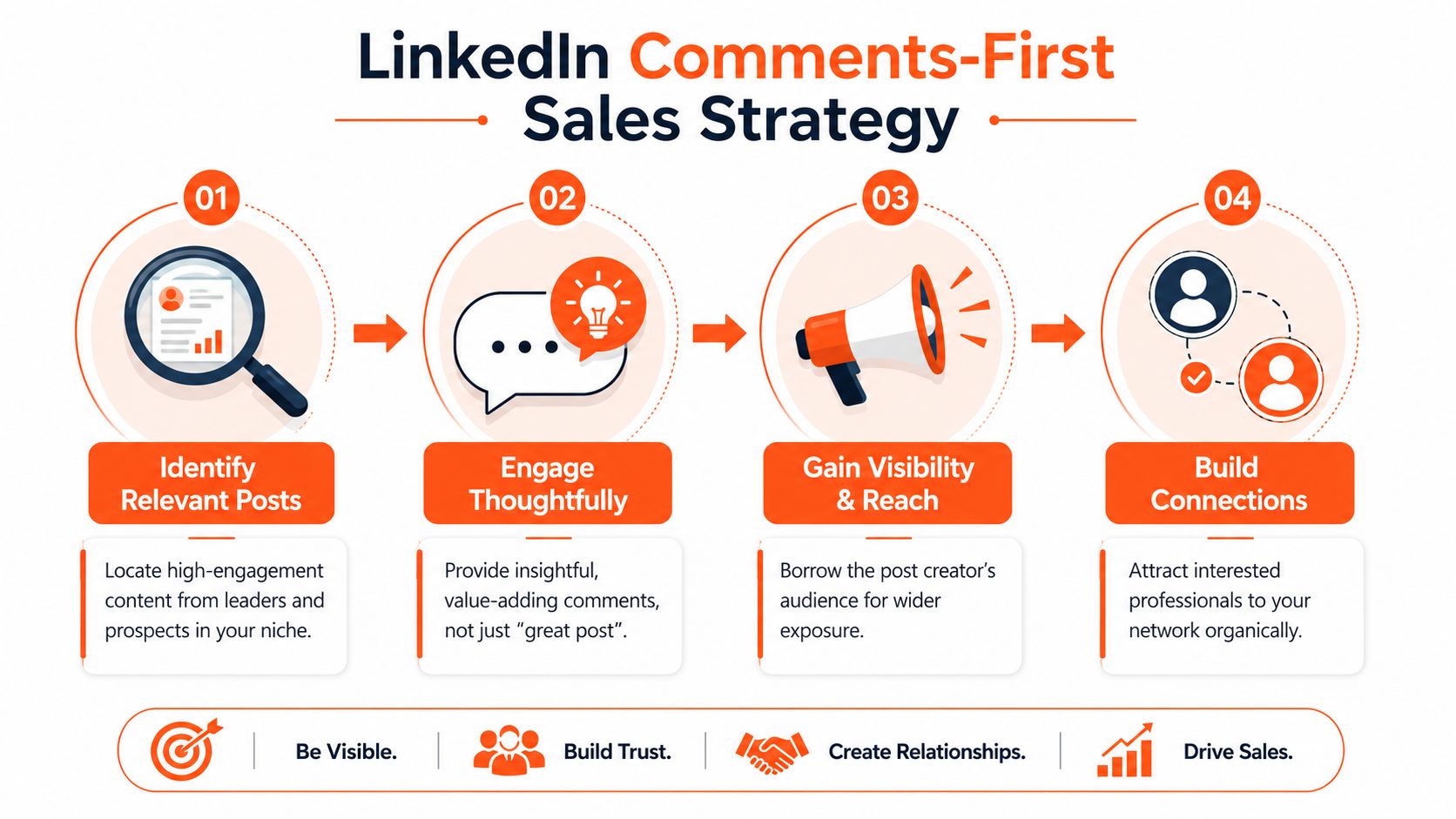
Posting is fine. Relying on posting alone is where most LinkedIn sales strategy falls apart. You publish into a crowded feed, the algorithm gives it a limited chance, and if you don't already have attention, the post dies quickly.
Commenting flips that dynamic. Instead of asking the feed to discover you, you enter conversations that already have distribution. That's the core of borrowed reach.
Why comments beat isolated posting
Strategic commenting for just 10 to 15 minutes daily on the right people can generate 2 to 3 times more visibility and leads than posting your own content alone, based on this analysis of LinkedIn comment strategy. That's the efficiency gap often overlooked.
The advantage isn't just reach. It's context. When you comment on a relevant post from a prospect, partner, or niche creator, your name appears next to an active buying conversation. That's a warmer entry point than dropping a cold connection request out of nowhere.
The timing matters too. Commenting on high-visibility posts within the first 30 to 60 minutes after publication is critical because LinkedIn uses that window to decide broader distribution, according to this breakdown of LinkedIn commenting strategy. If you want visibility, don't arrive late.
Add something the original post didn't include. A sharper example, a practical caveat, or a useful follow-up question works better than agreement.
For a more detailed operating model focused on comment-driven growth, see this LinkedIn comments marketing growth guide.
A daily workflow that creates warm visibility
The most effective cadence is simple enough to repeat every day.
Identify the right posts
Look for creators, customers, prospects, and adjacent operators your buyers already follow. Prioritize posts with early engagement and direct relevance to your offer.Read the full post before writing
Surface-level comments are easy to spot. Read for the underlying angle. What assumption is being made? What pain point is implied? What buyer objection sits underneath it?Comment with intent
Strong comments usually do one of three things:- Extend the idea: Add a second-order lesson or tactical nuance.
- Ground it in execution: Explain what happens when a team applies the idea in practice.
- Invite a response: Ask a specific question that opens a thread.
Check who engages
Profile visits, likes on your comment, direct replies, and new connection requests are not random. They're buying signals or at least curiosity signals.
What doesn't work:
- Generic praise: "Great post" gets ignored.
- Instant pitching: The comment is not the close.
- Spray-and-pray volume: Random commenting creates random audiences.
A comments-first system works because it creates recognition before outreach. When you later send a connection request, your name already feels familiar.
Creating Content and Outreach That Converts
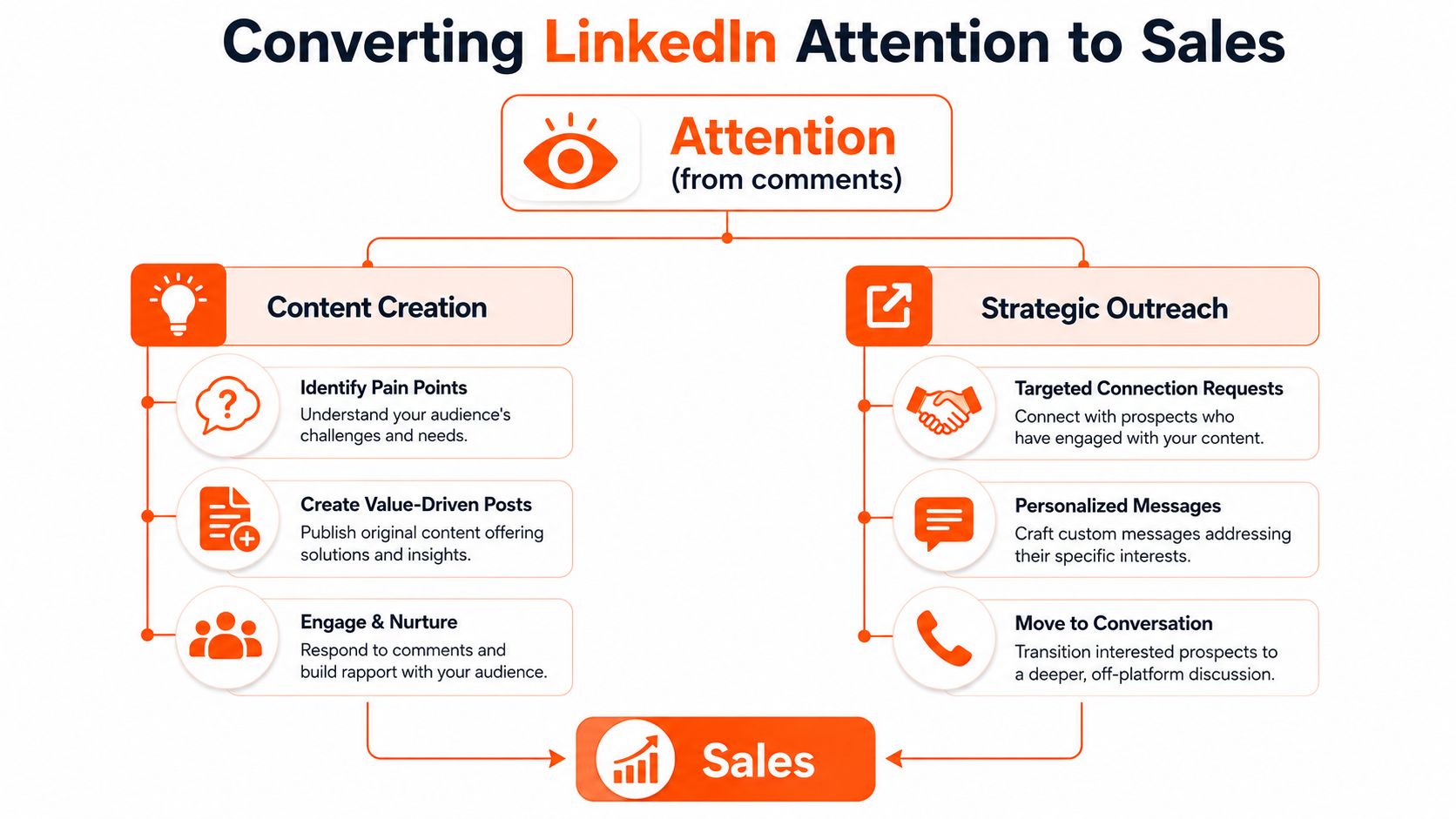
Comments earn attention. Content and outreach turn that attention into pipeline. Many teams, however, break the chain at this point. They comment well, get profile visits, then either post generic content or send a cold-sounding message that resets all the warmth they just built.
Your content should make the next step obvious. Your outreach should feel like a continuation, not an interruption.
Use a content mix built for sales conversations
The formats with the strongest engagement-to-pipeline conversion on LinkedIn are short-form insight posts on buyer pain points, document carousels teaching tactical frameworks, and short videos demonstrating workflows. The recommended mix is 40% problem education, 30% stories or case snippets, 20% point-of-view posts, and 10% direct offers, based on this LinkedIn B2B sales playbook.
That mix works because it mirrors how buyers evaluate risk:
- Problem education shows you understand the issue.
- Stories and case snippets make the issue concrete.
- Point of view differentiates your approach.
- Direct offers give people a path to act.
Don't overcomplicate the editorial calendar. A sales-led content engine usually needs a few repeatable post types.
| Content type | Best use |
|---|---|
| Short insight post | Name a pain point and explain why teams mis-handle it |
| Document carousel | Teach a process buyers can apply |
| Short video | Show how a workflow actually looks in practice |
Move from comment engagement to warm outreach
Warm outreach begins before the message. It starts in the comment thread.
If a prospect likes your comment, replies to it, or views your profile, you've earned a relevant reason to connect. Use that moment. Mention the post, reference the discussion, and keep the ask light.
A workable sequence looks like this:
- Connection request: Reference the post or discussion directly.
- First message after acceptance: Continue the topic. Don't pitch immediately.
- Follow-up: Share a useful angle, resource, or observation tied to their situation.
- Sales conversation: Move off-platform only when there's clear interest.
The best outreach message usually sounds like it belongs in the same conversation the buyer was already having.
One practical habit raises reply quality fast. Check the prospect's recent activity before each follow-up. If they accepted your request but didn't answer, use a recent post or comment as the next icebreaker instead of resending the same pitch in different words.
If you want message structures that fit this warmer style, this LinkedIn DM outreach strategy guide can help tighten the handoff from engagement to conversation.
Smart Automation with AI Guardrails
Time is the constraint that kills most good LinkedIn sales strategy. Reps mean to comment consistently, founders mean to post, and leaders mean to follow up. Then the week gets crowded and the system disappears.
AI helps when it handles the repetitive work without flattening your voice.
Use AI for consistency, not impersonality
A high-performing B2B strategy needs a 60/40 effort split, with 60% on inbound content and relationship building and 40% on outbound outreach. The strongest approach also involves engaging with a prospect's content for 1 to 2 weeks before sending a connection request, according to this LinkedIn sales strategy guide.
That's a smart model. It's also time-heavy if you do every step manually.
The right AI setup supports that inbound-heavy motion. It can help identify relevant posts, draft comments in your style, queue posts based on your content themes, and track which interactions deserve follow-up. Used that way, AI doesn't replace credibility. It protects consistency.
One option is Linqin, which automates comment discovery, drafts comments and posts in the user's voice, and ties engagement back to specific actions so teams can see which activity created lead interest. If you want a call to action to grow linkedin while you sleep, that's the practical use case.
Guardrails that keep automation useful
Automation fails when teams chase volume and ignore platform behavior. LinkedIn's algorithm detects automated comments with 97% accuracy when they show obvious patterns like identical text, instant timing, excessive volume, or pod-like reciprocity, according to this guide to LinkedIn comment automation and engagement.
That means the guardrails matter more than the tool.
Use this checklist:
- Vary timing: Don't publish or comment at perfectly uniform intervals.
- Vary phrasing: Repeated sentence shapes are a giveaway.
- Stay selective: Narrow relevance beats broad activity.
- Review drafts that matter: High-value accounts deserve human judgment.
- Preserve your voice: Train the system on your real writing, not generic prompts.
A product demo makes more sense once the operating rules are clear.
The best use of AI is narrow and disciplined. Let it remove blank-page friction, support your cadence, and surface opportunities. Keep strategy, targeting, and final judgment with the human operator.
Measuring What Matters and Capturing Leads
If you can't show how LinkedIn activity creates sales conversations, the program gets dismissed as branding. That's usually a tracking problem, not a channel problem.
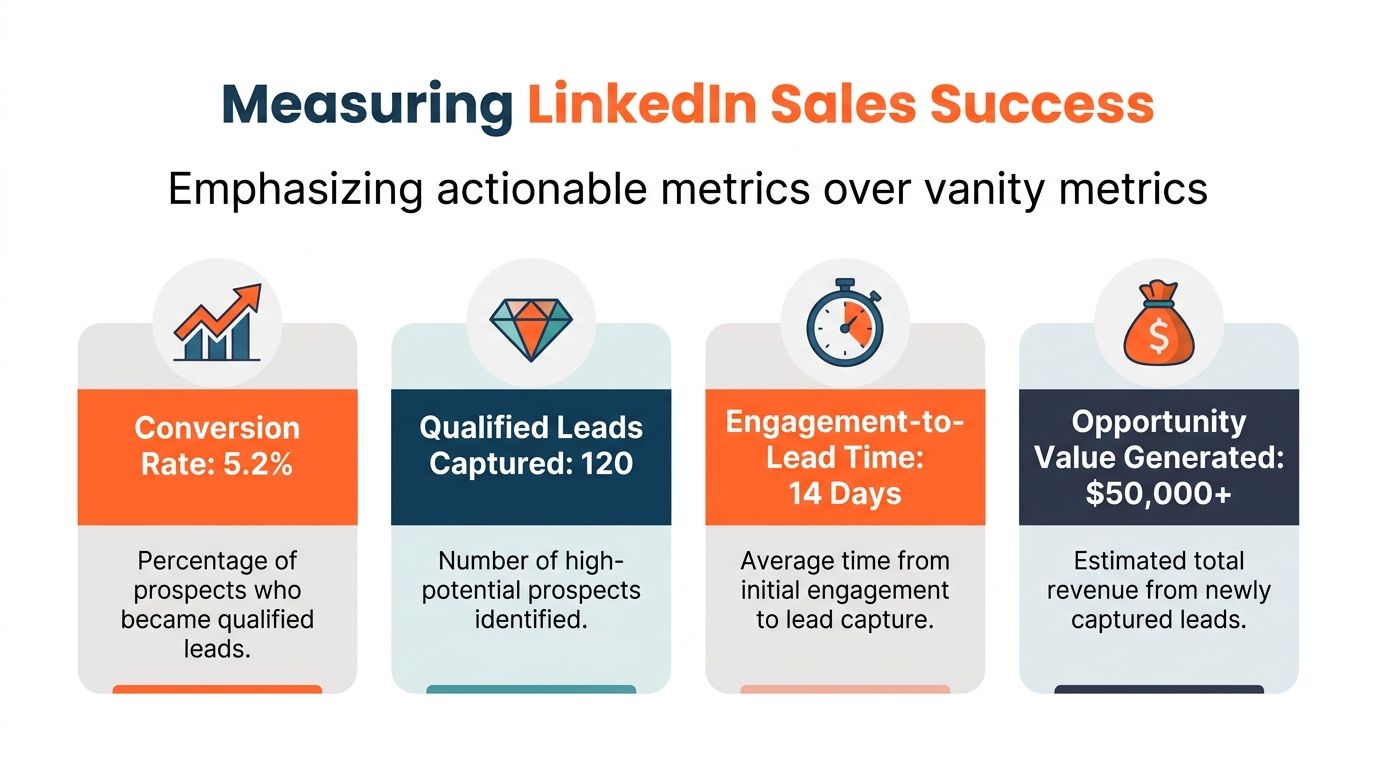
Likes, impressions, and follower growth can be useful directional signals, but they don't tell you which actions create qualified interest. A serious LinkedIn sales strategy needs attribution at the activity level.
Vanity metrics don't answer the pipeline question
The first metric I look at in a comments-first motion is comment reply quality. A comment reply rate between 20% and 40% indicates your comments are adding genuine value, and a response rate above 35% is the recommended goal for high-quality engagement that drives pipeline, based on this guide to LinkedIn comment analytics and ROI.
That's useful because it separates empty activity from meaningful participation. If people reply to your comments, your market is telling you the message has relevance.
Track metrics in layers:
- Engagement quality: Replies to comments, quality of responses, profile visits after visible interactions.
- Warm lead creation: New connection requests, inbound messages, and identifiable prospects engaging multiple times.
- Sales progression: Conversations booked, opportunities opened, and follow-up actions tied to the original interaction.
If a rep can't point to the comment, post, or message that created the lead, the team is still measuring exposure, not pipeline.
Build a lead capture loop from engagement signals
A measurable system needs a capture loop, not just analytics.
When someone engages, log the context immediately. That means the originating post, the comment topic, the account involved, and the next best action. Without that context, the SDR or founder doing follow-up has to reconstruct the interaction later, and relevance gets lost.
A clean workflow looks like this:
Spot the signal
Someone replies to your comment, visits your profile, connects, or sends a message.Capture the context
Save the post URL, the text of your comment, and what the person engaged with.Classify the lead
Sort by fit, intent, and recency. Someone who replied thoughtfully to a problem-specific comment is warmer than someone who passively liked a post.Route the follow-up
Decide whether the next move is a connection request, a direct message, a sales touch, or simple continued nurturing.
Teams that do this well don't treat LinkedIn as a separate universe. They push those signals into the same lead management process they use elsewhere. The result is faster follow-up, better message relevance, and a clearer view of what the channel is producing.
Scaling with a Team-Based Employee Advocacy Program
A strong individual seller can create momentum on LinkedIn. A coordinated team can turn it into market coverage. That's where employee advocacy becomes useful. Not as a vanity initiative, but as a structured way to put more credible voices into the right conversations.
The mistake is forcing everyone into the same posting template. Buyers don't trust copy-and-paste advocacy. They trust recognizable people who sound like themselves and still reinforce the company's message.
Standardize the system, not the personality
Start with shared inputs, not shared scripts.
Give the team a lightweight brand kit that includes core positioning, priority topics, approved proof points, language to avoid, and examples of strong comments and posts. That keeps the message coherent without flattening everyone's voice.
A practical team program usually includes:
- Topic lanes: Each rep, founder, or marketer speaks to a few themes they can discuss credibly.
- Comment targets: A shared list of creators, customers, prospects, and ecosystem accounts worth engaging.
- Approval rules: Clear guidance on what needs review and what doesn't.
- Lead routing: A way to assign follow-up when someone engages with the wrong person but fits another rep's patch.
Create simple operating rules for the team
The best employee advocacy programs are boring in the right places. Everyone knows what to do, how often to do it, and how to hand off results.
Use operating rules like these:
| Team element | Good rule |
|---|---|
| Commenting | Prioritize relevant conversations over random activity |
| Posting | Stick to buyer problems, lessons, and real execution insights |
| Follow-up | Reference the exact interaction that created familiarity |
| Reporting | Roll activity up to team-level lead and conversation outcomes |
One more point matters. Leadership has to participate. If founders and sales leaders don't model the behavior, the program becomes another enablement document nobody uses.
A team-based LinkedIn sales strategy works when it feels like distributed expertise, not distributed promotion.
If you want a system that helps you grow linkedin while you sleep, Linqin is built around the comments-first model. It identifies relevant conversations, drafts comments and posts in your voice, tracks which actions lead to profile visits and replies, and captures warm leads with context so follow-up doesn't depend on memory.