You're active on LinkedIn. You post when you can. You send connection requests. You get some likes, a few polite replies, and the occasional profile view. But your calendar still isn't filling with qualified meetings.
That gap is where most sales teams get stuck. They treat LinkedIn like a publishing platform, when it works better as a conversation platform. Posting matters, but broadcasting alone rarely creates enough trust to move a buyer toward a call. Buyers notice people who show up in the right discussions, add real context, and keep doing it consistently.
That's the shift behind how to use LinkedIn for sales in 2026. Stop relying on a post and pray routine. Build a system that starts with visibility inside existing conversations, turns that visibility into profile visits, and converts warm attention into outreach that feels timely instead of intrusive.
Table of Contents
- Why Your Current LinkedIn Efforts Are Falling Flat
- Optimize Your Profile for Conversion Not Connections
- The Comments-First Strategy to Borrow Reach and Build Authority
- Creating Content That Warms Up Prospects
- Executing Smart Outreach and Follow-Up Sequences
- Measure Automate and Scale Your Sales Engine
Why Your Current LinkedIn Efforts Are Falling Flat
Most weak LinkedIn strategies have the same pattern. People publish generic advice, send too many broad connection requests, and pitch too early. Activity goes up. Pipeline doesn't.
The problem usually isn't effort. It's sequencing. If you ask for meetings before a prospect has seen your thinking, read your comments, or clicked your profile, your outreach lands cold even when the message looks personalized.
Another issue is audience fatigue. Buyers see endless recycled posts and robotic DMs. They can tell when a seller skimmed a profile and pasted in a line about “loved your recent work.” That doesn't build trust. It signals laziness.
Buyers respond to relevance, not volume.
A lot of salespeople also overvalue their own feed and undervalue everyone else's. They spend time trying to generate impressions from scratch instead of joining conversations that already have their target buyers reading, reacting, and debating. That's the core flaw in the post and pray model. You're waiting for attention instead of stepping into it.
The old playbook breaks in predictable ways
- Generic posting gets ignored: Broad motivational content may earn likes, but it rarely signals that you understand a specific buying problem.
- Shotgun outreach damages trust: Messaging multiple people at the same company with the same pitch feels sloppy and creates internal friction.
- Early pitching kills momentum: Reaching out before any visible engagement makes your message feel abrupt.
- Vanity metrics hide weak intent: Likes from peers can feel encouraging while your actual buyers stay passive.
What works instead
The better approach is narrower and more disciplined:
| Weak approach | Strong approach |
|---|---|
| Post and wait | Comment where buyers already pay attention |
| Connect and pitch | Engage first, then connect |
| Talk about product | Talk about buyer pain, trade-offs, and decisions |
| Measure likes | Track profile visits, replies, and warm engagement |
The point isn't to post less. It's to earn context before outreach. When someone has already seen you make sharp comments on a topic they care about, your profile visit means more and your eventual message doesn't feel random.
That's how LinkedIn starts acting like a sales channel instead of a time sink.
Optimize Your Profile for Conversion Not Connections
A prospect who notices your comment will usually do one thing next. They'll click your profile. If that profile reads like a resume, you lose the moment.
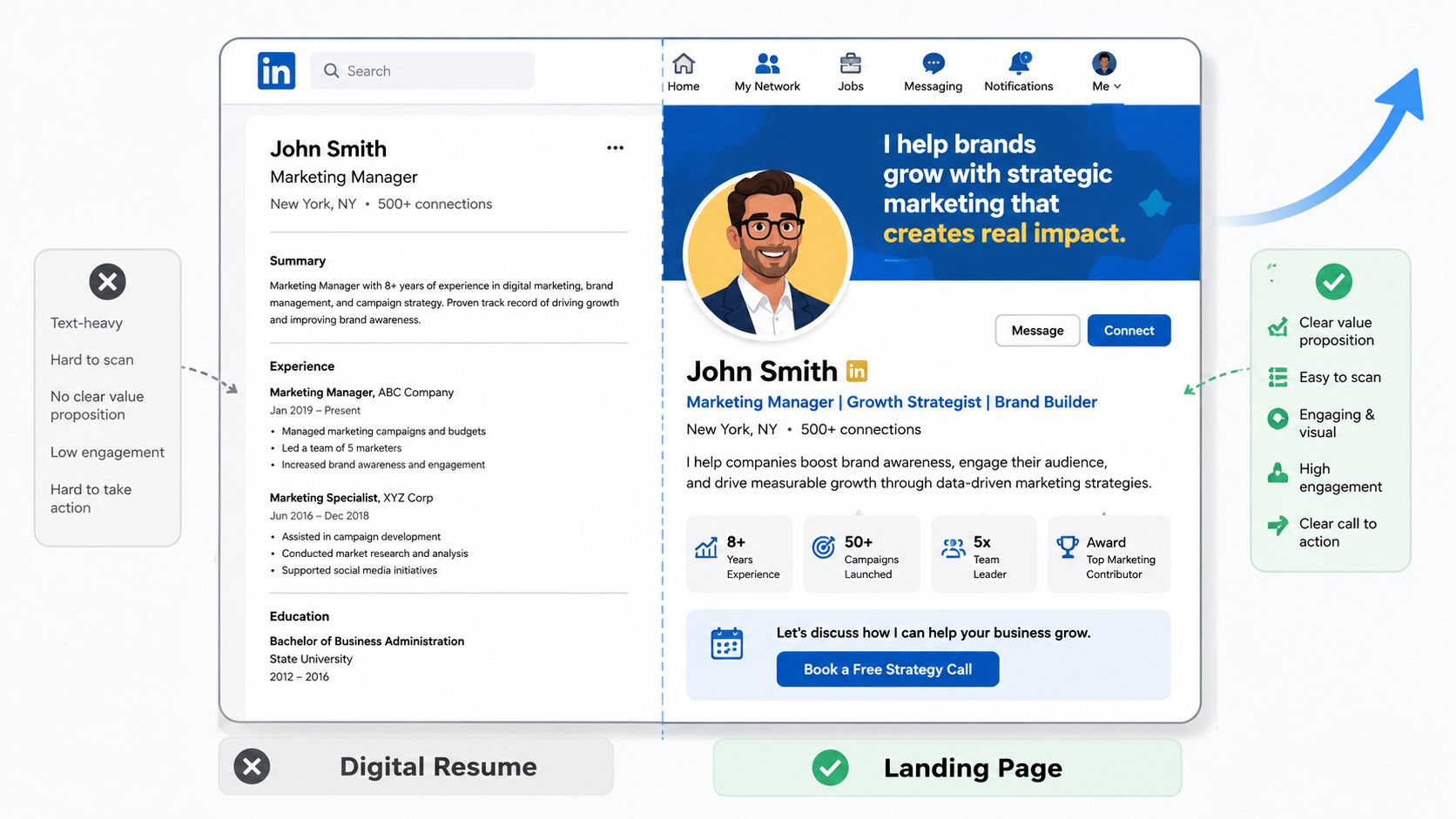
LinkedIn matters enough to justify getting this right. LinkedIn generates 80% of all B2B social media leads, and its visitor-to-lead conversion rate is 2.74%, nearly 4 times higher than Twitter. For 2026 planning, strategies targeting well-defined audiences can achieve conversion rates between 2.5% and 3.5% according to LinkedIn sales benchmark data. If your profile doesn't convert attention into trust, you're wasting the highest intent traffic you can get on the platform.
Your profile is a landing page
Your headline, About section, banner, Featured section, and recent activity should answer three buyer questions fast:
- Who do you help
- What problems do you help solve
- Why should I trust your perspective
That means dropping internal language like quota awards, territory ownership, and generic titles with no buyer context. Prospects don't care that you “exceeded plan.” They care whether you understand their situation.
Practical rule: If a first-time profile visitor can't tell who you help within a few seconds, rewrite the headline.
What to rewrite first
Headline
Don't just state your role. State your market and outcome.
Bad:
Account Executive at Company X
Better:
Helping SaaS revenue teams improve outbound quality and build warmer pipeline through LinkedIn
That second version gives a buyer a reason to stay.
About section
Write this like a concise sales page, not a career timeline. Keep it focused on buyer problems you see repeatedly, how you think about solving them, and the type of conversations you're open to.
A useful structure is:
- Opening line: Name the problem space
- Middle lines: Describe the patterns you help buyers manage
- Closing line: Invite relevant conversations
Featured section
Most sellers underperform in this aspect. Use it to surface assets that support a sales conversation.
Include things like:
- A strong post: One that teaches a framework your buyer can apply
- A document carousel: Something practical that shows how you think
- A customer-facing resource: A guide, checklist, or teardown
- A scheduling or contact option: Only if the rest of the profile already builds trust
If you want a deeper walkthrough, this LinkedIn profile optimization guide is a useful reference.
Make the profile match the buyer journey
Your comments create curiosity. Your profile should convert that curiosity into confidence. That means your recent activity matters as much as your static sections. If someone sees thoughtful comments and then lands on a profile full of corporate reposts, the chain breaks.
Treat your profile as the bridge between public credibility and private outreach. Connections are a byproduct. Conversion is the target.
The Comments-First Strategy to Borrow Reach and Build Authority
Trying to build LinkedIn reach only through your own posts is slow. A comments-first strategy is faster because it puts your thinking directly inside conversations that already have attention.
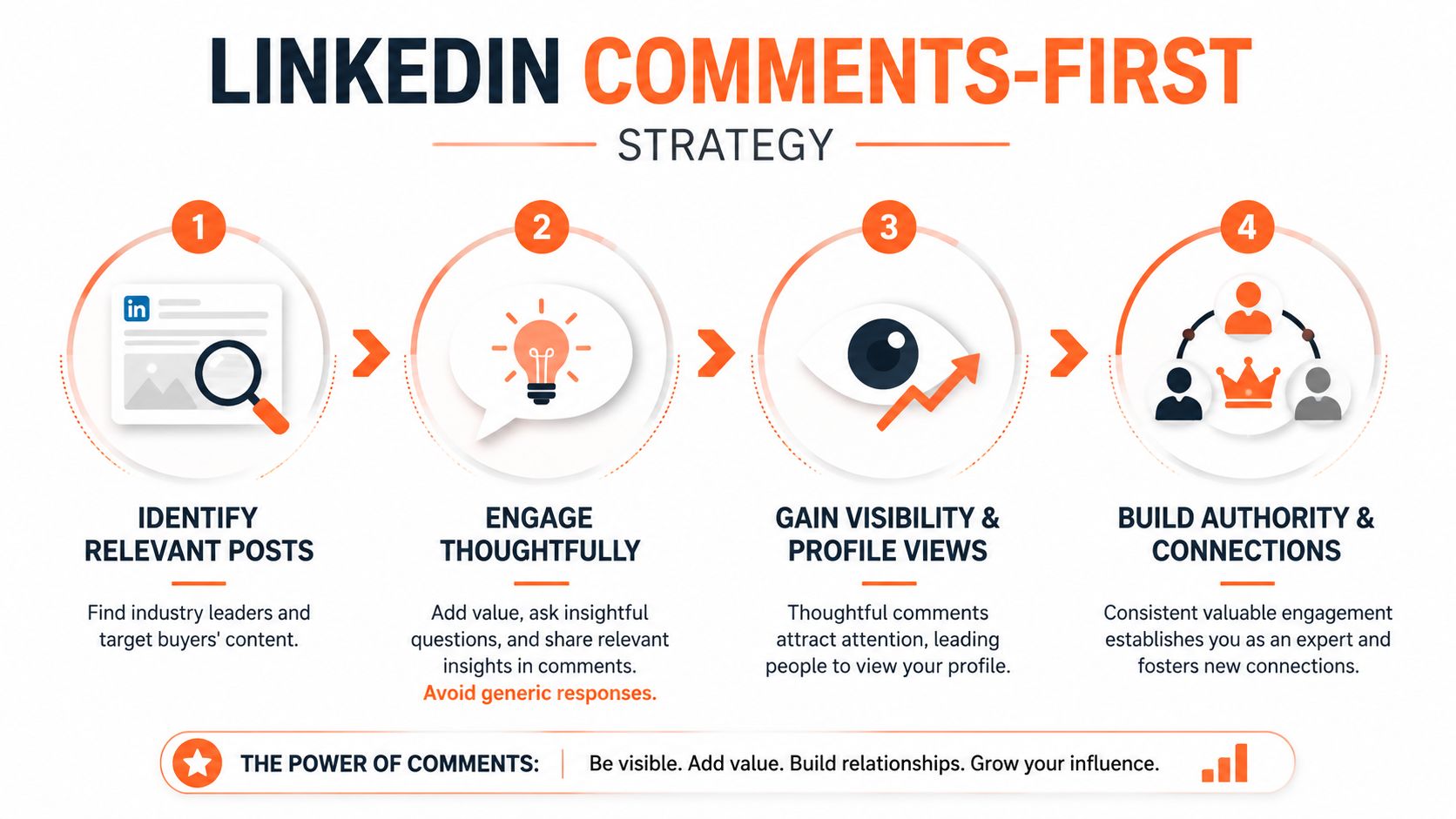
The Borrowed Reach angle is still underused. According to LinkedIn's marketing guide on content for sales success, proactively engaging on other people's content drives significantly more profile visits and warm-lead conversions than posting in isolation, even though most guides still fail to quantify that ROI clearly. In practice, that means thoughtful comments often create better sales opportunities than another standalone post in your own feed.
Why comments beat isolated posting
Comments do three jobs at once.
First, they put you in front of the post author's audience. If that author already attracts your buyers, you're borrowing distribution instead of manufacturing it.
Second, comments create a stronger credibility signal than low-effort posting. A good comment proves you read the argument, spotted the missing nuance, and can add something useful in public.
Third, comments shorten the path to outreach. When a prospect has already seen your name under multiple relevant posts, the first message doesn't feel like a cold introduction.
A lot of sellers miss this because they think comments are support activity. They aren't. On LinkedIn, comments are often the top of the funnel.
For a practical framework, this LinkedIn commenting strategy guide shows how to structure the workflow.
What a strong comment actually does
Most comments fail because they're too generic. “Great post.” “Completely agree.” “This is so true.” Those don't create trust or clicks.
A useful sales comment usually does one of these:
- Adds a missing insight: Expand the point with a specific operational nuance
- Names a trade-off: Explain where the advice breaks down in real buying situations
- Offers a brief example: Show what the idea looks like in the field
- Asks a serious question: Invite the author or other readers into a higher-value discussion
Here's the difference:
| Weak comment | Strong comment |
|---|---|
| Great take | The part teams miss is timing. If outreach starts before visible engagement, even personalized messaging feels cold |
| Totally agree | I've seen this work best when the rep comments first, then waits until the prospect has seen their name a few times |
| Love this | Useful point. The trade-off is that scale can flatten voice, which is why review and tone control matter |
A comments-first strategy works best when you target posts from industry operators, founders, niche creators, customers, and adjacent experts your buyers already follow. Don't chase every viral post. Chase relevance.
Here's a useful visual overview before building your routine:
Where AI fits without making you sound fake
The obvious challenge is consistency. Reading posts, finding the right ones, writing comments that sound like you, and doing it every day takes time.
That's where AI can help, but only if it works from the full post context and adapts to your voice. A title-only comment generator usually produces bland filler. A stronger system reads the full post, identifies the actual argument, and drafts something that fits your vocabulary and cadence.
The risk is over-automation. If you use comment automation, guidance on LinkedIn comment automation safety recommends staying under 30 to 50 comments per day, randomizing timing, and incorporating breaks to mimic human activity patterns. That's the right mental model. Use AI for consistency and research support, not for mass obvious activity.
One option in this category is Linqin, which uses a comments-first workflow to identify relevant discussions, draft comments in the user's voice, and tie engagement back to the comment or post that created the lead signal.
Good LinkedIn selling doesn't start with “How do I publish more?” It starts with “Where are my buyers already paying attention?”
Creating Content That Warms Up Prospects
Comments get you discovered. Content decides whether that attention turns into trust.
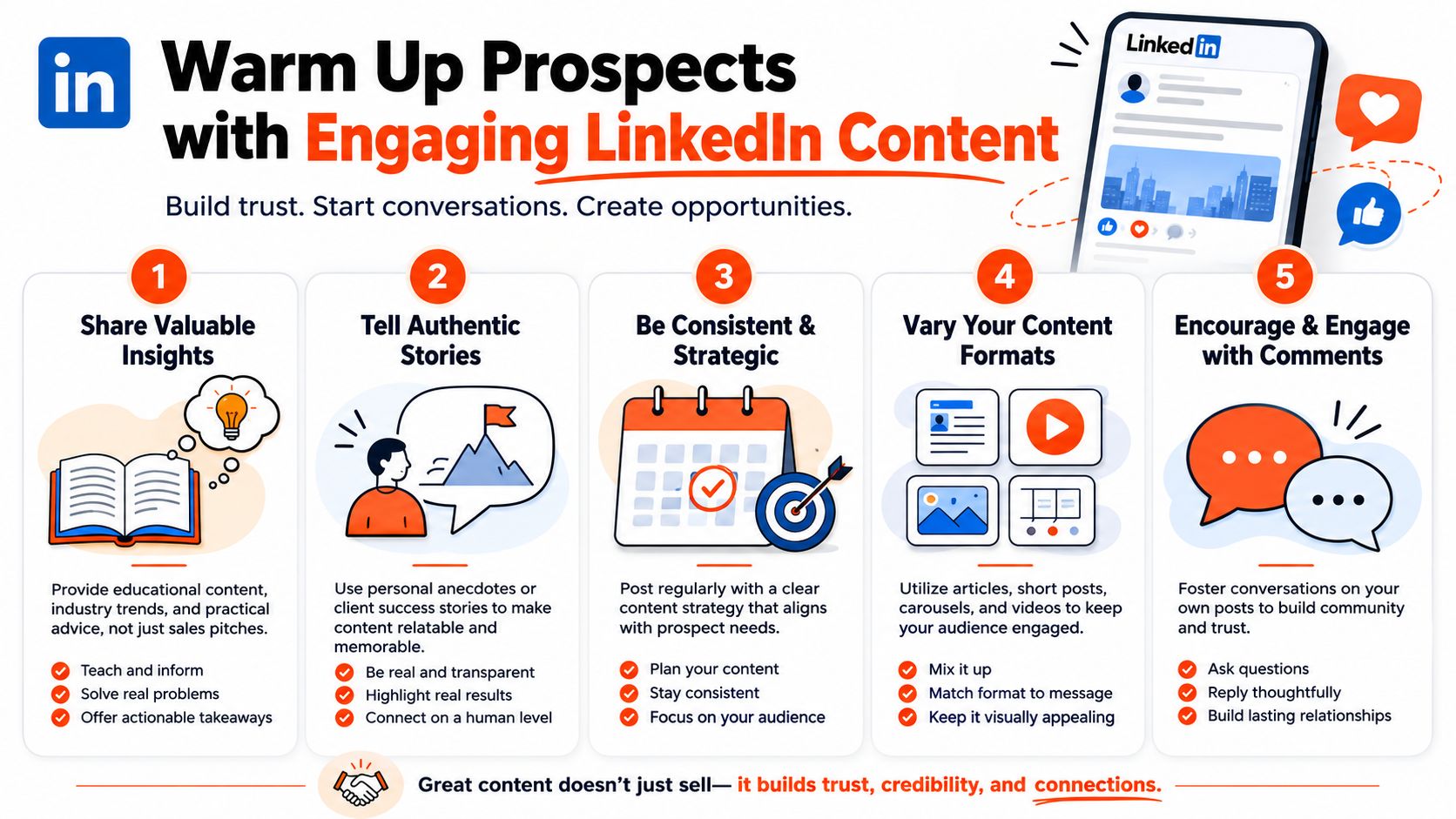
A comments-first strategy breaks down fast if your profile activity looks thin, random, or overly promotional. Prospects click after seeing you under someone else's post. They stay when your own content shows a clear point of view they can learn from.
That content has one job. Reduce friction before the first direct conversation.
The formats that move pipeline
Warm-up content works best when it teaches something a buyer can use without booking a call. LinkedIn's own guidance on creating content that educates professionals and sparks discussion points to practical, audience-specific posts as the ones that earn stronger engagement. In practice, three formats do that job well in B2B sales: short insight posts, document carousels, and brief workflow videos.
Each format helps in a different way.
Short text posts create recognition. They let prospects see how you diagnose problems and how clearly you communicate. Carousels slow people down and give you more room to teach a process step by step. Short videos help buyers hear your judgment, which matters if your sale depends on credibility more than brand awareness.
I would rather have a prospect read one sharp post and think, "they understand this problem," than collect a few thousand empty impressions from a broad post that says nothing.
A practical weekly content mix
You do not need daily posting to make this work. You need a body of content that supports the authority you started building in comments.
Short-form insight posts
These are the easiest place to start because they come straight from real sales conversations, objection patterns, and broken workflows you keep seeing.
Good examples:
- Sales teams confuse LinkedIn visibility with pipeline, then wonder why posting alone does not produce meetings.
- A connection request sent cold usually underperforms the same request sent after a prospect has seen your name in relevant comment threads.
- AI-assisted outreach sounds robotic when the draft copies surface-level personalization but misses how real sellers talk.
The best test is simple. If the post could help a buyer make a better decision this week, keep it.
Document carousels
Use carousels for material that benefits from sequence. Frameworks, checklists, teardown examples, and before-and-after rewrites all fit well here.
A strong carousel might cover:
- how to audit a rep's LinkedIn profile for conversion gaps
- how to spot fake engagement versus real buying signals
- how to turn comment activity into a shortlist for outreach
- how to rewrite a weak sales message after reviewing prospect context
This format also has better shelf life than a quick opinion post. Buyers often save it, share it internally, and return to it later.
Short workflow videos
Video helps when the value is in your reasoning, not just the final recommendation. Walk through a live example. Show how you decide whether a post is worth commenting on, how you turn a comment into a content idea, or how you judge whether someone is warm enough for outreach.
Keep it tight. One lesson. One example. One takeaway.
That is usually enough.
Build content from comments, not from a blank page
The comments-first model proves its worth. Your best content ideas are usually sitting in the discussions you already joined.
If a comment gets replies, profile visits, or DMs, expand it into a post. If several prospects react to the same point, turn that point into a carousel. If buyers keep misunderstanding the same issue, record a short video explaining it cleanly.
That approach beats "post and pray" because the topic already has market feedback. You are not guessing what will resonate. You are promoting ideas that already earned attention in the field.
It also improves ROI. One smart comment can get you in front of another creator's audience. One follow-up post can convert that borrowed reach into profile views, followers, and warmer conversations. Broadcasting without that feedback loop is usually less efficient.
Using AI without losing your voice
AI should help you publish more useful content with less friction. It should not flatten your thinking into generic B2B copy.
A practical workflow looks like this:
- start with a real comment, call note, objection, or sales observation
- use AI to organize the draft and tighten the structure
- add your own examples, phrasing, and judgment before posting
The informal 30% rule is a good guardrail. PostUnreel's guidance on ethical AI use for LinkedIn comments and posts recommends keeping meaningful human input in the final version so the content still reflects real experience, not just pattern-matched language.
Use a simple filter before anything goes live:
- Keep it: it names a real buyer problem and gives a clear point of view
- Rewrite it: it sounds polished but could apply to any market
- Delete it: it reads like content made to fill a calendar
If you want that content to support conversion later, pair it with a LinkedIn DM outreach strategy that builds on prior engagement. That is where warm content starts doing pipeline work, not just engagement work.
Executing Smart Outreach and Follow-Up Sequences
A prospect sees your name in the comments three times over two weeks. Then they get your connection request. That sequence usually outperforms a cold pitch because you already borrowed trust from a public conversation.
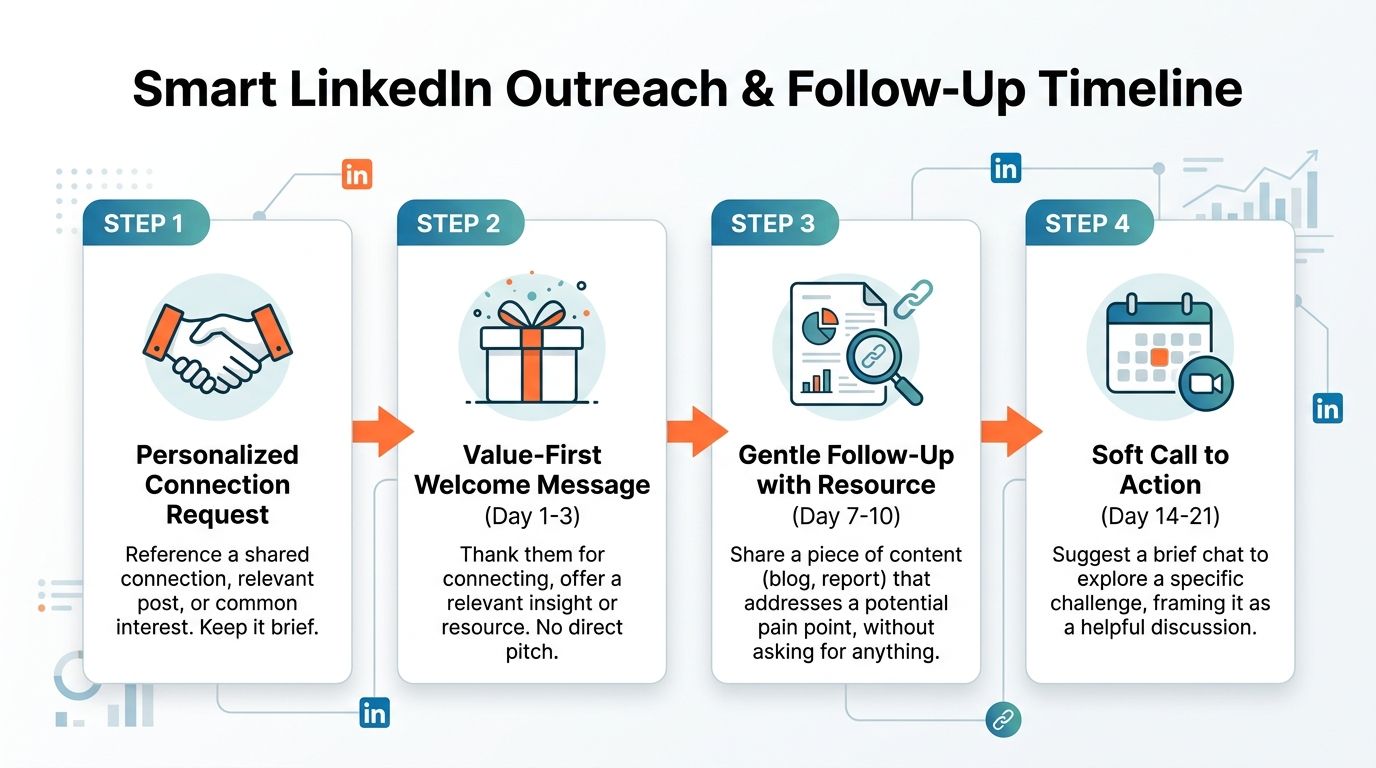
The mistake is assuming a new connection means buying intent. It means access. You still need context, timing, and a reason for the buyer to reply.
Warm the lead before the message
Comments-first selling changes the job of outreach. The message is no longer trying to create interest from zero. It is trying to convert light familiarity into a real conversation.
Growth Folks' guide to building LinkedIn outreach sequences that rely on personalized multi-touch messaging recommends using a short sequence instead of a single note, spacing follow-ups across several days, and combining outreach with visible engagement and useful content. That lines up with what works in practice. Buyers respond more often when they have already seen your name attached to a sharp comment or relevant post.
A good rule is simple. If there has been no interaction, earn a little familiarity first. A few thoughtful comments on the right posts can warm the path better than another generic connection request sent into a crowded inbox.
That matters for ROI. Ten comments on posts your buyers already read can create more qualified profile visits than one polished post that never reaches them. Outreach works better when it follows that exposure.
A sequence that feels professional
Use a sequence built for busy buyers who do not owe you attention.
Step 1
Engage with their content first. Add a comment only if you can move the discussion forward. If you have nothing useful to say, skip it.
AI helps here if you use it well. Feed it the post, your prospect's role, and the point you want to add. Then rewrite the draft so it sounds like you, not a sales assistant trained on clichés.
Step 2
Send a personalized connection request after there is clear context.
Example:
“Hi Sarah, your point on pipeline quality versus activity targets was right on target. I work with teams dealing with the same reporting problem, so I thought it made sense to connect.”
Step 3
After they accept, send a short note that continues the thread. Do not drop into a pitch.
Example:
“Thanks for connecting. Your point about rep activity inflation came up again this week. I keep seeing teams track volume closely but ignore whether any real engagement happened before outreach.”
Step 4
A few days later, follow up with something useful tied to their likely problem. Share an observation, a short framework, or a relevant post. Keep it tight.
Example:
“One pattern we keep seeing is that comment-led visibility warms DM response rates because the buyer has already seen your thinking in public. Posting helps, but comments often create the first real touch.”
Step 5
Use a soft CTA only after they reply, react, or show some signal.
Example:
“If LinkedIn-sourced pipeline is a focus this quarter, happy to compare notes on what is working and where teams usually lose momentum.”
For a tactical breakdown of timing, structure, and examples, use this LinkedIn DM outreach strategy guide for turning prior engagement into sales conversations.
Simple message templates that don't sound automated
Use these as starting points. Do not copy them line for line.
| Scenario | Template |
|---|---|
| Connection request after comment exchange | “Enjoyed the exchange on James's post about outbound quality. Your point on message timing was sharp. Thought it made sense to connect.” |
| Welcome note | “Thanks for connecting. I've been thinking about your point on buyer fatigue. A lot of teams still lead with product language before they've earned enough context.” |
| Follow-up with value | “Saw this come up again today, so sharing a quick thought. Comment-first visibility tends to warm conversations better than isolated posting because prospects see your judgment before they see your ask.” |
| Soft CTA | “If your team is actively working on this, I'm happy to compare notes on how I'd structure it.” |
Field note: The best LinkedIn messages feel like the next step in an existing conversation.
Stay calm. Skip fake familiarity, false urgency, and “just bumping this” language. If there is no signal, give the prospect space. Good follow-up creates pipeline. Bad follow-up trains buyers to ignore you.
Measure Automate and Scale Your Sales Engine
If you can't tie activity to outcomes, LinkedIn stays in the category of “good for brand.” That's not enough for a serious sales motion.
The right way to think about LinkedIn is as a system with visible inputs and traceable outputs. Comments create exposure. Exposure creates profile visits. Some of those visitors engage. A portion of those engagers become warm leads. Then outreach converts the best-fit ones into meetings.
What to measure each week
Don't drown in dashboards. Track the signals that help you improve execution.
- Profile visits by source: Which comments or posts triggered them
- Engagement quality: Who commented, replied, or viewed repeatedly
- Warm-lead list movement: Which people moved from passive viewer to active engager
- Message response patterns: Which outreach angle got conversation, not just acceptance
- Top engagers: The people repeatedly interacting with your content and comments
Comments-first selling becomes much more than personal branding. You can start to see which topics, audiences, and post types create commercial intent.
Automation needs guardrails
The hard part of scale isn't volume. It's preserving trust while increasing consistency.
That's the center of the AI Voice Authenticity problem. This 2026 LinkedIn outreach analysis argues that scaling outreach without losing trust depends on AI that can analyze a user's writing and replicate their tone and cadence in comments and posts. That's the missing layer in a lot of automation tools. They generate content, but not your voice.
There also needs to be a reliability bar. For critical AI agents, performance guidance for AI agents says incorrect outputs should stay below an error rate of 5%, and uptime should stay at 99.9%, which is less than 9 hours of downtime per year. If you're letting an agent participate in buyer-facing activity, those standards are a sensible benchmark.
The point of automation is simple. Let software handle the repetitive work of finding relevant conversations, drafting first passes, maintaining cadence, and logging outcomes. Keep humans focused on judgment, edits, live conversations, and closing.
That's how you grow LinkedIn while you sleep. Not by removing the human. By removing the manual grind around the human.
If you want a practical way to grow LinkedIn while you sleep, Linqin automates comments-first audience growth, drafts posts and comments in your voice, and tracks which actions lead to warm leads so your team can focus on real sales conversations.