You're probably doing at least some of the right things already. Your profile is filled out. You post when you can. You get a few likes from coworkers, maybe a polite comment or two, and then nothing happens. No buyer messages. No recruiter outreach worth caring about. No clear sign that the time you spend on LinkedIn is turning into pipeline.
That's the trap with most advice on personal branding on LinkedIn. It treats visibility like the end goal. It isn't. For B2B founders, marketers, and sales leaders, visibility only matters when it leads to conversations with the right people.
The playbook that works looks different from the usual “post more” advice. It starts with a profile that converts attention into interest. It leans hard on comments to borrow reach instead of posting into the void. And it tracks whether your activity creates business outcomes, not just vanity metrics.
Table of Contents
- Why Your Current LinkedIn Efforts Are Falling Flat
- Optimize Your Profile for Inbound Opportunities
- Adopt a Comments-First Content Strategy
- Execute Daily Engagement and Audience Targeting
- Turn Conversations into Qualified Leads
- Measure Your Personal Branding ROI
- Scale Your Presence with Automation and Team Advocacy
Why Your Current LinkedIn Efforts Are Falling Flat
Most weak LinkedIn strategies fail for one reason. They confuse activity with distribution.
You can publish thoughtful posts every week and still stay invisible if you're only talking to your existing network. That's what “posting into the void” looks like in practice. Good ideas, poor reach, no system for turning attention into pipeline.
A lot of B2B professionals also build personal branding on LinkedIn backward. They start with content volume before they've fixed profile clarity, audience targeting, or follow-up. So even when someone does notice them, the profile doesn't convert and the conversation dies.
The real problem isn't effort
The issue usually isn't laziness. It's misplaced effort.
- Too much focus on posting: publishing without participating in active conversations
- Too little attention on profile conversion: treating the profile like a resume instead of a sales asset
- No follow-up system: letting comments, profile views, and inbound interest disappear
- No ROI model: judging success by impressions instead of replies, DMs, and sales conversations
Practical rule: If your LinkedIn activity doesn't create qualified conversations, it's content marketing without a funnel.
That's why a stronger system starts with borrowed reach. Instead of waiting for the feed to reward your posts, you place yourself inside conversations that already have attention. Then you give people a reason to click your name, understand what you do, and start a relevant conversation.
Many personal branding guides often remain superficial. They talk about consistency, but not strategic amplification. They talk about growth, but not revenue. They talk about content, but not conversion.
A useful LinkedIn brand does three things well. It gets seen by the right people. It makes a sharp first impression. And it gives you a repeatable way to turn trust into pipeline.
Optimize Your Profile for Inbound Opportunities
A prospect reads one of your comments, clicks your name, and lands on a profile that looks like a job-search relic. Generic headline. Vague About section. No proof. That click is gone in seconds.
Your profile has one job. Convert curiosity into a relevant conversation.
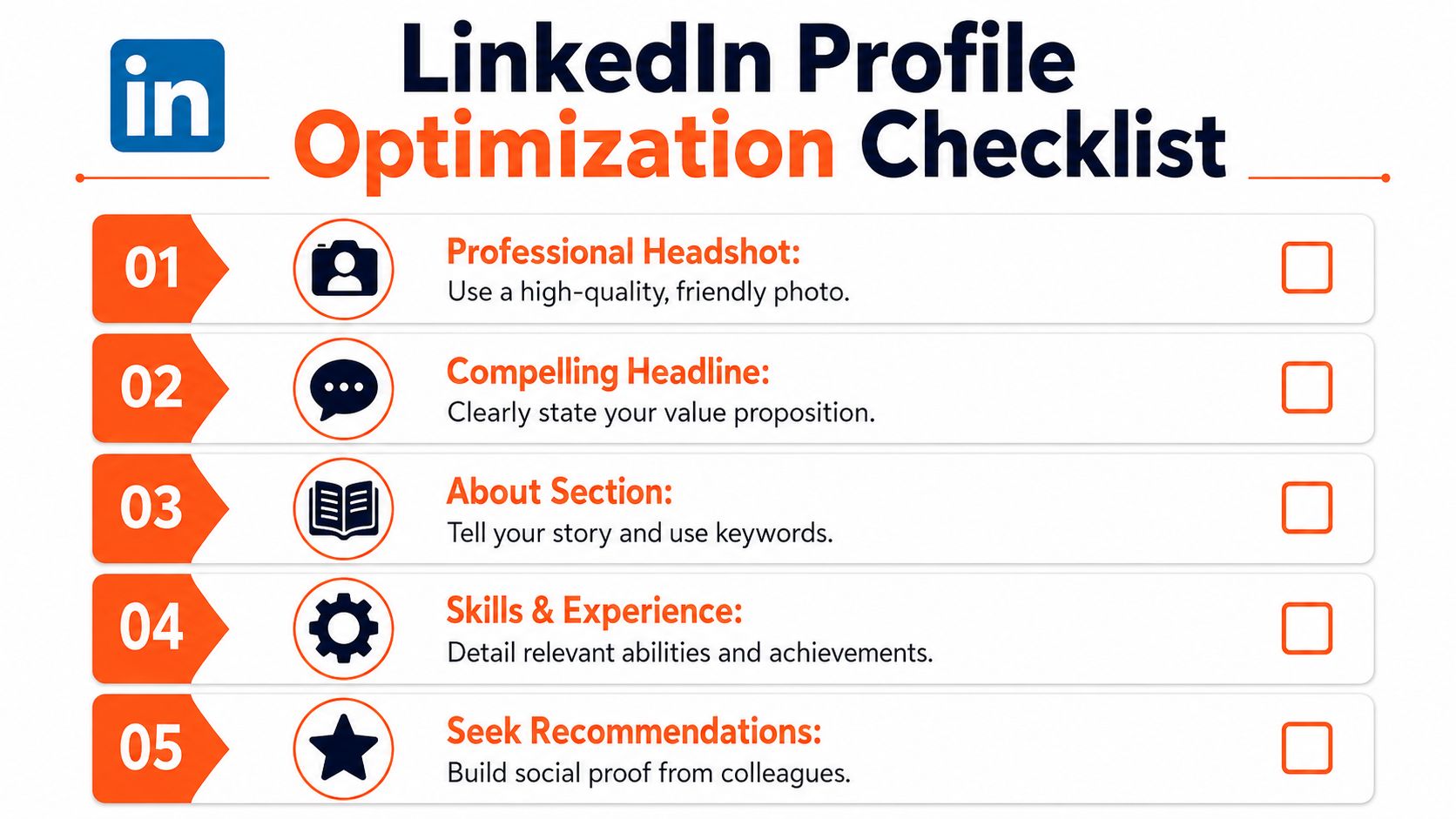
A stronger profile increases the odds that your comment activity turns into profile views, DMs, and sales conversations instead of dead traffic. If you want a practical walkthrough, use this LinkedIn profile optimization guide for headlines, banners, About copy, and featured assets.
Turn your profile into a landing page
Buyers do not read your profile like a recruiter. They scan for three things fast. Relevance, credibility, and a next step.
That changes how each section should work.
| Profile element | What the visitor wants to know |
|---|---|
| Headline | Who do you help and what outcome do you create |
| Banner | What category are you in and why should I remember you |
| About | How do you solve the problem and why should I trust you |
| Featured | Is there proof I can review in under a minute |
| Experience | Is your background current, specific, and credible |
A weak headline says, “Account Executive at SaaS Company.” That tells people your title, not your value. A stronger headline gives your market, problem space, and outcome in plain language.
The banner should back that up. Use it to reinforce positioning, not decoration. If someone only reads your photo, headline, and banner, they should still understand what kind of conversation you want.
Write for inbound conversion
The About section usually fails in one of two ways. It reads like a resume summary, or it reads like a motivational post with no commercial clarity.
Write it like buyer-facing copy.
Start with the problem you address. Explain your approach in simple terms. Add proof without overclaiming. End with a clear action, such as sending a message, reviewing a resource, or visiting a featured case study. Good profile copy reduces friction. It helps the right person decide, quickly, whether to contact you.
If your profile makes people work to understand what you do, you lose the click.
The Featured section carries more weight than many B2B founders and operators realize. In this section, you prove that your point of view leads somewhere concrete. Pin assets that shorten trust-building. A case study, sales teardown, webinar clip, lead magnet, or strong post can all work. The right choice depends on what you sell and how complex the buying decision is.
Use the experience section the same way. Skip long lists of responsibilities. Show business context, the work you led, and the outcomes tied to that work. For service providers, this often matters more than job titles. For operators in-house, it shows range and credibility without forcing visitors to decode your background.
A clear profile does not create demand by itself. It captures demand created elsewhere. That trade-off matters. Comments and engagement can earn attention, but profile clarity is what turns that attention into inbound pipeline.
Adopt a Comments-First Content Strategy
A founder blocks 30 minutes to write a LinkedIn post, publishes it, gets a few likes, and moves on. Then the same founder leaves three sharp comments on posts their buyers already follow, and those comments drive profile views, connection requests, and replies. That is the better starting point for personal branding on LinkedIn if the goal is pipeline.
Posting has a role. It is just not the first system I would build for a busy B2B operator with limited attention and no existing audience. Comments put your perspective inside active conversations. You borrow distribution from people who already have it.
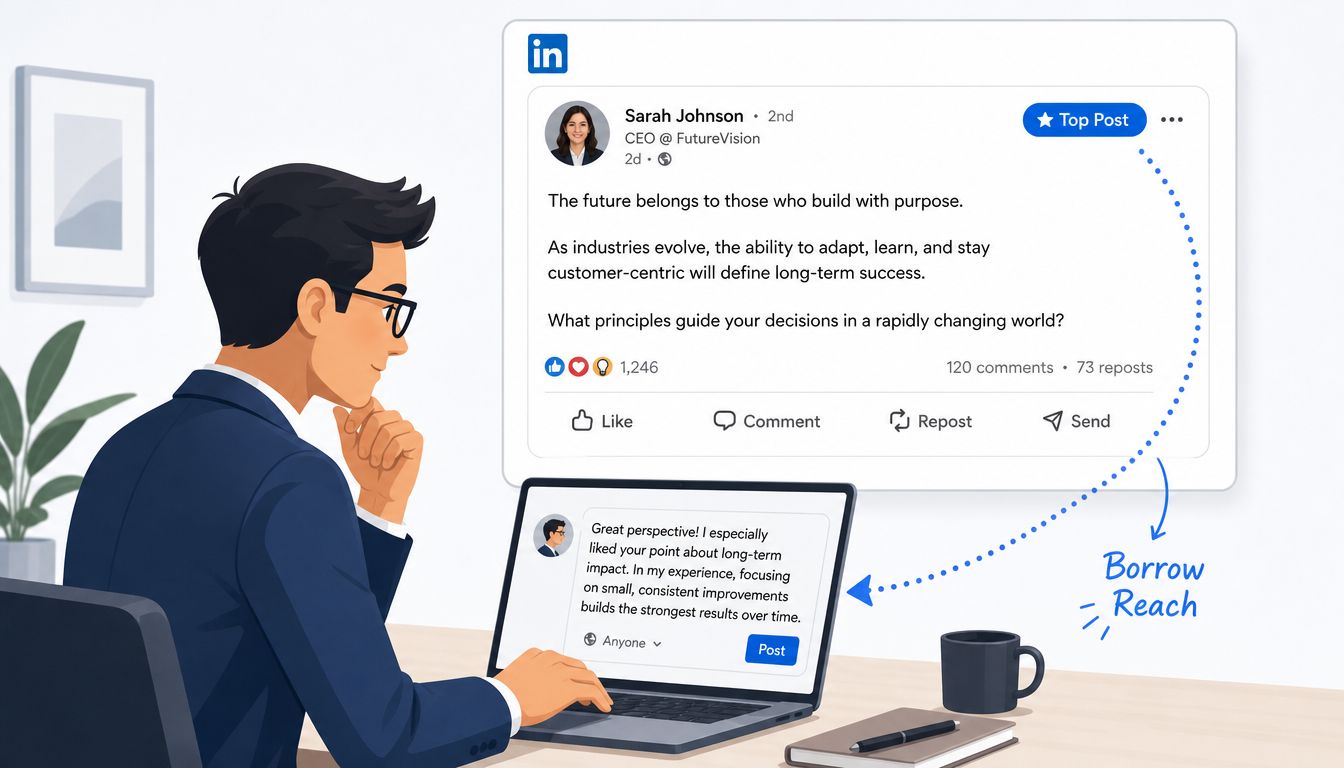
A useful tactical breakdown of this approach is in this guide on how to comment on LinkedIn to get noticed.
Why posting alone underperforms
Early-stage visibility on LinkedIn usually comes from participation, not publishing volume. A post from an unknown account has to earn distribution from scratch. A comment on a relevant post enters a discussion that already has attention, context, and the right audience around it.
That trade-off matters. Posting builds a library of ideas on your profile, but comments get you discovered faster. For consultants, founders, and in-house operators trying to build demand around a clear commercial problem, that speed matters more than maintaining an arbitrary posting streak.
Comments also create a stronger signal than low-effort posting. If someone sees your name repeatedly under smart posts in your niche, they start to associate you with that problem space. That is the first job of a personal brand. Recognition before conversion.
What a strong comment looks like
A useful comment does one of three things. It adds nuance, adds evidence, or moves the discussion forward.
Here's the difference:
- Weak comment: “Great post. Totally agree.”
- Better comment: “The point about onboarding friction is the part many organizations underestimate. When messaging changes but sales enablement doesn't, adoption usually stalls. We've seen the same issue when positioning shifts faster than call scripts.”
- Also strong: “Curious whether you've seen this work differently in mid-market versus enterprise. The buying committee changes the rollout math.”
The best comments are specific without turning into mini-posts. They should support the original post, not compete with it. Good commenters add something the audience can use.
A comment should make someone think, “This person understands the problem,” not “This person wants attention.”
Use a simple operating rule if you need one. Set aside a fixed block each day, focus on a small number of relevant posts, and write comments that show judgment. Ten thoughtful comments will outperform fifty generic ones.
Build content pillars after credibility
Comments create distribution. Posts create recall.
Once people start noticing your name in comment sections, your own posts have a better chance of landing. At that point, keep your posting strategy narrow. Broad personal-brand content gets attention from peers. Tight topic coverage gets attention from buyers.
For most B2B professionals, three content pillars are enough:
- Operational lessons: patterns from sales, growth, hiring, delivery, or customer work
- Proof of work: anonymized outcomes, process changes, teardown posts, lessons from wins and losses
- Point of view: clear positions on what companies in your category keep getting wrong
Format matters too, but it should follow the idea, not lead it. LinkedIn's own guidance on creating content for LinkedIn pages and members highlights a mix of formats, including video, images, and document posts, because different formats fit different messages. In practice, screenshots, simple diagrams, annotated visuals, and short clips tend to work well for B2B because they compress a complex point quickly.
Use visuals as compression, not decoration.
A quick example helps:
The practical rule is simple. If time is tight, put comments first and posts second. Comments help you earn attention from the right market. Posts help you capture and reinforce that attention once you have it.
Execute Daily Engagement and Audience Targeting
A comments-first strategy only works if your feed is full of the right conversations.
If your LinkedIn experience is mostly random updates from old coworkers, you won't build much momentum. You need a feed that surfaces buyers, partners, peers, competitors, and sharp operators in your niche.
Maintaining that kind of active presence matters. Your LinkedIn profile is 40 times more likely to receive career opportunities if you maintain an active presence and engage consistently through posting, commenting, and participating in conversations, according to LinkedIn data shared in this LinkedIn post on active presence.
Build a high-signal feed
Start by deliberately following people who influence the accounts you want to reach. That usually includes:
- Category creators: operators whose posts already attract your target audience
- Potential buyers: founders, heads of marketing, sales leaders, recruiters, depending on your goal
- Adjacent experts: consultants, advisors, and service providers who sit near your market
- Relevant companies: brands whose employees and customers overlap with your audience
This changes what LinkedIn shows you. Over time, your homepage becomes less passive and more useful for outbound visibility.
Use a repeatable daily workflow
Daily execution should be simple enough to do even on busy days. A practical rhythm looks like this:
- Scan for relevance first. Don't engage just because a post is popular. Engage where the topic connects to your expertise or target market.
- Prioritize posts with active discussion. If people are already replying, your comment has a better chance of starting side conversations.
- Leave fewer, better comments. One sharp observation beats a pile of filler.
- Reply when someone responds. The follow-up is where credibility gets built.
- Check profile viewers and new connection requests. That's often where warm intent first appears.
A lot of people waste time by commenting broadly instead of strategically. If you sell to RevOps leaders, don't spend your best attention in generic entrepreneurship threads. Join conversations where your future buyers already spend time.
Treat engagement like prospecting with public context. The goal isn't to be everywhere. It's to be memorable in the right rooms.
There's also a tone issue that matters. If every comment sounds polished and self-promotional, people feel it immediately. Strong engagement sounds like a person who knows the work and wants to contribute. That's why short, concrete comments often outperform mini-essays.
The practical test is easy. After reading your comment, would a target buyer understand what you know and whether you're worth following? If yes, keep it. If it sounds like networking theater, rewrite it.
Turn Conversations into Qualified Leads
A common LinkedIn pattern looks like this. You leave a sharp comment on a buyer's post, they reply, they view your profile, and then the thread dies because no one knows how to move it forward without making it awkward.
That drop-off is where a lot of pipeline gets lost.
A personal brand starts paying for itself when visible interaction turns into a relevant private conversation. The handoff matters. If the follow-up feels generic, you lose trust. If you wait too long, the context disappears and the moment passes.
If you want the full workflow, this guide on how to get inbound leads on LinkedIn breaks down the process in more detail.
Read buying intent before you send anything
The goal is not to DM everyone who engages. The goal is to identify who is showing real commercial curiosity.
Strong signals usually show up in the language people use and the pattern of their behavior:
- Problem-specific questions: they ask how you handled a workflow, decision, or constraint
- Follow-up curiosity: they want the method behind a result, not just the headline
- Profile revisit behavior: they check your profile after an exchange
- Repeated interaction: they respond to you more than once across posts or comment threads
- Fit with your market: their role, company stage, or use case matches the buyers you serve
There is a big difference between lightweight engagement and intent. A like is polite acknowledgment. A question like, “How did you get your team to adopt that?” signals a live problem.
That distinction keeps your outreach clean.
Use DMs to continue the conversation
Good LinkedIn outreach reads like a continuation of the thread people already participated in. It does not read like a sequence.
A few examples:
“Appreciated your reply on the onboarding post. You mentioned your team is running into the same issue. Happy to share the framework we use if helpful.”
“Thanks for the exchange on attribution. Your point about channel overlap was strong. I can send over the model we use with B2B teams if you want to compare approaches.”
“You asked how we structured that handoff. I can send a simple breakdown here if it would help.”
These messages work because they are earned. They reference a real interaction, a real topic, and a real reason to keep talking.
That is also why restraint matters. Pushing for a call on the first follow-up can kill momentum, especially if the buyer only wants a useful answer. In many cases, the better move is to send the resource, answer the question directly, and let the next step come from the strength of the exchange.
If you use tooling, keep the bar high. A platform like Linqin can capture people who engage with your comments or posts into a warm lead list and attach the context from the original interaction. That makes follow-up more relevant and helps teams avoid the common mistake of treating every engager like an MQL.
Qualified leads usually come from accumulated proof. People see how you think in public, test that impression in a short exchange, then decide whether to bring you into a buying conversation. Comments create the opening. Relevant follow-up turns that opening into pipeline.
Measure Your Personal Branding ROI
If you can't connect LinkedIn activity to business outcomes, you'll eventually stop doing it.
That's a widespread problem. A 2026 LinkedIn internal report found that 82% of B2B professionals cite unclear ROI as their top barrier to consistent personal branding, while only 12% of top-performing guides include analytics tied to specific business outcomes, according to this LinkedIn post summarizing the ROI barrier.
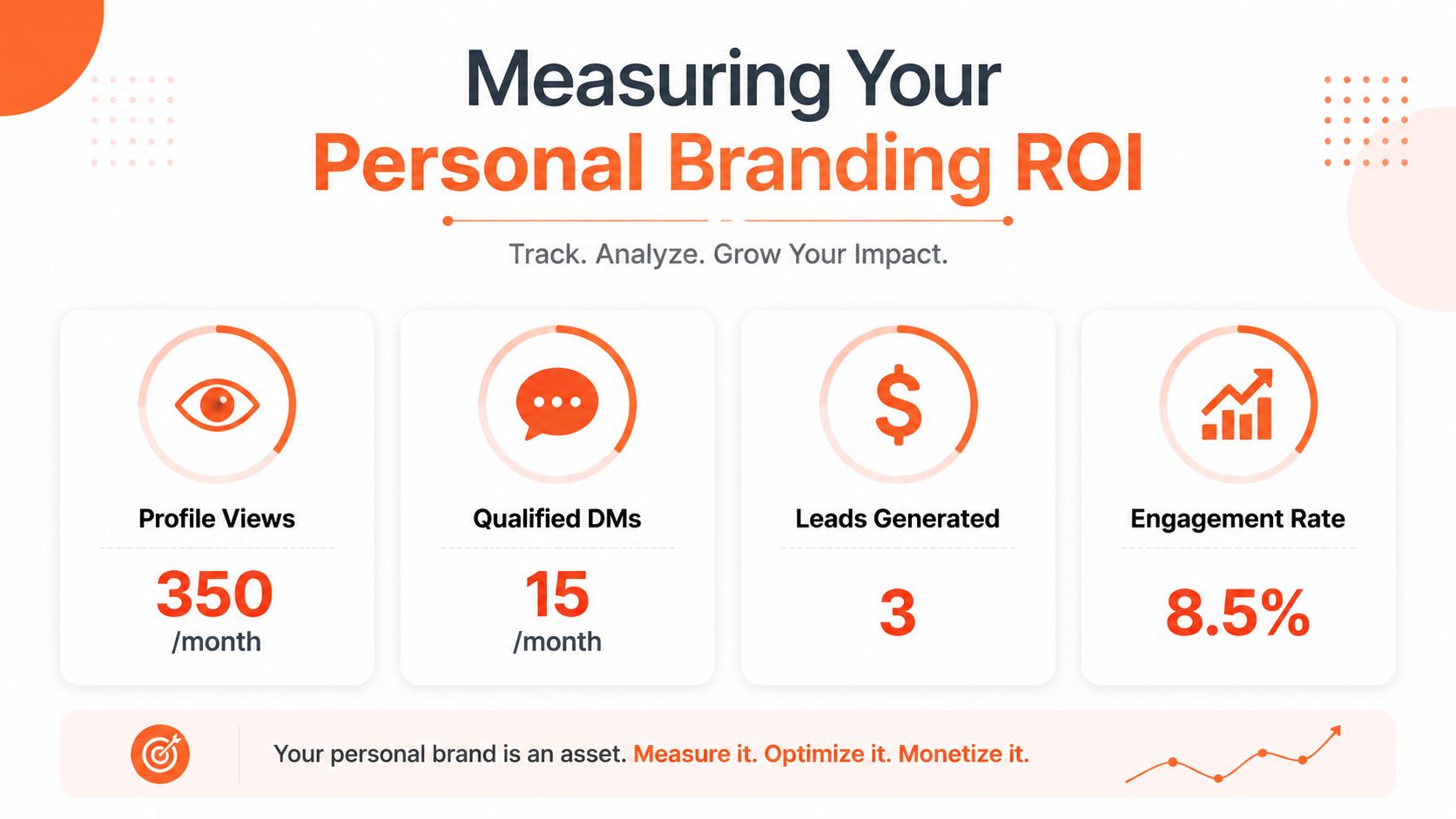
The fix isn't complicated. Stop asking, “Did this post perform well?” Start asking, “Did this activity create movement from the right people?”
Track business signals not vanity metrics
Likes can be useful as a weak signal. They aren't a business metric.
A sharper ROI dashboard for personal branding on LinkedIn tracks signals like:
| Metric | Why it matters |
|---|---|
| Profile views from relevant people | Indicates your comments or posts are creating curiosity |
| Inbound connection requests | Shows people want to stay in your orbit |
| DMs started | Measures conversation creation |
| Qualified replies to your comments | Shows your public engagement is attracting the right people |
| Calls or sales conversations booked | Connects activity to pipeline |
You can also track which themes consistently start better conversations. For example, a tactical teardown may drive more qualified messages than a generic motivational post, even if the second gets more reactions.
The post with fewer likes often creates more pipeline because it attracts fewer people and more relevant people.
Use a simple attribution model
You don't need enterprise analytics to get directional truth. A practical method is to log the originating action whenever a meaningful conversation starts.
That might mean tagging inbound activity as one of these:
- Comment-originated: the person found you through a comment on someone else's post
- Post-originated: they replied to or messaged you after one of your own posts
- Profile-originated: they discovered you through search, mutuals, or a profile view trail
From there, review patterns weekly. Which topics bring the strongest profile visitors? Which comments trigger the most replies from target accounts? Which posts attract peers versus buyers?
If you're using AI support for LinkedIn execution, attribution quality matters even more than output elegance. In multi-step agent workflows, Action Advancement and Action Completion are critical because they show whether the system progresses through tasks and achieves the user's goal, as explained in this LinkedIn post on AI agent evaluation metrics. For comment quality itself, precision measures correctness and recall reflects quantity handled, with BLEU or ROUGE used to assess text similarity, as described in this LinkedIn article on AI agent evaluation metrics.
That sounds technical, but the practical point is simple. Measure what leads to business movement, not just what looks busy on a dashboard.
Scale Your Presence with Automation and Team Advocacy
Manual consistency works. It also has limits.
Most B2B operators can maintain a good LinkedIn routine for a while. Then work gets busy, content slips, comments slow down, and the whole system becomes inconsistent. That's why sustainable personal branding on LinkedIn needs process, not just motivation.
Automate carefully or don't automate at all
Automation helps when it protects quality. It hurts when it creates spam.
There's one rule that matters most for comment automation. To avoid account restrictions, the agent must read each post in full, generate a unique comment based on the actual content, and pace interactions to mimic natural human behavior, according to Simular's guidance on safe LinkedIn auto-commenting. Tools that rely on titles, tags, or generic templates are fast, but they also create obvious, low-quality output.
If you're evaluating AI support, look for practical safeguards:
- Full-post reading: the tool should respond to the actual argument, not surface keywords
- Voice control: drafts should sound like your cadence, not platform default language
- Review options: you should be able to approve, edit, or limit frequency
- Outcome tracking: the tool should connect actions to replies, profile visits, or leads
Reliability matters too. For AI agents evaluating performance, 99.9% uptime and error rates below 5% for critical systems are cited as industry standards in this LinkedIn article on measuring AI agent performance. If a tool breaks often or misfires publicly, it creates more cleanup than benefit.
Turn one personal brand into team distribution
The next step isn't just automating one profile. It's creating coordinated reach across multiple people inside the company.
A solid employee advocacy setup usually includes a shared brand kit, lightweight approvals, and clear topic boundaries. The founder doesn't need to say the same thing as the head of growth or the account executive. In fact, they shouldn't. Each person should contribute from their role, while reinforcing the same market position.
That creates two advantages. First, the company gets more total distribution. Second, buyers see expertise from several angles, which builds trust faster than one corporate brand account ever could.
The core trade-off is governance. If you over-script people, the content feels sterile. If you give no guidance, the message drifts. Good systems create enough structure for consistency and enough freedom for real voice.
If you want to grow LinkedIn while you sleep, Linqin is one way to operationalize the system. It automates comments-first audience growth, drafts posts in your voice, tracks warm leads from engagement, and ties activity back to measurable outcomes so your personal brand produces pipeline instead of just impressions.