How LinkedIn Visibility Converts into Revenue
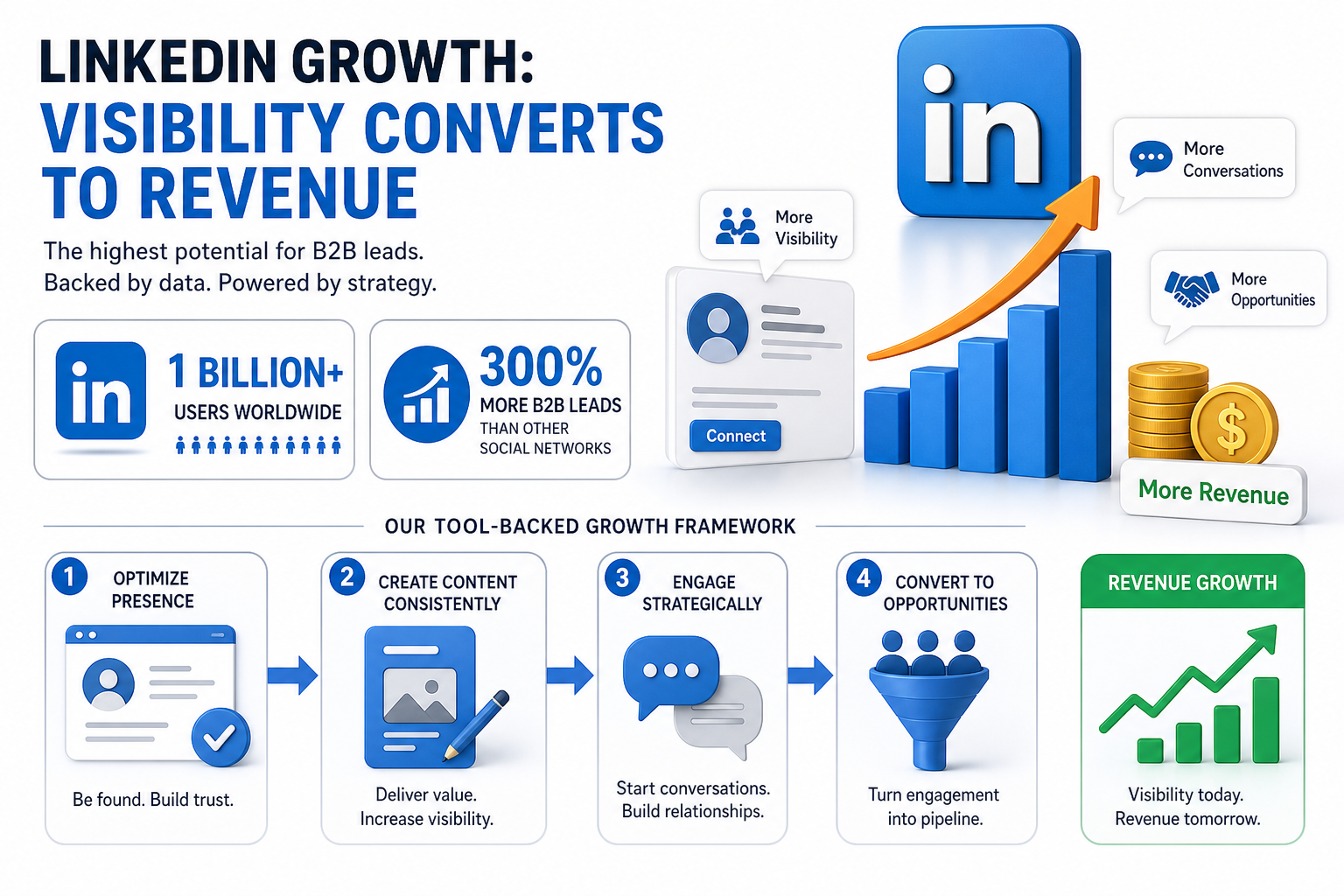
LinkedIn remains the platform with the highest potential for B2B leads because it combines a dense professional network with intent-driven interactions. We at linqin.ai harness this environment by turning visibility into measurable revenue, not just vanity metrics. With over 1 billion users worldwide, LinkedIn offers a dense, professional audience that is actively seeking insights, solutions, and partnerships. The platform has demonstrated a remarkable ability to generate demand for businesses, delivering three hundred percent more B2B leads than other social networks. This means that a well executed LinkedIn strategy is not a feel good exercise, but a direct driver of pipeline and revenue when we connect the right content to the right audience at the right moments.
To convert visibility into revenue, we need a practical, tool backed growth framework that moves from attention to action. At linqin.ai we focus on a repeatable process that couples profile optimization, content velocity, and systematic engagement. The goal is clear: transform audience familiarity into conversations, opportunities, and real business results. Below is a structured view of why LinkedIn works so well and how we translate that potential into an operational plan you can implement starting today.
| Factor | Why It Delivers Revenue | Our Approach at linqin.ai |
|---|---|---|
| Audience Scale | 1 billion users create a massive pool of potential clients, partners, and decision makers. | We identify the ICP and map engagement paths that align content with their priorities. |
| Lead Quality | LinkedIn generates higher quality, B2B leads due to professional context and targeted interactions. | We craft authority driven content and profile signals that attract the right buyers and stakeholders. |
| Content ROI | Consistent, valuable content builds credibility, which shortens sales cycles and increases close rates. | We deploy a content engine that converts conversations into opportunities using proven hooks and CTAs. |
| Engagement Signals | Engagement signals boost reach and compound over time, expanding visibility to qualified audiences. | We combine provocative hooks, authentic storytelling, and conversational formats to drive meaningful interactions. |
To frame the journey from visibility to revenue, consider this pragmatic growth pathway we apply at linqin.ai. It rests on three pillars that work in concert:
- Profile as a revenue engine — optimize every element so first impressions convert into conversations. We treat the profile as a landing page that clearly states who we help, the problems we solve, and the next steps for prospective clients.
- Content that attracts and converts — publish consistently with a clear point of view and practical takeaways. We use a content engine to turn conversations into repeatable assets like posts, carousels, and short videos that demonstrate impact.
- Systematic engagement — engage with the right people in a predictable cadence. We blend thoughtful comments, direct messages when appropriate, and strategic collaborations to accelerate pipeline creation.
The practical payoff comes from combining these elements into a repeatable workflow. Here is a concise framework we deploy:
- Profile optimization — sharpen the value proposition in the headline, craft an About section aligned to the target audience, and feature case studies or client outcomes in the Featured section. Ensure your profile is public and easily searchable on both LinkedIn and Google.
- Content engine — maintain a running ideation list, batch create content, and diversify formats. Build a mix of short posts, insightful carousels, and brief videos that illustrate concrete results.
- Engagement cadence — allocate dedicated time blocks for meaningful interactions. Leave valuable comments, share perspective, and initiate conversations with a clear invitation to continue the dialogue.
In practical terms, this approach translates into measurable revenue outcomes such as increased inbound inquiries, higher meeting volumes, and more qualified opportunities entering the sales funnel. Our aim at linqin.ai is to help you turn every spark of visibility into a revenue generating momentum. If you want a tested, scalable path to LinkedIn growth that consistently moves prospects from awareness to action, we are ready to partner with you and implement the framework that best fits your business context.
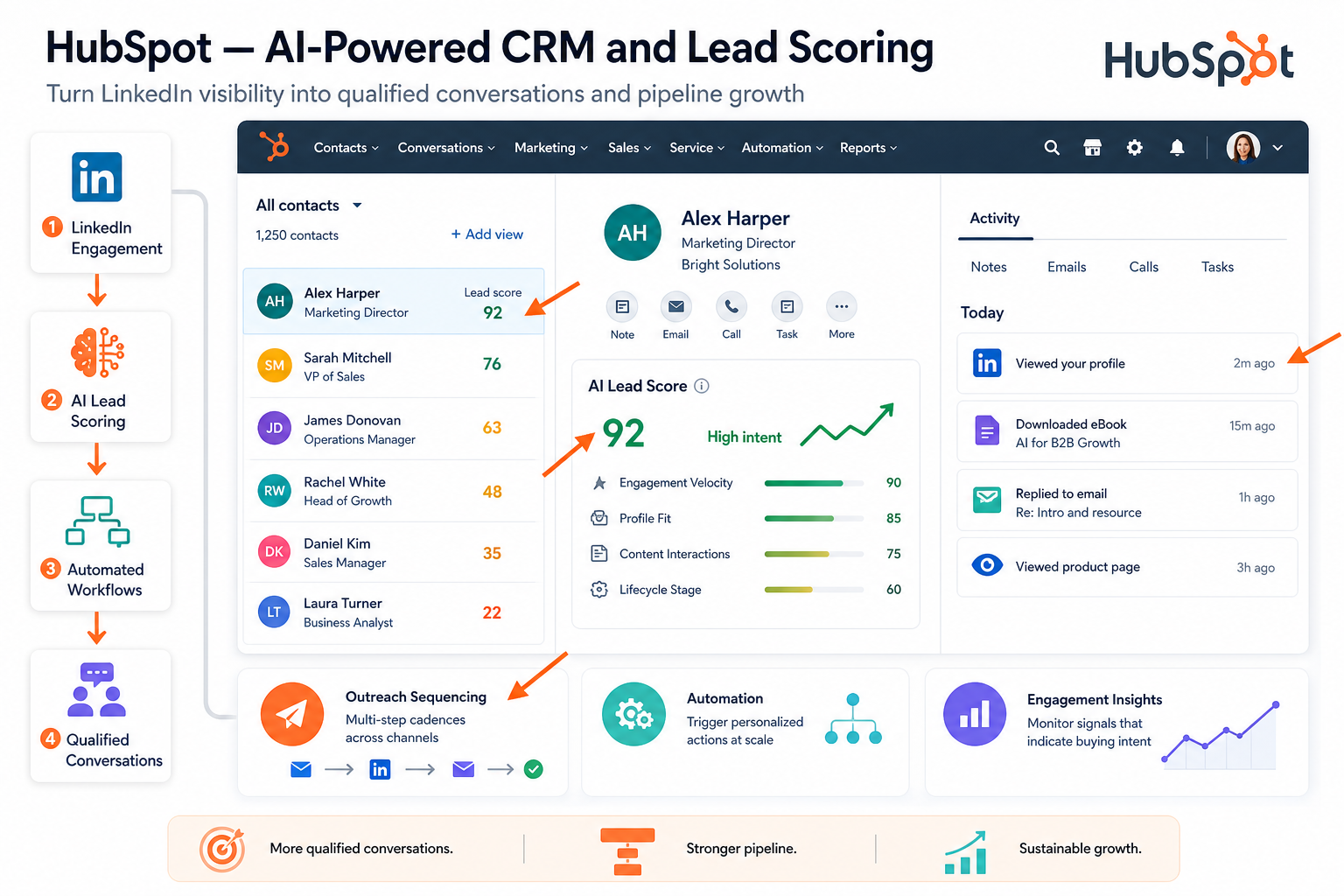
HubSpot — AI-Powered CRM and Lead Scoring
HubSpot’s AI powered Customer Relationship Management (CRM) platform introduces advanced capabilities that directly impact how LinkedIn visibility translates into qualified conversations and pipeline growth. By integrating intelligent lead scoring, automated workflows, and streamlined contact management, teams can move from incidental engagement to purposeful outreach at scale. The core strength lies in turning surface level interaction on LinkedIn into actionable signals that drive high-intent conversations with the right decision makers.
Lead Scoring with AI Intelligence
AI driven lead scoring assigns dynamic value to contacts based on multiple signals, including engagement history, demographic fit, and behavioral context. This shifts lead priority from purely qualitative impressions to data backed likelihood of conversion. Key elements include:
- Engagement velocity – assigns higher scores to contacts who interact across multiple touchpoints within a short window.
- Profile fit – evaluates alignment with your ICP using firmographic and technographic data where available.
- Content interactions – weights actions such as profile visits, content downloads, and message replies in your CRM.
- Lifecycle stage awareness – adapts scores as contacts move from new lead to MQL or SQL based on observed intent signals.
With AI assisted scoring, sales and marketing teams can prioritize outreach, allocate resources more efficiently, and reduce time spent on low potential contacts. The result is a more focused sequence of outreach that aligns with actual buying probability rather than subjective guesswork.
Automation and Contact Management
Automation in a modern CRM coordinates data capture, enrichment, and task creation without requiring repetitive manual input. In the context of LinkedIn driven activity, automation helps to:
- Capture LinkedIn engagement – automatically log profile views, post reactions, comments, and direct messages as engagement events on contact records.
- Enrich contact data – pull publicly available firmographic details, job titles, and company information to keep records up to date.
- Maintain contact history – preserve a complete timeline of outreach, responses, and content interactions for each contact.
- Segment and nurture – create dynamic lists based on engagement patterns and lifecycle stages to tailor follow ups.
Effective contact management ensures that every LinkedIn interaction feeds a contact’s profile with context. This makes it easier to craft personalized messages and reasoned follow ups when prospects move through the funnel.
Outreach Sequencing and Cadences
HubSpot supports outreach sequencing that can be aligned with LinkedIn inspired touchpoints while respecting platform norms. Sequence design typically includes:
- Multi channel steps – combine LinkedIn, email, and in app messages to advance conversations across channels.
- Timing optimization – use AI suggested send times and response-based adjustments to maximize reply rates.
- Contextual personalization – pull in LinkedIn derived signals such as company size, role, and recent activity to customize each step.
- Fallback paths – define triggers that gracefully skip steps or escalate to human follow ups when a contact stalls.
Automation does not replace meaningful human dialogue; it orchestrates the rhythm and ensures consistent follow ups, while data from each interaction informs subsequent steps to improve outcomes over time.
Monitoring Engagement Signals
Beyond logging activities, the AI enriched CRM interprets engagement signals to forecast pipeline impact. Practical monitoring patterns include:
- Signal aggregation – aggregate email replies, LinkedIn message responses, and content interactions into a composite engagement score.
- Trend analysis – observe rising or waning momentum to adjust cadences or escalate to a different owner.
- Deal progression alerts – trigger notifications when a contact demonstrates buying signals such as requesting demos or revisiting pricing pages.
- Forecast visibility – integrate engagement data with opportunity stages to provide more accurate forecasts and a transparent pipeline picture.
Using these signals, teams can identify the best moments to advance conversations, re-engage dormant leads, or reallocate resources to higher potential accounts.
Practical wiring for LinkedIn visibility to pipeline
To translate LinkedIn visibility into qualified conversations, consider a structured approach that uses HubSpot capabilities without deviating from platform best practices:
| Step | HubSpot Capability | LinkedIn Insight Utilization | Desired Outcome |
|---|---|---|---|
| 1 | AI driven lead scoring | Convert LinkedIn engagement into scoring signals as soon as contact records exist | Prioritize high potential prospects for outreach |
| 2 | Automation workflows | Trigger sequences after key LinkedIn interactions such as messaging replies or profile visits | Deliver timely, relevant follow ups across channels |
| 3 | Contact enrichment | Augment LinkedIn derived data with firmographic and behavioral data | Improve segmentation and personalization |
| 4 | Engagement monitoring | Track conversation velocity and sentiment cues from responses | Decide when to escalate or pivot messaging |
| 5 | Forecasting | Correlate engagement momentum with deal stages | Provide accurate revenue projections and resource planning |
In practice, this integrated approach helps a team convert visibility into conversations at scale while maintaining a high standard of personalization. By using LinkedIn driven signals with a data informed CRM backbone, organizations can accelerate time to first meaningful engagement and steadily grow their qualified pipeline.
Key takeaway: AI powered lead scoring, automated workflows, and intelligent engagement monitoring in HubSpot create a closed loop that turns LinkedIn visibility into qualified conversations, faster outreach sequencing, and measurable pipeline growth.
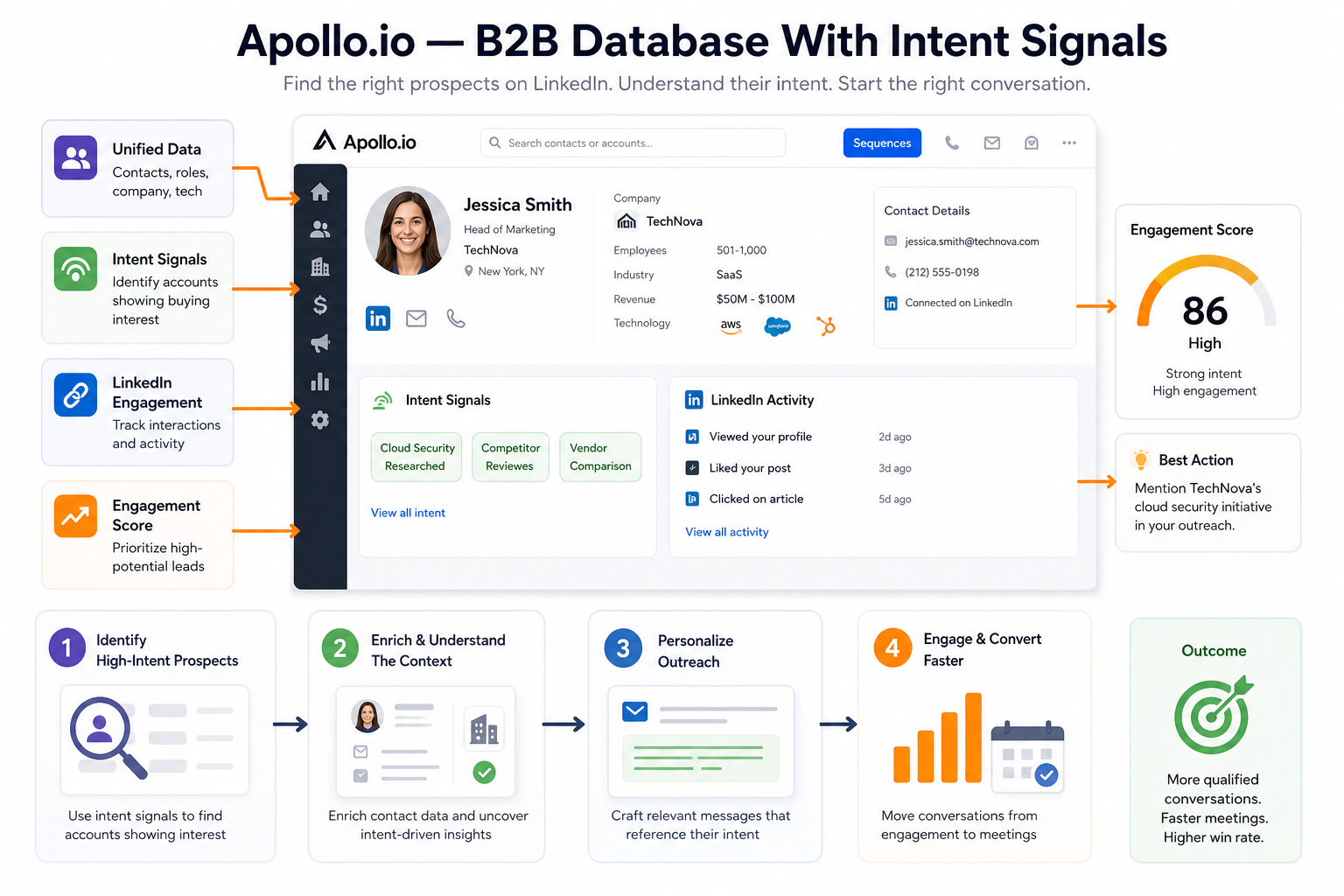
Apollo.io — B2B Database With Intent Signals
Apollo.io provides an extensive B2B contact database paired with intent signal data that helps teams identify and engage high-potential prospects from LinkedIn activity. The platform combines firmographic and technographic details with historical engagement trends to surface accounts and individuals most likely to move forward in the buyer journey. By aligning LinkedIn interactions with Apollo.io intent signals, you can move beyond scattershot outreach to targeted, timely conversations that feel earned rather than pushed.
Key strengths of Apollo.io in the context of LinkedIn growth include:
- Unified contact and account data — access accurate emails, phone numbers, roles, company information, and technology stacks to enrich LinkedIn derived signals.
- Intent signal layers — activity-based indicators that signal buying interest, such as product category searches, competitor reviews, or vendor comparison behavior within relevant industries.
- Match and enrichment workflows — automatically link LinkedIn touches to high fidelity contact records and enhance them with intent context for precise messaging.
- Engagement scoring integration — combine LinkedIn engagement with intent signals to adjust prioritization and sequencing for outreach cadences.
How intent signals translate into practical outreach, with examples:
| Intent Signal Type | What It Indicates | LinkedIn Driven Use Case | Example Outreach |
|---|---|---|---|
| Technology and vendor research | Interest in alternative software tools or feature sets relevant to your product | Identify decision makers at accounts actively evaluating solutions | LinkedIn message: “Noticing your team is evaluating tools in category X — we helped similar firms reduce time to implement by Y percent. Would you be open to a 15 minute discovery call?” |
| Industry specific problem searches | Pattern of queries signaling a pain point you solve | Prioritize accounts showing early signs of a relevant problem | LinkedIn InMail: “If data complexity is slowing your team, we built a repeatable approach that shortens cycle times. Could a quick chat help your team decide next steps?” |
| Vendor comparison and RFP activity | Intent to replace or augment existing systems | Time outbound around high urgency buying windows | LinkedIn post comment or direct message: “Saw you comparing vendors in Q2. We share case studies on fast deployment and measurable ROI. Want the 15 min summary?” |
| Company growth signals | Mergers, funding rounds, or team expansions indicating procurement velocity | Target accounts with increasing buying potential | LinkedIn message: “Congrats on the recent round see your team expanding. We can accelerate your vendor selection process with a tailored ROI model.” |
Practical workflow for using Apollo.io signals alongside LinkedIn activity:
- Capture LinkedIn engagement — track profile views, connection requests accepted, post interactions, and comment participation as early indicators of interest.
- Map to intent signals — translate observed LinkedIn behaviors into Apollo.io intent signals such as product category interest or technology changes within target accounts.
- Score and prioritize — combine LinkedIn engagement data with intent scores to create a composite lead score that drives the outreach queue.
- Personalize outreach — craft messages that reference specific intent signals, such as recent searches, product needs, or industry challenges surfaced by Apollo.io.
- Coordinate multi channel sequences — align LinkedIn touches with email, phone, and in-app messages to advance prospects through a predictable cadence.
Concrete scenarios where Apollo.io accelerates conversion from engagement to meetings:
- Scenario A — A target account shows frequent searches for data integration and has recently joined a webinar on data quality. Outreach angle: share a concise ROI narrative focused on data pipeline improvements and invite a meeting to review a lightweight proof of concept.
- Scenario B — An ICP contact demonstrates high intent in a new software category and holds a C level title. Outreach angle: present a targeted case study with concrete before and after metrics and propose a 20 minute discovery to map decision criteria.
- Scenario C — A company begins evaluating multiple vendors and expands its tech footprint. Outreach angle: provide a tailored competitive comparison and offer a short, outcome oriented demo that highlights integration with existing systems.
Operational best practices when pairing Apollo.io with LinkedIn activity include:
- Data hygiene — regularly verify contact records and company data to maintain accuracy for trusted outreach.
- Consent aware sequencing — respect platform norms and privacy considerations while using email and direct messaging within compliant boundaries.
- Timeline alignment — synchronize intent signal arrivals with your sales calendar to avoid delays between interest and outreach.
- Measurement and iteration — track meetings scheduled, hold rates, and pipeline contribution to refine which intent signals drive the strongest results.
Key takeaway: Apollo.io converts LinkedIn driven engagement into actionable intent signals that elevate targeting precision and shorten the path from first touch to booked meetings. By infusing outreach with data backed signals about what a company is actively pursuing, you can tailor messages to address real buying needs, accelerate conversations, and improve close velocity without spamming prospects.
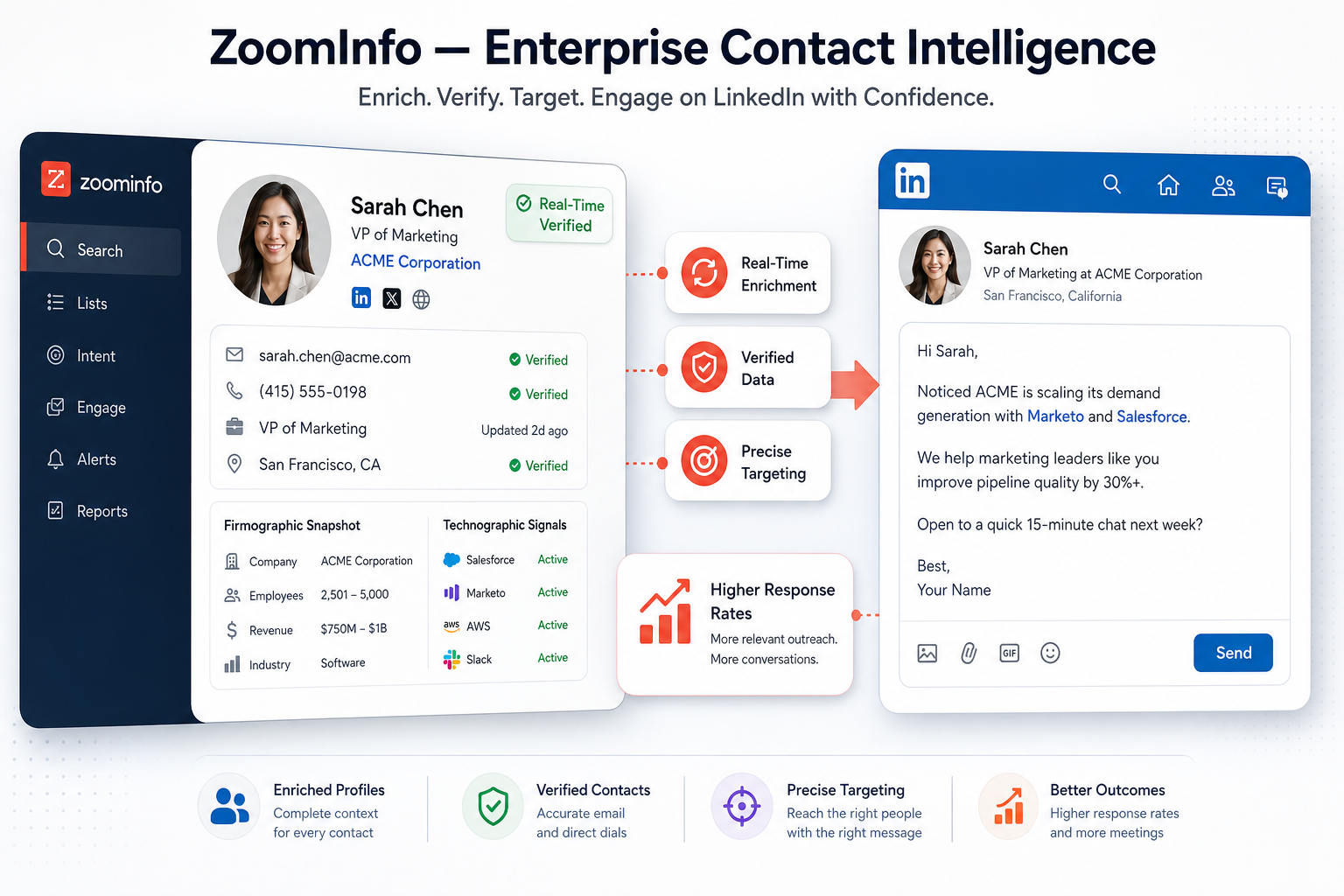
ZoomInfo — Enterprise Contact Intelligence
ZoomInfo offers enterprise grade contact intelligence that augments LinkedIn based outreach with rich, real time data. By enriching profiles with verified contact details, firmographic context, and technographic signals, teams can tailor messages with precision and reduce the friction that often slows response rates. This section explains how contact intelligence works, how it keeps data current, and how it translates into higher quality outreach on LinkedIn.
Real time contact data enrichment
Access to up to date contact information is essential for timely engagement. ZoomInfo aggregates and verifies contact data such as email addresses, direct phone numbers, and title updates as they occur in the real world. The real time enrichment capability means that outreach scripts and LinkedIn messages reference current roles, reporting lines, and company structures, reducing misalignment and skepticism from prospects. Key benefits include:
- Dynamic contact records — updates reflect role changes, department shifts, and new leadership, so your outreach remains relevant.
- Verified channels — email and direct dial information are confirmed to minimize bounce and misrouting.
- Contextual signals — accompanying data points such as department, team size, and technology stacks help tailor messages to the right buyer personas.
Profile enrichment for LinkedIn outreach
LinkedIn outreach benefits when each contact entry carries a richer, contextually relevant backdrop. Enrichment supports:
- Accurate targeting — use precise job titles, functions, and company attributes to identify ICPs for outreach campaigns.
- Personalized messaging — craft messages that reference verified details such as recent promotions, project initiatives, or organizational changes.
- Quality connection requests — align connection requests with verified job responsibilities and business relevance to improve acceptance rates.
Verification and data governance
Data quality is critical. ZoomInfo implements ongoing checks so that outreach teams can rely on the integrity of the information they use. Important aspects include:
- Email deliverability checks — rapid validation reduces the chances of invalid addresses triggering spam flags.
- Phone number validation — direct lines are tested for reachability, increasing the likelihood of successful conversations.
- Change alerts — proactive notifications when a contact or account undergoes a meaningful change, enabling timely follow ups.
Enabling precise targeting for LinkedIn outreach
Precise targeting combines enriched data with intent signals to prioritize high potential accounts and individuals. The workflow typically includes:
- ICP refinement — filter accounts by industry, company size, revenue band, technology footprint, and growth indicators to isolate ideal targets.
- Role alignment — identify decision makers and influencers whose responsibilities align with your value proposition.
- Message customization — assemble outreach that references verified role specifics, a relevant business initiative, and a clear next step.
- Multi channel coordination — synchronize LinkedIn touches with email and phone sequences using updated contact records to maintain coherence across channels.
Table: Impact of contact intelligence on LinkedIn outreach
| Dimension | What ZoomInfo Provides | LinkedIn Outreach Impact |
|---|---|---|
| Data freshness | Real time updates on roles, departments, and company changes | Higher relevance in initial messages and connection requests |
| Contact accuracy | Verified emails and direct phone numbers | Improved reply and answer rates due to accessible channels |
| Contextual intelligence | Firmographic and technographic data, buying signals | More personalized outreach that resonates with the prospect’s current priorities |
| Governance and quality | Data hygiene, confidence scoring, and change alerts | Reduced waste in messaging and better alignment with buyer intent |
Practical integration tips for teams
- Synchronize CRM and LinkedIn workflows — feed enriched contact records into your CRM and map LinkedIn touchpoints to updated profiles for unified outreach cadences.
- Prioritize high confidence leads — use verification status and confidence scores to sequence outreach to the most reliable contacts first.
- Leverage change alerts — when a contact changes roles or a company experiences growth, trigger timely LinkedIn messages referencing the new context.
- Respect privacy and compliance — maintain consent aware practices and document data provenance to align with regulatory standards and platform policies.
Key takeaway: Real time profile enrichment, verified contact data, and governance driven quality enable LinkedIn based outreach to be more precise, faster, and more likely to elicit a response. When your outreach references current roles and business needs, prospects perceive higher relevance, trust the sender more, and are more inclined to engage.
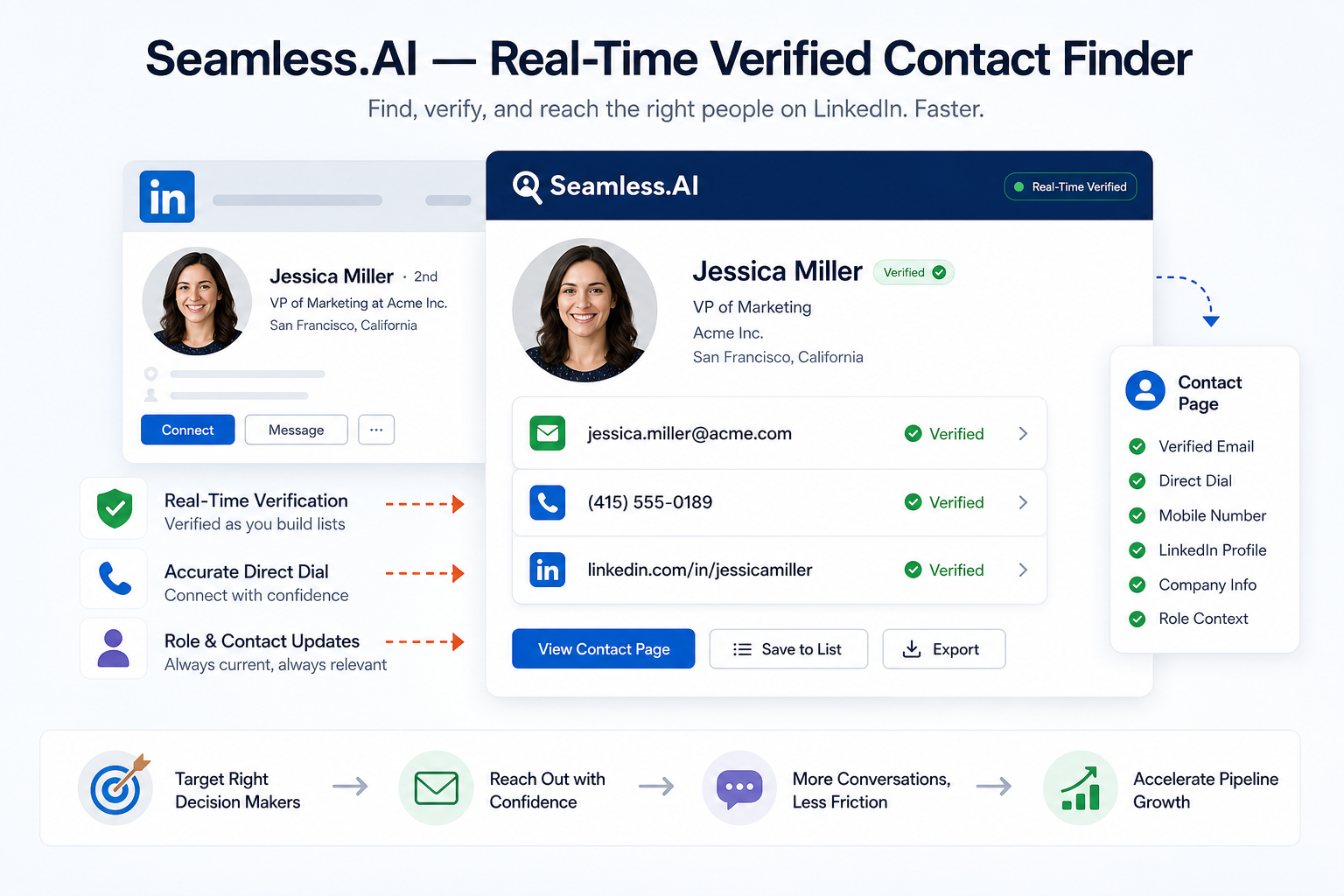
Seamless.AI — Real-Time Verified Contact Finder
Seamless.AI offers real-time contact verification and fast prospecting tools that speed up LinkedIn-driven lead generation. By combining instant validation with direct contact access, teams can move from initial engagement to meaningful conversations faster, reducing gatekeeping friction and speeding the path to pipeline creation. The core value lies in delivering accurate contact channels and up-to-date role context so outreach feels personal, timely, and squarely targeted to the right decision makers.
Real time contact verification
Real-time verification ensures that emails, direct dial numbers, and social handles are current at the moment you reach out. This reduces bounce rates, minimizes wasted follow ups, and improves overall outreach efficiency. Key aspects include:
- Instant validation – verify emails as you assemble lists to ensure high deliverability from the first touch.
- Phone number accuracy – confirm direct lines to reduce misroutes and increase response potential.
- Role and contact updates – reflect recent promotions, hires, and department changes to keep messaging relevant.
Verified emails and direct contact pages
Access to verified email addresses and dedicated contact pages accelerates conversations by providing reliable entry points for outreach. This capability supports LinkedIn driven sequences by enabling immediate multi-channel contact where appropriate.
- High confidence channels – rely on verified email and direct contact options to improve reply rates.
- Contextual relevance – align contact data with current roles, teams, and business initiatives to tailor messages.
- Friction reduction – minimize cold start friction by presenting prospects with familiar, reachable channels from the outset.
Impact on LinkedIn outreach workflow
In practice, verified contact data feeds LinkedIn driven efforts with accurate context and reliable channels. The workflow typically looks like:
- Identify target accounts – build a focused ICP using firmographic signals and recent activity.
- Verify contacts – pull verified emails and direct numbers for key decision makers within those accounts.
- Enrich context – capture role changes, department ownership, and project initiatives to personalize outreach.
- Execute multi channel touchpoints – sequence LinkedIn touches with verified emails and direct messages when appropriate to maximize receptivity.
- Monitor response quality – track reply rates, time to respond, and follow up effectiveness to optimize cadences.
Practical integration tips for teams
- Guardrails for privacy – ensure consented and compliant use of contact data, and document data provenance for audits.
- Data hygiene discipline – schedule regular verifications to keep contact records fresh and reliable.
- Cadence alignment – coordinate LinkedIn outreach with email and phone sequences to maintain a cohesive narrative across channels.
- Measurement and learning – track engagement velocity, contact acceptance, and meeting rate improvements to prove value and iterate.
Key takeaway: Real-time contact verification and verified direct channels transform LinkedIn visibility into faster conversations and stronger pipeline velocity. When outreach is built on up-to-date contact data and accessible communication paths, teams can convert interest into meetings with greater confidence and lower effort.
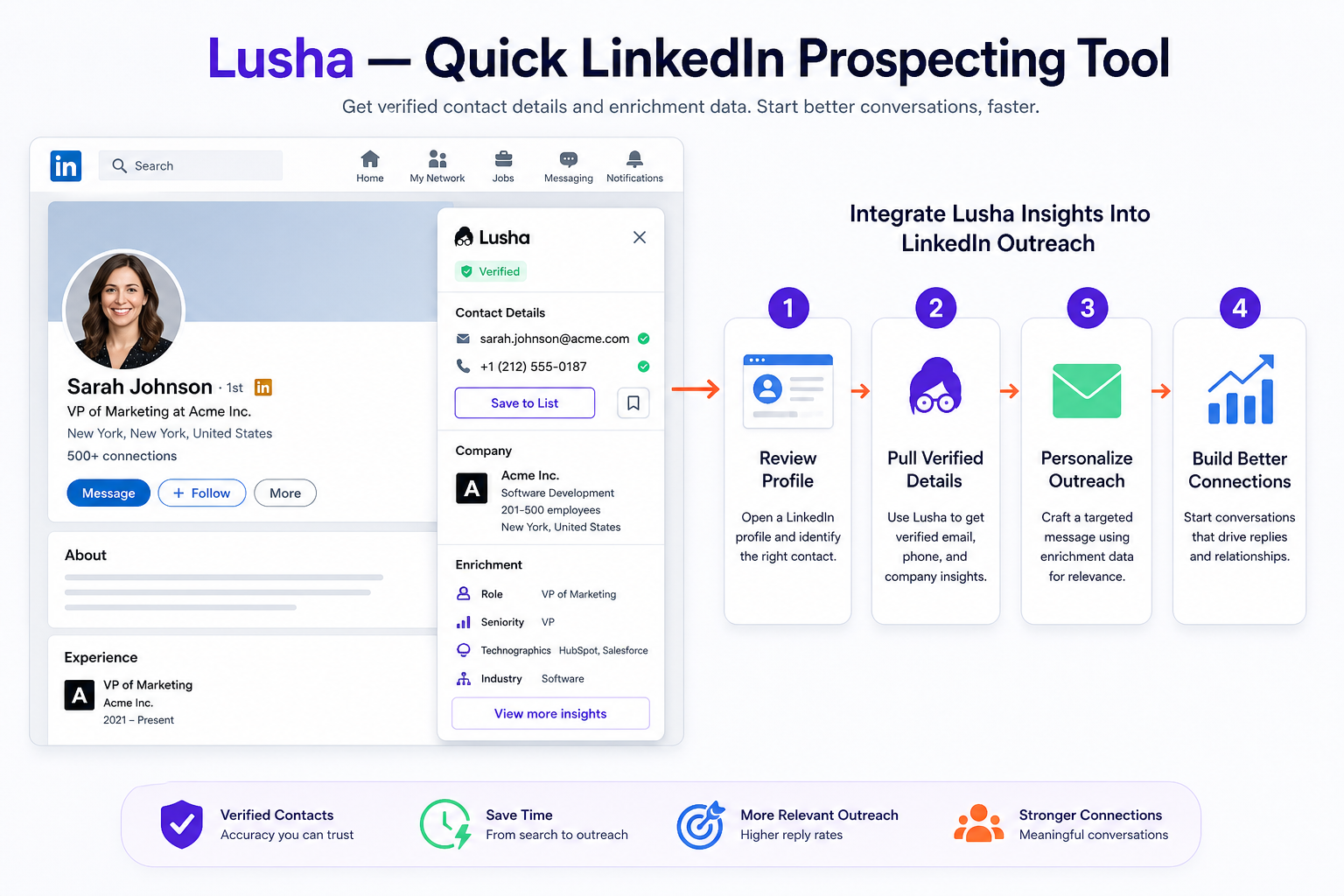
Lusha — Quick LinkedIn Prospecting Tool
Lusha offers fast access to contact details and enrichment data that boost LinkedIn prospecting efficiency. By supplying verified emails, direct phone numbers, and company context in real time, this tool helps you move from surface level connections to meaningful conversations faster. When integrated thoughtfully, Lusha reduces gatekeeping friction and raises the quality of outbound outreach without sacrificing relevance or personalization.
Fast access to contact details
One of the core advantages is immediate visibility of verified contact channels as you browse LinkedIn. With a lightweight add on or browser extension, you can surface direct emails and phone numbers for a target contact right from their profile or a LinkedIn message draft. This accelerates multi-channel outreach and shortens the time from first touch to a reply.
Enrichment data that tightens relevance
Beyond basic contact details, Lusha provides enrichment data that helps you tailor your outreach to the right buyer persona. Expect firmographic signals such as company size and industry, technographic clues when available, and role level context that clarifies who should make the next decision. This background information enables more precise messaging and improves acceptance rates for connection requests and follow ups.
Practical steps to integrate Lusha insights into LinkedIn outreach
- Capture verified channels during profile review — while viewing a contact’s LinkedIn profile, pull the supplied email or phone number into your outreach notes so you can decide the best first touch channel.
- Enrich connection requests with context — reference a specific company detail or role related insight when sending a connect request to increase acceptance likelihood.
- Personalize messages with enrichment data — in your InMail or message sequence, cite a firmographic or functional context that aligns with your value proposition, such as department priorities or recent company initiatives.
- Coordinate with your CRM — log LinkedIn touches alongside Lusha enrichment data to maintain a unified contact record and enable consistent follow ups across channels.
- Validate outreach cadences — use verified contact data to calibrate your sequencing timing. If a contact has multiple channels available, designate the primary channel and back up options based on responsiveness.
Profile optimization tips that pair with Lusha
- Headline alignment — craft a value proposition that resonates with the decision makers you target, and ensure it complements the kinds of roles surfaced by Lusha enrichments.
- About section augmentation — weave in data-backed context about how you help similar companies improve specific metrics, referencing the typical profiles you engage with via Lusha data.
- Featured material and proof — showcase case studies or quick win narratives that reflect the types of buyers enriched by your LinkedIn outreach.
Operational workflow for steady pipeline
To keep LinkedIn outreach efficient and scalable, adopt a repeatable workflow that leverages Lusha insights throughout the journey:
| Step | Action | Data Used | Desired Outcome |
|---|---|---|---|
| 1 | Identify target contacts on LinkedIn | Role, company, industry signals, enrichment notes | Curated list of high potential prospects |
| 2 | Surface verified contact channels | Emails, direct numbers, secondary channels | Immediate, appropriate touchpoint for outreach |
| 3 | Send personalized connection requests | Role context, company context, enrichment hints | Higher acceptance rates for new connections |
| 4 | Initiate multi channel sequence | LinkedIn messages, email, phone where permissible | Faster progression to meaningful conversations |
| 5 | Log and review outcomes | Engagement metrics, response quality, follow up success | Continuous improvement of targeting and messaging |
Key takeaway: Lusha accelerates LinkedIn prospecting by delivering verified contact pathways and rich enrichment data that inform sharper targeting and more credible outreach. When you couple these insights with profile optimization and disciplined cadences, you raise not only connection rates but also the relevance and resonance of your messaging.
6sense — Account-Based Marketing and Predictive Analytics
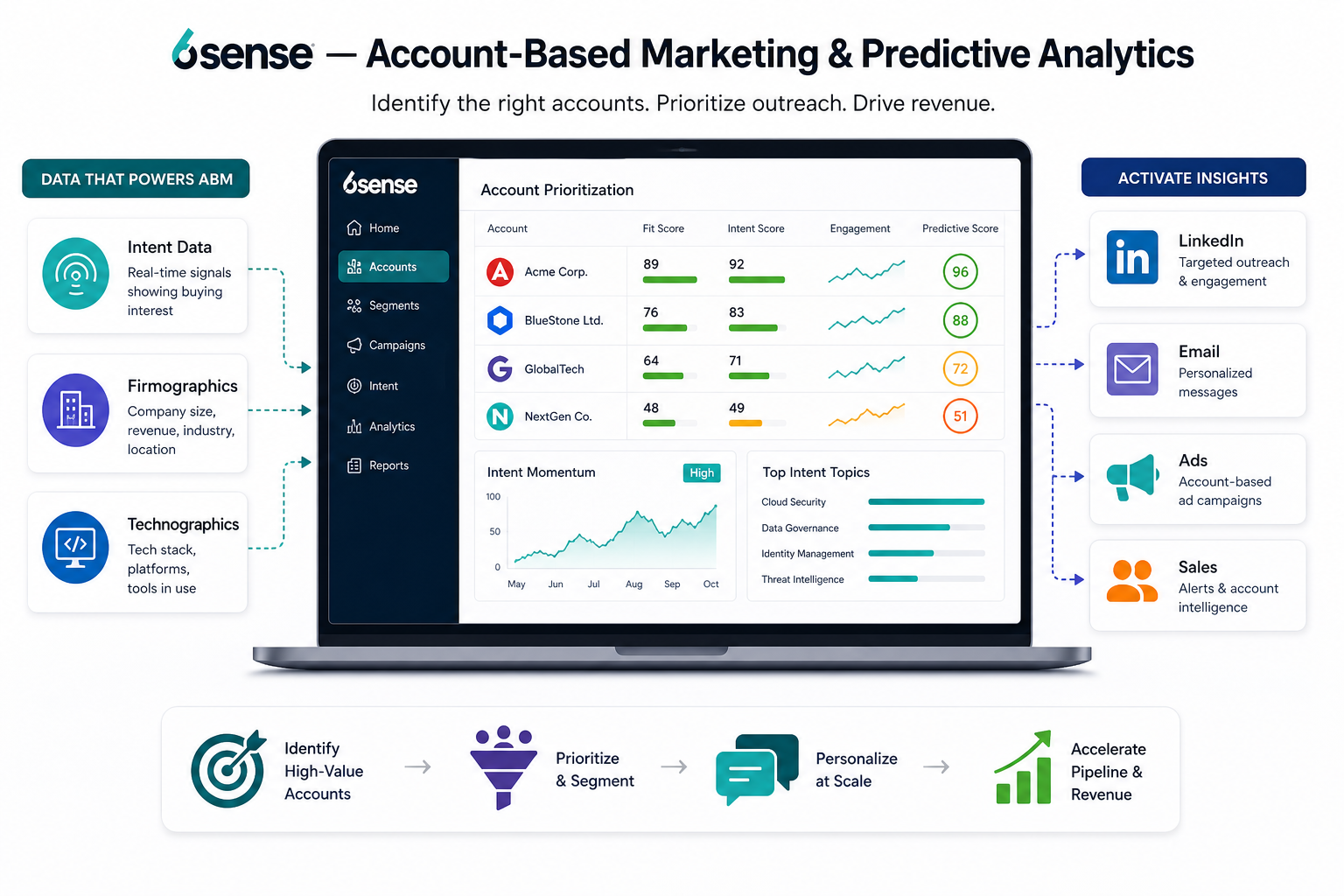
6sense offers a solid account-based marketing (ABM) platform that bridges LinkedIn engagement with enterprise level account targeting and predictive analytics.
By combining intent signals, firmographic context, and sophisticated scoring, 6sense helps revenue teams identify high potential accounts, prioritize outreach, and tailor messages at scale. This integrated approach moves LinkedIn activity from reactive engagement to proactive pipeline acceleration, ensuring that every touchpoint aligns with the accounts most likely to convert.
Intent data that powers ABM decisions
Intent data is the backbone of proactive ABM within 6sense. By tracking signals across a wide set of public and private sources, the platform surfaces accounts showing actual buying intent for your solutions. This enables teams to:
- Identify high-propensity accounts based on near term signals such as product category interest, vendor evaluations, and competitive checks.
- Prioritize outreach by ranking accounts with the strongest combination of intent momentum and fit to your ICP.
- Coordinate cross channel campaigns by weaving intent signals into LinkedIn, email, and paid media touchpoints for cohesive ABM programs.
Firmographics and technographics for precise targeting
Beyond intent, 6sense enriches accounts with firmographic and technographic data to sharpen targeting and personalize messaging. Key capabilities include:
- Account profiling with company size, revenue range, industry, and location to ensure messages resonate with the right buyer personas.
- Technology footprints to understand the tools and platforms already in use within target accounts, informing tailored use cases and ROI narratives.
- Weighing context by combining firmographics with intent signals to surface true buying groups and responsible stakeholders.
Predictive scoring and account prioritization
Predictive analytics elevate ABM by translating data into actionable priority. 6sense employs multi-faceted scoring to rank accounts and guide where to allocate resources. Important elements include:
- Opportunity scoring that forecasts likelihood of engagement, meeting, or closed won within a defined horizon.
- Engagement velocity tracking how rapidly an account moves through touchpoints and stages across channels.
- Fit and intent fusion combining ICP fit with current signals to avoid chasing accounts that show interest but poor alignment.
- Deal potential tiering to categorize accounts by potential revenue impact, enabling tailored outreach strategies for enterprise versus mid-market targets.
Aligning LinkedIn engagement with ABM campaigns
When LinkedIn activity is integrated into ABM workflows, outreach becomes more contextual and coordinated. Practices include:
- LinkedIn as a discovery channel to identify decision makers within priority accounts and validate stakeholder maps derived from 6sense insights.
- Personalized messaging anchored in intent that references specific buying signals observed in 6sense, such as recent research or vendor comparisons relevant to the account.
- Coordinated cadence that synchronizes LinkedIn touches with email and other channels based on account priority and predicted engagement windows.
- Content alignment ensuring that LinkedIn content, case studies, and resources reflect the use cases and ROI themes most relevant to each prioritized account.
Operational workflow: turning data into revenue
A practical workflow with 6sense typically follows these stages:
- Account selection — define target segments using ICP criteria and identify high intent accounts.
- Signal ingestion — capture intent, firmographic, and technographic signals and map them to accounts and stakeholders.
- Score synthesis — generate composite scores that combine fit, intent velocity, and engagement readiness.
- Cadence design — craft cross channel outreach plans, with LinkedIn as a primary engagement channel for priority accounts.
- Feedback loop — monitor outcomes, adjust scoring thresholds, and refine messaging based on real results.
Measurement and governance
To ensure ABM programs deliver measurable revenue impact, 6sense emphasizes continuous measurement and governance. Core metrics include:
- Account win rate by tier to compare performance across priority groups.
- Time to first engagement and time to opportunity progression within priority accounts.
- Engagement mix effectiveness across LinkedIn, email, and paid channels, with attribution to pipeline outcomes.
- ROI attribution linking ABM activities to closed deals and revenue contribution.
Why this matters for LinkedIn growth Tactics
Integrating 6sense with LinkedIn growth tactics helps teams move from broad visibility to targeted, revenue oriented conversations. By aligning LinkedIn engagement with account level signals and predictive scoring, teams can:
- Improve targeting accuracy by focusing on accounts with the strongest intent and best ICP fit.
- Personalize at scale by leveraging account context to tailor messages for each stakeholder group within an account.
- Accelerate pipeline velocity through timely, relevant outreach that resonates with buyers during their critical decision moments.
Key takeaway: 6sense connects LinkedIn engagement to ABM campaigns through intent signals, firmographic and technographic context, and predictive scoring. This synergy enables prioritization of accounts and personalized messaging that drives meaningful revenue outcomes.